TLDR
- Most app marketing agencies run the same paid social playbook. The ones worth hiring are differentiated by channel depth (Apple Search Ads, DSPs, CTV), MMP fluency, and how they handle iOS privacy measurement post-ATT.
- Pricing typically starts around $5,000 per month for managed service retainers; performance-based structures shift spend risk but add complexity to attribution.
- The critical hire decision is not budget size but whether the agency can read your MMP data, design incrementality tests, and separate organic from paid installs.
- Agency versus in-house is not a permanent decision. Most teams that scale past $500K monthly ad spend bring core UA in-house and keep an agency for channel-specific execution or creative production.
- Sponsored agencies in this list are marked. Editorial criteria apply to every entry regardless of sponsorship status.
The best mobile app marketing agencies for paid user acquisition in 2026 are Moburst, AppAgent, Admiral Media, Yodel Mobile, RocketShip HQ, Udonis, Fetch, Digital Turbine’s agency division, and Gummicube. Each differs meaningfully on channel mix, MMP integration depth, and whether they operate performance-only or include creative production. The right choice depends on your category, stage, and whether you already have an attribution infrastructure in place.
In this guide
Why Most App Marketing Agencies Look the Same From the Outside
Every agency pitch deck shows Meta, Google UAC, and Apple Search Ads logos. Most promise lower CPIs and higher ROAS. The surface presentation gives buyers almost no signal to differentiate on.
What actually separates a competent mobile user acquisition agency from a generic digital shop running app install campaigns is three things: how deeply they can work inside your MMP (AppsFlyer, Adjust, Singular, or Branch), whether they have channel access and expertise beyond the major two or three platforms, and how they approach measurement in a post-ATT, privacy-constrained environment. An agency that cannot articulate the difference between probabilistic and deterministic attribution, or that treats SKAdNetwork as a checkbox rather than a measurement framework, is running your budget without the data infrastructure to optimize it.
This matters especially for iOS-heavy apps. Since Apple’s App Tracking Transparency rollout, the signal loss on iOS install campaigns is material. Agencies that built iOS measurement competency before it became necessary tend to have better creative testing pipelines and more disciplined cohort analysis than shops that are still adjusting. For context on how MMPs handle this technically, our breakdown of mobile app attribution tools covers what to look for on the platform side before you bring an agency in.
The AboutMartech UA Agency Audit: Four Checks Before You Sign
Before evaluating any individual agency, run these four checks. We call this the UA Agency Audit, and it exists because most agency RFP processes over-index on case studies and under-index on operational compatibility.
MMP Fluency: Ask them which MMP you should use and why, given your category and platform mix. If they do not have a clear answer or default to “whatever you’re already using” without pushing back, that is a gap. Strong UA agencies have opinions about Singular versus AppsFlyer for specific use cases, and they can explain SKAdNetwork campaign limits in operational terms.
Creative Infrastructure: Paid UA is increasingly a creative volume game, especially on Meta and TikTok. Ask how many creative variants they test per week, what their production pipeline looks like, and whether creative strategy is in-house or subcontracted. Agencies that outsource creative often cannot close the loop between performance data and concept iteration fast enough.
Incrementality Posture: Ask whether they run holdout tests. An agency that has never designed a geo-holdout or a synthetic control experiment is optimizing for reported installs rather than real growth. This is a meaningful distinction when organic lift is significant or channels overlap.
Reporting Stack: Get specifics on what dashboards they deliver, how frequently, and whether you own the underlying data. Some agencies build reporting inside their own tools, creating a lock-in problem. You want raw data in your MMP and access to campaign-level data exports, not a curated agency dashboard that disappears if you leave.
How This List Differs From Other UA Agency Rankings
Agency ranking pages for UA tend to sort by brand recognition or by who has the most prominent web presence for terms like “user acquisition agency.” This list was built differently. Each agency was evaluated against the UA Agency Audit criteria above: MMP fluency, creative infrastructure, incrementality posture, and reporting transparency. Sponsored entries are marked, and sponsorship does not affect placement. Agencies that appear prominently in other rankings primarily because of SEO authority, rather than documented operational depth, were evaluated on the same criteria as every other entry. Where an agency has a strong reputation for a narrow capability (ASO, Apple Search Ads, on-device distribution), that is noted explicitly rather than papered over with generalist claims.
9 Best Mobile App Marketing Agencies for Paid UA
1. Moburst
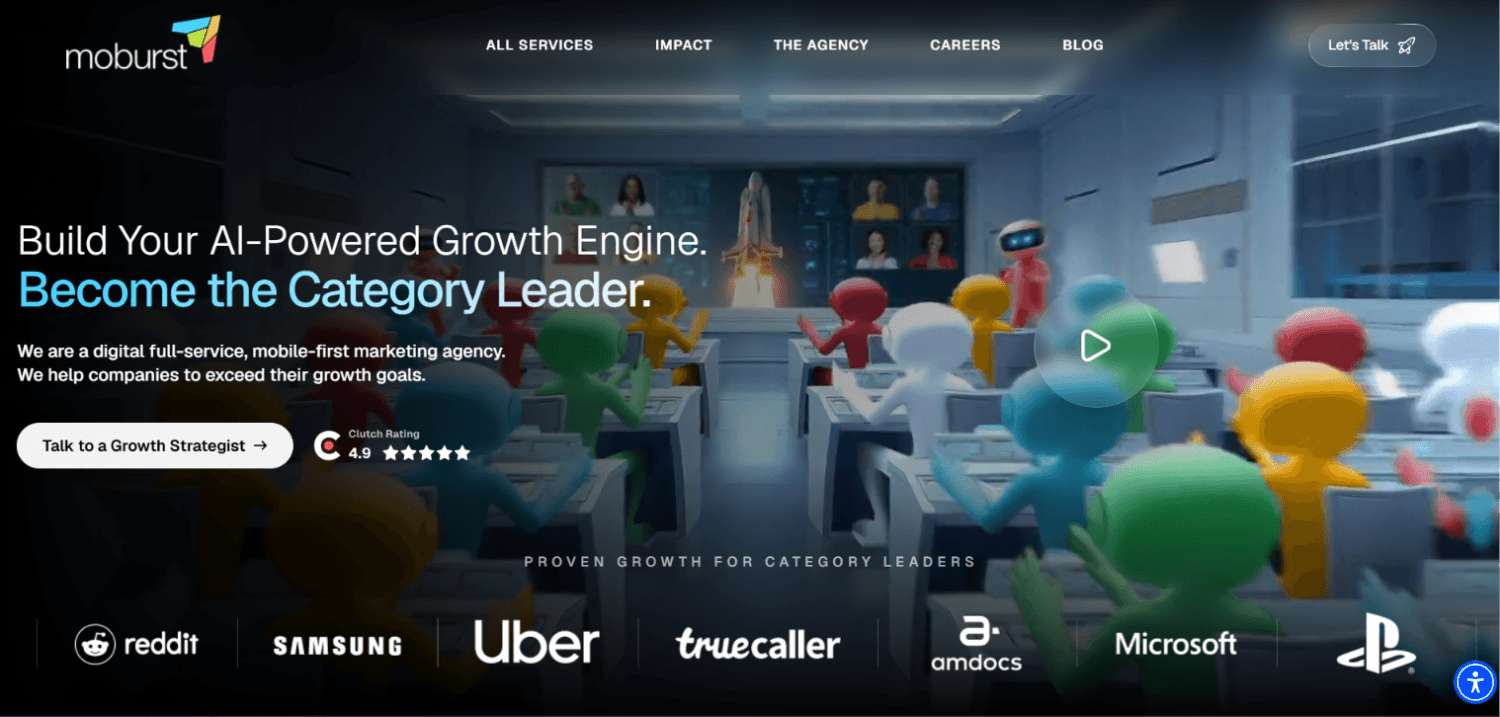
Moburst operates across paid UA, ASO, and creative production, with offices in New York, Tel Aviv, and San Francisco. Their public positioning leans into full-funnel mobile growth rather than pure media buying, which makes them a fit for apps that need creative production and channel management under one roof. Clients have included Subway, Reddit, and Google.
Their channel coverage includes Apple Search Ads, Google UAC, Meta, TikTok, and programmatic DSPs. On the measurement side, they work across AppsFlyer, Adjust, and Branch. The creative team produces UGC-style video at volume, which matters on TikTok and Instagram Reels where static units have significantly lower performance. Pricing is not publicly listed; engagements are quote-based.
Best for: apps with meaningful iOS budgets that also need creative production and do not have an in-house design function.
2. AppAgent
AppAgent is a Prague-based agency with a reputation that runs ahead of its size. They work with mid-market and growth-stage apps on paid UA and ASO, and their published case studies show granular CPI and ROAS data rather than vague growth percentages, which is a transparency signal worth noting.
Their methodology emphasizes creative testing as a core growth lever rather than an ancillary service. They run structured creative sprints, typically with defined hypotheses per variant, rather than producing volume and seeing what sticks. For teams that want an agency that will teach them the framework while running it, AppAgent publishes more operational content than almost any other agency on this list. Retainer pricing is not listed publicly.
Best for: European-headquartered apps, or US apps that want a process-driven creative testing partner with lower overhead than a large agency.
3. Admiral Media
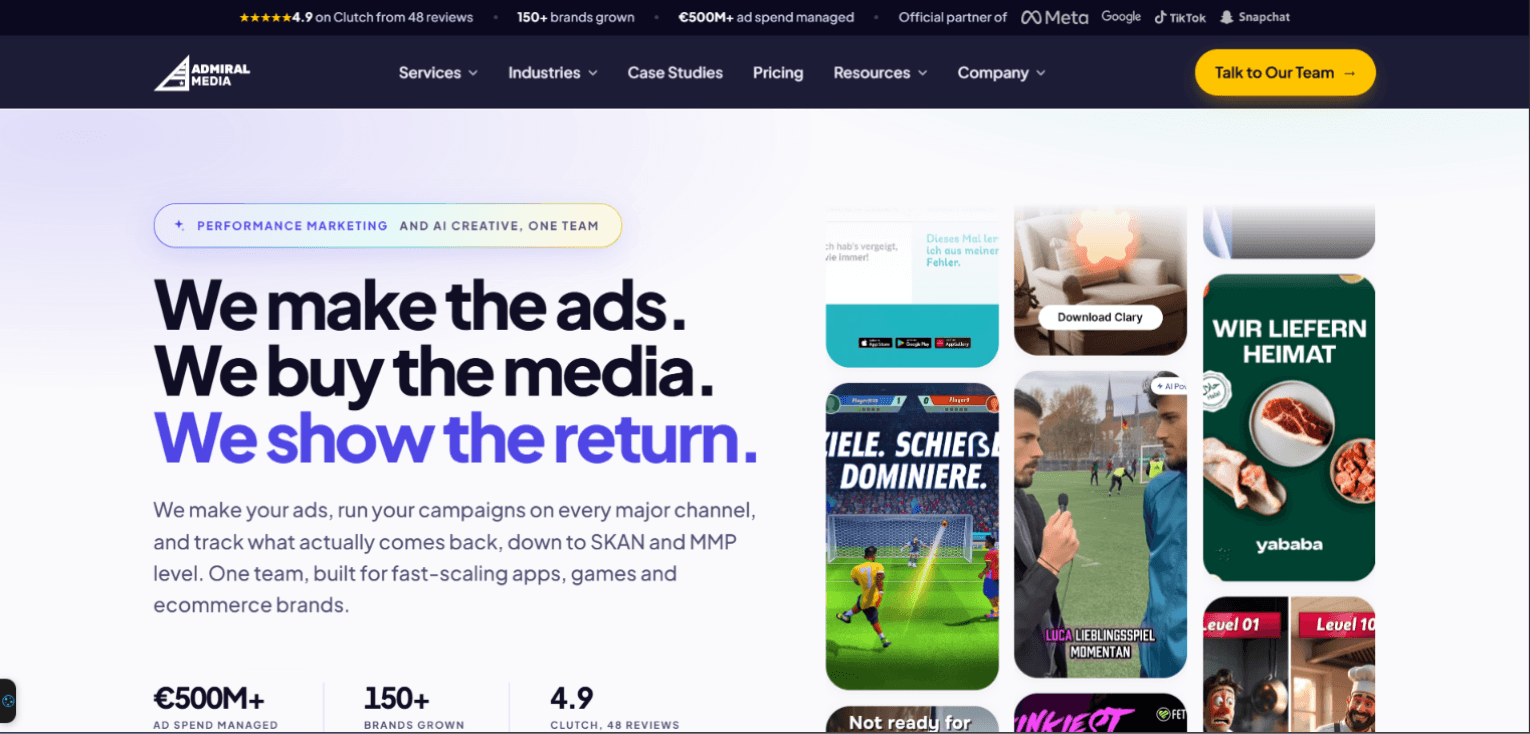
Admiral Media is a performance marketing agency focused on mobile apps, with particular depth in subscription apps and gaming. Their channel mix includes Meta, Google, Apple Search Ads, Snap, and TikTok, with programmatic options available at higher spend levels.
What distinguishes Admiral from generalist performance agencies is their subscription app focus. Subscription UA requires optimizing for trial start and paid conversion, not just install volume, and that distinction changes how campaigns are structured and how events are passed back to the MMP. Agencies that do not understand the trial-to-paid funnel will over-optimize for installs that never convert. Admiral’s public case studies reference subscription app clients in fintech, health, and fitness categories. Quote-based pricing.
Best for: subscription apps in regulated or health-adjacent categories where LTV modeling matters as much as CPI.
4. Yodel Mobile
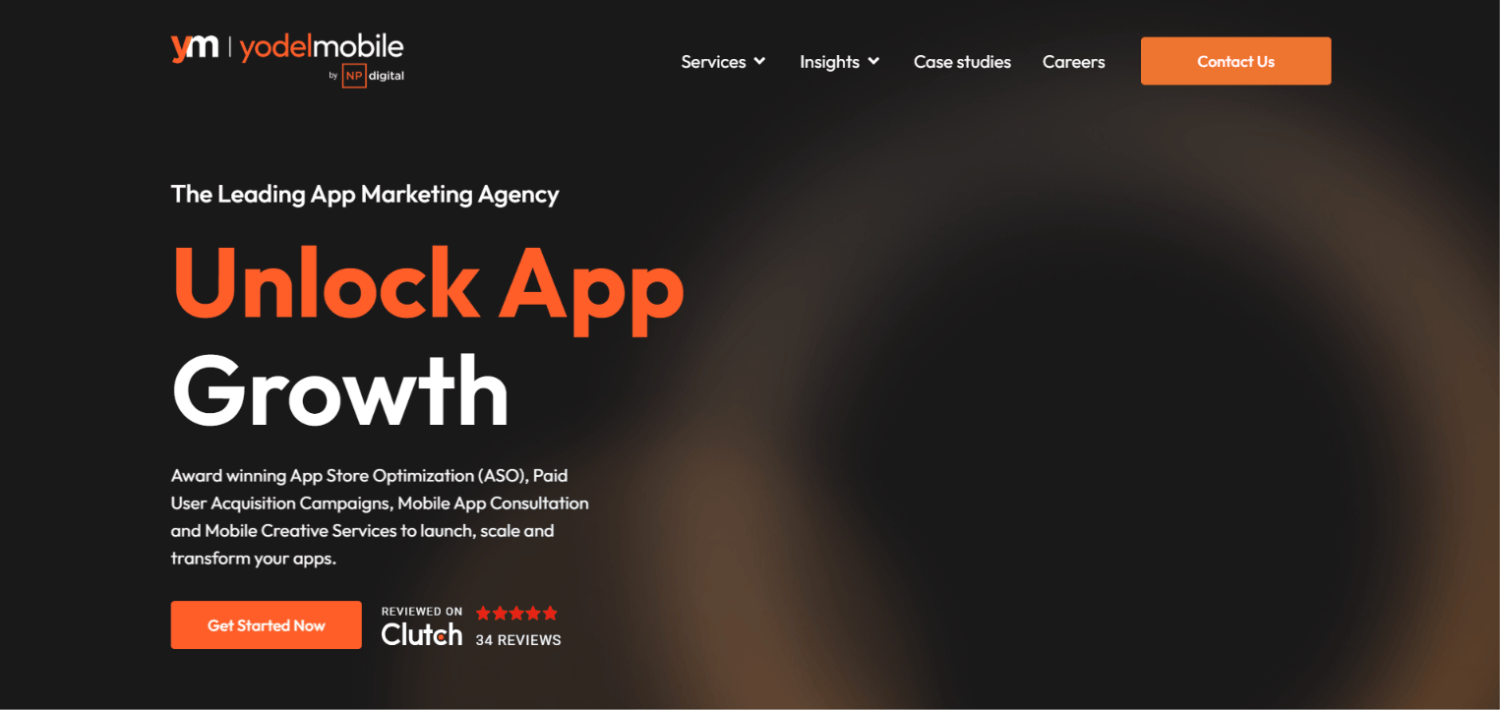
Yodel Mobile is a London-based agency that covers paid UA, ASO, CRM for mobile, and retention strategy. The combination of acquisition and retention under one agency relationship is unusual and reduces the finger-pointing that happens when install volume is up but D30 retention is down.
Their App Growth Program connects paid channel performance to in-app behavior metrics, which means they track what happens after the install, not just the install itself. This is relevant for apps where payback periods are long and early churn is the primary profitability constraint. Clients include DAZN and Adzuna. Pricing is not publicly listed.
Best for: apps with measurable retention problems, or teams that want acquisition and lifecycle under a single agency relationship.
5. RocketShip HQ
RocketShip HQ is a boutique growth agency focused on consumer apps, with a publicly stated specialization in Apple Search Ads and ASO. They are smaller than most agencies on this list, which has two implications: clients get senior practitioner attention rather than being handed off to junior account managers, and they have lower capacity for clients spending aggressively at scale.
Their Apple Search Ads depth is genuine. They have published detailed methodology on Search Match versus Exact Match campaign structures and on how to use Search Tab campaigns without cannibalizing organic keyword rankings. For iOS-first apps where Apple Search Ads is or should be a primary channel, this specificity is uncommon. Pricing is not publicly listed.
Best for: iOS-first apps, particularly consumer subscriptions, where Apple Search Ads is the primary or most underdeveloped paid channel.
6. Udonis

Udonis focuses almost exclusively on mobile app marketing, specifically gaming and non-gaming apps on Meta and Google. They have been public about their gaming heritage, which shows up in their creative approach: high iteration volume, short testing cycles, and a willingness to produce direct-response creative that many brand-conscious agencies avoid.
Their in-house creative team produces static, video, and playable ad formats. Playable ads are a meaningful differentiator in gaming UA specifically, and few non-gaming agencies have the production capability to test them properly. For non-gaming apps, their Meta and Google depth is strong, but their channel breadth is narrower than agencies like Moburst or Admiral. Pricing starts around $5,000 per month according to publicly available agency directory listings, though retainer structures vary.
Best for: gaming apps and casual consumer apps with significant Meta and Google budgets that need high-volume creative testing.
7. Fetch
Fetch (the agency, distinct from the rewards app of the same name) operates as a mobile-first media agency with programmatic and DSP capabilities that go beyond what most boutique UA shops offer. Their footprint includes CTV, in-app programmatic, and carrier-level distribution partnerships, which matters for apps targeting broad consumer segments where Meta and Google alone cannot reach incremental audiences cost-efficiently.
CTV as a UA channel is worth noting. For apps with strong brand recognition or category awareness, CTV drives search and organic install lift that does not show up in last-touch MMP reports. Agencies that can set up CTV alongside paid social and measure the cross-channel lift via incrementality testing are running a more sophisticated playbook than those still treating app UA as a two-platform game. Fetch’s scale makes them better suited to mid-market and enterprise app budgets.
Best for: apps with $100K+ monthly budgets that need programmatic and CTV alongside standard paid social channels.
8. Gummicube
Gummicube is primarily an ASO specialist with paid UA capabilities, and that sequencing matters. Their core product is a proprietary ASO data platform called Datacube, which feeds into both organic keyword strategy and paid keyword targeting, particularly on Apple Search Ads. For teams that have underinvested in ASO, Gummicube can close the gap between organic visibility and paid efficiency simultaneously.
The connection between ASO and Apple Search Ads is frequently missed by generalist UA agencies. Strong metadata and creative assets in the App Store improve Quality Scores on Apple Search Ads, which affects cost per tap. An agency that works both levers together will typically outperform one that runs ASA in isolation. Gummicube’s limitation is that their paid channel coverage beyond ASA and Google is thinner than full-service UA agencies. Pricing is not publicly listed.
Best for: apps with weak ASO foundations that also want paid UA, where closing the ASO gap will compound into paid performance.
9. Digital Turbine (Advertiser Solutions)
Digital Turbine is a different animal from the boutique agencies above. Their advertiser solutions division offers on-device distribution through carrier and OEM partnerships, meaning apps can be pre-installed or featured at device setup, bypassing the traditional install funnel entirely. This is not a fit for every team, but for apps with mass-market appeal and budgets to match, on-device distribution produces a cost-per-acquisition profile that paid social cannot replicate at scale.
The trade-off is that on-device installs often have lower initial intent than search or social-driven installs, which affects early engagement metrics. Attribution for on-device requires coordination with your MMP, and some MMPs handle Digital Turbine’s attribution differently than standard click-based models. Budget thresholds are significantly higher than boutique agencies, and pricing is entirely quote-based.
Best for: large consumer app publishers targeting mass market audiences where broad distribution economics outweigh the intent quality trade-off.
Channel Coverage and MMP Compatibility: A Side-by-Side View
The table below uses three ratings: Yes (agency actively runs and optimizes this channel as a core service, with no stated minimum spend caveat in their public materials), Limited (agency offers this channel but either requires higher minimum spend thresholds, treats it as an add-on, or has thinner documented case study depth on it), and No (channel not offered or not publicly documented). MMP fluency reflects platforms named in agency public materials and case studies; it does not reflect independent certification testing by AboutMartech.
| Agency | Meta | Google UAC | Apple Search Ads | TikTok | Programmatic/DSP | CTV | MMP Fluency | Sponsored |
|---|---|---|---|---|---|---|---|---|
| Moburst | Yes | Yes | Yes | Yes | Yes | Limited | AppsFlyer, Adjust, Branch | Yes |
| AppAgent | Yes | Yes | Yes | Yes | Limited | No | AppsFlyer, Adjust | Yes |
| Admiral Media | Yes | Yes | Yes | Yes | Yes | No | AppsFlyer, Adjust, Singular | Yes |
| Yodel Mobile | Yes | Yes | Yes | Yes | Limited | No | AppsFlyer, Adjust | Yes |
| RocketShip HQ | Limited | Yes | Yes (primary) | Limited | No | No | AppsFlyer, Adjust | Yes |
| Udonis | Yes | Yes | Limited | Yes | No | No | AppsFlyer, Adjust | No |
| Fetch | Yes | Yes | Yes | Yes | Yes | Yes | AppsFlyer, Adjust, Branch, Singular | No |
| Gummicube | Limited | Yes | Yes (primary) | No | No | No | AppsFlyer | No |
| Digital Turbine | No | No | No | No | On-device only | No | All major MMPs | No |
Sponsored listing. Channel and MMP coverage is based on publicly available agency information and self-reported capabilities. AboutMartech has not independently tested each agency’s claims.
How Much Does a Mobile App Marketing Agency Cost?
Most managed-service UA agencies price on a retainer plus a percentage of managed spend. Retainers at the entry level typically start around $5,000 per month, covering account management, creative support, and reporting. At that level, agencies are generally managing $20,000 to $50,000 in monthly ad spend. Larger engagements scale to $15,000 to $30,000 per month in fees against six-figure monthly media budgets.
Performance-based fee structures exist but are less common than they appear in sales conversations. True CPA or CPI-based pricing shifts risk to the agency and typically comes with creative control restrictions that constrain your input on messaging and audience strategy. Most experienced teams find that a blended model, a flat retainer plus a small performance bonus, aligns incentives better than pure performance pricing.
One cost buyers frequently underestimate is the MMP cost itself. If you do not have AppsFlyer or Adjust in place before engaging an agency, add that infrastructure cost to your first-year budget. Our guide to AppsFlyer alternatives and what they cost at scale is a useful reference if you are still choosing a measurement platform.
UA Agency vs. In-House: Where the Math Actually Lands
The scenario below is a worked example using publicly available US salary ranges and typical agency fee structures. It is not sourced from a specific study; it is intended to illustrate the cost structure at a realistic spend level, not to provide a precise benchmark.
Consider a consumer app spending $150,000 per month on paid UA across Meta, Google UAC, and Apple Search Ads. Running that in-house requires a UA manager (market salary in the US: roughly $90,000 to $130,000 annually, based on ranges from Glassdoor and LinkedIn salary data), a creative producer or designer, MMP access, and potentially a data analyst to build cohort reporting. Total in-house cost for a functional team is realistically $200,000 to $300,000 per year in personnel alone, before tools.
An agency managing the same spend would cost roughly $8,000 to $18,000 per month in fees, or $96,000 to $216,000 annually. At $150K monthly spend, the agency is often cheaper than a properly staffed in-house team. The calculus shifts as spend scales past $500,000 per month, where a dedicated in-house team can specialize by channel and the agency management fee becomes a material budget line.
The more important variable is creative iteration speed. Agencies with in-house creative production can test five to ten new concepts per week. In-house teams at small apps often take two to four weeks to move from concept to live test. That lag has a direct cost in CPI and ROAS because creative fatigue on Meta and TikTok degrades performance quickly when the same assets run for more than a few weeks.
What to Look For in App User Acquisition Agency Reporting
Reporting quality separates agencies that are actually managing your account from those maintaining a dashboard while collecting fees. A competent UA agency should deliver weekly performance reports that include campaign-level CPI, cost per first purchase or key event, ROAS by cohort (not blended), and creative performance ranked by the metric you care about, not just CTR.
Monthly reporting should include an incrementality update if you are running holdout tests, a SKAdNetwork attribution reconciliation for iOS campaigns, and a recommendation that did not exist in last month’s report. If the monthly report is the same template with different numbers, the agency is in maintenance mode.
One signal that gets overlooked: does the agency share bad news proactively? An agency that surfaces a campaign that underperformed and explains why, with a revised hypothesis, is more valuable than one that presents only wins. Attribution discrepancies between MMP-reported installs and platform-reported installs are common, especially on iOS. Agencies that explain the gap rather than ignoring it are operating with the level of rigor the channel requires.
For teams building out broader measurement infrastructure beyond a single MMP, the comparison of marketing attribution tools across channels is worth reviewing alongside your agency evaluation.
How to Choose the Right Mobile App Advertising Agency for Your Category
Category shapes everything. A gaming app has different creative requirements, audience targeting options, and LTV modeling needs than a fintech app or a health subscription. An agency with deep gaming experience will have pre-built creative frameworks for rewarded video and playable ads that a generalist shop cannot replicate quickly.
For fintech and banking apps, the relevant constraint is platform policy compliance. Meta and Google have specific restrictions on financial product advertising that an inexperienced agency will trip over repeatedly. The cost of a rejected campaign on a tightly timed product launch is not just the delay, it is the learning reset as campaign history resets after policy violations. Ask specifically whether the agency has run campaigns in your category and what policy issues they have encountered.
For subscription apps, the event optimization sequence matters enormously. Whether you optimize for trial start, trial-to-paid conversion, or a day-seven retention event changes which users the algorithm targets and what your install-to-payer rate looks like at D30. Most UA agencies default to install-optimized campaigns because they are easier to scale. The ones worth hiring will push back on that default and run a test structure that optimizes for downstream events from the start.
Frequently Asked Questions
How much does a mobile app marketing agency cost per month?
Entry-level retainers for mobile app marketing agencies start around $5,000 per month for accounts managing $20,000 to $50,000 in monthly ad spend. Mid-market engagements managing $100,000 to $500,000 monthly typically run $10,000 to $25,000 per month in agency fees. Large-scale programs are priced on request and often include a percentage of managed spend (typically 10 to 15 percent) rather than a flat retainer. Pricing is almost never publicly listed on agency websites.
What is the difference between a UA agency and a general digital marketing agency?
A mobile user acquisition agency is optimized for app installs and in-app events, not web traffic or lead generation. The key technical differences are MMP integration (AppsFlyer, Adjust, Singular), SKAdNetwork and ATT-compliant measurement, app store creative formats (including playables and feature graphics), and event optimization sequences tied to in-app behavior. A general digital agency may run app install campaigns, but they typically lack the measurement infrastructure and creative specialization to operate efficiently at scale in mobile-specific channels like Apple Search Ads.
How do I evaluate an app marketing company before signing a contract?
Run the UA Agency Audit: test MMP fluency by asking for their view on your current or planned attribution setup, assess creative production capacity by asking how many variants they test weekly, ask whether they run incrementality tests, and require clarity on data ownership and reporting stack before signing. Request references from clients in your category, not just general app clients. Ask about their SKAdNetwork experience specifically for iOS budgets above $20,000 per month.
What channels do the best mobile app advertising agencies use beyond Meta and Google?
Full-service UA agencies add Apple Search Ads (particularly valuable for iOS apps with strong keyword intent), TikTok (high creative volume and lower CPIs in some categories), Snap (strong for Gen Z demographics), programmatic DSPs for in-app inventory, and increasingly CTV for brand-aware apps targeting broad consumer audiences. On-device distribution through carriers and OEMs (as offered by Digital Turbine) is a separate, higher-cost channel suited to mass-market consumer apps with budgets to match.
Should I use an agency or build a UA team in-house?
At monthly ad spend below $200,000, a full in-house team (UA manager, creative producer, analyst) typically costs more annually than a mid-tier agency relationship. Above $500,000 monthly, in-house becomes more cost-efficient and allows deeper channel specialization. The most common model for scaling apps is a hybrid: in-house UA lead owns strategy, measurement, and creative direction, while an agency executes on specific channels or handles overflow creative production. The decision is reversible; start with an agency to build the playbook, then evaluate at 12 months.
How do mobile app marketing agencies handle iOS attribution after ATT?
Competent agencies use a combination of SKAdNetwork (Apple’s privacy-preserving attribution framework), probabilistic modeling where compliant, MMP-level aggregated reporting, and incrementality testing to estimate true iOS performance. SKAdNetwork limits each ad network to a maximum of eight campaign IDs, and since iOS 14.5, postback data is restricted to a single conversion value per install with a 24-to-48-hour conversion window before the postback fires to the network. Agencies that cannot explain how they structure their eight campaign slots, or what conversion value schema they map to in-app events, are not operating with the rigor iOS measurement requires. They cannot attribute individual iOS conversions without IDFA consent, so campaign architecture decisions around these constraints are where agency expertise shows up most clearly. Agencies that still report iOS CPI on a deterministic basis for non-consenting users should be pressed on methodology, since that data is not available without consent. For a broader view of how MMPs handle these constraints differently, see the Airbridge vs. AppsFlyer comparison on iOS privacy-safe measurement.
The Measurement Gap Is Where Budget Disappears
The most expensive mistake in mobile UA is not choosing the wrong channel. It is running campaigns without the measurement infrastructure to know which installs are incremental and which would have happened anyway. Organic lift, brand-driven search, and word-of-mouth all show up as attributed installs in a last-touch MMP report. An agency that does not design around this conflation will optimize toward sources that look efficient in the dashboard but do not actually move net new user counts.
The agencies on this list differ from generic digital shops primarily on this point. The better ones treat the MMP as a data source for optimization, not as the source of truth for business decisions. They run holdout tests, they reconcile platform-reported installs with MMP-reported installs, and they flag when a campaign’s reported ROAS is implausibly high because most installs are occurring in markets where organic would have converted anyway.
Choosing an agency is ultimately a measurement competency decision as much as a channel execution decision. If the agency cannot articulate how they will separate paid contribution from organic baseline, you are paying management fees to watch numbers in a dashboard rather than to grow. The internal discipline to ask that question before signing a contract is what separates teams that scale efficiently from those that spend the same budget and never understand why growth plateaus. For broader context on how attribution models affect these decisions, the comparison of multi-touch versus last-touch attribution models applies directly to how agency performance should be evaluated.