TLDR
- Twilio offers RCS through its Programmable Messaging API, giving developers tight code-level control but requiring significant build time and no managed fallback logic out of the box.
- Infobip delivers RCS through its Moments and API layers with built-in omnichannel orchestration, carrier-direct relationships in 190-plus countries, and managed fallback to SMS or WhatsApp when RCS is unavailable.
- For US enterprise teams that need a working RCS channel without a six-month integration sprint, Infobip’s pre-built campaign tooling and dedicated support structure give it a meaningful operational advantage over Twilio’s self-serve model.
- Twilio remains the stronger pick for engineering-led teams building custom messaging infrastructure, especially where the broader Twilio stack (Verify, Segment, Flex) is already in place.
- Pricing for both platforms is quote-based at enterprise scale; neither publishes per-message RCS rates publicly, so any specific figure circulating on comparison sites should be treated as outdated or estimated.
For US enterprise teams choosing an RCS business messaging provider, Infobip holds a concrete advantage in carrier coverage, managed fallback orchestration, and dedicated enterprise support. Twilio matches it on API quality and US carrier access but demands substantially more developer investment to reach production. Teams with existing Twilio infrastructure should evaluate migration cost honestly before switching. Teams evaluating fresh, Infobip is the faster path to a live RCS program.
In this guide
Why This Comparison Matters Right Now for US Enterprise Messaging
Most enterprise messaging teams assume Twilio is the default choice for any new channel. It owns the developer mindset, it runs on recognizable infrastructure, and its documentation is excellent. RCS is where that assumption deserves scrutiny.
Google’s rollout of RCS on Android and Apple’s addition of RCS in iOS 18 moved the addressable US audience from a niche to the majority of smartphone users. Enterprise brands that had been waiting for critical mass are now in active vendor evaluation. The SERP data for “evaluate Infobip on RCS” and “twilio rcs” reflects exactly that: marketers and engineers searching in parallel, often landing on Twilio first out of habit.
What those searches tend to miss is that RCS is not just another API endpoint bolted onto an SMS platform. It introduces verified sender registration, carrier-level brand identity, rich media templating, and read-receipt infrastructure that changes how enterprise compliance and creative teams operate. The platform that handles those layers well matters more than which one has the better base API.
How Does Twilio Actually Handle RCS Today?
Twilio’s RCS Business Messaging runs through its Programmable Messaging API. Developers send RCS messages using the same REST endpoints and helper libraries they already use for SMS, with RCS-specific parameters added for rich cards, carousels, and suggested replies. That familiarity is a real advantage for teams already on Twilio.
Twilio has carrier relationships with major US operators and supports verified sender status through its platform. Brand registration for RCS on Twilio follows the standard GSMA-defined process, but the configuration and management of verified sender profiles sits largely with the developer. There is no drag-and-drop campaign builder for RCS in Twilio’s current product lineup. The Twilio Studio visual flow builder handles some messaging automation, but RCS-specific rich content templating requires direct API work.
Fallback behavior when a recipient’s device does not support RCS requires explicit logic in the application layer. Twilio does not automatically fall back to SMS on RCS failure without the developer writing that routing. For teams used to Twilio’s model, this is expected. For enterprise marketing teams hoping to hand off channel management to a CDP or campaign tool, it creates a meaningful gap. Our breakdown of how US providers handle RCS-to-SMS channel fallback covers this gap in detail across multiple vendors.
How Does Infobip Handle RCS, and Where Does It Differ?
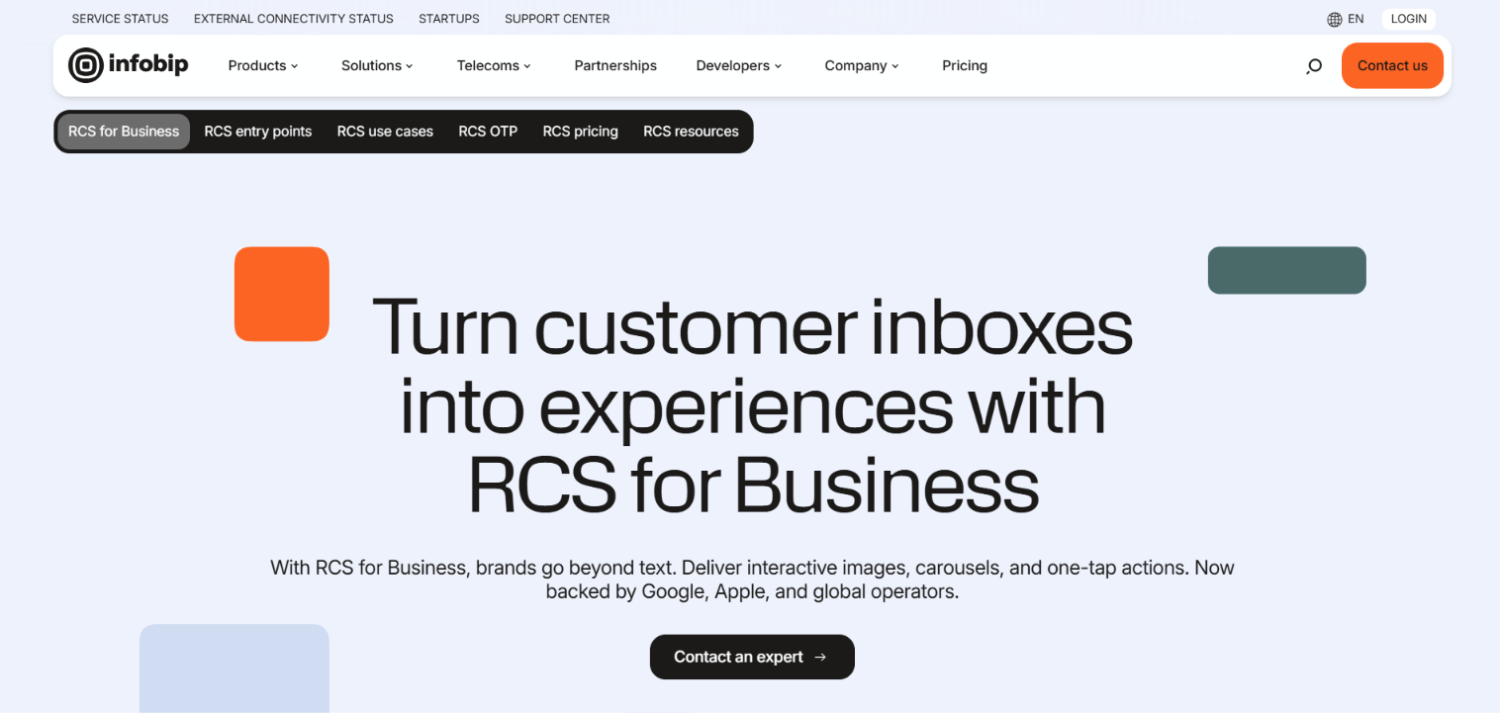
Infobip’s RCS offering sits inside its broader omnichannel platform, which includes the Moments campaign builder, the Answers chatbot engine, and direct carrier connectivity it has built over roughly two decades across 190-plus countries. That direct connectivity is not a marketing claim; it reflects Infobip’s founding model as a carrier-grade messaging aggregator rather than an API startup that added carrier agreements later.
On the product side, Infobip’s Moments interface lets non-technical marketing teams build RCS campaigns with rich card templates, event triggers, and audience segmentation without touching an API. That matters in enterprises where the team building the campaign is not the team that owns the codebase. RCS verified sender registration is managed through Infobip’s onboarding team, not left to the buyer to work through carrier registration portals alone.
Fallback orchestration is where the operational difference becomes concrete. Infobip routes undeliverable RCS messages to SMS, WhatsApp, or Viber based on rules the customer defines, and that logic runs at the platform level rather than requiring custom code. For a retailer sending transactional order updates or a bank sending authentication alerts, that managed fallback is the difference between a working program and a failed delivery at 2 a.m. when no engineer is watching.
What Does the RCS Verified Sender Process Look Like on Each Platform?
RCS verified sender status is the mechanism that puts a brand’s logo, name, and verified checkmark inside the messaging thread. Without it, RCS messages appear as generic rich messages with no brand identity. The process involves brand registration with carriers and Google’s Business Messages registry, plus a verification review that can take weeks.
On Twilio, the developer submits brand registration through Twilio’s API console and works through any carrier-specific requirements manually. Twilio’s documentation covers the steps, but support for resolving registration issues is tied to the customer’s support tier, which at lower plan levels means asynchronous ticket resolution.
Infobip assigns a dedicated onboarding contact for enterprise accounts and manages the verified sender registration process on the customer’s behalf. For teams that have run through the pain of 10DLC registration for SMS, the difference between guided onboarding and self-serve documentation is not abstract. Our guide on getting a verified RCS business sender explains exactly what that process involves regardless of which platform you use.
The AboutMartech RCS Fit Matrix: Four Checks Before Choosing
Comparing feature lists between Twilio and Infobip surfaces the wrong question. The right question is which operational model fits the team that will actually run the channel. The AboutMartech RCS Fit Matrix runs four checks that cut through feature parity claims:
Check 1: Build ownership. Who maintains the messaging code? If it is a dedicated engineering team, Twilio’s API-first model is a natural fit. If the channel will be owned by a marketing or CRM team, Infobip’s campaign tooling removes the engineering dependency.
Check 2: Fallback tolerance. What happens when RCS fails to deliver? If the organization can absorb undelivered messages in low-stakes use cases, Twilio’s developer-managed fallback is manageable. If fallback to SMS or WhatsApp must be guaranteed for transactional or compliance-sensitive messages, Infobip’s platform-level orchestration is more reliable without additional build time.
Check 3: Global footprint. Does the enterprise operate outside the US? Infobip’s carrier-direct model in 190-plus countries gives it an advantage for brands running a single messaging vendor across regions. Twilio has strong US coverage but relies more on aggregators in certain international markets.
Check 4: Stack lock-in. Is the team already deep in the Twilio product suite, with Segment, Verify, or Flex integrated? Switching to Infobip for RCS while retaining Twilio for everything else adds vendor complexity that may outweigh the gains. A team running on a neutral or multi-vendor stack has a cleaner decision.
Twilio vs Infobip: Feature and Capability Comparison for RCS
| Capability | Twilio | Infobip |
|---|---|---|
| RCS API access | Yes, via Programmable Messaging | Yes, via REST API and SDK |
| Visual campaign builder for RCS | Limited (Studio for flows; no native RCS template editor) | Yes, Moments drag-and-drop builder |
| Managed fallback to SMS/WhatsApp | Developer-configured, not automatic | Platform-level, rule-based |
| Verified sender support | Yes, self-serve registration | Yes, managed onboarding |
| US carrier coverage | Major US carriers | Major US carriers plus direct carrier relationships globally |
| Rich cards and carousels | Yes, via API parameters | Yes, via API and visual builder |
| Dedicated enterprise support | Tier-based, primarily self-serve at lower tiers | Dedicated account and technical contacts for enterprise |
| Omnichannel orchestration (RCS + WhatsApp + SMS) | Possible but requires custom routing logic | Native within Moments platform |
| Public RCS pricing | Not published; quote-based | Not published; quote-based |
| Chatbot and conversational RCS | Via Flex or third-party integration | Via Answers (native chatbot engine) |
How Much Does Each Platform Charge for RCS Business Messaging?
Neither Twilio nor Infobip publishes per-message RCS pricing on their public pricing pages as of this writing. Both use quote-based pricing at enterprise scale, with rates influenced by message volume, carrier mix, and contract terms. Any specific per-message figure cited on third-party comparison sites should be treated as estimated or outdated.
Twilio’s broader pricing model is consumption-based and visible for SMS and voice on its public pricing page, but RCS is not listed there. Infobip’s pricing is similarly opaque for RCS. Both vendors require a sales conversation for enterprise volume commitments.
One cost variable worth building into the evaluation: Twilio’s self-serve model may look cheaper on a per-message basis but frequently underestimates the engineering hours required to build fallback logic, manage carrier registration, and maintain the integration. Infobip’s managed model tends to include those services in a higher base cost. Teams that have run the math on total cost of ownership for enterprise SMS programs know this pattern well. Our analysis of RCS business messaging pricing across US providers breaks down what each vendor actually charges relative to what is included.
Which US Enterprise Use Cases Favor Infobip Over Twilio?
Consider a US retail bank sending two-factor authentication alerts and account notifications to several million customers. The messages must reach every device, fall back to SMS when RCS is unavailable, carry the bank’s verified logo, and be auditable for compliance. That team’s engineering resources are allocated to core banking systems, not messaging infrastructure maintenance.
Infobip’s platform-level fallback, managed verified sender registration, and dedicated support structure map directly to those requirements. The bank’s marketing and CX teams can configure campaigns in Moments without writing API calls. Compliance teams get message logs through a single vendor rather than stitching together Twilio logs and custom middleware.
Now take a growth-stage SaaS company with a five-person engineering team that already runs Twilio for SMS verification and has Segment running as its customer data layer. Adding Twilio RCS is a configuration exercise, not a vendor evaluation. The cost of switching to Infobip for a single channel would exceed any operational benefit.
The vertical where Infobip wins most clearly against Twilio on RCS is financial services, where compliance, carrier coverage, and managed support matter more than API elegance. Our breakdown of RCS providers built for compliant bank and insurer messaging covers this category in depth.
What About Sinch, and How Does It Compare to Both?
Sinch occupies a similar space to Infobip as a carrier-direct messaging provider with global reach and enterprise RCS capability. It is worth evaluating in the same round as Infobip for teams not already committed to either platform. The key distinction is that Sinch tends to be more developer-oriented than Infobip’s Moments interface, while being less developer-centric than Twilio’s pure API model. Our detailed comparison of Twilio vs Sinch for RCS covers that pairing directly if Sinch is also on your shortlist.
Is Infobip Reliable Enough for US Enterprise Production Traffic?
Infobip is a Croatian company founded in 2006 with a long operational history in carrier-grade messaging. It is not a startup; it handles traffic for banks, retailers, and mobile operators across its global network. The company does not publicly disclose uptime SLA figures, but enterprise contracts typically include negotiated SLA terms.
Third-party comparisons, including reviews on G2 and similar platforms, note that Infobip receives stronger marks for customer support and ease of setup than Twilio, while Twilio scores higher on developer documentation and breadth of product portfolio. Neither platform has a public track record of major US RCS outages, though that partly reflects how new RCS enterprise traffic volumes are.
For teams with zero tolerance for messaging downtime, the relevant question is not which brand is more reliable in the abstract but which contract includes the SLA terms and escalation paths required. Infobip’s dedicated enterprise support model makes those conversations more direct than Twilio’s tiered support structure.
Frequently Asked Questions
Does Twilio support RCS business messaging in the US?
Yes. Twilio offers RCS Business Messaging through its Programmable Messaging API, accessible using the same REST interface used for SMS. US carrier coverage includes major operators. However, Twilio does not publish per-message RCS pricing publicly, and features like automatic fallback to SMS require custom developer implementation rather than platform-level configuration.
What makes Infobip’s RCS offering different from Twilio’s?
Infobip combines an RCS API with a visual campaign builder called Moments, managed verified sender onboarding, and platform-level fallback orchestration to SMS or WhatsApp. Teams that need a non-technical team to run RCS campaigns without writing code will find Infobip’s tooling more complete. Twilio offers deeper API control but requires more engineering investment to reach the same functional state.
How much does RCS business messaging cost on Twilio vs Infobip?
Neither Twilio nor Infobip publishes RCS per-message pricing publicly as of this writing. Both platforms require a sales conversation for enterprise volume commitments. Any specific figures on third-party review sites are estimated. When comparing, factor in total cost of ownership including engineering time for integration, fallback logic build, and ongoing carrier registration management, not just the per-message rate.
What is RCS verified sender status and how do I get it?
Verified sender status is a carrier and Google-administered process that places a brand’s logo, name, and verification badge inside the RCS messaging thread. Without it, messages appear as unbranded rich messages. On Twilio, brands register through the API console and manage carrier requirements themselves. On Infobip, enterprise accounts receive managed onboarding support. The process typically takes several weeks regardless of platform.
Which enterprises are better served by Infobip for RCS than by Twilio?
Enterprises in regulated industries like financial services, healthcare, and insurance that need managed fallback, carrier-grade compliance, and dedicated support tend to find Infobip’s model more practical than Twilio’s self-serve approach. The same applies to global enterprises needing a single messaging vendor across multiple countries, where Infobip’s direct carrier relationships in 190-plus countries reduce aggregator dependency.
Is Infobip a reliable platform for enterprise production messaging?
Infobip has operated as a carrier-grade messaging provider since 2006 and handles messaging traffic for banks, mobile operators, and large retailers. Enterprise contracts include negotiated SLA terms. Third-party reviews consistently rate Infobip’s customer support and onboarding higher than Twilio’s, while Twilio’s developer documentation and product breadth draw stronger marks from engineering-led evaluators. Neither platform discloses uptime figures publicly.
Who are Infobip’s main competitors beyond Twilio?
Infobip’s closest competitors in enterprise RCS and omnichannel messaging are Sinch, Vonage (now part of Ericsson), and MessageBird (rebranded as Bird). In the US market specifically, Twilio and Sinch are the most direct comparisons for RCS-capable enterprise messaging. For teams evaluating Infobip alternatives, the key differentiators are carrier-direct connectivity, visual campaign tooling, and the depth of enterprise support offered.
Can I use Twilio for RCS if I already use Twilio Segment?
Yes, and the integration case is stronger than it might appear. Teams running Segment as their customer data layer can pipe audience segments directly into Twilio’s messaging infrastructure with minimal additional build. Adding Twilio RCS to an existing Twilio-plus-Segment stack is a configuration exercise rather than a new vendor evaluation. For these teams, the cost of switching to a separate RCS provider for marginal feature gains rarely justifies the additional vendor relationship.
The Enterprise Verdict
Twilio’s default-choice status in enterprise messaging is earned, not arbitrary. Its API quality is high, its documentation is thorough, and for teams already running Twilio infrastructure, adding RCS is the lowest-friction path. That is a real advantage, and it should not be dismissed to make this comparison feel more dramatic than it is.
The argument for Infobip is not that Twilio is bad. The argument is that RCS, as a channel, rewards operational completeness more than API elegance. Verified sender management, fallback orchestration, and campaign tooling that non-technical teams can operate are not secondary concerns for enterprise programs. They are the work. Infobip’s platform handles more of that work natively, and its dedicated support model reduces the internal burden on teams that cannot afford to treat messaging infrastructure as a continuous engineering project.
For enterprises evaluating this fresh, without legacy Twilio dependencies, Infobip is the stronger RCS starting point. For teams already on Twilio, the migration cost calculus matters more than any feature comparison table can capture. Run the AboutMartech RCS Fit Matrix before committing either way.