TLDR
- Several enterprise RCS providers already meet the audit trail, consent logging, and data residency requirements that banks and insurers face under regulations like GDPR, CCPA, and MiFID II.
- The compliance gap is not in the RCS protocol itself but in how each platform handles message archiving, fallback consent, and sender verification at the carrier level.
- Sinch, Infobip, Twilio, Vonage (now part of Ericsson), and Kaleyra are the most commonly evaluated options for regulated-industry deployments, each with distinct strengths in audit infrastructure and regional carrier coverage.
- The providers that actually serve compliance teams well offer immutable message logs, signed delivery receipts, and documented data processing agreements, not just marketing claims about security.
- Pricing across all seven providers is quote-based for financial services volumes; no public per-message rate cards exist for enterprise compliance tiers.
Several RCS business messaging providers already meet the audit trail, consent documentation, and data residency requirements banks and insurers need. Sinch, Infobip, Twilio, Vonage, Kaleyra, Messagebird (now Bird), and Dotdigital all offer compliance-relevant features including immutable delivery logs, GDPR and CCPA data processing agreements, and sender verification through Google’s RCS Business Messaging registry. The compliance question for financial services teams is no longer whether RCS can clear the bar, but which provider’s compliance architecture fits your regulatory environment and existing stack.
Why Financial Services Teams Still Doubt RCS Compliance (and What They’re Missing)
The skepticism is understandable. SMS has three decades of regulatory precedent behind it. Banks and insurers have audited SMS archiving workflows, tested fallback consent flows, and negotiated data processing agreements with telecom carriers. RCS is newer, and procurement teams have learned to be cautious when a vendor says “enterprise-ready” without showing the evidence.
What most evaluations miss is that RCS compliance lives at the platform layer, not the protocol layer. The RCS protocol itself, standardized through the GSMA’s Universal Profile, does not dictate how messages are logged or how consent is stored. That is the provider’s responsibility. A bank choosing an RCS vendor is really choosing a compliance architecture, and the differences between providers are significant.
The other missing piece: sender verification in RCS is structurally stronger than in SMS. Every RCS Business Messaging sender must be verified through Google’s agent registry, and that verification ties a brand’s display name, logo, and verified checkmark to a sender ID that cannot be spoofed the way SMS long codes can. For fraud alert and OTP use cases, that structural trust matters.
The AboutMartech Regulated-Messaging Compliance Checklist
This checklist emerged from reviewing how compliance teams at banks and insurers actually structure RCS RFPs , not from vendor marketing materials. The platform-layer vs. protocol-layer distinction above is what makes this checklist different from generic messaging security frameworks: it targets the decisions that are actually in a procurement team’s control, since the RCS protocol itself is fixed. After reviewing regulatory guidance from the FFIEC, FCA, and GDPR Article 28, five requirements appear consistently in financial services RCS RFPs.
- Immutable audit trails: Message content, delivery timestamps, read receipts, and consent records stored in a tamper-evident log, exportable on demand for regulatory review.
- Consent management with timestamped opt-in records: Proof that a consumer explicitly consented to receive RCS messages from a specific sender, stored separately from campaign data.
- Data residency controls: The ability to specify that message content and metadata stay within a defined geographic region (EU, UK, US) to satisfy data sovereignty requirements.
- Signed data processing agreements (DPAs): A formal contract under GDPR Article 28 or equivalent that defines how the vendor processes personal data on behalf of the financial institution.
- Fallback compliance: When a device does not support RCS, the fallback SMS must carry the same consent and opt-out mechanics, and that fallback event must be logged in the same audit trail.
Every provider below is evaluated against these five checks. The fallback compliance requirement is the one most commonly underweighted in initial RFP scoring , and the one most likely to surface as a gap during a regulator audit.
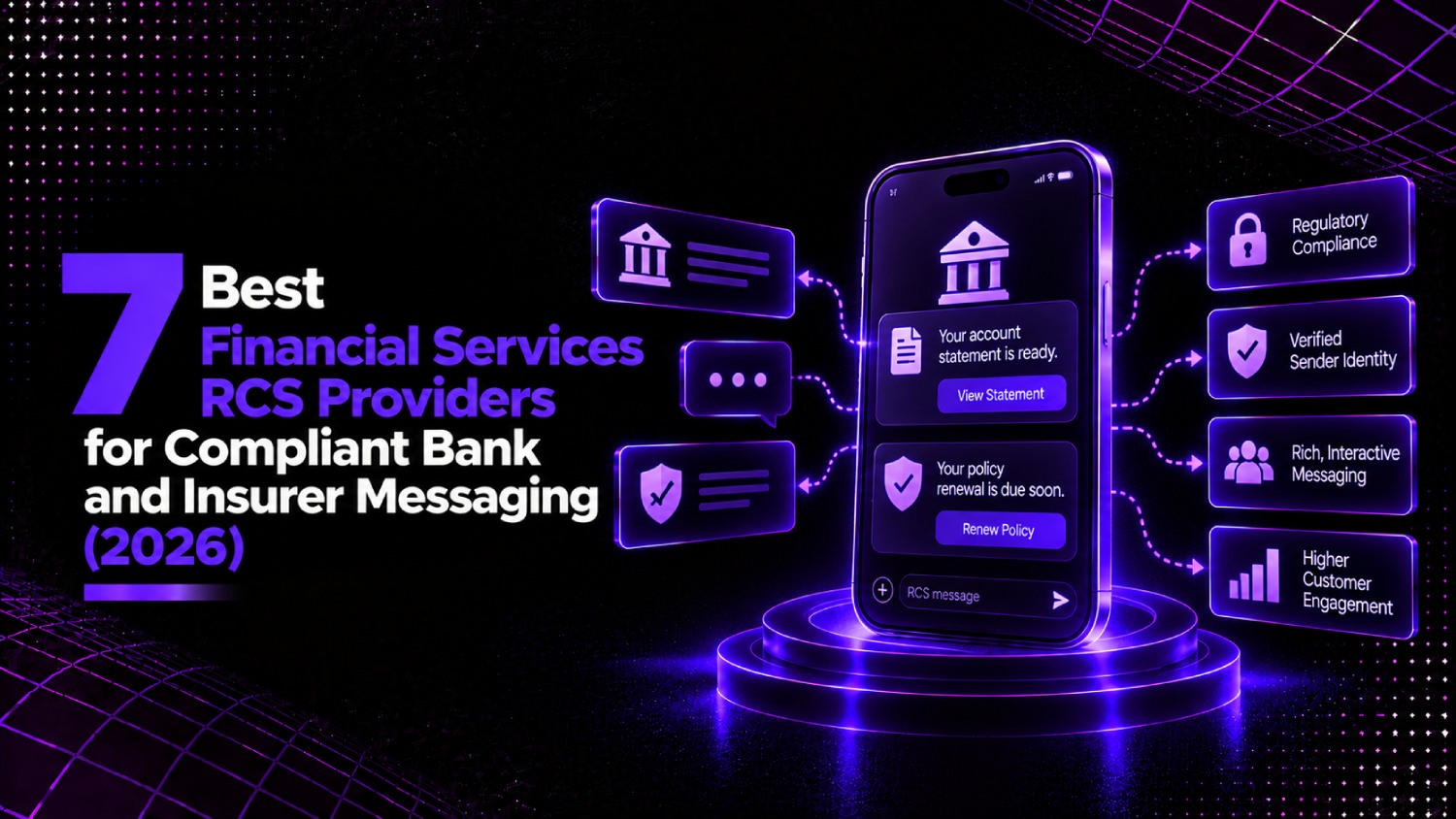
Which 7 RCS Providers Are Built for Bank and Insurer Compliance?
1. Sinch
Sinch is the most frequently cited RCS provider in financial services deployments, partly because of its direct carrier relationships across more than 60 countries and partly because its compliance documentation is the most accessible of any vendor in this space. Sinch holds ISO 27001 certification, publishes a GDPR-ready DPA on request, and offers data residency options across EU, US, and APAC regions.
For audit trails, Sinch’s Conversation API logs message events, including delivery, read, and fallback triggers, in a structured format that exports to SIEM tools or data warehouses. Consent records are managed separately from campaign metadata, which matters when a regulator asks you to produce a single customer’s full consent history without pulling campaign data.
The gap to know: Sinch’s self-serve audit export is limited to its Conversation API integration. Teams using Sinch’s legacy SMS APIs alongside RCS will need to reconcile logs from two separate systems, which creates overhead in compliance reporting. That reconciliation cost is a real operational variable , not a theoretical one , for banks running hybrid SMS/RCS programs during a channel transition.
2. Infobip
Infobip makes the clearest case for financial services compliance infrastructure. The company holds ISO 27001, SOC 2 Type II, and PCI DSS certifications, and its platform documentation explicitly addresses GDPR, CCPA, and MiFID II data handling requirements. That last certification matters specifically for investment firms and wealth managers sending trade confirmations or transaction alerts.
Infobip’s Moments platform includes a consent management module that logs opt-in source, timestamp, channel, and message type, which covers the granularity most financial services compliance teams need. Message logs are immutable and can be retained for up to seven years, aligning with MiFID II’s five-year record-keeping requirement and leaving headroom for firms with longer internal retention policies.
Infobip also runs its own private cloud infrastructure rather than relying entirely on hyperscalers, which gives financial institutions more direct control over data residency commitments in their DPA negotiations. The trade-off is that self-service onboarding is slower than with Twilio or Sinch; most financial services deployments go through Infobip’s enterprise sales team.
3. Twilio
Twilio brings the broadest developer community of any provider on this list, which is a meaningful advantage for banks and insurers with in-house engineering teams that want to build custom compliance workflows on top of a messaging API. Twilio holds SOC 2 Type II and ISO 27001 certifications, and its DPA covers GDPR and CCPA. Twilio’s RCS offering runs through its Messaging API and supports the full RCS Business Messaging feature set including rich cards, suggested replies, and verified sender display.
The audit trail story with Twilio requires more assembly than with Infobip. Twilio logs message events through its native logging infrastructure, but building a compliance-grade audit trail typically means routing events to a destination like Snowflake or Splunk via Twilio’s Event Streams. Teams already using Twilio for SMS who want to add RCS will find the transition easier than starting fresh, since consent records and sender configurations can be managed within the same account structure.
For teams evaluating Twilio’s RCS capabilities alongside other providers, the Twilio vs Sinch RCS comparison on AboutMartech covers the API depth and carrier coverage differences in detail.
4. Vonage (Ericsson)
Vonage, now operating under Ericsson following its 2022 acquisition, brings telecom-grade infrastructure to the RCS compliance conversation. Ericsson’s network heritage means Vonage’s RCS routing sits closer to the carrier layer than most CPaaS providers, which has practical implications for delivery receipt accuracy, an underappreciated compliance variable when delivery confirmation is part of a regulated workflow.
Vonage’s Messages API supports RCS with fallback to SMS, and the platform logs both the RCS delivery event and the fallback trigger in a single message record, which simplifies the compliance reporting requirement around fallback consent. Vonage holds ISO 27001 and SOC 2 certifications and offers EU and US data residency options. The DPA is available under Ericsson’s enterprise agreement framework.
The practical limitation: Vonage’s developer documentation for RCS is less comprehensive than Twilio’s or Sinch’s, and the sales process for financial services contracts now runs through Ericsson’s enterprise channel, which adds timeline to procurement. Teams with existing Vonage SMS contracts will find it easier to expand to RCS than new entrants.
5. Kaleyra
Kaleyra (now a Tata Communications company) has a stronger presence in APAC and EMEA financial services than in North America, which makes it the right choice for banks and insurers with significant operations in India, the Middle East, or Southern Europe. Kaleyra holds ISO 27001 and PCI DSS Level 1 certifications, and its RCS Business Messaging product includes consent management, message archiving, and delivery reporting that maps to TRAI regulations in India alongside GDPR.
For retail banking use cases, Kaleyra’s RCS templates include pre-built flows for transaction alerts, OTP delivery, and loan application status updates, which reduces implementation time for compliance-reviewed message types. The company’s integration with Tata Communications’ network infrastructure gives it direct carrier relationships across South and Southeast Asia that other CPaaS providers access only through aggregators.
North American banks should be aware that Kaleyra’s US carrier coverage is thinner than Sinch or Twilio, and US enterprise support is less responsive than its APAC teams. It earns its place on this list for international financial institutions.
6. Bird (formerly MessageBird)
Bird rebranded from MessageBird in 2023 and has been repositioning toward larger enterprise clients with more complex compliance requirements. Its RCS offering runs through a unified communications API that handles RCS, SMS, WhatsApp, and email under a single data model, which is useful for financial institutions that need a consistent audit trail across multiple customer communication channels.
Bird holds ISO 27001 and SOC 2 Type II certifications and offers GDPR-compliant data processing through EU-hosted infrastructure. The consent management system tracks opt-in and opt-out events across channels and stores them in a unified contact record, which is an advantage for institutions that need to demonstrate channel-level consent granularity to a regulator.
The honest caveat: Bird went through significant leadership and product changes during its rebrand, and some enterprise customers have reported inconsistencies in account management continuity. Financial institutions with long procurement cycles should request references from banks or insurers in their region before committing.
7. Dotdigital

Dotdigital is the most marketing-oriented platform on this list, but it earns a place in the financial services RCS conversation because it is ISO 27001 certified, holds Cyber Essentials Plus accreditation, and is one of the few platforms designed for marketers (rather than developers) that still delivers compliance-grade message logging and consent management. For insurers running customer communications through a marketing team rather than an engineering team, this distinction matters.
Dotdigital’s RCS integration sits inside its broader cross-channel marketing platform, which means compliance teams get audit trails alongside campaign performance data in a single view. The consent records are stored at the contact level and exportable in formats that support subject access requests under GDPR. The limitation is coverage: Dotdigital’s RCS reach is strongest in the UK and Australia, and US carrier support is more limited than the developer-first CPaaS providers above.
Head-to-Head Compliance Feature Comparison
| Provider | ISO 27001 | SOC 2 Type II | PCI DSS | Immutable Audit Logs | Consent Management | Data Residency (EU/US) | Fallback Logging | Best For |
|---|---|---|---|---|---|---|---|---|
| Sinch | Yes | Not publicly confirmed | No | Yes (Conversation API) | Yes | EU, US, APAC | Yes | Global banks, multi-carrier reach |
| Infobip | Yes | Yes | Yes | Yes (up to 7 years) | Yes (granular, per-channel) | EU, US, private cloud | Yes | MiFID II firms, insurers needing long retention |
| Twilio | Yes | Yes | No (varies by use case) | Yes (via Event Streams) | Yes | US, EU | Yes | Banks with in-house engineering teams |
| Vonage (Ericsson) | Yes | Yes | Not publicly stated | Yes (unified record) | Yes | EU, US | Yes (single record) | Insurers prioritizing delivery receipt accuracy |
| Kaleyra | Yes | Not publicly confirmed | Yes (Level 1) | Yes | Yes (TRAI + GDPR) | APAC, EMEA | Yes | International banks in India, MENA, SE Asia |
| Bird | Yes | Yes | Not publicly stated | Yes (cross-channel) | Yes (unified contact record) | EU | Yes | Insurers needing cross-channel audit trail |
| Dotdigital | Yes | Not publicly confirmed | No | Yes (campaign-level) | Yes (GDPR SAR-ready) | UK, AU | Limited | UK/AU insurers running marketing-led comms |
What Do RCS Audit Trails Actually Look Like for a Bank?
Consider a retail bank sending 500,000 fraud alerts per month via RCS, with SMS fallback for customers on non-RCS devices. A compliance-grade audit trail for that program needs to capture: the message content (or a reference ID if content is stored separately), the delivery timestamp, whether the message was delivered as RCS or fell back to SMS, the device’s read receipt if available, and the customer’s consent record including the opt-in timestamp and channel.
That sounds straightforward until you add the fallback dimension. If 30% of those 500,000 messages fall back to SMS because a customer’s device or carrier does not support RCS, the compliance team needs to demonstrate that the SMS fallback carried an identical opt-out mechanism and that the fallback event itself was logged. Platforms that store RCS and SMS events in separate systems, which includes some older CPaaS architectures, force compliance teams to reconcile two datasets when a regulator asks for a customer’s full communication history.
Infobip and Vonage handle this with a unified message record that logs both the RCS attempt and the SMS fallback as a single event. Twilio requires an Event Streams configuration to achieve the same result. Sinch logs both events but in the same API response structure, which is workable but requires documentation in the compliance workflow. This is the fallback logging variable from the Regulated-Messaging Compliance Checklist made concrete: it looks minor in an RFP scoring sheet and surfaces as a reporting gap six months into production. For a detailed look at how these providers handle fallback technically, the RCS vs SMS channel fallback comparison on AboutMartech covers the mechanics by provider.
How Does RCS Sender Verification Work for Financial Institutions?
Every RCS Business Messaging sender goes through Google’s agent registry verification process before a brand name, logo, or verified checkmark appears in a customer’s message thread. For financial institutions, this verification is a compliance asset, not just a branding feature, because it creates a documented chain of custody between the institution’s legal identity and its RCS sender profile.
The verification process requires the institution to submit business registration documents, domain ownership confirmation, and use-case descriptions. Google then reviews the sender configuration before activating it for any carrier. The verified sender profile is tied to the institution’s brand and cannot be transferred or modified without re-verification, which means a fraudster cannot spin up a fake “First National Bank” sender under RCS the way they can with an SMS long code or short code.
For a step-by-step guide to completing this process, the RCS business sender verification guide on AboutMartech covers the full registration workflow including common rejection reasons and how to fix them. For teams also evaluating how US carriers handle brand display name and logo verification separately from Google’s registry, the RCS brand verification providers guide covers that layer in detail.
RCS for Insurance: Claims Notifications, Policy Updates, and Premium Reminders
Insurance use cases for RCS fall into three categories, each with different compliance requirements. Claims status notifications are regulated in most jurisdictions by state insurance departments (in the US) or the FCA (in the UK) around timing and content requirements. Policy renewal and premium reminder messages fall under marketing consent rules in many markets, meaning they require explicit opt-in and a documented opt-out mechanism. First notice of loss (FNOL) workflows, where a customer initiates a claims report via messaging, carry higher data sensitivity requirements because they may capture incident details, location data, and third-party information.
Of the seven providers reviewed here, Infobip has the most pre-built template infrastructure for insurance workflows, with documented examples of FNOL chatbot flows, claims tracker cards, and policy document delivery via RCS. Sinch and Twilio support the same use cases but require more custom build. Bird’s cross-channel audit trail is particularly relevant for insurers that communicate across RCS, email, and in-app messaging, since a single claims event might generate touchpoints across all three channels simultaneously.
What About TCPA Compliance for US Banks Using RCS?
The Telephone Consumer Protection Act (TCPA) applies to RCS messages sent to US consumers, and the FCC has confirmed that RCS messages sent using an automatic telephone dialing system (ATDS) are subject to the same prior express written consent requirements as SMS. For banks using RCS for marketing messages (account upgrade offers, credit card promotions), this means the consent infrastructure required is identical to compliant SMS marketing programs.
Where it gets more nuanced: transactional RCS messages, such as balance alerts, fraud alerts, and OTP delivery, fall under the established exception for informational messages initiated by the consumer’s account relationship, provided the message content stays within the transactional scope. The compliance risk in RCS for banks is when a transactional template includes a promotional element, which converts the message to a marketing message under TCPA and triggers the full consent requirement.
Sinch, Twilio, and Infobip all document this distinction in their financial services compliance guidance and offer consent management tools that can enforce message-type segregation. The TCPA and 10DLC compliance rules for SMS and messaging on AboutMartech covers the current regulatory framework in detail, including the consent language requirements that apply equally to RCS marketing messages.
RCS Business Messaging Pricing for Financial Services
No provider on this list publishes a public per-message rate card for financial services RCS deployments. All seven operate on enterprise agreements with volume-based pricing negotiated through a sales team. The variables that drive pricing are message volume, message type (basic text vs rich card vs carousel), geographic reach, and the level of compliance infrastructure included in the contract.
Teams evaluating cost should request line-item pricing for compliance features specifically: audit log storage and retention, data residency configuration, and DPA negotiation. Some providers include these at no additional cost; others price compliance features as add-ons or professional services engagements. The RCS business messaging pricing breakdown on AboutMartech covers what each US provider actually charges per message at different volume tiers.
Frequently Asked Questions About RCS for Financial Services
Is RCS messaging compliant enough for banks and regulated financial institutions?
Yes, when deployed through a provider with ISO 27001 and SOC 2 certifications, a signed DPA, and immutable message logging. RCS is not inherently compliant or non-compliant; the compliance framework is built at the platform layer by the provider. Infobip, Sinch, and Twilio are the most commonly evaluated options for US and EU financial institutions. The RCS protocol itself adds structural trust through mandatory sender verification that SMS cannot match.
What audit trail requirements should banks look for in an RCS provider?
Banks should require immutable logs that capture message content or a content reference ID, delivery and read timestamps, fallback events with their channel identifier, and the customer’s consent record including opt-in source and timestamp. Logs must be exportable on demand in a format compatible with the institution’s eDiscovery or SIEM tooling. Retention periods should match regulatory requirements: at minimum five years for MiFID II firms, and seven years for some US federal recordkeeping rules.
How does RCS consent management differ from SMS consent management for insurers?
The legal consent requirement is the same: prior express written consent for marketing messages, established account relationship for transactional messages. The operational difference is that RCS platforms can capture consent interactively within the messaging thread using suggested reply buttons, and that consent event can be logged with a richer metadata record than a standard SMS opt-in keyword. Insurers should confirm that their RCS provider stores channel-level consent separately, since a customer who opts in to RCS policy alerts has not necessarily consented to SMS marketing.
Can RCS replace SMS for OTP and two-factor authentication in banking?
RCS can deliver OTPs and is used for this purpose by some banks in markets with high RCS penetration. The limitation is device and carrier coverage: if a customer’s device or carrier does not support RCS, the message must fall back to SMS. For authentication-critical messages, banks must verify that the fallback is configured and logged, and that the OTP delivery mechanism meets their security policy for both channels. Verified sender display in RCS adds anti-phishing protection that SMS OTPs lack.
What is the difference between RCS and SMS for fraud alert compliance?
For fraud alerts, RCS adds two compliance-relevant features that SMS cannot provide. First, verified sender display shows the bank’s registered brand name, logo, and verified checkmark, reducing the risk that a customer dismisses a legitimate alert as phishing. Second, interactive suggested replies allow the customer to confirm or dispute a transaction within the same verified thread, creating a structured response record. SMS fraud alerts lack both the sender verification and the structured response logging that regulators increasingly expect in dispute documentation.
Which RCS provider is best for a UK or EU insurer?
Infobip is the strongest choice for EU insurers that need long-term message retention (up to seven years), private cloud data residency, and documented GDPR Article 28 compliance. For UK insurers with marketing-led communication teams, Dotdigital’s ISO 27001 certification and Cyber Essentials Plus accreditation make it a credible option, though its RCS carrier coverage is narrower. Bird is worth evaluating for insurers that need a unified audit trail across RCS, email, and WhatsApp.
How to Choose Between These Seven Providers
The decision comes down to three variables: where your customers are, who owns your messaging stack, and how long you need to retain message records. If your customers are primarily in the US and you have an engineering team that wants API control, Twilio gives you the most flexibility and the largest developer community. If you need documented MiFID II compliance and long-term retention out of the box, Infobip is the most complete answer without custom engineering. If your customers span APAC and EMEA alongside the US, Kaleyra’s carrier relationships in those regions justify the extra evaluation time.
For insurers specifically, the cross-channel audit trail is often more important than raw RCS feature depth, because a single claims event touches multiple channels simultaneously. Bird and Infobip both handle this better than the developer-first CPaaS providers, where cross-channel log unification requires custom implementation work.
The broader context for financial services teams evaluating messaging infrastructure: RCS sits alongside SMS, WhatsApp, and in-app messaging in a channel mix that compliance teams increasingly need to govern as a single system. Platforms that treat RCS as an isolated channel create compliance reporting overhead. Platforms that treat it as one node in a unified messaging layer , with a single consent record and a single audit trail per customer , are building toward the architecture that regulators will eventually require. That governance model is also what separates a platform-layer compliance decision from a protocol-layer one, which is the distinction that should anchor any financial services RCS evaluation from the start.