- RCS carrier brand verification is not a single form submission. Each major US carrier (AT&T, T-Mobile, Verizon) reviews your RCS Business Messaging agent independently, and a provider who automates that multi-carrier submission process can cut weeks off your launch timeline.
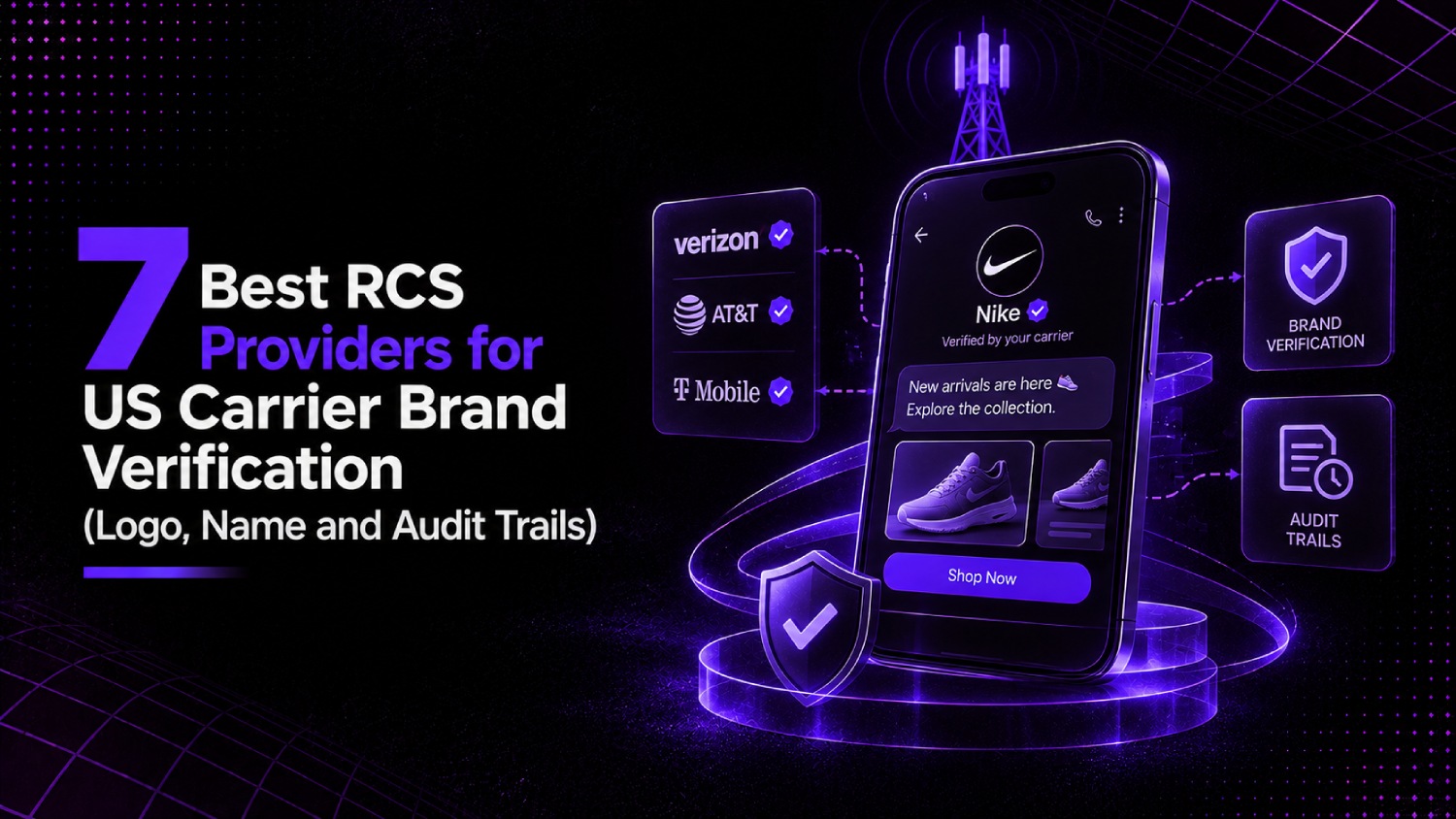
- The RCS Brand Agent determines everything visible to the recipient: your verified business name, logo, verification badge, and contact card. Getting it wrong means your messages land without branding, indistinguishable from an unverified sender.
- Audit trail depth varies significantly by provider. Some log every submission state change with timestamps and carrier responses; others give you a status badge and nothing else. For regulated industries, the difference is material.
- The seven providers below were selected for their documented carrier relationships, audit logging capabilities, and disclosed verification workflows. Bandwidth, Kaleyra, and Telnyx are not included in this ranking.
- Picking the wrong provider does not just slow you down. It creates gap periods where messages send without verified branding, damaging the trust signal RCS is supposed to deliver.
The fastest RCS brand verification services for US carriers are Twilio, Sinch, MessageBird (Bird), Vonage (Ericsson), Syniverse, Infobip, and Google’s own RCS Business Messaging platform. Verification timelines range from roughly five business days on the fast end to four-plus weeks depending on the provider’s carrier pipeline, your brand’s documentation readiness, and whether you need simultaneous approval across AT&T, T-Mobile, and Verizon.
Why Carrier Brand Verification for RCS Is More Complicated Than You Think
Most buyers assume RCS verification works like a domain registrar: fill out one form, wait, get approved. The reality is that AT&T, T-Mobile, and Verizon each maintain separate vetting processes for RCS Business Messaging agents. A provider’s job is to submit your brand’s RCS agent profile to each carrier, manage the back-and-forth on documentation, and surface status updates to you in a way that does not require you to call carrier partner portals directly.
Your RCS Brand Agent carries your verified business name, logo, verification badge, color scheme, and contact card. According to Google’s RCS Business Messaging documentation, brand verification confirms that an authorized brand representative has verified the agent information and their right to manage it. That verification is a prerequisite before any carrier will deliver branded messages at scale.
There is also a compliance dimension that goes beyond branding. If you are in financial services, healthcare, or any sector subject to messaging regulations, you need a record of who submitted what, when carriers approved or rejected it, and what version of your brand assets was on file at each point. That is what audit trail capability means in practice. For a deeper look at the mechanics of getting verified, the step-by-step process is covered in how to get a verified RCS business sender on AboutMartech. This article focuses specifically on which providers handle that process best.
What Should You Evaluate Before Picking an RCS Verification Provider?
The AboutMartech Verification Stack Audit is a four-factor test for comparing RCS brand verification providers before you commit. Run each factor against every vendor you shortlist.
Carrier pipeline depth: Does the provider have direct relationships with AT&T, T-Mobile, and Verizon, or does your submission route through an aggregator? Direct relationships generally mean faster response times and cleaner escalation paths when a carrier requests additional documentation.
Submission automation vs. manual handling: Some providers automate the multi-carrier submission, meaning your brand assets go to all three simultaneously. Others require sequential submissions or manual hand-offs. Sequential submissions add weeks.
Audit trail format: What exactly gets logged? Look for timestamp-level records of every state change (submitted, under review, approved, rejected, appealed), carrier-specific response data, and version history for your brand assets. A status badge is not an audit trail.
Rejection handling: Carriers reject RCS agent submissions for documentation gaps, logo specification failures, or category mismatches. Does the provider tell you why, or do you get a generic failure notice? Providers with direct carrier contacts can often surface rejection reasons within 24 to 48 hours versus a week or more through indirect channels.
What Is the Typical Carrier Brand Approval Timeline?
Timeline ranges in the table below are drawn from publicly available provider documentation, including Twilio’s RCS documentation and Google’s RCS Business Messaging developer guides. Individual timelines vary based on documentation quality, brand category, and carrier queue depth. The “Best For” column reflects AboutMartech’s editorial assessment based on documented capabilities; it is not a paid placement or vendor claim.
| Provider | Typical Approval Timeline | Multi-Carrier Simultaneous Submission | Audit Trail Depth | Best For (AboutMartech Assessment) |
|---|---|---|---|---|
| Twilio | 5-15 business days | Yes (via Console) | Full state-change logs, API-accessible | Developer-led teams needing programmatic access to verification status |
| Sinch | 7-21 business days | Yes | Dashboard status plus exportable logs | Teams already on Sinch’s messaging stack |
| Bird (MessageBird) | 10-21 business days | Yes | Dashboard status logs, campaign-level history | Multi-channel operators centralizing on one platform |
| Vonage (Ericsson) | 7-14 business days | Yes (Ericsson network) | Submission receipts and status history via API | Enterprise brands with existing Ericsson or Vonage relationships |
| Syniverse | 10-28 business days | Yes (carrier-direct) | Compliance-grade audit logs, carrier response records | Regulated industries needing defensible compliance records |
| Infobip | 7-21 business days | Yes | Full submission trail plus brand asset version history | Global brands needing US and international verification in one workflow |
| Google RCS Business Messaging | 5-10 business days | Yes (Google-managed) | Partner portal status logs | Brands working directly through Google’s RCS partner program |
Which RCS Provider Handles US Carrier Brand Verification Fastest?
1. Twilio
Twilio’s RCS offering operates through its Messaging Console, where brands register an RCS Business Messaging agent with logo, verified name, and description. Twilio submits to US carriers simultaneously and exposes verification status through both the Console dashboard and the Messaging API, so engineering teams can pull status programmatically rather than checking a dashboard manually.
The audit trail is the strongest of any CPaaS (Communications Platform as a Service) option here. Every state change, from initial submission through carrier approval or rejection, is timestamped and accessible via API. If a carrier rejects your agent, Twilio surfaces the rejection reason rather than a blank failure state. For teams building on top of Twilio’s stack already, the verification workflow integrates cleanly with existing API credentials.
Twilio pricing for RCS is usage-based and not listed on a flat public pricing page for verification specifically. Message pricing varies by carrier and volume. The broader comparison between Twilio’s RCS capabilities and Sinch’s is covered in Twilio vs Sinch for RCS.
2. Sinch
Sinch manages RCS brand verification for AT&T, T-Mobile, and Verizon through its carrier relationships built over years in the A2P SMS market. The verification workflow mirrors its 10DLC registration process in structure, which means teams already familiar with Sinch’s SMS registration will find the RCS agent submission process recognizable.
Timeline sits in the seven-to-twenty-one-day range depending on carrier queue and documentation completeness. Sinch provides dashboard-level status updates and exportable logs, but the audit trail is less granular than Twilio’s API-accessible version. Where Sinch wins is in account management: enterprise customers typically get a named contact who can escalate carrier rejections, which matters when a logo fails carrier spec and you need a fast turnaround.
Sinch’s RCS pricing is also usage-based and quote-driven for enterprise accounts. Sinch’s public pricing page covers messaging broadly but RCS verification costs are handled during the sales process.
3. Bird (formerly MessageBird)
Bird rebranded from MessageBird and has positioned its RCS offering as part of a broader omnichannel suite that includes email, WhatsApp, and SMS alongside RCS. For teams running multi-channel campaigns who want a single verification record across channels, Bird’s consolidated dashboard is a genuine operational advantage.
US carrier brand verification through Bird routes through its aggregator relationships. Timelines run ten to twenty-one business days, which is on the slower end for straightforward submissions. The audit trail covers campaign-level and sender-level history, useful for showing regulators or internal compliance teams a record of when each carrier approved your brand. Bird’s pricing is quote-based for RCS at scale.
4. Vonage (acquired by Ericsson in 2022)
Vonage was acquired by Ericsson in 2022, and its messaging infrastructure now runs on Ericsson’s global network, which includes direct carrier interconnects. For RCS brand verification, that Ericsson backbone translates to carrier relationships that predate most CPaaS players. Submission timelines for US carriers run seven to fourteen business days in typical conditions.
The API-accessible submission receipts and status history make Vonage a reasonable choice for engineering teams who need to build verification status into internal dashboards. The compliance audit record is solid but not as detailed at the per-carrier-response level as Syniverse. Vonage pricing is available by contacting Ericsson’s enterprise sales team and is not publicly listed for RCS specifically.
5. Syniverse
Syniverse is the least consumer-facing name on this list and the most carrier-native. Syniverse operates infrastructure for all three major US carriers directly, which gives its RCS verification pathway a different character than a CPaaS intermediary. When you submit through Syniverse, you are closer to the carrier’s own review queue.
The compliance-grade audit logs Syniverse produces are the deepest available among these providers. Every carrier response, rejection reason, document version, and submission timestamp is logged in a format designed for regulated-industry review. Financial services firms and healthcare brands that need to demonstrate messaging compliance to auditors will find Syniverse’s records defensible in ways that a basic dashboard status log is not.
The trade-off is timeline and accessibility. Syniverse is built for enterprise and carrier-grade deployments. Smaller teams without dedicated messaging infrastructure contacts may find the onboarding process heavy. Pricing is quote-based and typically involves a carrier services agreement.
6. Infobip
Infobip has direct carrier relationships across more than 190 countries, and its US RCS verification workflow draws on those relationships for AT&T, T-Mobile, and Verizon submissions. The standout feature is brand asset version history: Infobip logs each version of your logo and brand name submitted to carriers, meaning you have a record of exactly what was approved at each point in time.
For global brands running RCS across multiple markets, the ability to handle US carrier verification and international operator approval in a single vendor relationship reduces coordination overhead materially. Infobip’s audit trail covers submission state changes, carrier-specific responses, and brand asset versioning. Pricing is not publicly listed and is handled through regional sales teams.
7. Google RCS Business Messaging (Direct Partner Program)
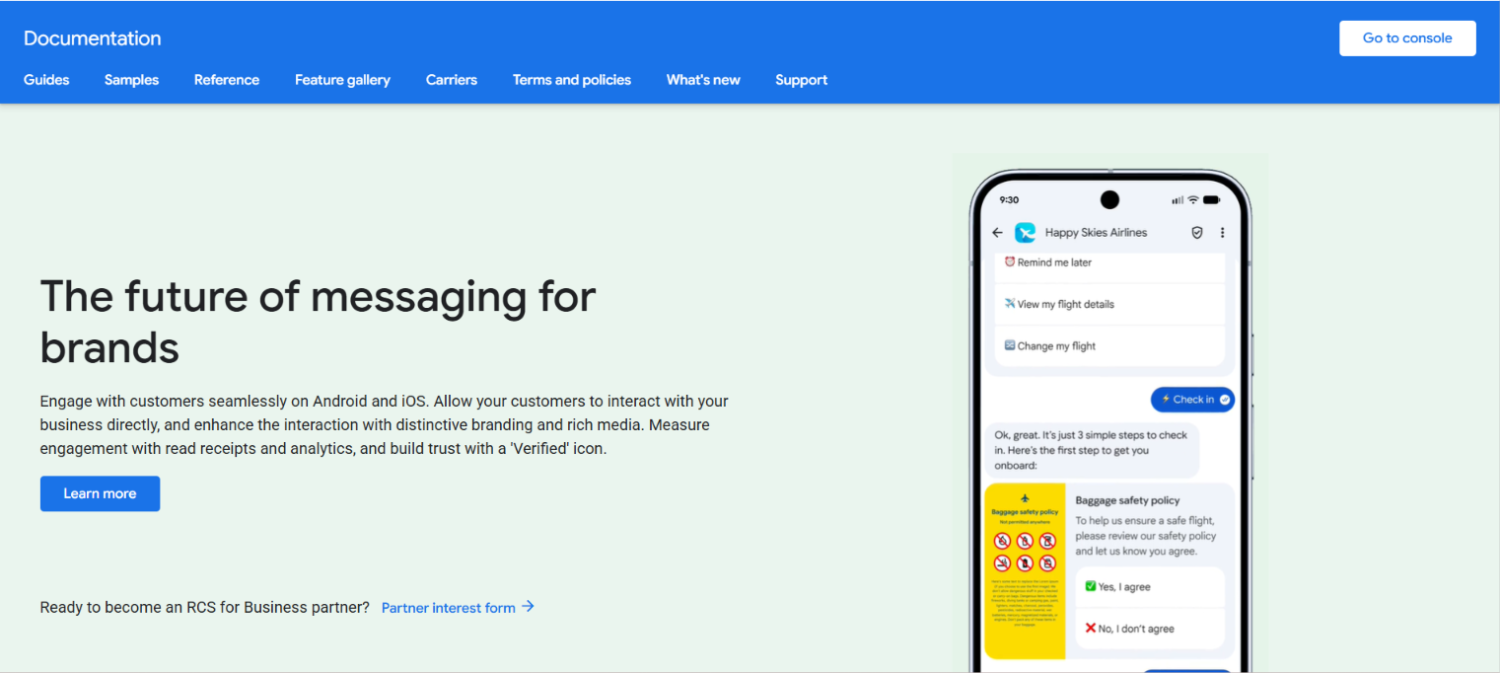
Google’s RCS Business Messaging platform operates through a partner program. Brands work with a Google-certified partner (which includes several providers on this list) or engage Google directly through the partner portal. Google’s own verification process for RCS agents tends to move faster than carrier-side review because Google controls the agent registry before pushing to carrier networks.
For brands whose primary concern is speed, working directly through a Google RCS partner and ensuring the agent is Google-approved first, then carrier-approved, can compress the visible timeline. The partner portal provides status logs, though they are less API-accessible than Twilio’s implementation. Google’s RCS Business Messaging is the platform every other provider on this list is ultimately building on top of.
Do You Need Separate Verification for Each US Carrier?
Yes, and understanding exactly what that means operationally changes how you plan your launch. AT&T, T-Mobile, and Verizon each independently review your RCS Business Messaging agent profile. Google’s agent registry provides the underlying identity, but carrier approval governs whether branded messages actually deliver on each network.
A provider submitting simultaneously to all three carriers does not guarantee simultaneous approval. One carrier may approve in five days while another takes three weeks. During that gap, your messages on the delayed carrier’s network either fall back to SMS or deliver without verified branding, depending on your fallback configuration. This is not an edge case. It is the normal pattern, and it means your effective launch date is determined by the slowest carrier, not the fastest.
The practical implication: if you need branded RCS delivery on all three networks by a specific campaign date, submit at least six weeks before that date. If you are launching on T-Mobile first because of its network composition, confirm your provider has a direct T-Mobile relationship and ask for typical T-Mobile-specific timelines, not aggregate estimates.
What Does RCS Sender Verification Actually Cost?
None of the providers in this ranking publish a flat verification fee for RCS brand verification. The cost structure across the industry is usage-based for message delivery, with verification treated as part of onboarding rather than a line-item purchase.
What you are actually paying for is message volume at approved rates, plus any platform or account fees the provider charges. Some providers charge a one-time agent setup fee; others fold it into the messaging rate. Enterprise accounts typically negotiate both. The closest analog from the SMS world is 10DLC registration fees, which are documented in TCPA and 10DLC rules explained, but RCS does not use the 10DLC system. RCS verification fees and structures are negotiated separately.
If you are evaluating providers and cost is a primary factor, ask specifically for: the one-time agent registration or setup fee per carrier, the per-message rate for verified RCS, the fallback SMS rate when RCS is unavailable, and whether there are minimum monthly commitments. Providers that cannot answer all four in writing before you sign are worth treating with caution.
Which Providers Give the Best Audit Trails for Compliant RCS Messaging?
Audit trail quality splits cleanly into three tiers among the providers above.
Syniverse produces the most defensible compliance records, with carrier-response level logging designed for regulated-industry use. Infobip adds brand asset version history that other providers do not offer. Twilio provides the most developer-accessible audit data through its API, making it the best option for teams that need to ingest verification status into internal compliance dashboards.
Sinch, Bird, and Vonage offer dashboard-level status histories that satisfy most internal compliance requirements but may not satisfy external audit demands without additional documentation from the provider. Google’s partner portal logs are adequate for most use cases but are the least exportable of the group.
For regulated industries, the specific question to put to any provider is: “Can you provide a timestamped record of every carrier submission state change, including rejection reasons, in a format exportable to PDF or CSV?” The answer to that question alone will eliminate most of the ambiguity in the comparison.
How Does RCS Brand Verification Relate to 10DLC?
They are separate systems that serve different channels. 10DLC (10-digit long code) registration applies to A2P SMS traffic on US carrier networks. RCS Business Messaging uses Google’s agent registry plus carrier-specific approval, with no dependency on the 10DLC campaign registry.
The conceptual similarity is that both systems are designed to give carriers a verified record of who is sending commercial messages, reducing spoofing and spam. The operational difference is that 10DLC is managed through The Campaign Registry (TCR) and Campaign Service Providers (CSPs), while RCS verification runs through Google’s RBM (RCS Business Messaging) platform and individual carrier approval workflows. A brand that is fully 10DLC-registered for SMS still needs to complete RCS verification separately before sending branded RCS messages.
Frequently Asked Questions About RCS Carrier Brand Verification
How long does carrier brand approval actually take for RCS in the US?
Plan for five to twenty-eight business days depending on your provider’s carrier relationships and your documentation readiness. The fastest documented timelines come from providers with direct carrier relationships submitting simultaneously to all three major US carriers. The slowest timelines typically occur when documentation is incomplete at submission, triggering a rejection-and-resubmit cycle that adds one to three weeks. Build a six-week buffer before any campaign launch that depends on verified branding across AT&T, T-Mobile, and Verizon.
Does my brand need a separate approval with each US carrier for RCS?
Yes. AT&T, T-Mobile, and Verizon each independently approve RCS Business Messaging agents. Google’s agent registry provides the foundational identity, but carrier approval is what allows branded messages to deliver on each specific network. A provider can submit to all three simultaneously, but the approval timing differs by carrier. Your effective verified launch date is determined by the last carrier to approve, not the first.
What exactly appears as my verified RCS sender identity?
Your RCS Brand Agent displays your verified business name, brand logo, a verification badge, brand color scheme, and a contact card with website and phone number. According to Google’s RCS Business Messaging documentation, the Brand Agent controls how your business appears in the messaging thread. Recipients see this instead of a phone number, which is the primary trust signal RCS offers over standard SMS.
What causes RCS brand verification to get rejected by carriers?
Common rejection triggers include logo files that do not meet carrier pixel and format specifications, brand name inconsistencies between the submission and official business registration documents, mismatched business categories, and incomplete contact information. Some carriers also reject agents when the submitted website does not match the registered business entity. Providers with direct carrier contacts can usually surface the specific rejection reason within one to two business days; those working through aggregators often take longer to get that feedback.
Is RCS brand verification required even if I am only sending to opted-in customers?
Carrier brand verification is required regardless of your list composition. The verification establishes your sender identity at the network level, separate from consent and opt-in status. You cannot deliver branded RCS messages with your logo and verified name without completing carrier approval, even if every recipient explicitly opted in and your messaging is fully compliant with applicable regulations.
Which RCS providers are not included in this ranking and why?
Bandwidth, Kaleyra, and Telnyx are not ranked here. All three offer messaging services relevant to this category and merit evaluation depending on your stack. If you are considering any of the three, reach out to AboutMartech for an updated comparative assessment as part of a broader vendor review.
How does RCS brand verification differ from verified sender programs in email?
Email sender verification programs like Gmail’s verified sender feature or BIMI (Brand Indicators for Message Identification) verify domain ownership and align brand logos with authenticated sending infrastructure. RCS carrier brand verification is a separate process that authenticates your business identity with mobile carriers, not email providers. The trust signals are analogous but the technical registries, submission processes, and compliance requirements are completely distinct.
How to Choose the Right RCS Verification Provider for Your Team
The right choice depends on three variables that only you can answer: your timeline pressure, your compliance requirements, and your existing messaging infrastructure.
If you are a developer-led team already on Twilio with a hard launch date, Twilio gives you the fastest programmatic visibility into verification status and the cleanest rejection-reason surfacing. If you need compliance-grade records for a regulated industry, Syniverse’s carrier-native audit depth is worth the longer onboarding process. If you are running RCS alongside WhatsApp, email, and SMS in a single orchestration layer and need one audit record across all of them, Infobip’s brand asset version history makes it the most complete option for that use case.
One consistent mistake buyers make is optimizing for the provider’s claimed timeline rather than their rejection-handling capability. A provider who claims ten days but goes silent on rejections is slower in practice than one who quotes fifteen days but resolves carrier feedback within forty-eight hours. Ask every provider you shortlist: “What is your documented process when a carrier rejects our agent, and how long does a resubmission typically take?” The specificity of the answer is itself a data point. For context on how the RCS business messaging space has matured at the platform level, the full provider comparison in best RCS business messaging platforms covers the broader stack beyond verification.
Carrier brand verification is infrastructure, not a campaign tactic. Getting it right once means every subsequent RCS send carries your verified logo and name. Getting it wrong, or picking a provider who stalls the process, means your first impression to recipients looks identical to spam. The providers here have documented carrier relationships and defined audit processes. The selection decision comes down to how much of that process you need to own directly, and how much you can hand off.