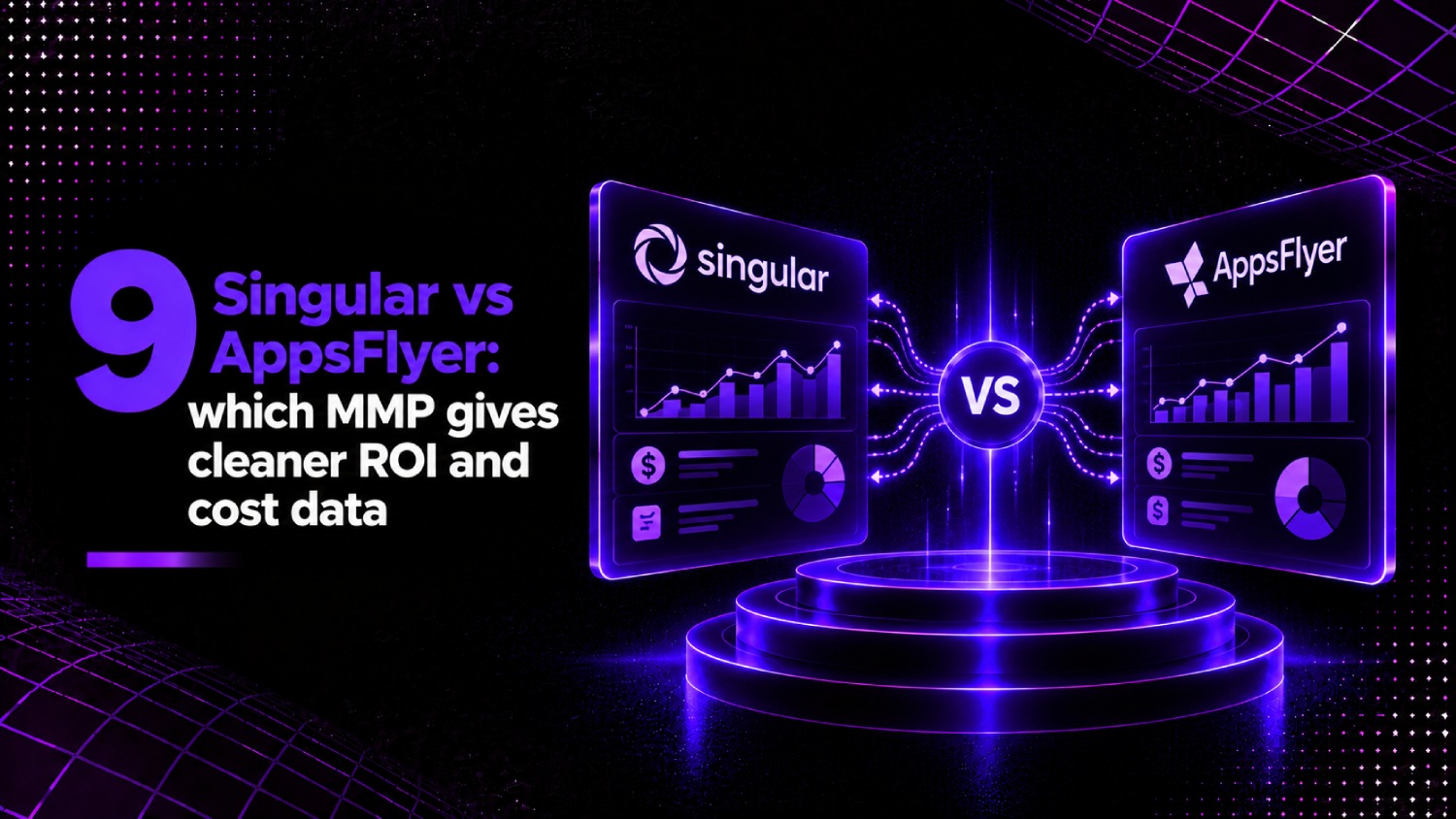
- Singular and AppsFlyer both measure mobile attribution, but they solve the ROI reporting problem differently: AppsFlyer starts with clicks and installs, while Singular starts with ad spend.
- Singular’s cost aggregation pulls raw spend data directly from ad network APIs and joins it to attribution data in one platform, which changes how you calculate ROAS at the campaign level.
- AppsFlyer has a significantly larger market share and a broader partner network, which matters for teams running on exotic or regional networks that Singular may not support.
- Singular pricing is modular and publicly documented; AppsFlyer pricing is quote-based beyond its free tier, making direct cost comparison difficult without a sales call.
- For teams where cost data lives in a separate BI tool today, Singular’s architecture closes that gap natively. For teams prioritizing partner coverage and fraud protection maturity, AppsFlyer remains the default choice.
In the singular vs appsflyer decision, Singular is the better pick for mobile marketing teams where blended ROAS and cost-per-outcome reporting are the primary measurement goals, because its native cost aggregation eliminates the manual step of joining spend data to attribution data. AppsFlyer is the stronger choice for teams running complex, multi-network campaigns that need the broadest partner coverage and a more mature fraud prevention layer, particularly if ROI reporting can tolerate a separate data pipeline for cost data.
Why the ROI Reporting Gap Between These Two MMPs Actually Matters
Most mobile attribution platforms share the same core loop: SDK fires on install, platform matches the install to a click, you get a report. AppsFlyer and Singular both do this competently. Where they separate is what happens when you try to answer “what did that install actually cost, and was it worth it?”
Getting to ROAS requires two data sets: attribution data (which network drove which conversion) and cost data (what you paid that network for the clicks). In a traditional MMP setup, those two data sets live in different places. Your MMP has the attribution side; your ad networks have the cost side. You either export both into a BI tool and join them manually, or you lose hours each week to spreadsheet reconciliation.
Singular’s core architectural argument is that this join should happen inside the MMP, not outside it. Its cost aggregation feature connects directly to ad network APIs, pulls raw spend data, and unifies it with attribution data at the campaign, ad set, and creative level. The result is a single ROAS number without a warehouse step in between. This is a real structural difference, not a marketing claim, and it changes the ROI reporting workflow enough to drive a buying decision.
How Does Singular Cost Aggregation Actually Work?
Singular describes its cost aggregation as a marketing data pipeline that pulls spend data from over 2,000 ad network integrations via API , a figure Singular cites on its own platform documentation and marketing materials. The platform maps that spend data to the same granularity as its attribution reports, so you can see cost per install, cost per event, and ROAS at the creative level without building a custom ETL job.
The practical implication is significant. A performance marketing team running campaigns across Meta, Google UAC, TikTok, and three DSPs does not need to export five separate cost reports, normalize the naming conventions, and join them to attribution exports. Singular does that reconciliation internally and surfaces a unified cost view in its reporting layer.
AppsFlyer offers a comparable feature called Cost Aggregation within its broader ROI360 add-on product, which maps ad spend from network APIs to attribution data. The difference is that ROI360 is a paid add-on on top of AppsFlyer’s base attribution plan, whereas Singular’s cost aggregation is part of its core platform proposition. Teams evaluating purely on ROI reporting should understand that getting equivalent functionality from AppsFlyer may require purchasing an additional tier.
What Do Singular and AppsFlyer Each Do Best?
Where Singular has a structural edge
Singular was built from the beginning as a marketing analytics platform, not purely an MMP. That origin shows in how it treats cost data as a first-class data type rather than a supplement to attribution. For teams where the primary deliverable from their MMP is a clean ROAS report by campaign and creative, Singular’s architecture is purpose-built for that output.
On G2’s platform, Singular’s publicly listed ratings show higher scores than AppsFlyer on Quality of Support and Ease of Use categories , reviewers can verify current scores directly on Singular’s G2 profile and AppsFlyer’s G2 profile, as scores update with each review cycle. That pattern in the ratings suggests smaller teams with leaner ops capacity may find it easier to maintain. Singular also offers a self-serve onboarding path and publicly documented pricing, which AppsFlyer does not provide at scale.
Where AppsFlyer retains the advantage
AppsFlyer holds meaningfully larger market share in the attribution tracking category than Singular , Enlyft, a technology market intelligence provider, publishes customer counts and market share estimates for both platforms, though those figures reflect their database coverage rather than a verified census of all deployments. What is not in dispute is the gap in partner network scale: AppsFlyer publicly claims roughly 10,000+ partner integrations across its network, compared to Singular’s 2,000+ cost-focused integrations , both are vendor-stated figures. That difference in breadth translates into more pre-built integrations with measurement partners and a more mature fraud prevention product called Protect360.
For teams running campaigns on regional or emerging ad networks, AppsFlyer’s partner coverage is often decisive. The platform also has a longer track record with iOS privacy-safe measurement, including support for SKAdNetwork and its own advanced privacy framework. Teams with a complex attribution setup across owned and paid media may find AppsFlyer’s depth harder to replicate in Singular.
How Does Singular Pricing Compare to AppsFlyer Pricing?
Singular publishes a tiered pricing structure on its public pricing page. Plans are based on attributed installs per month, with a free tier available for early-stage apps and paid plans scaling upward from there. Cost aggregation is included across paid plans, not gated behind a separate purchase.
AppsFlyer’s pricing model, as documented on its public pricing page, includes a free-to-start tier with limited attributed conversions. Paid plans are quote-based and scale with conversion volume. ROI360, the add-on that includes cost aggregation and advanced ROI reporting, is priced separately. AppsFlyer does not publish the cost of ROI360 publicly, so a direct dollar comparison requires contacting their sales team.
The meaningful pricing insight: if a team’s evaluation criteria centers on cost data and ROI reporting, and they choose AppsFlyer, they are likely looking at the base attribution cost plus the ROI360 add-on. Singular includes that reporting layer by default. For budget-conscious teams, that structure may tip the total cost of ownership calculation.
| Dimension | Singular | AppsFlyer |
|---|---|---|
| Core attribution | Yes, SDK-based, iOS and Android | Yes, SDK-based, iOS and Android |
| Cost aggregation | Included in platform (2,000+ network integrations, per vendor) | Available via ROI360 add-on (paid separately) |
| ROAS reporting | Native, no separate BI join required | Available with ROI360; base plan requires external join |
| Fraud prevention | Available | Protect360, more mature and widely tested |
| SKAdNetwork / Privacy sandbox | Supported | Supported, longer track record |
| Partner network size | 2,000+ cost integrations (vendor-stated) | ~10,000+ partner integrations (vendor-stated) |
| Pricing transparency | Published tiers with free plan | Quote-based above free tier |
| G2 ease of use | Higher rated (see G2 profiles for current scores) | Lower rated vs Singular on G2 |
| Market share (attribution tracking) | Smaller share (Enlyft estimate; not independently audited) | Larger share (Enlyft estimate; not independently audited) |
A Worked Scenario: Where the ROI Reporting Difference Shows Up in Practice
Consider a mobile gaming team running user acquisition across Meta, Google UAC, ironSource, and two programmatic DSPs. They have a UA manager and a single analyst. Their current setup uses AppsFlyer for attribution and manually exports cost data from each network into a Google Sheet, which the analyst reconciles every Monday morning before the weekly UA review.
That reconciliation step takes roughly three to four hours a week. Naming convention mismatches between networks mean campaign names need to be standardized manually. If a network changes its reporting API, the Sheet breaks and last week’s data is unavailable until it is fixed. The UA team is making optimization decisions on Friday with data that is four days old by Monday.
In a Singular setup, cost data from all five networks flows into the platform via direct API connections. The ROAS view by campaign, ad set, and creative is available same-day. The analyst’s Monday reconciliation disappears. The UA manager can pause underperforming creatives on Thursday instead of Tuesday. For this team, the operational value of Singular’s cost aggregation is not marginal. It changes the speed of decision-making, which compounds over a campaign cycle.
This scenario does not make Singular the universal answer. A team running campaigns on niche regional networks that Singular has not integrated yet would still need an external data pipeline anyway, erasing the advantage. The scenario applies specifically to teams running standard major-network spend across a manageable number of partners.
The Cost-First MMP Test: Four Checks Before You Pick
The standard MMP evaluation covers attribution accuracy, SDK stability, and partner coverage. Those matter. But for teams where ROI reporting is the primary use case, four additional checks determine whether Singular or AppsFlyer is the right call. This framework , the Cost-First MMP Test , is designed for teams where the bottleneck is turning ad spend data into an actionable ROAS figure, not just confirming which network drove which install. It asks different questions than a standard MMP RFP and surfaces trade-offs that a demo alone will not reveal.
- Cost data source check: Map every ad network you spend on today. Verify whether both platforms integrate with those networks for cost ingestion, not just for attribution clicks. A gap in cost integration on one network means your ROAS numbers are incomplete regardless of which MMP you choose.
- Reporting layer check: Ask each vendor to demo a ROAS report at the creative level. Count how many clicks it takes to get from login to a blended ROAS view. The difference between a two-click and a seven-click path to that report affects how often the UA team actually uses it.
- Add-on cost check: Request a full quote from AppsFlyer that includes ROI360 if cost aggregation is a requirement. Compare that total to Singular’s equivalent tier. The base plan comparison is not the relevant comparison for this use case.
- Fraud exposure check: If your campaigns run on incentivized networks or emerging DSPs with elevated fraud risk, weight AppsFlyer’s Protect360 more heavily. Singular’s fraud tools are functional but the depth and tenure of Protect360 is a real difference for teams running in high-fraud inventory environments.
Which Ad Networks Does Each Platform Support for Cost Data?
Singular publicly positions its cost aggregation as covering 2,000+ networks and data sources (per Singular’s own platform documentation), with direct API integrations for major platforms including Meta, Google, TikTok, Twitter, Snap, ironSource, Unity, and AppLovin. The breadth of its cost API coverage is a genuine technical differentiator and the primary reason cost-focused teams gravitate toward it.
AppsFlyer’s ROI360 also connects to major ad networks for cost data, but the exact list of cost integrations is not as prominently documented publicly. AppsFlyer’s total partner network is larger overall, covering measurement, attribution, analytics, and engagement partners. The distinction is that AppsFlyer’s breadth is strongest for attribution event matching rather than for cost API coverage specifically.
For teams evaluating this question, both vendors provide integration directories. The verification step is to input your current media plan’s network list into each directory and check whether cost API access (not just click/impression attribution) is confirmed for each partner. Attribution integration and cost integration are separate things; a network can be supported for one and not the other.
If you are mapping out a broader mobile measurement stack, the 8 best mobile app attribution tools comparison on AboutMartech covers how MMPs fit alongside probabilistic measurement and incrementality testing tools. For teams also evaluating how their MMP connects to broader attribution infrastructure, the 11 best marketing attribution tools overview is worth reviewing alongside this comparison.
How Do Singular and AppsFlyer Handle iOS Privacy Measurement?
Both platforms support SKAdNetwork, Apple’s privacy-preserving attribution framework, and both have invested in probabilistic modeling to fill the gap created by ATT (App Tracking Transparency). The mechanics are functionally similar: deterministic matching where IDFA is available, modeled attribution where it is not.
AppsFlyer has been in the iOS privacy measurement space longer and has published more public documentation on its Privacy Cloud and its SKAdNetwork conversion value management tools. Singular supports SKAdNetwork conversion schema management and has its own modeling layer for unmeasured installs.
For teams where iOS measurement depth is the primary concern, the Airbridge vs AppsFlyer comparison on AboutMartech covers the iOS privacy measurement trade-offs in more granular detail than this piece does. The short version: for pure iOS attribution sophistication, AppsFlyer’s depth is marginally greater, though both platforms have kept pace with Apple’s framework updates.
Is Singular Better Than AppsFlyer for ROI Reporting?
For ROI reporting specifically, Singular’s architecture produces cleaner outputs because the cost data and attribution data share the same schema and live in the same platform. The absence of a manual join step or an external BI dependency is not a convenience feature. It is the operational difference between ROI data that informs Wednesday’s creative decisions and ROI data that confirms what the team already guessed.
AppsFlyer with ROI360 activated produces comparable ROI outputs, but the add-on structure means teams need to budget for it explicitly and confirm that their account tier supports it. Teams that have already purchased AppsFlyer without ROI360 and are currently solving the cost data problem with a data warehouse and a reverse ETL tool should evaluate whether switching to Singular or adding ROI360 is the better path. The comparison between those two options depends on how deeply the team has invested in their existing warehouse-based reporting. For context on that infrastructure question, the 11 best marketing attribution tools overview covers how attribution platforms interact with data stack infrastructure.
Frequently Asked Questions
What is the main difference between Singular and AppsFlyer?
Singular combines mobile attribution and marketing cost aggregation in a single platform, letting teams calculate ROAS without joining data from separate sources. AppsFlyer is a larger, more established MMP with a broader partner network and more mature fraud prevention tools. Cost aggregation in AppsFlyer requires its ROI360 add-on, which is priced separately from base attribution plans.
How much does Singular cost?
Singular publishes tiered pricing based on attributed installs per month, with a free plan available for early-stage apps. Paid plans scale with volume, and cost aggregation is included across paid tiers. For current plan details, Singular’s public pricing page is the authoritative source, as specific tier prices can change between plan updates.
How much does AppsFlyer cost?
AppsFlyer offers a free-to-start plan with a limited number of attributed conversions per month. Paid plans are quote-based and scale with conversion volume. The ROI360 add-on, which includes cost aggregation and advanced ROI reporting, is priced separately. AppsFlyer does not publish specific plan costs publicly beyond the free tier structure.
What does Singular’s cost aggregation do that AppsFlyer’s base plan does not?
Singular’s cost aggregation pulls ad spend data directly from network APIs and joins it to attribution data inside the platform, producing campaign-level ROAS reports natively. AppsFlyer’s base attribution plan does not include this capability. Teams using AppsFlyer without ROI360 need to export cost data separately and join it externally, typically in a BI tool or data warehouse, to produce equivalent ROI reports.
Who are AppsFlyer’s main competitors?
AppsFlyer’s primary competitors in the mobile measurement partner category are Singular, Adjust, Kochava, and Branch. Airbridge and Tenjin compete in specific segments. Among these, Singular is the most direct competitor on ROI reporting because of its cost aggregation architecture. Adjust and Branch are generally positioned as attribution-first platforms without the same level of native cost data integration.
Is Singular a good choice for small mobile app teams?
Singular’s free plan and published pricing tiers make it accessible for smaller teams. Its higher ease-of-use scores on G2 relative to AppsFlyer suggest leaner teams with limited technical support can operate it without dedicated implementation resources. The cost aggregation feature provides particular value for small UA teams who currently reconcile spend data manually, since it eliminates that workflow entirely.
Does AppsFlyer have a cost aggregation feature?
AppsFlyer offers cost aggregation as part of its ROI360 add-on product. ROI360 pulls ad spend from network APIs and maps it to attribution data, producing ROAS and cost-per-event reports comparable to what Singular offers natively. The key operational difference is that ROI360 is an additional purchase on top of the base attribution plan, not a built-in capability.
How do I choose between Singular and AppsFlyer for my team?
Start with your media plan. If you spend across major networks like Meta, Google, TikTok, and ironSource, and your team’s primary MMP deliverable is ROAS by creative, Singular’s architecture is a better fit without additional tooling. If you run campaigns on regional networks, spend on incentivized inventory with elevated fraud risk, or need deep iOS privacy measurement infrastructure, AppsFlyer’s broader partner network and Protect360 fraud layer warrant the added cost and complexity.
The Verdict: Which MMP Gives Cleaner ROI Data
The reader who came to this comparison believing every MMP reports ROI the same way should leave with a different mental model. Attribution data and cost data are two separate things. The MMP that collects both in one place and joins them without manual intervention produces cleaner, faster, and more operationally useful ROI reporting than the MMP that leaves that join as an exercise for the analyst. Singular’s architecture is designed around that principle. AppsFlyer’s base architecture is not, though ROI360 closes most of the gap.
AppsFlyer is still the right answer for a meaningful subset of mobile teams: those running on diverse or regional network mixes, those with active fraud exposure on incentivized inventory, and those who have already built a data warehouse pipeline that makes the cost data join fast enough to be tolerable. For those teams, AppsFlyer’s partner network breadth and fraud tooling outweigh Singular’s reporting convenience. For teams that are still running that cost reconciliation in a spreadsheet, Singular eliminates a real operational cost and speeds up the decision cycle.
The decision is ultimately about where the bottleneck lives. If the bottleneck is attribution accuracy and fraud protection, AppsFlyer is the incumbent for good reason. If the bottleneck is turning ad spend data into a ROAS number quickly enough to actually optimize campaigns on the data, Singular’s cost-first architecture solves that problem by design. Teams evaluating broader attribution infrastructure alongside their MMP choice may also want to review how multi-touch vs last-touch attribution models interact with MMP-level reporting, since the model choice affects how meaningful any ROAS figure actually is at the campaign level.