- Most attribution software does not fail because the models are bad. It fails because the underlying event data is incomplete, and no model corrects for gaps you do not know exist.
- The right tool depends on your data infrastructure: DTC brands running paid social need incrementality and media-mix logic; B2B SaaS teams need account-level, multi-touch touchpoint stitching across long sales cycles.
- Probabilistic attribution is not a weakness. For channels like TV, podcast, or dark social, it is the only honest answer available.
- Rockerbox and Northbeam lead for performance-marketing teams; HockeyStack and Dreamdata lead for B2B revenue teams; Bizible leads for orgs already deep in Salesforce and Marketo.
- Before buying any attribution platform, run what we call the Revenue Signal Audit: verify that closed-won data flows from CRM to the attribution layer, because tools that stop at MQL are measuring marketing activity, not marketing results.
The best marketing attribution software for most teams is Rockerbox for DTC and performance-heavy stacks, HockeyStack for B2B SaaS with complex account evaluation cycles, and Bizible (Adobe Marketo Measure) for enterprise teams on Salesforce. No single tool wins across all contexts. The right choice depends on your sales cycle length, channel mix, whether you sell to individuals or accounts, and whether your CRM data actually reaches the attribution layer.
Why Marketing Attribution Is Hard to Get Right (and What Most Teams Get Wrong)
The frustration with attribution is rarely about the math. It is about data plumbing. A brand can have a sophisticated multi-touch attribution model running on top of a broken tracking setup, and the output will be confidently wrong. Before evaluating any tool on this list, it is worth understanding the two types of attribution failure.
The first type is model failure: using last-click when the customer path spans 14 touchpoints and three weeks. The second type, far more common and harder to fix, is data-completeness failure: iOS privacy changes, cross-device sessions, incognito browsers, and ad blockers mean a material share of touchpoints never get recorded. A tool that shows you clean, precise numbers without acknowledging signal loss is a tool that is lying by omission.
Good attribution software either solves for signal loss directly (through probabilistic modeling, media-mix regression, or incrementality testing) or tells you explicitly where its data is incomplete. Every tool on this list does at least one of those things. Several do both.
The AboutMartech Revenue Signal Audit: Four Checks Before You Buy
Before spending time on demos, run these four checks on your own stack. They will determine which category of attribution tool you actually need and which vendors will fail you inside 90 days.
Check 1: CRM-to-attribution data flow. Confirm that closed-won opportunities, deal values, and close dates are flowing from your CRM into the attribution layer. If they are not, you are measuring click activity and lead volume, not revenue. Most attribution tools support Salesforce and HubSpot natively. Anything outside those two should be verified before signing a contract.
Check 2: Identity resolution coverage. Determine what percentage of your site sessions are anonymous versus identified. A high-traffic informational site might have 95% anonymous sessions. An attribution tool that relies purely on deterministic matching (email-based identity) will have huge gaps. You need either a probabilistic matching layer or a tool that integrates with your customer data platform for cross-device identity resolution.
Check 3: Channel coverage. List every paid channel you run: search, social, programmatic, affiliate, podcast, TV, out-of-home. Some attribution tools handle digital touchpoints well but have no mechanism for offline or dark-social channels. If you are running YouTube or Connected TV, confirm the tool has an incrementality or media-mix module, not just a pixel.
Check 4: Sales cycle alignment. Calculate your average time from first touch to closed-won. If it exceeds 60 days, you need a tool built for long-window attribution. Tools calibrated for DTC e-commerce (typically 7-30 day windows) will systematically misattribute B2B deals where the first touchpoint predates the attribution window.
Which Attribution Model Should You Actually Use?
Attribution models are not a settings menu to scroll through and pick the most impressive-sounding option. Each model encodes an assumption about how buyers make decisions, and choosing the wrong one produces recommendations that hurt your budget allocation.
| Model | Core assumption | Best for | Biggest blind spot |
|---|---|---|---|
| Last-click | The final touch before conversion caused the sale | Short-cycle, direct-response campaigns | Ignores all awareness and consideration activity |
| First-touch | The channel that created awareness deserves credit | Measuring top-of-funnel channel efficiency | Ignores all nurture and closing activity |
| Linear | Every touchpoint contributed equally | Getting a baseline before building something better | Treats a homepage visit and a demo page visit identically |
| Time-decay | Recent touches contributed more | Retargeting and conversion campaigns | Punishes brand and SEO which drive early awareness |
| Position-based (U/W-shaped) | First and last touches are most valuable | B2B teams tracking lead creation and opportunity stage | Middle of funnel gets systematically undervalued |
| Data-driven / algorithmic | A machine learning model calculates actual contribution | High-volume, data-rich environments | Requires large conversion volumes to be statistically valid |
| Incrementality / MMM | What revenue would have occurred without this channel? | Upper-funnel channels, TV, brand spend | Requires controlled experiments or historical spend data |
The practical recommendation: start with a position-based model if you have a B2B funnel, or a data-driven model if you run high-volume e-commerce. Add incrementality testing for any channel spending more than $20,000 per month where the attribution signal is inherently weak (YouTube, podcast, display).
The 11 Best Marketing Attribution Tools Compared
| Tool | Best for | Attribution models | Public pricing | Standout capability |
|---|---|---|---|---|
| Rockerbox | DTC and performance marketers | MTA, MMM, incrementality | Quote-based | Unified view across digital + offline, strong incrementality |
| Northbeam | High-spend DTC brands | MTA, MMM | Quote-based | Fast spend-optimization recommendations |
| Triple Whale | Shopify DTC brands | MTA, pixel-based | Starts ~$129/month (public pricing page) | Shopify-native, creative analytics |
| Ruler Analytics | SMB B2B lead-gen teams | MTA, first, last, linear | Starts at $199/month (public pricing page) | Call tracking plus digital attribution in one |
| HockeyStack | B2B SaaS revenue teams | MTA, influence-based, pipeline | Quote-based | Account-level touchpoint analytics, LinkedIn integration |
| Dreamdata | B2B SaaS with data-warehouse stacks | MTA, data-driven, pipeline | Free tier; paid plans quote-based | Warehouse-native, deep Salesforce + HubSpot sync |
| Bizible (Adobe Marketo Measure) | Enterprise Salesforce + Marketo orgs | MTA, custom model builder | Quote-based (Adobe pricing) | Native SFDC objects, revenue attribution on opportunities |
| Attribution | Growth teams needing fast setup | MTA, data-driven | Quote-based | Real-time attribution dashboard, broad connector library |
| Wicked Reports | Direct-response and info-product marketers | First-click, last-click, MTA | Starts at $250/month (public pricing page) | Long attribution windows (up to 1 year), email-based identity |
| Measured | Enterprise brands doing incrementality at scale | Incrementality, MMM | Quote-based | Geo-holdout experiments run natively in the platform |
| Hyros | High-ticket offers and info-product funnels | MTA, AI-based | Quote-based | Deep funnel tracking for long coaching/sales funnels |
Rockerbox
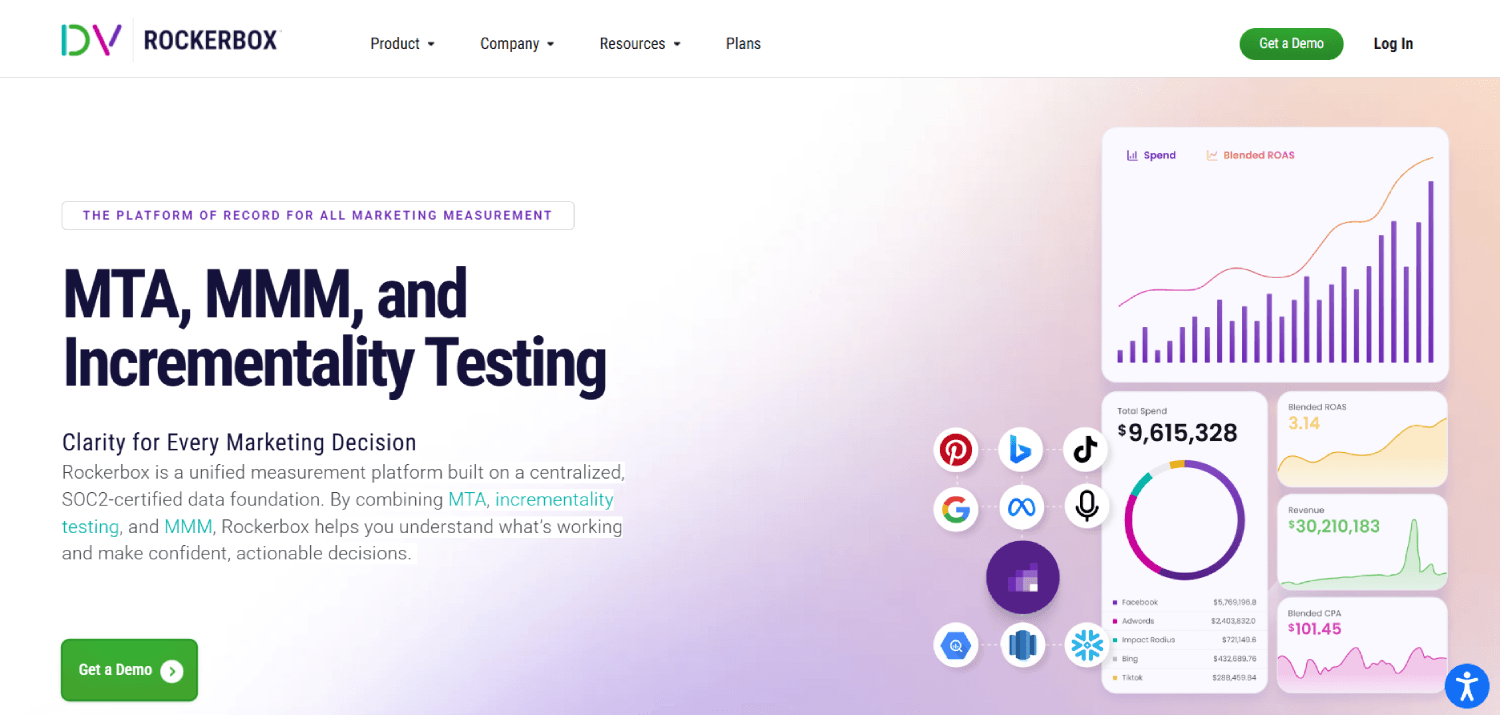
Rockerbox sits at the intersection of multi-touch attribution and media-mix modeling, which is the combination that matters most for brands running spend across both digital and offline channels. Its incrementality module lets teams run geo-holdout tests directly inside the platform without standing up a separate experiment infrastructure. For DTC and omnichannel retail brands, that operational simplicity is the actual selling point, not the model sophistication.
Where Rockerbox loses ground is in B2B use cases. Account-level touchpoint tracking is not its primary design. If your CRM tracks companies and contacts through long evaluation cycles, there are better options further down this list.
Northbeam
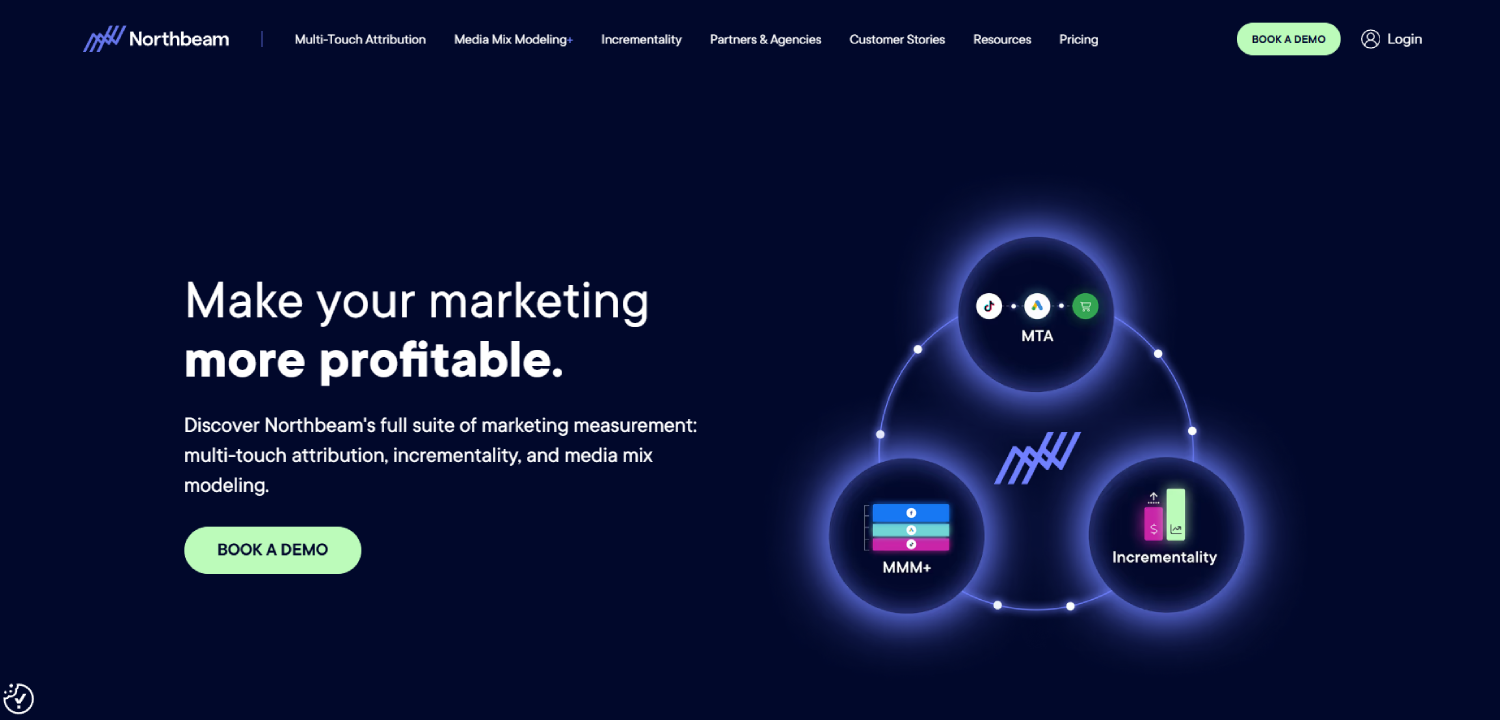
Northbeam is built for high-spend performance marketers who need spend recommendations faster than a traditional media-mix model can produce. It uses a proprietary machine learning layer to ingest spend data and first-party signals, then surfaces channel-level efficiency scores. The pitch is speed: faster feedback loops than weekly MMM outputs.
Pricing is quote-based, and independent buyer reports suggest it skews toward larger DTC brands with meaningful paid spend. Teams spending under $100,000 per month on paid media may find the cost-to-signal ratio harder to justify.
Triple Whale

Triple Whale targets Shopify merchants specifically, and that focus shows. Its pixel deploys in minutes on Shopify stores, its creative analytics dashboard surfaces ad-level performance data that Meta’s native reporting increasingly obscures post-iOS 14, and its pricing starts at approximately $129 per month according to its public pricing page. For a Shopify brand spending $10,000 to $100,000 per month on Meta and Google, it is the fastest time-to-value option on this list.
Outside Shopify, Triple Whale loses most of its advantage. Its connectors exist for other platforms, but the depth of native integration drops off sharply the moment you leave the Shopify environment.
Ruler Analytics
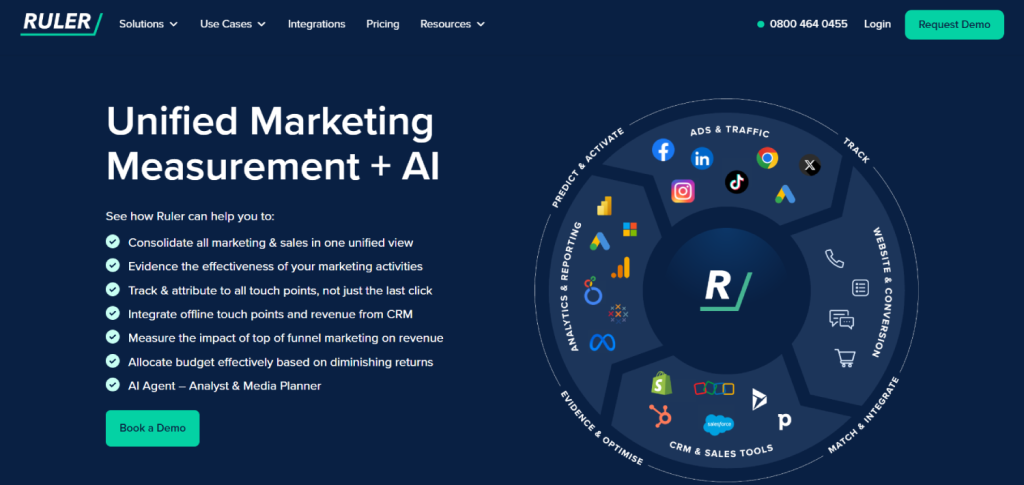
Ruler Analytics occupies a specific and underserved niche: B2B and professional services companies that generate leads through both digital forms and phone calls. Its call-tracking module attributes inbound calls to the marketing touchpoints that drove them, then syncs that revenue data back into Google Analytics and CRM. Most attribution tools force you to buy call tracking separately. Ruler bakes it in, which matters for industries where a significant share of conversions happen over the phone. Pricing starts at $199 per month according to Ruler’s public pricing page.
HockeyStack
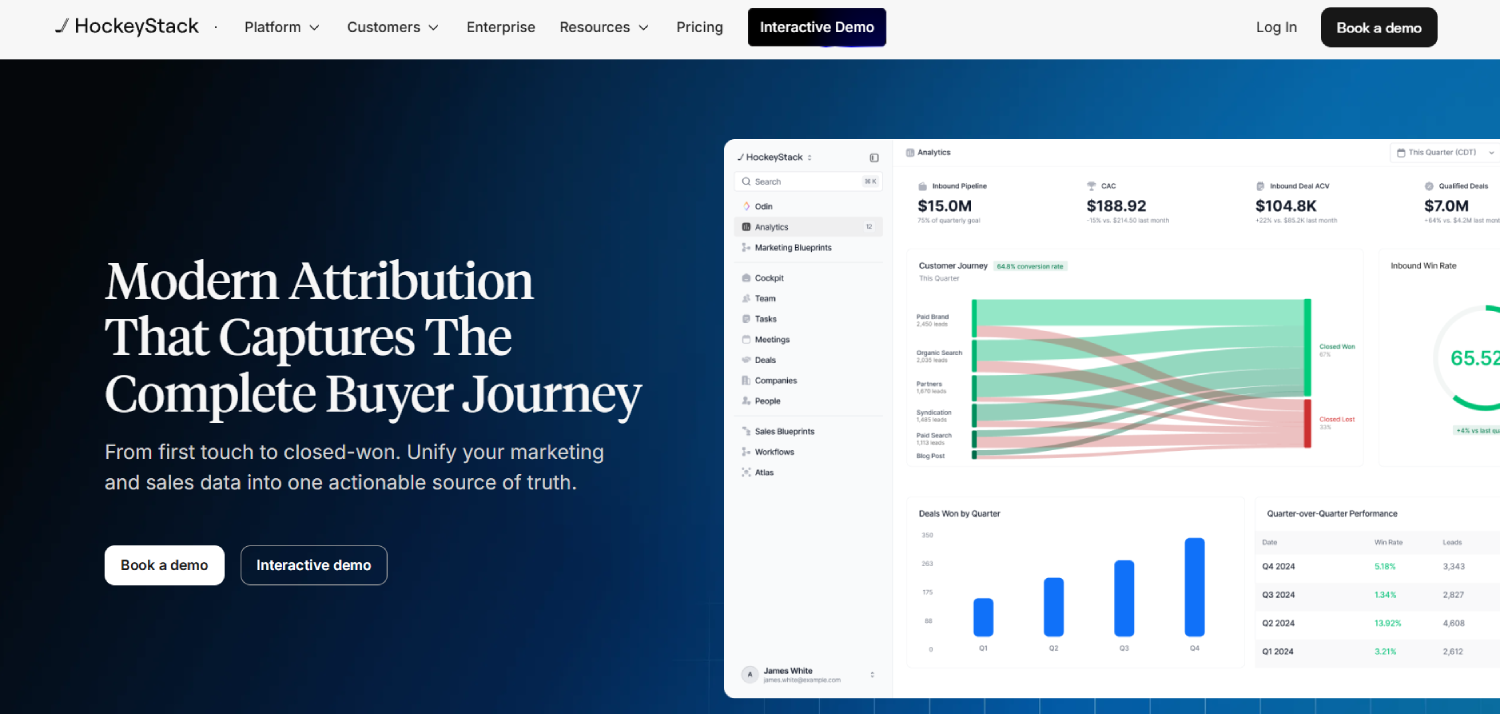
HockeyStack is the strongest B2B attribution tool for teams that want to understand account-level touchpoint sequences without building a data warehouse from scratch. It connects to Salesforce, HubSpot, LinkedIn, G2, and most major ad platforms, then stitches together every touchpoint at the account level so you can see which combination of channels influenced a deal, not just which channel got the last click.
Its LinkedIn Ads integration is deeper than most competitors, surfacing impression-level influence data for contacts within target accounts. For B2B SaaS companies running ABM programs, that matters because LinkedIn influence is systematically underreported in last-click environments. Pricing is quote-based and scales with your data volume and CRM seat count.
Dreamdata
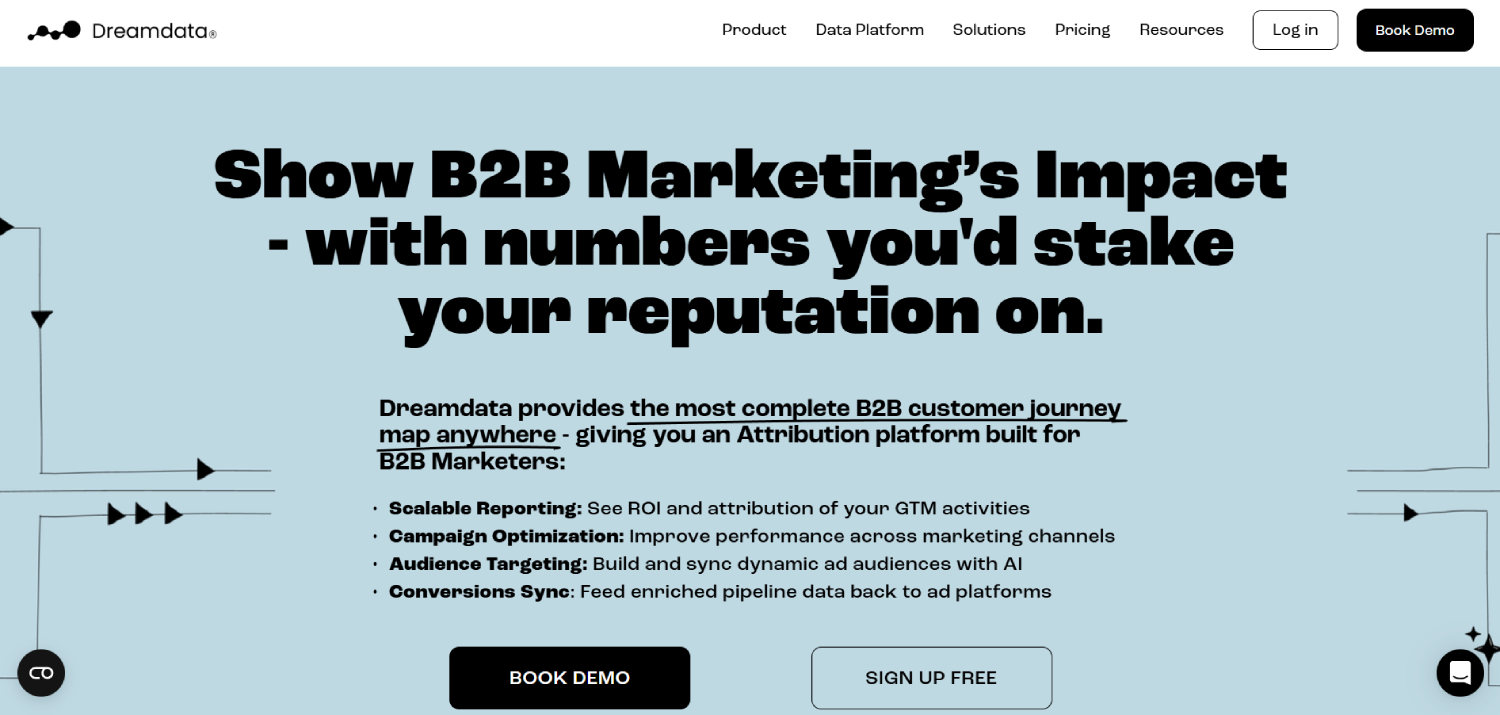
Dreamdata is the warehouse-native option for B2B teams. It ships with a free tier that covers basic multi-touch attribution, and its paid tiers add data-driven modeling, pipeline attribution, and reverse ETL outputs that push attribution data back into your warehouse. For teams that have invested in a modern data stack, Dreamdata fits more cleanly than tools built around proprietary data stores. If your team is already thinking about reverse ETL pipelines to activate warehouse data, Dreamdata is the attribution layer most likely to connect cleanly to that infrastructure.
Its free tier genuinely covers small teams: up to a certain monthly active account volume, you can run first-touch, last-touch, and linear attribution without paying. That makes it the lowest-barrier evaluation option on this list for B2B teams in the early evaluation phase.
Bizible (Adobe Marketo Measure)
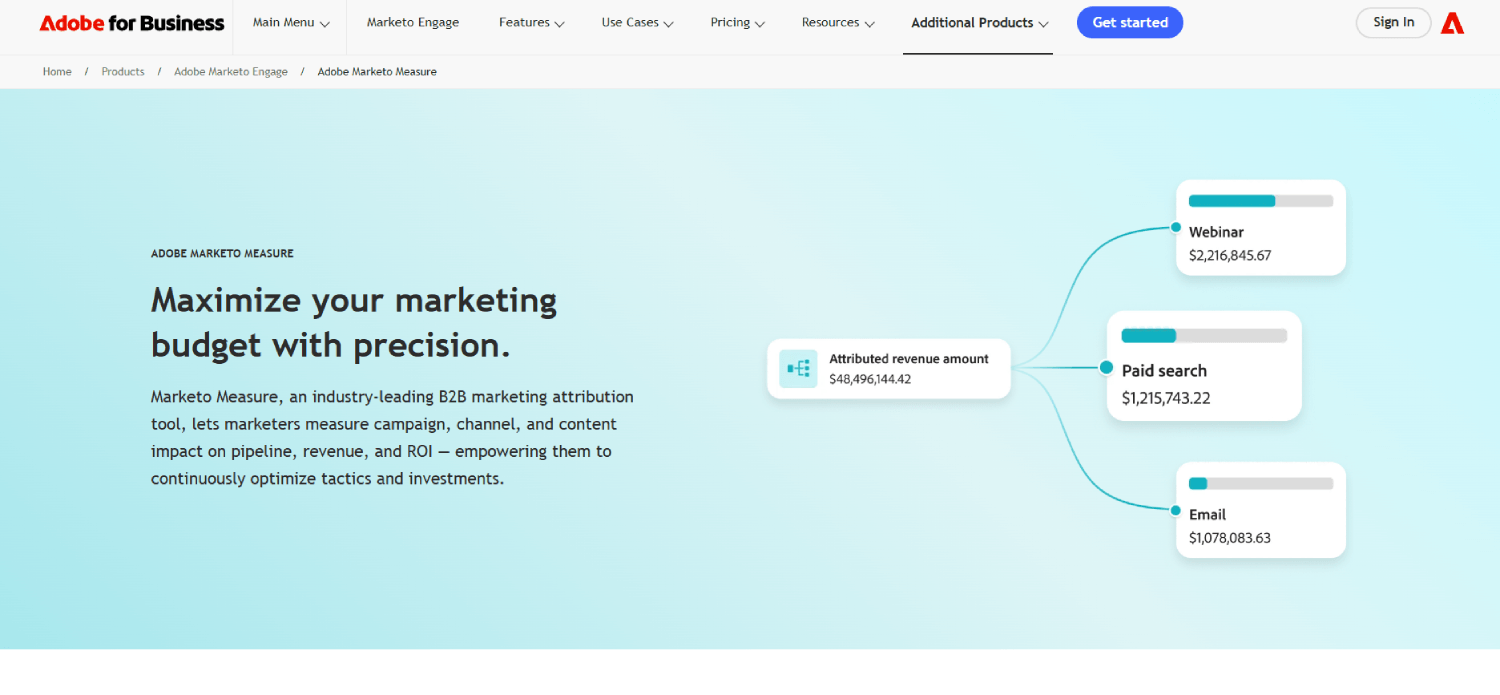
Adobe Marketo Measure, formerly Bizible, is the attribution tool for enterprises already running on Salesforce and Adobe Marketo. It creates native Salesforce objects for attribution touchpoints, meaning attribution data lives inside your CRM rather than in a separate data silo. Revenue teams can report on attributed pipeline, influenced pipeline, and closed-won revenue directly from Salesforce dashboards without exporting anything.
The trade-off is deployment complexity and cost. Bizible requires Salesforce administrator involvement to set up correctly, and pricing is quote-based through Adobe’s sales process, which typically reflects enterprise-scale contracts. It is the right tool for a 500-person company with a dedicated MOps team. It is the wrong tool for a 30-person startup without a Salesforce admin.
Attribution
Attribution (the company, not the concept) emphasizes connector breadth and real-time dashboards. It claims integrations with over 200 data sources, which covers most paid channels, CRMs, and billing platforms. For growth teams that need to get something working across a fragmented stack without extensive data engineering, the broad connector library reduces setup friction.
Its data-driven model requires sufficient conversion volume to be statistically meaningful. Teams with fewer than a few hundred monthly conversions should stick to rule-based models within the platform rather than expecting algorithmic accuracy at low volumes.
Wicked Reports
Wicked Reports is built for direct-response and subscription marketers with long email nurture sequences. Its defining feature is attribution window flexibility: you can set windows up to one year, which matters when a prospect first touches your brand in January and buys in September. Most tools default to 30 or 90-day windows and simply miss that credit entirely. Pricing starts at approximately $250 per month according to its public pricing page, with pricing scaling by contact and revenue volume.
Wicked Reports is not built for enterprise B2B pipeline tracking or account-level attribution. It is a strong fit for course creators, SaaS with long evaluation periods, and subscription e-commerce brands where email is the primary conversion driver.
Measured
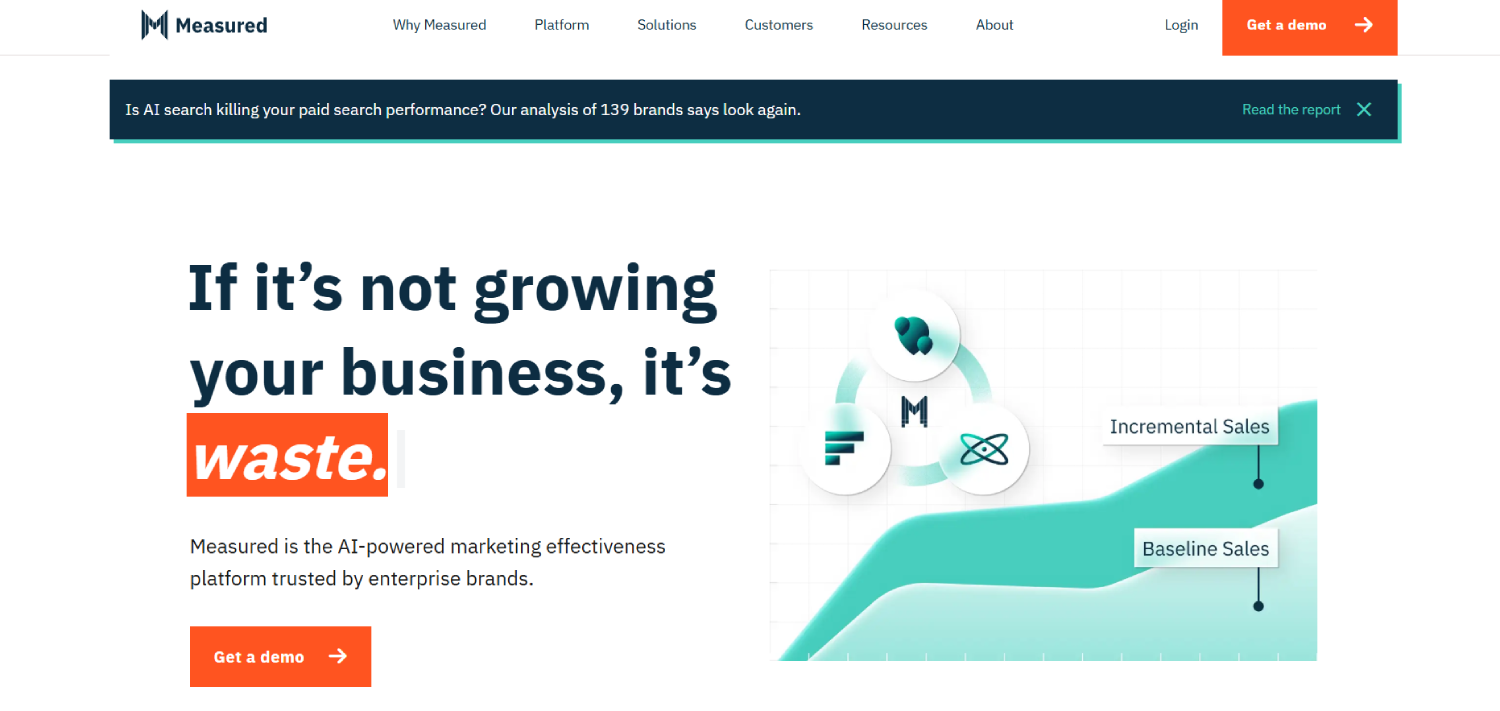
Measured focuses almost entirely on incrementality testing and media-mix modeling, which sets it apart from every other tool on this list. Rather than asking which touchpoint got credit, Measured asks which channels would be missed if they disappeared. It runs geo-holdout experiments natively, compares regional lift against control markets, and produces budget allocation recommendations based on marginal return on ad spend.
This approach is more rigorous than multi-touch attribution for brand and upper-funnel channels, but it requires meaningful spend levels and a team comfortable running controlled experiments. Pricing is quote-based and typically reflects enterprise-level engagements.
Hyros

Hyros serves a specific audience: high-ticket coaching programs, online education, and direct-response funnels with long pre-purchase sequences. Its AI-based tracking layer attempts to reconcile ad platform data with actual sale data by using email-based identity resolution across the funnel, including sales calls and email sequences that occur outside the tracked website.
For mainstream B2B SaaS or DTC e-commerce, Hyros is not the natural fit. Its strength is in funnels where the gap between an ad click and a $5,000 purchase spans weeks of phone calls and email sequences, and where the standard pixel fires on the wrong event entirely.
How Does B2B Attribution Differ From DTC Attribution?
The structural difference is that B2B sells to accounts with multiple stakeholders over months, while DTC sells to individuals over days. That difference breaks most DTC-calibrated attribution tools when applied to B2B.
In B2B, a single deal might involve a champion who clicked your LinkedIn ad, a CFO who read your G2 reviews, and a procurement team member who downloaded your security documentation. A pixel-based multi-touch model that tracks individual sessions will assign credit to one or two of those touchpoints and miss the rest. Account-level attribution tools like HockeyStack and Dreamdata group all of those sessions under a single account and map the full sequence of touches.
B2B attribution also requires CRM integration at the opportunity level, not just the lead level. Tracking to MQL-to-SQL conversion is measuring activity. Tracking to closed-won deal value is measuring revenue. The distinction sounds obvious, but a large share of B2B marketing teams are still reporting on marketing-sourced leads rather than marketing-influenced revenue, which means they are optimizing for a metric that does not directly correlate to business outcomes.
Four Capabilities That Separate Useful Attribution Tools From Interesting Dashboards
Four capabilities separate attribution tools that produce defensible budget decisions from those that produce interesting dashboards.
First, closed-loop revenue data. The tool must ingest actual deal value and close date from your CRM, not just form fills or pipeline stages. Without that, every recommendation is optimizing for a proxy metric.
Second, cross-device and cross-session identity resolution. A buyer who reads your blog on mobile, watches a webinar on desktop, and converts via a sales email must be recognized as one person. Tools that rely solely on cookie-based tracking will fragment that path into three unrelated sessions and misattribute the conversion.
Third, offline and dark-social coverage. Branded search, direct traffic, and referrals from LinkedIn or Slack communities often represent influenced demand that never shows a trackable referral source. The tool should have a framework for handling this, whether through view-through attribution, probabilistic modeling, or explicit dark-social capture (UTM disciplines plus direct-traffic analysis).
Fourth, model transparency. You should be able to see why the model is giving credit where it does. Black-box outputs that say “paid social contributed 34% of revenue” without showing the underlying logic are hard to defend to a CFO or a board and hard to act on when results are surprising.
How Does Marketing Attribution Connect to CDPs and Data Warehouses?
Attribution tools need event data, identity data, and revenue data. CDPs and warehouses are where much of that data already lives, which is why the most technically mature attribution setups treat attribution as a layer that reads from the warehouse rather than a standalone data collector.
Dreamdata’s warehouse-native architecture is the clearest example of this pattern on this list. Its approach mirrors how modern data teams think about analytics: the warehouse is the source of truth, and every tool reads from it rather than maintaining its own copy of customer data. Teams already running Snowflake or BigQuery with event data will find this model significantly easier to trust and audit. For teams evaluating the broader question of how to unify customer data before attribution, reviewing B2B customer data platforms alongside attribution tools is worth doing in parallel, because the two decisions are increasingly intertwined.
Frequently Asked Questions About Marketing Attribution Software
What is marketing attribution software?
Marketing attribution software assigns credit for conversions or revenue to the marketing touchpoints that contributed to them. It tracks interactions across channels (paid search, paid social, email, organic, events, offline), applies a mathematical model to determine contribution weight, and reports on which channels and campaigns are producing revenue. The goal is to move budget decisions from gut feel to evidence, with the quality of that evidence determined by data completeness and model choice.
What is the difference between multi-touch attribution and media-mix modeling?
Multi-touch attribution (MTA) tracks individual user paths at the session or event level and assigns fractional credit to each touchpoint. Media-mix modeling (MMM) uses aggregate spend and revenue data over time to statistically isolate the contribution of each channel without needing individual-level tracking. MTA gives more granular, real-time insights but breaks down when tracking is incomplete. MMM is more privacy-resilient and better for upper-funnel channels but requires months of historical data to be accurate. The best attribution setups use both in combination.
How much does marketing attribution software cost?
Pricing varies widely. Triple Whale’s entry plan starts around $129 per month according to its public pricing page; Ruler Analytics starts at $199 per month; Wicked Reports starts at $250 per month. Enterprise-grade tools like Rockerbox, Northbeam, HockeyStack, Bizible (Adobe Marketo Measure), and Measured are quote-based, with contracts that typically scale based on data volume, ad spend tracked, or CRM seat count. Dreamdata offers a genuine free tier for small B2B teams. Budget significantly more for enterprise platforms with MMM and incrementality testing built in.
Can attribution software work without cookies?
Yes, but the approach changes. Server-side tracking, first-party data collection, probabilistic identity matching, and media-mix modeling all operate without relying on third-party cookies. Tools like HockeyStack and Dreamdata use first-party event tracking and CRM data rather than third-party cookie graphs. Measured and Northbeam use aggregate and MMM approaches that are inherently privacy-compliant. The shift away from third-party cookies is an argument for choosing tools with strong first-party data architectures, not an argument against attribution software entirely.
Is last-click attribution still worth using?
Last-click is worth using as a baseline and nothing more. It will systematically undervalue brand channels, content marketing, SEO, and any channel that drives awareness earlier in the funnel. It will systematically overvalue retargeting and branded search, because those touchpoints appear at the end of paths that other channels created. In a budget allocation context, acting on last-click data alone will shrink your top-of-funnel investment over time in ways that hurt pipeline 6 to 12 months later.
What attribution tool is best for a B2B SaaS company?
HockeyStack is the strongest choice for most B2B SaaS companies needing account-level attribution with ABM capabilities. Dreamdata is the better choice for teams with a mature data warehouse who want warehouse-native attribution. Bizible (Adobe Marketo Measure) is the right choice for enterprise teams already running Salesforce and Adobe Marketo who want attribution data to live inside native CRM objects. All three outperform DTC-oriented tools for long-cycle, multi-stakeholder B2B sales.
How do I know if my attribution data is trustworthy?
Start with a data-completeness audit before trusting any model output. Check what percentage of your conversions have complete touchpoint histories recorded, how many sessions are appearing as direct or unattributed traffic (a proxy for broken UTM tagging), whether closed-won deal values from your CRM match the revenue figures in the attribution tool, and whether cross-device paths are being stitched correctly. Attribution tools built on incomplete data produce precise-looking numbers that are directionally unreliable. The plumbing must be correct before the model matters.
Should attribution software replace gut feel entirely?
No, but it should constrain and challenge gut feel with evidence. Attribution data is strongest for high-volume, directly trackable channels like paid search and email. It is weakest for channels where signal is inherently incomplete: word of mouth, executive brand, community, and analyst coverage. Experienced marketers treat attribution output as one input into budget decisions, weighted more heavily for direct-response channels and less heavily for brand channels where incrementality testing produces more reliable answers.
Which Attribution Tools Are Worth Your Time?
The companies that get the most from attribution software share a common trait: they invest in data infrastructure before they invest in attribution models. A sophisticated algorithmic model running on top of incomplete event data produces worse decisions than a simple rule-based model running on clean, validated data. The Revenue Signal Audit described earlier is the most important thing you can do before any tool evaluation, not because it will identify the perfect tool, but because it will tell you how much of your attribution problem is a data problem versus a modeling problem.
For teams whose primary challenge is measuring paid media efficiency across Meta, Google, and TikTok on a Shopify storefront, Triple Whale at entry-level pricing or Northbeam at scale are the pragmatic answers. For B2B teams trying to connect LinkedIn impressions and webinar attendance to pipeline and closed-won revenue, HockeyStack and Dreamdata are meaningfully better than anything built for e-commerce. For orgs inside the Salesforce and Adobe stack, the switching cost of building attribution outside Bizible rarely justifies itself. As AI-generated content and new discovery surfaces reshape how buyers find vendors, attribution is also converging with AI visibility tracking tools that measure brand presence in ChatGPT and Perplexity, which represents the next frontier attribution vendors will need to address.
Attribution is not a solved problem, and anyone who tells you otherwise is selling you certainty that the data cannot support. What these eleven tools offer is something more defensible than gut feel and more practical than waiting for perfect data: a structured, auditable read on where your marketing budget is producing returns, with enough transparency to explain the logic to a skeptical CFO. That is worth the investment.