- Appcues and Pendo both build in-app experiences, but Pendo ships with a native product analytics layer that Appcues does not match out of the box.
- Appcues deploys faster and costs less at the entry tier, making it the practical choice for lean teams that need onboarding flows live in days, not weeks.
- Pendo’s depth comes at a price: the full platform, including analytics, NPS, and session replay, is quote-based and typically lands in enterprise budget territory.
- If your team already has a product analytics tool like Mixpanel or Amplitude, paying for Pendo’s bundled analytics is redundant spend.
- The fit decision comes down to one question: do you need a digital adoption platform (DAP) with analytics baked in, or do you need the best standalone onboarding layer?
Appcues is the faster, lighter digital adoption platform for SaaS teams that want onboarding flows and tooltips without a heavy implementation lift. Pendo is the stronger choice when you need in-app engagement plus product analytics in a single platform, particularly at enterprise scale. Teams already running Mixpanel or Amplitude will likely find Pendo’s analytics redundant. Teams without a dedicated analytics stack will get more from Pendo’s all-in-one approach.
Why Most Appcues vs Pendo Comparisons Miss the Point
Both tools put modals, tooltips, checklists, and banners inside your product. Both let non-engineers build those experiences without touching code. Comparing them feature by feature usually ends in a tie on paper, which is why most buyers walk away confused.
The real difference is architectural. Pendo was built from the analytics layer outward. Its behavioral data collection, funnel analysis, and feature adoption tracking are not bolt-ons; they are the foundation the engagement layer sits on. Appcues was built from the experience layer inward. It is purpose-built for creating onboarding flows and in-app messaging, and it relies on your existing analytics stack to close the measurement loop.
That distinction matters more than any individual feature comparison. It determines how much your team already needs to own in your data stack, and how much overlap you can tolerate paying for twice.
What Does Each Platform Actually Do in Practice?
Appcues: fast deployment, focused scope
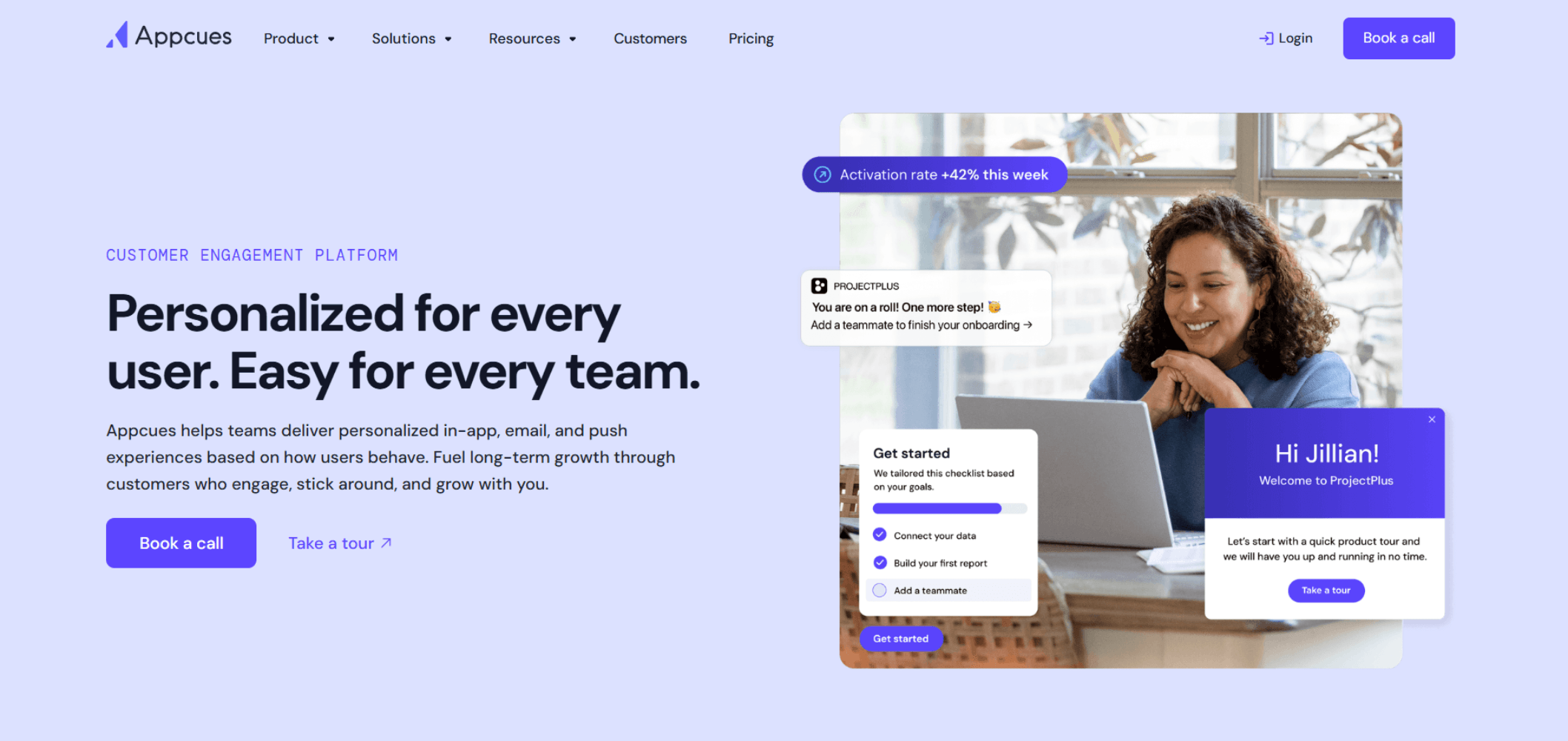
Appcues is a digital adoption platform centered on in-app experience creation. Its core capabilities are a no-code builder for product tours, checklists, tooltips, modals, and slideouts; audience targeting based on user properties and events; and A/B testing of onboarding flows. The builder is genuinely fast to learn. A product manager or customer success lead can build and publish a flow without an engineering sprint.
Appcues integrates with Segment, Heap, Mixpanel, Amplitude, and most CRMs through native connectors or webhooks. That means it reads user data from your existing warehouse or analytics tool to drive targeting, rather than collecting that data itself. For teams with a working analytics stack, this is a strength. For teams without one, it is a gap.
According to Appcues’s public pricing page, plans start at $249 per month for up to 2,500 monthly active users (billed annually), covering up to three users on the platform. The Growth plan at $879 per month raises the MAU limit and adds A/B testing and advanced targeting. The Enterprise tier is quote-based.
Pendo: analytics-first, engagement second
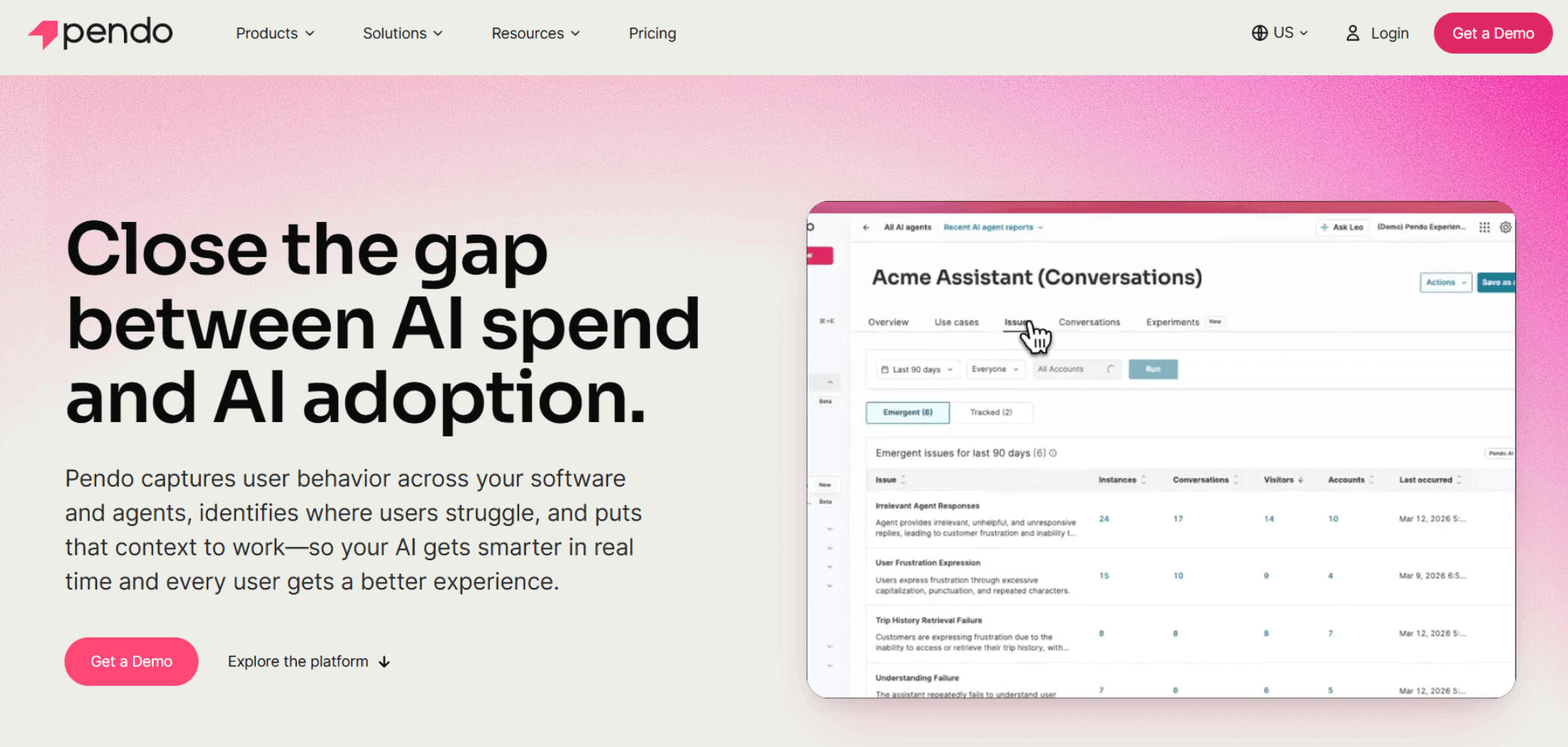
Pendo installs a JavaScript snippet that begins passively recording every click, page view, and feature interaction before you configure a single guide. That auto-captured behavioral data powers Pendo’s analytics dashboards, funnel reports, and feature adoption metrics. The in-app guides, NPS surveys, and resource centers sit on top of that data layer, which means every experience you create can be directly tied to adoption metrics in the same platform.
Pendo also includes Session Replay (available on higher tiers), a product roadmap module called Pendo Roadmap, and Pendo AI, which surfaces adoption insights and drafts guide content. The depth here is substantial. For a product team that wants to understand exactly where users drop out of an onboarding checklist and then immediately test a fix without switching tools, Pendo delivers that loop natively.
Pendo’s pricing is almost entirely quote-based beyond a free tier limited to 500 monthly active users with restricted features. According to Pendo’s public pricing page, paid plans are custom-priced based on MAUs and modules selected. Buyers on G2 and Capterra frequently describe mid-market contracts running into five-figure annual territory, though Pendo does not confirm specific figures publicly.
Appcues vs Pendo: Side-by-Side Feature Comparison
| Capability | Appcues | Pendo |
|---|---|---|
| No-code flow builder | Yes, Chrome extension + visual editor | Yes, visual editor |
| Product tours and walkthroughs | Yes | Yes |
| Tooltips and hotspots | Yes | Yes |
| Onboarding checklists | Yes | Yes |
| In-app NPS and surveys | Yes (Growth and above) | Yes (native) |
| Native product analytics | No (integrates with third-party tools) | Yes (core feature) |
| Auto-capture behavioral data | No | Yes |
| Feature adoption tracking | Via integrations | Native |
| A/B testing of flows | Yes (Growth and above) | Yes |
| Session replay | No | Yes (higher tiers) |
| Resource center / in-app help | Yes | Yes |
| Mobile (iOS/Android) | Yes | Yes |
| Roadmap module | No | Yes (Pendo Roadmap) |
| AI-assisted content creation | Limited | Yes (Pendo AI) |
| Free tier | 14-day trial | Yes (500 MAUs, limited) |
| Entry-level public pricing | $249/month | Quote-based above free tier |
How Do Appcues and Pendo Handle Pricing for Growing Teams?
Appcues’s pricing structure is transparent and MAU-based, which makes budget planning straightforward for growing SaaS products. At $249 per month for 2,500 MAUs, it is accessible for early-stage teams. The Growth plan at $879 per month adds A/B testing and more advanced segmentation, which most serious onboarding programs will need.
Pendo’s pricing opacity is a consistent friction point in buying processes. The free tier is genuinely useful for early validation, but any team that outgrows 500 MAUs enters negotiation territory with no published anchor. For teams evaluating both tools against a fixed budget, Pendo requires a sales call where Appcues lets you begin a trial without one.
That said, comparing them purely on sticker price ignores the consolidation argument. A team paying separately for Appcues at $879 per month, plus Mixpanel or Amplitude for analytics, plus a separate NPS tool, may find Pendo’s all-in contract competitive on total cost of ownership. The math depends on which modules you actually use, not which ones are included.
The DAP Stack-Fit Test: Four Checks Before You Buy
Most buying decisions in this category go wrong because teams evaluate the tool in isolation rather than against their existing stack. The AboutMartech DAP Stack-Fit Test is a four-check framework designed to surface the right answer before you enter a sales process.
Check 1: Do you already own a product analytics tool? If Mixpanel, Amplitude, Heap, or a warehouse-based analytics layer is already instrumented and trusted, Pendo’s analytics layer is duplication. Appcues’s integration-first design fits better here. For context on how these analytics tools compare, see the Mixpanel vs Amplitude breakdown published on AboutMartech.
Check 2: Who builds and maintains your flows? If the answer is a product manager or CSM without engineering support, both tools work, but Appcues has a shallower learning curve and a faster time-to-first-flow. Pendo’s analytics configuration, particularly setting up tagged features and funnels, takes more initial setup.
Check 3: What is your MAU trajectory over 24 months? Appcues’s published pricing scales in MAU tiers, and costs climb predictably. Pendo’s custom pricing can become advantageous at enterprise scale when multiple modules are bundled. If you are heading past 50,000 MAUs, the Pendo conversation is worth having.
Check 4: Do you need roadmap or feedback tooling? Pendo Roadmap and its feedback collection modules serve product teams that want to connect user behavior to backlog prioritization. Appcues does not have an equivalent. If your product team is your primary buyer, that gap matters.
Where Does Each Tool Fall Short?
Appcues limitations
Appcues has no native analytics. You cannot open Appcues and answer “what percentage of users who saw this flow activated the core feature within 7 days” without pulling that data from your connected analytics tool. For teams with a mature stack, that is fine. For teams still assembling their data infrastructure, it creates a dependency they may not be ready for.
Appcues also does not offer session replay, so debugging why a flow underperforms requires going to a separate tool. The lack of an AI-assisted guide builder is increasingly noticeable as Pendo and newer competitors ship AI drafting features. If you are evaluating alternatives beyond these two, the best Appcues alternatives comparison covers eight tools with different positioning across the DAP category.
Pendo limitations
Pendo’s guide builder, while functional, is not as fast or intuitive as Appcues’s. Teams coming from Appcues frequently note the builder feels heavier. The pricing opacity creates real friction in budget cycles; a product team that needs to get approval for a number cannot get one without a sales engagement.
Pendo’s auto-capture approach also generates noise. Every click is recorded, which means analytics configurations require deliberate cleanup and tagging to be useful. Teams without a dedicated product operations or analytics owner can end up with data they do not know how to interpret. The platform’s breadth is both its strength and its complexity cost.
A Worked Scenario: Which Tool Fits a 20-Person SaaS Team at Series A?
Note: The following scenario is illustrative and based on a specific combination of stack choices and team structure. It is not representative of all Series A companies, which vary widely in analytics maturity, budget, and product complexity.
Consider a B2B SaaS company at Series A with 8,000 MAUs, a two-person customer success team, and Segment already running in the stack feeding data to Amplitude. They want to reduce time-to-value for new customers by deploying a guided onboarding checklist and a feature announcement modal for an upcoming release.
In this scenario, Appcues is the clear fit. Amplitude handles behavioral analytics. Segment handles identity and event plumbing. Appcues slots in as the experience layer, pulling user properties from Segment to target the right cohorts, and pushing completion events back to Amplitude for measurement. The CS team can build and iterate on flows without engineering involvement. Total additional spend: $249 to $879 per month depending on A/B testing needs.
Now change one variable: the same team has no analytics stack and is starting from scratch. Pendo becomes more competitive. Deploying one snippet gives them auto-captured behavioral data, funnel visibility, and in-app guides in a single contract. The tradeoff is higher cost, a longer setup, and a sales process instead of a credit card checkout. For teams that want to understand the broader onboarding infrastructure picture, the best customer onboarding tools comparison covers the category beyond DAPs.
How Do Appcues and Pendo Compare to the Broader DAP Market?
Appcues and Pendo are the two most commonly evaluated DAPs for SaaS companies, but they are not the only options. Chameleon, UserGuiding, Intercom’s Product Tours, and WalkMe all compete in overlapping segments. WalkMe sits squarely in the enterprise tier, often evaluated alongside Pendo at large organizations. Chameleon competes more directly with Appcues on price and builder simplicity. For a broader view of the category, the best digital adoption platforms for SaaS onboarding teams covers seven tools with distinct use-case positioning.
Pendo also competes with product analytics tools directly. At companies where the product team evaluates Pendo, the analytics vendors typically in the conversation are Amplitude, Mixpanel, and FullStory. Pendo’s argument in those deals is consolidation. Whether that argument holds depends on the depth of analytics work the team actually does.
What Do Real Buyers Say About Appcues vs Pendo?
On G2 and Capterra, Appcues consistently receives high marks for ease of use and speed of implementation. Buyers frequently cite the visual builder as a differentiator and note that flows can go live within a day of installation. Criticism tends to cluster around limited native analytics and price increases at higher MAU tiers.
Pendo reviews reflect the platform’s complexity. Teams that invest in setup report strong satisfaction with the unified view of adoption and engagement. Teams that underestimated the configuration effort often describe an implementation that ran longer and cost more in internal time than expected. NPS and survey feedback tools within Pendo draw consistently positive reviews as a standalone feature. Neither vendor’s G2 rating is publicly disclosed in available data, so treat directional feedback as signal rather than score.
Verdict: Which Tool Should You Actually Buy?
| Your situation | Best fit |
|---|---|
| You have Segment + Amplitude/Mixpanel already instrumented | Appcues |
| You need onboarding flows live in under a week | Appcues |
| Budget is under $1,000/month | Appcues |
| No product analytics stack in place | Pendo |
| You want analytics, NPS, and guides in one contract | Pendo |
| Enterprise with 50,000+ MAUs and a product ops function | Pendo |
| Product team needs roadmap and user feedback tooling | Pendo |
| CS team building flows without engineering support | Appcues |
Appcues is the right buy for the majority of growth-stage SaaS teams that already have analytics instrumented and want a focused, fast-to-deploy onboarding layer. It does one job well, integrates cleanly with the tools most teams already run, and does not require a sales negotiation to begin.
Pendo is the right buy when you need a single platform to answer both “what are users doing” and “how do we respond to that in-app,” and when you have the internal bandwidth to configure and maintain a more complex system. The all-in approach pays off most clearly when the alternative is buying and integrating three separate tools.
Teams with a customer success or revenue operations function managing product adoption alongside account health should also consider how these tools connect to the broader CS stack. The best customer success platforms for B2B SaaS covers that layer in detail, including how DAP data flows into health scoring and renewal workflows.
Frequently Asked Questions
Is Appcues or Pendo easier to set up?
Appcues is faster to deploy. Teams routinely report publishing their first flow within one to two days of installing the JavaScript snippet. Pendo’s setup takes longer because configuring auto-captured data into meaningful analytics requires tagging features and setting up funnels before the platform delivers value. For teams without a dedicated product operations function, Appcues’s lighter configuration is a real advantage.
Does Pendo include product analytics, or is that a separate add-on?
Pendo includes product analytics as a core part of its platform, not an add-on. Auto-captured behavioral data, funnel analysis, and feature adoption dashboards are available on paid plans. Session Replay and some advanced modules appear on higher tiers. This bundled analytics layer is Pendo’s primary differentiator from Appcues, which does not collect behavioral data natively and relies on integrations with third-party analytics tools.
Can Appcues integrate with Amplitude or Mixpanel?
Yes. Appcues offers native integrations with Segment, Amplitude, Mixpanel, Heap, and several CRMs including HubSpot and Salesforce. User properties and events flow into Appcues for targeting, and flow completion events can be pushed back to your analytics tool for measurement. This integration model works well for teams that have already instrumented their analytics stack and want Appcues to act as the experience layer on top of it.
How much does Pendo cost for a company with 10,000 MAUs?
Pendo does not publish pricing for paid tiers beyond its free plan, which is limited to 500 MAUs. Pricing is negotiated based on MAU volume, modules selected (guides, analytics, NPS, Session Replay, Roadmap), and contract length. Teams should expect a sales process and custom quote. Buyers on G2 and Capterra frequently describe mid-market contracts running into five-figure annual territory, though Pendo does not confirm specific figures publicly.
What is the difference between Appcues and Chameleon?
Appcues and Chameleon are both in-app experience tools without native analytics, and they compete closely at the growth-stage tier. Chameleon tends to offer more flexible styling customization and a more granular targeting engine, while Appcues has a larger set of integrations and a more established customer base. Both are alternatives to Pendo for teams that already have a product analytics tool. The best Appcues alternatives comparison includes Chameleon alongside seven other tools.
Is Pendo worth it for a small SaaS startup?
Pendo’s free tier supports up to 500 MAUs with limited features and is useful for early validation. Beyond that, Pendo’s custom pricing and implementation complexity make it a harder fit for teams under roughly 5,000 MAUs or without a dedicated product operations function. Early-stage teams with fewer than 10,000 MAUs and tight budgets typically find Appcues, Chameleon, or UserGuiding more cost-effective and faster to produce results.
Do Appcues and Pendo both support mobile apps?
Both platforms support mobile. Appcues offers iOS and Android SDKs for building in-app experiences in native mobile applications. Pendo also provides mobile SDKs for iOS and Android, with the added benefit of auto-capturing mobile behavioral data the same way it does on web. For products with significant mobile user bases, Pendo’s unified web and mobile analytics in a single dashboard is a meaningful advantage over Appcues’s approach of relying on external analytics for mobile behavior.
What should I use instead of Pendo if the price is too high?
Appcues is the most direct alternative at a lower price point for teams that primarily need in-app guides and onboarding flows. Chameleon and UserGuiding both offer similar experience-building capabilities with transparent pricing. For teams that specifically need the analytics layer Pendo provides but cannot justify the cost, Amplitude or Mixpanel on their own tiers, combined with Appcues for guides, often delivers comparable coverage at a lower combined spend. The digital adoption platform comparison covers the full range of options across price points.