- A CRM tracks contacts and deals. Customer success software tracks health, engagement signals, renewal risk, and playbook execution across your entire account base simultaneously.
- Gainsight owns the enterprise end. ChurnZero and Planhat are the strongest mid-market options. Vitally and Catalyst are built specifically for product-led or lean CS teams.
- The biggest procurement mistake is buying a platform sized for your current headcount rather than your churn problem. The two are not the same calculation.
- Most B2B SaaS teams should evaluate at least three platforms against the AboutMartech CS Stack-Fit criteria before signing a contract.
- Pricing at the enterprise tier is uniformly quote-based. At the SMB and mid-market tier, expect a per-seat or per-customer model, with costs that vary widely by data volume.
The best customer success software for most B2B SaaS companies is either ChurnZero or Planhat at the mid-market, and Gainsight at the enterprise. Smaller or product-led teams will find Vitally or Catalyst more cost-effective. The right choice depends on CSM headcount, data infrastructure, and whether churn is primarily a relationship problem or a product adoption problem.
Why a CRM Is Not Enough to Prevent Churn at Scale
CRMs were designed to move deals forward. Customer success management software is designed to catch accounts that are quietly moving backward. Those two jobs share almost no logic in common.
A CRM stores contact records, logs activity, and tracks pipeline. What it cannot do natively is aggregate product usage telemetry, calculate a health score from six weighted signals, fire a playbook when that score drops below a threshold, and surface the at-risk account to a CSM before the QBR request never comes. That sequence is the core operational loop of a CS platform, and it runs continuously across every account in your book of business without manual input.
Consider a SaaS team managing 400 mid-market accounts with four CSMs. Each CSM theoretically owns 100 accounts. In Salesforce or HubSpot, those accounts exist as records. There is no native mechanism to rank them by renewal risk this week versus last week, or to flag that Account X dropped its daily active users by 40% over the past 14 days. A dedicated CS platform does exactly that, automatically. The CRM-plus-spreadsheet approach works at 40 accounts. At 400, it is a liability.
The AboutMartech CS Stack-Fit Test: How to Evaluate These Platforms Before You Buy
Most CS platform evaluations start with a feature checklist and end with a demo that looks identical across vendors. The following four-part framework cuts through that noise.
Signal coverage: Does the platform ingest the data sources that actually reflect health for your product? This means CRM data, product usage via event tracking or a warehouse connection, support ticket volume, email engagement, and NPS. Platforms that require only CSV imports will lag reality by days or weeks.
Playbook depth: Can CSMs build branching workflows that trigger based on health score changes, contract dates, and behavioral signals without engineering support? Some platforms offer this natively. Others require workarounds that erode adoption.
CSM usability: The platform only works if your CSMs open it daily. Tools with cluttered interfaces or steep learning curves get abandoned in favor of email. Ask vendors for CSM activation rates among their customers, not just NPS scores.
Commercial model fit: Per-seat pricing favors lean teams. Per-customer pricing favors large CS orgs with many accounts per CSM. Per-revenue pricing (common at the enterprise tier) can become expensive fast as ARR grows. Map the pricing model against your three-year plan before signing.
The 13 Best Customer Success Platforms, Ranked
1. Gainsight
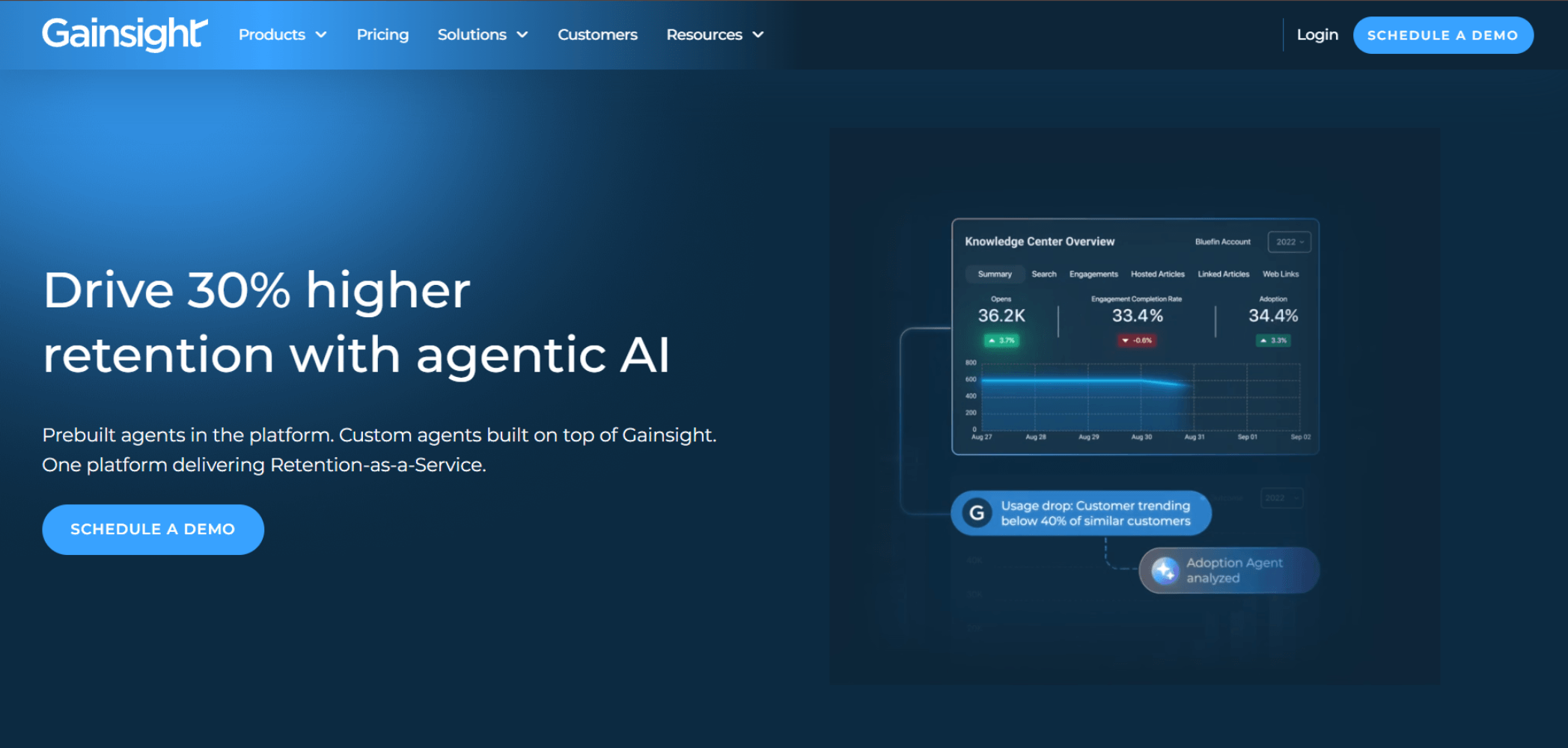
Gainsight is the category-defining platform for enterprise B2B SaaS. It handles the full CS lifecycle: health scoring, automated playbooks, renewal management, executive business reviews, and product experience through its separate Gainsight PX module. No other platform matches its configurability at scale.
The trade-off is implementation complexity. Most enterprise deployments require a dedicated admin or a third-party implementation partner, and the time-to-value window is measured in months, not weeks. Pricing is quote-based and generally positions Gainsight above mid-market budgets. Best for: CS orgs with 10+ CSMs, complex multi-product accounts, and an operations resource to maintain the instance.
2. ChurnZero
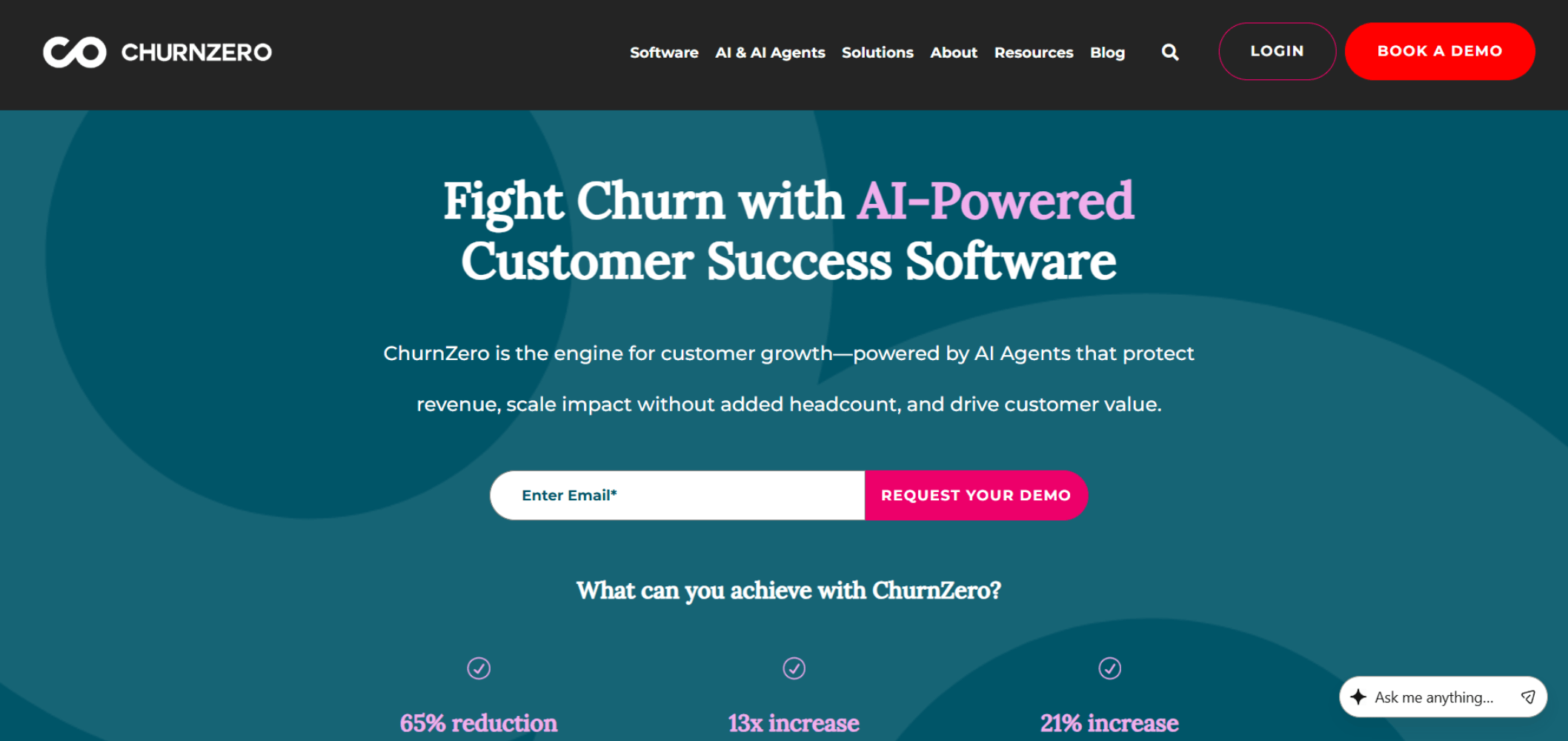
ChurnZero is the strongest mid-market option in the category. It combines real-time health scoring, in-app communication, automated plays, and a revenue intelligence layer that surfaces expansion and churn risk simultaneously. The interface is notably cleaner than Gainsight, which drives faster CSM adoption.
ChurnZero has invested heavily in its AI layer, including a feature called ChurnZero AI that generates account summaries and suggests next-best actions. Pricing is quote-based. Best for: B2B SaaS companies with 50-500 employees, a dedicated CS team, and a mix of high-touch and scaled accounts.
3. Planhat
Planhat is the most commercially flexible platform on this list. It offers three pricing tiers based on data volume and seats, with a flat-fee model that makes budget forecasting straightforward compared to most competitors. The platform covers health scoring, playbooks, pipeline management, and customer portals.
Planhat’s data model is worth examining closely. It handles hierarchical account structures well, which matters for companies selling to enterprise customers with multiple subsidiaries. According to Planhat’s public pricing page, tiers are available starting at a flat monthly rate with volume-based scaling. Best for: mid-market teams that need pricing predictability and clean account hierarchy management.
4. Vitally
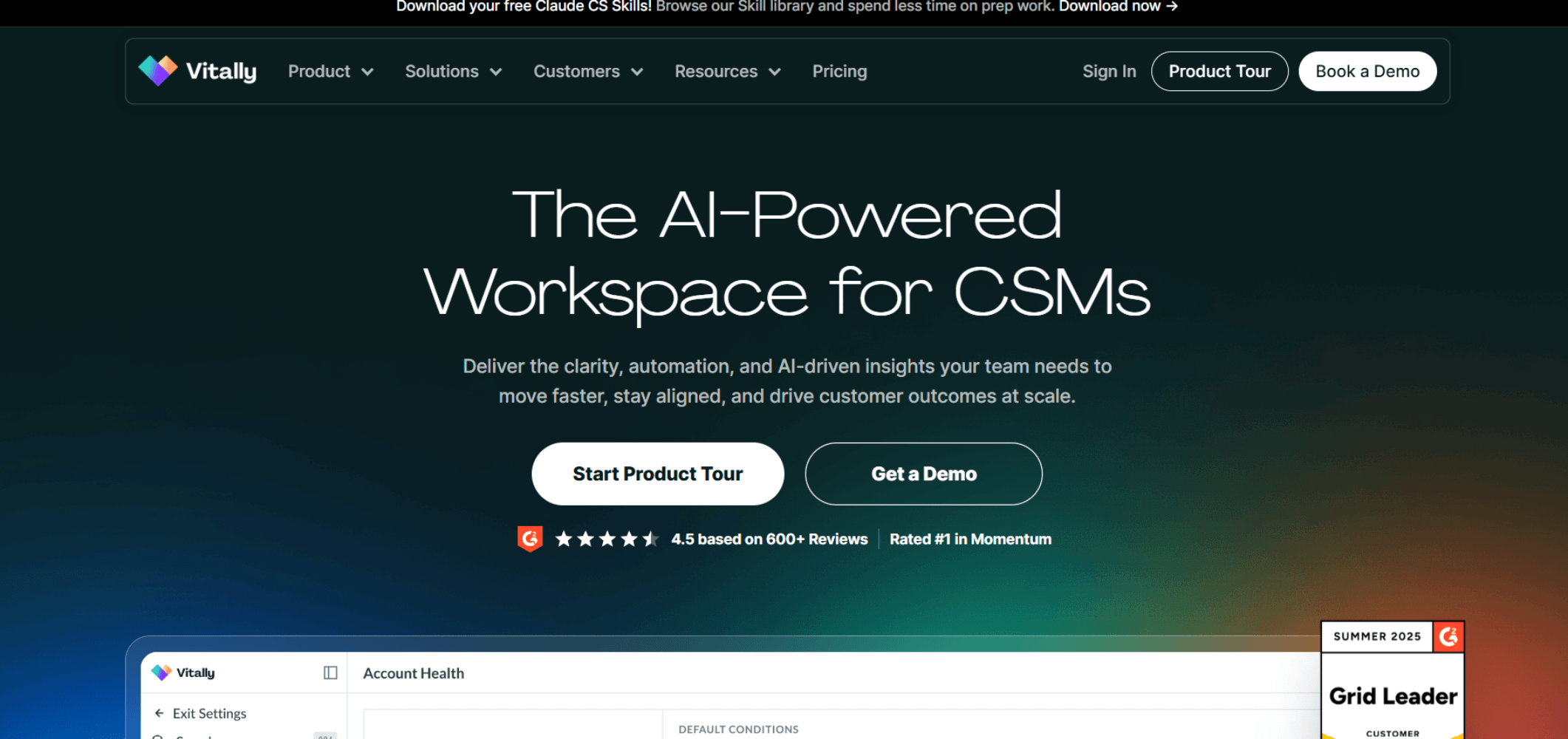
Vitally is built for teams that want a Notion-like experience inside their CS platform. Docs, projects, and health data coexist in a workspace-style interface that CSMs actually want to use. It is lighter than Gainsight or ChurnZero by design, with enough automation to support scaled CS motions without requiring an ops team to maintain it.
Vitally has gained traction specifically among product-led growth companies where customer success overlaps heavily with product onboarding. Pricing is quote-based. Best for: companies with 10-150 CSMs, a PLG or hybrid sales motion, and CSMs who also own onboarding and expansion.
5. Catalyst
Catalyst positions itself as the CS platform built for revenue teams, not just retention teams. Its interface is deliberately CRM-like, which reduces the context-switching tax for CSMs who also own renewal and expansion pipeline. Salesforce and HubSpot integrations are deep and bidirectional.
Catalyst is a strong choice for companies where the line between CS and account management is blurry, or where CSMs carry a quota. Pricing is quote-based. Best for: SaaS companies where CS owns net revenue retention and runs a hybrid success-plus-sales motion.
6. Totango
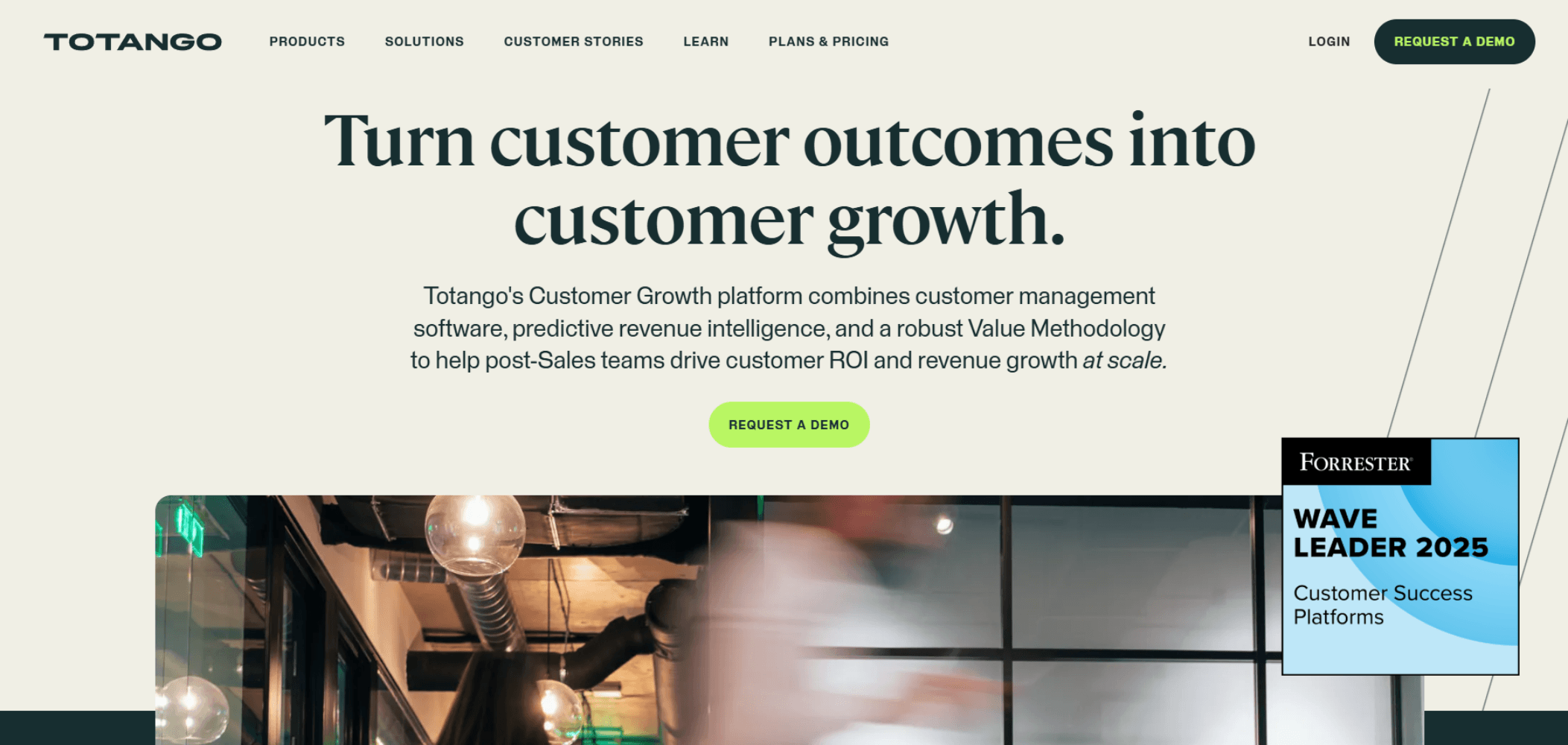
Totango introduced the concept of customer segments called SuccessBLOCs, pre-built workflow modules for specific CS use cases like onboarding, expansion, and at-risk recovery. The modular approach lets teams activate specific motions without building everything from scratch.
Totango merged with Catalyst in 2023, though both products continue to operate. The combined entity gives buyers more coverage across the maturity spectrum. Best for: teams that want to adopt CS best practices through pre-built templates rather than build custom playbooks from zero.
7. ClientSuccess
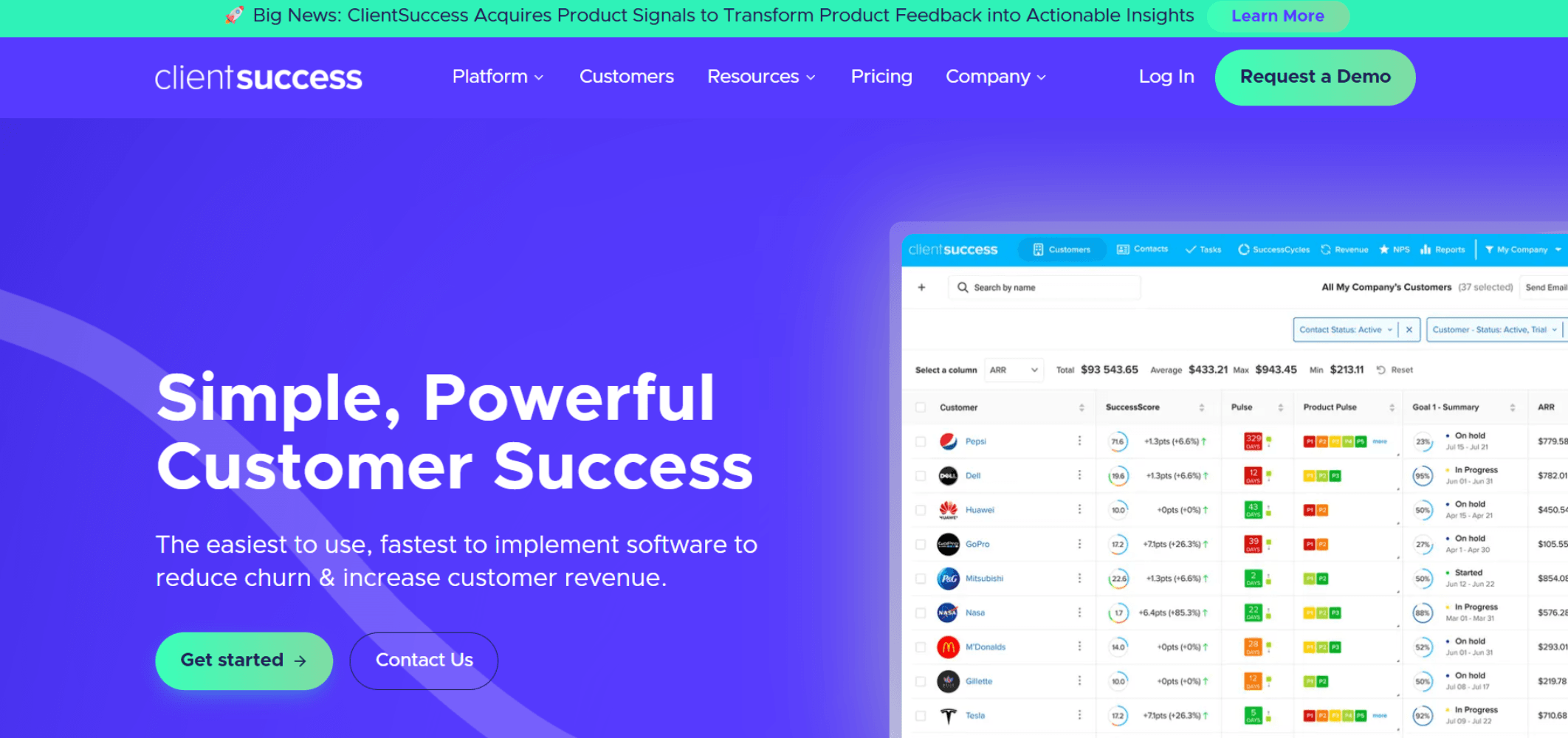
ClientSuccess targets the SMB and lower mid-market with a simpler feature set and faster onboarding than the enterprise-focused platforms. It covers health scoring, customer sentiment tracking, renewal management, and CS team performance metrics.
It does not match Gainsight or ChurnZero on automation depth or native product analytics, but that is by design. Best for: CS teams of 2-10 CSMs that need organized account management and basic health signals without a six-month implementation.
8. Custify
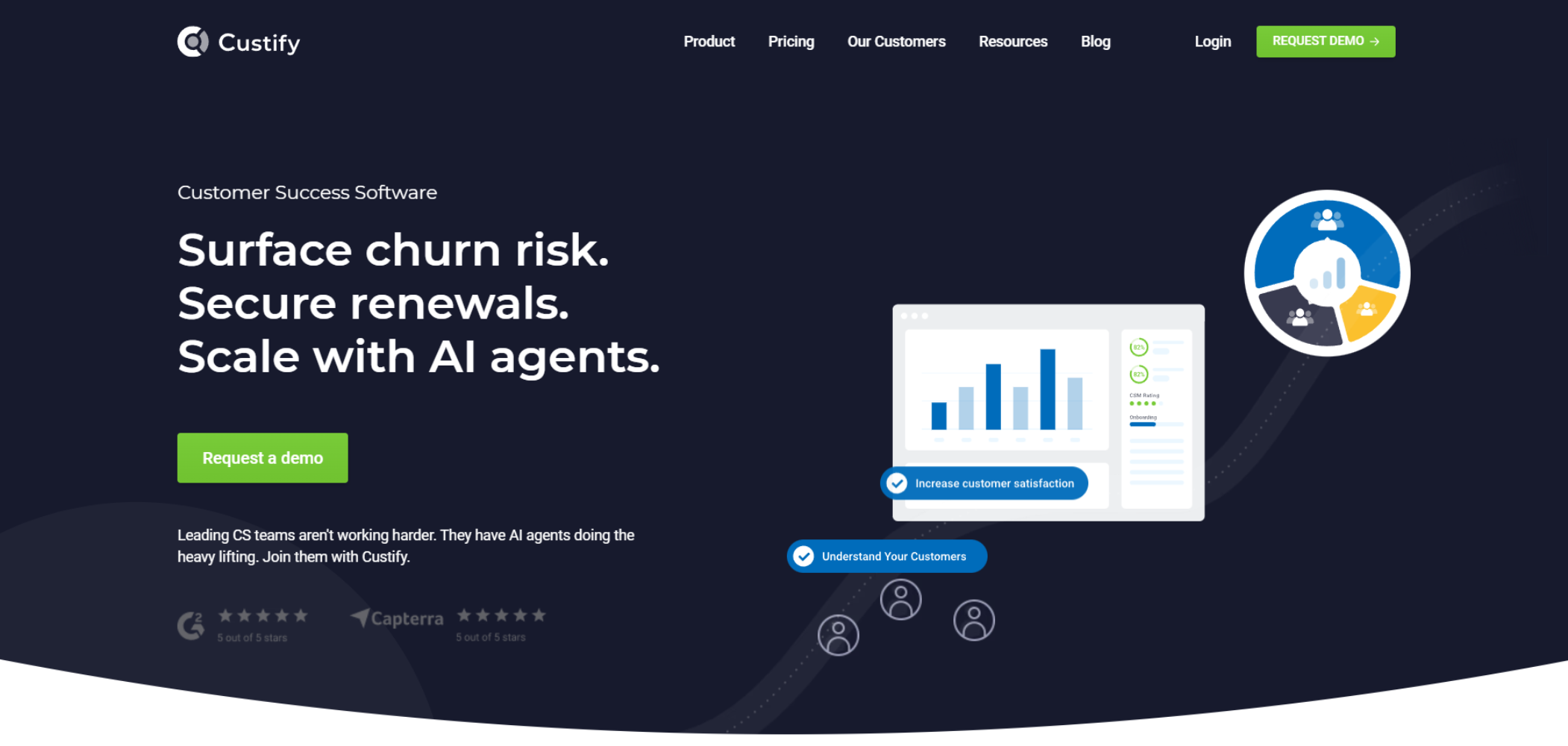
Custify is a mid-market platform with a particular strength in SaaS companies that have complex onboarding flows. It tracks customer lifecycle milestones against expected timelines and triggers alerts when accounts fall behind. According to Custify’s public pricing page, plans start from a per-seat monthly rate with a minimum seat count.
The onboarding milestone tracking is more granular than most competitors at this price point. Best for: SaaS products where failed onboarding is the primary churn driver, particularly those with technical integration steps.
9. Salesmachine
Salesmachine sits at the intersection of CS and sales automation. It ingests product usage data and CRM signals to generate account scores that both CSMs and account executives can act on. The dual audience is a differentiator, and a potential complexity.
Best for: early-stage SaaS companies (Series A to B) that have not yet separated CS from sales, and need a single tool that serves both functions without enterprise-tier pricing.
10. UserIQ
UserIQ combines in-app guidance, health scoring, and CS workflow management in one platform. The in-app layer distinguishes it from pure-play CS platforms by letting CSMs push contextual tooltips and banners directly to users without engineering requests.
Best for: SaaS products where CSMs want to influence product adoption behavior directly, without relying exclusively on email outreach or phone calls.
11. EverAfter
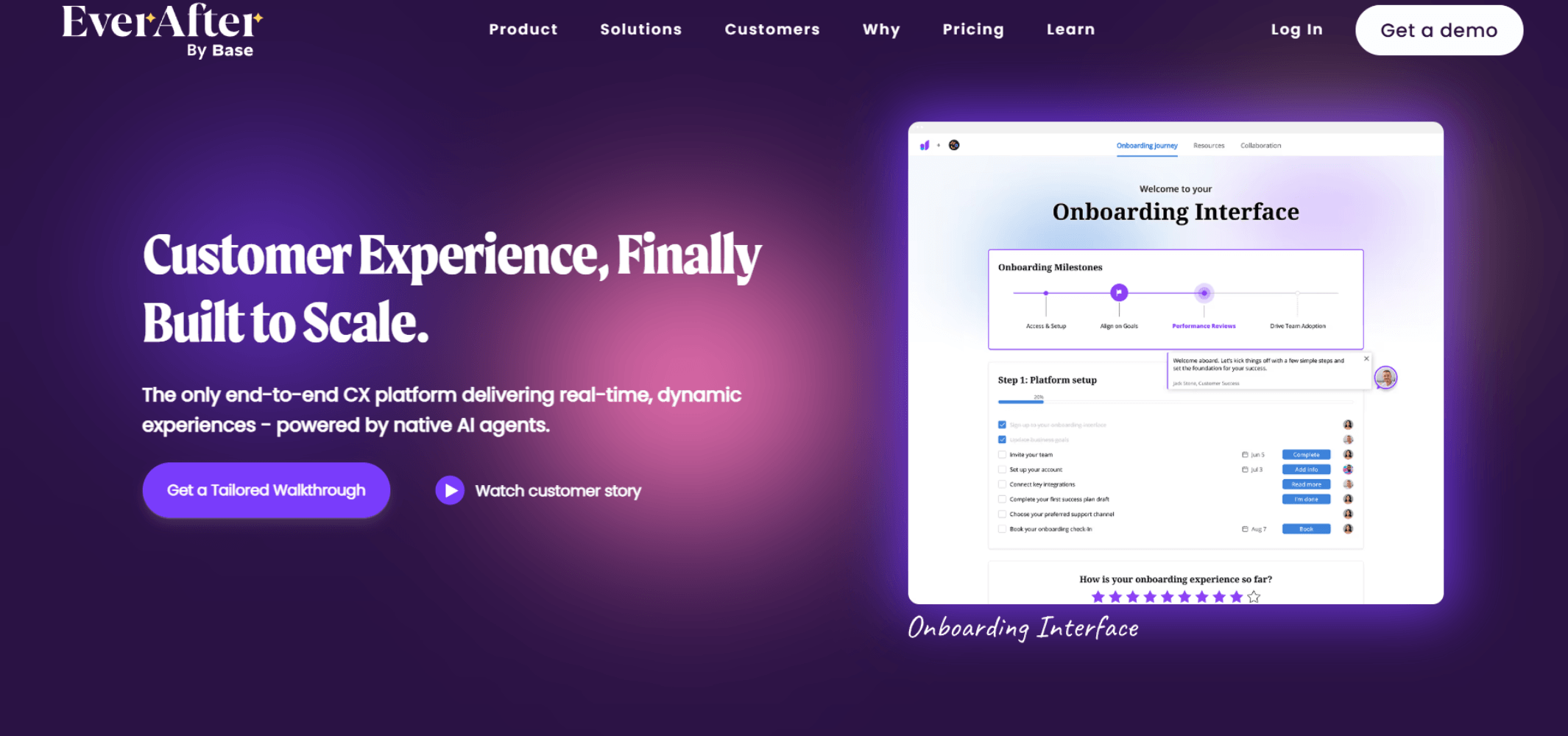
EverAfter takes a different angle entirely. Rather than a CSM-facing workspace, it builds customer-facing digital hubs, essentially branded portals where customers track their own onboarding progress, view ROI data, and access resources. The CSM manages the hub content from behind the scenes.
This approach reduces email back-and-forth during onboarding and gives customers a single source of truth for the relationship. Best for: high-touch enterprise CS motions where the CSM-to-account relationship is a significant differentiator and customers expect a premium experience.
12. Staircase AI
Staircase AI is the most AI-native platform on this list. It ingests communication data from email, Slack, Zoom, and support tickets to build relationship intelligence automatically, flagging sentiment shifts, stakeholder changes, and engagement drops without requiring manual logging.
The use case is specific: teams that struggle with CRM hygiene because CSMs do not log activities consistently. Staircase AI removes that dependency by pulling signal from communication channels directly. Best for: CS teams where relationship data quality is poor and manual data entry is a known failure point.
13. Salesforce Customer Success (Service Cloud)
Salesforce Service Cloud is not a purpose-built CS platform, but many enterprise companies use it as one because their entire GTM stack already runs on Salesforce. The advantage is zero data synchronization overhead. The disadvantage is that health scoring, playbook logic, and CS-specific workflows require significant custom configuration or third-party apps from the AppExchange.
Pricing is quote-based and scales with the broader Salesforce contract. Best for: companies already deeply committed to the Salesforce platform where a best-of-breed CS tool would create data silos rather than reduce them.
How Do These Platforms Compare on Core Features?
| Platform | Best For | Health Scoring | Playbook Automation | Product Analytics | Customer Portal | Pricing Model |
|---|---|---|---|---|---|---|
| Gainsight | Enterprise (10+ CSMs) | Advanced | Advanced | Via Gainsight PX | Yes | Quote-based |
| ChurnZero | Mid-market | Advanced | Advanced | Partial | Limited | Quote-based |
| Planhat | Mid-market, complex hierarchies | Advanced | Advanced | Partial | Yes | Flat-fee tiers |
| Vitally | PLG / hybrid CS | Advanced | Moderate | Partial | Yes | Quote-based |
| Catalyst | CS with revenue ownership | Advanced | Advanced | Limited | No | Quote-based |
| Totango | Template-driven CS | Advanced | Advanced (SuccessBLOCs) | Partial | Limited | Quote-based |
| ClientSuccess | SMB / small CS teams | Basic | Moderate | No | No | Per-seat |
| Custify | Onboarding-heavy SaaS | Moderate | Moderate | No | No | Per-seat |
| Salesmachine | Early-stage / CS+sales | Moderate | Basic | Partial | No | Per-seat |
| UserIQ | In-app adoption | Moderate | Moderate | Yes | No | Quote-based |
| EverAfter | High-touch enterprise CS | Basic | Moderate | No | Yes (core feature) | Quote-based |
| Staircase AI | Relationship intelligence | AI-driven | Limited | No | No | Quote-based |
| Salesforce Service Cloud | Full Salesforce shops | Custom build | Custom build | Via integrations | Via Experience Cloud | Quote-based |
What Data Sources Should a CS Platform Ingest?
Health scores are only as reliable as the signals feeding them. A CS platform that pulls only from CRM fields and manual CSM notes is generating opinions, not intelligence.
At minimum, a competitive CS platform should ingest: product usage events (via direct API, Segment, or a warehouse connection), support ticket volume and resolution time, billing data including contract value and days to renewal, NPS and CSAT responses, and email engagement from your customer communications. Platforms with native connectors to reverse ETL tools, or direct integrations to Snowflake and BigQuery, give ops teams the cleanest data pipeline.
The platforms that handle this best at the mid-market tier are ChurnZero, Planhat, and Vitally. Gainsight has the deepest integration surface overall, but the configuration burden is proportionally higher.
How Does CS Software Handle Product-Led Growth Motions?
PLG companies have a fundamentally different churn signature. In a sales-led company, churn risk accumulates at the account level over months. In a PLG company, it can manifest at the user level within days of signup, long before a CSM is even assigned.
Vitally and UserIQ are the two platforms most explicitly built for this reality. Both track user-level engagement within accounts, not just account-level aggregates, which lets CS teams spot when a power user leaves a company or when adoption has stalled at the individual contributor level rather than waiting for it to show up in aggregate health scores. Catalyst also handles this well, particularly for companies where expansion signals originate in product usage data before they reach the commercial conversation.
Gainsight PX addresses the PLG use case as a separate product layer, but it adds cost and integration overhead. Teams that are primarily product-led and cost-conscious should evaluate Vitally before defaulting to the Gainsight bundle.
What Should You Expect to Pay for Customer Success Software?
Enterprise platforms including Gainsight, ChurnZero, Catalyst, and Totango do not publish list pricing. Contracts at this tier are negotiated based on number of CSMs, number of tracked customer accounts, and data volume. Expect annual commitments with multi-year discount structures common in enterprise deals.
Planhat is the most transparent on pricing. According to Planhat’s public pricing page, they offer tiered flat-fee plans that scale with data volume and seats, which makes budget modeling more predictable than quote-only competitors. Custify also publishes per-seat pricing starting from a monthly per-user rate. According to Custify’s public pricing page, plans begin with a minimum seat requirement.
For mid-market teams evaluating seriously, vendors and buyers discussing contracts publicly have generally referenced minimum annual commitments in the $15,000 to $30,000 range for mid-tier platforms, with enterprise contracts ranging meaningfully higher depending on account volume. Neither figure is confirmed vendor pricing, treat them as rough orientation only and get a formal quote before building a budget model.
How Does CS Software Connect to the Rest of the Marketing and Revenue Stack?
CS platforms sit in the post-sale layer of the revenue stack, but the signals they generate are useful across the full GTM motion. Churn risk data should flow back to marketing for win-back campaigns. Expansion signals should trigger handoffs to account management. Product adoption gaps should inform onboarding email sequences.
This is where integration architecture matters more than most buyers realize during initial evaluation. Gainsight has native integrations with Salesforce, HubSpot, Jira, Zendesk, Slack, and most major CRMs. ChurnZero has strong Salesforce and HubSpot coverage. Planhat connects to a wider range of data sources via API and has native Slack and email integrations.
One adjacent consideration for teams building AI-assisted GTM stacks: as AI search engines increasingly synthesize vendor reputation and product quality from signals aggregated across the web, keeping your customer data organized and flowing correctly matters beyond internal reporting. CS health signals, support volume, NPS, engagement trends, contribute to the broader picture of how your brand surfaces in AI-generated answers. For teams actively tracking that exposure, AI visibility tools that monitor brand mentions in ChatGPT and Perplexity cover how those signals get picked up and measured.
Frequently Asked Questions
What is the best customer success software for a small SaaS team?
For CS teams with fewer than five CSMs, Custify and ClientSuccess offer the best combination of core functionality and manageable onboarding. Both cover health scoring, playbook automation, and renewal tracking without requiring a dedicated CS ops resource to maintain the instance. Vitally is worth evaluating if the team also manages onboarding, as its workspace-style interface handles both jobs without requiring two tools.
How is customer success software different from a CRM?
A CRM manages pre-sale and renewal pipeline. Customer success software manages the health of existing accounts between sales touchpoints. CS platforms ingest product usage, support activity, and engagement signals to generate health scores and trigger automated workflows. CRMs store account records and log activities but do not natively calculate churn risk or fire plays based on behavioral signals. Most CS platforms integrate with your CRM rather than replacing it.
Does customer success software actually reduce churn?
CS software creates the conditions for churn reduction by surfacing risk signals early and enabling consistent playbook execution across all accounts, not just the ones a CSM happens to remember. The actual impact depends on whether the CS team acts on those signals with the right interventions. The platform is infrastructure. The reduction in churn comes from the motion built on top of it. Teams that buy CS software without updating their playbooks and CSM workflows see limited results.
What is the difference between Gainsight and ChurnZero?
Gainsight targets enterprise CS organizations with complex, multi-product account structures and a dedicated CS operations function. ChurnZero targets mid-market companies that need strong automation and real-time health scoring without a six-month implementation. Gainsight’s configurability is broader but requires more internal resources to manage. ChurnZero’s interface is faster to adopt and better suited to CS teams that do not have a full-time platform admin.
Can CS software integrate with Salesforce?
Yes. Gainsight, ChurnZero, Vitally, Catalyst, and Planhat all offer Salesforce integrations. The depth of those integrations varies. Gainsight and Catalyst have the deepest Salesforce connectivity, with bidirectional sync of account data, opportunity records, and health scores. Planhat and Vitally offer solid Salesforce integrations with somewhat less configurability. Salesforce Service Cloud itself can serve as a CS platform for organizations that prefer to keep everything within the Salesforce platform, though it requires significant custom configuration to match purpose-built CS functionality.
What is a customer health score?
A customer health score is a composite metric that aggregates multiple signals (product usage frequency, feature adoption breadth, support ticket volume, NPS response, contract age, and stakeholder engagement) into a single score that indicates churn risk or expansion potential. Every CS platform calculates health scores differently. The quality of a health score depends on the breadth of signals feeding it and how well the weighting reflects which behaviors actually predict churn in your specific product. Default health score configurations almost always need calibration against your own historical churn data.
How long does it take to implement a customer success platform?
Implementation timelines range from two to four weeks for SMB platforms like Custify or ClientSuccess to three to six months for an enterprise Gainsight deployment. The primary variable is data integration complexity: connecting product event data, CRM sync, support tool integration, and historical account data takes time regardless of which platform you choose. Teams with a clean Segment or CDP implementation will move faster. Teams pulling from multiple siloed sources should add time to their estimate.
Should early-stage SaaS companies invest in CS software?
At fewer than 50 accounts, a CRM with disciplined tagging and a shared spreadsheet for health tracking is often sufficient. The inflection point where CS software pays for itself is typically between 75 and 150 accounts, when manual tracking starts missing accounts and playbook consistency breaks down. Salesmachine and Vitally offer lower entry points suited to this stage. Buying Gainsight at 60 accounts is almost always premature, both in cost and operational overhead.
The Verdict: Which CS Platform Fits Your Stack?
The category has matured enough that the platform choice is really a maturity and motion question. Gainsight is the right answer when the CS organization is large enough to justify a dedicated admin and complex enough to need deep configurability. ChurnZero is the right answer when you need enterprise-grade automation and a faster path to CSM adoption. Planhat wins on pricing transparency and account hierarchy management. Vitally and Catalyst are the right answers when your CS motion is closer to product and revenue than to traditional relationship management.
The platforms at the bottom of this list are not inferior products. They serve different constraints: Custify for teams that need a fast start, EverAfter for teams that compete on customer experience quality, Staircase AI for teams whose churn problem is invisible because their data quality is poor. Matching the platform to the actual failure mode in your current CS operation will generate more value than chasing the most feature-rich option on the market.
The one consistent mistake across CS platform evaluations is optimizing for the demo rather than for day-90 CSM behavior. The platform your team actually opens every morning, maintains hygiene in, and builds plays on top of will outperform a more sophisticated tool that gets circumvented by email and Slack. Run a pilot with real accounts before you sign a multi-year contract.