- HubSpot’s own onboarding gets you technically live. A specialist partner gets you operationally live , pipeline stages, lifecycle definitions, and CRM hygiene that match how your sales team actually works.
- The five sponsored agencies in this list (RevPartners, Campaign Creators, Modgility, MakeWebBetter, SyncMatters) are disclosed as such. The other four were selected on tier, specialization, and publicly documented case results.
- Partner tier matters, but it is not the only filter. A Diamond partner that specializes in ecommerce is a poor fit for a B2B SaaS company with a 90-day sales cycle.
- The fastest implementations happen when a partner has a documented discovery-to-go-live playbook and your team has a named internal owner on day one.
- If you are migrating from Salesforce or a legacy CRM, prioritize partners with documented data migration experience over general HubSpot certifications.
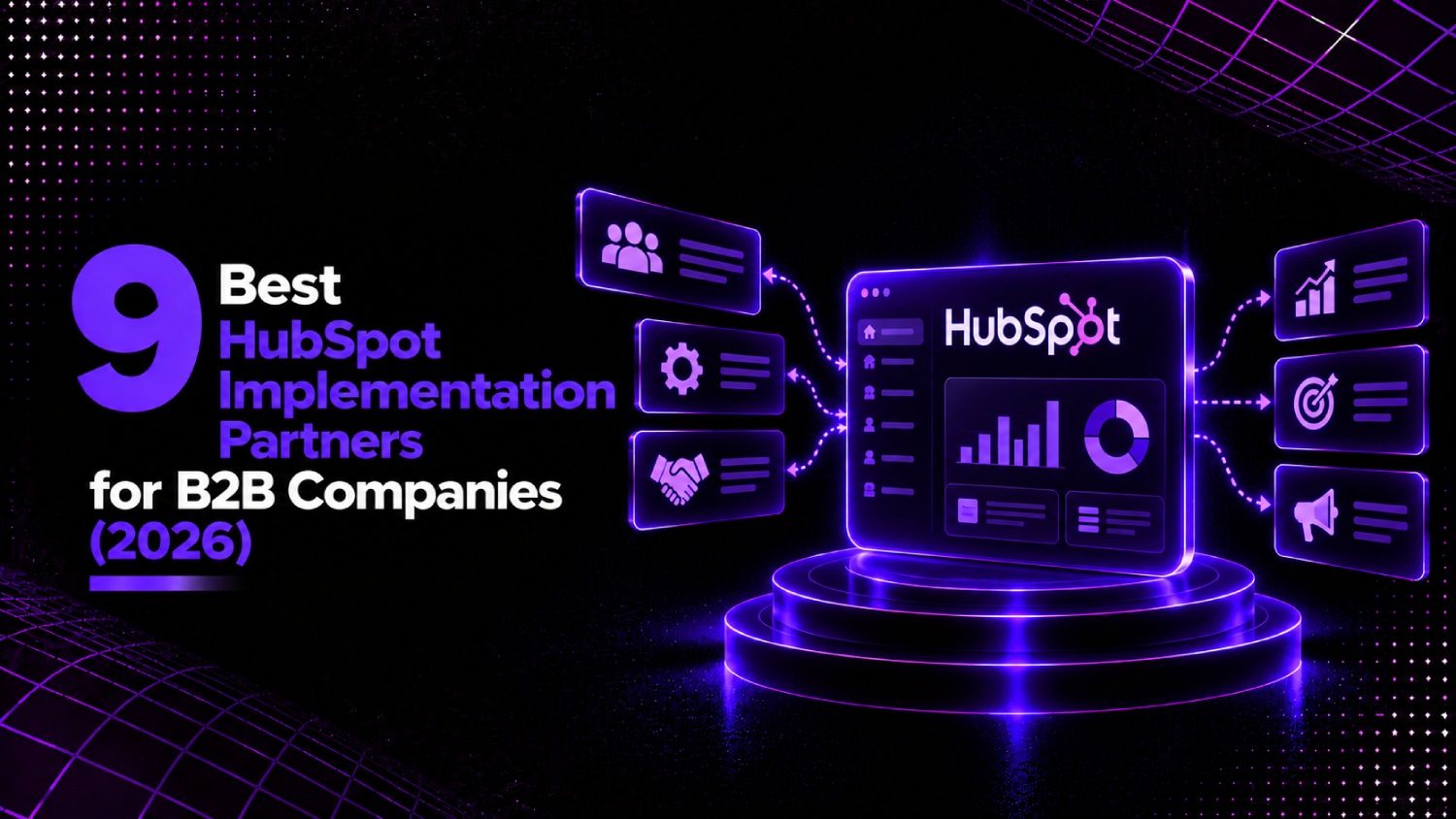
The best HubSpot implementation partners for B2B companies are RevPartners, Campaign Creators, Modgility, BabelQuest, Huble Digital, New Breed, Remotish, MakeWebBetter, and SyncMatters. Each specializes in a different company size, hub combination, or migration scenario. HubSpot’s native onboarding covers platform basics. A solutions partner handles CRM architecture, deal stage logic, workflow automation, and data migration specific to your sales process.
Why HubSpot’s Default Onboarding Is Not Enough for Most B2B Teams
HubSpot sells onboarding as a guided setup experience, typically a few calls with a specialist who walks you through the portal. For a solo founder using Marketing Hub Starter, that may be enough. For a B2B company with a sales team, marketing automation, and an existing CRM to migrate, it is not.
The gap shows up in three places. First, HubSpot’s onboarding is hub-specific, not process-specific. It will show you where to create a workflow; it will not tell you whether your lead lifecycle stages map correctly to your sales motion. Second, default onboarding does not cover data migration from Salesforce, Dynamics, or a legacy spreadsheet setup. Third, HubSpot onboarding ends when your portal is configured, not when your team is actually using it.
A HubSpot solutions partner fills that gap. The best ones run a discovery phase that maps your actual go-to-market process before touching a single property. They set MQL and SQL definitions, build deal pipelines that match your sales stages, configure lead routing and assignment rules, and then train the team on the system they built. That is a fundamentally different scope from onboarding.
How to Choose a HubSpot Implementation Partner: The Stack-Fit Filter
Most buyers treat partner selection as a tier check. Diamond Partner equals safe choice. That logic fails regularly. The AboutMartech Stack-Fit Filter is a four-part evaluation that cuts the list faster and surfaces better matches.
Hub depth: Does the partner’s case studies involve the specific hubs you are buying? A partner strong in Marketing Hub automations may not have the Sales Hub deal stage architecture experience you need. Ask for a case study that involves your exact hub combination.
Company-size match: A partner that runs 10-person Sales Hub setups and a partner that implements HubSpot Enterprise for 500-person sales orgs are solving different problems. Ask directly how many of their last ten engagements were at your company size.
Migration history: If you are moving off Salesforce, Dynamics, or any other CRM, ask how many migrations they have run from that specific system, what data hygiene issues they encountered, and how they handled custom objects. Vague answers are a red flag.
Internal-owner requirement: Good partners require a named internal owner on your side. If a partner says they will handle everything without needing an internal point of contact, the implementation will likely not survive the first quarter of use.
What Do HubSpot Partner Tiers Actually Mean?
HubSpot’s Solutions Partner Program ranks agencies as Gold, Platinum, Diamond, and Elite based on the managed recurring revenue they generate through new HubSpot sales and retained customers. Elite is the top tier, held by a small number of global agencies. Diamond is the most common tier among well-established implementation shops.
Tier reflects sales volume, not implementation quality. A newly certified Platinum partner with deep RevOps expertise may deliver a better implementation for a 50-person B2B SaaS company than a Diamond partner whose team is split across dozens of simultaneous projects. Tier is a starting filter, not a final answer. Use the Stack-Fit Filter above to go deeper.
The 9 Best HubSpot Implementation Partners for B2B Companies
| Partner | HubSpot Tier | Best For | Notable Strength | Sponsored |
|---|---|---|---|---|
| RevPartners | Diamond | Revenue-aligned RevOps builds | Full-funnel RevOps + HubSpot architecture | Yes |
| Campaign Creators | Diamond | Marketing Hub-heavy implementations | Inbound strategy + automation depth | Yes |
| Modgility | Platinum | SMB and mid-market Sales Hub | Fast turnaround, sales-first configuration | Yes |
| MakeWebBetter | Diamond | Custom integrations and WooCommerce/ecommerce | Custom HubSpot integrations and app development | Yes |
| SyncMatters | Platinum | CRM data migration and syncing | Salesforce-to-HubSpot migrations | Yes |
| BabelQuest | Elite | UK mid-market B2B | Systems architecture and HubSpot process design | No |
| Huble Digital | Elite | Global enterprise implementations | Multi-hub, multi-region rollouts | No |
| New Breed | Elite | B2B SaaS and complex go-to-market | Revenue architecture and Sales + Marketing Hub depth | No |
| Remotish | Diamond | Ongoing RevOps as a service | Fractional HubSpot admin and RevOps retainers | No |
RevPartners , Best for Revenue-Aligned RevOps Builds
RevPartners positions itself as a RevOps agency that happens to implement HubSpot, rather than the other way around. That distinction matters. Their engagements start with revenue architecture, defining the handoff points between marketing, sales, and customer success, before touching portal configuration.
Their documented approach aligns HubSpot deal stages, lifecycle stages, and reporting to a single revenue model. For B2B companies that have grown past the “whoever closes a deal updates the CRM” phase, that structured approach prevents the MQL-to-SQL leakage that makes pipeline reporting unreliable. RevPartners holds Diamond tier and works primarily with Series A through Series C B2B SaaS companies.
Worth noting: their model leans toward retained engagements rather than one-time implementations. If you want someone to build and leave, they are not the best fit. If you want ongoing RevOps support alongside the build, they are one of the strongest options in this list.
Campaign Creators , Best for Marketing Hub-Heavy Implementations
Campaign Creators is a Diamond-tier HubSpot partner with a specialization in inbound marketing architecture. Their implementations emphasize Marketing Hub configuration: email nurture sequences, workflow automation, lead scoring models, and campaign attribution setup.
For B2B companies where marketing owns a significant portion of the pipeline and needs HubSpot configured to track content-driven lead generation, Campaign Creators brings documented methodology. Their gap is Sales Hub depth. If your primary need is deal pipeline architecture and sales process automation, pair them with a Sales Hub specialist or look at RevPartners or New Breed instead.
Modgility , Best for SMB and Mid-Market Sales Hub
Modgility is a Platinum-tier partner that focuses on Sales Hub implementations for companies between 10 and 200 employees. Their pitch is speed and sales-first configuration: they build deal pipelines, sequence templates, meeting link setups, and rep dashboards that sales teams can use in the first week.
Compared to larger Diamond or Elite partners, Modgility operates with a smaller team, which means more direct access to senior consultants during the engagement. For a company that wants to avoid being handed off to a junior consultant after the sales call, that is a real advantage. Their limitation is scale: they are less suited to multi-hub Enterprise implementations with complex integrations.
MakeWebBetter , Best for Custom Integrations
MakeWebBetter is a Diamond-tier partner with development capabilities that most pure-strategy agencies lack. They build custom HubSpot integrations, native app connectors, and WooCommerce-to-HubSpot data pipelines. For B2B companies that need HubSpot to talk to a custom-built internal tool, an ERP, or a commerce platform, MakeWebBetter handles the technical layer that most onboarding agencies cannot.
Their strength is custom objects and API-level integrations. If your implementation is standard hub configuration with no custom data architecture, they are likely overspecified for the work. If you have a non-standard data model or need bidirectional syncing between HubSpot and a proprietary system, they belong on your shortlist. For data migration and syncing specifically, also evaluate SyncMatters below.
SyncMatters , Best for CRM Data Migration and Syncing
SyncMatters specializes in CRM-to-CRM data migration and ongoing data syncing between HubSpot and other systems. Their core use case is Salesforce-to-HubSpot migrations, including contact, company, deal, and custom object data, with field mapping that preserves historical data integrity.
Data migration is where many implementations fail. Contacts arrive without associated companies. Deal history gets lost. Custom fields from Salesforce have no equivalent in HubSpot and get dropped. SyncMatters addresses this systematically with a migration audit before any data moves. For any company switching from an existing CRM, their involvement in the data migration phase is worth evaluating even if another partner handles the HubSpot configuration work.
BabelQuest , Best for UK Mid-Market B2B
BabelQuest is one of the few Elite-tier HubSpot partners in the UK that publishes detailed case studies on systems architecture rather than campaign outcomes. Their process documentation covers how they define contact and company properties, how they structure custom objects, and how they design lifecycle stage transitions before writing a single workflow.
For UK-based B2B companies, BabelQuest’s legal and data handling familiarity with UK GDPR is a practical advantage. For US-based companies, they are less relevant unless you have UK operations or specifically want their process design methodology applied to your implementation.
Huble Digital , Best for Global Enterprise Implementations
Huble Digital is an Elite-tier partner with offices across the US, UK, Europe, and South Africa. Their differentiation is multi-hub, multi-region HubSpot implementations: companies running Marketing Hub, Sales Hub, Service Hub, and CMS Hub across multiple countries with different team structures and language requirements.
That scope comes with a longer engagement timeline and higher project cost than most mid-market implementations require. Huble is the right choice when your HubSpot implementation is effectively a company-wide CRM transformation with stakeholders in multiple time zones. For a 50-person B2B SaaS company running one hub, they are more than you need.
New Breed , Best for B2B SaaS and Complex Go-to-Market
New Breed is an Elite-tier partner based in Burlington, Vermont with a clear specialization in B2B SaaS companies. Their work spans Sales Hub, Marketing Hub, and HubSpot CRM architecture for companies with product-led growth motions, long enterprise sales cycles, or both.
New Breed publishes detailed content on revenue architecture, and their implementations reflect that. They define handoff logic between users at different stages of a product trial, product-qualified leads, and enterprise pipeline separately, which is a level of nuance most generalist partners do not cover. Their pricing reflects their Elite tier and SaaS specialization. Budget accordingly, but for a Series B SaaS company with a complex go-to-market, the fit is close to exact.
Remotish , Best for Ongoing RevOps as a Service
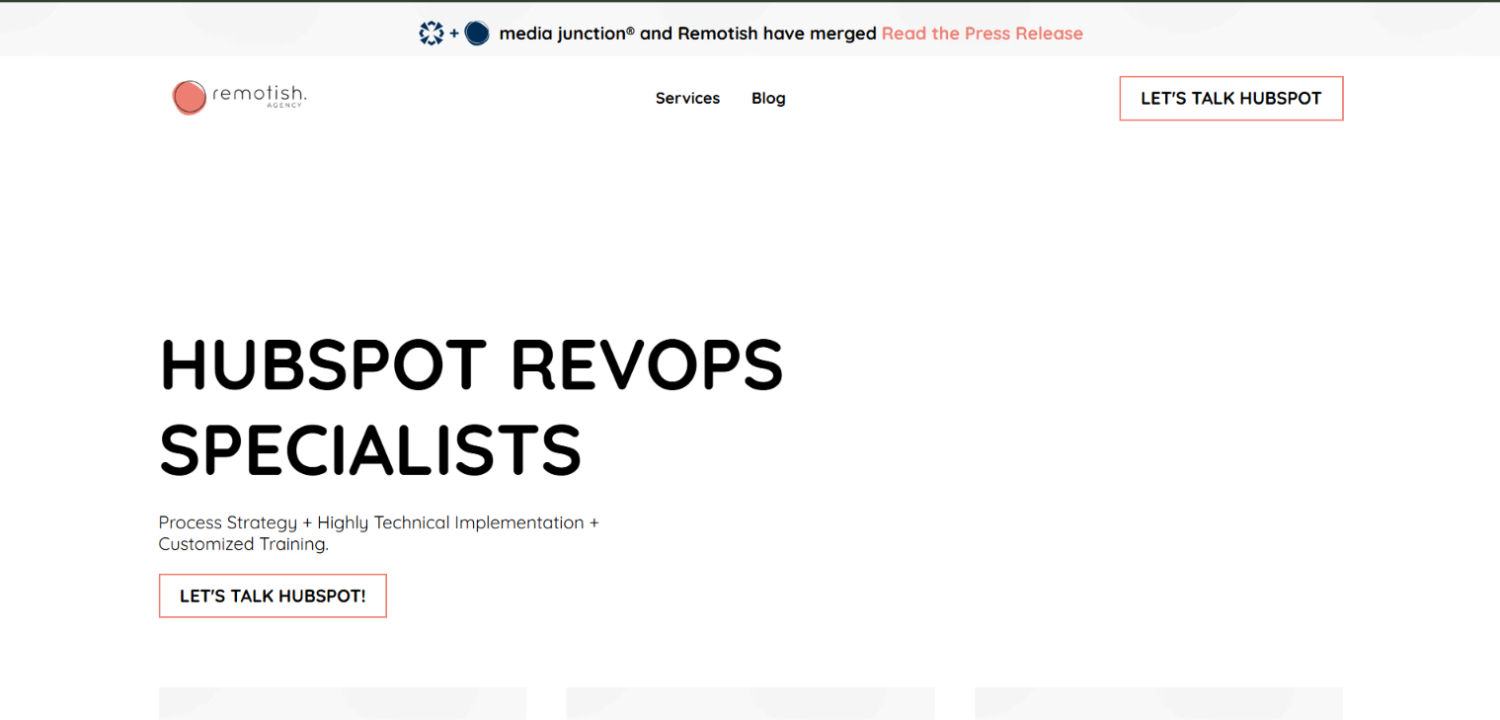
Remotish operates primarily as a fractional HubSpot admin and RevOps retainer service rather than a pure implementation shop. They build the initial configuration and then stay on as an embedded team member, handling portal maintenance, new workflow builds, reporting updates, and HubSpot feature adoption over time.
For companies that do not have an internal HubSpot admin but need more than periodic project work, Remotish fills a real gap. Their Diamond tier and documented RevOps-as-a-service model work well for companies between 30 and 300 employees that want consistent HubSpot management without a full-time hire. The trade-off is that their model is retainer-first. If you want a project-based implementation with a clear end date and handoff, look at Modgility, New Breed, or RevPartners instead.
HubSpot Onboarding Partner vs. HubSpot’s Own Onboarding: What You Actually Get
According to HubSpot’s public onboarding page, their onboarding service is a structured program delivered by HubSpot-employed specialists, priced per hub and tier. Professional hub onboarding and Enterprise hub onboarding carry different fees. The deliverable is a configured portal that meets HubSpot’s definition of “live.”
A solutions partner’s implementation is scoped to your definition of live. That includes property mapping, deal pipeline architecture, lifecycle stage definitions, lead routing rules, integration setup, historical data migration, and team training. None of those are guaranteed outputs from HubSpot’s native onboarding. A useful way to think about it: HubSpot onboarding teaches you to drive the car. A solutions partner wires the car for your specific route.
One practical consideration: HubSpot will waive its onboarding fee if you buy through a solutions partner. That means the cost of a partner-led implementation may net out lower than you expect once the waived onboarding fee is factored in. Confirm this directly with any partner you evaluate, since HubSpot’s partner program terms change periodically.
How Much Does a HubSpot Implementation Cost?
Implementation costs vary by partner tier, scope, and hub combination. None of the agencies in this list publish fixed pricing publicly, which is standard for custom implementation work. As a general orientation based on publicly available partner positioning:
- SMB Sales Hub implementations with Platinum-tier partners like Modgility typically run in the range of a few thousand dollars for a focused engagement.
- Mid-market multi-hub implementations with Diamond-tier partners range from $10,000 to $50,000 depending on scope, data migration complexity, and integration requirements.
- Enterprise or multi-hub implementations with Elite partners like Huble or New Breed can exceed $75,000 for complex, multi-region deployments.
These are orientation ranges, not quotes. Get a scoped proposal from at least two partners before committing. The variance between firms on the same project description is often 2x or more, and the cheapest bid rarely reflects the same scope as the most thorough one. For context on what a full RevOps stack costs alongside the HubSpot implementation, the RevOps tools breakdown on AboutMartech covers the adjacent tooling layer.
What a Good HubSpot Implementation Looks Like: A Worked Scenario
Consider a B2B SaaS company with 40 salespeople, a 90-day average sales cycle, three distinct customer segments, and an existing Salesforce instance they are migrating off. Their Marketing team runs paid LinkedIn campaigns and a content blog. They have around 80,000 contacts in Salesforce, roughly 30,000 of which are actively managed.
In this scenario, a competent implementation partner would run a discovery phase covering lifecycle stage definitions (subscriber, lead, MQL, SQL, opportunity, customer, churned), deal pipeline stages mapped to their actual sales process (not HubSpot’s default), contact property mapping from Salesforce to HubSpot, custom objects if their Salesforce data model used them, lead routing rules by segment and territory, email domain authentication and deliverability setup for Marketing Hub, and a data migration audit on the 80,000 contacts before any sync runs.
That is eight to twelve weeks of work for a skilled team. An agency that promises the same scope in three weeks either has a larger team assigned than they are disclosing or is not covering the full scope. Ask any partner you evaluate to walk through the milestone plan for a scenario like this. Their answer will tell you more than any case study PDF.
Connecting HubSpot data to your broader marketing measurement layer is a separate step. If your team needs to understand attribution across channels once HubSpot is live, the B2B attribution tools guide on AboutMartech covers what to add downstream.
Frequently Asked Questions
Who is a HubSpot implementation partner?
A HubSpot implementation partner is an agency or consultancy certified in HubSpot’s Solutions Partner Program that handles the setup, configuration, data migration, and training for a HubSpot deployment. They are distinct from HubSpot’s internal onboarding team. Partners are classified into Gold, Platinum, Diamond, and Elite tiers based on their sales and retention performance with HubSpot customers. They typically scope implementations based on the specific hubs purchased, company size, and existing CRM data.
What does a HubSpot solutions partner actually do?
A HubSpot solutions partner maps your go-to-market process to HubSpot’s data model, configures deal pipelines and lifecycle stages, builds workflow automation, migrates data from existing CRMs, sets up integrations with your tech stack, and trains your team. The scope varies by engagement. Some partners offer one-time project implementations. Others offer ongoing retainer support as a fractional HubSpot admin. The key difference from HubSpot’s own onboarding is that partners work to your process, not to a generic checklist.
How much does it cost to implement HubSpot with a partner?
HubSpot implementation partner costs are not publicly listed and vary by scope. A focused SMB Sales Hub implementation through a Platinum-tier partner typically starts in the low thousands. Mid-market multi-hub implementations with Diamond-tier agencies commonly range from $10,000 to $50,000. Enterprise-grade, multi-region implementations with Elite partners can exceed $75,000. These are orientation ranges. Any partner you evaluate should provide a scoped proposal based on your specific hub combination, contact volume, integration requirements, and migration complexity.
HubSpot onboarding partner vs. HubSpot’s own onboarding: which should you choose?
HubSpot’s native onboarding is a guided setup service focused on getting your portal technically configured. It follows HubSpot’s structure, not your sales process. A solutions partner implements HubSpot to match your actual go-to-market: deal stages, lifecycle definitions, lead routing, data migration, and integrations. Most B2B companies with an existing CRM, a sales team of ten or more, or complex data requirements benefit from a partner. HubSpot typically waives its onboarding fee when you purchase through a partner, which reduces the net cost difference.
How do you evaluate a HubSpot implementation partner?
Use the Stack-Fit Filter: hub depth (does their experience match your exact hub combination?), company-size match (how many of their recent engagements resemble yours?), migration history (have they moved data from your specific source CRM?), and internal-owner requirement (do they require a named point of contact on your side?). Ask for a milestone plan for a scenario that resembles your implementation, not just a general proposal. A partner who cannot walk through their discovery-to-go-live process in detail does not have a repeatable methodology.
What is the difference between HubSpot Gold, Platinum, Diamond, and Elite partners?
HubSpot’s partner tiers reflect the managed recurring revenue each agency generates through new HubSpot sales and retained customers, not implementation quality directly. Elite is the top tier and held by a small number of globally active agencies. Diamond is the most common tier among established implementation shops. Platinum partners are often smaller, more specialized firms. Tier is a useful initial filter for agency size and HubSpot commitment, but it does not guarantee implementation quality. A Platinum partner with deep specialization in your industry may outperform a Diamond generalist.
Can a HubSpot partner help migrate data from Salesforce?
Yes, and this is one of the most important reasons to use a partner rather than HubSpot’s native onboarding. Salesforce-to-HubSpot migrations involve contact and company deduplication, field mapping from Salesforce’s data model to HubSpot’s, custom object translation, deal and activity history migration, and data hygiene work before any sync runs. SyncMatters specializes specifically in this layer. For most partners, Salesforce migration is part of a broader implementation scope. Ask any partner you evaluate how many Salesforce migrations they have completed and what data hygiene issues they typically encounter.
How to Run the Final Selection: A Two-Partner Shortlist
Most buyers waste time evaluating six or seven partners simultaneously. The better approach is to apply the Stack-Fit Filter to the full list, eliminate anyone without a documented case study at your company size and hub combination, and get to exactly two finalists. Then ask both for a milestone plan specific to your scenario, not a general proposal deck.
The milestone plan conversation reveals more than any reference check. A partner who can describe week-by-week deliverables for your situation has implemented it before. A partner who sends a generic statement of work with placeholder timelines has not. When both finalists pass that test, choose based on the internal-owner chemistry. You will work with this team for months. The technical quality difference between two strong Elite or Diamond partners is smaller than the communication style difference.
One last check before signing: confirm whether the partner relationship with HubSpot means they earn a commission on your subscription. Most do. That is not disqualifying, but it means their recommendation to buy additional hubs or upgrade to Enterprise is not purely objective. Run any upsell recommendation against the adjacent martech categories to confirm HubSpot is the right layer before expanding the contract.