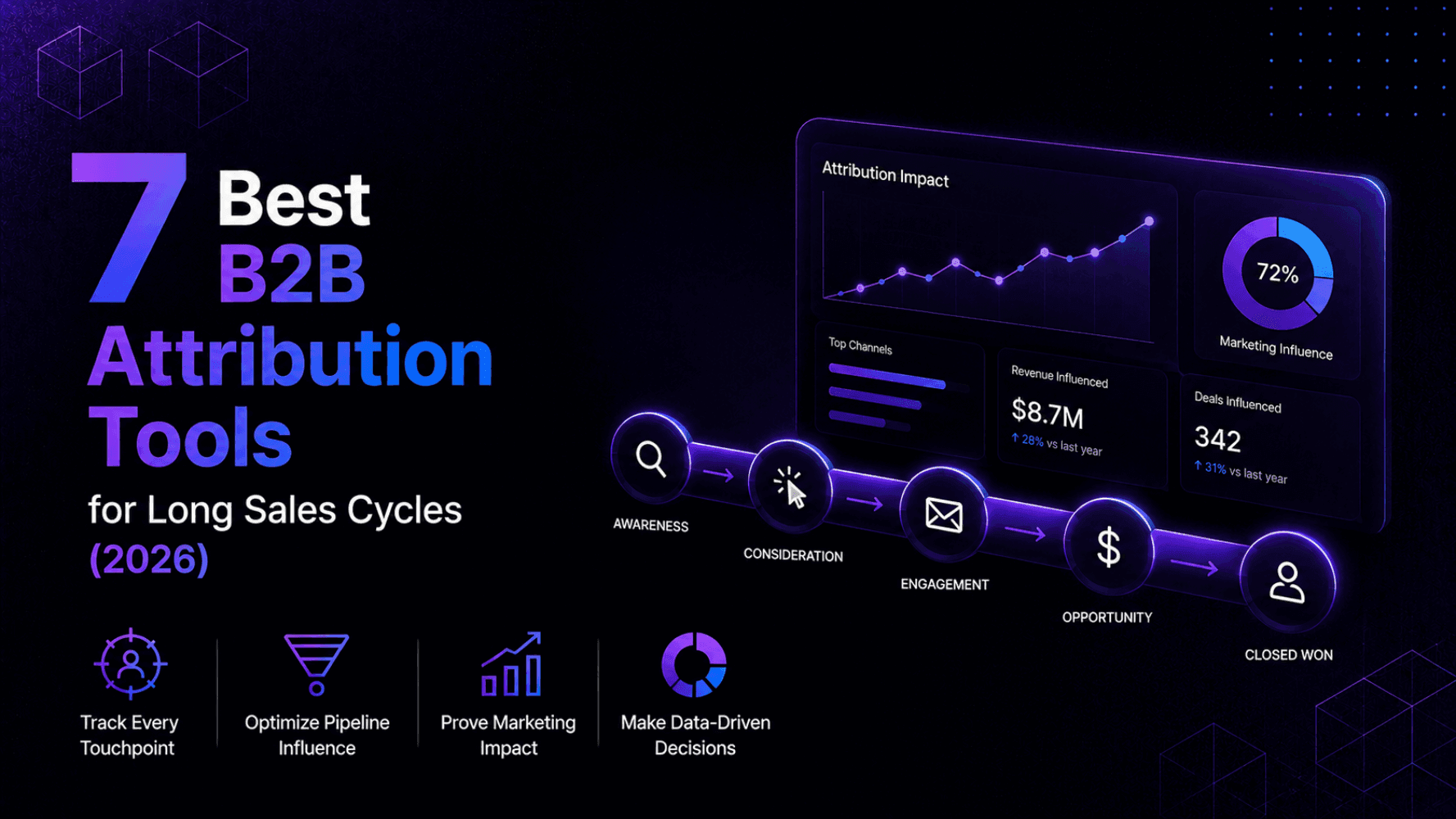
- Most attribution tools were built for e-commerce conversion windows of days or weeks. B2B sales cycles that run 90 to 180 days break those models at the foundation.
- Account-level attribution, not contact-level attribution, is what matters when six people from the same company touch your content before anyone talks to sales.
- The tools below are selected specifically for multi-touch, long-cycle B2B buying cycles, not adapted from consumer analytics.
- Pricing varies significantly. Several vendors require a quote and will not publish list prices, which reflects how complex the underlying data stitching actually is.
- If your primary gap is connecting marketing data to your warehouse before you attribute anything, that is a data pipeline problem, not an attribution tool problem.
The best B2B attribution tools for long sales cycles are Dreamdata, HockeyStack, Bizible (Adobe Marketo Measure), Rockerbox, Terminus, CaliberMind, and Triple Whale. Each handles multi-touch account-level attribution across extended buying cycles, with the right choice depending on your CRM, data warehouse setup, and whether your team needs self-serve analytics or professional services support.
Why Standard Attribution Breaks on Long B2B Sales Cycles
A CMO running Google Ads for a software product with a seven-day trial-to-purchase window can use last-touch attribution and be directionally right most of the time. The same model applied to a $80,000 annual contract with a 120-day sales cycle will credit the trade show that happened two days before the signed order, and nothing else.
The structural problem is threefold. First, B2B purchases involve multiple contacts at the same account, often 4 to 10 people depending on deal size, so person-level attribution undercounts the influence of any single touchpoint. Second, touchpoints span channels that most analytics tools do not stitch together: paid search, organic content, G2 reviews, LinkedIn dark social, direct mail, SDR outreach, and webinars can all contribute to one deal. Third, the attribution window on most consumer-grade tools defaults to 30 days, which is too short to capture how a whitepaper read in Q1 contributed to a deal closed in Q3.
What distinguishes the tools on this list is account-level identity resolution, meaning they map touchpoints to a company entity rather than a browser cookie, and extended attribution windows measured in months rather than days. Several also connect CRM pipeline data so that attribution credit flows backward from a closed-won deal to every marketing interaction in the record.
The AboutMartech B2B Attribution Fit Test: Four Checks Before You Buy
Before evaluating any vendor, run these four checks. They determine which category of tool you actually need and will eliminate half the options immediately.
Check 1: Unit of attribution. Does the tool attribute credit to individual contacts or to accounts? If your CRM tracks opportunities at the account level and multiple contacts influence each deal, you need account-level attribution. Contact-level tools will show you a fractured picture.
Check 2: Attribution window length. What is the maximum lookback window the tool supports? If your median sales cycle is 90 days, a 30-day window leaves the top-of-funnel invisible. Most purpose-built B2B tools support 365 days or custom windows.
Check 3: CRM depth. Does the tool pull opportunity stage data, deal value, and close dates from Salesforce or HubSpot, or does it only read contact records? Full-funnel attribution requires opportunity-level CRM data, not just lead records.
Check 4: Offline and dark channel coverage. Can the tool ingest event attendance, SDR email sequences, direct mail, or LinkedIn intent data? If 40% of your pipeline starts with a BDR conversation, an attribution tool that only reads web analytics is modeling 60% of the buying cycle.
The 7 Best B2B Attribution Tools, Ranked by Use Case
1. Dreamdata
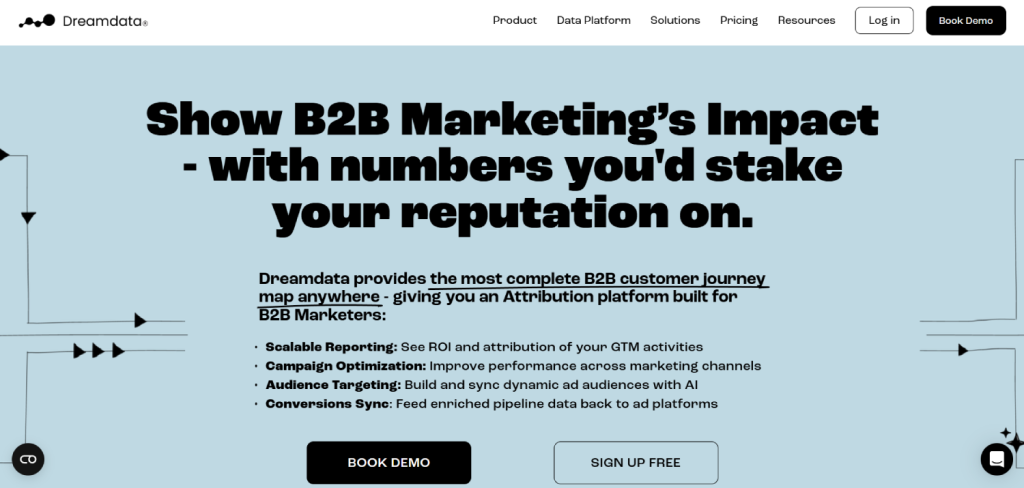
Dreamdata is the most complete purpose-built B2B revenue attribution platform on this list. It was built from the ground up for account-based go-to-market teams and connects every touchpoint, from first anonymous visit to closed-won, into a single account timeline. The platform pulls data from your CRM, ad platforms, marketing automation, product analytics, and customer success tools, then builds a unified account view for every deal in your pipeline.
Where Dreamdata stands out technically is in its handling of anonymous-to-known identity resolution. It matches early, pre-form-fill website sessions to accounts using IP enrichment and domain matching, which means a prospect who reads your pricing page twice before ever submitting a form still appears in the attribution model. Most tools only start the clock at the first identified touchpoint.
Dreamdata publishes a free tier for small teams and a Growth plan starting at $999 per month as of their public pricing page, with Enterprise pricing on request. It connects natively to Salesforce, HubSpot, Pipedrive, and several marketing automation platforms. Best fit for B2B SaaS teams with a dedicated marketing operations function and deal sizes that justify tracking attribution across months-long cycles.
2. HockeyStack
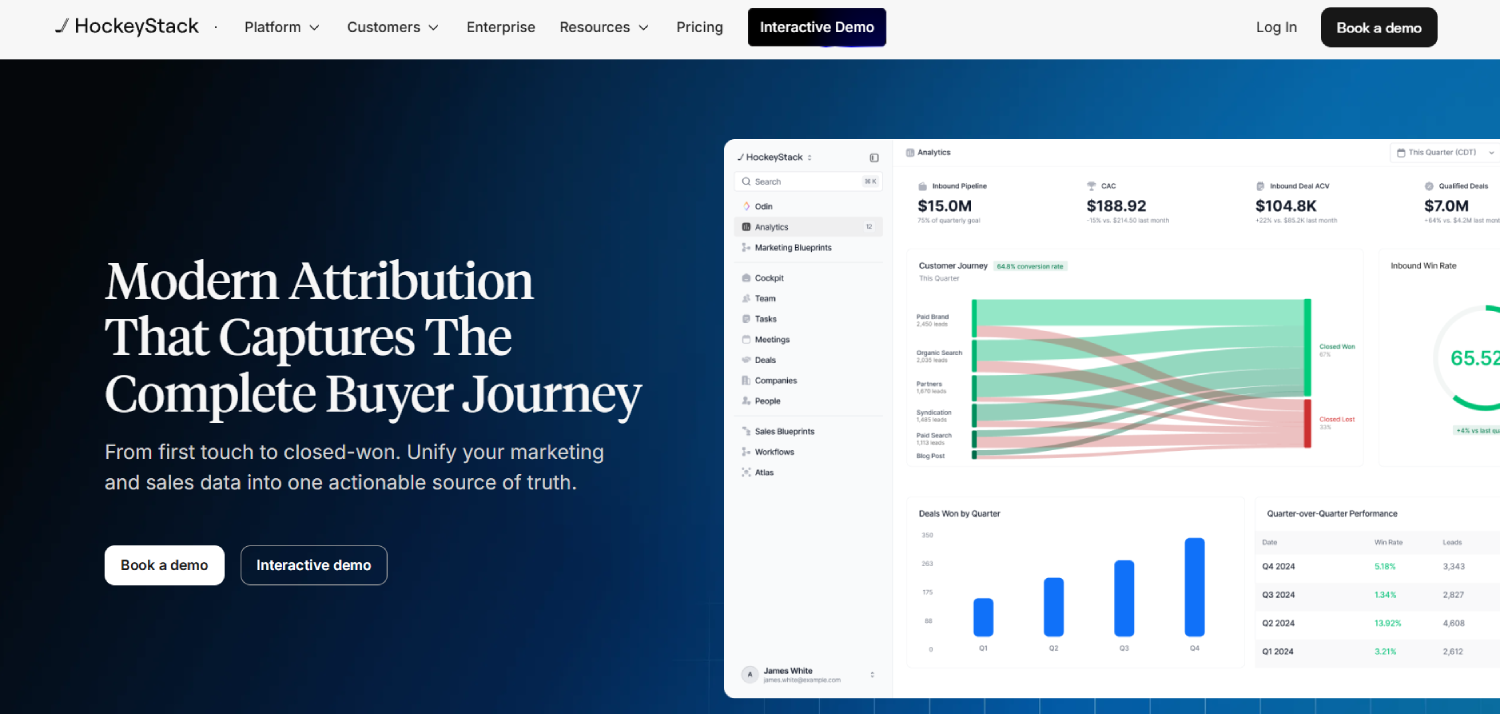
HockeyStack took a different approach to B2B attribution than most of its competitors. Rather than building a pre-defined multi-touch model, it lets revenue and marketing teams build custom attribution rules in a no-code query interface, almost like a BI tool with attribution logic baked in. That flexibility makes it unusually powerful for teams whose attribution questions do not fit a standard first-touch or linear model.
The platform handles account-level attribution and pipeline influence reporting, and it integrates with Salesforce, HubSpot, LinkedIn Ads, Google Ads, and intent data providers like G2. One notable feature is its LinkedIn attribution, which tracks organic LinkedIn content influence on pipeline, not just paid. For teams investing heavily in dark social, that closes a meaningful gap.
HockeyStack does not publish pricing publicly; plans are quote-based. It tends to position toward mid-market and enterprise B2B companies with active demand generation programs and a need for board-level pipeline reporting. If you want a tool that writes the attribution model for you, look elsewhere. If your team has the analytical maturity to define what you want to measure, HockeyStack gives you the infrastructure to measure it.
3. Bizible (Adobe Marketo Measure)
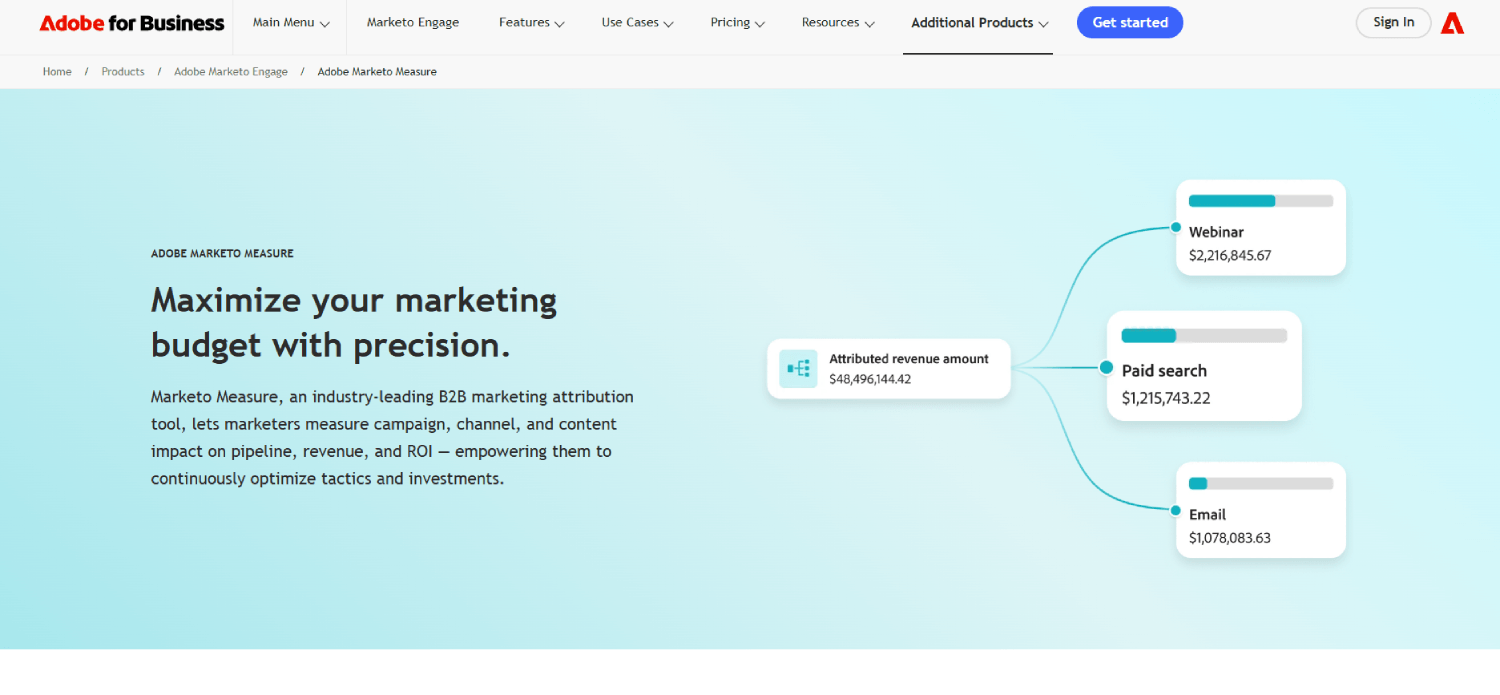
Bizible, now branded as Adobe Marketo Measure, has been the incumbent B2B attribution platform for Salesforce shops for over a decade. It embeds directly into Salesforce, adding attribution touchpoint objects to every lead, contact, and opportunity record. The major advantage is that attribution data lives inside the CRM where sales and marketing already operate, which eliminates the reporting gap between marketing dashboards and sales pipeline views.
Bizible supports every standard multi-touch model, including first touch, lead creation, U-shaped, W-shaped, and full path, plus custom weighting. The W-shaped model, which distributes credit to the first touch, lead creation touch, and opportunity creation touch, is particularly relevant for B2B teams that track MQL-to-SQL conversion as a discrete stage.
Pricing is not publicly disclosed; it is bundled with Adobe Marketo Engage at the enterprise tier. That makes it effectively inaccessible to companies that do not already run Marketo. For Salesforce plus Marketo shops with enterprise budgets, it remains the most deeply integrated option. For everyone else, the acquisition into Adobe has created an enterprise pricing structure that prices out most mid-market buyers.
4. Rockerbox
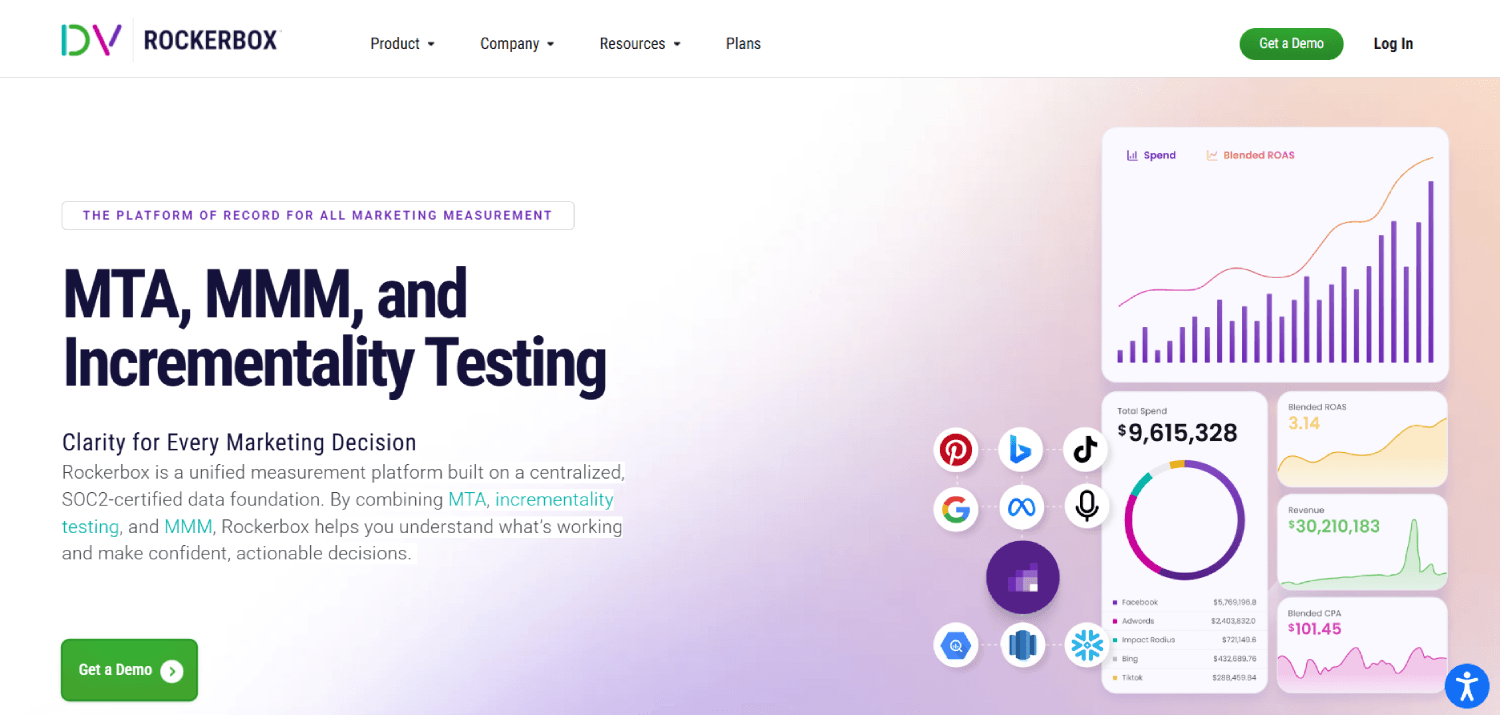
Rockerbox started as a direct-to-consumer attribution platform. Its strength is channel-level marketing mix analysis: it ingests spend and conversion data across paid and organic channels and models contribution using both rule-based and data-driven attribution. For B2B teams running significant paid media budgets across Google, Meta, LinkedIn, and programmatic, Rockerbox provides cleaner cross-channel spend allocation than most CRM-embedded tools.
The platform supports custom attribution windows, which is the minimum requirement for long-cycle B2B work. Where Rockerbox has real limits for B2B is at the account level: it does not resolve buying committee members into a unified account record the way Dreamdata or HockeyStack do, and its CRM integration writes to lead and contact records rather than opportunities. That makes it a fit for B2B teams whose primary attribution question is “which paid channels drive pipeline conversions” rather than “which touchpoints across six buying committee members influenced this specific deal.” If account-level buying committee attribution is the core requirement, look at Dreamdata or HockeyStack first. Pricing is quote-based. For a broader comparison of attribution tools across both B2B and B2C use cases, the best marketing attribution tools for proving revenue impact covers the full range in more depth.
5. Terminus
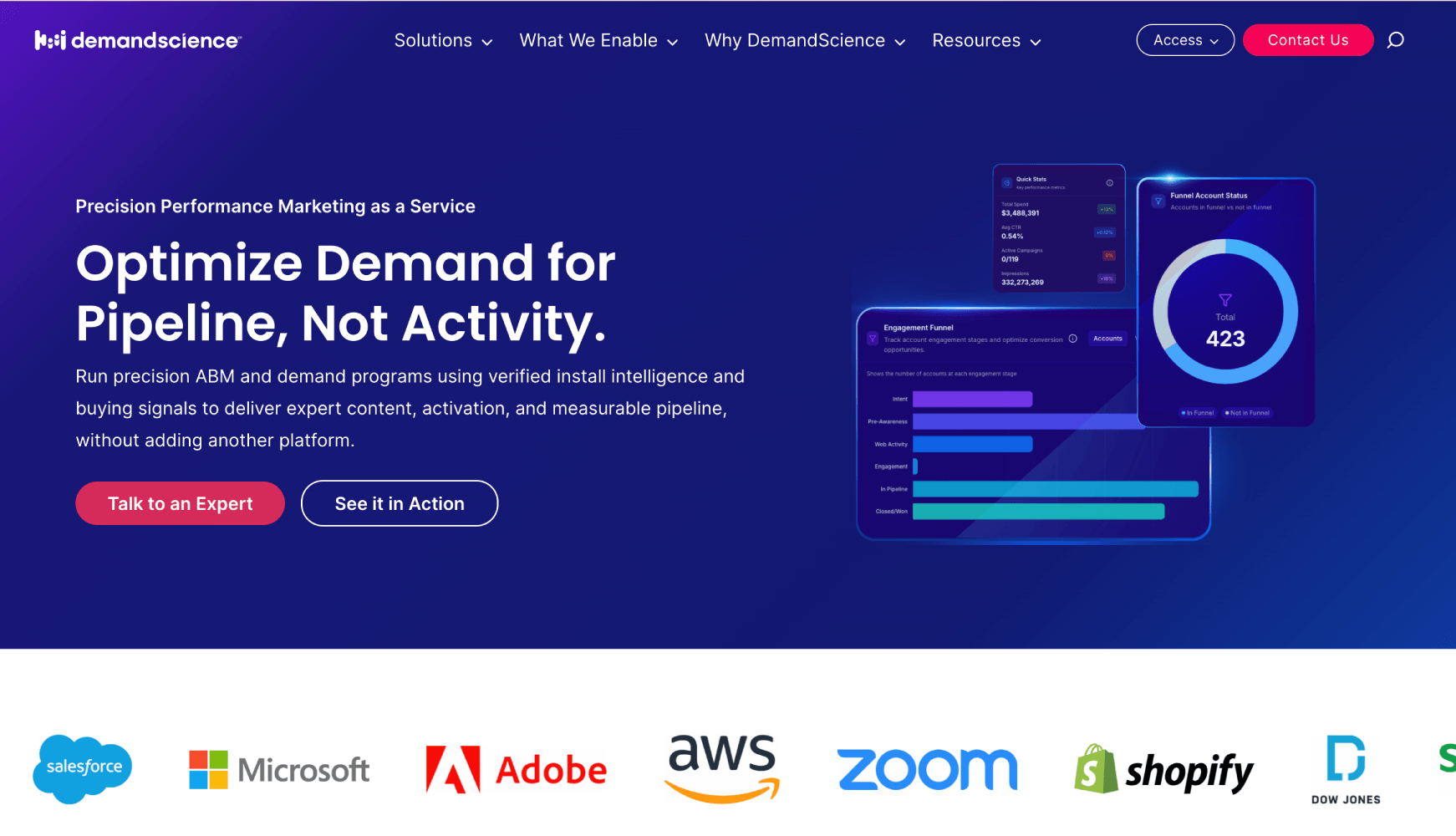
Terminus is primarily an ABM platform, but its attribution and intent reporting capabilities are strong enough to warrant inclusion here. Because Terminus tracks account-level engagement across display advertising, email, web, and chat, it generates attribution data that is native to an account-based model rather than retrofitted from a contact-level system.
The key use case is intent-to-pipeline attribution. Terminus connects account-level intent signals, such as rising research activity on competitor keywords or increased ad engagement, to pipeline stage progression. That gives demand-gen teams evidence for which ABM activities moved accounts through the funnel, not just which clicked an ad. Pricing is not publicly disclosed and is enterprise-tier.
Terminus makes most sense for companies already running an ABM program who want attribution built into their ABM platform rather than a standalone analytics tool. Teams looking for a pure attribution solution should consider Dreamdata or HockeyStack instead.
6. CaliberMind
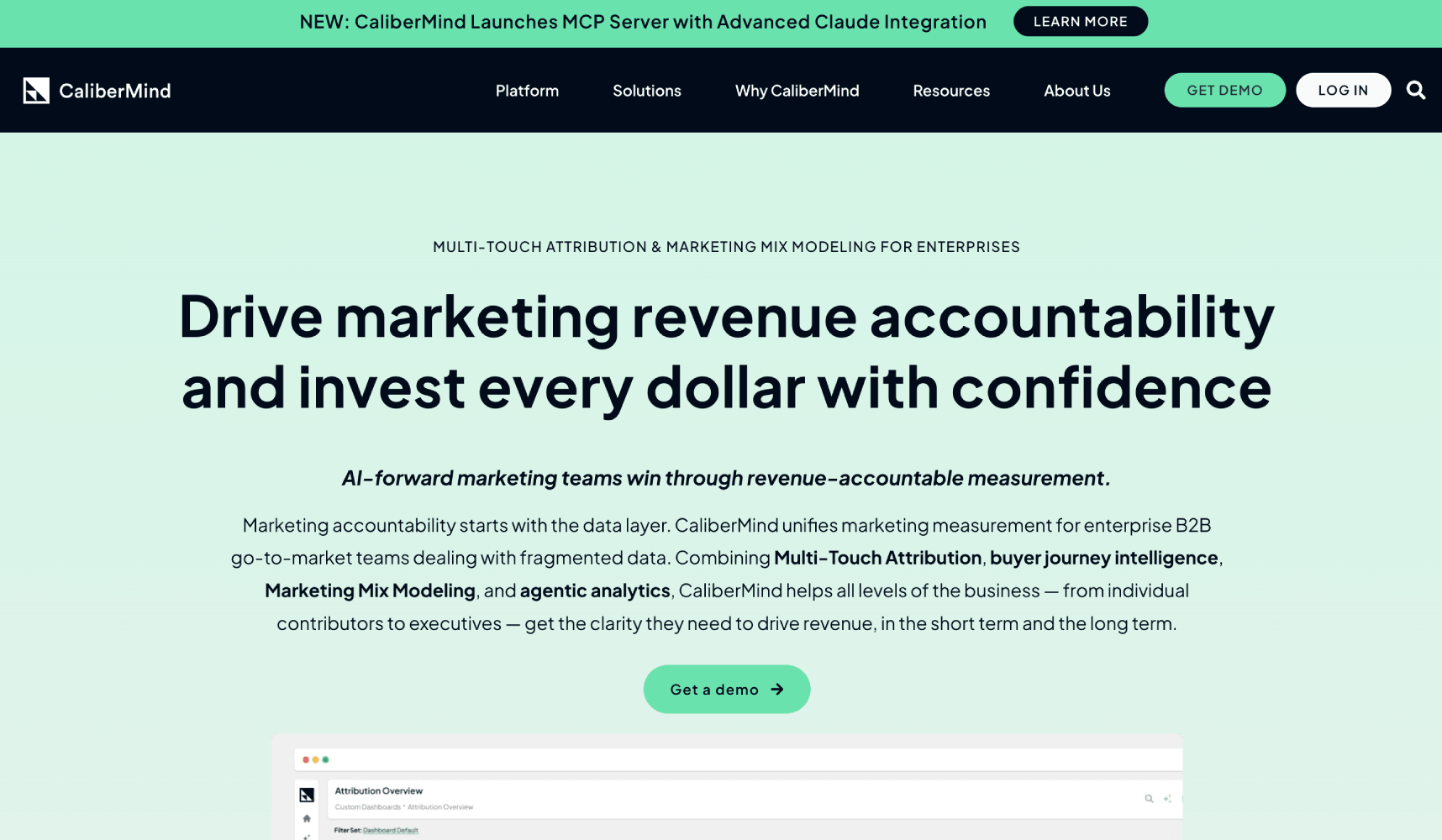
CaliberMind focuses specifically on the B2B pipeline analytics problem and sits closer to the revenue operations toolset than the marketing analytics category. It pulls data from Salesforce, marketing automation platforms, and ad channels, then builds account-level attribution and pipeline influence reports designed for RevOps and CMO audiences.
One area where CaliberMind has historically been strong is buyer journey analytics: it surfaces which content assets, campaigns, and channels appear most frequently in the paths of deals that close versus deals that stall. That is meaningfully different from standard attribution, which distributes credit but does not surface patterns across many deals simultaneously. Pricing is quote-based and positioned toward mid-market and enterprise teams.
CaliberMind fits well inside a RevOps function that needs to present pipeline influence data to a board without building custom Salesforce reports from scratch. For teams whose data already lives cleanly in a warehouse, connecting a CDP to attribution may be a more cost-effective path. The relationship between CDPs and attribution pipelines is covered in more detail in the best B2B customer data platforms comparison.
7. Triple Whale

Triple Whale is an honest inclusion with a narrow use case. It is primarily a D2C and e-commerce attribution platform, and its core architecture reflects that: no native account-level identity resolution, no CRM opportunity integration, and attribution windows calibrated for short conversion cycles. It earns a spot here because a specific subset of B2B companies, those running product-led growth motions with self-serve conversion paths and sales cycles under 30 days, find its blended attribution and media mix modeling useful for managing paid channel spend. If that description does not match your business, skip it.
For a traditional enterprise B2B motion with a 90-plus day sales cycle and a multi-person buying committee, Triple Whale is not the right tool. For B2B companies closer to the B2C end of the spectrum, including PLG SaaS businesses where an individual user signs up and converts before a procurement process begins, it can provide cleaner paid media attribution than CRM-embedded tools. Pricing starts at $129 per month as of their public pricing page, which makes it the most accessible entry point on this list.
B2B Attribution Tool Comparison: Feature Matrix
| Tool | Account-Level Attribution | Custom Attribution Windows | CRM Integration Depth | Best For | Pricing Model |
|---|---|---|---|---|---|
| Dreamdata | Yes | Yes (custom) | Opportunity-level | Full-funnel B2B SaaS | From $999/mo (public) |
| HockeyStack | Yes | Yes (custom) | Opportunity-level | Custom attribution modeling | Quote-based |
| Bizible / Marketo Measure | Yes | Yes | Deepest (native Salesforce) | Salesforce + Marketo shops | Enterprise / bundled |
| Rockerbox | Partial | Yes (custom) | Lead/contact-level | Paid media channel mix | Quote-based |
| Terminus | Yes (native ABM) | Yes | Opportunity-level | ABM teams tracking intent-to-pipeline | Enterprise / quote-based |
| CaliberMind | Yes | Yes | Opportunity-level | RevOps pipeline reporting | Quote-based |
| Triple Whale | No | Limited | Light | PLG / high-velocity B2B | From $129/mo (public) |
What Does B2B Attribution Software Actually Cost?
Most of the tools built specifically for enterprise B2B attribution do not publish pricing, which tells you something about where these deals get made. CaliberMind, HockeyStack, Terminus, and Bizible all require direct sales conversations. Dreamdata is the notable exception with a published starting price of $999 per month, which puts a floor on what purpose-built B2B attribution costs.
The hidden cost in any attribution implementation is data integration work. Getting Salesforce opportunity data, marketing automation touchpoints, ad platform spend, and offline channel records into a single attribution model requires either a strong native connector set or a data engineering investment. Tools like Dreamdata and HockeyStack have invested heavily in pre-built connectors precisely because integration failure is the primary reason attribution projects stall.
For teams whose primary challenge is getting clean data into attribution tools in the first place, the relationship between attribution and the broader data stack matters. Reverse ETL tools that push warehouse data back into CRMs and analytics platforms are often a prerequisite for making attribution work well. The best reverse ETL tools for activating warehouse data covers that layer of the stack if your data plumbing needs attention before attribution makes sense.
How Should B2B Teams Model Credit Across a Multi-Person Buying Committee?
The W-shaped and full-path models are the most defensible starting points for most B2B companies. The W-shaped model credits three milestone touchpoints equally: first touch, lead creation, and opportunity creation. It acknowledges that both demand generation and pipeline acceleration matter, rather than over-weighting either end of the funnel.
The full-path model adds a fourth milestone: the customer conversion touch. For companies where post-opportunity nurture, proposals, and legal review take weeks, full-path gives credit to late-stage marketing touches that a W-shaped model ignores.
Custom data-driven models are the theoretical gold standard but require large datasets of closed deals to produce statistically reliable weights. Most mid-market B2B teams do not have enough closed deals per quarter to train a reliable algorithmic model. W-shaped is the practical choice for companies with fewer than 50 closed deals per month. Data-driven attribution becomes worth the investment at higher deal volumes, which is one reason enterprise software companies invest in it earlier than their mid-market counterparts.
One structural issue most teams underestimate is MQL-to-SQL leakage: marketing attributes a campaign to an MQL but the opportunity never gets created in Salesforce, so the attribution chain breaks before it reaches revenue. The fix is ensuring your attribution tool reads opportunity creation, not just lead creation. Every tool in this list handles this, but your CRM data quality has to support it.
When Is a Standalone Attribution Tool the Wrong Answer?
Attribution software does not fix bad tracking infrastructure. If your UTM parameters are inconsistently applied, your CRM has duplicate account records, or your marketing automation platform is not logging every touchpoint to the contact record, adding an attribution tool layers analysis on top of bad data. The output will be wrong, and confidently wrong is worse than admittedly incomplete.
Before buying any attribution tool, audit three things: UTM consistency across every paid channel, Salesforce or HubSpot account deduplication rates, and the completeness of activity logging in your marketing automation platform. If those three are clean, attribution software will return reliable answers quickly. If any one is broken, fix it first.
Teams building a more sophisticated data foundation sometimes find that the attribution capability they need is already available inside their CDP or warehouse, without a dedicated attribution tool. If you are already running a warehouse-native CDP, check whether it offers pipeline attribution before adding another vendor. The best warehouse-native CDPs for modern data stacks covers which platforms have moved into analytics territory.
Frequently Asked Questions About B2B Attribution Software
What is account-level attribution and why does it matter for B2B?
Account-level attribution maps marketing touchpoints to a company entity rather than an individual contact. In B2B buying, multiple people from the same organization typically engage with your content before a deal closes. Contact-level attribution misses this by treating each person as a separate path. Account-level attribution stitches those individual interactions together into a single account view, which gives marketing a more accurate picture of what influenced a deal.
How long should my attribution window be for B2B sales cycles?
Your attribution window should match or slightly exceed your median sales cycle length. If your median sales cycle is 90 days, use a 90 to 120 day window. Most purpose-built B2B attribution tools support custom windows up to 365 days or longer. Using a default 30-day window on a long B2B cycle systematically undercredits top-of-funnel content and inflates the apparent value of late-stage touchpoints, which can cause teams to cut early-funnel investment that is actually generating pipeline months later.
Can I use Google Analytics 4 for B2B attribution?
GA4 can provide useful channel-level data but has three specific gaps that make it a poor fit for B2B attribution. First, it does not natively support account-level identity resolution, it tracks sessions and users, not companies or buying committees. Second, it has no connection to CRM opportunity data, so there is no way to tie a web session to a closed-won deal without significant custom engineering. Third, its default attribution windows and models are calibrated for e-commerce conversion paths, not 90-plus day B2B sales cycles. Teams that need GA4 alternatives better suited to B2B reporting can review the best Google Analytics 4 alternatives for marketers who need more control. For full B2B pipeline attribution, a dedicated tool from this list is a more appropriate fit.
Does Bizible work without Marketo?
Bizible (Adobe Marketo Measure) can connect to other marketing automation platforms including Pardot and HubSpot, but its deepest integration is with Marketo Engage. The product is sold as part of Adobe’s enterprise marketing suite, and pricing reflects that. Buyers not already in the Adobe stack will find it difficult to access at a mid-market budget, and the native Salesforce integration, while deep, is available from other vendors without requiring an Adobe contract.
What is the difference between attribution and marketing mix modeling for B2B?
Attribution tracks individual touchpoints across a buying cycle and assigns credit to each. Marketing mix modeling (MMM) uses statistical regression to estimate the contribution of marketing channels at an aggregate level without requiring individual touchpoint data. Attribution is better for campaign-level optimization and CRM-connected reporting. MMM is better for measuring channels that do not generate trackable clicks, such as out-of-home, podcasts, or brand advertising. Most B2B teams benefit from both, but attribution is the practical starting point because it connects directly to CRM pipeline data.
What should I look for in B2B attribution software if I run an ABM program?
Prioritize tools that handle account-level attribution natively, not as a bolt-on feature. You want the ability to track engagement across everyone at a target account, connect that engagement to opportunity stage progression, and measure pipeline influence by channel and campaign. Terminus builds this natively because it is an ABM platform. Dreamdata and HockeyStack both support ABM workflows through account-level reporting. Tools built on contact-level or session-level data models require significant configuration to approximate account-level reporting and often miss anonymous pre-form touchpoints entirely.
The Single Most Important Variable in Choosing a B2B Attribution Tool
CRM data quality and architecture determine whether any attribution tool works, more than the tool’s features. Every platform on this list can produce meaningful pipeline attribution reports when the underlying CRM is clean: opportunities properly linked to accounts, lead conversion mapped to contact records, deal values and close dates populated consistently. When the CRM is not clean, no attribution tool can compensate. The sophistication of the attribution model matters far less than the integrity of the input data.
The practical implication for buyers is to sequence the investment correctly. If your Salesforce or HubSpot data is messy, a six-month RevOps cleanup project will return more value than any attribution software purchase. Once the data foundation is solid, the right tool is the one that matches your go-to-market motion: Dreamdata or HockeyStack for teams that want depth and flexibility, Bizible for Marketo shops already inside Adobe, Terminus for ABM-first programs, and CaliberMind for RevOps teams that need board-ready pipeline reporting without building it in Salesforce reports.
The broader point about attribution that most vendors avoid saying directly: attribution is a model, not a measurement. Every model is wrong in some way. The goal is to choose a model that is wrong in ways that do not drive bad decisions, and to make sure your whole go-to-market team understands that caveat. The teams that get the most value from B2B attribution software are the ones who use it to ask better questions about their pipeline, not the ones who treat the output as ground truth.