
- GA4 is not the only free or low-cost web analytics option. Several alternatives cost less than $20/month to start and deliver cleaner data with less configuration work.
- Privacy-first tools like Plausible and Fathom operate without cookies, which removes the consent-banner requirement for many EU and UK deployments and simplifies GDPR compliance significantly.
- Matomo and Piwik PRO offer self-hosted options that give marketing and legal teams full data ownership, a meaningful difference when your DPA or InfoSec team objects to Google’s data processing terms.
- GA4’s event model is powerful but front-loaded: it rewards teams with dedicated analytics engineers. If you lack that resource, you will spend months on configuration before seeing useful reports.
- The right alternative depends on whether your gap with GA4 is complexity, privacy compliance, or depth of behavioral analysis. These are three different problems with three different tool categories.
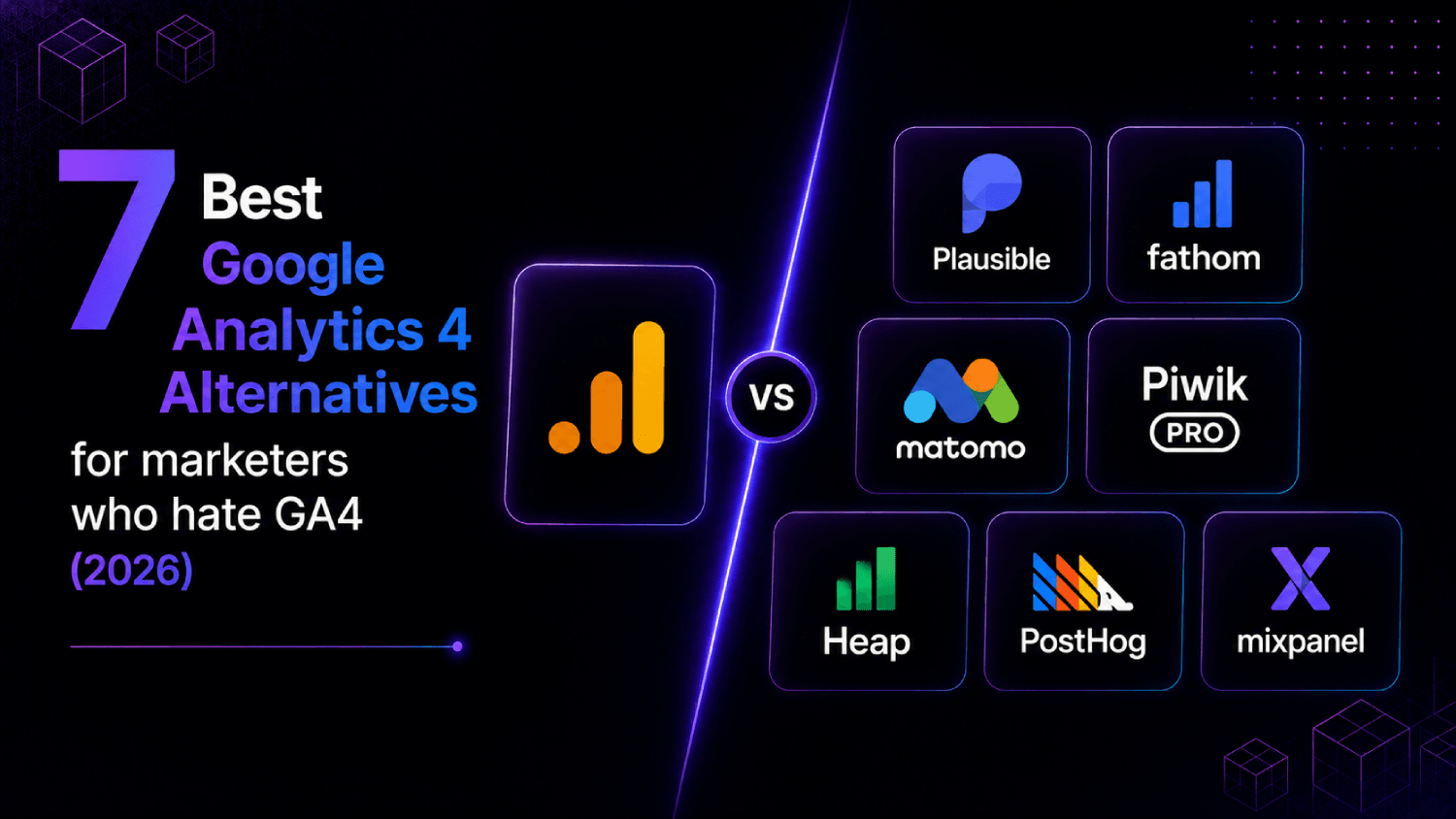
The best Google Analytics 4 alternatives include Plausible, Fathom, Matomo, Piwik PRO, Heap, PostHog, and Mixpanel. Plausible and Fathom are the simplest drop-in replacements for teams that want cookieless, GDPR-compliant tracking with no analytics engineer required. Matomo and Piwik PRO suit regulated industries needing full data ownership. Heap, PostHog, and Mixpanel go deeper on product and behavioral analytics for SaaS and product-led growth teams.
Why Are So Many Marketers Looking for GA4 Alternatives in the First Place?
GA4 launched as a complete rebuild of Universal Analytics, and it shows. The interface redesigned around an event-based data model that treats every user interaction as a custom event, which is technically correct but practically hostile to anyone who just wants to know where their traffic comes from and which pages convert.
The friction compounds quickly. Setting up conversions requires configuring events in the interface or via Google Tag Manager. Sampling kicks in on free accounts for high-traffic properties. Sessions and bounce rate now calculate differently than they did in Universal Analytics, so year-over-year comparisons require explanation. And Google’s data retention default sits at two months, which means historical analysis beyond that window requires BigQuery exports or manual workarounds.
There is also a structural issue. GA4’s terms of service require sending user data to Google’s servers, processed under Google’s privacy policy. For companies in regulated industries, or those selling to enterprise buyers with strict data processing agreements, that arrangement creates compliance friction that no amount of consent mode configuration fully resolves.
The AboutMartech GA4 Escape Test: Four Questions Before You Switch
Before evaluating any alternative, run what we call the GA4 Escape Test: four questions that identify whether you are solving a complexity problem, a privacy problem, a depth-of-data problem, or simply a cost problem. The answer determines which category of tool you actually need.
- Can your team configure and maintain GA4 without an analytics engineer? If no, you need a simpler tool, not a more powerful one.
- Does your legal or compliance team have objections to Google processing your visitor data? If yes, you need a self-hosted or EU-hosted option with a data processing agreement that satisfies your DPA.
- Do you need behavioral analytics beyond pageviews: funnels, retention cohorts, session replays? If yes, you need a product analytics platform, not a pageview counter.
- Are you paying for GA4 360 or relying heavily on BigQuery integration? If yes, switching costs are higher and you should evaluate warehouse-native options carefully.
Most GA4 frustration maps to questions one or two. Most teams reaching for Heap or Mixpanel are solving question three. These are different products solving different problems, and conflating them leads to expensive mistakes.
Which GA4 Alternative Is Best for Simple Traffic Reporting?
1. Plausible Analytics
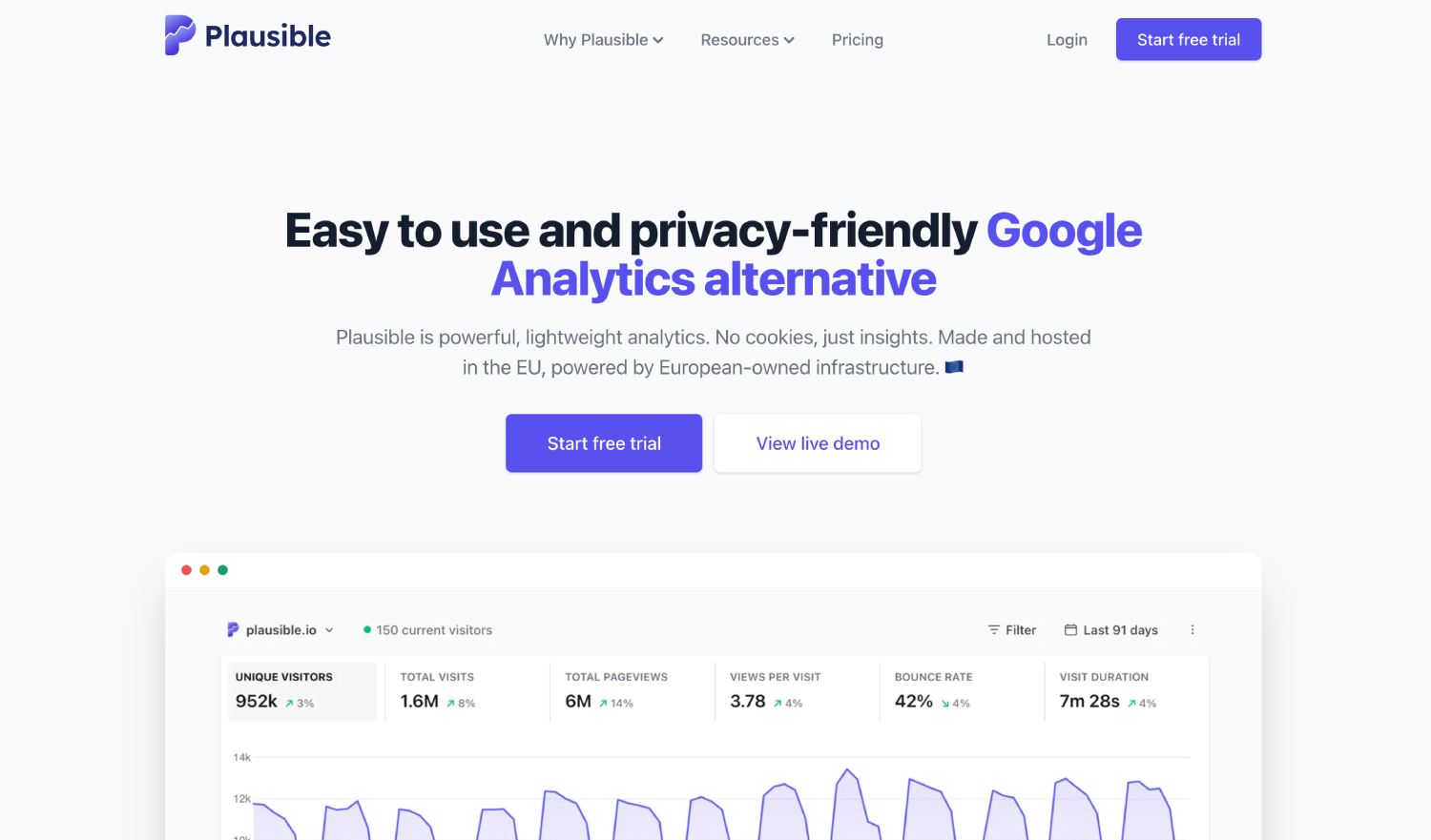
Plausible is the most direct answer to GA4 complexity. The entire product fits on a single dashboard: pageviews, unique visitors, bounce rate, session duration, top sources, top pages, and goal conversions. There is nothing else to configure.
Plausible is cookieless by design, which means no consent banner is required under GDPR, CCPA, or PECR for most standard implementations. The script weight is under 1KB, compared to roughly 45KB for the Google Tag Manager container plus GA4 script. That matters for Core Web Vitals. The company is incorporated in the EU and stores data on EU-owned infrastructure, which simplifies data processing agreements for European marketing teams.
Pricing starts at $9/month for up to 10,000 monthly pageviews as listed on Plausible’s public pricing page, scaling by traffic volume. There is no free tier, but there is a 30-day trial. The trade-off is obvious: if you need user-level behavioral analysis, funnel visualization beyond simple goal completions, or custom dimensions, Plausible runs out of road quickly. It is designed to do one thing well.
Best for: Content sites, marketing agencies managing multiple client properties, and any team where the current GA4 install is mostly unused because nobody wants to learn the interface.
2. Fathom Analytics
Fathom occupies nearly the same market position as Plausible, with a few meaningful differences. Fathom routes traffic through its own servers before logging it, which the company argues makes it more resistant to ad blockers than first-party script setups. Its EU isolation feature routes EU visitor data exclusively through EU servers before it touches any US infrastructure, a claim Plausible also makes through its data residency setup.
Fathom’s event tracking model is slightly more flexible than Plausible’s, allowing custom event attributes that can distinguish between, say, two different CTA buttons on the same page. Neither tool approaches GA4’s depth here, but Fathom edges ahead for teams with moderate customization needs who still want to avoid a full analytics engineer engagement.
Pricing starts at $14/month for up to 100,000 monthly pageviews according to Fathom’s public pricing page. That is more expensive per pageview than Plausible at lower traffic volumes but less expensive at higher ones. Fathom also charges per site rather than per pageview bucket, which is simpler for multi-site setups.
Best for: SaaS companies and publishers that need clean traffic data, solid EU compliance, and are willing to pay a modest premium for slightly better ad-blocker resilience and cleaner multi-site billing.
Which Alternatives Give You Full Data Ownership?
3. Matomo

Matomo is what you deploy when your legal team has specifically said no to any third-party data processing. The self-hosted version is free and open-source. You run it on your own server, the data never leaves your infrastructure, and Matomo’s feature set is close enough to Universal Analytics that migration from the old Google product feels familiar.
The catch is operational overhead. Self-hosting Matomo means your team handles updates, server capacity, and database maintenance. A mid-size marketing team running 5 million monthly events will need meaningful infrastructure. Matomo Cloud removes that burden but reintroduces a third-party processor, which partially defeats the purpose for compliance-driven buyers.
Matomo’s feature set is genuinely deep: funnels, cohorts, heatmaps (via plugin), A/B testing, session recordings, and custom dimensions all exist. The interface has improved significantly over the past two years. For teams that previously lived in Universal Analytics and need a comparable feature surface without Google’s data terms, Matomo is the closest analog available.
Best for: Healthcare, finance, and public sector teams operating under strict data residency requirements, and any organization where a DPA with Google is a non-starter.
4. Piwik PRO
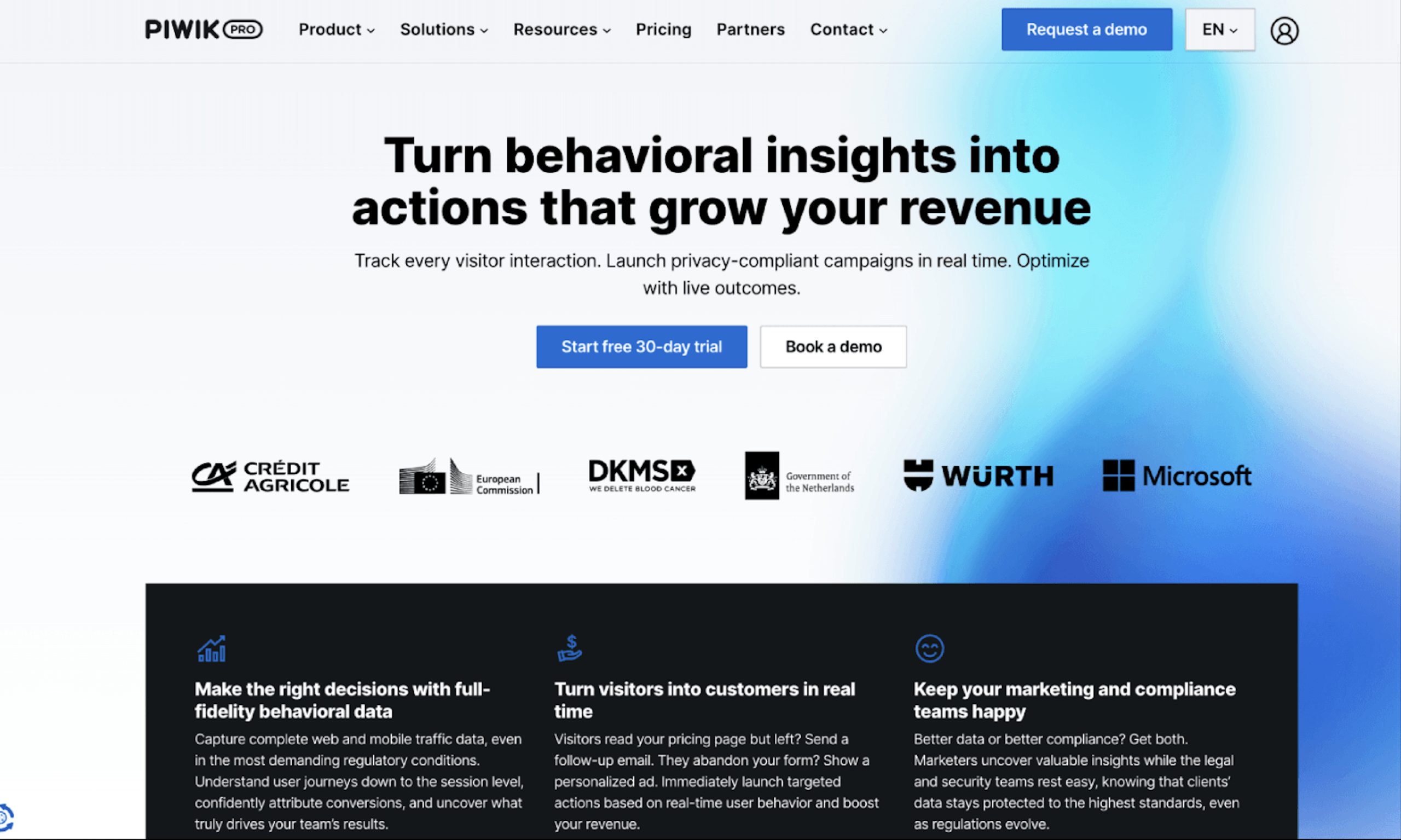
Piwik PRO is Matomo’s more enterprise-ready cousin. It forked from the Matomo codebase years ago and has since built a full Customer Data Platform layer on top, including a tag manager, consent manager, and a customer data module designed to unify behavioral data with CRM records.
The Core tier is free for up to 500,000 monthly actions and includes the full analytics suite, tag manager, and consent manager. That free tier is more generous than GA4’s sampling thresholds for many mid-size sites. The paid Enterprise tier is quote-based and targeted at large organizations needing private cloud or on-premises deployment with SLA commitments.
Piwik PRO’s consent manager is genuinely useful. It handles consent mode v2 compatibility, which matters if you are running Google Ads alongside a privacy-first analytics setup. For teams trying to maintain Google Ads optimization while moving away from GA4 for measurement, that combination is worth examining. If you are evaluating how behavioral data from tools like Piwik PRO connects to your broader customer data infrastructure, the comparison of best customer data platforms for B2B teams covers how CDPs handle this kind of data unification.
Best for: Mid-market and enterprise teams in regulated industries that need a full analytics and consent stack, not just a pageview counter, and want EU data residency with enterprise support terms.
Which Alternatives Go Deeper on Behavioral Analytics?
5. Heap
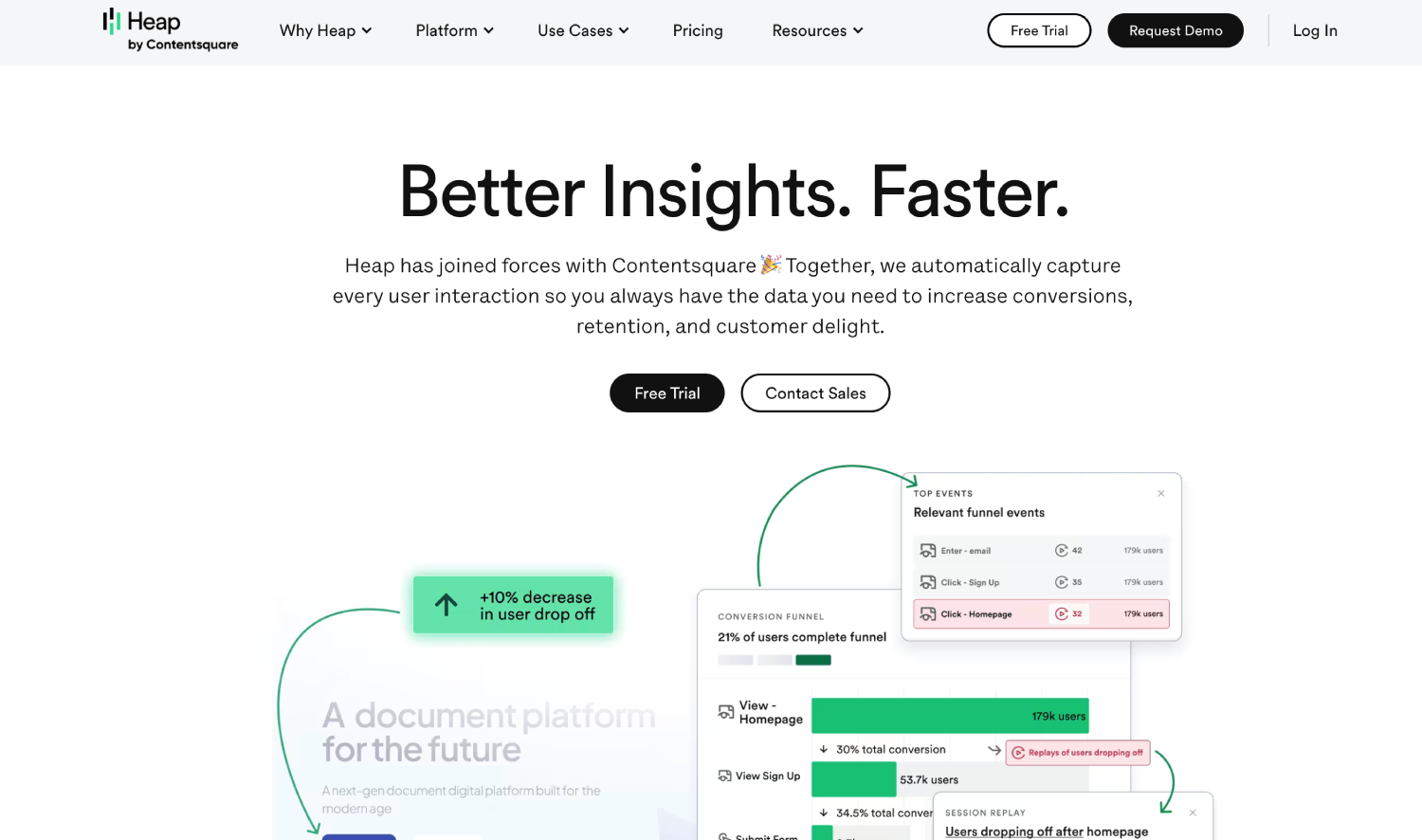
Heap solves a different problem than the privacy-first tools above. Its core feature is retroactive event capture: install one script, and Heap automatically captures every click, form submission, and page view. You define what those interactions mean later, in the interface, without touching code or redeploying tags.
For product-led growth teams, that retroactive model is genuinely valuable. Say a team needs to analyze whether users who clicked a specific in-app tooltip in Q1 converted to paid plans at a higher rate. With GA4, that requires an analyst to have instrumented the tooltip click before Q1. With Heap, you can define that event today and query historical data going back to when the script was installed.
Heap’s pricing is not publicly listed. You will need to request a demo. The product sits above Plausible or Fathom in complexity and is aimed at product and growth teams rather than general marketing. If you are solving for marketing attribution specifically rather than in-product behavioral analysis, Heap may be more tool than you need. Teams working on closed-loop attribution should also evaluate dedicated marketing attribution platforms alongside behavioral analytics tools.
Best for: SaaS product teams that want autocapture and retroactive analysis, and have the product analytics use case front and center, not just traffic reporting.
6. PostHog
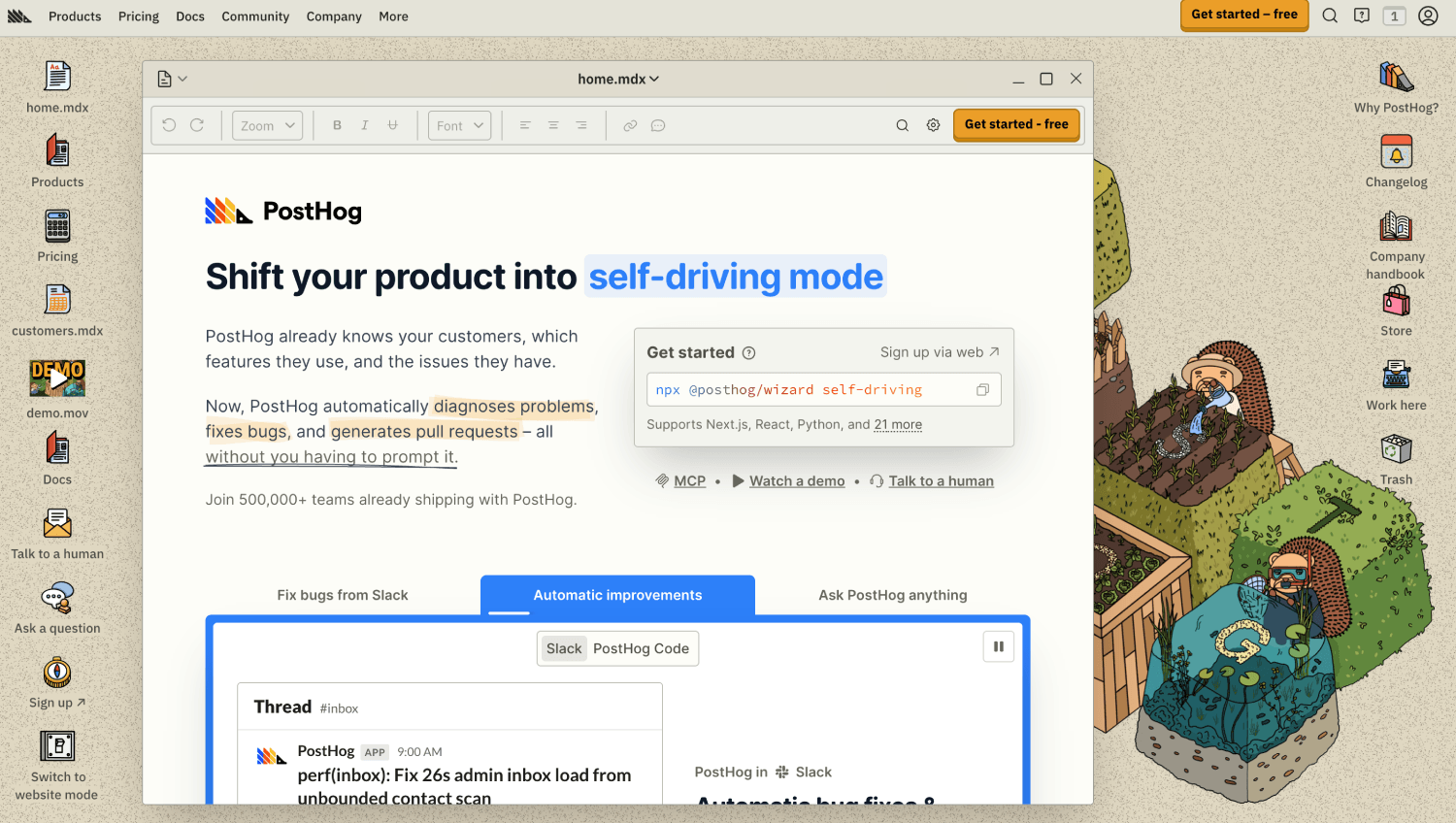
PostHog combines product analytics, session replay, feature flags, A/B testing, and a basic customer data pipeline in one open-source package. The free tier is generous: 1 million events per month at no cost according to PostHog’s public pricing page. Self-hosted deployment means data stays on your infrastructure, which addresses privacy compliance needs for engineering-led teams comfortable running their own stack.
PostHog’s strength is engineering team adoption. The product is built with developers in mind. SDKs exist for every major framework, the query interface exposes raw event data, and the feature flag system integrates directly with deployment pipelines. Marketing teams working closely with engineering will find PostHog more tractable than pure marketing tools. Marketing teams operating independently of engineering will find it requires more setup than Plausible or Fathom.
One underappreciated PostHog feature: its data warehouse connector allows syncing PostHog event data to Snowflake, BigQuery, or Redshift. For teams building a warehouse-first analytics architecture, PostHog can serve as the behavioral data collection layer without locking that data inside a proprietary store. If your team is thinking through how behavioral event data fits into a broader activation strategy, reverse ETL tools are the mechanism that pushes warehouse data back into ad platforms and CRMs.
Best for: Engineering-led SaaS teams that want an all-in-one product analytics and experimentation platform with data portability and a generous free tier.
7. Mixpanel
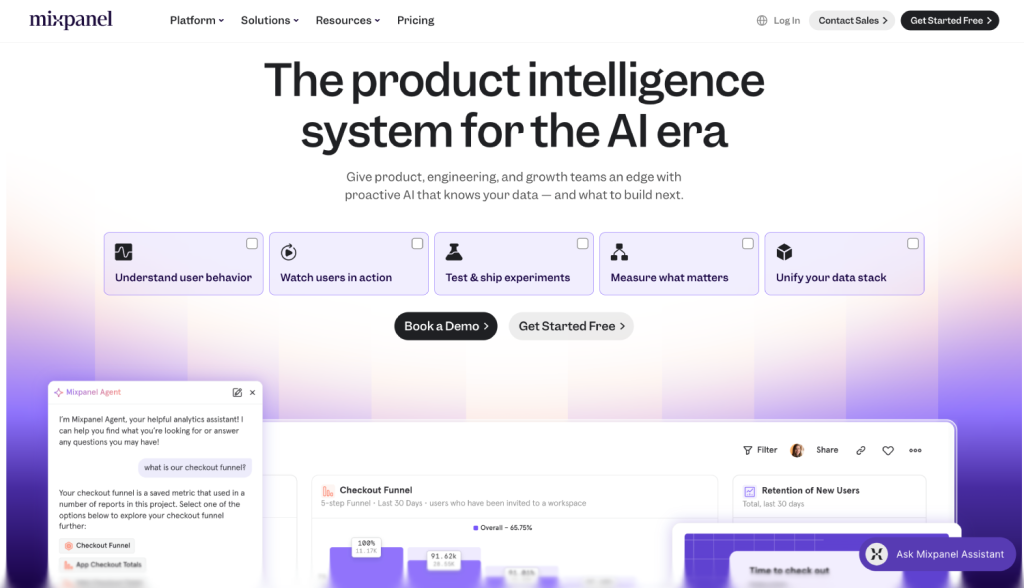
Mixpanel is the most established name in event-based product analytics. Its funnel analysis, retention reports, and segmentation are well-regarded, and it has been the benchmark tool for product analytics teams at consumer and SaaS companies for over a decade.
The free tier covers 20 million monthly events according to Mixpanel’s public pricing page, which is genuinely large. Paid plans start at $28/month. Mixpanel’s data residency options include EU servers, which satisfies most GDPR requirements without self-hosting. The interface is more approachable than GA4 for event-based analysis, though it still assumes familiarity with concepts like funnels and cohort retention. It is not a drop-in replacement for traffic reporting.
Mixpanel’s integration with data warehouses is mature. It can ingest data from Segment, Rudderstack, or direct warehouse connections, making it a reasonable choice for teams that already have a customer data layer and want to add behavioral analytics on top. Teams building that data layer from scratch might find the CDP evaluation process worth completing first, particularly the question of how user identity resolution works across anonymous and authenticated sessions.
Best for: Consumer apps, B2C SaaS, and product-led growth companies that need deep funnel and retention analysis and have a product or analytics team that will actually use Mixpanel’s more advanced reporting features.
How Do These GA4 Alternatives Compare on Key Criteria?
| Tool | Cookieless | Self-host option | Free tier | Paid starts at | Primary use case | GA4 complexity vs. |
|---|---|---|---|---|---|---|
| Plausible | Yes | Yes (open source) | No (30-day trial) | $9/mo | Simple traffic reporting | Much simpler |
| Fathom | Yes | No | No (30-day trial) | $14/mo | Simple traffic reporting | Much simpler |
| Matomo | Configurable | Yes (free) | Yes (self-hosted) | Free (self-hosted) | Full analytics, data sovereignty | Similar complexity |
| Piwik PRO | Configurable | Yes (enterprise) | Yes (500K actions/mo) | Quote-based | Analytics + consent, regulated industries | Similar complexity |
| Heap | No | No | No | Quote-based | Retroactive behavioral analytics | More complex |
| PostHog | No | Yes (open source) | Yes (1M events/mo) | Usage-based above free | Product analytics + experimentation | More complex |
| Mixpanel | No | No | Yes (20M events/mo) | $28/mo | Product analytics, funnel/retention | Similar complexity |
What Does Switching From GA4 Actually Cost?
The tooling cost is rarely the dominant switching cost. The real costs are data migration, tag reconfiguration, and the reports your stakeholders have built mental models around.
Consider a hypothetical scenario: a 50-person B2B SaaS company with 80,000 monthly sessions runs GA4 with 12 custom events, 4 conversion goals, and a weekly leadership dashboard built on Looker Studio connected to GA4’s API. Switching to Plausible means rebuilding that Looker Studio dashboard from Plausible’s API, remapping 12 events to Plausible’s simpler goal system (losing some granularity), and resetting historical baselines. That is two to four weeks of a marketing operations person’s time, conservatively. The Plausible subscription cost is trivial by comparison.
Switching to Matomo self-hosted adds server provisioning and ongoing maintenance. Switching to Piwik PRO Core avoids that but introduces a new tag manager configuration. Switching to Heap or PostHog often means a parallel-run period of 60 to 90 days while you validate data parity.
The teams that underestimate switching costs are almost always the same ones who underestimated GA4’s initial configuration cost. Build the migration timeline honestly before committing. If your team is managing complex data pipelines across multiple tools, the operational model for warehouse-native customer data platforms is worth understanding as a reference architecture for how behavioral data can be centralized regardless of which front-end analytics tool you choose.
Frequently Asked Questions About GA4 Alternatives
Is there a free Google Analytics 4 alternative?
Yes, several. Matomo’s self-hosted version is free and open-source, though you pay for server infrastructure. PostHog’s free tier covers 1 million events per month at no charge. Mixpanel offers a free tier up to 20 million monthly events. Piwik PRO Core is free up to 500,000 monthly actions. Plausible and Fathom have no free tier but offer 30-day trials. None of these are technically free at scale, but the Mixpanel and PostHog free tiers are large enough for many mid-size teams.
Which GA4 alternative is best for GDPR compliance?
Plausible and Fathom are cookieless and require no consent banner for basic traffic measurement under most GDPR interpretations, making them the simplest compliance path. Matomo self-hosted keeps data entirely on your own servers. Piwik PRO has EU data residency options and a built-in consent manager that handles GDPR, CCPA, and consent mode v2 for Google Ads. The right answer depends on whether you need to eliminate third-party processing entirely or simply need an EU-resident processor with a proper DPA.
Can I replace GA4 with Plausible or Fathom for an e-commerce site?
For basic traffic and conversion tracking, yes. Both tools support goal completions and can track revenue events. Neither offers the depth of GA4’s e-commerce reporting, which includes product-level performance, cart abandonment funnels, and promotion tracking tied to Google’s enhanced e-commerce schema. If you run significant Google Shopping or Google Ads campaigns and rely on GA4’s audience signals for bid optimization, removing GA4 entirely will affect campaign performance. A common approach is running Plausible or Fathom as the primary analytics tool while keeping a minimal GA4 implementation for ad platform signals only.
Is Matomo actually comparable to GA4 in features?
For most marketing use cases, yes. Matomo covers traffic sources, campaigns, goal conversions, funnels, cohorts, and custom dimensions. It lacks GA4’s predictive metrics and its direct integration with Google Ads audiences, which are Google-exclusive features. Matomo’s interface is closer to Universal Analytics than GA4, which is a feature for teams migrating from UA. The meaningful trade-off is that Matomo’s self-hosted version requires operational maintenance GA4 does not.
Does switching from GA4 affect Google Ads performance?
It can. GA4’s conversion data feeds Google Ads’ smart bidding algorithms. Removing GA4 as the conversion source requires you to either import conversions from another system or use Google Ads’ own conversion tracking independently. Teams running Target CPA or Target ROAS bidding strategies with heavy reliance on GA4 import will see a temporary performance dip during transition. Importing conversions via Google Ads conversion tags directly, or via a server-side implementation, is the standard mitigation. Plan for four to six weeks of bidding recalibration after switching conversion sources.
What is the easiest GA4 alternative to set up?
Plausible is the fastest deployment. You paste one script tag and the dashboard populates automatically. There are no events to configure, no conversion schemas to define, and no tag manager layers required. Fathom is comparably simple. Both tools are designed specifically around the constraint that a non-technical marketer should be able to install and read the tool without help. PostHog and Heap require more configuration and are better suited to teams with engineering support for the initial setup.
Can these alternatives track AI-driven traffic sources?
Most can identify referral traffic from ChatGPT, Perplexity, and similar AI platforms when those platforms pass referrer headers, but referrer data from AI interfaces is inconsistent. Some AI-generated traffic appears as direct traffic when the referrer is stripped. Dedicated tools for tracking your brand’s visibility in AI search environments go beyond what any of these analytics platforms offer natively. Teams actively managing their presence in AI-generated answers should look at purpose-built AI visibility and brand monitoring tools rather than expecting standard analytics platforms to fill that gap.
Which GA4 Alternative Should You Actually Choose?
If your team’s primary complaint is that GA4 is too complicated and nobody actually looks at it, the answer is Plausible or Fathom. Both are operational within an hour, readable without training, and legally simpler to defend under EU privacy law. The paid cost is small. The configuration cost is nearly zero.
If your compliance team is the blocker, Matomo self-hosted is the benchmark for data sovereignty. Piwik PRO Core is the better choice if you want enterprise-grade compliance tools without running your own infrastructure, and its free tier is sufficient for most mid-size marketing teams.
If you want to replace GA4’s behavioral depth and go beyond it, PostHog and Mixpanel serve different audiences. PostHog fits engineering-led product teams comfortable with open-source deployment. Mixpanel fits growth and product teams that want a polished interface and a broad set of integrations. Neither is a simple swap for a marketing team that just wants to know which blog posts drive the most leads. Know what problem you are actually solving before you evaluate the tool.