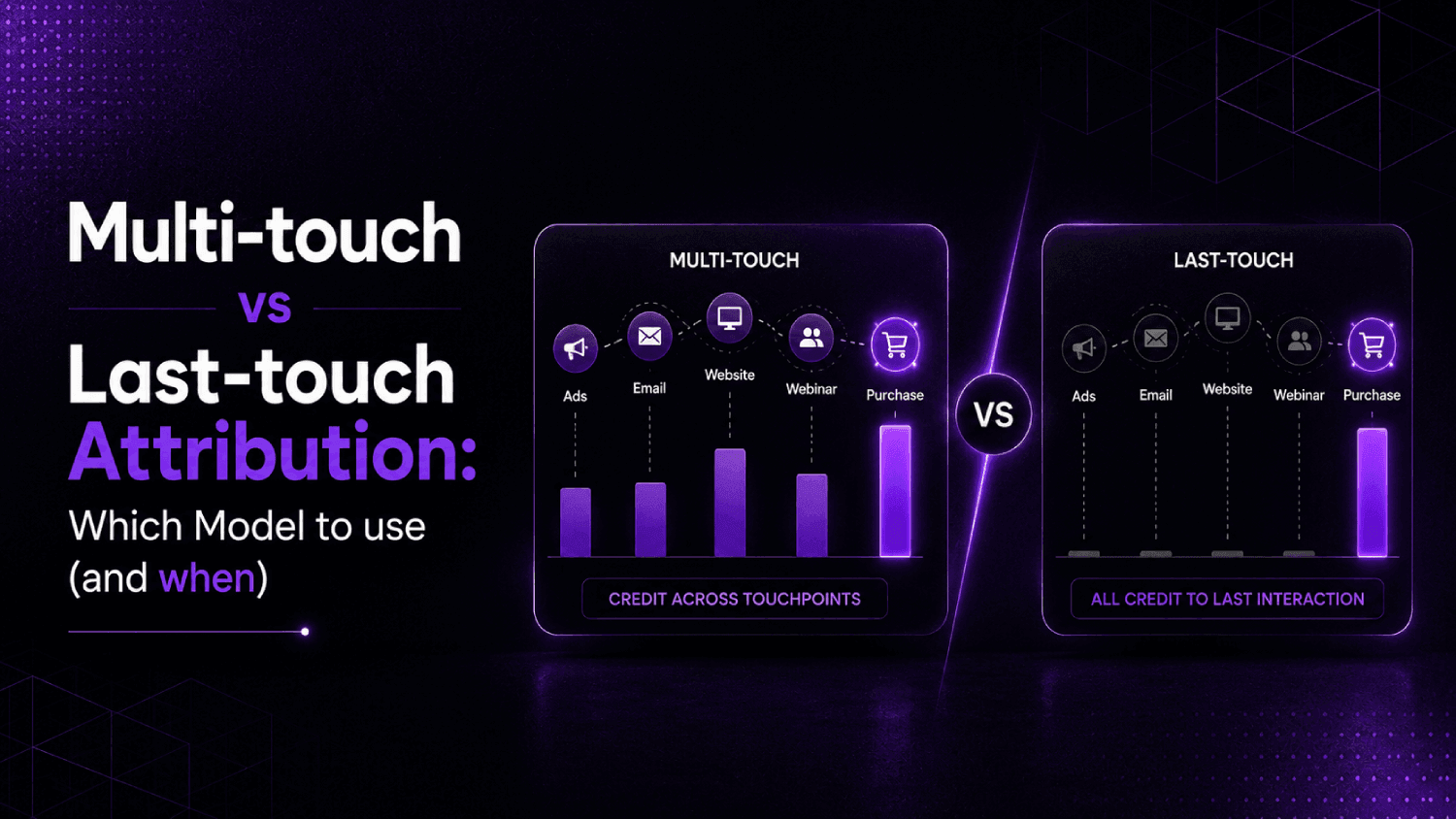
- Last-touch attribution is not wrong by default. It is wrong when your buyers take more than one step before converting, which is most B2B and mid-funnel consumer funnels.
- Multi-touch attribution does not mean “credit everything equally.” Linear, time-decay, U-shaped, and W-shaped models each tell a different story about where budget should go.
- The model you pick changes your actual budget decisions. Teams running last-touch routinely starve top-of-funnel channels that generate pipeline but rarely close it.
- Multi-touch requires cross-channel identity resolution and a clean data layer to produce trustworthy output. Without those, the numbers are noise.
- Most teams should run last-touch for quick tactical decisions and a multi-touch model in parallel for strategic budget planning.
Last-touch attribution gives 100% of conversion credit to the final interaction before a sale. Multi-touch attribution distributes credit across all tracked touchpoints in the buyer path. The multi-touch vs last-touch attribution choice is not purely philosophical: it changes which channels look profitable, which get cut, and how next quarter’s budget gets allocated. Last-touch is faster to set up and sufficient for single-step funnels. Multi-touch is more accurate for complex funnels with multiple channels, and the model type you choose (linear, time-decay, U-shaped, W-shaped, or data-driven) changes which channels appear to be working.
Why Your Attribution Model Changes Real Budget Decisions
Most marketing teams treat attribution as a reporting exercise. It is actually a budget allocation mechanism. The model you choose determines which channels appear profitable and which appear wasteful, and that perception drives where next quarter’s spend goes.
Consider a realistic B2B scenario: a prospect sees a LinkedIn Sponsored Content ad promoting a category comparison post. They do not click. Four days later, they search Google for a competitor comparison, find your organic article, and download a white paper after submitting a form. Two weeks later, they register for and attend a live product webinar, ask two questions in the Q&A, and get added to a follow-up sequence. A week after that, they click a LinkedIn retargeting ad, land on a demo page, and book a call. The demo runs, a second stakeholder joins, and the deal closes three weeks later.
Under last-touch, the LinkedIn retargeting ad gets 100% of the credit. The LinkedIn brand impression, the organic article, the white paper download, and the webinar attendance are invisible to the model. Under a U-shaped model, the organic white paper download (first tracked conversion event) and the demo booking split roughly 40% each, with the webinar and retargeting ad sharing the remaining 20%. Under W-shaped, the white paper download, the opportunity creation event (when the deal entered the CRM pipeline after the demo), and the final close each receive approximately 30%, with the webinar and retargeting ad splitting the last 10%.
Those three reports produce completely different budget recommendations. Last-touch says: double down on LinkedIn retargeting. U-shaped says: protect organic content and the demo conversion path. W-shaped says: the pipeline-creation event deserves its own budget line, meaning the sales conversation and its supporting materials need investment alongside marketing channels.
Now extend that scenario to a buying committee. In enterprise B2B deals, a second stakeholder often enters mid-cycle with their own touchpoint history: they may have attended a different webinar six weeks earlier, read a G2 review, and joined the final demo without ever clicking a paid ad. Last-touch and even basic multi-touch models typically credit whoever submitted the final form, not the economic buyer who drove the decision. That blind spot causes teams to underinvest in the analyst-targeted content and peer review presence that influences the actual decision-maker.
Teams using last-touch consistently tend to over-invest in retargeting and branded paid search because those channels disproportionately appear at the end of paths. Top-of-funnel channels that generate awareness and interest get cut because they rarely touch the final click. The pipeline dries up quietly, and it often takes two or three quarters before anyone connects the cause to the effect.
What Are the Main Attribution Model Types?
Before comparing multi-touch and last-touch directly, it helps to see all the common models in one place. Each one embeds a hypothesis about buyer behavior.
| Model | How Credit Is Distributed | Built-In Assumption | Best Fit |
|---|---|---|---|
| Last-touch (last-click) | 100% to the final touchpoint | The closing interaction is what matters | Short, single-channel funnels; transactional ecommerce |
| First-touch | 100% to the first touchpoint | Awareness drives everything | Brand-building measurement; new market entry |
| Linear | Equal split across all touchpoints | Every interaction contributes equally | Teams that want a baseline without strong assumptions |
| Time-decay | More credit to touchpoints closer to conversion | Recency signals intent | Short sales cycles where recent engagement predicts close |
| U-shaped (position-based) | ~40% first, ~40% last, ~20% distributed across middle | First touch and lead conversion are the highest-value moments | Demand-gen teams managing MQL volume |
| W-shaped | ~30% first, ~30% opportunity creation, ~30% last, ~10% middle | Pipeline creation is a distinct value event worth crediting | B2B teams with a clear opportunity stage in their CRM |
| Data-driven (algorithmic) | Machine learning weights based on actual conversion paths | No manual assumption; the data decides | High-volume teams with enough conversion data to train a model |
The progression from last-touch to data-driven is not a quality ladder. Each model answers a different question. Last-touch answers “what closed the deal?” Data-driven attempts to answer “what combination of touches maximizes conversion probability?” A growth-stage SaaS team closing 30 deals a month does not have enough data to run a statistically valid algorithmic model. They should be on U-shaped or W-shaped, not chasing data-driven because it sounds more sophisticated.
What Is the Actual Difference Between Multi-Touch and Last-Touch Attribution?
Last-touch attribution is mechanically simple: one touchpoint, all credit, done. It works in Google Analytics 4 out of the box, in most CRMs with minimal configuration, and requires no special tooling. For B2C brands selling low-consideration products through one or two channels, it is often good enough.
Multi-touch attribution requires stitching together every interaction across sessions, devices, and channels into a coherent buyer path. That requires identity resolution , the ability to recognize that the same person clicked a LinkedIn ad on their laptop, opened an email on their phone, and attended a webinar on a company machine. Without cross-device stitching, you are measuring fragments, not full paths.
This is where most teams underestimate the implementation complexity. The model itself (U-shaped, W-shaped, etc.) is just math. The hard part is feeding it clean, unified event data that accurately represents how real buyers moved through the funnel. A poorly instrumented multi-touch model produces confident-sounding numbers that are just as wrong as last-touch, but harder to spot as wrong.
The Attribution Signal Chain: What You Need Before Multi-Touch Works
The Attribution Signal Chain is a useful mental model for evaluating whether your team is actually ready for multi-touch. It has four links, and the chain breaks if any one is weak.
- Identity resolution: Can you tie anonymous visits, known contacts, and CRM records into a single buyer profile? Without this, multi-touch models double-count or miss touchpoints entirely.
- Cross-channel event capture: Are you tracking paid ads, organic, email, webinars, direct, and offline interactions (SDR calls, events) in one system? Gaps produce systematic bias toward the channels you do track.
- CRM-to-marketing data alignment: Does your marketing touchpoint data map accurately to CRM opportunity stages? W-shaped and custom models require this alignment to credit pipeline-creation events correctly.
- Conversion volume: Do you have enough closed-won deals to produce statistically meaningful path analysis? Data-driven models need hundreds of conversions minimum. Rule-based multi-touch models (U-shaped, W-shaped) work with lower volumes.
If the first two links are broken, adding a sophisticated attribution model is a reporting cosmetic. It looks more serious, but the underlying signal is still unreliable. Teams working toward a cleaner data foundation often benefit from a customer data platform built for B2B data unification before investing heavily in attribution tooling.
When Last-Touch Attribution Is Actually the Right Call
Last-touch gets unfairly maligned by vendors selling multi-touch software. There are real scenarios where it is the appropriate model.
Single-channel acquisition campaigns are the clearest case. If you run Google Shopping ads and buyers reliably click an ad, visit a product page, and purchase in one session, last-touch is accurate because the last touch is the only touch. Layering multi-touch complexity onto that path adds no information.
Tactical campaign testing is another. When you are A/B testing two ad creatives or two landing pages, you want to know which variant closed more deals. Last-touch gives you that answer directly, without the noise of upstream touchpoint weighting.
Short sales cycles with a single decision-maker also tend to produce last-touch-aligned paths. A one-person startup buying a $49/month tool after a Google search and a short product trial is not exhibiting multi-touch buyer behavior. Modeling it that way adds complexity without accuracy.
When Multi-Touch Attribution Becomes Necessary
The inflection point is usually around three factors: funnel length, channel count, and deal complexity. If any two of these are high, last-touch will mislead you.
B2B SaaS teams with a 30-to-90-day sales cycle and buyers who touch content, ads, email, and sales conversations before signing are the canonical multi-touch use case. The buying committee problem compounds this: enterprise deals often involve multiple stakeholders, each with their own touchpoint history, and last-touch models typically credit whoever filled out the final form rather than the economic buyer who drove the decision.
Multi-channel consumer brands face a similar problem. A customer who sees a Facebook video ad, searches organically, reads a review, and converts via email is following a genuine multi-touch path. Last-touch credits email, which causes email to look like the highest-ROI channel, which causes over-investment in email retention relative to the awareness channels that actually generated the customer in the first place.
Teams managing a complex mix of paid, organic, and owned channels benefit from pairing attribution software with broader measurement approaches. The marketing mix modeling tools built for post-cookie measurement handle the macro-level channel weighting that multi-touch attribution misses at the individual-path level.
Which Attribution Model Should You Actually Use?
The shortest useful answer: start with U-shaped or W-shaped if you have a defined lead-to-opportunity funnel and more than one marketing channel. Use last-touch only if your sales cycle is under a week or you are running single-channel campaigns. Use data-driven only if you have hundreds of conversions per month and a mature data infrastructure.
Here is a decision framework based on team profile:
| Team Profile | Recommended Model | Reason |
|---|---|---|
| Early-stage startup, 1-2 channels, short sales cycle | Last-touch | Complexity overhead outweighs benefit |
| B2B SaaS, demand-gen team, 30+ day sales cycle | U-shaped or W-shaped | Reflects MQL creation and opportunity stages accurately |
| B2C multi-channel, subscription or considered purchase | Time-decay or linear | Recognizes recency without ignoring awareness |
| Enterprise with 500+ closed-won deals/year | Data-driven (algorithmic) | Volume justifies ML weighting; removes manual bias |
| Agency managing clients across multiple verticals | Model per client based on funnel | One-size attribution misleads cross-client reporting |
Running two models in parallel is underused and undervalued. A demand-gen team can use last-touch for campaign-level optimization (which ad closed the most deals this month?) and W-shaped for budget planning (where should we allocate next quarter?). The two models answer different questions and do not need to agree.
What Software Do You Need for Multi-Touch Attribution?
Last-touch runs in Google Analytics 4, Salesforce campaign attribution, and most CRMs without additional tooling. Multi-touch attribution at any meaningful scale requires dedicated software.
The reason is the identity resolution and data stitching problem described above. Platforms like Rockerbox, Northbeam, Triple Whale, Bizible (now Marketo Measure), and Ruler Analytics are built specifically to ingest cross-channel event data, stitch it into buyer paths, and apply multiple attribution models simultaneously. Some use deterministic identity matching (email addresses, login events); others layer in probabilistic methods (IP and device fingerprinting) for anonymous sessions.
B2B teams with long sales cycles have a different set of requirements than B2C performance marketers, and the tool choices diverge accordingly. The best marketing attribution tools reviewed for revenue-focused teams break down those differences in detail, including pricing and integration requirements.
Teams with a warehouse-first data stack should also consider whether they need a dedicated attribution platform or whether their existing data infrastructure can support attribution logic directly. B2B-specific attribution tools built for long sales cycles often handle CRM integration and opportunity-stage modeling better than general-purpose analytics platforms. And for teams evaluating how data moves between the warehouse and downstream marketing tools, reverse ETL tools designed for warehouse data activation are worth understanding alongside attribution platform selection.
Frequently Asked Questions
What is the difference between multi-touch and last-touch attribution?
Last-touch attribution gives 100% of conversion credit to the single touchpoint immediately before a conversion. Multi-touch attribution distributes credit across all tracked interactions in the buyer path, using rules (linear, U-shaped, W-shaped, time-decay) or machine learning to assign weights. The practical difference is that last-touch makes the closing channel look most valuable, while multi-touch exposes the contribution of earlier channels like content, paid social, and brand awareness campaigns.
Is last-click attribution still useful in 2024?
Yes, in specific contexts. Last-click attribution works well for single-channel campaigns, short sales cycles under one week, and tactical A/B testing where you want a direct read on which variant closed more business. It becomes misleading when buyers interact with multiple channels over days or weeks before converting. The problem is not the model itself but applying it to paths it was not designed to measure accurately.
Which attribution model is most accurate?
Data-driven (algorithmic) attribution is theoretically the most accurate because it learns from actual conversion path data rather than imposing a fixed weighting rule. In practice, it requires hundreds of conversions per month and clean cross-channel data to produce reliable output. For most teams, a rule-based multi-touch model like W-shaped or U-shaped is more accurate than last-touch and far more practical than algorithmic models. Accuracy is ultimately bounded by the quality of your event tracking and identity resolution, not by the model’s sophistication.
How does multi-touch attribution handle offline touchpoints?
Multi-touch platforms handle offline touchpoints (trade show scans, SDR calls, in-person events) through CRM integration. When a sales rep logs a call in Salesforce or HubSpot, attribution platforms that sync with those CRMs can include that interaction as a touchpoint in the buyer path. Coverage depends entirely on how consistently your sales team logs activity. Patchy CRM hygiene is the most common reason offline touchpoints are underrepresented in multi-touch models.
What data infrastructure does multi-touch attribution require?
At minimum, you need a way to tie anonymous website visits to known contacts (typically via form fills, login events, or email clicks), cross-channel event tracking (ad platform pixels, email tracking, CRM sync), and a clean matching key (usually email address or a persistent user ID) that follows the buyer across systems. Most dedicated attribution platforms provide their own tracking snippet and CRM connectors to assemble this. Teams on a warehouse-native stack can build attribution logic directly in their data warehouse, but that path requires significant engineering time.
Can I run multiple attribution models at the same time?
Yes, and most serious attribution platforms support model comparison views for this reason. Running last-touch alongside W-shaped, for example, lets you see which channels gain or lose credit under different assumptions. This is particularly useful before switching models, because it shows stakeholders exactly how budget recommendations would change. Most platforms store the raw touchpoint data and apply whichever model you select at query time, so switching models does not require re-collecting data.
How many touchpoints does a typical B2B buyer have before converting?
The number varies widely by deal size, industry, and sales cycle length. Public benchmarks are unreliable because they aggregate across very different buyer types. What is consistent is that enterprise B2B deals almost always involve more touchpoints than SMB deals, and self-serve SaaS conversions typically involve fewer touchpoints than sales-assisted ones. The practical implication is that teams selling higher-ACV products to larger organizations have the most to gain from multi-touch modeling, because the path is complex enough for model choice to materially change budget conclusions.
The Model Is the Lens, Not the Answer
Attribution models are hypotheses about buyer behavior made into math. Last-touch says the final click was decisive. U-shaped says the first impression and the conversion moment were decisive. W-shaped says pipeline creation deserves its own weight. None of them are true in an absolute sense. They are all simplifications designed to produce useful budget signals from incomplete data.
The teams that get the most out of attribution are not the ones with the most sophisticated model. They are the ones who are clear about what question they need answered, who have invested in the underlying data plumbing to get trustworthy inputs, and who are willing to run two models in parallel rather than searching for the one that confirms what they already believe. A clean W-shaped model on good data beats a data-driven model on fragmented tracking every time.
If your current setup is last-touch and you have a multi-channel funnel with a 30-day-plus sales cycle, you are almost certainly underfunding the channels that generate pipeline and overfunding the ones that close it. That is the gap worth fixing first, before any conversation about which specific multi-touch model to adopt. Getting the data infrastructure right is the harder and more valuable project. The model selection comes after, not before.