- RCS business messaging billing splits into three models: basic (text-only), single (one rich message, no reply expected), and conversational (session-based, two-way). Each is priced differently, and confusing them inflates cost estimates.
- Most US providers layer two fees: a platform fee they control, and a carrier surcharge they pass through from T-Mobile, AT&T, and Verizon. The surcharge is real and often omitted from headline pricing.
- Fallback SMS messages, sent when a recipient’s device does not support RCS, are typically billed as a separate SMS event. This matters if your opted-in list has low RCS-capable device penetration.
- Volume tiers and minimum commits vary sharply by provider. A team sending 500,000 messages a month may pay a meaningfully different blended rate than one sending 5 million, even at the same nominal CPM.
- RCS is generally more expensive per message than SMS, but the comparison is misleading without factoring in the richer payload: one RCS message can replace a multi-part SMS or an email with an embedded CTA.
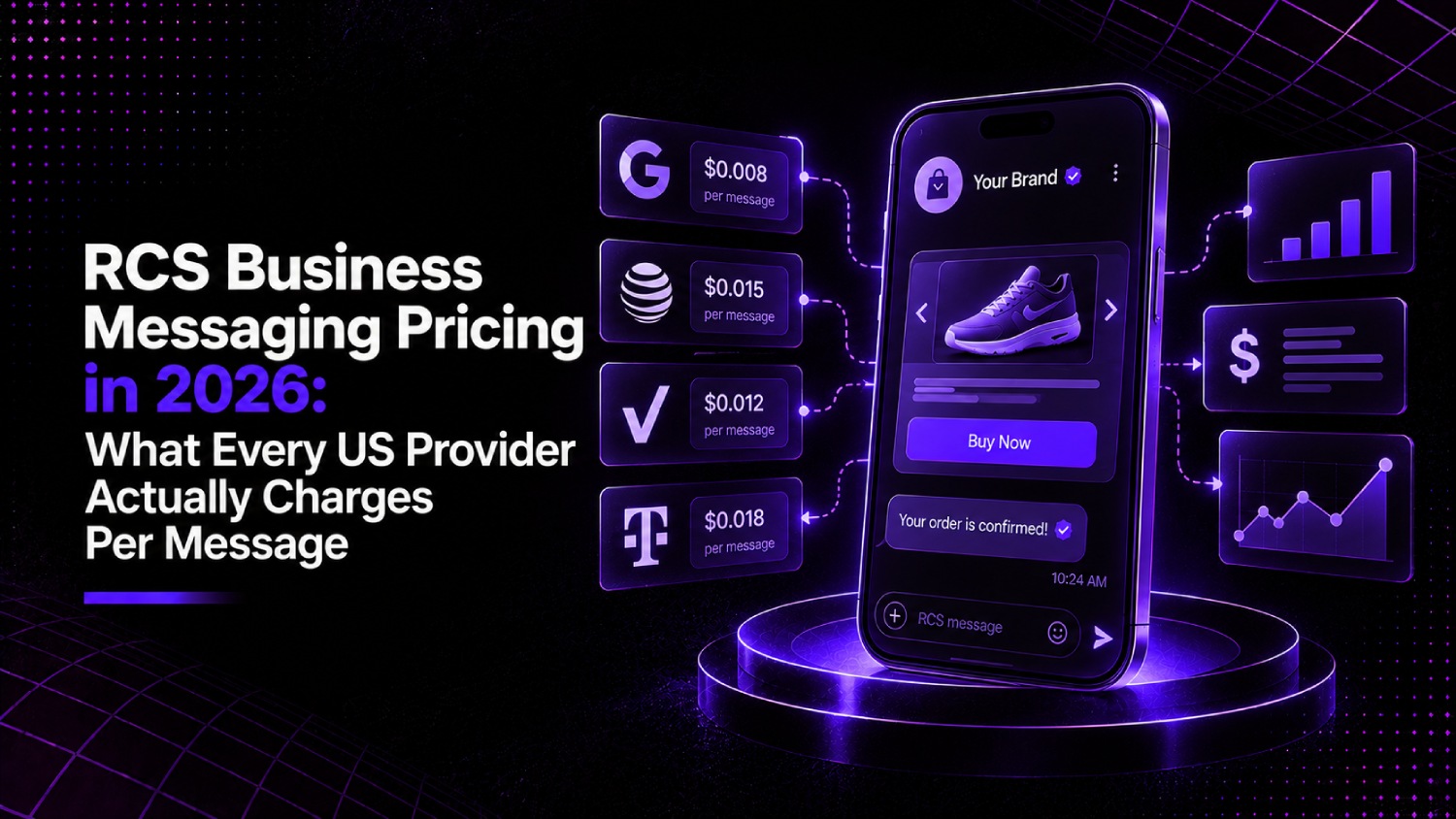
Most RCS vendors in the US default to “contact us” buttons rather than published rate cards, and that opacity is a choice, not a technical constraint. The billing logic itself is standardized, documented by Google through the RCS Business Messaging (RBM) framework, and consistent enough across providers that a competent cost estimate is achievable before any sales call. RCS business messaging follows three billing models (basic, single, and conversational), and every provider layers a platform fee on top of a carrier surcharge passed through from T-Mobile, AT&T, and Verizon. Basic messages run cheaper than conversational sessions, fallback SMS events are billed separately, and published rates are available from at least one provider before you talk to anyone. A team that understands these variables can build a working cost model independently.
Why RCS Pricing Feels Opaque When It Does Not Have to Be
Most marketers walk into an RCS sales call believing pricing is custom, negotiated, and effectively unknowable in advance. That belief is partly the industry’s fault: vendors default to “contact us” buttons rather than published rate cards. But the billing logic itself is standardized, documented by Google through the RCS Business Messaging (RBM) framework, and consistent enough across providers that a competent estimate is possible before you talk to anyone.
The opacity comes from three places: jargon that conflates message types, carrier surcharges buried in contracts, and volume tiers that are real but unpublished. This article breaks each one apart.
What Are the Three RCS Billing Models, and How Do They Differ?
Google’s RBM framework defines billing at the message-type level, and every aggregator or CPaaS provider that sits on top of it inherits this structure. Understanding it is the prerequisite to any cost comparison.
Basic messages
Basic messages are text-only RCS messages sent from a verified business sender. No images, no carousels, no suggested reply chips. They are the structural equivalent of an SMS, but delivered over the RCS channel with sender verification and read receipts. Google’s own documentation treats these as the lowest-cost tier.
Single messages
Single messages carry rich content: images, cards, carousels, PDFs, or suggested action buttons. The defining characteristic is directionality. A single message is outbound only; no conversational session is opened. A promotional push with a product image and a “Shop Now” button is a single message. Pricing runs higher than basic because of the richer payload capacity, but lower than a full conversational session.
Conversational messages
Conversational messages open a billing session. Once a user replies or interacts with a suggested reply chip, the session begins. Google’s standard billing model charges per session (typically a 24-hour window from the first message in that thread) rather than per individual message within it. This is the most expensive tier per initiation event, but can become cheaper per interaction if a session contains multiple exchanges.
The practical implication: a chatbot flow where a user selects options and gets personalized responses burns a session. A one-way OTP or appointment reminder does not. Getting this classification wrong at volume means materially miscalculating your monthly invoice.
How Does the Two-Layer Pricing Structure Actually Work?
Every RCS provider in the US charges you twice, even if they present a single blended number. According to AWS End User Messaging’s public documentation, RCS pricing uses two cost components: a platform fee and a carrier fee passed through without markup. That structure is broadly consistent across the market.
Layer 1: The platform or aggregator fee
This is the fee the provider controls, and the one you negotiate. It varies by volume tier, message type, and contract length. Providers including Twilio, Sinch, Infobip, and MessageBird all have platform-level margins built into their RCS rates.
Layer 2: The carrier surcharge
T-Mobile, AT&T, and Verizon each set their own RCS delivery fees, which providers pass through to customers. These fees are separate from the platform fee and are not negotiable at the customer level. They vary by carrier and, in some cases, by message type. When evaluating a quoted RCS rate, always ask whether the number is all-in or whether the carrier surcharge is itemized separately on your invoice.
AWS is explicit about this split in its public pricing documentation. Other providers are less transparent. If a vendor’s pricing page shows only one number, ask directly: “Does this include the carrier passthrough fee?” The answer changes your blended CPM meaningfully at high volume.
What Does RCS Actually Cost Per Message in the US?
Published pricing in the US RCS market is sparse, but not entirely absent. The following table reflects publicly available or documented rates as of mid-2025. Where a provider does not publish rates, this table says so rather than estimate.
| Provider | Basic message (text-only) | Single message (rich) | Conversational session | Carrier surcharge disclosed? | Pricing published? |
|---|---|---|---|---|---|
| AWS End User Messaging | Documented; split into AWS fee + carrier fee | Documented; split into AWS fee + carrier fee | Documented; session-based | Yes, itemized | Yes (public docs) |
| Twilio RCS | Quote-based | Quote-based | Quote-based | Not disclosed publicly | No public rate card |
| Sinch RCS | Quote-based | Quote-based | Quote-based | Not disclosed publicly | No public rate card |
| Infobip RCS | Varies by region and volume; quote-based for US | Varies; quote-based | Varies; quote-based | Partially disclosed | Limited; contact required |
| MessageBird (Bird) | Quote-based | Quote-based | Quote-based | Not disclosed publicly | No public rate card |
| Bandwidth | Quote-based | Quote-based | Quote-based | Not disclosed publicly | No public rate card |
AWS stands alone here: it publishes a documented pricing model with explicit separation between its platform fee and the carrier fee. Every other major US-market provider routes buyers through a sales conversation. That does not mean their prices are higher. It means you cannot compare them without a call.
For context on how messaging platform pricing tends to work at volume, the pattern here mirrors what you see in RCS-to-SMS fallback handling, where providers are similarly inconsistent about disclosing how fallback events are billed.
Is RCS More Expensive Than SMS?
On a raw per-message basis, yes. An RCS single or conversational message costs more than a standard SMS. But the comparison breaks down quickly once you account for what each channel actually delivers.
A standard SMS is 160 characters. If your message is longer, it is split into multiple segments, each billed separately. A promotional SMS with a link, a personalized name, and a call to action commonly runs two or three segments, meaning your effective CPM is two to three times the headline rate. An RCS single message delivers all of that in one event, with a branded sender, a product image, and a tappable button, billed once.
The comparison that actually matters is cost per conversion or cost per click, not cost per message. RCS’s richer payloads typically produce higher engagement rates than plain SMS, which means a higher per-message cost can still produce a lower cost per outcome. That case still has to be proven on your own list with your own creative, but the math does not automatically favor SMS just because the nominal rate is lower.
For a fuller channel comparison including WhatsApp, which competes for the same rich-messaging budget, see our breakdown of WhatsApp vs SMS for marketing channel selection.
Does Fallback SMS Get Billed Separately?
Yes, and this is the line item most teams miss when building their initial cost model.
When an RCS message cannot be delivered because the recipient’s device or carrier does not support RCS, most providers fall back to SMS automatically. That fallback event is a separate billable message: you pay the RCS attempt fee (or nothing, depending on the provider’s policy for undelivered RCS) and then the SMS delivery fee on top. If your opted-in list has significant device or carrier coverage gaps, your effective messaging cost can run well above the headline RCS rate.
The question to ask every provider before signing: “If an RCS message falls back to SMS, how many billing events appear on my invoice?” The answers vary. Some providers bill both the attempted RCS send and the successful SMS delivery. Others bill only the successful delivery channel. A minority absorb the fallback cost entirely. None of this is standardized, which is why it deserves a direct question in your evaluation. For a detailed breakdown of how each major provider handles this, the RCS vs SMS vs WhatsApp fallback comparison covers it provider by provider.
How Do Volume Tiers and Minimum Commits Affect the Real Cost?
Most enterprise RCS contracts include a minimum monthly commit, typically expressed as a message volume or a dollar floor. Below that floor, you pay the floor. Above it, higher volumes qualify for lower per-message rates in the next tier. The specific thresholds are not public for most providers, but the structure is consistent enough to model.
The AboutMartech Volume-Tier Estimation Model
This four-step framework is AboutMartech’s structured approach to building a pre-call RCS cost estimate. It does not replace a vendor quote, but it gives you a working model before any sales conversation, and a set of specific questions that force providers to be precise rather than evasive.
- Classify your message mix. Estimate what percentage of your sends will be basic, single, and conversational. A transactional use case (OTPs, order updates) skews heavily toward basic or single. A chatbot or lead qualification flow will be predominantly conversational.
- Estimate your monthly volume by type. Separate these into three buckets. Mixing them into a single number will give you a blended rate that does not reflect your actual invoice.
- Add a fallback buffer. If you do not have device-level RCS capability data on your list, assume 20-40% fallback to SMS. Apply SMS rates to that portion. Adjust as you gather real delivery data.
- Ask vendors for their tier thresholds, not just the rate. The rate at 500,000 messages per month may be the same as the rate at 1 million, or it may be substantially different. The tier boundary is the number you need, not the rate that applies above it.
Teams sending above roughly one million messages per month typically qualify for enterprise rate negotiation regardless of provider. Below that threshold, most providers apply published (or at least internally consistent) mid-market rates. The practical question at that scale is not which provider has the lowest rate card, it is which provider’s minimum commit aligns with your actual volume without padding.
Do US Carriers Charge a Surcharge on Top of the Provider Fee?
They do, and it applies to all three major US carriers. T-Mobile, AT&T, and Verizon each set independent RCS delivery fees that aggregators pass through. This is structurally identical to the carrier surcharges that apply to SMS in the US, which became a significant cost issue for senders after the 10DLC registration requirements took effect.
The carrier fees for RCS are not published by the carriers directly. They are disclosed by providers in contracts or, in AWS’s case, in public documentation. The practical implication for buyers: when comparing two providers’ blended RCS rates, confirm whether both numbers include the carrier passthrough or whether one provider is quoting the platform fee only. An apples-to-apples comparison requires all-in cost per message for both.
For teams evaluating which provider to build on, the Twilio vs Sinch RCS comparison covers how the two largest CPaaS providers handle carrier relationships and cost transparency differently.
Which RCS Provider Is Cheapest at One Million Messages Per Month?
No honest answer exists to this question without live quotes, because no provider publishes their million-message rate card publicly. What can be said with confidence:
- AWS End User Messaging is the most price-transparent option. Its published documentation separates platform fees from carrier fees and is auditable without a sales conversation.
- Twilio and Sinch compete on enterprise contract terms and integration depth, not on published pricing. Teams already on their SMS infrastructure will often find favorable bundled RCS rates, because the incentive for the provider is platform consolidation, not per-message margin.
- Infobip and Bandwidth have strong carrier relationships and may offer competitive passthrough fees, but both require direct negotiation to get to real numbers.
The “cheapest at scale” question is better framed as: which provider’s tier structure aligns with my volume trajectory, and which one’s minimum commit does not force me to pre-pay for volume I will not use? At one million messages per month, the difference between providers in nominal per-message rate is likely smaller than the difference in minimum commit structure, contract flexibility, and what fallback billing looks like. For a vetted shortlist of platforms to evaluate, the RCS business messaging platforms comparison covers the major providers across multiple criteria.
What Is a Conversational RCS Session, and When Does It Close?
A conversational RCS session opens when either the brand or the user sends the first message in an exchange. Google’s standard billing framework closes the session after 24 hours of inactivity. All messages within that 24-hour window are typically counted as a single session event, not as individual per-message charges. This is the structural parallel to WhatsApp’s conversation-based billing, which moved to a similar 24-hour session model in 2023.
The billing implication is significant for chatbot deployments. A customer service flow where a user asks three follow-up questions within 24 hours costs the same as a single-exchange interaction if you are on session-based billing. That changes the economics of conversational use cases relative to simple blast campaigns, where every send is a separate event.
One caveat: not every provider defaults to Google’s standard session definition. Some aggregate by message, some use 24-hour windows, and some have proprietary session definitions. Confirm the session boundary in writing before signing a contract.
Frequently Asked Questions About RCS Pricing
How much does RCS cost per message in the US?
AWS End User Messaging is the only major US provider that publishes its rate structure publicly, separating its platform fee from the carrier surcharge in its documentation. Every other significant provider, Twilio, Sinch, Infobip, Bandwidth, requires a sales conversation to get real numbers. The blended cost per message varies by message type (basic, single, or conversational), volume tier, and whether carrier surcharges are included in the quoted rate. Use the AboutMartech Volume-Tier Estimation Model above to build a working estimate before any vendor call.
Is RCS more expensive than SMS on a per-message basis?
On a raw per-message basis, yes. RCS single and conversational messages cost more than a standard SMS. The practical comparison is murkier: a long promotional SMS splits into multiple billable segments, while an equivalent RCS message is a single event with richer content. Cost per outcome (click, conversion) is the more useful metric. RCS’s higher engagement rates can offset its higher per-message cost, but this depends on your specific creative and audience.
What is conversational RCS billing, and how does it differ from per-message billing?
Conversational RCS billing charges per session rather than per individual message. A session opens with the first message in an exchange and typically closes after 24 hours of inactivity. All messages within that window are billed as one session event. Per-message billing (used for basic and single messages) charges each outbound message individually. Conversational billing advantages: multi-turn chatbot flows become cheaper per interaction. Disadvantage: a single low-value exchange costs the same as a rich multi-step one.
Does a fallback SMS get billed separately from the RCS attempt?
In most cases, yes. When an RCS message cannot be delivered and the provider falls back to SMS, the SMS delivery is typically a separate billable event. Some providers charge only for the successful delivery channel; others charge for both the attempted RCS send and the SMS fallback. A small number absorb the fallback cost. This is not standardized across the market and should be confirmed explicitly with any provider before committing to a contract.
Do US carriers charge a surcharge on RCS messages?
Yes. T-Mobile, AT&T, and Verizon each set carrier-level fees for RCS delivery, which aggregators and CPaaS providers pass through to customers. These fees are separate from the provider’s platform fee. AWS End User Messaging discloses this split in its public documentation. Other providers typically disclose carrier fees in contracts rather than on public pricing pages. Always ask for an all-in cost per message that includes the carrier passthrough before comparing vendor quotes.
What is the difference between RCS and RBM in pricing terms?
RCS (Rich Communication Services) is the protocol. RBM (RCS Business Messaging) is Google’s commercial framework built on top of it, which defines the message types, billing models, and agent verification standards. When providers quote RCS pricing in the US, they are operating within the RBM framework. The billing models (basic, single, conversational) are RBM constructs, not arbitrary vendor definitions. Understanding RBM’s structure is the starting point for any RCS cost discussion.
What is a minimum commit in an RCS contract, and how does it affect cost?
A minimum commit is a floor on monthly spend or message volume below which you pay regardless of actual usage. Most enterprise RCS contracts include one. Below the floor, you overpay relative to your actual sends. Above the floor, higher volumes qualify for lower per-message rates in the next volume tier. The minimum commit matters more than the nominal rate for teams whose volume fluctuates month to month, because under-sending against a large commit erases any rate advantage the tier offered.
How do I estimate my RCS costs before a sales call?
Classify your message mix into basic, single, and conversational sends. Estimate monthly volume for each type separately. Add a fallback buffer of 20-40% if you do not have RCS device-coverage data for your list, and apply SMS rates to that portion. Take this model into vendor calls and ask for rates by message type, tier thresholds, and whether the quoted rate includes the carrier surcharge. With those four inputs, you can build a working cost model before any contract discussion.
The Underlying Logic Most Teams Miss
RCS pricing appears opaque because vendors present it as custom when the underlying framework is standardized. The RBM billing structure is documented, the carrier surcharge is real and consistent, and the session-based conversational model follows a pattern any team familiar with WhatsApp Business API pricing will recognize immediately. The variability is in provider margin, volume tier thresholds, and minimum commits, not in the fundamental billing architecture.
Teams that go into vendor calls without this model get quoted a blended number, accept it at face value, and have no basis for negotiation or comparison. Teams that understand the two-layer structure, the message-type split, and the fallback billing question walk in with a working cost estimate and a specific set of questions that force providers to be precise.
The most important number in any RCS evaluation is not the headline rate. It is the all-in cost per delivered message, net of fallback events, calculated against your actual mix of basic, single, and conversational sends. Build that number before the call, and the pricing conversation changes from opaque to auditable.