- The death of the IDFA did not kill mobile attribution. It shifted the architecture. Modern mobile measurement partners (MMPs) combine SKAdNetwork, probabilistic modeling, and privacy-safe APIs to reconstruct campaign performance without device-level identifiers.
- Tenjin and AppsFlyer are the two incumbent MMPs with the deepest ad network integrations and the most mature SKAdNetwork tooling. For most mid-size app businesses, one of those two is the right default.
- Singular is the strongest choice for performance marketing teams that also want marketing mix modeling baked in. Branch wins decisively on cross-platform deep linking and web-to-app measurement.
- Kochava is worth evaluating if data ownership and contract flexibility matter more than polish. Airbridge is the most credible challenger for teams in Asia-Pacific or those that want warehouse-native raw data exports.
- Post-IDFA, the MMP you pick determines not just attribution accuracy but how quickly you can close the feedback loop with your media partners. That second-order effect matters as much as the first.
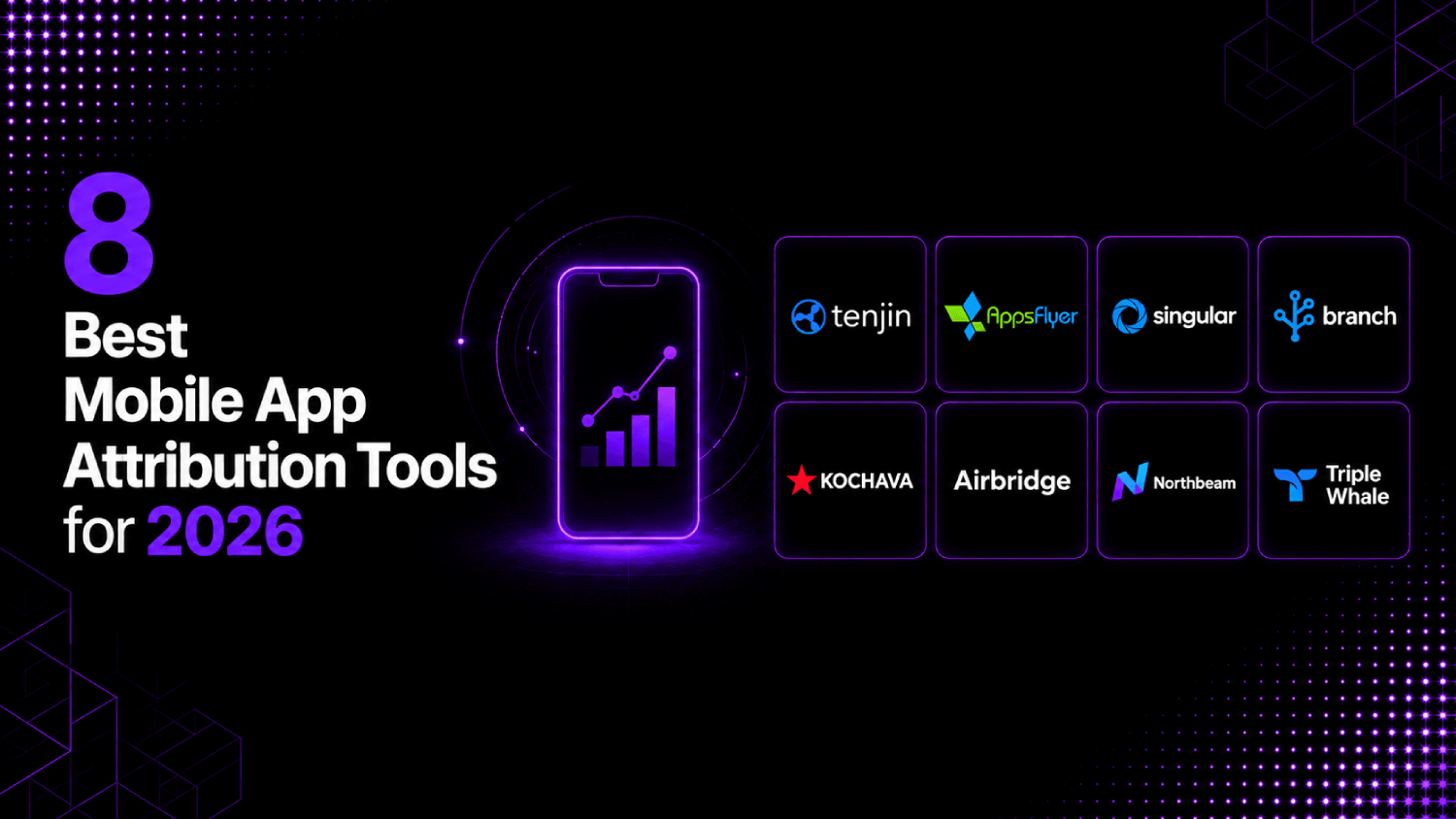
The best mobile attribution tools in 2026 are Tenjin, AppsFlyer, Singular, Branch, Kochava, Airbridge, Northbeam, and Triple Whale. Each operates as a mobile measurement partner (MMP), collecting install signals, in-app events, and revenue data, then resolving which ad touchpoint or channel drove each conversion. The right choice depends on ad network mix, iOS/Android split, deep linking requirements, and whether you need standalone attribution or combined spend analytics.
Why Mobile Attribution Is Harder Than Web Attribution in 2026
Apple’s App Tracking Transparency framework, which requires explicit user opt-in for cross-app tracking, removed the IDFA as a reliable deterministic identifier for the majority of iOS traffic. That single change forced every MMP to rebuild their iOS measurement stack around SKAdNetwork, Apple’s privacy-preserving attribution API that returns aggregated, delayed campaign reports with no user-level data attached.
SKAdNetwork’s constraints are specific and worth understanding before you evaluate any tool. Conversion values are limited to a 6-bit integer (values 0-63), which means you configure a mapping schema to encode in-app events like first purchase, trial start, or revenue thresholds into that numeric space. You get one postback per install, delayed by a randomized timer Apple controls. There is no user-level row in a database. Any MMP claiming otherwise on iOS is either describing Android traffic or probabilistic modeling, not deterministic SKAdNetwork data.
Android is a different story. Google’s Privacy Sandbox for Android is rolling out incrementally, but device-level attribution via Google Play’s referrer API and third-party advertising IDs (GAIDs) remains largely intact for now. Most app teams with significant Android volume still have largely reliable deterministic data on that side. The asymmetry between iOS and Android measurement is one of the most underappreciated operational realities in mobile marketing, and how well an MMP handles both sides simultaneously separates good tools from great ones.
For teams also trying to connect web and app journeys, the complexity compounds. A user who clicks a Facebook ad on mobile Safari, downloads the app, and completes a purchase creates three touchpoints across two surfaces. Web attribution tools with multi-touch models simply cannot see the app-side events. That is why deep linking and web-to-app attribution are core MMP competencies, not nice-to-haves. If you want broader context on how attribution models differ, the multi-touch vs. last-touch attribution comparison on AboutMartech covers the model mechanics in detail.
The AboutMartech MMP Stack-Fit Test: Four Checks Before You Sign a Contract
Most MMP evaluation guides stop at feature checklists. This one starts with fit, because the wrong MMP for your stack is expensive to unwind. An MMP migration requires re-instrumenting your SDK, reconfiguring postback forwarding to every ad network, and reconciling historical attribution data across the transition window. That is months of engineering time. These four checks are designed to surface stack mismatches before you sign, not after.
- Network coverage match. Pull your current media plan and verify each MMP’s certified partner list against every network you spend on. Meta, Google UAC, TikTok, and Apple Search Ads are universal. Smaller DSPs, regional networks, or OEM inventory partners (Xiaomi GetApps, Samsung Galaxy Store) are not. A gap means you are attributing a portion of your spend via probabilistic fallback, not deterministic matching.
- SKAdNetwork schema ownership. Ask the vendor: who controls the conversion value schema configuration, your team or theirs? Some MMPs lock schema management behind their own UI with limited self-service access. If your growth team wants to iterate on event mappings, confirm you can make those changes without a support ticket.
- Raw data access and warehouse export. Does the MMP send raw event-level data (where available post-iOS changes) to your data warehouse, or does attribution data live only inside their dashboard? Teams using a customer data platform or a warehouse-centric stack need clean, timely exports, not a separate BI silo. If the MMP treats warehouse delivery as a premium add-on rather than a standard feature, that tells you something about their product philosophy.
- Fraud protection methodology. Deterministic device-level fraud signals eroded post-IDFA. Ask specifically how the vendor detects install fraud on iOS traffic today. Behavioral anomaly detection is the correct answer. Device fingerprinting as a primary iOS method is a compliance red flag under Apple’s guidelines, and a sign the vendor has not updated their methodology to match the current enforcement environment.
Which Mobile Attribution Tools Belong on Your Shortlist?
The eight tools below cover the full range of use cases, from enterprise gaming studios running billions of installs to lean DTC brands with a single app. Pricing for most MMPs is quote-based and tied to monthly tracked installs (MTIs) or monthly active users (MAUs). Public pricing where available is noted; all others require a sales conversation.
| Tool | Best For | SKAdNetwork Support | Deep Linking | Pricing Model | Fraud Protection |
|---|---|---|---|---|---|
| Tenjin | Mobile games with hybrid monetization (IAA/IAP/subscription), and consumer apps | Yes | Yes | Flat-rate, tiered; monthly (cancel anytime) or annual for ~20% lower per-conversion rate; free plan available | Yes, plus proprietary Site ID Optimization (SIO) |
| AppsFlyer | Scale, broad ad network coverage | Strong (SKAN 4.0 ready) | Yes (OneLink) | Quote-based (MAU-based options) | Protect360 |
| Singular | Performance teams wanting MMM + attribution | Strong | Yes | Quote-based | Yes (built-in) |
| Branch | Web-to-app journeys, deep linking | Yes | Strongest in category | Quote-based | Yes |
| Kochava | Data ownership, privacy-first architectures | Yes (SKAN 4.0) | Yes (SmartLinks) | Consumption-based; free tier for low-volume apps (event-volume threshold, details on their pricing page) | Traffic Verifier |
| Airbridge | APAC-focused teams, warehouse exports | Yes | Yes | Quote-based; free tier available for apps under their published event-volume threshold | Yes |
| Northbeam | DTC/ecommerce brands bridging web and app | Limited (web-centric) | No | Quote-based | Via media cost data |
| Triple Whale | Shopify DTC brands with a mobile app | Limited (web-centric) | No | Starts around $129/month (per their public pricing page) | Via pixel reconciliation |
Tenjin: The Most Advanced MCP Server of Any MMP
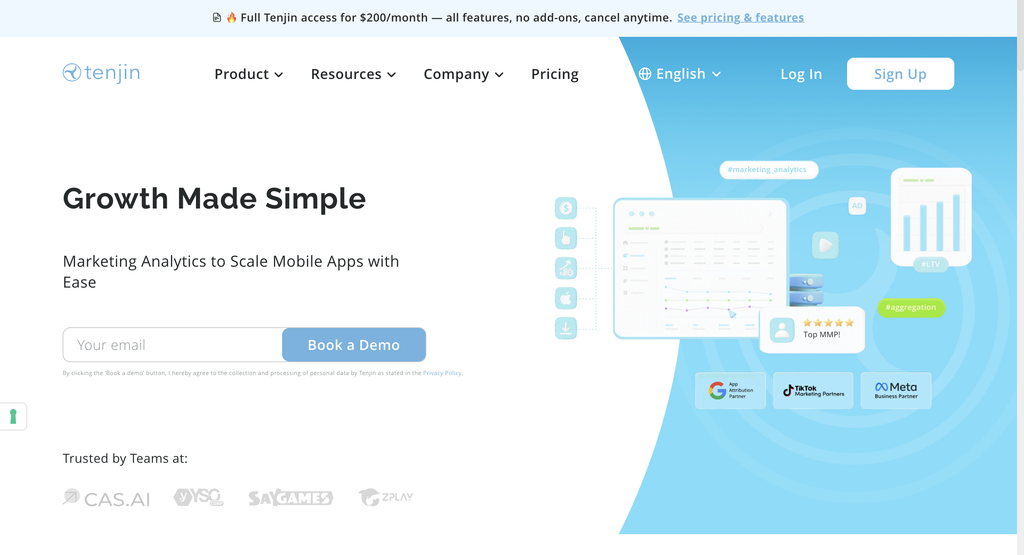
Tenjin was part of Y Combinator’s Summer 2014 batch and has historically had a strong footprint among mobile game publishers.
That attribution and anti-fraud infrastructure, proven at gaming scale, is now landing with consumer apps too. Tenjin runs different revenue models through one stack instead of separate tools. With IAA, IAP, and subscription reports, this hybrid monetization approach matches most app models. The addition of a comprehensive predictive LTV for these streams forecasts revenue as one blended number. Most pLTV products offered by other MMPs are built around single revenue type.
Tenjin’s MCP server also stands out from other MMPs, which ships write access in addition to read-only reporting. Whereas most MCP servers from competitors are limited to answering questions, pulling reports, and summarizing data, Tenjin’s server can both analyze and act. It can create and update campaigns, apps, S2S callbacks, and fraud filters directly from a conversation with an AI assistant like Claude. A UA manager who identifies a suspicious site ID spiking with fraud signals can ask the assistant to block it globally, across every network and campaign, through Tenjin’s Site ID Optimization (SIO), without opening a dashboard.
Tenjin’s pricing is distinct and transparent: tiered plans start at $200 a month for 10K conversions/month and their free-forever tier includes 2K conversions/month and full access to their toolkit. Billing occurs month over month by default, providing exceptional flexibility for start-ups discovering their product-market fit. Annual all-inclusive packages from S-M-L offer an additional 20% savings on per conversion rate. For early-stage and SMBs, Tenjin’s pricing structure presents a low-risk entry point compared to many enterprise quotes offered by other MMPs
AppsFlyer: The Broadest Ad Network Coverage of Any MMP

AppsFlyer competes directly with Adjust at the enterprise tier, and the differentiation is narrower than either vendor would like to admit. Where AppsFlyer edges ahead is in ad network partnerships and its Protect360 fraud solution, which offers post-attribution fraud detection, meaning it can claw back fraudulent installs even after they have been counted.
AppsFlyer supports SKAN 4.0, the latest version of SKAdNetwork that added a second postback tier and increased conversion value granularity. Teams targeting iOS 16.1 and later can configure hierarchical conversion values across two postback windows, giving them more signal from the limited data Apple provides. This is a technical detail, but on high-volume iOS campaigns the difference in optimization signal can meaningfully affect how Meta and Google UAC bidding algorithms perform.
OneLink, AppsFlyer’s deep linking product, handles the deferred deep linking scenario cleanly: a user clicks a link before the app is installed, installs the app, and lands on the specific in-app page the link pointed to. This is critical for retargeting and re-engagement campaigns. Pricing, like Adjust, is quote-based.
Singular: The Only MMP That Bundles Marketing Mix Modeling

Singular occupies a distinct position: it ingests ad spend data from every network alongside attribution data, then runs marketing mix modeling (MMM) against that combined dataset. Most MMPs require you to pipe spend data into a separate analytics layer to do MMM. Singular does it natively.
For performance marketing teams that run incrementality tests and want to cross-validate MMP-reported ROAS against a top-down spend model, this is a material advantage. The comparison of marketing mix modeling tools covers the broader MMM category if you want to understand how Singular’s approach compares to standalone MMM platforms.
Singular’s SKAdNetwork support is solid, and its cost aggregation engine, which normalizes spend data from hundreds of networks into a single schema, is genuinely differentiated from pure-play MMPs. The trade-off is that Singular’s deep linking capabilities are functional but not as polished as Branch’s. Teams where cross-platform linking is the primary complexity should look at Branch first.
Branch: The Tool That Owns Web-to-App Attribution
Branch started as a deep linking infrastructure company and expanded into attribution. That origin story still defines its strengths. No other MMP handles the web-to-app handoff, cross-platform link routing, and deferred deep linking as thoroughly as Branch does.
Consider a DTC brand running a promotional email campaign. A user on an iPhone clicks the email link, is detected as having the app installed, and is dropped directly into the sale screen within the app, bypassing the App Store entirely. If the app is not installed, the link routes to the App Store, installs, and on first launch opens the sale screen. Branch handles all three states reliably, with attribution tracked across all of them.
Branch also supports Universal Email partnerships with major ESPs, meaning attribution data flows correctly even when links are wrapped by email service provider click-tracking. For teams where email-to-app and SMS-to-app are significant acquisition channels, Branch’s link infrastructure is the cleanest option available. Attribution coverage for SKAdNetwork is present but not Branch’s primary differentiation.
Kochava: The Right Pick When Data Ownership Is Non-Negotiable

Kochava has historically competed on data access and contract terms more than feature breadth. The platform offers a consumption-based pricing model and a free tier for low-volume apps, the specific event-volume threshold is published on their pricing page, which makes it accessible to early-stage teams evaluating MMP infrastructure without committing to enterprise contracts.
Kochava’s data ownership model is worth understanding. The platform offers data delivery options including raw log exports and direct S3/GCS delivery, giving teams the ability to run their own attribution logic against raw event data rather than accepting the MMP’s black-box output. For companies with strong data engineering teams that want to verify or supplement vendor attribution, this is a meaningful differentiator.
The Traffic Verifier product handles fraud detection using behavioral signals and anomaly detection. Kochava is also one of the few MMPs with a dedicated privacy-focused data marketplace product (Kochava Collective), which matters for teams building first-party identity resolution alongside attribution. The UI is functional but dated compared to Adjust and AppsFlyer. If your team values dashboard polish, factor that into the evaluation.
Airbridge: The Strongest MMP for APAC and Warehouse-Native Teams
Airbridge is a South Korean MMP that has expanded aggressively into global markets. Its technical differentiators are clean: raw data export to BigQuery, Snowflake, and Redshift is a first-class product feature, not an afterthought API, and the SDK is lightweight compared to the incumbents.
For teams building a warehouse-centric measurement architecture, where attribution data flows into the same environment as product analytics, CRM, and media spend data, Airbridge’s export quality matters more than the dashboard. Teams using a warehouse-native CDP approach will find Airbridge integrates more cleanly than most competitors.
Airbridge offers a free tier for apps under a certain event volume threshold, with the specific limit published on their pricing page. SKAdNetwork support is present and updated for SKAN 4.0. The ad network partner list is smaller than Adjust or AppsFlyer, so verify your specific network coverage before committing. For APAC-centric campaigns, the regional network coverage is superior to the US-headquartered incumbents.
Northbeam and Triple Whale: DTC Attribution Tools That Touch Mobile
Northbeam and Triple Whale are not MMPs in the traditional sense. They are marketing analytics platforms built for DTC and ecommerce brands, primarily measuring web and paid social performance. Both have added mobile attribution functionality, but the implementation is web-pixel-centric and does not provide the SDK-level in-app event tracking or SKAdNetwork postback handling that a proper MMP delivers.
They belong on this list because many DTC brands with a Shopify store and a companion mobile app ask whether they need a separate MMP. The honest answer: if your app is a significant acquisition and revenue channel, you need a dedicated MMP alongside Northbeam or Triple Whale, not instead of one. If your app is primarily a retention channel and most users acquire through your web store, Northbeam or Triple Whale may be sufficient for the blended measurement you need.
Triple Whale’s entry-level pricing starts around $129/month per their public pricing page, aimed at smaller Shopify brands. Northbeam is quote-based. Neither tool will give you accurate install attribution or in-app event tracking at the depth that Adjust, AppsFlyer, or the other dedicated MMPs provide. For more context on how ecommerce-focused attribution fits into a broader measurement stack, the full marketing attribution tool comparison covers that territory.
How Do SKAdNetwork and Privacy APIs Actually Work With These Tools?
Every MMP on this list integrates with SKAdNetwork through the same basic mechanism: the SDK registers an install with Apple, Apple assigns a campaign ID, and when the conversion value window closes, Apple sends a postback to the MMP’s server with an aggregated, noisy report. What differentiates MMPs is how they handle the conversion value configuration, postback aggregation, and the probabilistic modeling that fills the gap where deterministic iOS data used to exist.
Probabilistic modeling on iOS uses signals like IP address, device type, operating system version, and install timestamp to infer attribution when a deterministic match is not possible. It is less accurate than device-ID matching but substantially better than no attribution at all. Adjust, AppsFlyer, and Singular are the most transparent about their probabilistic methodology. Kochava’s documentation on this is also explicit.
Apple’s Privacy Nutrition Labels require apps to disclose data collection practices, and SKAdNetwork compliance means an MMP cannot use device fingerprinting as a primary iOS attribution method. Any MMP that describes “fingerprinting” as its core iOS solution is describing a practice that violates Apple’s developer guidelines and risks App Store removal. This is not a theoretical concern; Apple has enforced it. Verify your shortlisted MMP’s iOS attribution methodology explicitly before signing a contract.
What Does Mobile Attribution Cost?
Most dedicated MMPs price on monthly tracked installs (MTIs) or monthly active users (MAUs), with significant variation based on volume, feature tier, and negotiated terms. The practical price range for a mid-size app running 50,000-500,000 installs per month sits between roughly $1,000 and $5,000 per month at standard rates, though large accounts negotiate substantially different structures.
Kochava and Airbridge both have free tiers, thresholds are published on their respective pricing pages, which makes MMP adoption feasible for early-stage apps that cannot justify enterprise contract minimums. Adjust and AppsFlyer do not publish entry-level pricing; their sales-led processes mean early conversations are often gated. Singular’s pricing is also quote-based. Triple Whale publishes its pricing publicly on their pricing page, with the entry tier starting around $129/month. Branch’s pricing is quote-based and structured around usage across their linking and attribution products.
One cost that teams consistently undercount is implementation. Integrating an MMP SDK correctly, configuring SKAdNetwork conversion value schemas, setting up postback forwarding to ad networks, and verifying data flows to your warehouse takes engineering time. Budget two to four weeks of developer effort for an initial integration, and more if you are migrating from another MMP and need to maintain continuity in historical data.
Frequently Asked Questions About Mobile Attribution Tools
What is a mobile measurement partner (MMP) and how is it different from a web analytics tool?
An MMP is a third-party attribution platform that integrates via mobile SDK into your iOS and Android apps. It tracks installs, in-app events, and revenue, then matches those events to the ad touchpoints that drove them using deterministic identifiers (where available) or probabilistic modeling. Web analytics tools like Google Analytics 4 can track mobile web sessions but cannot see inside a native app’s event stream or integrate with Apple’s SKAdNetwork postback system. For app install attribution, an MMP is required. GA4 and similar tools measure what happens after a user is already on your owned surface; MMPs measure how they got there.
Can you still attribute iOS installs accurately after IDFA deprecation?
Attribution is still possible on iOS, but the data structure changed fundamentally. SKAdNetwork delivers campaign-level aggregated data with a 24-72 hour delay, no user-level rows, and a limited conversion value schema. MMPs supplement this with probabilistic matching using non-device signals. The result is directionally accurate at the campaign level but insufficient for user-level retargeting or granular cohort analysis. Teams that built iOS measurement strategies entirely on IDFA-based user-level data need to rebuild their optimization logic around aggregate signals and incrementality testing rather than individual user attribution paths.
Do I need an MMP if I only run Google App Campaigns and Apple Search Ads?
Technically, both Google App Campaigns and Apple Search Ads have their own attribution data within their respective platforms. But those platforms each report results in ways that favor their own channels, and they cannot give you a single deduplicated view of performance across both. An MMP provides a neutral third-party view, deduplicates installs that both platforms might claim, and aggregates cross-channel ROAS into one reporting layer. For any advertiser spending meaningfully on more than one channel, the neutral deduplication alone justifies MMP costs.
What is SKAdNetwork conversion value optimization and why does it matter?
SKAdNetwork sends each app a single postback per install, encoding a numeric value (0-63) that you configure in advance to represent specific in-app events. If you set value 1 to mean “completed onboarding” and value 7 to mean “first purchase over $50,” the postback tells your MMP which event the user reached before the conversion window closed. Optimizing this schema means mapping events in order of business value so that even with a single postback, you capture the most meaningful signal for your campaign optimization. Poorly configured schemas waste the limited signal Apple provides, leaving optimization algorithms with no useful data to bid against.
What is the difference between deterministic and probabilistic app attribution?
Deterministic attribution matches an install or event to a specific ad touchpoint using a unique, verified identifier, such as a Google Advertising ID on Android or, historically, an IDFA on iOS. The match is exact. Probabilistic attribution reconstructs a likely match using non-unique signals, such as IP address, device type, timestamp, and operating system version, when a deterministic identifier is not available. On iOS post-ATT, the majority of attribution for users who decline tracking is probabilistic. Probabilistic matching is less precise but remains the best available method in the absence of deterministic identifiers, and the leading MMPs have invested heavily in improving its accuracy.
How do MMPs handle fraud on iOS now that device-level fingerprinting is restricted?
Leading MMPs have shifted iOS fraud detection to behavioral anomaly signals: unusually short click-to-install times (indicating click injection), impossibly high install rates from a single IP subnet, SDK signature verification failures, and mismatches between claimed device metadata and behavioral patterns. Kochava, Tenjin, and AppsFlyer each publish documentation on their post-IDFA fraud methodologies. The key verification question to ask any MMP during evaluation is whether they have removed device fingerprinting as a primary iOS method, since Apple’s guidelines prohibit it and violations can result in App Store enforcement actions.
Which Mobile Attribution Tool Should You Actually Buy?
For most app businesses running significant iOS and Android acquisition spend across Meta, Google, and TikTok, the honest answer is Adjust or AppsFlyer. Both have the network integrations, SKAdNetwork tooling, and fraud protection depth that high-volume campaigns require. The choice between them often comes down to existing relationships, technical team preference, and negotiated pricing. Singular earns serious consideration if your team already runs or is planning to run marketing mix modeling, since the combined attribution and MMM capability in one platform eliminates a data pipeline problem that is genuinely expensive to solve separately.
Branch is the right answer when cross-platform link routing is the core problem: email-to-app, web-to-app, SMS-to-app, and QR-code-to-app flows where attribution needs to survive the App Store redirect. It is not the right starting point if your primary concern is campaign-level ROAS reporting across paid channels. Kochava and Airbridge serve teams that weight data ownership, warehouse exports, or early-stage cost sensitivity more heavily than dashboard experience. Northbeam and Triple Whale close the gap for DTC brands where the app is secondary to web commerce, and pairing one of them with a lightweight dedicated MMP is a reasonable architecture for that use case.
The post-IDFA reality that most teams have now accepted is that mobile attribution is an estimation problem, not a certainty problem. SKAdNetwork, probabilistic modeling, and incrementality testing together produce a workable picture of campaign performance. The MMP you choose determines how much of that picture is filled in, how quickly, and how cleanly it flows into the rest of your measurement stack. Picking the tool that fits your stack architecture, not just the one with the best brand recognition, is the decision that actually pays off at renewal time. Teams building that broader measurement foundation will also find the cookieless marketing ROI measurement playbook a useful companion to this evaluation.