Adobe Real-Time CDP vs Salesforce Data Cloud is the most common enterprise CDP decision, and Tealium is usually the third name on the shortlist. Most buyers already know the headline answer: pick the one that matches the stack you already run. That is still true, but 2026 changed the details. Salesforce renamed Data Cloud to Data 360 and now publishes list prices (Salesforce), Gartner moved Tealium from Leader to Challenger in its January 2026 Magic Quadrant (CX Today), and Adobe rewrote its Real-Time CDP license terms in September (Adobe product description).
We compared the three on how they are licensed, what each publishes about price and real-time limits, how they connect to your warehouse and other tools, and what analysts and G2 reviewers say, all read on November 11, 2026. If you are still building a longer list, start with our guide to the best enterprise CDPs.
TLDR
Short answer: Choose Salesforce Data 360 if your customer records already live in Salesforce and you want a published price to model: Flex Credits cost $500 per 100,000, or you can pay $240 per 1,000 profiles a year. Choose Adobe Real-Time CDP if you run Adobe Analytics, Target or Journey Optimizer and need in-session personalization; it is licensed per 1,000 profiles with no public price. Choose Tealium if your stack spans many vendors and data collection and consent are the hard part; it prices on inbound events, by quote, and connects to 1,300+ tools.
- Analyst view, 2026: Salesforce is a Leader for both Gartner and Forrester. Adobe is a Forrester Leader and Gartner’s only Visionary. Tealium is a Gartner Challenger and a Forrester Contender.
- Only published list price: Salesforce. Data 360 Starter lists at $60,000 a year with 10 million Flex Credits.
- The meter to watch on Salesforce: the Real-Time Pipeline uses 250,000 credits per million events at the base tier, about $1,250, while bringing data in is free.
- Adobe’s hidden ceiling: license terms cap average profile size at 75 KB and batch segmentation at one job per day per sandbox.
- G2 ratings: Tealium 4.3 (490 reviews), Data 360 4.2 (769), Adobe Real-Time CDP 4.1 (183).
In this guide
Adobe Real-Time CDP vs Salesforce Data Cloud vs Tealium at a glance
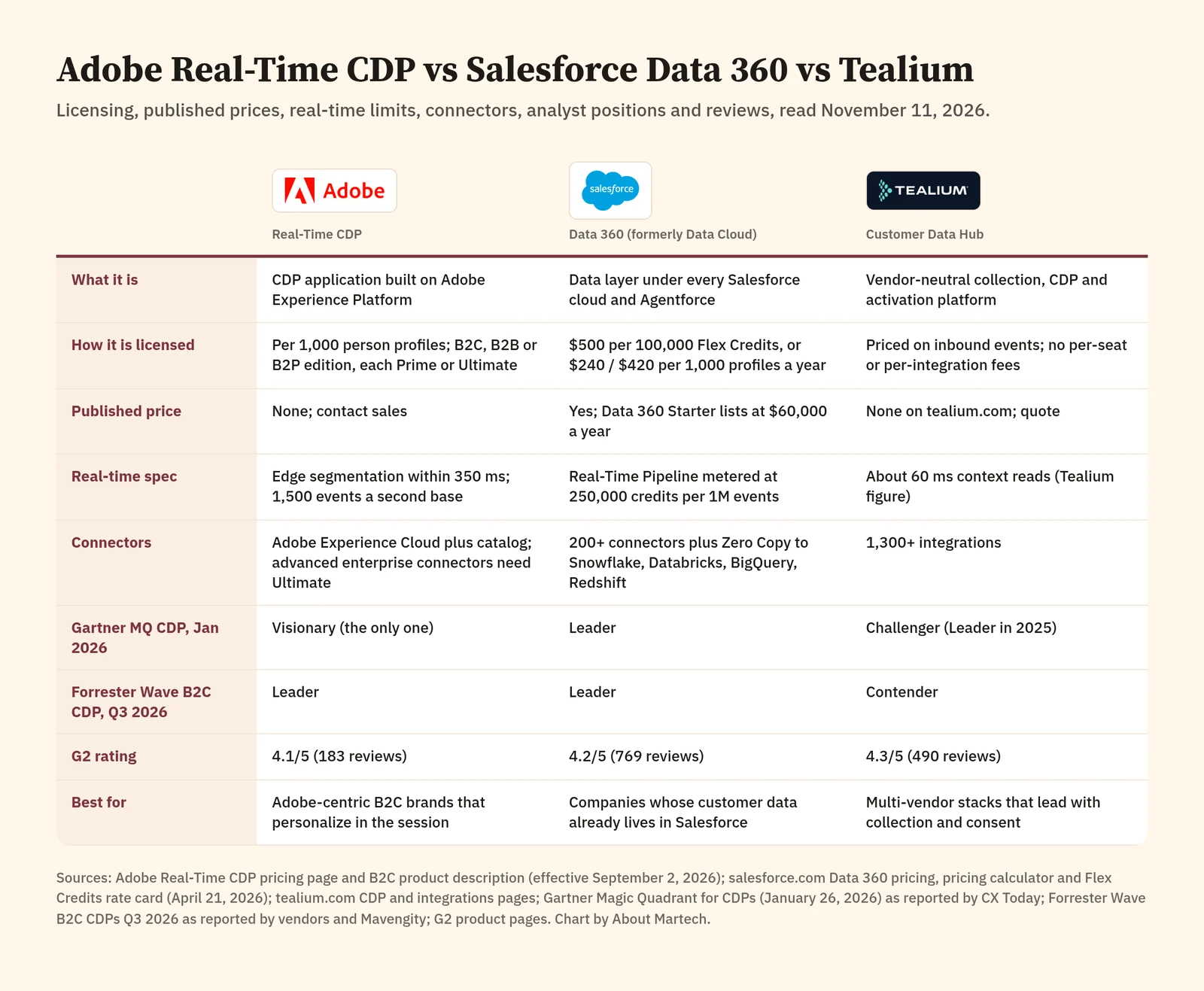
| Adobe Real-Time CDP | Salesforce Data 360 (formerly Data Cloud) | Tealium | |
|---|---|---|---|
| License metric | Per 1,000 person profiles | Flex Credits ($500 per 100,000) or profiles ($240 or $420 per 1,000 a year) | Inbound events |
| Editions | B2C, B2B and B2P, each Prime or Ultimate | One product, two pricing models | Data Collection, Customer Data Platform, Data Cloud Activation |
| Published price | No | Yes; Starter lists at $60,000 a year | No |
| Free entry | No-cost license during implementation, before the term starts | $0 Provisioning SKU for Salesforce customers (250,000 credits, 1 TB) | Demo and self-guided demo |
| Warehouse data | Federated Audience Composition add-on | Zero Copy to Snowflake, Databricks, BigQuery and AWS | Segments built on Snowflake, Databricks, BigQuery or Redshift |
| Journeys and orchestration | Needs Journey Optimizer or the Profile Orchestration add-on | Native to Salesforce Marketing Cloud and Flow | Real-time triggers to downstream tools |
| Gartner MQ for CDPs (Jan 2026) | Visionary | Leader | Challenger |
| Forrester Wave B2C CDPs (Q3 2026) | Leader | Leader | Contender |
| G2 rating | 4.1 (183 reviews) | 4.2 (769 reviews) | 4.3 (490 reviews) |
Sources: Adobe pricing, Adobe product description, Data 360 pricing, Data 360 pricing calculator, Tealium CDP page, read November 11, 2026.
How the three platforms differ in one paragraph each
Adobe Real-Time CDP is an application built on Adobe Experience Platform. It stitches data into real-time person profiles, and on the B2B and B2P editions, account profiles, then activates audiences to Adobe and outside destinations (Adobe). It is strongest when Adobe Analytics, Target and Journey Optimizer already sit next to it.
Salesforce Data 360 is the new name for Data Cloud. Salesforce describes it as the data engine behind the whole Salesforce platform and the data foundation for Agentforce, with Zero Copy access to data in Snowflake, Databricks and Google Cloud (Salesforce). Its unified profiles show up inside Sales, Service and Marketing Cloud.
Tealium started in tag management and sells a vendor-neutral platform for collection, identity, consent and activation. Its CDP can keep profiles in Tealium, in your warehouse, or both, and it says it serves 850+ enterprise customers (Tealium). Gartner lists two products: Tealium Customer Data Hub as the full CDP and Tealium Collect as the composable option (CX Today).
Pricing and licensing: what each vendor publishes
This is where the three differ most. One publishes list prices, one publishes detailed license limits but no price, and one publishes neither.
Salesforce Data 360: published credits and profile prices
- Flex Credits: $500 per 100,000 credits, usable on any Data 360 action and transferable to Agentforce, with pre-purchase, pay-as-you-go and pre-commit options (Data 360 pricing).
- Profiles: $240 per 1,000 profiles a year, with 1 Flex Credit per profile, 25 calculated insights, 25 transforms and 100 segments included.
- Enterprise Profiles: $420 per 1,000 profiles a year, with 2 Flex Credits per profile, 100 calculated insights, 100 transforms, 500 segments, and data masking and ad audience add-ons.
- Data 360 Starter: list price $60,000 a year, with 10 million Flex Credits, 5 TB of storage and one Data 360 instance (Salesforce pricing calculator).
- Data 360 Provisioning: a $0 SKU for Salesforce customers whose other products rely on Data 360, with 250,000 Flex Credits and 1 TB of storage.
Ingestion is free on every model, including batch and Zero Copy integrations (Salesforce). You pay when you prepare, unify, segment, activate, query or stream data. Customers still on older Data Services credits can stay on them; switching to Flex Credits or profile pricing means swapping all existing credits.
Adobe Real-Time CDP: license terms, no public price
Adobe sells three editions: B2C for consumer brands, B2B for leads and accounts, and B2P for companies that need one person profile across both. Price depends on profile volume (Adobe pricing). The B2C license, effective September 2, 2026, is metered per 1,000 person profiles and comes in two packages (Adobe product description):
- Prime: the standard features, including real-time profiles, segmentation, governance and activation to pre-built destinations.
- Ultimate: adds advanced enterprise source and destination connectors, an entitlement to Profile API calls (up to 5 per profile a year), and the Destination SDK for building custom destinations.
- Overage: if you exceed your licensed profiles, you get a 7-day grace period, then pay a daily overage rate set in your sales order.
- Add-ons priced separately: extra data volume, extra sandboxes, computed attributes, Customer AI insights, Federated Audience Composition for warehouse data, Privacy and Security Shield, Healthcare Shield and Real-Time CDP Profile Orchestration.
Adobe also grants a no-cost license during implementation, before the paid term starts. One G2 reviewer at a mid-sized team called the license a significant commitment and said some features feel built for much larger data volumes (G2).
Tealium: priced on inbound events, by quote
Tealium says it prices on inbound events, the data you send into the platform, with no per-seat fees, no charges per integration and no extra cost when you connect a new destination (Tealium). We could not find a published price list on tealium.com on November 11, 2026. An August 2026 review of Tealium’s pricing page recorded $1,000 a month, billed annually, for Data Cloud Activation alone, with Data Collection and the CDP tier by quote (Hardal). Treat that figure as a floor for warehouse activation, not the price of a full CDP.
One correction to other comparisons: several list Tealium’s pricing model as a platform fee plus profiles. Tealium’s own CDP page says inbound events, and it argues that deleted cookies and multi-device users do not inflate the bill the way profile or MTU counts can.
What real-time usage costs on Salesforce Data 360
Salesforce is the only one of the three that publishes enough to do the arithmetic. Its Flex Credits rate card, updated April 21, 2026, lists credits per million rows for each Data 360 action (Salesforce rate card). At the list price of $500 per 100,000 credits, one credit costs half a cent.
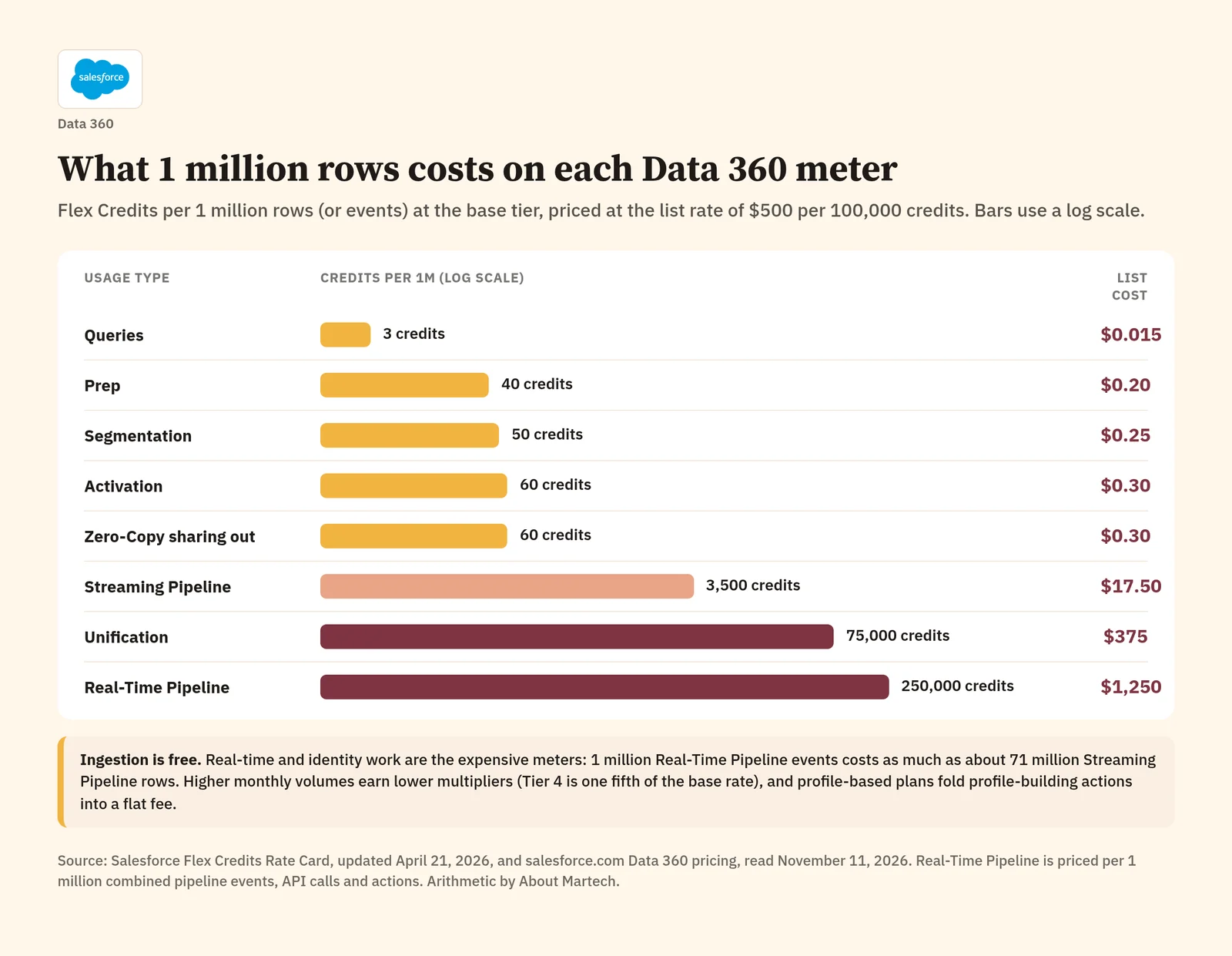
| Data 360 action | Credits per 1M rows (base tier) | List cost per 1M |
|---|---|---|
| Queries | 3 | $0.015 |
| Prep | 40 | $0.20 |
| Segmentation | 50 | $0.25 |
| Activation | 60 | $0.30 |
| Streaming Pipeline | 3,500 | $17.50 |
| Unification (identity resolution) | 75,000 | $375 |
| Real-Time Pipeline (per 1M events, API calls and actions) | 250,000 | $1,250 |
Multipliers drop as monthly use grows: the base tier covers the first 300,000 credits of each usage type, Tier 2 runs to 1.5 million credits at 80% of the base rate, Tier 3 to 12.5 million at 40%, and Tier 4 after that at 20%. Tiers reset on the first of each month.
Worked example: 10 million Real-Time Pipeline events in one month. The first 1.2 million events use 300,000 credits at the base tier. The next 6 million events use 1.2 million credits at Tier 2 (200,000 per million). The last 2.8 million events use 280,000 credits at Tier 3 (100,000 per million). That is 1.78 million credits, or $8,900 at list price for the month, before any discount. The same 10 million rows through the Streaming Pipeline would cost about $175 (35,000 credits) at the base rate.
This is why Gartner’s main caution on Salesforce is unpredictable credit consumption, with some clients reporting exhausted credit limits without delivering value (CX Today). Salesforce’s answer is profile-based pricing, which folds profile-building actions into a flat fee, and the free Digital Wallet tool for tracking use in near real time (Salesforce).
Real-time profiles and segmentation compared
| Adobe Real-Time CDP | Salesforce Data 360 | Tealium | |
|---|---|---|---|
| Fastest path | Edge segmentation: up to 350 ms, 1,500 inbound events a second in the base entitlement | Real-Time Pipeline, end-to-end processing at sub-second speed | Real-time profile updates and about 60 ms context reads |
| Streaming segmentation | 1,500 events a second base; uses profile attributes plus the last 24 hours of events | Streaming Pipeline, metered per million rows | Audiences update when signals, consent or behavior change |
| Batch segmentation | One job per day per sandbox; a job can take up to seven hours | Segmentation metered per million rows | On a schedule or a trigger |
| Identity | Deterministic identity graph by default; each graph links 2 to 50 identities | Identity resolution through unification rules | Identity resolved across devices, sessions and channels into one persistent profile |
| Limits to know | 75 KB average profile size; 3 merge policies; 5 sandboxes | Credits per action; segment and calculated-insight counts on profile plans | Inbound event volume in the quote |
Sources: Adobe product description, Salesforce Data 360 pricing, Tealium CDP page. Latency figures are vendor statements, not our tests.
Adobe’s edge network is the clearest real-time strength in this group: Gartner credits it with sub-200 millisecond decisions for in-the-moment personalization (CX Today). The trade-off is the license math. Adobe’s 75 KB average profile richness is shared across all your profiles, so long event histories or many attributes can push you into the Additional Data Volume add-on. Adobe’s profile guardrails document more limits for profile and segmentation data.
Need help choosing an identity approach first? Our guide to identity resolution tools compares deterministic and probabilistic options across vendors.
Warehouse and zero-copy support
- Salesforce Data 360 reads live data in Snowflake, Databricks, Google BigQuery and AWS through Zero Copy, and lists 200+ connectors (Salesforce). Zero Copy ingestion is free, but queries and sharing out use credits.
- Adobe Real-Time CDP sells Federated Audience Composition as an add-on, priced per gigabyte, to build audiences from data in your warehouse and federate them into Experience Platform; it can run in up to two sandboxes per license (Adobe).
- Tealium builds segments on Snowflake, Databricks, BigQuery or Redshift and activates them without loading a second copy, streams consented events into the warehouse, and supports Databricks Delta Sharing (Tealium).
For a vendor-by-vendor answer on which CDPs query the warehouse and which copy it, see our zero-copy CDP vs data replication breakdown, and our list of CDPs that support Snowflake, BigQuery and Databricks. If your data team wants to skip a packaged CDP entirely, compare warehouse-native CDPs.
Connectors, consent and data collection
Tealium leads here. It lists 1,300+ integrations across tags and API connectors and 900+ vendor tag integrations, so you can swap vendors without code changes (Tealium). Consent is enforced at collection: tags that need consent do not fire without it, with native integrations for OneTrust, Didomi and Usercentrics. Tealium also lists HIPAA BAAs, SOC 2, ISO 27001 and ISO 27018 (Tealium). Gartner counts 1,200+ prebuilt integrations and highlights HIPAA-compliant private cloud environments (CX Today).
Adobe includes tag management, streaming collection and edge event forwarding in every edition (Adobe pricing), and its patented data usage labels govern what each attribute can be used for. Automated consent policy enforcement and customer-managed encryption keys sit in the Privacy and Security Shield or Healthcare Shield add-ons (Adobe).
Salesforce’s strength is depth inside its own clouds rather than breadth outside them. In buyer interviews, Data Cloud customers praised the CRM and Marketing Cloud connection but described bringing in outside data as painful and costly (Alium).
Comparing collection layers? See our guides to consent management platforms and server-side tagging providers. For regulated data, our list of HIPAA-compliant CDPs covers the healthcare add-ons in more detail.
What analysts and reviewers say in 2026
Gartner Magic Quadrant for CDPs, January 2026
Gartner published the report on January 26, 2026 (Gartner). Salesforce, Hightouch, Oracle and Uniphore are Leaders; Adobe is the only Visionary; Tealium dropped from Leader to Challenger (CX Today).
- Salesforce: praised for Data 360 as a context engine for structured and unstructured data, with 141% year-over-year growth in paying Data 360 customers in fiscal Q3 2026. Cautions: unpredictable credit consumption, and buyers with non-Salesforce stacks may need extra products such as Tableau.
- Adobe: praised for real-time data management and attribute-level data governance. Cautions: Real-Time CDP may not cover broader enterprise data management, and packaging often requires adjacent products such as Journey Optimizer for orchestration. Adobe declined to give Gartner supplemental information.
- Tealium: praised for its partner certification program, integration ecosystem and healthcare bundles. Caution: slower market momentum, with a decline in its annual recurring revenue growth rate from 2021 to 2025.
Forrester Wave: Customer Data Platforms for B2C, Q3 2026
Forrester scored 10 vendors on 25 criteria (Forrester). Adobe and Salesforce are Leaders, and Tealium is a Contender alongside BlueConic and Rokt (Mavengity). Salesforce says it received the top score in the strategy category (Salesforce), and Adobe sits highest of any vendor on strength of offering on the published graphic (Mavengity).
G2 reviews, read November 11, 2026
- Tealium: 4.3 out of 5 from 490 reviews. Reviewers praise real-time unification and integrations, and most often mention a steep learning curve (G2). On G2’s head-to-head page, reviewers rate Tealium’s ease of setup 7.6 out of 10 against 7.4 for Adobe, and report an average of 6 months to implement for both (G2 compare).
- Data 360: 4.2 out of 5 from 769 reviews. Reviewers like Zero Copy and the Salesforce integration, and flag hard-to-predict credit consumption and setup complexity (G2).
- Adobe Real-Time CDP: 4.1 out of 5 from 183 reviews. Reviewers like audience building and Adobe ecosystem fit, and describe XDM schema and identity setup as complex (G2).
Head to head: which one wins each pairing
Adobe Real-Time CDP vs Salesforce Data Cloud
Both build unified profiles, resolve identity and segment in real time, so the stack you already run usually decides. In Alium’s buyer interviews, an airline, a food company and a cruise line chose Adobe, while a regional bank on Marketing Cloud chose Salesforce (Alium). Pick Adobe for in-session web and app personalization with Target and Journey Optimizer. Pick Salesforce when the same profile has to reach sales, service and AI agents, and when you need a number to budget before the first sales call.
Tealium vs Adobe Real-Time CDP
Pick Tealium when your tools come from many vendors, you change them often, and consent at collection is a hard requirement. Pick Adobe when most activation runs through Adobe Experience Cloud and you have data architects to design XDM schemas. Teams sometimes run Tealium for collection and feed Adobe or another CDP downstream.
Salesforce Data Cloud vs Tealium
Pick Salesforce Data 360 when Salesforce is your system of record and Agentforce is in your plans, since Flex Credits move between both. Pick Tealium when Salesforce is one destination among many and you do not want customer data tied to one vendor’s clouds.
Which enterprise CDP should you choose?
- Choose Adobe Real-Time CDP if you already license Adobe Analytics, Target or Journey Optimizer, run high-traffic B2C sites or apps, and can staff a multi-month implementation with data architects.
- Choose Salesforce Data 360 if your CRM, service and marketing run on Salesforce, you plan to use Agentforce, or finance wants a published price to model.
- Choose Tealium if you need tag-led collection, consent enforcement and 1,300+ integrations across a multi-vendor stack, or healthcare-grade controls.
- Look elsewhere if your warehouse is already the source of truth and you mainly need activation; Segment, Hightouch and other composable tools may fit better, and our CDP buyer’s guide covers them.
Questions to ask in every demo
- What is our metered unit (profiles, credits or inbound events), and what happens on the day we exceed it?
- Which features in the demo are add-ons, such as Journey Optimizer, Federated Audience Composition, Shields or extra sandboxes?
- What are the real-time limits in our contract: events per second, latency and batch segmentation frequency?
- How many integrations will we use, and are any of them premium or custom?
- Who implements it, how long did reference customers take, and what did the systems integrator charge?
How we compared these platforms
We read the pages that rank for “Adobe Real-Time CDP vs Salesforce Data Cloud” and the Tealium comparisons. Most are two-way pages, several are written by vendors or their implementation partners, and none put all three side by side with current 2026 licensing. Every price, limit and entitlement here comes from the vendor’s own pricing page, license terms or rate card, read on November 11, 2026. Analyst positions come from Gartner and Forrester summaries published by CX Today, Mavengity and the vendors, because the full reports are paywalled. Ratings come from G2. We did not run live tests, latency figures are vendor statements, and no vendor paid to be included.
Frequently asked questions
Is Salesforce Data Cloud the same as Data 360?
Yes. Salesforce renamed Data Cloud to Data 360. Existing Data Cloud contracts keep their pricing and capabilities until the end of the current term.
How much does Salesforce Data 360 cost?
Salesforce lists Flex Credits at $500 per 100,000, Profiles at $240 per 1,000 profiles a year and Enterprise Profiles at $420 per 1,000 profiles a year. Data 360 Starter has a list price of $60,000 a year with 10 million Flex Credits, and a $0 Provisioning SKU gives Salesforce customers 250,000 credits.
How much does Adobe Real-Time CDP cost?
Adobe does not publish a price. Real-Time CDP is licensed per 1,000 person profiles in B2C, B2B or B2P editions, each with Prime and Ultimate packages, and add-ons such as extra data volume, sandboxes and Federated Audience Composition are priced separately.
How much does Tealium cost?
Tealium does not publish a CDP price on its website. It says it prices on inbound events, with no per-seat or per-integration fees. An August 2026 third-party review recorded $1,000 a month, billed annually, for Data Cloud Activation alone.
Which is better, Adobe Real-Time CDP or Salesforce Data Cloud?
Neither wins outright; the stack you already run usually decides. Adobe suits brands on Adobe Experience Cloud that need in-session personalization. Salesforce Data 360 suits companies whose customer data already lives in Salesforce and that plan to use Agentforce.
Is Tealium still a Leader in the Gartner Magic Quadrant for CDPs?
No. In the January 2026 Gartner Magic Quadrant for Customer Data Platforms, Tealium moved from Leader to Challenger. In the Forrester Wave for B2C CDPs, Q3 2026, it is a Contender.
Can Tealium and Adobe or Salesforce work together?
Yes. Tealium connects to both through its integrations, and some enterprises use Tealium for data collection and consent while another CDP holds profiles. Agree on which system owns identity and consent before you run two.
Do these CDPs work with Snowflake or Databricks without copying data?
All three offer a route. Salesforce Data 360 uses Zero Copy, Adobe sells Federated Audience Composition as an add-on, and Tealium builds and activates segments on Snowflake, Databricks, BigQuery or Redshift without loading a second copy.