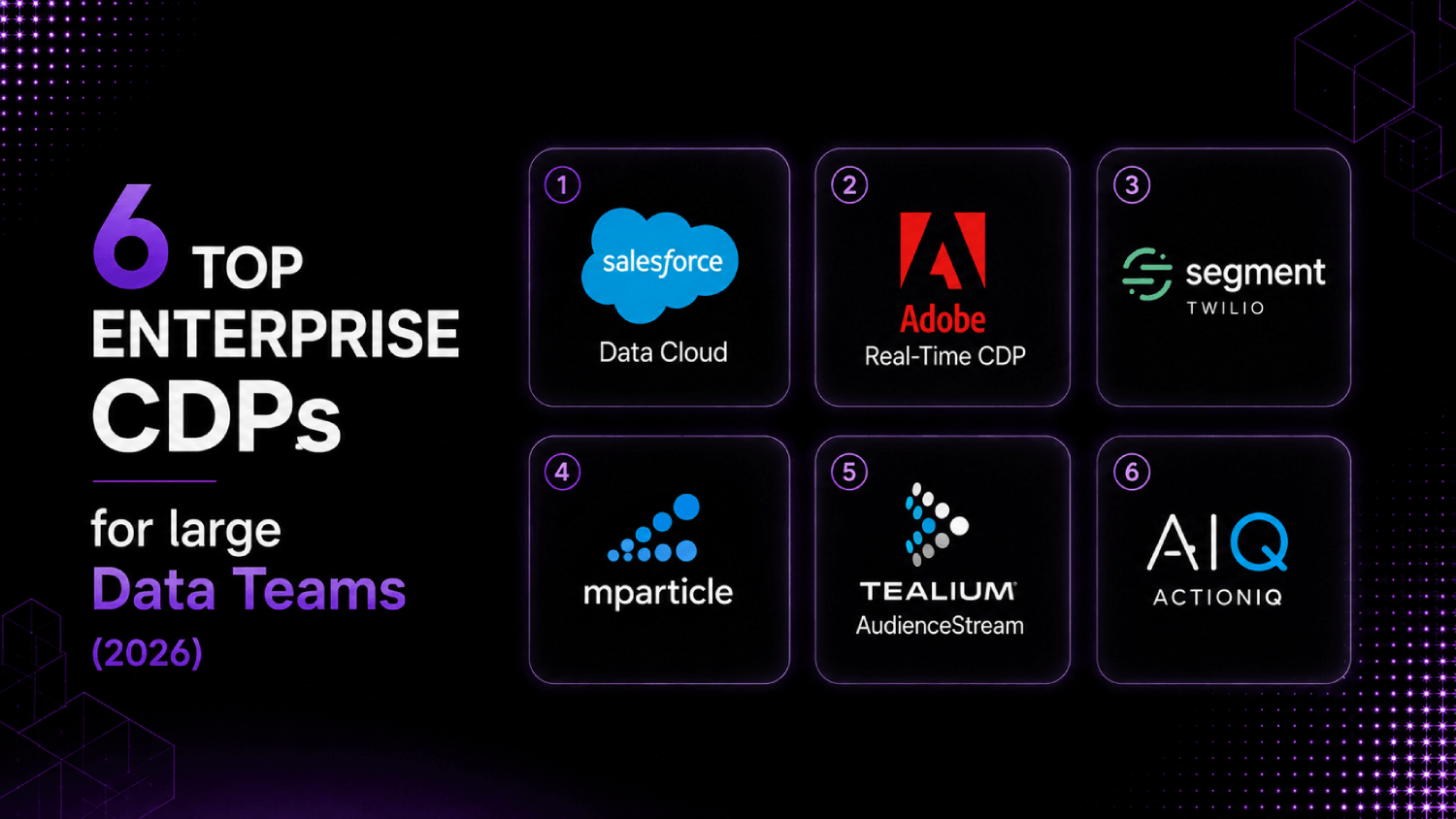
- Enterprise CDPs are not just larger versions of SMB tools , they differ on identity resolution at scale, data governance, SLA commitments, and real-time latency guarantees that most mid-market platforms do not offer.
- Salesforce Data Cloud and Adobe Real-Time CDP are the default choices for orgs already committed to those vendor stacks; switching costs are high, but so is out-of-the-box integration depth.
- Tealium and mParticle win on tag management heritage and mobile data pipelines, respectively , meaningful if those are your primary collection surfaces.
- ActionIQ is the only vendor here built specifically for large marketing teams that need SQL-native audience segmentation without involving data engineering on every campaign.
- Warehouse-native activation (via reverse ETL) can replace a traditional enterprise CDP for some stacks , worth evaluating before committing to a seven-figure contract.
The six enterprise customer data platforms that consistently hold up under large-team scrutiny are Salesforce Data Cloud, Adobe Real-Time CDP, Segment (Twilio), mParticle, Tealium AudienceStream, and ActionIQ. Each handles billions of events, supports role-based access controls and audit logging for compliance teams, and offers SLA-backed uptime. Which one fits your stack depends on your existing cloud commitments, your primary data collection surface, and whether your data team wants to own the pipeline or hand it off.
Why enterprise CDPs are a different buying category entirely
Most CDP comparisons treat scale as a slider , just pick the plan with more monthly tracked users and you are done. That framing collapses when you are processing billions of events per month across dozens of source systems, managing data residency requirements across multiple regions, and asking a platform to maintain sub-second profile updates while your attribution and personalization systems read from the same profiles simultaneously.
Three criteria separate enterprise CDPs from their mid-market cousins. First, deterministic identity resolution at volume: stitching anonymous to known profiles across web, mobile, CRM, and offline touchpoints without degrading match rates as the graph grows. Second, governance infrastructure: field-level encryption, consent signal propagation, data lineage, and role-based access that satisfies a security review. Third, contractual SLAs on ingestion latency and uptime , not just a status page, but a documented commitment with remedies.
This article focuses on those criteria deliberately. If your team is under 50 people or under $5 million ARR, you are probably not the buyer this list is for. The best CDPs for B2B teams covers platforms better suited to those budgets and complexity levels.
The AboutMartech Enterprise CDP Stack-Fit Test
Before evaluating any specific vendor, run four checks against your current architecture. This framework , the AboutMartech Enterprise CDP Stack-Fit Test , is designed to surface the constraints that vendor demos will not raise on their own.
Check 1: Identity graph ownership. Does the CDP maintain its own identity graph, or does it defer to your CRM? Platforms that rely entirely on your CRM as the system of record cannot resolve anonymous-to-known identity before a user logs in, which breaks personalization for the majority of web visitors who arrive and browse without authenticating.
Check 2: Ingestion latency ceiling. What is the maximum acceptable lag between a behavioral event firing and a profile update being available for activation? If your use case requires sub-second audience membership for real-time decisioning (like next-best-offer on a product page), batch-oriented CDPs are disqualifying regardless of their other capabilities.
Check 3: Governance surface area. Map every data type you will ingest , PII, behavioral, transactional, third-party , against your legal team’s data residency and retention requirements. Some platforms process everything in US-East and offer EU hosting only as an add-on. Others build regional isolation into the core architecture.
Check 4: Activation breadth vs. warehouse proximity. If your data team already runs a Snowflake or BigQuery warehouse, a warehouse-native approach via warehouse-native CDPs or reverse ETL may duplicate work a full CDP would do. Only buy a traditional CDP if you need managed profile APIs that your warehouse cannot serve directly.
What separates the six finalists from the rest of the enterprise CDP market
Roughly two dozen vendors claim the enterprise CDP label. The six below cleared a practical threshold: public documentation of real-time ingestion, a named enterprise SLA tier, and verifiable deployments at companies processing over one billion events per month. Vendors that could not demonstrate all three are not on this list regardless of analyst coverage.
Salesforce Data Cloud
Salesforce Data Cloud is the default choice for any organization that has already standardized on Sales Cloud, Marketing Cloud, or Service Cloud. The integration is not just an API connection , Data Cloud unified profiles write directly into Salesforce objects, which means sales reps see the same behavioral history that triggered a marketing workflow, without a separate data export.
The identity resolution engine uses both deterministic matching (email, phone) and probabilistic signals, and Salesforce publishes match rate benchmarks by vertical in their documentation. Governance is handled through Salesforce Shield and field-level encryption, which most enterprise security teams already understand from their CRM evaluation. The trade-off is vendor lock-in: Data Cloud’s value compounds the deeper you are in the Salesforce platform, and degrades sharply if you are not.
Pricing is not publicly listed. Salesforce structures Data Cloud around credits, with cost varying by data volume and the number of unified profiles. Enterprise deployments typically begin well into six figures annually on a multi-year contract. Organizations comparing Data Cloud against Adobe Real-Time CDP should know that both vendors negotiate from a base that factors in your existing spend across their broader product suite , standalone pricing conversations rarely reflect what a net-new customer would pay.
Adobe Real-Time CDP
Adobe Real-Time CDP is the natural counterpart for organizations running Adobe Experience Platform as their data backbone. The platform is built on AEP, which means it shares the same unified profile schema, the same data lake, and the same streaming ingestion pipeline , there is no separate sync job between your CDP and your analytics layer.
Real-time profile updates are the product’s genuine differentiator. According to Adobe Experience League documentation, profile attributes can be updated and made available for activation within milliseconds of an event firing, which matters for use cases like abandonment suppression or real-time offer insertion. The B2B edition adds account-level profiles that roll up individual contact data, which is rare among CDPs that treat identity as inherently person-centric.
Adobe does not publish pricing publicly. Licensing is tied to the broader Adobe Experience Cloud contract, and organizations outside that platform will find the onboarding costs and implementation timelines significant. Adobe Real-Time CDP is not a tool you deploy in a quarter without a systems integrator. Like Salesforce Data Cloud, contract minimums are negotiated, not listed, and SI implementation fees frequently match or exceed first-year licensing costs.
Segment (Twilio)
Segment is the most developer-friendly platform on this list, and the one most likely to already be partially deployed in your stack. Its SDK coverage spans web, mobile, server-side, and cloud sources, and its Connections product handles data collection and routing with less engineering lift than most alternatives.
The enterprise tier adds Twilio Engage for cross-channel campaign execution, Protocols for schema enforcement (which is where the real governance story lives), and advanced access controls. Identity resolution in Segment uses Profiles, which merge events across anonymous and known states using a configurable merge strategy. That configurability is valuable and creates risk , a misconfigured merge rule can silently corrupt profile data at scale, and debugging it is nontrivial.
Segment’s pricing moved to a volume-based model after Twilio’s acquisition, and enterprise contracts are quote-based. Segment tends to carry lower deal minimums than Salesforce Data Cloud or Adobe Real-Time CDP, which makes it more accessible for organizations in the 200-to-500-employee range that need enterprise governance features without an eight-figure vendor relationship. The platform’s position as a well-documented default has also generated a large community of partners and Segment alternatives worth evaluating if your primary concern is cost at very high event volumes.
mParticle
mParticle was built for mobile-first data pipelines, and that heritage shows in its SDK quality for iOS, Android, and React Native. Teams that collect a significant share of behavioral data from native mobile apps consistently rate mParticle’s data quality controls above what Segment or Tealium deliver on mobile surfaces.
The platform’s Data Master product enforces schema validation at the point of collection , events that do not match the defined plan are blocked or flagged before they corrupt the profile, not cleaned up downstream. For large teams with multiple engineering squads shipping instrumentation independently, that upstream enforcement is a meaningful operational difference.
mParticle’s identity API supports both deterministic and probabilistic resolution, and the platform offers GDPR and CCPA compliance tooling including consent forwarding to downstream systems. Enterprise pricing is quote-based and scales with monthly active users and event volume. mParticle typically negotiates smaller initial contract minimums than Salesforce Data Cloud or Adobe Real-Time CDP, though it does not carry the same breadth of native integrations with those vendors’ downstream tools.
Tealium AudienceStream
Tealium AudienceStream is most competitive for organizations that already use Tealium iQ for tag management. The two products share a data layer, which means behavioral events collected through iQ flow into AudienceStream without an additional instrumentation layer , a real reduction in engineering overhead for web-heavy organizations.
AudienceStream builds real-time visitor profiles and supports rule-based audience segmentation with low-latency activation to ad platforms, personalization engines, and downstream martech. The consent management integration through Tealium’s own Consent Manager is one of the more complete implementations in this space, with bidirectional consent signal propagation across the stack.
The platform’s weakness is mobile and server-side collection, where Tealium’s tooling lags mParticle. Organizations with significant app traffic will find they need to supplement AudienceStream with additional SDKs or accept lower data fidelity on mobile surfaces. Pricing is enterprise and quote-based, typically structured around event volume and the number of visitor profiles maintained. Tealium deals are generally more modular than Salesforce or Adobe contracts, which can reduce upfront commitment for organizations that want to start with tag management and expand into audience activation incrementally.
ActionIQ
ActionIQ takes a different architectural position than the other five. Rather than building its own data lake, ActionIQ queries your existing cloud data warehouse directly , Snowflake, BigQuery, Redshift , and runs segmentation and audience logic on top of your data without duplicating it into a separate store. This matters because it eliminates the data freshness problem that plagues traditional CDPs: your profiles are as fresh as your warehouse, and there is no secondary sync to wait on.
The platform’s audience builder is designed for marketing operations users, not data engineers. Marketers can write SQL-native queries through a visual interface, and data teams can expose pre-built metrics and dimensions that marketing can combine without writing code. That separation of concerns is rare and valuable at organizations where the bottleneck is engineering bandwidth rather than data availability.
ActionIQ’s identity resolution is federated , it works with your existing identity graph rather than replacing it, which reduces the deployment risk of migrating to a new platform. The trade-off is that ActionIQ does not add resolution capabilities your warehouse does not already have. Pricing is enterprise and quote-based. ActionIQ tends to position against Salesforce Data Cloud and Adobe Real-Time CDP on total cost of ownership, particularly for organizations that do not want to duplicate data storage costs into a separate CDP layer.
Enterprise CDP comparison: key capabilities
| Platform | Real-time profiles | Identity resolution type | Governance tier | Best fit for | Pricing model |
|---|---|---|---|---|---|
| Salesforce Data Cloud | Yes | Deterministic + probabilistic | Salesforce Shield | Full Salesforce stack | Credit-based, quote |
| Adobe Real-Time CDP | Yes (millisecond latency per Adobe documentation) | Deterministic + probabilistic | AEP-native | Adobe Experience Platform orgs | AEC contract, quote |
| Segment (Twilio) | Yes | Configurable merge rules | Protocols + RBAC | Developer-led stacks | Volume-based, quote |
| mParticle | Yes | Deterministic + probabilistic | Data Master enforcement | Mobile-first data pipelines | MAU + event volume, quote |
| Tealium AudienceStream | Yes | Rule-based stitching | Consent Manager integration | Tealium iQ tag management orgs | Event volume, quote |
| ActionIQ | Warehouse-dependent | Federated (uses existing graph) | Warehouse-level | SQL-literate marketing ops teams | Enterprise, quote |
When should an enterprise team use reverse ETL instead of a CDP?
A traditional CDP stores and manages profiles. A reverse ETL tool reads profiles from your warehouse and pushes them to activation endpoints. For organizations with a mature warehouse and a data team that already maintains clean, modeled customer data, the CDP may be solving a problem you do not have.
The practical test: if your marketing team is blocked on audience creation because they cannot access warehouse data without engineering help, a CDP with a marketer-facing segment builder (like ActionIQ) solves that. If your data team already ships audience tables to Snowflake on a regular cadence and the only missing piece is pushing those audiences to Meta, Salesforce, or Braze, a reverse ETL tool does the job at a fraction of the cost.
The two approaches are not mutually exclusive. Some large teams run a CDP for real-time behavioral profile management and a reverse ETL layer for warehouse-to-destination activation. The overlap is real, but so are the distinct use cases that justify both. For a detailed breakdown of where these categories diverge, the ETL vs reverse ETL vs CDP explainer covers the architecture distinctions without the vendor spin.
What does enterprise CDP implementation actually cost?
None of the six platforms above publish list pricing. All are quote-based, and all involve contract negotiations that factor in event volume, monthly active profiles, the number of destination connections, and support tier. Implementation costs are separate and often substantial: a Salesforce Data Cloud or Adobe Real-Time CDP deployment without a systems integrator is uncommon at enterprise scale, and SI fees frequently exceed first-year licensing costs. Segment and Tealium can be deployed with smaller professional services engagements, though that advantage narrows as data volume and governance complexity increase.
The more honest framing is total cost of activation: platform license, implementation, ongoing data engineering support, and the cost of the downstream destinations the CDP feeds. A team that buys an enterprise CDP and then also needs marketing attribution instrumented across those same touchpoints should account for that data layer investment once, not twice. The modern marketing data stack decisions are interconnected in ways that individual vendor evaluations tend to obscure.
How do enterprise CDPs handle GDPR and CCPA compliance at scale?
Consent signal propagation is where most enterprise CDP deployments develop technical debt. The challenge is not storing a consent flag , every platform does that. The challenge is ensuring that when a user revokes consent in one channel, that revocation propagates to every downstream system that received their data: the ad platform, the email tool, the personalization engine, and the data warehouse. Most platforms propagate consent to their native destinations. Third-party destinations are less consistent.
Tealium has invested in this area more visibly than most, with bidirectional consent propagation documented across its connector catalog. Salesforce Data Cloud inherits Salesforce’s Privacy Center tooling. mParticle’s consent state management API allows downstream systems to receive consent updates programmatically. For organizations in regulated verticals , financial services, healthcare, retail in California , the compliance architecture of the CDP warrants a dedicated technical review before signing any contract. Teams building out a broader cookieless measurement strategy should also consider how CDP consent architecture connects to their first-party data stack decisions upstream.
Frequently asked questions about enterprise CDPs
What is an enterprise CDP, and how does it differ from a standard CDP?
An enterprise customer data platform is built to handle billions of events per month, maintain unified profiles across millions of users in real time, and support governance requirements including role-based access, audit logging, data lineage, and consent propagation. Standard CDPs handle collection and basic segmentation but typically lack the SLA commitments, identity resolution depth, and compliance infrastructure that enterprise deployments require. The practical difference shows at scale: a mid-market CDP may process profiles in batches; an enterprise CDP is expected to reflect a behavioral event in an updated profile within seconds.
How do I choose between Salesforce Data Cloud and Adobe Real-Time CDP?
The decision is almost always determined by your existing cloud vendor relationship. If your CRM is Salesforce and your customer-facing teams live in Sales Cloud or Service Cloud, Data Cloud extends that investment without a new data model. If your web analytics, content management, and campaign execution run on Adobe Experience Cloud, Real-Time CDP uses the same AEP infrastructure you already pay for. Evaluating either platform in isolation, without accounting for the integration value of your existing contracts, produces a distorted comparison. Only consider switching platforms if you have a specific capability gap the other vendor addresses and your current stack does not.
Can an enterprise CDP replace a data warehouse?
No. A CDP manages unified customer profiles optimized for low-latency reads and activation. A data warehouse is designed for analytical workloads, historical queries, and data modeling at arbitrary granularity. They serve different access patterns and optimize for different things. Some enterprise CDPs, like ActionIQ, sit on top of an existing warehouse rather than duplicating data into a separate store , that architecture narrows the overlap but does not eliminate the warehouse. Teams that want to activate warehouse data without a full CDP should evaluate warehouse-native CDP approaches before committing to a traditional platform.
What ingestion latency should an enterprise CDP guarantee?
For real-time personalization and suppression use cases, profile updates need to be available for activation within seconds of an event firing , ideally under five seconds. For batch-oriented use cases like daily audience refreshes for paid media, latency matters less than reliability and completeness. According to Adobe Experience League documentation, Adobe Real-Time CDP targets millisecond-level profile update availability for streaming ingestion. Most other platforms in this category target single-digit second latency for streaming ingestion. Get the SLA in writing, including remedies, before signing.
How does identity resolution work in an enterprise CDP?
Identity resolution stitches together data from different sources , a web cookie, an email address, a CRM ID, a device fingerprint , into a single unified profile. Deterministic resolution links identities when there is an exact match, like the same email address appearing in two systems. Probabilistic resolution uses statistical signals , shared IP address, device type, behavioral patterns , to infer that two anonymous identifiers belong to the same person. Enterprise CDPs typically use both. The match rate and the false positive rate are both important metrics; a high match rate achieved by incorrectly merging profiles creates personalization errors that are hard to detect and harder to unwind.
What is the minimum viable team size to operationalize an enterprise CDP?
A realistic enterprise CDP deployment requires at minimum a data engineer to manage ingestion pipelines and schema governance, a marketing operations resource to own audience logic and activation workflows, and a legal or privacy stakeholder to sign off on data usage and consent configuration. Teams smaller than this tend to buy enterprise CDP capabilities they cannot operationalize, then underuse the platform. Organizations without dedicated data engineering capacity should evaluate whether a simpler collection tool plus a reverse ETL layer covers their actual use cases before committing to a full enterprise CDP contract.
Do enterprise CDPs support first-party data activation to paid media platforms?
Yes, and this is one of the primary activation use cases for all six platforms covered here. Typical integrations include Meta Custom Audiences, Google Customer Match, The Trade Desk, LinkedIn Matched Audiences, and programmatic DSPs via clean room partnerships. The depth of those integrations varies: some CDPs send a file; others maintain a live sync that updates audience membership as profiles change. For paid media suppression , removing recent purchasers or current customers from acquisition campaigns , live sync capability is meaningfully better than batch file delivery, which can lag by 24 hours or more. For teams building out a cookieless measurement strategy, the first-party data stack architecture decisions upstream of the CDP affect what activation is possible downstream.
Which enterprise CDP should you actually buy?
Start with your platform commitment. Organizations deeply embedded in Salesforce or Adobe should default to Data Cloud or Real-Time CDP respectively , the integration value is real and the switching costs from those platforms are high enough that a better CDP in isolation rarely justifies the migration. For organizations without a dominant cloud vendor allegiance, mParticle is the strongest choice for mobile-heavy data pipelines, Segment for developer-led web stacks, and Tealium for organizations already running its tag management layer.
ActionIQ is the one platform on this list that warrants serious consideration regardless of existing vendor commitments, specifically for large marketing operations teams that are bottlenecked by data access rather than data quality. Its warehouse-native architecture avoids the data duplication problem, and its marketer-facing segment builder genuinely reduces the engineering dependency on audience creation. That combination is rare, and it addresses a real organizational failure mode at enterprise scale.
The most expensive CDP mistake at enterprise scale is buying a platform sized for your ambitions rather than your current operational capacity. Every platform here can ingest data faster than most teams can act on it. The constraint is almost always the people and process to turn profile data into campaign decisions, not the platform’s throughput ceiling. Buy the CDP your team can actually run today, with a clear path to the capabilities you will need in 18 months.