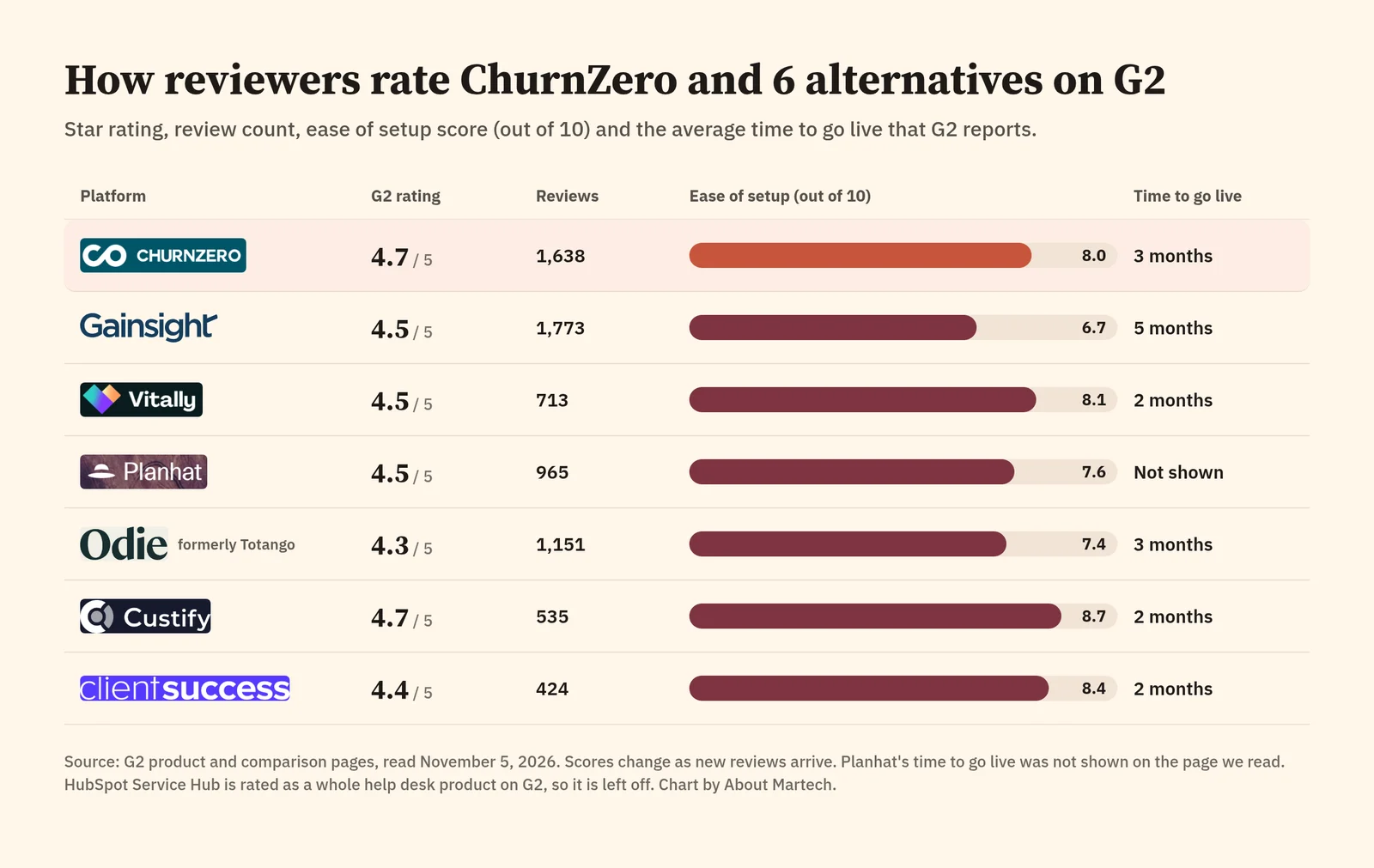
ChurnZero is one of the best rated customer success platforms on G2, with 4.7 out of 5 from 1,638 reviews (G2). Teams still leave it. The usual reasons are the effort it takes to set up and run, a pricing model that grows with your customer count, and the wish for something lighter, or for one platform that also covers sales and support.
We compared seven platforms that teams move to from ChurnZero, using what each vendor publishes, what G2 reviewers report and what buyers actually paid according to Vendr, all read on November 5, 2026. If you are still building a shortlist from scratch, start with our guide to the best customer success software.
TLDR
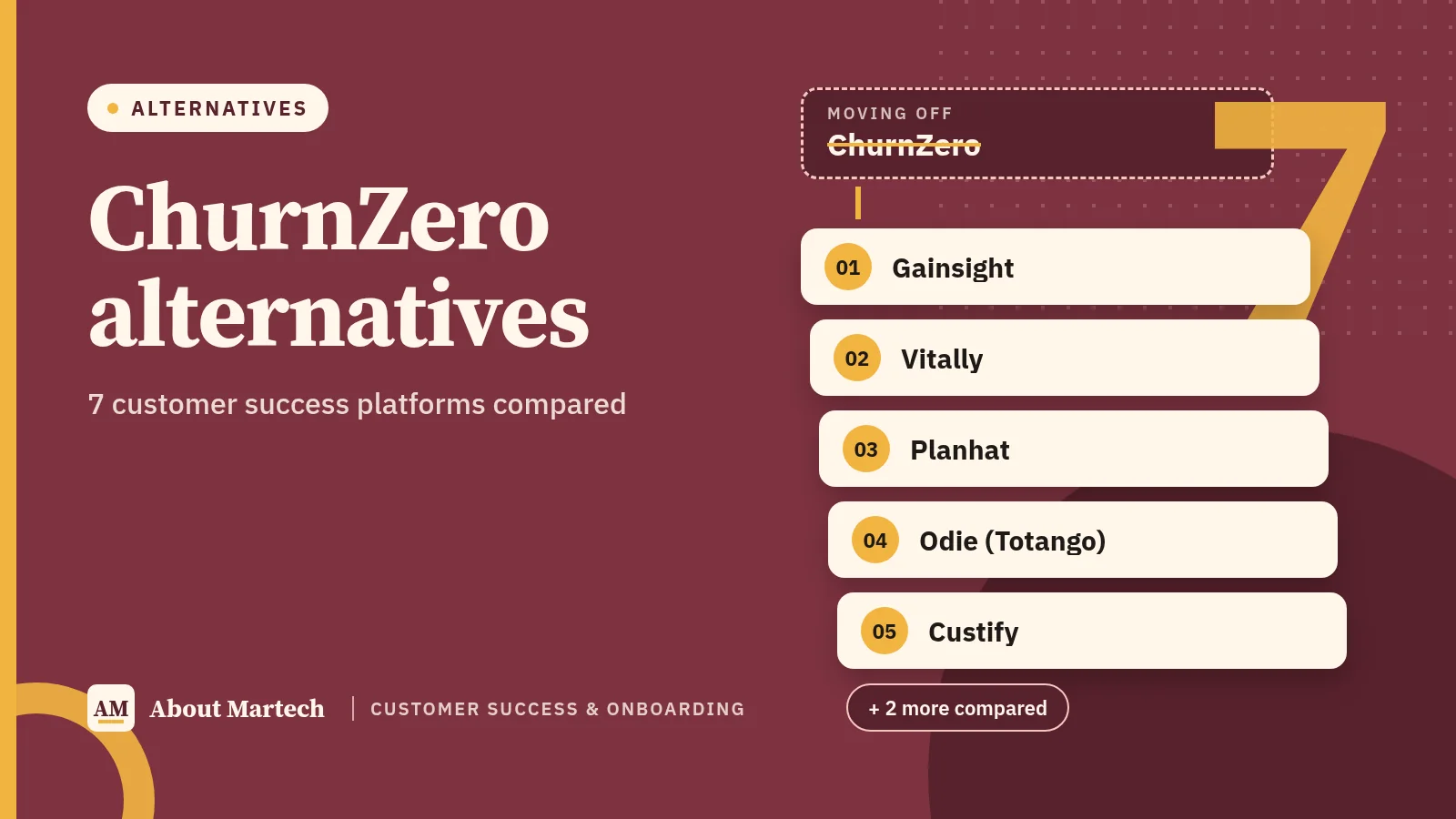
Short answer: For most mid-market SaaS teams, Vitally is the closest ChurnZero alternative that is easier to run: G2 reviewers rate its setup 8.1 out of 10 against 8.0 for ChurnZero, with a 2-month average go-live instead of 3, and buyers report a lower median price. Pick Gainsight for complex enterprise CS, Planhat if you want CS, sales and services in one system, and Custify or ClientSuccess if budget comes first.
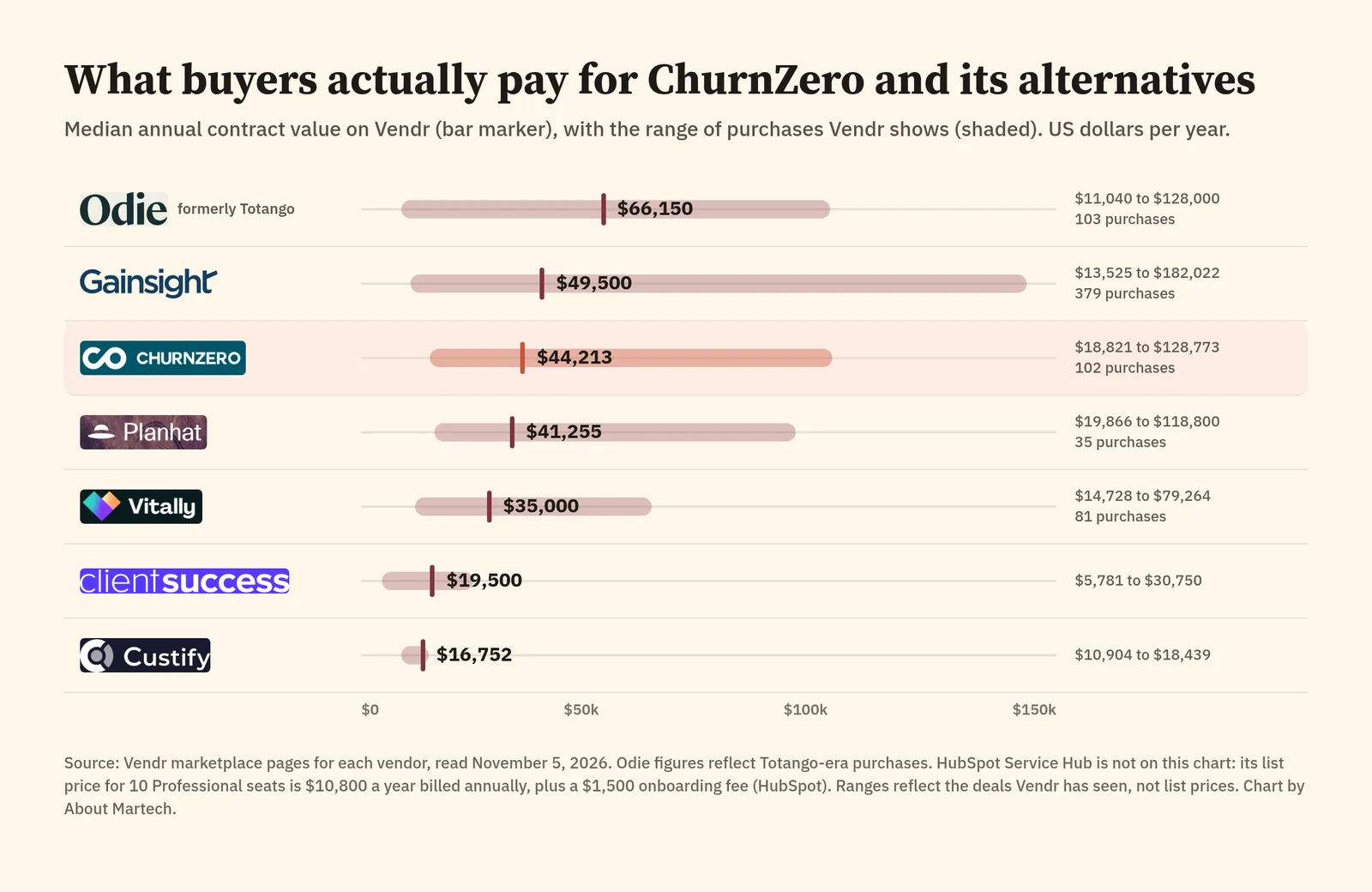
- Lowest price paid: Custify (Vendr median $16,752 a year) and ClientSuccess ($19,500), against $44,213 for ChurnZero.
- Most depth: Gainsight, with 4.5 out of 5 from 1,773 G2 reviews, but the longest average go-live (5 months).
- Published prices: only Odie (formerly Totango, from $1,500 a month) and HubSpot Service Hub ($90 per seat a month billed yearly) list them.
- Already on HubSpot? Service Hub Professional includes a customer success workspace.
In this guide
ChurnZero alternatives at a glance
| Platform | Best for | G2 rating | Ease of setup (G2) | Median price paid (Vendr) | Published price |
|---|---|---|---|---|---|
| ChurnZero (baseline) | Automated, tech-touch CS at scale | 4.7 (1,638 reviews) | 8.0 | $44,213 a year | No |
| Gainsight | Complex enterprise CS | 4.5 (1,773) | 6.7 | $49,500 a year | No |
| Vitally | Mid-market teams that want quick adoption | 4.5 (713) | 8.1 | $35,000 a year | No |
| Planhat | CS, sales and services in one platform | 4.5 (965) | 7.6 | $41,255 a year | No |
| Odie (formerly Totango) | AI-first CS for enterprises | 4.3 (1,151) | 7.4 | $66,150 a year (Totango era) | From $1,500 a month |
| Custify | Small SaaS teams on a budget | 4.7 (535) | 8.7 | $16,752 a year | No |
| ClientSuccess | SMB and mid-market renewals and onboarding | 4.4 (424) | 8.4 | $19,500 a year | No |
| HubSpot Service Hub | Teams already on HubSpot CRM | Not compared | Not compared | Not on Vendr chart | $90 per seat a month, yearly |
Sources: G2 product and comparison pages, Vendr marketplace pages and vendor pricing pages, all read on November 5, 2026. G2 rates HubSpot Service Hub as a whole help desk product, so its scores are not comparable here.
Why teams look for ChurnZero alternatives
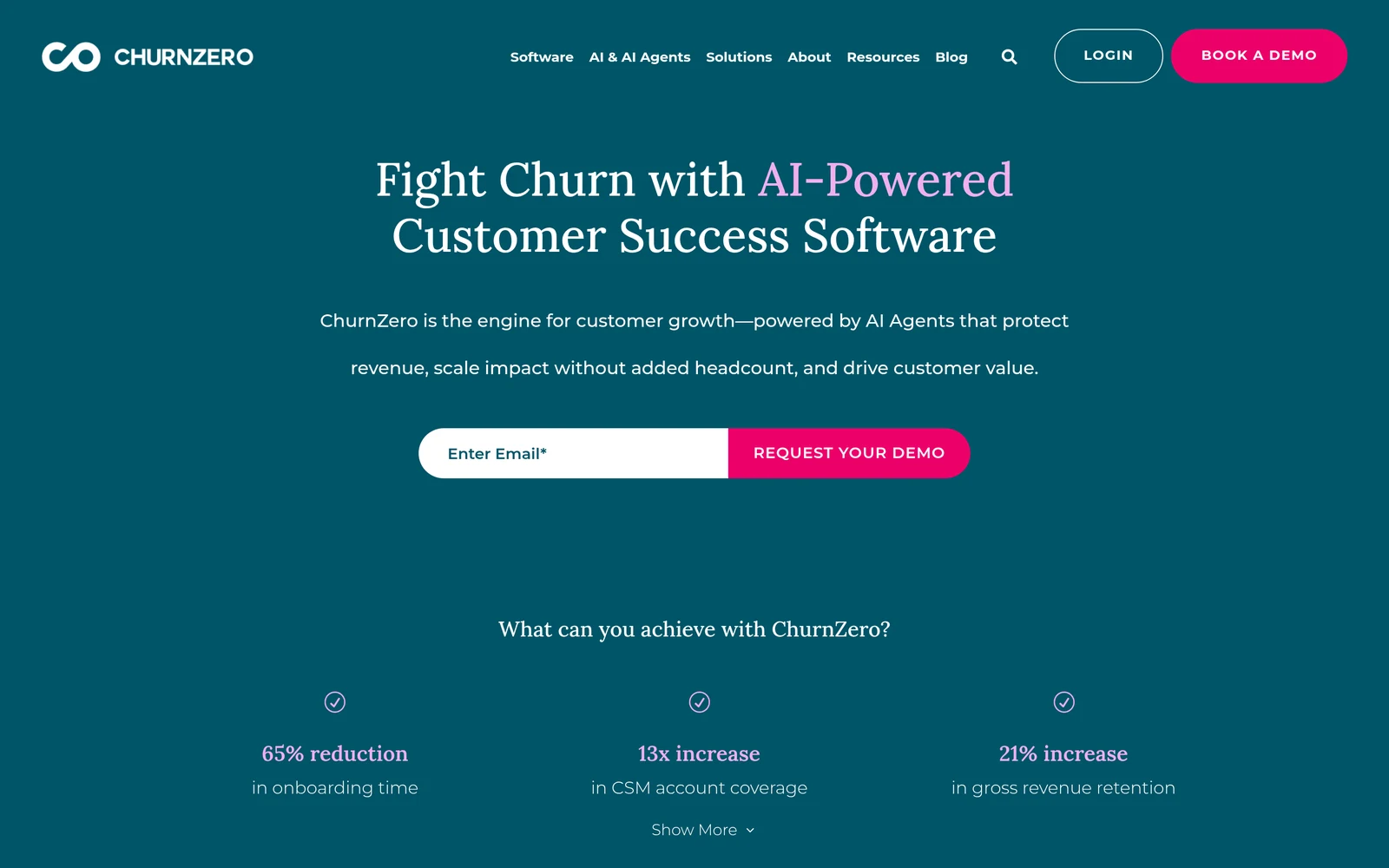
ChurnZero does a lot well. Its G2 quality of support score is 9.5, and on October 20, 2026 it launched Kit, an AI assistant that works inside ChurnZero, Slack and Microsoft Teams (PR Newswire). The reasons to switch tend to be about fit, not quality:
- Learning curve. On G2, reviewers mention ChurnZero’s “learning curve” 54 times and its “complexity” 41 times among its drawbacks. G2 reports an average of 3 months to go live.
- Pricing grows with accounts. ChurnZero has no maximum number of users. Each user covers 400 accounts, and every account above that costs $1, according to its Editions sheet. A team with a long tail of small customers can see the bill climb without adding a single CSM.
- Integration caps. The same sheet caps add-on integrations at 5 on the Professional edition; Enterprise has no cap.
- Price paid. The median ChurnZero buyer pays $44,213 a year across 102 purchases on Vendr, with deals from $18,821 to $128,773.
In a r/CustomerSuccess thread where a team compared ChurnZero, Planhat and Vitally, replies broadly agreed that ChurnZero was strongest for scaled segmentation and automated email plays, Vitally had the most intuitive interface for a lean team, and Planhat offered the most customization but needed technical skills to implement. That is anecdotal, but it matches the G2 numbers below. For a direct head to head, see our ChurnZero vs Vitally and Gainsight vs ChurnZero comparisons.
What to check before you switch
- What the bill counts. ChurnZero counts accounts. Gainsight includes a set number of users and customers per user, Planhat charges a platform fee plus Core Users, HubSpot charges per seat, and Odie prices by portfolio size and how deeply it analyzes each account. Model your own numbers before comparing quotes.
- Time to go live. G2 reports 2 months for Vitally, Custify and ClientSuccess, 3 months for ChurnZero and Odie (Totango), and 5 months for Gainsight. Your migration adds to this.
- Automation depth. If most of your customers are tech-touch, check that journeys, in-app messages and email plays match what you run in ChurnZero today.
- AI that is shipping, not on a roadmap. ChurnZero Kit, Planhat Pi, Vitally Quin, CustifyAI and Gainsight’s agents all launched recently. Ask which are included in the plan you are quoted.
The 7 best ChurnZero alternatives, reviewed
1. Gainsight: best for complex, enterprise customer success
| Best for | Complex, enterprise customer success |
| G2 rating | 4.5 out of 5 (1,773 reviews) |
| Ease of setup / time to go live | 6.7 out of 10 / 5 months |
| Median price paid | $49,500 a year (Vendr, 379 purchases) |
| Pricing model | Essentials or Enterprise; users and customers per user included |
Gainsight is the largest name in the category. Beyond its customer success platform it sells Staircase AI, the Atlas AI renewal service, Gainsight PX for in-app engagement, Gainsight CC for communities and Skilljar for customer education (Gainsight).
Its pricing page lists two editions without prices. Essentials includes 10 full users and 100 customers per user; Enterprise includes 20 full users and 200 customers per user, and adds renewal and expansion forecasting, organizational mapping and sponsor tracking. On Vendr, the median buyer pays $49,500 a year, with deals from $13,525 to $182,022 and average savings of 15%.
Where it beats ChurnZero: it goes deeper on renewals, forecasting, communities and education, and it has the most G2 reviews of any tool here (G2). Our Gainsight pricing guide breaks down the editions.
Where it falls short: it is the hardest to set up of the group (6.7 out of 10 on G2) and takes about 5 months to go live, so it rarely fixes a “too complex” complaint about ChurnZero.
2. Vitally: best for mid-market teams that want quick adoption
| Best for | Mid-market teams that want quick adoption |
| G2 rating | 4.5 out of 5 (713 reviews) |
| Ease of setup / time to go live | 8.1 out of 10 / 2 months |
| Median price paid | $35,000 a year (Vendr) |
| Pricing model | Tech-Touch, Hybrid-Touch or High-Touch plan |
Vitally sells three plans named for how you manage customers: Tech-Touch, Hybrid-Touch and High-Touch. All three say “Request Pricing”, every plan includes unlimited observer seats, and High-Touch adds unlimited full seats (Vitally pricing). On October 20, 2026 it launched Quin, an AI assistant, in open beta (Vitally).
Buyers on Vendr report a median of $35,000 a year, with a range of $14,728 to $79,264 across 81 purchases.
Where it beats ChurnZero: it is the alternative teams most often name when ChurnZero feels heavy: a higher setup score and a shorter average go-live on G2, plus a lower median price paid.
Where it falls short: its automation for large tech-touch books is less proven than ChurnZero’s, and none of its prices are published.
3. Planhat: best for one platform for CS, sales and services
| Best for | One platform for CS, sales and services |
| G2 rating | 4.5 out of 5 (965 reviews) |
| Ease of setup | 7.6 out of 10 |
| Median price paid | $41,255 a year (Vendr) |
| Pricing model | Platform fee plus a minimum number of Core Users |
Planhat sells CRM and customer success plans that combine a platform fee with a minimum number of Core Users, plus any extra Core Users and Solution Extensions you add (Planhat pricing). Its AI assistant, Pi, is part of the core product (Planhat), and Planhat says it was named a Leader in Gartner’s 2026 Magic Quadrant for Customer Success Management Platforms (Planhat).
On Vendr, the median buyer pays $41,255 a year, with deals from $19,866 to $118,800 across 35 purchases.
Where it beats ChurnZero: custom objects and a flexible data model let you run customer success, sales and services in one place, which ChurnZero does not try to do (G2).
Where it falls short: it has a lower setup score than ChurnZero, so it is a better fit for teams that want more flexibility than for teams that want less work. Our Planhat vs Vitally vs ChurnZero comparison covers that trade-off in more detail.
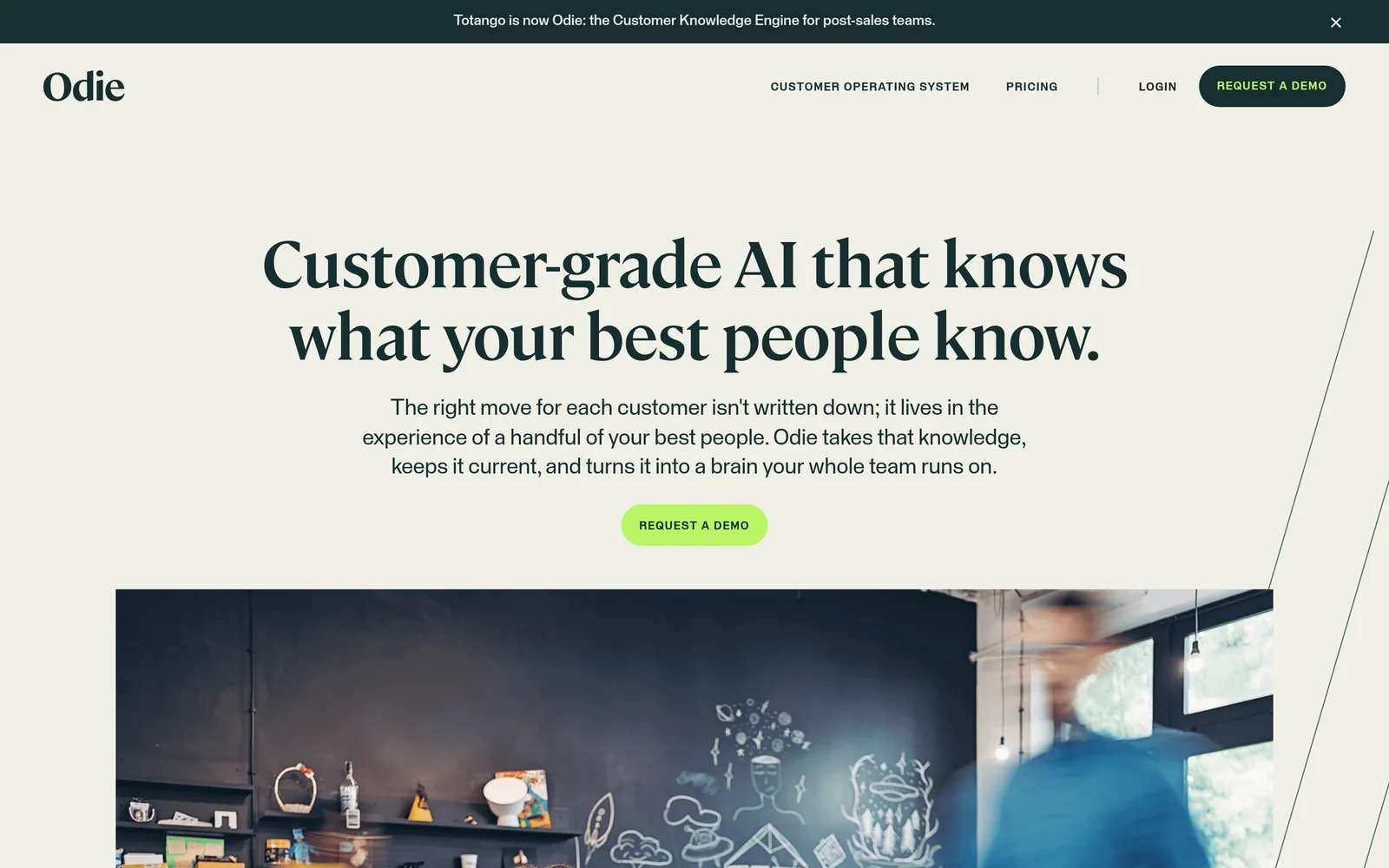
4. Odie (formerly Totango): best for enterprises that want AI-first customer success
| Best for | Enterprises that want AI-first customer success |
| G2 rating (as Totango) | 4.3 out of 5 (1,151 reviews) |
| Ease of setup / time to go live | 7.4 out of 10 / 3 months |
| Published price | Knowledge Engine from $500 a month; Customer Operating System from $1,500 a month |
| Contract | Terms start at one year; most customers sign for two |
Totango became Odie on September 10, 2026, according to a letter from CEO Keith Frankel (Odie). Totango and Catalyst merged in 2024, and both still appear as products on totango.com. Odie says legacy Totango and Catalyst customers keep the same contract, pricing and product for now.
Odie is the only vendor here with a published starting price. Its Customer Knowledge Engine starts at $500 a month and its Customer Operating System at $1,500 a month. There is no seat-based pricing; the price depends on customer portfolio size and how deeply and often Odie analyzes each account (Odie pricing). Totango-era buyers on Vendr paid a median of $66,150 a year across 103 purchases.
Where it beats ChurnZero: it is built around AI agents and an MCP server for your own AI tools, and it does not charge per seat (G2). Our Gainsight vs Totango comparison covers the Totango side in more depth.
Where it falls short: the Odie platform is weeks old under its new name, so ask for references on the new product rather than relying on Totango reviews.
5. Custify: best for small SaaS teams on a budget
| Best for | Small SaaS teams on a budget |
| G2 rating | 4.7 out of 5 (535 reviews) |
| Ease of setup / time to go live | 8.7 out of 10 / 2 months |
| Median price paid | $16,752 a year (Vendr) |
| Onboarding | Concierge onboarding in 4 weeks |
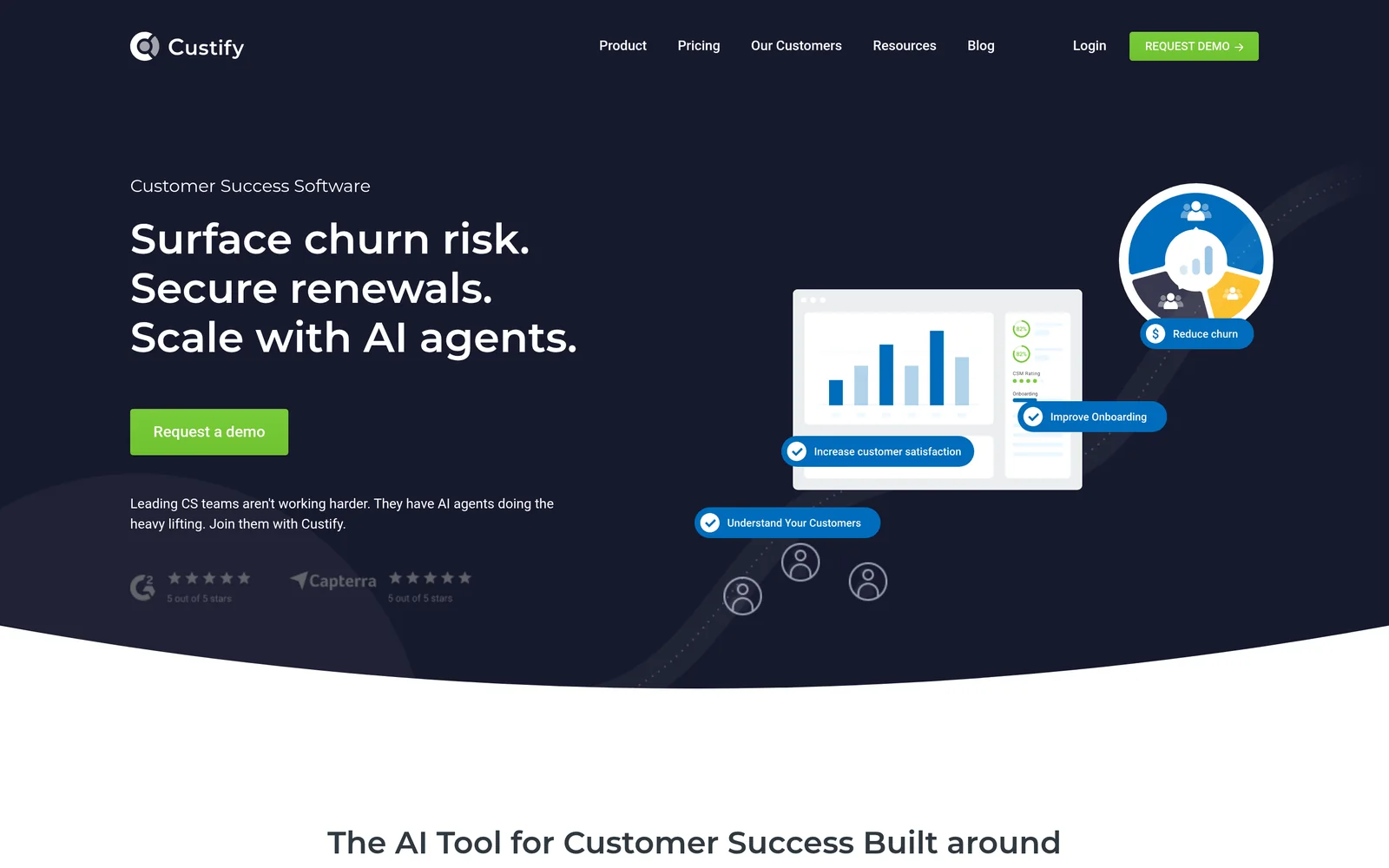
Custify does not publish prices, but it offers concierge onboarding that it says gets you live in 4 weeks, holds ISO 27001 certification and will add an integration free of charge if it suits its wider customer base (Custify pricing). CustifyAI covers churn risk, playbooks and summaries (Custify).
It has the highest setup score of any tool here, and G2 shows small businesses as its largest reviewer group (G2). Buyers on Vendr report a median of $16,752 a year, with a range of $10,904 to $18,439.
Where it beats ChurnZero: it costs well under half of ChurnZero’s median price paid and is the easiest to set up, while matching ChurnZero’s 4.7 rating.
Where it falls short: it is built for smaller teams, so enterprises with complex hierarchies may outgrow it. Some comparison sites quote a monthly Custify price; we could not find one on Custify’s own site.
6. ClientSuccess: best for SMB and mid-market renewals and onboarding
| Best for | SMB and mid-market renewals and onboarding |
| G2 rating | 4.4 out of 5 (424 reviews) |
| Ease of setup / time to go live | 8.4 out of 10 / 2 months |
| Median price paid | $19,500 a year (Vendr) |
| Packages | Startup (500 customers, 10 licences), Growth (5,000, 50), Enterprise (unlimited) |
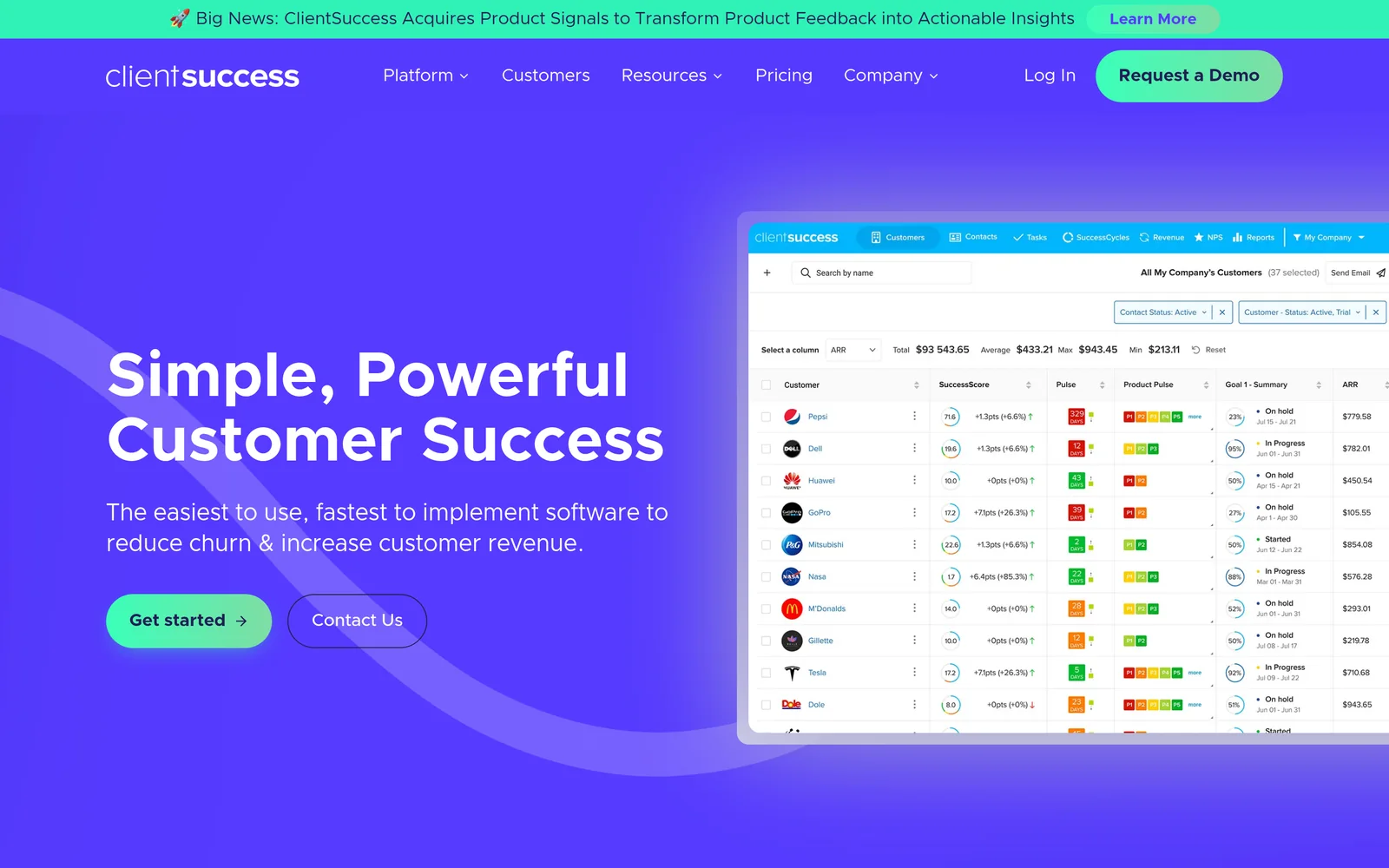
ClientSuccess lists three packages without prices: Startup covers up to 500 customers and 10 full licences, Growth 5,000 customers and 50 licences, and Enterprise unlimited (ClientSuccess pricing). It says most customers are live in 4 to 6 weeks, that annual contracts typically get 15 to 20% off month-to-month rates, and that it is typically 30 to 50% cheaper than enterprise platforms such as Gainsight (a vendor claim).
It has been adding pieces through acquisitions: Baton for onboarding and implementation, and Product Signals for product feedback. The median buyer on Vendr pays $19,500 a year, with deals from $5,781 to $30,750.
Where it beats ChurnZero: clear customer and licence limits per package and a lower median price paid than ChurnZero (G2).
Where it falls short: its rating and review count are the lowest of the dedicated platforms here, and it has fewer automation options for very large tech-touch books.
7. HubSpot Service Hub: best for teams that already run on HubSpot CRM
| Best for | Teams that already run on HubSpot CRM |
| Customer success feature | Customer success workspace, in Professional and up |
| List price | $90 per seat a month billed yearly, or $100 monthly |
| Onboarding fee | $1,500 one time for Professional |
| Example | 10 seats = $10,800 a year (HubSpot) |
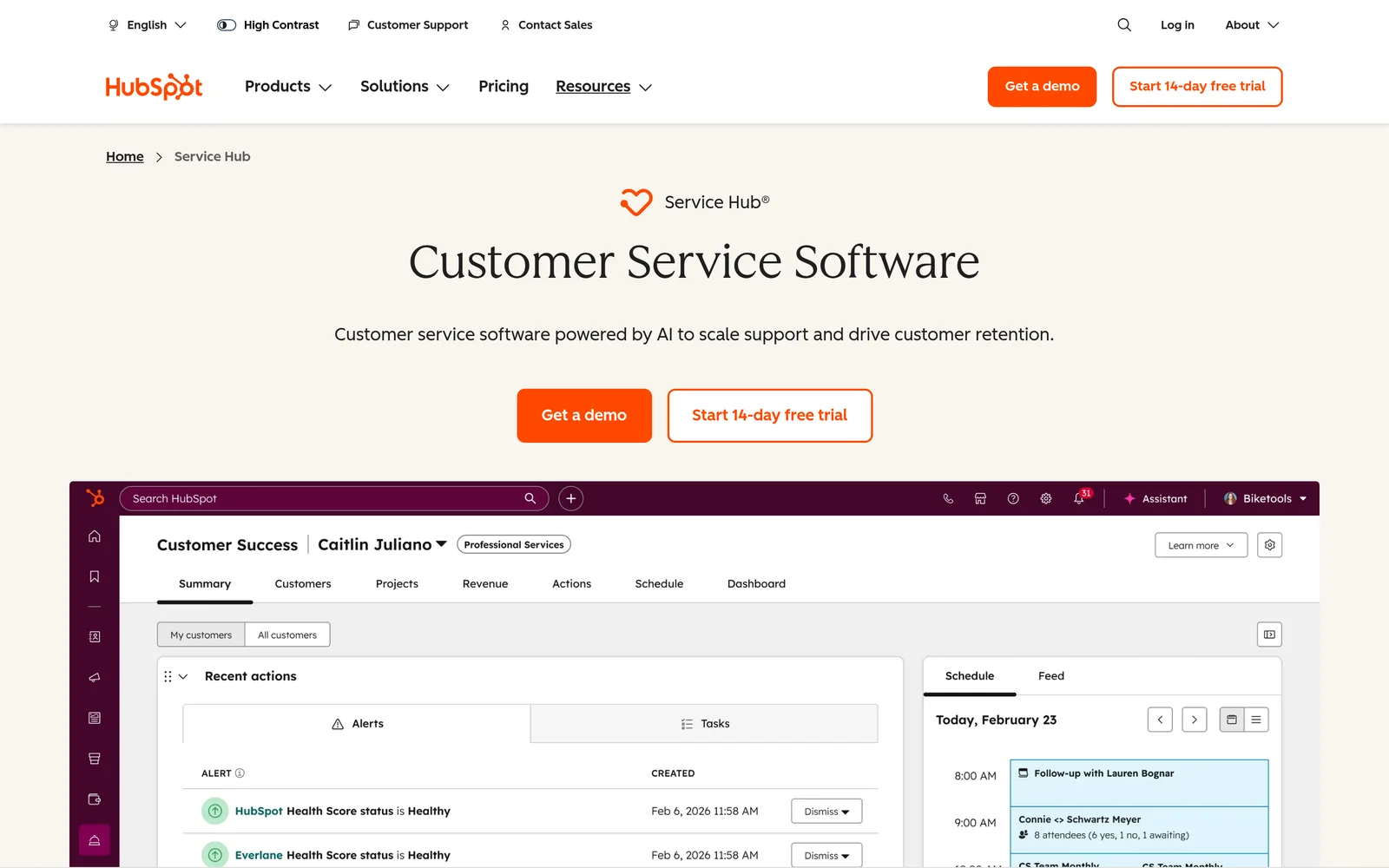
Service Hub Professional includes a customer success workspace for managing a book of business, building customer health scores and prioritizing rep activity (HubSpot). HubSpot’s own pricing guide puts Professional at $90 per seat a month billed yearly, with a mandatory $1,500 onboarding fee, and works through an example: 10 seats cost $10,800 a year (HubSpot).
Because it sits on the same CRM as your marketing and sales data, there is no sync to build or maintain.
Where it beats ChurnZero: if your CRM is HubSpot, you get health scores and a CSM workspace without a second system, at a published price. Our CRM vs customer success platform guide explains when that is enough.
Where it falls short: it is a help desk with customer success features, not a dedicated CS platform, so expect less depth in journeys, in-app messaging and account-based automation.
Which ChurnZero alternative should you pick?
- Pick Vitally if ChurnZero feels heavy and you want a platform your CSMs adopt quickly.
- Pick Gainsight if you are an enterprise that needs renewal forecasting, communities and customer education from one vendor.
- Pick Planhat if you want customer success, sales and services in one flexible system and can invest in setup.
- Pick Odie if you want an AI-first platform with a published starting price and no seat pricing.
- Pick Custify or ClientSuccess if price paid is the main reason you are leaving.
- Pick HubSpot Service Hub if your company already runs on HubSpot CRM and your CS motion is simple.
Comparing costs side by side? Our customer success software pricing guide covers six platforms, and our list of customer success tools for startups covers cheaper options.
How to migrate off ChurnZero
- Check your renewal date first. Give notice in the window your contract sets, and ask what export formats ChurnZero provides before you sign elsewhere.
- Export what you cannot rebuild. Health score history, NPS and survey responses, tasks, notes and journey or play definitions. Usage events usually come back from your product analytics or data warehouse, not from ChurnZero.
- Rebuild health scores, do not copy them. A switch is a good time to drop inputs that never predicted churn.
- Run both tools for a short overlap. Keep ChurnZero live until renewal and in-app plays run in the new platform, so no renewal slips through.
- Budget time, not just licence cost. G2 reports 2 to 5 months to go live for the tools here.
How we chose these ChurnZero alternatives
We read the pages that rank for “ChurnZero alternatives” and “ChurnZero competitors” and kept dedicated customer success platforms plus one CRM option. We left out tools that only handle cancellation flows. Every rating, price and limit comes from G2, Vendr or the vendor’s own pages, read on November 5, 2026; where a price is not published, we say so. Vendr figures are prices buyers reported paying, not list prices. We did not run live trials of each tool, and no vendor paid to be included.
Frequently asked questions
What is the best alternative to ChurnZero?
For most mid-market SaaS teams, Vitally is the closest alternative that is easier to run, with an 8.1 out of 10 setup score and a 2-month average go-live on G2. Gainsight suits complex enterprises, Planhat suits teams that want CS, sales and services in one platform, and Custify or ClientSuccess suit tighter budgets.
How much does ChurnZero cost?
ChurnZero does not publish prices. Its Editions sheet says each user covers 400 accounts and extra accounts cost $1 each, with no maximum number of users. On Vendr, the median buyer pays $44,213 a year across 102 purchases.
What is the cheapest ChurnZero alternative?
Among dedicated platforms, Custify has the lowest median price paid on Vendr at $16,752 a year, followed by ClientSuccess at $19,500. HubSpot Service Hub Professional costs $90 per seat a month billed yearly plus a $1,500 onboarding fee.
Is Totango still available?
Totango became Odie on September 10, 2026. Existing Totango and Catalyst customers keep their contract, pricing and product for now. Odie’s Customer Operating System starts at $1,500 a month.
Is ChurnZero better than Gainsight?
ChurnZero is easier to set up (8.0 vs 6.7 on G2) and faster to go live (3 vs 5 months), and buyers report a lower median price. Gainsight goes deeper on renewal forecasting, communities and customer education.
How long does it take to switch customer success platforms?
G2 reports an average of 2 months to go live for Vitally, Custify and ClientSuccess, 3 months for ChurnZero and Totango, and 5 months for Gainsight. Plan for data export, rebuilding health scores and a short overlap with your old tool.
Does ChurnZero have AI features?
Yes. ChurnZero launched Kit, an AI assistant that works inside ChurnZero, Slack and Microsoft Teams, on October 20, 2026.