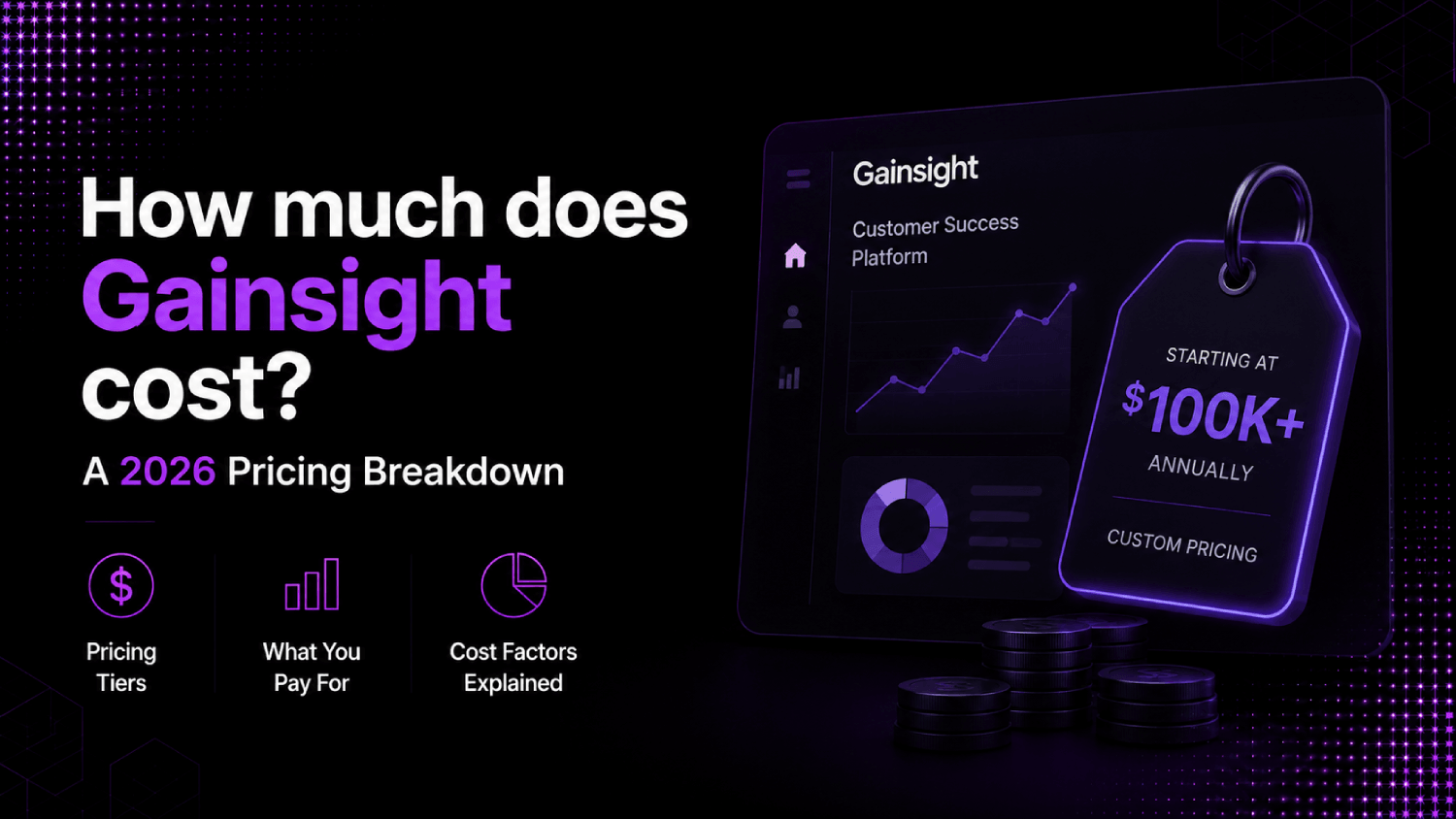
- Gainsight does not publish pricing. Every contract is negotiated, and the vendor positions this as “flexibility” , but it also means you cannot budget without a sales call.
- Based on publicly reported buyer accounts, annual contracts typically land between $30,000 and $150,000+, with enterprise deals running higher depending on customer account volume and product tier.
- Implementation costs are a second, often-overlooked budget line: professional services or third-party partners commonly add $20,000 to $60,000 on top of license fees for mid-market deployments.
- Gainsight sells three distinct products , CS (customer success), PX (product experience), and Gainsight AI , which are each priced separately, so “Gainsight pricing” depends heavily on which modules you are buying.
- If the numbers here exceed your budget or your customer count does not justify the seat cost, the best Gainsight alternatives for teams without enterprise budgets covers the options that undercut Gainsight on price without gutting core CS functionality.
Gainsight does not list prices publicly. Annual contracts for its core customer success platform start around $30,000 for smaller deployments and frequently exceed $100,000 for mid-market teams once professional services, add-on modules, and implementation are factored in. Enterprise accounts with large customer bases can exceed $150,000 annually. Implementation through Gainsight’s professional services or a certified partner typically adds $20,000 to $60,000 for a standard deployment.
Why Gainsight Hides Its Pricing, and What That Costs You as a Buyer
Gainsight’s pricing opacity is a deliberate sales strategy, not an operational accident. By forcing a discovery call before any number appears, the vendor can anchor deals based on your company’s size, ARR, and customer account volume rather than a published rate card. For buyers, this means you are negotiating without a floor or ceiling in sight.
The practical consequence: many buyers budget only for the software license and miss what implementation, data migration, internal onboarding time, and ongoing admin overhead add to the total. These costs appear after the contract is signed. Buyer accounts on G2 and Gartner Peer Insights (as of 2025) commonly report first-year totals running well above the license alone. This guide names the line items you need to plan for before you sign.
What Products Does Gainsight Actually Sell?
Gainsight is not a single product. It is a suite, and each component carries its own price tag. Buyers who search “Gainsight pricing” are often conflating three distinct platforms that the vendor sells separately.
Gainsight CS
This is the flagship customer success platform: health scores, lifecycle playbooks, risk alerts, renewal tracking, and CSM workflow automation. It is the product most teams mean when they say “Gainsight.” Pricing is based on the number of customer accounts managed, not seats, though CSM seat counts influence the tier as well.
Gainsight PX
Gainsight PX is a product analytics and in-app engagement layer aimed at product teams, not CS teams. It tracks feature adoption, triggers in-app guides, and feeds usage data into Gainsight CS. It is priced separately, typically based on monthly active users (MAUs). Teams that want both platforms need to negotiate a bundle, which may or may not be discounted.
Gainsight AI
Gainsight’s AI layer, branded as Gainsight AI, sits on top of CS and PX and adds generative call summaries, AI-powered health scoring, and churn prediction nudges. As of 2025, this is being sold as an add-on or included in higher tiers rather than as a standalone SKU , but confirm current packaging with your AE because module bundling shifts frequently.
How Much Does Gainsight Cost? The Number Ranges Buyers Report
Gainsight does not publish pricing on its website. The figures below are drawn from buyer-reported data on review platforms including G2 and Gartner Peer Insights (as of 2025), as well as publicly available procurement discussions. Treat these as planning ranges, not quotes.
| Company Profile | Estimated Annual License (Gainsight CS) | Implementation Cost | First-Year Total (Est.) |
|---|---|---|---|
| Mid-market SaaS (50-200 customer accounts, 5-10 CSMs) | $30,000, $60,000 | $20,000, $30,000 | $50,000, $90,000 |
| Growth SaaS (200-1,000 accounts, 10-25 CSMs) | $60,000, $100,000 | $30,000, $50,000 | $90,000, $150,000 |
| Enterprise (1,000+ accounts, dedicated CS ops) | $100,000, $200,000+ | $40,000, $80,000+ | $140,000, $280,000+ |
These ranges assume Gainsight CS only. Adding Gainsight PX or the AI layer increases total contract value, often by 20 to 40 percent depending on MAU volume and negotiated bundle pricing.
What Drives Gainsight’s Price Up (or Down)?
Gainsight’s AEs price deals based on a combination of signals. Knowing which levers move the number lets you enter negotiation with a clearer position.
Customer account volume
The primary pricing unit for Gainsight CS is the number of customer accounts in the system, not the number of CSM seats. A company managing 2,000 SMB accounts pays substantially more than one managing 150 enterprise accounts, even if both have the same headcount. If your CS motion is scaled via pooled or tech-touch coverage of many small accounts, expect this line to be significant.
CSM seat count
Seat count is a secondary factor but still influences tier placement. Teams that need to license Gainsight across a large CS org, including managers, analysts, and renewals reps, will land in higher tiers where per-seat costs start to compound against the per-account base.
Product tier
Gainsight CS ships in multiple tiers (Essentials, Enterprise, and above). The Essentials tier strips out advanced features like AI-driven health scoring, revenue intelligence integrations, and some automation depth. Teams that buy Essentials to save money often find themselves upgrading within 12 to 18 months once their CS ops mature, which resets the negotiation clock.
Contract length and prepay
Multi-year contracts and annual prepay typically yield 10 to 20 percent discounts. Gainsight’s AEs are incentivized on annual contract value (ACV), so signing a two-year deal with upfront payment is one of the cleaner ways to pull the price down without negotiating feature scope.
Salesforce dependency
Gainsight CS can run on its own data layer or sync with Salesforce CRM. Teams running the Salesforce-native configuration (Gainsight NXT on Salesforce) may incur additional Salesforce licensing costs or API call charges on the Salesforce side, separate from Gainsight’s invoice entirely. Budget for both.
What Does Gainsight Implementation Actually Cost?
Implementation is where Gainsight’s total cost of ownership diverges most sharply from the sticker price. The platform’s data model is complex: you are mapping customer account hierarchies, configuring health score rules, building playbooks, and integrating with your CRM, billing system, and product telemetry before a single CSM can use it productively.
Gainsight offers its own professional services at day rates that are not publicly listed. Third-party implementation partners, including certified Gainsight consulting firms, typically quote $20,000 to $60,000 for a standard mid-market deployment covering data integration, health score setup, and initial playbook configuration. Enterprise deployments with complex data environments regularly exceed that range.
Timeline matters too. A typical Gainsight CS implementation runs 8 to 16 weeks for a mid-market team. That window carries internal opportunity cost: CS ops time, IT bandwidth for data work, and CS manager time for health score calibration. Those hours are real costs that do not appear on any vendor invoice.
The AboutMartech Implementation Cost Test
Before signing, run this four-part check to size your true implementation exposure:
- Data source count: How many systems feed Gainsight? Each source (CRM, billing, product analytics, support) adds integration scope. More than three sources typically means a longer and more expensive setup.
- Health score complexity: Are you configuring one blended health score or multiple by segment? Custom weighting and multi-segment scoring adds configuration time and requires CS leadership to have already defined what “healthy” means before kickoff.
- Playbook library size: Building out lifecycle playbooks (onboarding, renewal, expansion, escalation) from scratch is where teams underestimate hours. A realistic first phase is four to six playbooks. Each additional one adds scope.
- Internal admin ownership: Gainsight requires an ongoing admin , someone who owns the instance, configures new rules, and manages the data sync. If that role does not exist internally, add ongoing admin retainer cost ($1,500 to $4,000/month with a partner) to your budget model.
How Does Gainsight Compare to Alternatives on Price?
The customer success platform market has a clear pricing tier structure. Gainsight sits at the high end alongside Salesforce Customer Success and Totango Enterprise. Platforms like ChurnZero, Vitally, and Planhat target the mid-market with lower entry prices, often starting at $10,000 to $20,000 annually based on buyer-reported data from G2 and Gartner Peer Insights (as of 2025), though they carry different feature tradeoffs.
For a direct product comparison, the Gainsight vs Totango breakdown covers how the two enterprise-tier platforms differ on both capability and cost structure. For teams that want to see what the market below Gainsight looks like, the 13 best customer success platforms for B2B SaaS maps the full field with pricing context for each vendor.
| Platform | Entry-Level Annual Price (Est.)* | Pricing Model | Best For |
|---|---|---|---|
| Gainsight CS | ~$30,000+ | Per account + seats | Enterprise CS with complex data needs |
| Totango | ~$20,000+ | Per account | Enterprise CS with faster time-to-value |
| ChurnZero | ~$12,000+ | Per seat | Mid-market CS teams scaling from manual processes |
| Vitally | ~$15,000+ | Per seat | Lean CS teams that prioritize UX over automation depth |
| Planhat | ~$10,000+ | Per seat + accounts | Data-forward CS teams with RevOps overlap |
*Entry-level prices for ChurnZero, Vitally, and Planhat are estimated from buyer-reported data on G2 and Gartner Peer Insights (as of 2025). None of these vendors publish list prices. All figures are planning estimates; verify current pricing directly with each vendor before budgeting.
If you are evaluating the customer success platform category more broadly, the best customer success tools for early-stage SaaS startups covers lighter-weight options that make more sense before your CS org is large enough to justify Gainsight’s contract floor.
Where Gainsight’s Cost Is Justified, and Where It Is Not
Gainsight earns its price tag in specific situations: large CS organizations managing hundreds or thousands of accounts, teams that need sophisticated health scoring across multiple data sources, and companies where CS is a revenue-generating function with quota-carrying CSMs tied to expansion and renewal. In those environments, the automation depth and reporting sophistication pay for themselves through reduced churn and more efficient renewal cycles.
The platform does not justify its price for teams below roughly 500 managed accounts, companies where a single CSM or small team handles all accounts manually, or early-stage companies still defining their CS playbook. Paying $50,000 to $90,000 in year one to build processes you could run in a spreadsheet and a lighter tool is a sunk cost, not an investment. The correct move in those scenarios is to implement a cheaper platform first, build the CS muscle, then graduate to Gainsight when the complexity warrants it.
One useful signal: if your CS team is not yet generating structured health score data, has not defined lifecycle stages, and cannot articulate what a “healthy” account looks like in measurable terms, Gainsight’s sophistication will sit idle. The platform rewards CS maturity. It does not create it.
For teams that need Gainsight’s data integration depth but without the customer success workflow layer, it is worth asking whether a B2B customer data platform combined with a lighter CS tool solves the problem at lower cost. The architecture is different, but the outcome , a single view of customer health informed by product and CRM data , can be achieved multiple ways.
Frequently Asked Questions About Gainsight Pricing
Does Gainsight publish pricing anywhere?
No. As of 2025, Gainsight does not list prices on its public website. All pricing is quote-based and requires a sales conversation. Buyer-reported figures on G2 and Gartner Peer Insights and procurement forums provide the most reliable planning ranges, but individual contracts vary based on account volume, seat count, product tier, and negotiation. Treat any number from a third-party source as a starting estimate, not a ceiling.
What is the minimum contract size for Gainsight CS?
Buyer reports suggest the practical floor for Gainsight CS is around $20,000 to $30,000 annually for small deployments. However, Gainsight’s sales motion is built around mid-market and enterprise buyers, so deals below $40,000 are uncommon and may receive less sales support. Teams at that budget level are often better served by platforms specifically built for smaller CS organizations, where they are a target customer rather than a small deal.
How much does Gainsight implementation cost?
Gainsight implementation costs depend on the complexity of your data environment and the depth of configuration required. Based on buyer-reported data and partner firm pricing, mid-market deployments typically run $20,000 to $50,000 through Gainsight’s own professional services or a certified implementation partner. Enterprise implementations with multiple data sources and custom integrations can exceed $80,000. Timeline is typically 8 to 16 weeks for a mid-market deployment, though this varies significantly based on data readiness.
Is Gainsight PX priced separately from Gainsight CS?
Yes. Gainsight CS and Gainsight PX are distinct products with separate pricing. Gainsight PX is priced on monthly active users (MAUs) and is primarily used by product teams for in-app engagement and feature adoption tracking. Teams that want both platforms negotiate a bundle, which may include a discount, but each product is its own contract line. Budget for both separately if you intend to use both, and confirm current bundle pricing with your Gainsight AE.
Can you negotiate Gainsight’s price?
Yes, and you should. Multi-year commitments, annual prepay, and deal timing (end of quarter, end of Gainsight’s fiscal year) are all negotiating points. Limiting initial account volume or scope with a structured expansion clause is another approach , start with a defined account set, prove ROI, then expand. Teams that walk in without a competing vendor quote in hand typically pay more. Running a genuine evaluation of two or three platforms before entering final negotiation is the most reliable way to create price pressure.
Does Gainsight charge per seat or per account?
Gainsight CS pricing is primarily driven by customer account volume , the number of accounts in the system , with seat count as a secondary factor influencing tier placement. This is different from purely seat-based platforms like ChurnZero, where the headcount of your CS team is the dominant variable. For teams managing a large volume of small accounts, Gainsight’s account-based model can result in a higher bill than a seat-based model would at equivalent team size.
What ongoing costs should I budget for beyond the license?
Beyond the annual license, budget for: implementation ($20,000 to $60,000+ in year one), ongoing Gainsight admin time (internal hire or partner retainer), Salesforce licensing if running the Salesforce-native configuration, training for new CSMs as the team grows, and potential module upgrades if you start on Essentials and need to move up. Total cost of ownership in year one frequently runs 1.5 to 2x the license fee. Year two and beyond stabilize to closer to 1.1 to 1.3x as implementation costs drop off.
What to Do Before You Request a Gainsight Quote
Gainsight’s sales process is designed to qualify you, not inform you. Walking in without a clear sense of your account volume, CSM headcount, required integrations, and budget ceiling means you are at an informational disadvantage from the first call. Document those four numbers before any vendor conversation.
Getting two or three competing quotes from ChurnZero, Vitally, or Totango is not just about finding a backup , it is the mechanism that creates price pressure on Gainsight. Sales teams respond to real competition. A one-vendor evaluation almost always produces a higher final price than a three-vendor shortlist.
If Gainsight’s price range fits your budget and your CS operation has the maturity to use the platform at depth, it is genuinely one of the most capable tools in the category. The ceiling on what it can do , health scoring, lifecycle automation, CS-to-revenue attribution , is high. The question is whether your organization’s current CS maturity and account volume justify paying for that ceiling, or whether a lighter platform closes 80 percent of the gap at 40 percent of the cost.