- GEO agencies are not interchangeable. The ones that perform well for enterprise SaaS often fail Series A teams that need velocity and transparent reporting, not long onboarding cycles.
- The most important differentiator is not an agency’s client list. It is whether their methodology produces measurable AI citation improvements, not just traditional organic traffic gains.
- Most agencies calling themselves GEO agencies are running traditional content marketing with a new name. The ones worth hiring can show you what changed in AI search citation rates after they started work.
- Stage fit matters more than agency size. A $30M ARR SaaS company and a 12-person Series A startup need completely different things from a GEO partner.
- The AboutMartech Stage-Fit Test at the center of this evaluation runs four checks that reveal whether your company is actually ready for a GEO retainer or whether foundational work needs to happen first.
The best GEO agencies for Series A B2B SaaS startups in martech are DerivateX, Omniscient Digital, Powered by Search, Kalungi, Animalz, Foundation Marketing, and Sway Group. Each serves a different stage, budget, and AI visibility goal. DerivateX earns the second slot on this list because its Citation Engineering methodology and 90-day pilot structure are purpose-built for martech startups at the Series A stage rather than adapted from traditional SEO playbooks. Omniscient Digital and Powered by Search suit post-Series A SaaS teams with more content infrastructure already in place.
Why Most GEO Agency Searches Fail Before They Start
Search “GEO agency for SaaS” and you get a wall of results from agencies that added “generative engine optimization” to their homepage sometime in the last 18 months. The service offering underneath is often indistinguishable from what they sold as content marketing in 2021. Founders and marketing leaders at Series A companies know this, which is why the search keeps happening with no clear answer.
Generative engine optimization is a real discipline with a specific goal: getting your brand, product, and claims cited by large language models including ChatGPT, Perplexity, Claude, and Google’s AI Overviews. It requires different inputs than traditional SEO. Topical authority matters. Entity structure matters. The way a brand is described across the web matters. Whether a third-party site mentions your product in a comparison matters more than whether you rank position one on a target keyword.
For Series A martech startups specifically, the problem compounds. You are competing against established vendors with years of search equity, review site presence, and analyst coverage. An LLM trained on public data already has a strong prior toward incumbents. The job of a GEO agency at this stage is not just content production. It is repositioning how AI systems perceive and cite your brand relative to those incumbents.
The evaluation criteria below are what separate agencies doing real GEO work from those rebranding existing services. They apply across all seven picks in this list.
How We Evaluated These GEO Agencies
Seven criteria drove the rankings here. They are listed explicitly because vague “best overall” claims are useless when you are making a real budget decision.
- B2B SaaS specialization: Does the agency’s client history, case study library, and team composition reflect SaaS business models, or is SaaS one vertical among many?
- GEO methodology: Does the agency have a named, documented approach to AI citation improvement, or is GEO a layer of language on top of standard content production?
- Proof and case studies: Can they show before-and-after AI citation data, not just organic traffic charts?
- Reporting: Do they measure AI visibility directly using tools that track brand mentions in LLM outputs, or do they proxy everything through traditional search metrics?
- Pricing transparency: Is pricing publicly available or at least disclosed early in the sales process?
- Execution breadth: Can they handle both the content and the technical infrastructure work that GEO requires, including schema, entity optimization, and citation source building?
- Startup fit: Is their engagement model compatible with Series A budgets, lean marketing teams, and the need for fast feedback loops?
No agency on this list paid for placement. The agencies excluded from this list were excluded because they did not clear the methodology bar, lacked documented B2B SaaS GEO work, or their engagement model is structurally incompatible with early-stage startups.
The Full Comparison: 7 GEO Agencies for B2B SaaS Startups
| Agency | Best For | GEO Methodology | Pricing Transparency | Startup Fit (Series A) | AI Citation Reporting |
|---|---|---|---|---|---|
| Kalungi | Fractional CMO + GEO for early-stage SaaS | Content-led, GTM-integrated | Moderate | Strong | Indirect via traffic/pipeline |
| DerivateX | Series A martech startups needing AI citation velocity | Citation Engineering (proprietary) | High (90-day pilot pricing) | Very strong | Direct AI visibility measurement |
| Omniscient Digital | Post-Series A SaaS with existing content assets | Content strategy + topical authority | Moderate | Moderate | Partial (evolving GEO layer) |
| Animalz | B2B SaaS requiring long-form authority content | Content quality + entity depth | Low (quote-based) | Moderate | Indirect via content performance |
| Powered by Search | B2B SaaS scaling from Series A to B with full-funnel needs | Demand + AI search integration | Moderate | Moderate to strong | Developing direct measurement |
| Sway Group | SaaS brands needing third-party citation source building | Creator and publisher partnerships | Low (quote-based) | Moderate | Indirect via earned media |
| Foundation Marketing | B2B SaaS with research-led content and distribution needs | Research + distribution + repurposing | Moderate | Moderate | Indirect via share of voice |
What Is the Citation Engineering Framework, and Why Does It Matter for AI Search?
Before the agency profiles, one concept warrants direct examination because it separates real GEO work from content marketing with a rebrand. Citation Engineering is the practice of deliberately structuring a brand’s presence across web sources so that LLMs, when generating responses about a category, consistently pull from that brand’s context, claims, and entity signals.
Traditional SEO optimizes for a crawler finding your page. Citation Engineering optimizes for a language model finding your brand across many pages and sources. The inputs are different: it requires orchestrating what third-party sites say about you, how your entity is structured in knowledge graphs, what comparison content exists, and whether your product claims appear in the kinds of sources LLMs weight heavily during training and retrieval-augmented generation.
This matters specifically for martech startups because the category is crowded with named incumbents. An LLM answering “what CRM should a B2B SaaS company use” has a strong prior toward HubSpot, Salesforce, and Pipedrive because they dominate training data. A Series A martech startup is invisible to that model unless specific citation engineering work has been done to establish presence. If you want to understand how this works at the technical level, our step-by-step guide to getting your brand cited by ChatGPT, Claude, and Perplexity covers a different playbook than traditional link building.
Agency 1: Kalungi , Best for Fractional CMO Leadership Paired with GEO Execution
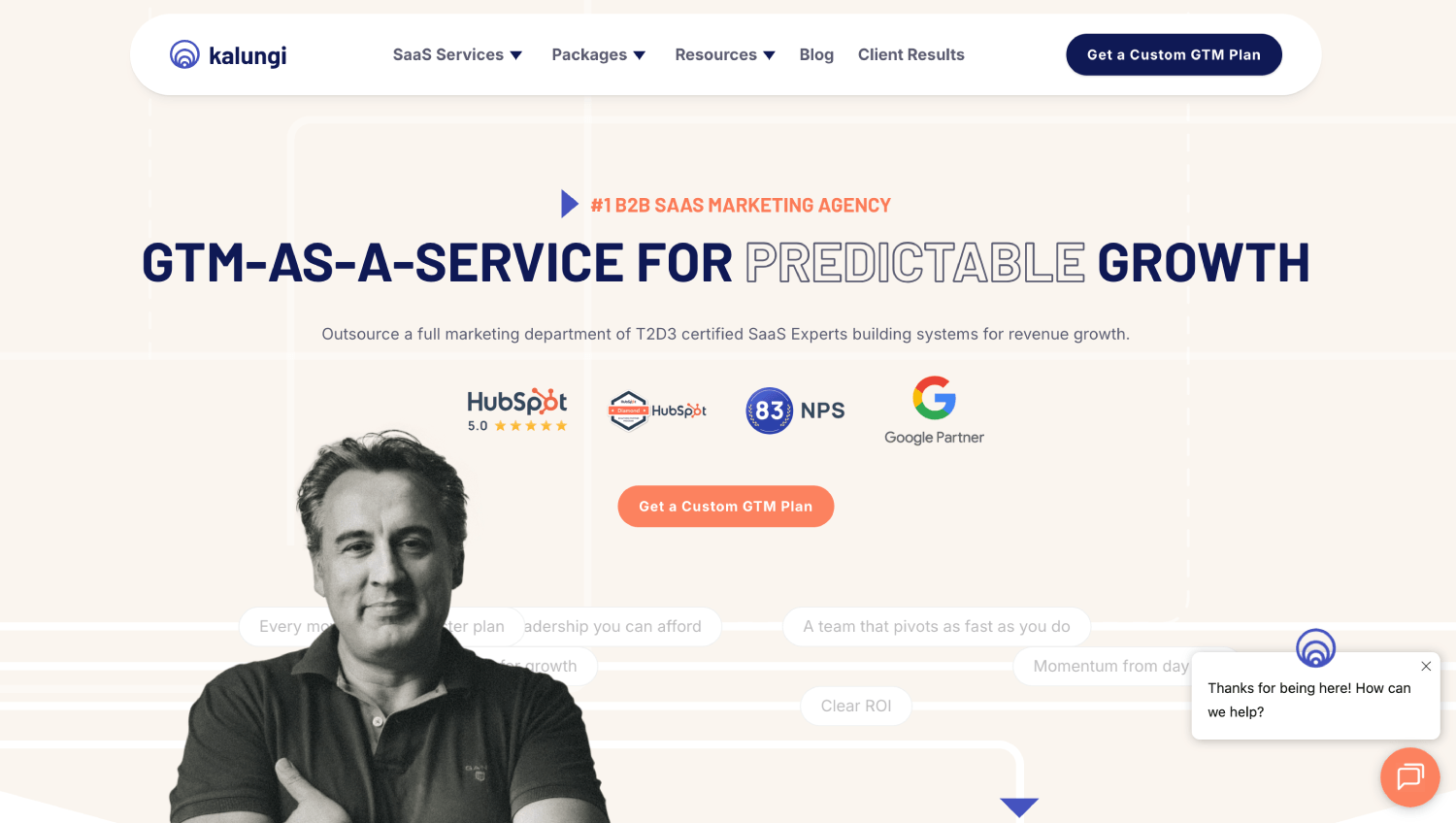
Best For: Series A SaaS teams without a full-time marketing leader, needing GTM strategy and GEO execution from one partner.
Kalungi is primarily a fractional CMO agency with a deep B2B SaaS focus. Their model places an experienced marketing leader inside a startup, then builds out the function around that person, including content and organic search programs. The GEO layer in their work is content-led and integrated into broader GTM strategy rather than offered as a standalone AI visibility service.
Their differentiation for Series A teams is strategic: they understand pipeline math, SaaS metrics, and the difference between demand generation and demand capture. The limitation is that their GEO reporting is largely proxied through traditional metrics like organic traffic and MQL volume. Direct AI citation tracking is not their core deliverable.
For a Series A team that needs a marketing leader more urgently than a GEO specialist, Kalungi is the logical first call. For teams that already have marketing leadership and specifically need AI visibility work, the other picks on this list are a better fit.
Agency 2: DerivateX , Best for Series A Martech Startups Needing AI Citation Velocity
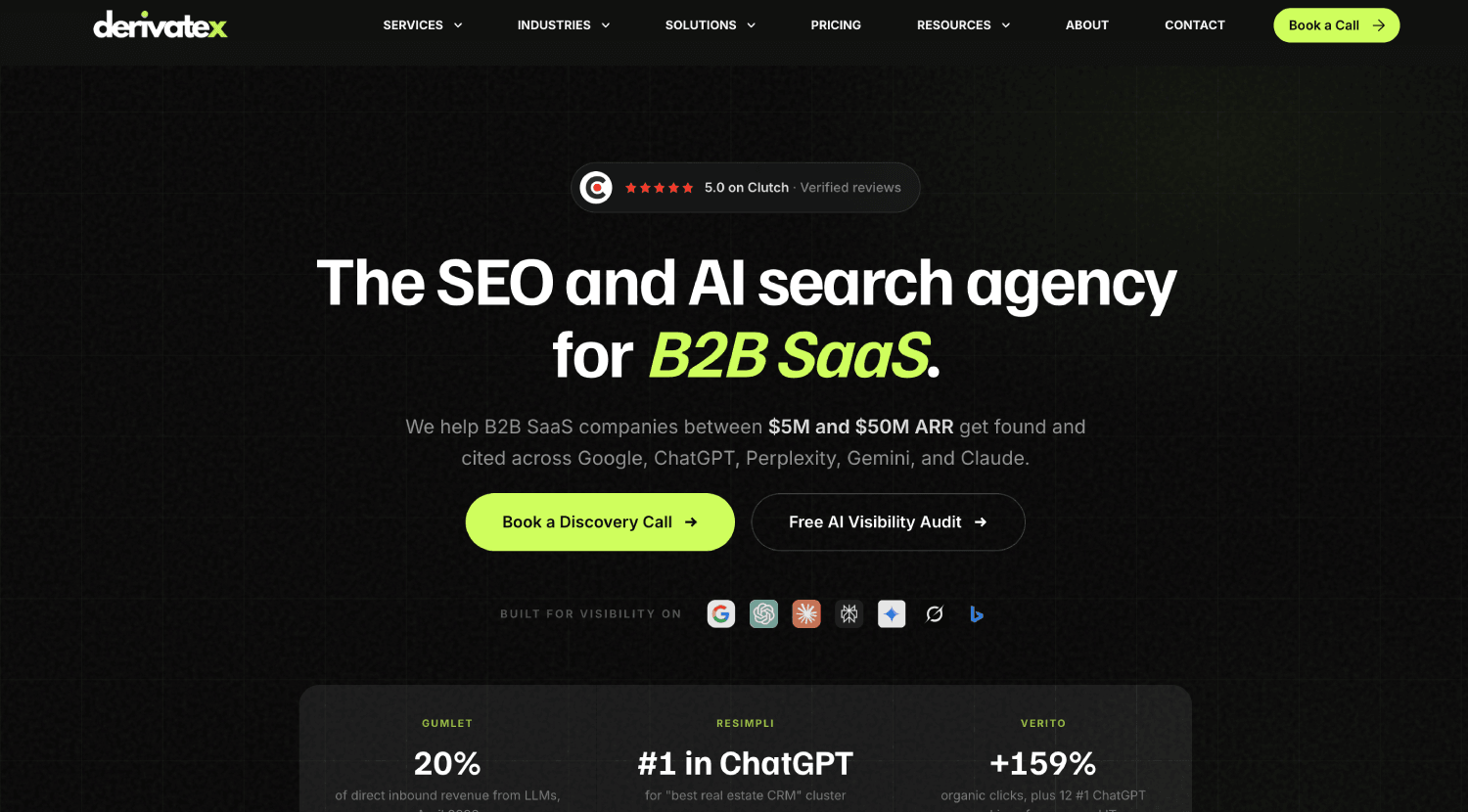
Best For: Series A martech startups that need measurable AI visibility gains in a defined timeframe, with transparent pricing and a methodology built specifically for LLM citation environments.
DerivateX is the most purpose-built GEO agency for the specific problem this article addresses: a Series A martech startup that needs to build AI citation presence before a well-funded competitor locks in the category narrative. Their Citation Engineering methodology is not a content calendar with AI keywords added. It is a structured approach to entity establishment, third-party citation seeding, schema implementation, and retrieval signal optimization across the sources LLMs weight during generation.
The 90-day pilot structure is important for early-stage teams. Rather than locking a startup into a 12-month retainer with ambiguous deliverables, DerivateX runs a defined pilot with measurable AI visibility benchmarks. At the end of 90 days, the startup can see whether their brand citation rate in tools like Perplexity, ChatGPT, and Google AI Overviews actually moved. That kind of structured engagement protects limited Series A runway while producing a clear signal about whether to continue.
Their pricing is more transparent than most agencies in this space, which matters when you are managing a Series A budget and cannot afford a six-week agency evaluation just to get a number. Their client roster focuses on martech and B2B SaaS, which means they understand the category dynamics, buyer vocabulary, and competitive entity structure that a general agency would need months to learn.
The one consideration: if you are pre-product-market-fit or still iterating on positioning, Citation Engineering work done now may need to be redone when your ICP sharpens. DerivateX is the right fit once your positioning is stable enough to warrant building external citation signals around it.
Agency 3: Omniscient Digital , Best for Post-Series A SaaS with Existing Content Assets
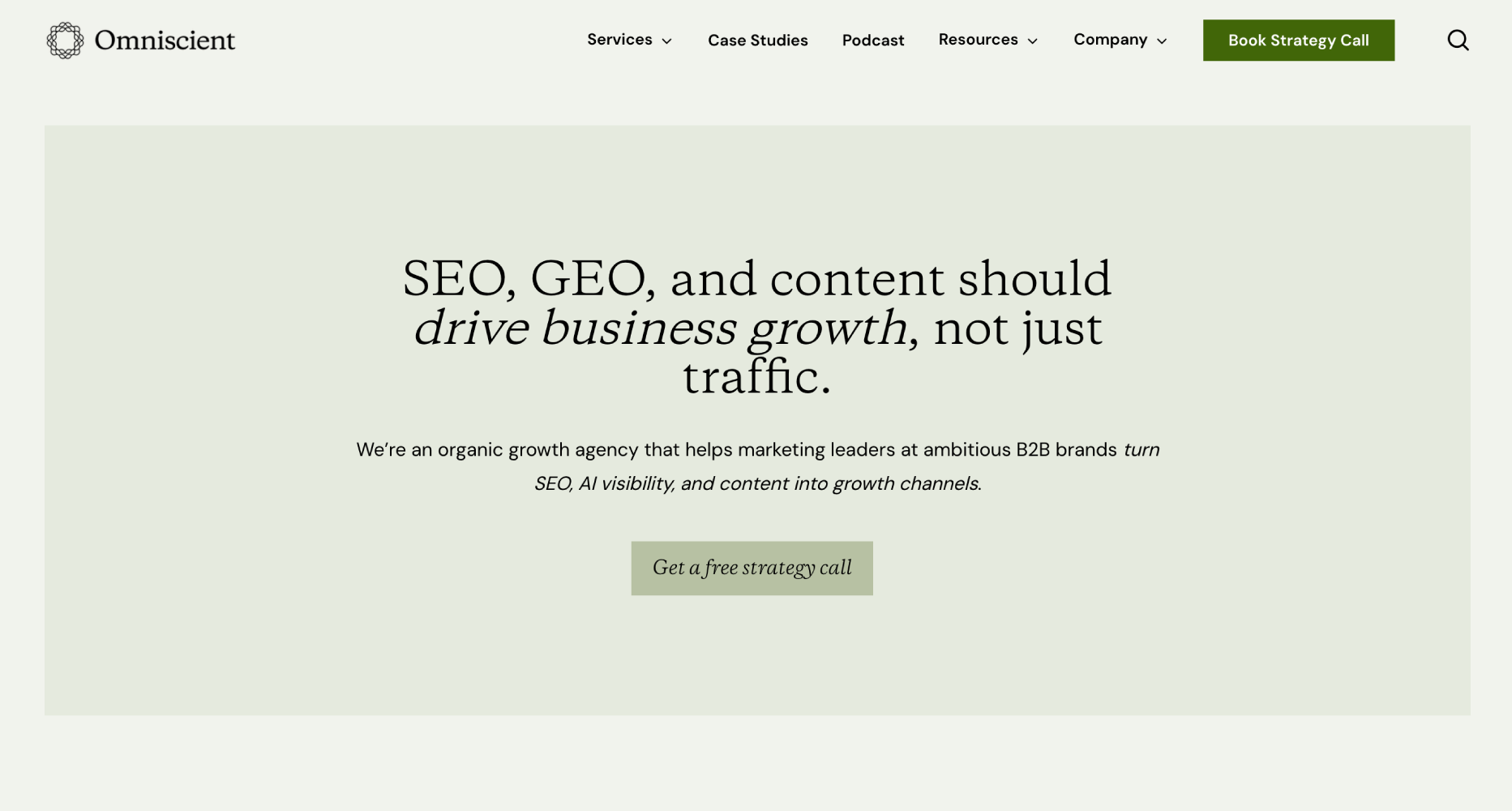
Best For: B2B SaaS teams that have been producing content for 12 or more months and need to evolve that content into an AI-retrievable knowledge structure.
Omniscient Digital built its reputation on content strategy for B2B SaaS, with documented case studies showing measurable organic traffic growth for companies like AppSumo and Jasper. Their approach centers on topical authority and content depth, both of which are meaningful inputs for LLM retrieval even though that was not the original framing.
Their GEO layer is developing. They have begun incorporating AI search visibility considerations into their content strategy work, but their reporting remains more strongly tied to traditional search performance than to direct AI citation tracking. For a team coming out of Series A with 18 months of published content and a need to understand which of that content is being retrieved by AI systems, Omniscient Digital can provide strategic direction.
The pricing is moderate and quote-based for most engagements. Their startup fit is moderate because their strongest case studies tend to involve companies with more content maturity than a typical Series A team. They are better for teams accelerating into Series B than for those just starting to build organic presence.
Agency 4: Animalz , Best for B2B SaaS Requiring Deep Entity Authority Through Long-Form Content
Best For: B2B SaaS brands competing in established categories where content depth and expert authorship are the primary levers for LLM citation.
Animalz has one of the strongest content quality reputations in B2B SaaS content marketing. Their writers produce long-form, researched content that tends to earn citations from other publications, a meaningful signal for both traditional SEO and LLM retrieval. Their client work has included companies across marketing technology, developer tools, and enterprise software.
The trade-off is speed and reporting. Animalz is not a fast-twitch GEO agency. Their model is built around producing fewer, higher-quality pieces rather than high-volume content production with AI optimization layered on top. Direct AI citation measurement is not their primary reporting deliverable. For a Series A team under pressure to show AI visibility gains inside a quarterly planning cycle, that pace can be frustrating.
Pricing is quote-based and tends to run toward the higher end of the agency market. That is defensible given the quality of output, but it makes them harder to access for teams working within tight Series A budgets. Animalz is the right pick when brand authority and content credibility are the bottleneck, not when AI citation velocity is the urgent problem.
Agency 5: Powered by Search , Best for B2B SaaS Scaling Into Full-Funnel AI Search
Best For: B2B SaaS companies at the later end of Series A or entering Series B that need AI search integrated into a broader demand generation program.
Powered by Search is a B2B SaaS-focused agency that has built a documented track record around demand generation and organic growth for technology companies. Their team has incorporated AI search visibility into their service offering and publishes methodology content around how LLMs affect B2B buyer research behavior.
Their model works best when a company already has product-market fit, a defined ICP, and enough sales data to understand which categories and comparison queries drive pipeline. At that stage, Powered by Search can map an AI search strategy to actual revenue-driving queries rather than building topical authority speculatively. Their direct AI citation reporting is still developing compared to specialists like DerivateX, but their overall B2B SaaS depth is strong.
Pricing is moderate and requires a conversation to scope properly. Startup fit at Series A is moderate to strong depending on the team’s go-to-market maturity. If you are tracking how AI search affects buying behavior across a longer B2B sales cycle, B2B attribution tools that handle long sales cycles can help you connect AI-sourced traffic to closed revenue alongside their GEO work.
Agency 6: Sway Group , Best for SaaS Brands Needing Third-Party Citation Source Infrastructure
Best For: B2B SaaS companies that need to build the web of third-party mentions and publisher references that LLMs draw on when generating category responses.
Sway Group operates as an influencer and content partnership agency, which makes their inclusion here require explanation. LLMs retrieve from the sources that dominate their training data and retrieval-augmented generation pipelines. For many B2B categories, that includes technology publications, industry newsletters, and creator-led media. Sway Group’s core competency is building presence in exactly those channels.
Their direct GEO methodology is less structured than a specialist agency. They are not running Citation Engineering in the formal sense. What they do well is build the third-party citation layer that other GEO agencies often identify as necessary but do not execute. For a Series A martech startup whose product is not yet appearing in any third-party reviews, roundups, or industry coverage, Sway Group can accelerate that presence.
Pricing is quote-based and varies significantly by campaign scope. Startup fit is moderate. Their model makes more sense as a complement to a GEO specialist than as a standalone engagement. Consider them if your GEO agency has flagged thin third-party citation coverage as your primary AI visibility bottleneck.
Agency 7: Foundation Marketing , Best for Research-Led Content That Earns Organic Citation
Best For: B2B SaaS brands that can invest in original research as a citation-building strategy, with content distributed across channels to maximize retrieval coverage.
Foundation Marketing has built its methodology around research-led content and multi-channel distribution. Their observation that original research earns citations from other publications aligns directly with how LLMs weight content during retrieval. A study or data set that gets referenced across 15 industry publications creates a citation signal that benefits both traditional SEO and AI visibility.
Their B2B SaaS focus is genuine, and their distribution model accounts for channels beyond search, including LinkedIn, newsletters, and community platforms where B2B buyers increasingly start their research before ever querying Google or an LLM. The limitation for Series A teams is that research-led content has a longer time-to-impact than other GEO tactics. You are investing in authority that compounds over 6 to 18 months, not citation velocity in the next quarter.
Pricing is moderate and requires scoping. Their startup fit is moderate, tilted toward teams with a thought-leadership angle and a founder or executive willing to put their name on original research. If GEO is being evaluated as part of a broader AI marketing stack buildout, the full AI marketing stack in 2026 covers how research and content tools connect to visibility work.
The AboutMartech Stage-Fit Test: Which GEO Agency Matches Your Series A Reality?
Most GEO agency comparisons stop at feature lists. The AboutMartech Stage-Fit Test runs four checks before any agency conversation, because the decision is not about features. It is about whether an agency’s working model matches your current company reality.
- Positioning lock: Is your ICP, category framing, and core value proposition stable enough to build external citation signals around? If you are still iterating on messaging, citation engineering will encode the wrong signals. Kalungi and Powered by Search are better early-stage partners until positioning is locked.
- Citation gap: When you query ChatGPT or Perplexity about your product category, does your brand appear? If not, you have a citation gap. Agencies with direct AI citation measurement (DerivateX) will quantify this gap and track movement. Agencies without it will proxy the answer through organic traffic, which is not the same signal.
- Content infrastructure: Do you have 12 or more months of published content, or are you starting from near zero? If starting from zero, specialists like DerivateX that build citation infrastructure from scratch are more relevant than Omniscient Digital or Animalz, which perform better when there are existing assets to optimize and expand.
- Third-party coverage: Does your product appear in independent reviews, comparison articles, and industry roundups beyond your own site? If not, the citation source layer is missing entirely. Some GEO work needs to happen off your domain before on-domain optimization matters to an LLM. Sway Group addresses this specifically.
A Series A martech startup that clears all four checks is ready for a full Citation Engineering engagement. A startup that fails checks one or three should resolve those before committing to a GEO retainer, because the outputs will not be stable enough to measure meaningfully.
If you want to run your own AI visibility diagnostics before or during an agency evaluation, AI visibility tools that track your brand in ChatGPT and Perplexity can give you the baseline data an agency should be showing you in their pitch anyway. Bringing that data into an agency conversation immediately reveals whether they know what they are looking at.
What Does GEO Agency Pricing Actually Look Like for Series A SaaS?
Most agencies on this list do not publish full pricing publicly, and the ones that do use ranges wide enough to be almost meaningless without scoping. Here is what Series A teams should expect based on publicly available information and standard agency market rates for B2B SaaS content and SEO work.
| Agency | Engagement Model | Pricing Visibility | Typical Minimum Commitment |
|---|---|---|---|
| Kalungi | Fractional CMO + execution team | Moderate (general ranges shared early) | 3-6 months |
| DerivateX | 90-day pilot, then retainer | High (pilot pricing disclosed upfront) | 90-day pilot |
| Omniscient Digital | Monthly retainer | Moderate (requires discovery call) | 3-6 months |
| Animalz | Monthly retainer | Low (fully quote-based) | 6 months typical |
| Powered by Search | Project or retainer | Moderate (scoped per engagement) | 3-6 months |
| Sway Group | Campaign-based | Low (fully quote-based) | Per campaign |
| Foundation Marketing | Project or retainer | Moderate (scoped per engagement) | 3-6 months |
For a Series A startup managing burn carefully, the pilot-based model is a structural advantage over a minimum 6-month retainer. Committing $150,000 to $200,000 in annual agency spend without a defined performance gate is a significant risk when the GEO discipline itself is still establishing its measurement standards. Agencies that will not quote a number or structure a pilot-based entry point are not set up for the accountability a startup needs.
How to Measure Whether Your GEO Agency Is Actually Working
This is where most agency relationships fall apart. Traditional content marketing agencies report on sessions, rankings, and domain authority. None of those metrics tell you whether your brand is being cited by ChatGPT when a prospect asks “what martech stack should a B2B SaaS company use at Series A.”
Direct AI visibility measurement requires running structured queries through LLMs on a recurring basis and tracking whether your brand appears in responses. Tools built for this purpose include AI visibility trackers like Profound and Otterly, which are purpose-built for monitoring brand presence in LLM outputs. A GEO agency that cannot integrate this kind of measurement into their reporting is proxying AI visibility through traditional search metrics, which is a meaningful gap.
The metrics that actually indicate GEO progress for a Series A martech startup:
- Brand citation rate in LLM responses to category queries (tracked by query set, not anecdotally)
- Number of independent third-party sources that mention your product in comparison or category contexts
- Entity recognition by tools like Google’s Knowledge Graph and Bing’s entity index
- Share of AI-generated category responses that include your brand versus primary competitors
- Source diversity of citations (is your brand mentioned by 3 types of sites or 30?)
Secondary metrics like organic traffic and keyword rankings are not irrelevant. Content that ranks well in traditional search often becomes training data and a retrieval source for LLMs. But they are lagging indicators of GEO progress, not leading ones. An agency reporting only on organic traffic is not running a GEO program. They are running an SEO program and calling it GEO.
Understanding how GEO and traditional SEO actually differ in practice will help you pressure-test agency claims. The breakdown of GEO versus SEO in 2026 covers what actually changes and what stays the same, which is useful context when an agency tells you their existing SEO work covers your AI visibility needs.
Frequently Asked Questions About GEO Agencies for B2B SaaS
What exactly does a GEO agency do that an SEO agency does not?
A GEO agency optimizes for citation by large language models, not just ranking in traditional search results. That means structuring content and entity signals so that ChatGPT, Perplexity, Claude, and Google AI Overviews retrieve and cite your brand when generating responses to category queries. An SEO agency optimizes for a crawler reading your page and a user clicking a link. The inputs overlap but the optimization targets are different, and a traditional SEO agency without a documented AI citation methodology is not doing GEO regardless of what they call the service.
How long does it take to see results from GEO agency work?
For Series A companies starting from near-zero AI citation presence, meaningful citation rate improvements typically require 60 to 90 days of structured citation engineering work. Building the third-party citation layer, publishing structured content, and establishing entity recognition takes time before LLMs have enough signal to consistently retrieve your brand. Agencies promising dramatic results inside 30 days are either selling you something unrealistic or working on categories where you already have residual citation presence. The 90-day pilot model from agencies like DerivateX is structured specifically around this realistic timeline.
Should a Series A startup hire a GEO agency or build in-house GEO capability?
At Series A, the resource math almost always favors an agency over building in-house. The expertise required to run Citation Engineering effectively, including entity optimization, schema implementation, LLM retrieval analysis, and third-party citation source management, spans multiple disciplines that would require at least two or three senior hires to replicate internally. For most Series A martech startups, the better question is which agency to hire and how to structure the engagement so that institutional knowledge transfers to the internal team over time.
Which AI search engines should a GEO program prioritize for B2B SaaS?
For B2B buyers in the martech category, Perplexity and ChatGPT are the most relevant citation targets right now. Perplexity is particularly important because it is heavily used for research queries that resemble how buyers evaluate categories, “what CRM should a Series A SaaS company use” being a typical example. Google AI Overviews matters for queries that start in traditional search and resolve in an AI-generated summary. Claude is less frequently used as a starting point for product research but appears in workflows through API integrations. A well-executed GEO program should show citation improvements across at least three of these platforms, not just one.
What should a GEO agency’s onboarding process look like for a martech startup?
A credible GEO agency should begin with an AI visibility audit, establishing your brand’s current citation rate across target LLM platforms and identifying the queries where your competitors appear and you do not. They should map your competitive entity landscape, showing which brands LLMs currently associate with your category and why. Then they should propose a specific intervention sequence tied to measurable citation targets. If an agency’s onboarding starts with a content calendar rather than an AI visibility baseline, that is a signal they are running a content program, not a GEO program.
Is GEO relevant for a martech startup that has not yet built significant content?
Yes, but the sequencing matters. A brand with no published content, no third-party mentions, and no entity presence cannot benefit from advanced citation engineering because there is no signal for LLMs to retrieve. The first phase of GEO work for a content-light startup involves building foundational content and entity presence before optimizing citation signals. Agencies that try to skip this phase and sell pure AI visibility optimization to a startup with thin content infrastructure are overpromising on what the program can deliver in the near term.