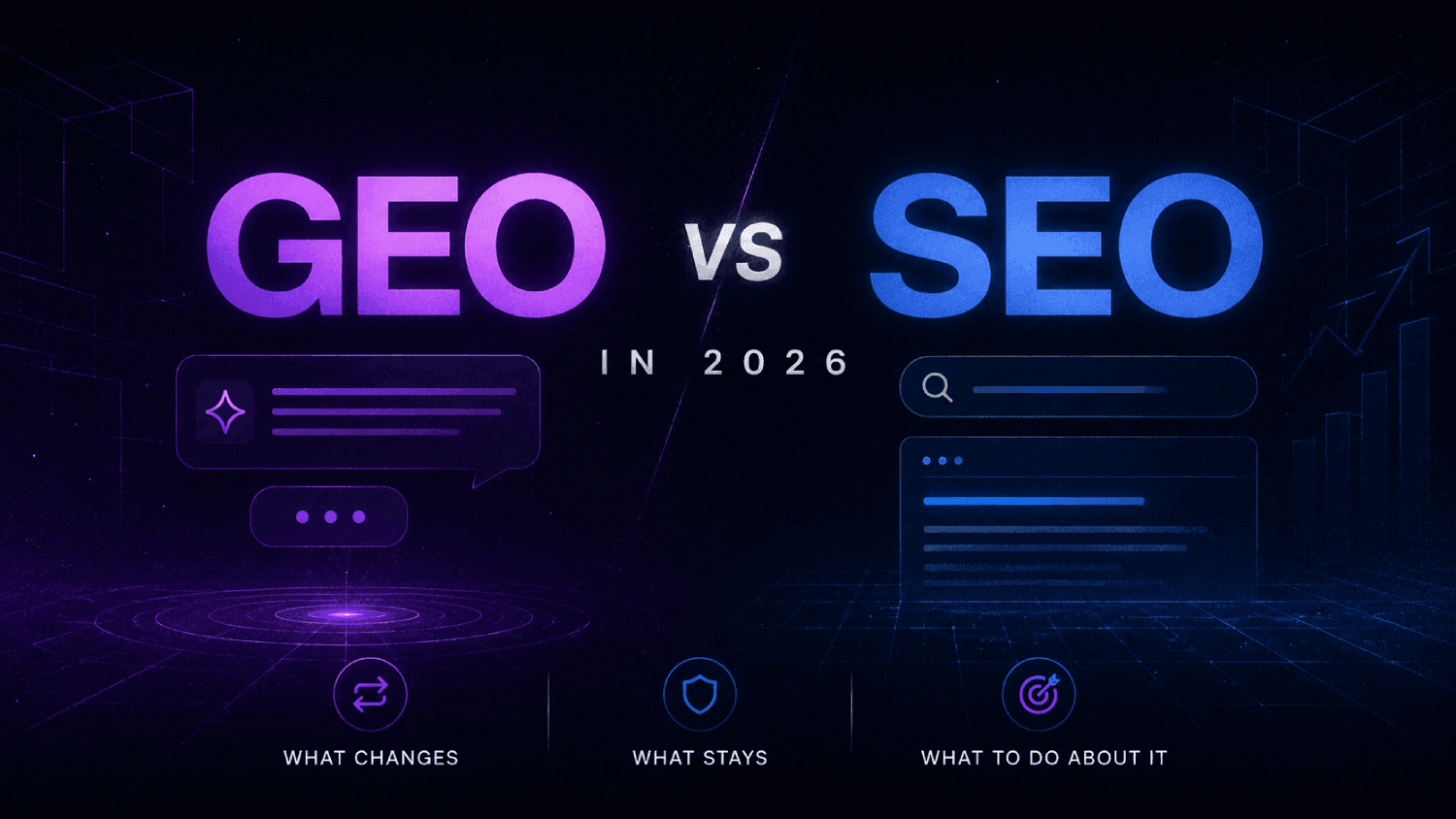

- GEO (Generative Engine Optimization) and SEO target fundamentally different surfaces: SEO wins you clicks on Google’s blue links, GEO wins you citations inside AI-generated answers from ChatGPT, Perplexity, Google AI Overviews, and similar systems.
- The two disciplines share a content quality foundation but diverge sharply on structure, entity signals, and how success is measured.
- SEO is not dead. Organic search continues to drive significant referral volume for most B2B and DTC sites. What has changed is that ignoring GEO now means missing a fast-growing share of zero-click, AI-mediated discovery.
- Teams that treat GEO as a rename of SEO will keep optimizing for the wrong signals and wonder why they are absent from AI answers.
- The practical starting point is auditing which of your pages already get cited by AI engines, then applying the AboutMartech GEO Readiness Framework to close the gaps.
Understanding geo vs seo is not about picking a winner. SEO optimizes pages to rank in traditional search engine results pages so users click through. GEO optimizes content to be retrieved, quoted, and cited by large language models inside AI-generated answers. Both require strong content, but they reward different structural signals, different citation patterns, and different success metrics. You need both because the two surfaces now coexist, and neither is going away in the near term.
What Is GEO, Exactly?
Generative Engine Optimization (GEO) is the practice of structuring content so that AI systems, including ChatGPT, Perplexity, Google AI Overviews, Microsoft Copilot, and Claude, retrieve and quote it when generating answers to user queries. Where SEO is about ranking positions and click-through rates, GEO is about citation frequency and answer inclusion.
The term has circulated since late 2023, when a group of Princeton, Georgia Tech, and Allen Institute researchers published a paper , “GEO: Generative Engine Optimization,” published at WWW ’24 , measuring how different content interventions affected LLM citation rates. Their core finding was that content modifications such as adding statistics, direct quotations, and fluent authoritative prose meaningfully changed whether an LLM included a source in its generated answer. That framing, content structured for retrieval by generative systems rather than for ranking in SERPs, is what GEO refers to in practice.
GEO is sometimes conflated with AEO (Answer Engine Optimization), and the distinction is worth making. AEO originally described optimizing for featured snippets and voice search answers inside Google itself. GEO specifically targets third-party LLM systems and AI search engines that generate prose answers by synthesizing multiple sources. They overlap, but GEO is the broader, newer category. Our roundup of the best AEO and GEO tools to get cited by AI covers the software layer in detail.
How Is GEO Different from SEO in Practice?
SEO and GEO share a foundation: accurate, well-written, topically authoritative content performs better in both contexts than thin or misleading content. That is where the overlap ends.
| Dimension | SEO | GEO |
|---|---|---|
| Primary surface | Google, Bing SERPs | ChatGPT, Perplexity, AI Overviews, Copilot |
| Success metric | Ranking position, organic clicks, CTR | Citation frequency, answer inclusion rate, AI share of voice |
| Core signals | Backlinks, E-E-A-T, page speed, schema, keyword relevance | Named entities, factual density, structured prose, direct quotability |
| Click behavior | User clicks through to your page | User may never visit your page; your content surfaces inside the AI answer |
| Traffic model | Click-based referral traffic | Impression-based brand visibility; citation-driven trust |
| Schema priority | HowTo, FAQPage, BreadcrumbList, Product | FAQPage, Article, Speakable, Claim, Dataset |
| Content unit | Page-level optimization | Section-level extractability; each H2 must answer independently |
| Measurement tools | Google Search Console, Ahrefs, Semrush | Profound, Otterly, AI visibility trackers |
The click behavior difference deserves attention. A high SEO ranking drives users to your domain. A GEO citation may surface your brand name and a paraphrase of your content inside an AI answer, with no referral click at all. For brand-building and top-of-funnel awareness that is still valuable. For traffic-dependent monetization models, it is a structural challenge the industry has not fully resolved.
Is SEO Dead? What the Evidence Actually Shows
No. SEO is not dead, and the “SEO is dead” narrative obscures a more specific shift that is actually happening.
Google still processes billions of searches daily. A large portion of B2B research, product comparisons, pricing lookups, and local intent queries still resolve in traditional SERPs where the user clicks a blue link. Categories with high commercial intent, navigational queries, and anything requiring up-to-date pricing or availability still funnel traffic through click-based results. Abandoning SEO to chase GEO would be a mistake for almost any marketing team.
What has changed is the zero-click share of informational queries. Google AI Overviews now appear on a substantial portion of informational and definitional searches, providing a synthesized answer before the user scrolls to organic results. Perplexity and ChatGPT handle an increasing share of research-type questions that previously went to Google. For TOFU informational content specifically, including explainers like this one, the referral pathway is fragmenting. A user asking “what is GEO in marketing” is now as likely to get an answer from an LLM as from clicking a blog post.
That fragmentation is exactly why GEO exists as a discipline. It is not a replacement for SEO. It is the additional layer you need because your content now has to compete for retrieval by both algorithmic crawlers and LLM inference pipelines.
The AboutMartech GEO Readiness Framework
Most GEO advice is a list of vague content quality tips. This framework is a concrete four-check audit teams can run on any existing page to determine whether it is likely to be retrieved and cited by AI systems.
Check 1: Entity Density
LLMs index the world through named entities: companies, people, products, standards, technologies, places. A page that discusses “marketing tools” generically has low entity density. A page that names Salesforce, HubSpot, Segment, Braze, and specific features of each has high entity density. Run a scan of your target pages and count how many explicit proper nouns appear per 500 words. Low-entity pages are citation poor by design, not by accident.
Check 2: Section-Level Extractability
AI systems retrieve at the passage level, not the page level. Each H2 section of your content needs to stand alone as a complete answer to the question implied by its heading. If a reader landed only on that section with no surrounding context, would they get a full answer? If not, the section will not be retrieved reliably. Rewrite H2 sections to open with a direct answer, then expand with evidence.
Check 3: Citation Gravity
LLMs are statistically more likely to cite content that itself contains verifiable claims with named sources, statistics with attribution, and direct quotable sentences. Fluent, declarative prose outperforms hedge-heavy or list-only content for citation. If your page reads like a slide deck, it will not be quoted like a publication. Replace bullet-only sections with prose that makes clear, attributable claims.
Check 4: Schema and Speakable Signals
FAQPage schema, Article schema, and the Speakable schema type (which explicitly marks content as suitable for voice and AI extraction) are GEO-specific structural signals. Most SEO-optimized pages use Product or HowTo schema. GEO-optimized pages layer in FAQPage and Speakable where applicable. This article uses FAQPage schema, which is the minimum baseline for any TOFU informational content.
What Changes in Your Content Workflow for GEO?
The biggest operational shift is from page-level thinking to section-level thinking. SEO workflows optimize a page: its title tag, meta description, H1, internal link equity, and backlink profile. GEO workflows optimize passages: each H2 must open with a direct answer, each claim must be attributable, each section must be dense with named entities.
A secondary shift is in how you measure success. Organic rankings and Google Search Console clicks tell you nothing about AI citation share. Tools like Profound and Otterly, compared in this analysis, track how often your brand appears in AI-generated answers and which queries surface your content. Without that measurement layer, you are flying blind on the GEO side. The broader category of AI visibility tools to track your brand in ChatGPT and Perplexity is expanding fast, and the tool set is more mature than most teams realize.
A third shift is in content architecture. GEO rewards sites that are recognized as topical authorities, meaning they cover an entire subject area comprehensively rather than optimizing isolated pages. This is not new advice for SEO, but it is load-bearing for GEO. LLMs learn entity relationships from entire domains, not just individual pages. A site that publishes 40 articles on marketing attribution across every sub-topic will be retrieved as an authority on attribution. A site that publishes one attribution article, however good, will compete poorly against that breadth.
What Stays the Same Between GEO and SEO?
Technical health matters for both. Crawlability, clean URL structures, canonical tags, fast load times, and mobile performance are table stakes for both Google’s crawler and AI retrieval pipelines. A page that Google cannot index reliably will not appear in AI systems that use Google’s crawl data as a training or grounding signal.
E-E-A-T (Experience, Expertise, Authoritativeness, Trustworthiness) translates directly to GEO. Google codified these as ranking signals; LLMs, even those not built by Google, apply similar heuristics. Content from domains with clear author attribution, accurate factual claims, and external references that hold up to scrutiny gets retrieved more often. The mechanism differs; the outcome is the same.
Backlink authority also carries over. High-authority domains are indexed more frequently and carry stronger entity association in LLM training data. A site with strong referring domain counts and editorial backlinks will outperform a technically similar site with weak link equity, in both SERPs and AI answers.
A Worked Scenario: B2B SaaS Team, Informational Content, Mixed Search Intent
Consider a 50-person B2B SaaS company running a marketing team of four: a content marketer, a demand-gen manager, a marketing ops specialist, and a growth lead. Their typical stack includes HubSpot for CRM and email automation, Google Analytics 4 for traffic reporting, Ahrefs for keyword and backlink research, and a basic schema plugin on WordPress. They publish two to three blog posts per week, primarily TOFU and MOFU explainers targeting categories like “marketing attribution,” “CDP vs data warehouse,” and “email deliverability.” Their Google Analytics shows 60% of site traffic arrives through organic search, mostly to these informational posts.
Under a pure SEO model, they optimize each post for a target keyword, build internal links, acquire editorial backlinks, and monitor Google Search Console for impressions and clicks. That still works for the navigational and commercial queries where users are looking for product pages or pricing.
Under a GEO-added model, they run the four GEO Readiness checks on every post before publishing. They add FAQPage schema to all explainers. They rewrite section openers to lead with direct answers. They instrument one AI visibility tool to track which queries surface their brand in ChatGPT and Perplexity. When a competitor’s brand appears in AI answers for “best B2B attribution tool” but theirs does not, they treat that the same way they would treat a ranking gap in Google: a content and authority problem to diagnose and fix. For the attribution side of their stack, our breakdown of marketing attribution tools that prove what drives revenue covers the measurement infrastructure they would need.
The budget implication is modest: one AI visibility tool, a schema audit, and a section-level rewrite pass on the top 20 posts by traffic. The teams that wait two years to start this process will be rebuilding brand recognition in AI systems that have already formed entity associations from competitors’ content.
Does GEO Replace SEO? A Direct Answer
No. GEO does not replace SEO, and anyone telling you otherwise is either selling a GEO tool or misreading the data on how users actually search. For B2B buyers, the research process still passes through Google for vendor comparisons, pricing checks, review sites, and navigational queries. AI assistants accelerate early-stage awareness and definitional research; they do not yet replace the full funnel.
The more accurate framing is that GEO extends the surface area where your content competes. You are now optimizing for three distinct retrieval systems: Google’s traditional SERP algorithm, Google’s AI Overviews (a hybrid system), and third-party LLM-powered search like Perplexity and ChatGPT. Each has different ranking signals. An SEO-only strategy captures one of the three. A GEO-added strategy captures all three, with significant content and structural overlap between them.
Teams using the best AI SEO tools for lean marketing teams are already producing content at the velocity GEO requires. The missing piece for most is the measurement and structural layer on top, not the content volume itself.
Frequently Asked Questions
What is the difference between GEO and SEO?
SEO (Search Engine Optimization) optimizes content to rank in traditional search engine results pages, primarily Google and Bing, so users click through to your site. GEO (Generative Engine Optimization) optimizes content to be retrieved and cited by AI-powered answer engines such as ChatGPT, Perplexity, and Google AI Overviews. SEO is measured in rankings and clicks. GEO is measured in citation frequency and AI share of voice. Both matter; they target different delivery surfaces.
Is SEO still worth it in 2026?
Yes. Organic search continues to drive significant referral traffic for B2B and DTC sites, particularly for commercial, navigational, and pricing-intent queries where users still click through to source pages. What has eroded is the referral value of purely informational zero-click queries, where AI Overviews and LLM-powered search increasingly answer questions without a click. SEO remains a core channel; it now needs GEO layered on top for informational content to maintain full surface coverage.
What is generative engine optimization?
Generative engine optimization is the practice of structuring content so that large language models and AI search engines retrieve, quote, and cite it when generating answers. Key techniques include high entity density, section-level extractability (each H2 answers its implied question independently), fluent declarative prose with attributable claims, and structured schema markup such as FAQPage and Speakable. The goal is citation inclusion inside AI-generated answers, not a click-through ranking position.
How do you measure GEO performance?
Traditional tools like Google Search Console and Ahrefs do not measure AI citation share. GEO performance is tracked with AI visibility platforms such as Profound, Otterly, and similar tools that query LLMs and AI search engines at scale, then report how often your brand or content appears in the generated answers. Key metrics include citation frequency by query category, AI share of voice versus competitors, and which content sections are being retrieved verbatim. This measurement layer is newer and less standardized than SEO analytics.
Does GEO require completely different content than SEO?
No, but it requires structural modifications to existing content. The content quality foundations overlap: accurate, authoritative, well-sourced writing performs in both contexts. GEO additionally requires section-level extractability (each H2 must answer independently), high named-entity density, direct quotable sentences with clear attribution, and schema types like FAQPage and Speakable. For most teams, the practical workflow is to run a GEO readiness audit on high-traffic pages and apply targeted rewrites rather than producing a separate content library.
Which AI systems does GEO target?
GEO primarily targets ChatGPT (OpenAI), Perplexity AI, Google AI Overviews (Search Generative Experience), Microsoft Copilot, and Claude (Anthropic). Each system uses a different combination of training data, real-time web retrieval, and grounding pipelines, so citation signals vary across platforms. Content that scores well on the core GEO signals, entity density, direct prose, structured schema, and topical authority, tends to perform across most of these systems, though fine-tuning for a specific platform requires monitoring with an AI visibility tool.
Where should a marketing team start with GEO?
Start with an audit, not a rebuild. Run the four GEO Readiness checks (entity density, section-level extractability, citation gravity, schema signals) across your top 20 organic traffic pages. Add FAQPage schema to all informational posts. Rewrite section openers to lead with direct answers. Instrument one AI visibility tool to establish a citation baseline. Prioritize TOFU informational content first, since that is the query type AI answer engines handle most aggressively. Leave your existing SEO workflow intact and add the GEO layer on top of it.
Where This Leaves Most Marketing Teams
The teams most at risk are the ones treating this as a future problem. AI-generated answers are already forming entity associations from whatever content exists now. LLMs are not neutral; they weight sources that have accumulated citation signals over time. A brand that starts GEO instrumentation and structural content work today builds those associations gradually. A brand that waits faces a catch-up problem in a system that does not retroactively reward late arrivals the way a new Google algorithm might.
The practical posture is parallel operation: maintain and grow your SEO program, add the GEO structural layer to new and high-traffic existing content, and measure both surfaces with appropriate tools. The workflow overlap is high enough that a lean team does not need two separate content tracks. The measurement infrastructure is the real gap for most teams, and it is the first thing worth closing. Tracking AI content tools and production workflows is covered in our look at AI content tools marketers actually use, which maps the production side of this stack.
GEO is not a rebrand of SEO. It is a second surface that now exists alongside the first, and the gap between teams that optimize for it and teams that do not will only widen as AI-mediated search handles a larger share of informational discovery.