- Most AI writing tools run on the same underlying models. What separates them is workflow integration, brand voice controls, and how they handle long-form vs. short-form output , not raw generation quality.
- Jasper, Copy.ai, and Writesonic are the most-searched names, but they are not the best fit for every team size or use case.
- Teams producing SEO content at volume need different tools than demand-gen teams writing ad copy or lifecycle emails.
- Pricing gaps between tiers are wide , some tools start under $20/month per seat; others require a sales call before you see a number.
- The tools that consistently outperform in real marketing workflows share one trait: they constrain the model rather than open it up, giving writers guardrails instead of blank prompts.
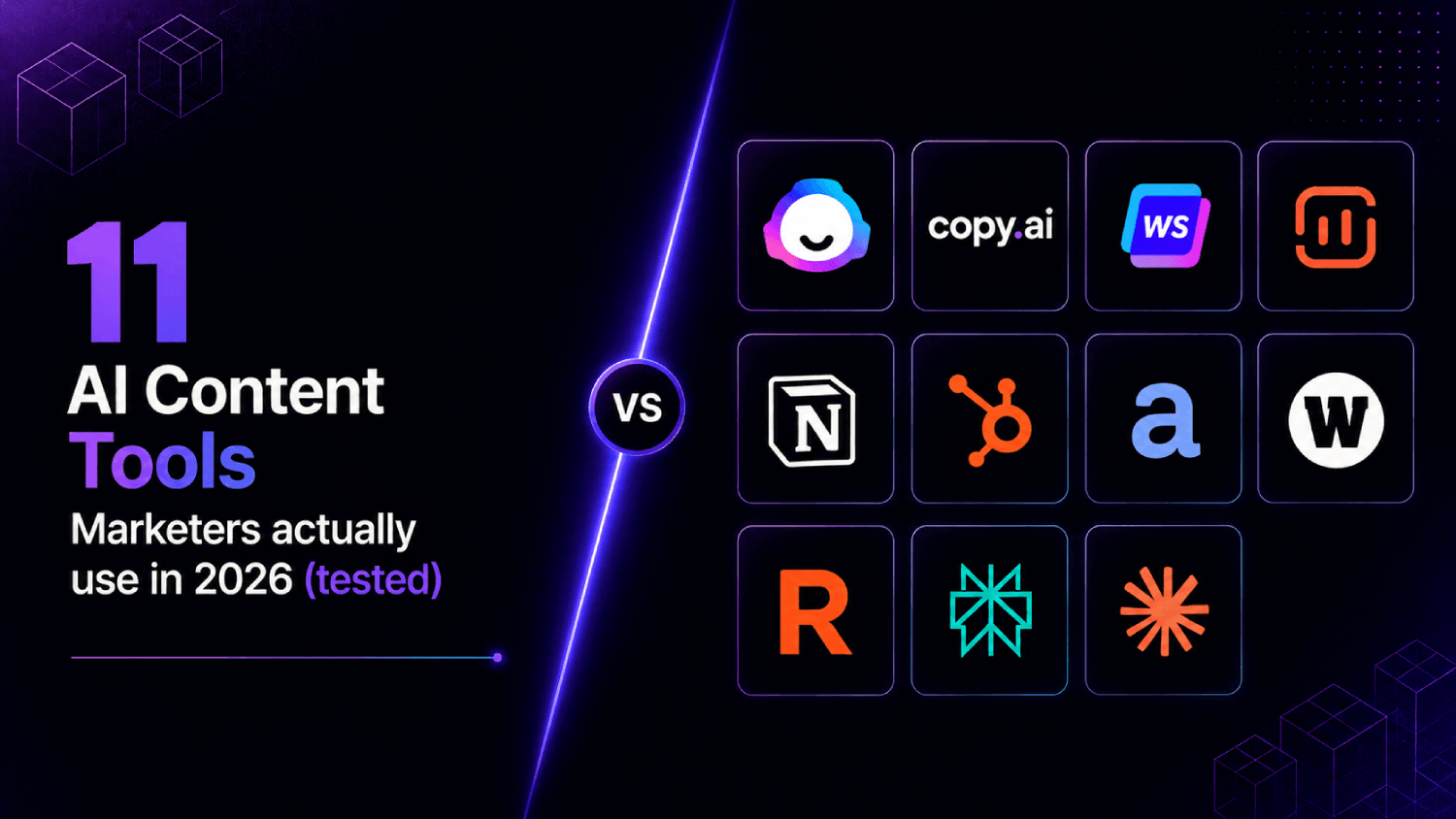
The best AI content tool for most marketing teams is Jasper for brand-governed, multi-channel campaigns; Copy.ai for GTM workflow automation; and Writesonic for SEO-first content at scale. Which one fits depends on whether your bottleneck is brand consistency, content volume, or pipeline from organic search , and this article separates them on exactly those dimensions.
Why “All AI Writers Are the Same” Is the Wrong Starting Point
The assumption that AI content tools are interchangeable GPT wrappers made sense in 2022. It does not hold in 2026. The underlying model is now a commodity layer. The differentiation is the layer above it: workflow design, memory architecture, brand voice enforcement, and integration depth with your existing stack.
A demand-gen team running paid social and email needs short-form variation at speed, approval workflows, and UTM-aware copy. An SEO team publishing 40 articles per month needs SERP-aware briefs, internal linking logic, and content refresh tooling. A founder writing a product newsletter needs none of that. These are different jobs, and different tools are built for each one.
The AboutMartech Content-Fit Matrix names four dimensions that actually determine fit: Output Type (short vs. long), Workflow Depth (standalone vs. integrated), Brand Control (none vs. trained voice), and Model Access (single model vs. multi-model). Score a tool on those four axes before you trial it, and you will cut your evaluation time in half. The matrix is applied in the buying section below, with worked examples for three common team profiles.
How We Tested These AI Content Tools
We ran each tool through the same five tasks: write a 150-word homepage hero section for a B2B SaaS company, generate five Google Search ad headline variants for a CRM product, produce a 1,200-word blog post from a keyword brief, rewrite a product description in three different tones, and draft a 5-email nurture sequence for a mid-funnel lead. We scored on output quality, consistency with brief instructions, time-to-usable-draft, and template or workflow availability for each task type.
We did not test hallucination rates on factual claims , that is a model-level variable, not a tool-level one, and every team using AI content tools should apply human editorial review regardless of platform. We also did not test every feature in every tool. We focused on the workflows real marketing teams run daily.
The 11 Best AI Content Tools for Marketing Teams
| Tool | Best For | Starting Price (public) | Long-Form | Brand Voice | Team Workflows |
|---|---|---|---|---|---|
| Jasper | Brand-governed multi-channel content | $49/mo (Creator) | Yes | Yes (trained) | Yes |
| Copy.ai | GTM workflow automation | $49/mo (Starter) | Partial | Yes | Yes (Workflows) |
| Writesonic | SEO content at volume | $16/mo (Individual) | Yes | Yes | Yes |
| Surfer SEO | SEO-integrated long-form | $99/mo (Scale) | Yes | Limited | Partial |
| Notion AI | Internal docs and ops content | $10/mo add-on | Partial | No | Partial |
| HubSpot AI (Content Hub) | Teams already on HubSpot CRM | Included in Content Hub | Yes | Yes | Yes |
| Anyword | Performance-optimized ad copy | $39/mo (Starter) | No | Yes | Yes |
| Writer | Enterprise brand compliance | Quote-based | Yes | Yes (deep) | Yes |
| Rytr | Solo marketers, tight budgets | $9/mo (Saver) | Partial | Limited | No |
| Perplexity Pages | Research-grounded editorial content | $20/mo (Pro) | Yes | No | No |
| Claude (via API or Claude.ai) | Custom prompt workflows, technical writing | $20/mo (Pro) | Yes | Prompt-dependent | No native |
Pricing above reflects each vendor’s current public pricing page as of this writing. Several tools tier heavily on seat count and word credits, so the starting figure is a floor, not an average spend.
1. Jasper , Best for Brand-Governed, Multi-Channel Content Teams
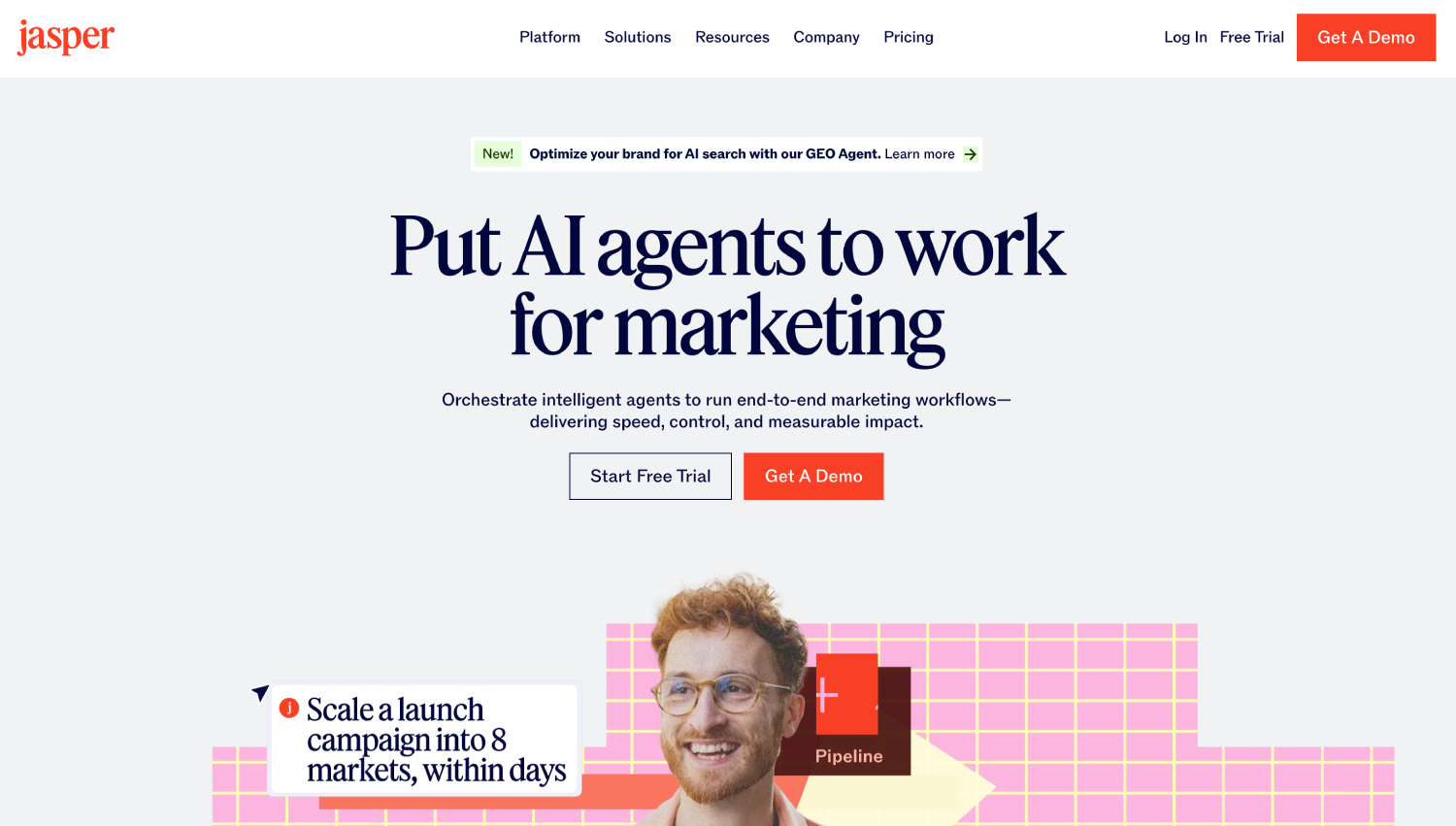
Jasper built its lead on one specific problem: large marketing teams that cannot afford brand inconsistency across dozens of writers and dozens of channels. The Brand Voice feature lets teams upload sample content, define tone parameters, and lock the model to that style across all outputs. That is not a prompt trick , it is a persistent configuration layer most competitors do not replicate at the same fidelity.
In our tests, Jasper produced the most on-brief hero copy and email sequences of any tool we evaluated. The Campaigns feature, which chains assets together from a single brief, reduced the setup time for a multi-asset launch from what would take a writer a full afternoon to roughly 45 minutes of review and editing. The trade-off is price: the Teams plan (required for collaborative workflows) is not cheap, and the per-seat cost adds up at larger marketing departments.
Jasper is not the right pick for a solo founder or a team whose primary output is SEO blog content. It over-engineers what a simpler tool handles fine. But for a marketing team with a defined brand standard, cross-channel campaigns, and multiple contributors, it is the most complete workflow tool on this list.
2. Copy.ai , Best for GTM Teams Who Need Workflow Automation, Not Just a Writing Assistant
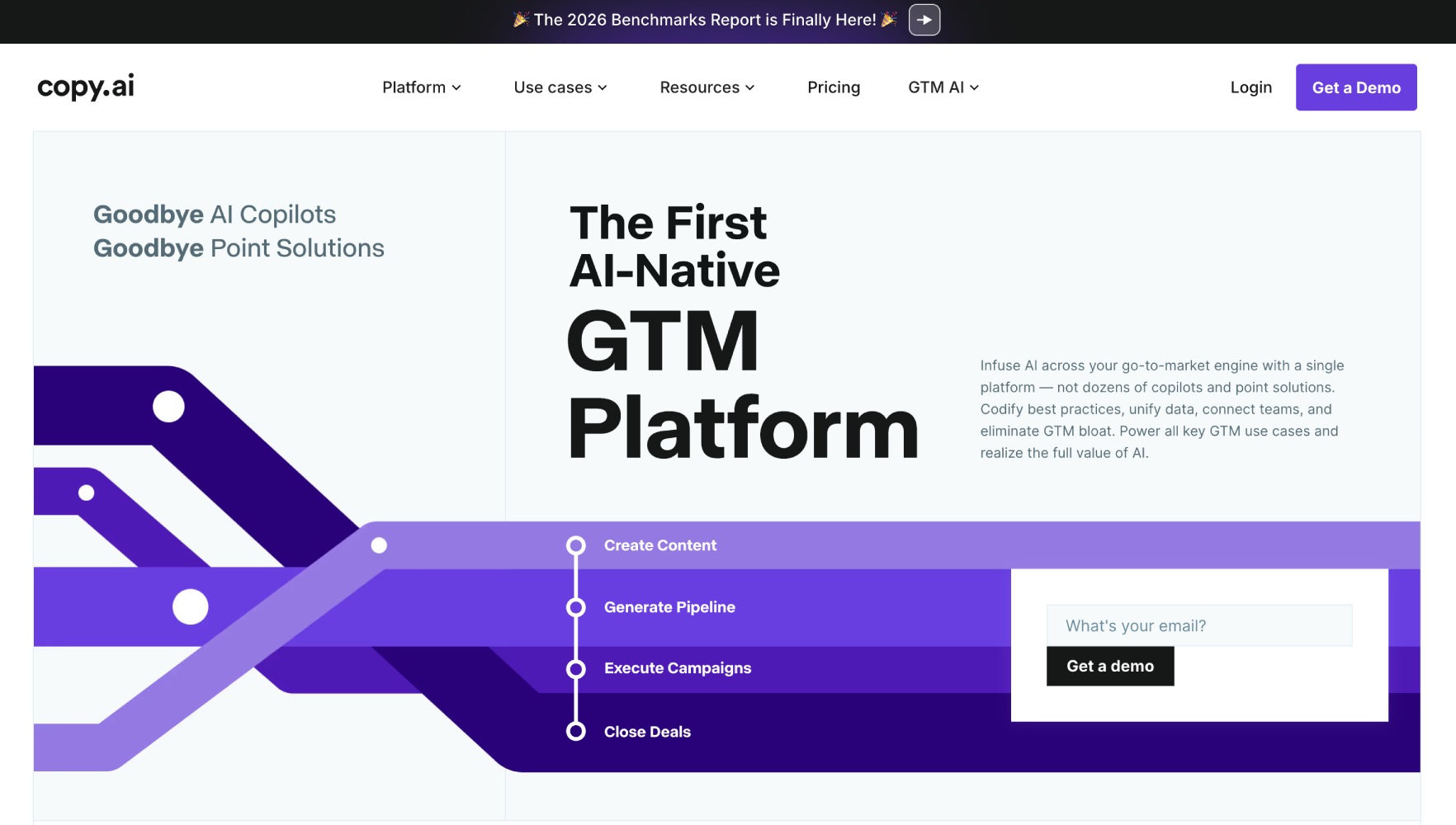
Copy.ai made a deliberate product pivot away from being an AI writing assistant toward being a GTM workflow engine. The Workflows feature lets teams chain prompts together with conditional logic, CRM data inputs, and structured outputs , think “pull contact data from HubSpot, generate a personalized outreach email, log the draft back to the contact record” as a single automated flow, not a manual process.
For demand-gen and sales-enablement teams, that shift matters. Most AI writing tools are tools you go to. Copy.ai increasingly comes to you, embedded in the processes where content gets created and deployed. The short-form output quality (ad copy, email subject lines, LinkedIn posts) is solid. Long-form blog production is available but not where the tool shines compared to Writesonic or Surfer SEO.
The free tier is more generous than most competitors, which makes it a reasonable starting point for a lean team. If your content operation is heavily automated or you are building AI-assisted outreach workflows, Copy.ai is worth serious evaluation.
3. Writesonic , Best AI Content Generator for SEO Teams Publishing at Volume
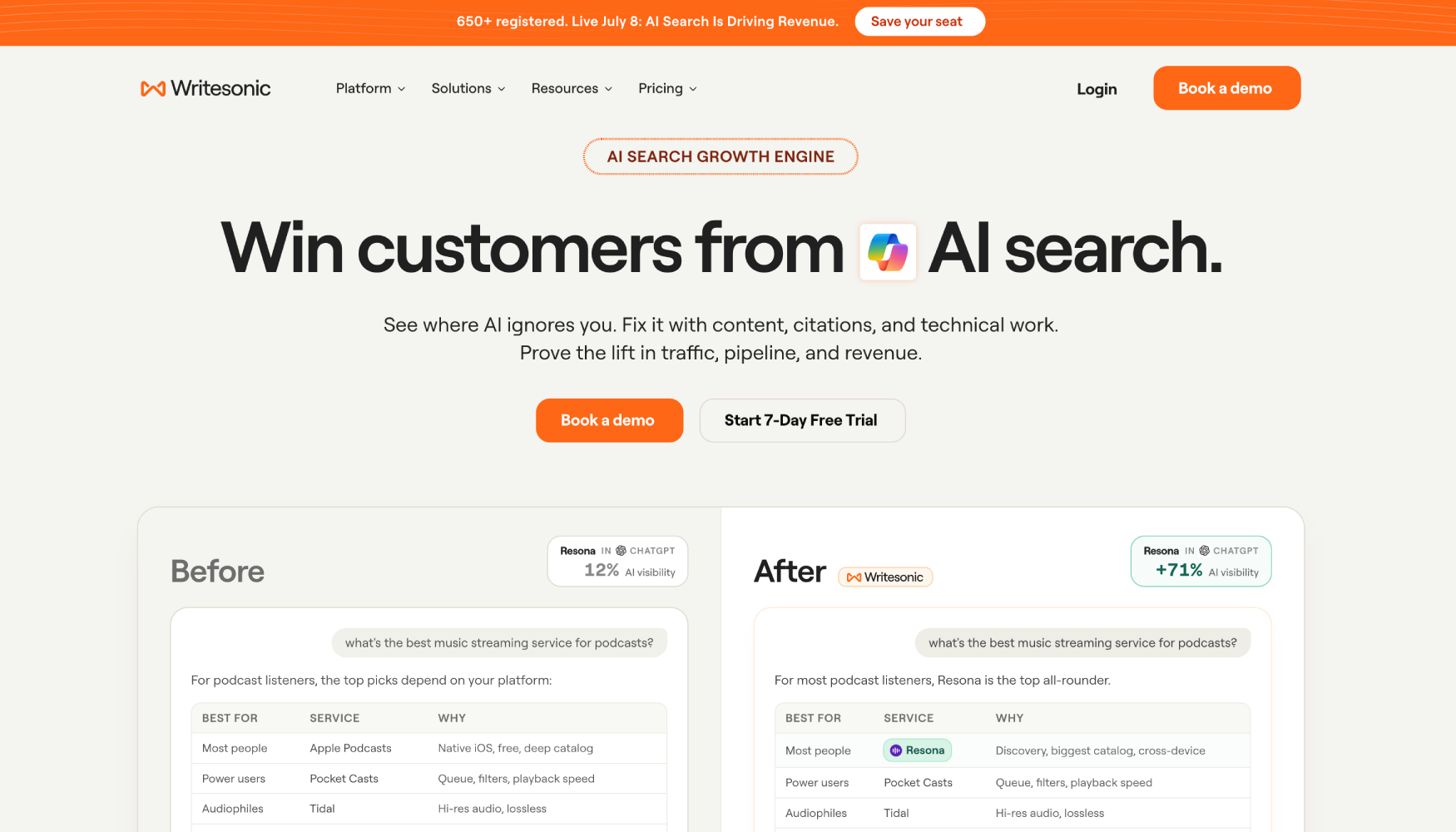
Writesonic built its product around a problem that Jasper and Copy.ai treat as secondary: generating SEO-optimized long-form content at a pace that an in-house team of two or three writers cannot match manually. The Chatsonic and Article Writer features pull live web data into generation, which reduces factual drift on topics that change frequently. The SEO integration with Semrush is a direct connection, not a copy-paste workflow.
Output volume is genuinely high. A 1,500-word article from a keyword brief takes under three minutes to generate. Quality on first draft is adequate for an editorial team to work from , not publishable without editing, but close enough that the human effort shifts from writing to revising, which is the correct direction for a content team under pressure.
At $16/month for an individual plan, Writesonic is also the most accessible tool on this list for teams without large software budgets. The caveat: brand voice training is available but less thorough than Jasper’s, and there is no deep workflow automation. It is a content generation tool, not a content operations platform.
4. Surfer SEO , Best for SEO-Led Content Programs That Need Brief-to-Draft in One Tool
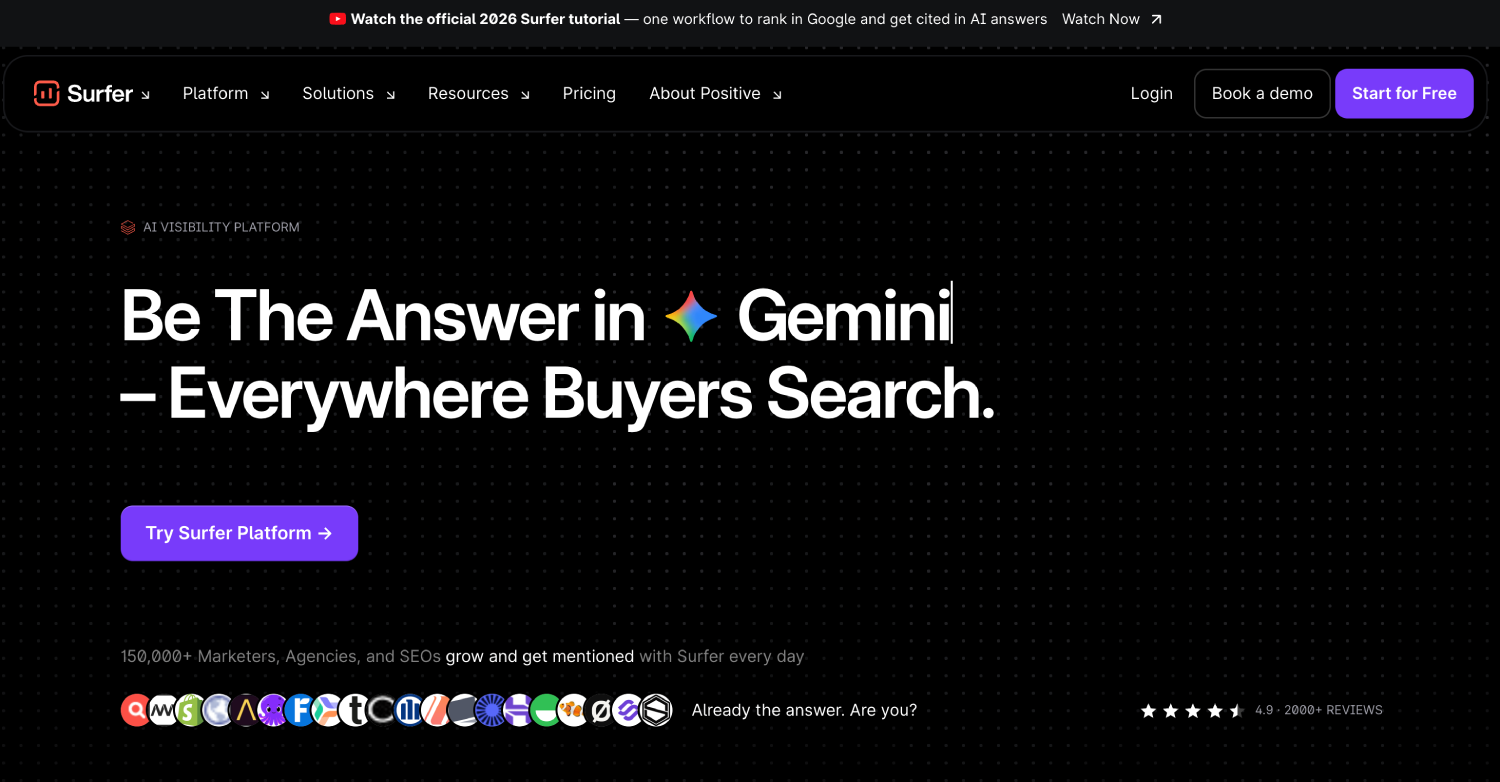
Surfer SEO has layered AI writing into what was already the leading SERP-analysis and content-scoring tool for SEO professionals. The value here is tight integration: a content brief built from Surfer’s SERP data feeds directly into AI-generated text, and the NLP keyword coverage score updates in real time as you write. That feedback loop , brief construction informed by real SERP analysis , shortens the gap between “ranking intent” and “publishable draft.”
The trade-off is that Surfer SEO’s AI writing is not as versatile as dedicated writing tools. It does long-form SEO content well. It does not do ad copy, email sequences, or social content. Teams that use it for SEO and a separate tool for everything else will find it worth the cost. Teams looking for a single AI content tool across all formats will find it limiting.
Surfer SEO’s entry plan starts at $99/month as of their public pricing page, which is more expensive than several full-featured writing tools. The premium is for the SEO intelligence layer, not the writing itself. If organic search is your primary acquisition channel, the premium is defensible.
5. Notion AI , Best for Internal Documentation and Ops Content, Not Marketing Output
Notion AI earns its spot on this list with an important asterisk: it is not a marketing content tool in the traditional sense. At $10/month per member as an add-on to existing Notion workspaces, it is the most convenient AI writing layer for teams already living in Notion for project management and documentation.
For writing internal briefs, summarizing research, drafting SOPs, or polishing internal memos, Notion AI is fast and frictionless. For customer-facing marketing content , blog posts, ads, emails , it lacks the templates, brand controls, and output volume of dedicated tools. Do not buy Notion AI because you want a content generator. Buy it if your team already runs in Notion and wants AI-assisted editing baked into the same workspace.
6. HubSpot AI (Content Hub) , Best for Teams Already Running on HubSpot
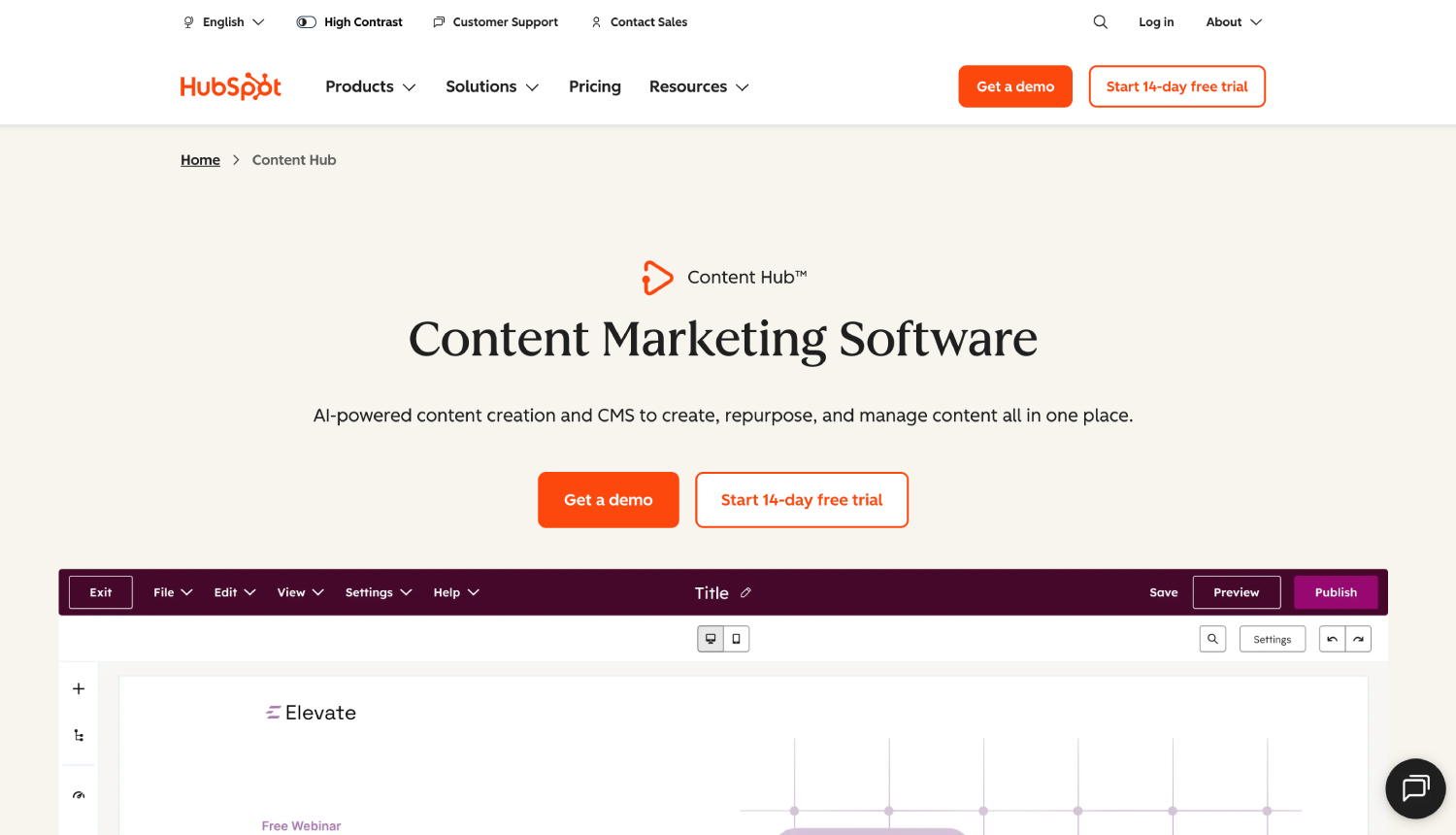
HubSpot’s Content Hub includes AI writing tools that generate blog drafts, email copy, landing page content, and social posts directly inside the HubSpot CMS and email builder. For teams already paying for HubSpot’s Marketing Hub or CMS Hub, this is effectively free AI content generation layered onto infrastructure they already use.
The output quality is mid-tier compared to dedicated tools. Brand voice controls are available but not as granular as Jasper or Writer. What makes it worth considering is zero-friction deployment: writers do not leave HubSpot to use it, and content feeds directly into existing campaign workflows without export/import steps. For a 10-person marketing team on HubSpot with no appetite for adding another platform, it is the path of least resistance.
7. Anyword , Best AI Copywriting Tool for Performance-Tested Ad and Email Copy
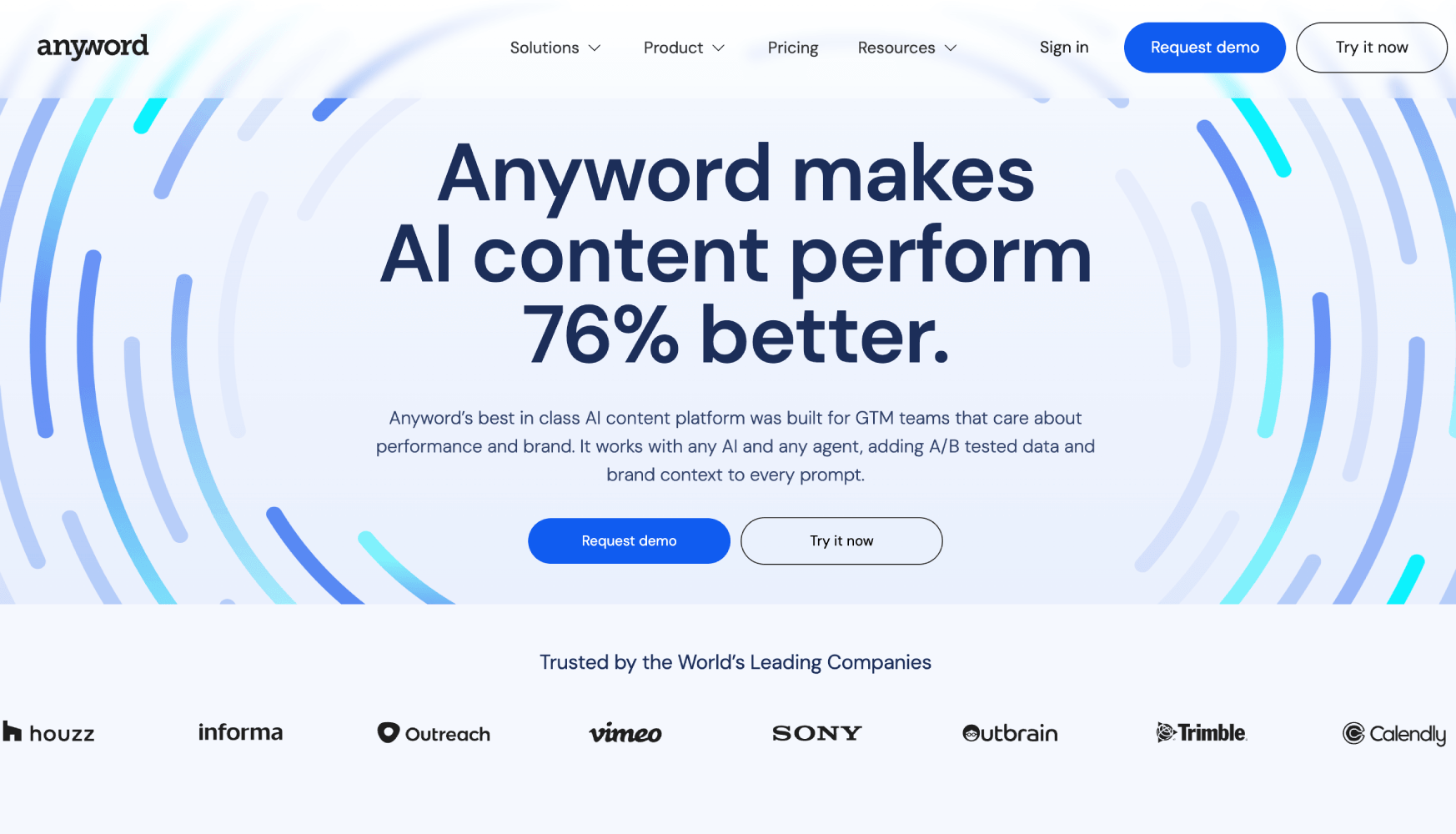
Anyword takes a different angle than most AI writing tools: it scores generated copy against predicted performance data before you publish it. The Performance Prediction Score draws on training data from ad and email campaigns to estimate how different copy variants will perform for a given audience segment.
That scoring layer is not magic, and the predictions are probabilistic rather than certain. But for a paid media manager generating 20 ad headline variants and trying to prioritize which five to test, having a directional score is more useful than pure gut-feel. It shifts the process from “write and hope” toward something closer to data-informed iteration.
Anyword does not do long-form content well. It is built for short-form, performance-context copy: ads, subject lines, CTAs, landing page headlines. Teams with heavy paid media programs and a need to move fast on copy will find it fits their workflow. Teams primarily publishing editorial or blog content should look elsewhere.
8. Writer , Best AI Writing Software for Enterprise Brand Compliance at Scale

Writer is the most enterprise-grade tool on this list and the only one where brand compliance is an architectural decision, not a settings toggle. The platform lets organizations upload full brand guidelines, terminology lists, compliance dictionaries, and prohibited language sets. Every output runs against those parameters before it surfaces to the writer.
Writer does not publish public pricing. Enterprise plans are quote-based and typically involve contract discussions with a sales team. That immediately disqualifies it for teams under 50 people or without a dedicated marketing ops function. For a 500-person company with legal, brand, and compliance review requirements baked into content creation, Writer solves a real and expensive problem.
Writer also offers a team knowledge graph that surfaces relevant internal documents, approved messaging, and product details at generation time. That reduces the gap between what AI generates and what the company actually says about itself , a failure mode that erodes trust in AI-generated content faster than anything else.
9. Rytr , Best Budget AI Content Generator for Solo Marketers
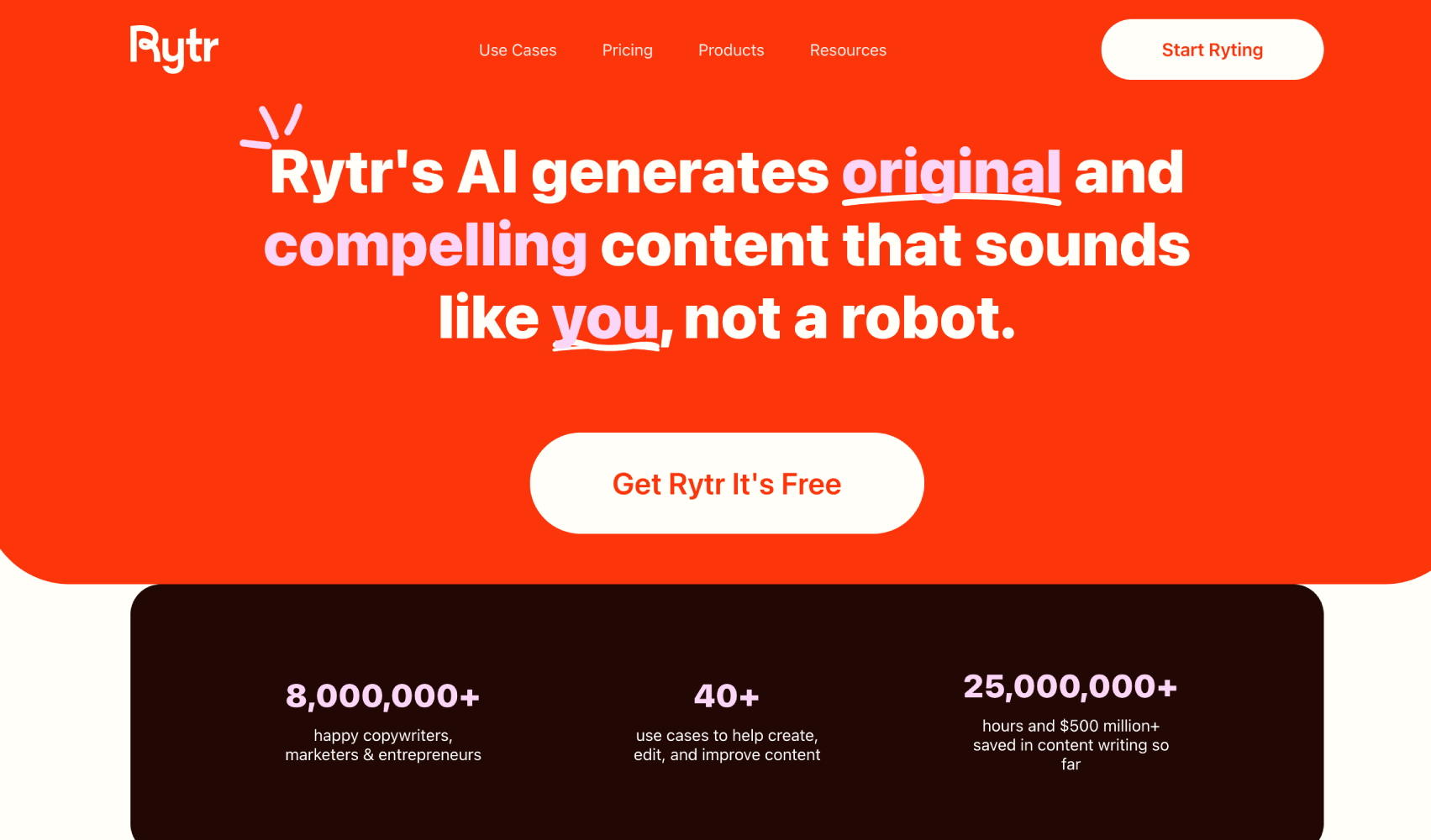
Rytr occupies the low end of the market with a $9/month Saver plan that covers most short-form use cases a solo marketer encounters: blog intros, social captions, email copy, product descriptions, SEO meta descriptions. The output quality is adequate, not impressive. It will not replace a skilled copywriter, but it will reduce the blank-page paralysis that slows down one-person marketing functions.
Rytr has no meaningful workflow automation, no deep brand voice training, and no long-form content engine worth using at professional quality. It is the Toyota Corolla of AI writing tools: reliable, affordable, and completely unexciting. For a bootstrapped founder writing their own content, it is hard to justify spending more.
10. Perplexity Pages , Best for Research-Grounded Editorial and Thought Leadership Content

Perplexity Pages is the most unusual tool on this list. It generates long-form editorial content with inline citations drawn from live web sources, making it the only tool here where factual grounding is a core feature rather than an afterthought. The output reads more like a researched briefing document than marketing copy, which is either a strength or a weakness depending on what you are making.
For thought leadership content, industry reports, competitive analyses, or position papers where citing sources matters, Perplexity Pages is faster and more credible than generating unsupported text in a traditional AI writer. For branded marketing content , campaigns, product pages, conversion-oriented copy , the tone is wrong and the format is inflexible.
At $20/month for the Pro plan, it is not a primary content tool for most marketing teams. It is a specialist tool for a specific content type that other tools handle poorly. Marketers investing in AI-powered brand visibility and citation in AI search results , a growing concern covered in depth in this breakdown of AI visibility tools that track your brand in ChatGPT and Perplexity , will find Perplexity Pages useful for producing content that AI search engines are structurally inclined to cite.
11. Claude (via Claude.ai or API) , Best for Custom Prompt Workflows and Technical or Nuanced Writing

Anthropic’s Claude does not arrive with marketing-specific templates, brand voice training, or workflow automation. What it offers is superior instruction-following, long context windows (up to 200K tokens on certain plans), and writing quality on nuanced or technically complex content that outperforms GPT-4-class models in direct comparison tests on professional writing tasks.
For marketing teams willing to invest in prompt engineering , writing detailed system prompts that define brand voice, output format, and content goals , Claude functions as a powerful custom content engine. Teams using it this way typically maintain a library of system prompts for different content types, essentially building their own lightweight content tool on top of Claude’s API.
That setup requires more sophistication than loading a Jasper template. But for a marketing operations team or a growth team with engineering support, the flexibility is worth more than any template library. Claude’s Pro plan is $20/month. API pricing is usage-based and publicly available on Anthropic’s pricing page.
How to Apply the AboutMartech Content-Fit Matrix to Your Own Stack
The four dimensions from the matrix introduced earlier , Output Type, Workflow Depth, Brand Control, and Model Access , function as a buying filter, not a ranking. Score each dimension by how important it is to your team’s actual bottleneck, then match that priority profile against the tools above.
Three worked examples show how this plays out in practice:
- Profile A: 8-person B2B SaaS marketing team, high Brand Control needs, high Workflow Depth needs. The matrix points to Jasper (under 200 employees, collaborative campaigns) or Writer (over 200 employees, compliance requirements). The deciding variable is whether legal review of content is a hard requirement.
- Profile B: 3-person SEO content team, high Output Type needs (long-form, high volume), low Brand Control needs. The matrix points to Writesonic at the $16/month individual tier or Surfer SEO if keyword targeting precision justifies the $99/month premium. The deciding variable is whether SERP-integrated briefs save enough editing time to offset the cost difference.
- Profile C: Solo founder or one-person marketing function, low needs across all four axes. The matrix points to Rytr at $9/month or Notion AI if the team already runs in Notion. Anything above $20/month at this profile is paying for features that will not get used.
The mistake most teams make is buying the tool with the most features rather than the most relevant features. Jasper’s campaigns feature is genuinely good. If your team does not run multi-asset campaigns, you are paying for infrastructure you will not use. Conversely, a team running 40 SEO articles per month that buys Anyword for its performance-prediction scores on ad copy is solving the wrong problem. Match the bottleneck, not the feature count.
What Do These Tools Cost Across Different Team Sizes?
Pricing structures vary significantly between tools, and the per-seat economics shift at different team sizes. Here is a view of what each tool costs for a solo user, a 5-person team, and a 20-person team, based on public pricing pages. Where a vendor does not publish per-seat pricing at a given tier, the table notes that directly rather than estimating.
| Tool | Solo (1 seat) | Small Team (5 seats) | Mid Team (20 seats) | Notes |
|---|---|---|---|---|
| Jasper | $49/mo (Creator) | $125/mo (Teams, up to 3 seats included; additional seats add-on) | Contact sales | Teams plan required for collaboration features; 20-seat pricing not publicly listed |
| Copy.ai | $49/mo (Starter) | $249/mo (Team plan, up to 5 seats) | Contact sales (Enterprise) | Free tier available; Enterprise pricing not publicly listed |
| Writesonic | $16/mo (Individual) | $79/mo (Team, per public pricing) | Contact sales | Most affordable entry point; 20-seat pricing not publicly listed |
| Anyword | $39/mo (Starter) | $79/mo (Data-Driven) | Contact sales | Starter limits team features; 20-seat pricing not publicly listed |
| Writer | N/A | Contact sales | Contact sales | Enterprise-only; no public per-seat pricing at any tier |
| Rytr | $9/mo (Saver) | $29/mo (Unlimited) | $29/mo (Unlimited) | Flat unlimited plan, no per-seat pricing |
| Notion AI | $10/mo add-on | $50/mo add-on (5 seats at $10/seat) | $200/mo add-on (20 seats at $10/seat) | Requires existing Notion plan; per-seat pricing is consistent across team sizes |
These figures reflect public pricing at time of writing. Several tools (Copy.ai, Writesonic, Anyword) have credit or usage caps at lower tiers that may require upgrades for high-volume teams. Check each vendor’s current pricing page before committing.
Which AI Content Tool Should You Pick?
For teams with brand consistency as the primary concern and multiple writers producing content across formats, Jasper is the most complete solution. For GTM and demand-gen teams that want AI embedded in automated workflows rather than a separate tool to visit, Copy.ai’s Workflows feature is the most distinctive offering in this category. For SEO-led content programs that need volume and keyword integration, Writesonic at $16/month is hard to beat on value.
Writer is the right answer for enterprises with legal or compliance constraints on content , no other tool on this list enforces brand governance at that depth. Anyword is the right pick for paid media teams that need directional performance data on copy variants before testing. Everyone else should match their specific bottleneck to the Content-Fit Matrix before spending anything.
If you are evaluating how AI-generated content affects your brand’s visibility in AI search engines and citation models, that is a separate infrastructure problem from content creation. The AEO and GEO tools built to get your brand cited by AI address that layer of the stack. The tools in this article handle generation. Both matter, and they are not the same category.
Frequently Asked Questions About AI Content Tools
What is the best AI content tool for a small marketing team in 2026?
For a team of 3-10 marketers producing a mix of blog content, emails, and ads, Jasper or Copy.ai are the strongest options. Jasper wins if brand consistency is the primary concern. Copy.ai wins if the team needs workflow automation to connect content creation to CRM or outreach processes. Writesonic is the right call if the primary output is SEO content and budget is a constraint.
Is there a meaningful difference between AI writing tools that use the same underlying model?
Yes. The underlying model is increasingly a shared commodity , many tools access GPT-4 or similar models via API. The differentiation is the product layer: how prompts are structured and constrained, how brand voice is enforced, how outputs are formatted for specific use cases, and how the tool fits into existing workflows. Two tools on the same model can produce dramatically different outputs given the same input, because their system prompts and instruction layers differ.
Which AI content tools work best for SEO blog content specifically?
Writesonic and Surfer SEO are the strongest options for SEO-focused content. Surfer SEO offers tighter integration between SERP analysis and writing, making it better for teams where keyword targeting precision matters most. Writesonic offers higher output volume at lower cost, making it better for teams publishing frequently. Both require human editorial review before publishing , AI-generated SEO content without editing tends to underperform on topical depth signals.
Can AI content tools replace a human copywriter?
Not for work requiring strategic judgment, brand nuance, or original positioning. AI content tools are most accurately described as draft-acceleration tools: they reduce time-to-first-draft significantly, but the editing, strategic framing, and brand voice shaping still require human judgment. Teams that treat AI output as publishable without editing typically see declining content quality over time, because the model cannot course-correct without human feedback in the loop.
How do AI content tools handle brand voice?
Approaches vary widely. Jasper and Writer use trained brand voice profiles that persist across all outputs. Copy.ai and Writesonic allow style guidelines as inputs, but they are prompt-based rather than architecturally enforced. Rytr and Notion AI have minimal brand voice functionality. Writer is the deepest implementation: it ingests brand guidelines documents, terminology lists, and prohibited language at the model level, not as a prompt wrapper.
What is the cheapest AI content generator that is still usable for professional work?
Rytr at $9/month is the most affordable on this list and produces adequate output for short-form content. For long-form or SEO work, Writesonic at $16/month is worth the step up. Both require more editorial work than premium tools, but for a solo marketer or bootstrapped team, the output-to-cost ratio is defensible. Notion AI at $10/month per member is cheaper if the team already uses Notion, but it is not a replacement for a dedicated content tool.
Do any AI content tools integrate directly with marketing automation platforms?
Yes. HubSpot AI is embedded directly in HubSpot’s CMS, email builder, and social tools , no integration required for HubSpot users. Copy.ai’s Workflows feature connects to HubSpot, Salesforce, and other CRMs via native integrations. Jasper offers HubSpot and Webflow integrations at higher plan tiers. Writer offers broader enterprise integration via API. For teams building connected content operations, this matters as much as output quality. Understanding how your content stack connects to broader martech infrastructure , including the customer data platforms your content tools pull audience data from , is worth mapping before you buy.
How does AI content generation affect marketing attribution?
AI-generated content, when it is well-edited and correctly published, does not inherently change how attribution models track content-driven conversions. The concern most marketing ops teams should have is content volume inflation: publishing more AI-generated articles can dilute topical authority signals and make attribution modeling harder if pages are not properly tagged or if they cannibalize each other on intent. Teams scaling content production with AI tools need attribution tooling that can separate organic content performance by page and cluster, not just channel-level reporting.
The Verdict
The gap between AI content tools is not about which one writes better sentences on a blank canvas. It is about which one is designed for the content job your team actually runs. Jasper is built for marketing departments with brand standards to protect. Copy.ai is built for GTM teams that want AI in the workflow, not alongside it. Writesonic is built for SEO content teams that need throughput. Writer is built for enterprises that cannot afford compliance failures in published content. Anything else on this list fills a narrower slot , and should only be bought when that slot matches your actual bottleneck.
The worst outcome is buying the most-marketed tool instead of the best-fit tool. Jasper has the loudest brand in this category, and it is a genuinely good product , but a five-person startup SEO team spending $125/month on Jasper Teams when $16/month Writesonic covers 90% of their use case is a mistake the sales process is designed to encourage. The AboutMartech Content-Fit Matrix exists to prevent exactly that. Score your bottleneck first. Buy the tool that solves it.
The broader pattern across AI content tools is that the best ones are moving from generation toward governance: helping teams produce content that is not just fast, but consistent, on-brand, and connected to the systems where content actually gets used. That direction favors Writer and Jasper long-term. Short-term, the tool that wins is the one that fits the workflow you already have, not the workflow you aspire to build.