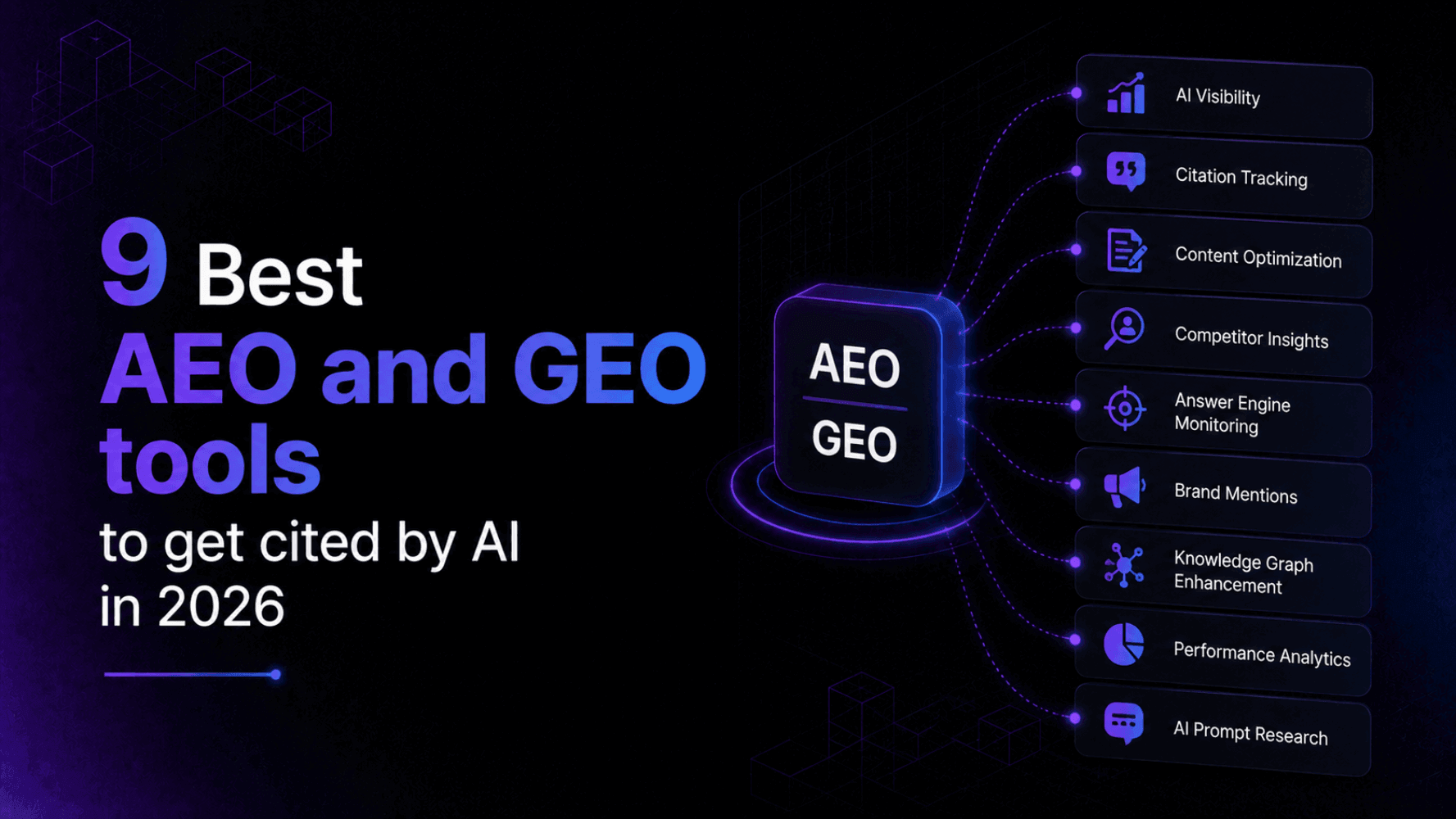
- A real GEO software category exists. At least nine platforms now track AI citations, audit content for generative-engine visibility, and recommend structural changes to earn mentions in ChatGPT, Perplexity, and Google AI Overviews.
- Most tools split into two jobs: monitoring (did an LLM cite your brand?) and optimization (why not, and what should change?). The best ones do both.
- Purpose-built GEO platforms like Profound, Otterly.ai, and Scrunch AI target marketing and SEO teams directly; enterprise SEO suites like Semrush and BrightEdge are bolting on AI-visibility modules as add-ons.
- The fastest path to AI citations is structured, factually dense content with clear entity markup , not keyword stuffing. Tools that diagnose that gap are worth the subscription.
- If you already track AI brand mentions, check our roundup of AI visibility tools for ChatGPT and Perplexity alongside this list , the categories overlap but serve different briefs.
The best AEO and GEO software for getting cited by AI includes purpose-built platforms like Profound, Otterly.ai, Scrunch AI, Goodie AI, and Peec.ai, plus AI-visibility modules inside Semrush and BrightEdge. These tools track whether LLMs like ChatGPT, Perplexity, and Google AI Overviews mention your brand, diagnose why content gets skipped, and recommend specific structural fixes to increase citation frequency across generative search surfaces.
Why Most Marketers Are Wrong About GEO Tooling
The prevailing assumption in marketing circles is that generative engine optimization is a philosophy, not a software category. Ask ten CMOs what GEO tool they use and eight will say “we just write better content.” That was defensible in 2023. It is not defensible now.
LLMs do not rank pages the way Google does. They pull entities, facts, and structured answers from content they deem authoritative on a topic. If your brand is absent from those answers, you are invisible to a growing share of buyers who start research in ChatGPT or Perplexity rather than a search bar. Tracking that absence, and fixing it, now has dedicated software.
The category is young, which is why the tooling is uneven. Some platforms are mature enough for enterprise procurement; others are early-access products still finding their feature set. This list covers both ends honestly.
The AboutMartech GEO Stack-Fit Test: Four Checks Before You Buy
Before evaluating any GEO platform, run four quick checks against your actual situation. We call this the GEO Stack-Fit Test, and it cuts shortlist time significantly.
- Citation surface coverage: Does the tool monitor the specific LLMs where your buyers actually search? ChatGPT, Perplexity, Google AI Overviews, and Microsoft Copilot are not interchangeable. A tool covering only one misses the others entirely.
- Diagnostic depth: Can it tell you why a competitor gets cited instead of you , entity gaps, schema deficiencies, content structure , or does it only report that you were missed?
- Workflow fit: Does output flow to your existing stack (CMS, Slack, Notion, your SEO tool)? GEO recommendations that live in a separate dashboard get ignored within 60 days.
- Team maturity: Does your content team understand structured data and entity optimization, or do you need the tool to prescribe changes in plain English? Some platforms assume technical SEO fluency. Others do not.
Run these four checks before reading vendor demos. They will immediately eliminate two or three options from your shortlist.
What Separates AEO Tools From Standard SEO Software?
Answer engine optimization software targets a different retrieval mechanism than traditional SEO tools. Google’s organic algorithm weighs backlinks, PageRank, and hundreds of on-page signals. Generative AI systems weight entity authority, factual density, content structure, and schema markup , especially FAQ, HowTo, and Article schema that LLMs parse cleanly.
Traditional SEO platforms like Ahrefs or Moz were not built to query GPT-4 or Claude, interpret citation patterns, or audit whether your content answers the specific question an LLM is likely to surface. AEO tools are. The distinction matters when you are allocating budget: you may need both categories, or you may find that an incumbent suite like Semrush has added enough AI-visibility functionality to cover your needs for now.
The 9 Best GEO Software Tools Compared
| Tool | Primary job | LLMs monitored | Best for | Pricing model |
|---|---|---|---|---|
| Profound | AI citation monitoring + competitive intelligence | ChatGPT, Perplexity, Gemini, Copilot | Mid-market and enterprise brands | Quote-based |
| Otterly.ai | Brand visibility tracking in AI answers | ChatGPT, Perplexity, Google AI Overviews | SMBs and agency teams | Public tiered pricing |
| Goodie AI | Content auditing for AI readability | Multiple (audit-focused, not just monitoring) | Content-heavy sites and publishers | Freemium + paid tiers |
| Scrunch AI | GEO platform: monitor, diagnose, recommend | ChatGPT, Perplexity, Gemini | Growth-stage brands with content ops | Quote-based |
| Peec.ai | AI search visibility tracking | ChatGPT, Perplexity | SMBs and early-stage startups | Public tiered pricing |
| Evertune | Brand sentiment monitoring in AI answers | ChatGPT, Perplexity, Gemini, Copilot | Brand and comms teams at larger orgs | Quote-based |
| Semrush (AI Toolkit) | AI-overview tracking added to existing SEO suite | Google AI Overviews (primary) | Teams already using Semrush | Add-on to existing Semrush plan |
| BrightEdge Autopilot | Enterprise SEO with generative-search module | Google AI Overviews, Bing Copilot | Enterprise SEO teams | Quote-based (enterprise) |
| Narrato AI | Content creation optimized for GEO signals | Creation-side (not monitoring) | Content teams producing at scale | Public tiered pricing |
1. Profound
Profound sits at the top of this list because it covers more LLMs simultaneously than any other purpose-built platform in the category. The platform tracks how ChatGPT, Perplexity, Google Gemini, and Microsoft Copilot respond to queries relevant to your brand and category, then surfaces competitive gap analysis showing which competitors are cited instead of you and on which platforms.
The diagnostic layer is what distinguishes Profound from simple monitoring tools. Rather than just logging missed citations, it maps your content inventory against the topics where competitors earn mentions and flags the entity and structural gaps creating that delta. Pricing is quote-based and positions toward mid-market and enterprise teams.
Best for: brands serious about competitive AI-search intelligence who need cross-LLM coverage from day one.
2. Otterly.ai
Otterly.ai is the most accessible entry point in the GEO software category. It tracks brand and competitor mentions across ChatGPT, Perplexity, and Google AI Overviews on a query set you define, and its public pricing tiers make it viable for SMB marketing teams and agencies managing multiple clients.
The interface is clean, the setup is fast, and the output is straightforward enough that a content marketer without technical SEO background can act on the recommendations. The trade-off is depth: Otterly covers the monitoring brief well but does not go as deep on content diagnostics as Scrunch AI or Profound.
Best for: SMBs and agencies who need GEO monitoring without a six-figure platform commitment.
3. Goodie AI
Goodie AI takes a content-audit approach rather than purely a monitoring one. The platform analyzes your existing content for AI readability signals: structured data completeness, entity coverage, factual specificity, and the formatting patterns that generative AI systems tend to extract cleanly.
This makes Goodie AI particularly useful for content-heavy sites , publishers, SaaS companies with large knowledge bases, media brands , where the question is less “are we being cited?” and more “why are these 400 pages invisible to LLMs?” Its freemium tier lets teams do an initial audit before committing budget.
Best for: content ops teams who need a diagnostic audit before deciding on a full GEO platform.
4. Scrunch AI

Scrunch AI positions itself as a full generative engine optimization platform, covering monitoring, diagnosis, and content recommendations in a single workflow. The platform tracks citation frequency across ChatGPT, Perplexity, and Gemini, then connects that data to specific content gaps and recommends changes at the page level.
The recommendation engine is the differentiator. Where most tools tell you what is missing, Scrunch AI specifies what to write, which schema to add, and which entities to strengthen on a given page. For growth-stage brands with a content team but no dedicated technical SEO function, this prescriptive output has real value. Pricing is quote-based.
Best for: brands that want monitoring and optimization in one tool, without needing to interpret raw citation data themselves.
5. Peec.ai
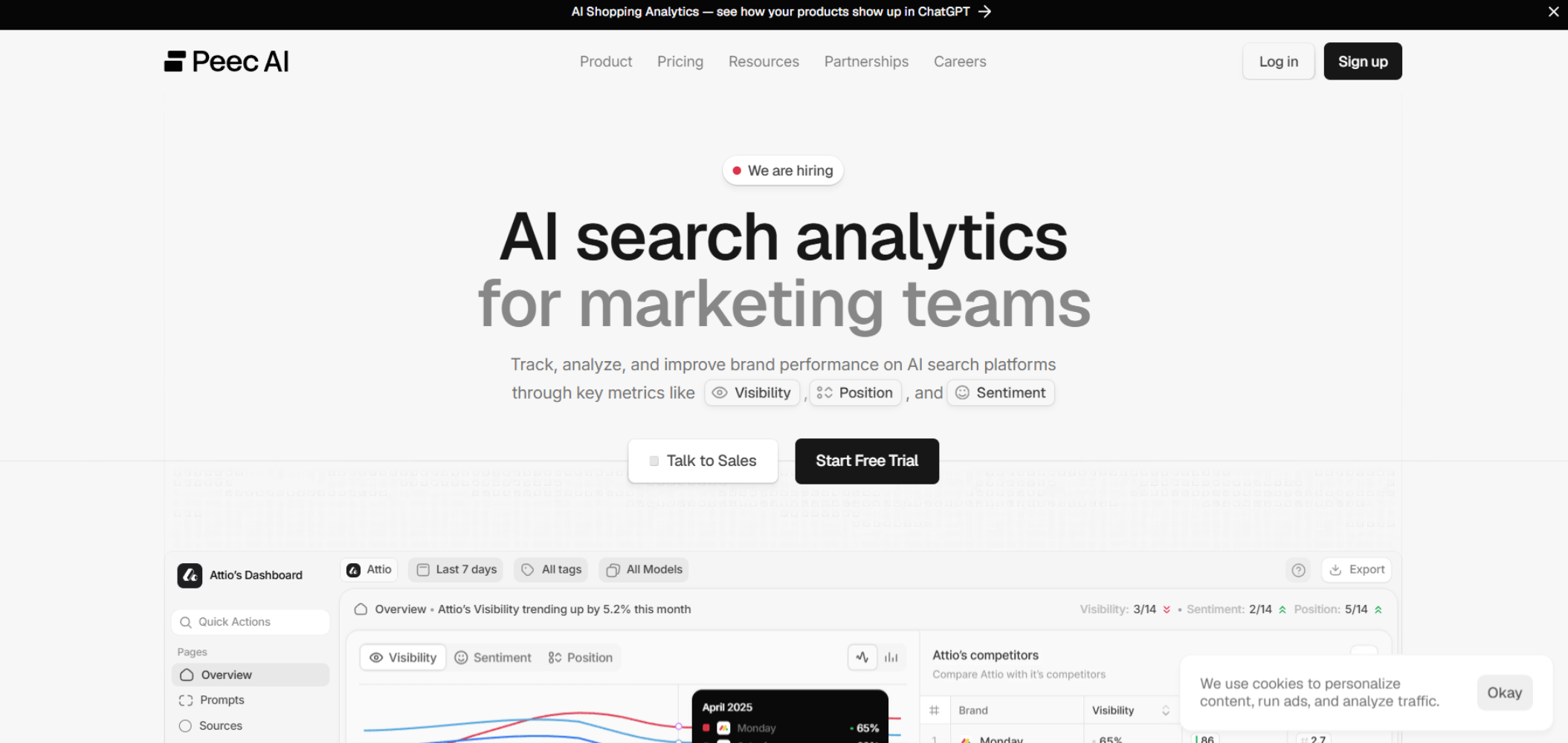
Peec.ai is a lean AI search visibility tracker focused on ChatGPT and Perplexity. It monitors how frequently your brand appears in AI-generated answers for a set of tracked queries, shows sentiment around those mentions, and benchmarks your visibility against named competitors.
The platform’s public pricing tiers put it within reach of early-stage startups and solo marketers who want to establish a baseline before investing in more comprehensive tooling. The monitoring coverage is narrower than Profound’s, but the data is clean and the setup time is minimal.
Best for: startups and SMBs that need a fast, low-cost baseline on AI search visibility before scaling spend.
6. Evertune
Evertune approaches GEO from a brand-intelligence angle. The platform monitors how AI systems describe your brand, products, and category across ChatGPT, Perplexity, Gemini, and Copilot, with particular focus on sentiment, framing, and whether AI answers reflect your intended positioning.
This makes Evertune the strongest option for brand and communications teams at larger organizations who care not just about citation frequency but about narrative accuracy. If an LLM consistently describes your product in outdated or inaccurate terms, Evertune surfaces that gap. Pricing is quote-based and targets enterprise buyers.
Best for: enterprise brand teams managing reputation and narrative consistency across AI answer surfaces.
7. Semrush (AI Toolkit)
Semrush has been adding AI-overview tracking capabilities to its core SEO suite. For teams already paying for Semrush, the AI Toolkit add-on provides visibility into Google AI Overviews appearances for tracked keywords without requiring a separate platform.
The coverage is currently strongest for Google AI Overviews and weaker on ChatGPT and Perplexity compared to purpose-built GEO tools. If Google AI Overviews is your primary concern and you are already running Semrush for broader SEO, the add-on is a pragmatic choice. If you need cross-LLM monitoring, the purpose-built platforms on this list outperform it.
Best for: Semrush users who want AI Overviews tracking without adding a new vendor to the stack.
8. BrightEdge Autopilot
BrightEdge Autopilot is the enterprise-grade option for organizations that need GEO functionality inside an existing enterprise SEO contract. The platform’s generative search module tracks Google AI Overviews and Bing Copilot appearances and integrates that data with BrightEdge’s broader organic performance reporting.
Enterprise procurement teams will recognize the contract structure: quote-based, multi-year, with implementation support. That structure makes it a realistic choice only for organizations already running BrightEdge or those large enough to justify it from scratch. Teams outside that bracket will find the purpose-built GEO platforms faster to deploy and more cost-effective.
Best for: enterprise SEO teams already on BrightEdge who want GEO data inside their existing reporting environment.
9. Narrato AI

Narrato AI sits on the creation side of the GEO workflow rather than the monitoring side. The platform helps content teams produce articles, landing pages, and FAQ content optimized for the structural signals that generative AI systems favor: clear entity definitions, factual density, structured headings, and schema-ready formatting.
Narrato does not track whether you are being cited. It helps you produce content that is more likely to get there. For content teams publishing at volume who need GEO best practices baked into the production workflow rather than applied as a post-publish audit, it fills a specific gap. Public pricing tiers are available on their site.
Best for: content teams that need GEO signals built into the writing workflow, not layered on afterward.
Which GEO Platform Should You Actually Use?
The honest answer depends on where you are in the GEO maturity curve. Teams just establishing a baseline should start with Peec.ai or Otterly.ai , both have accessible pricing, fast setup, and enough data to determine whether AI citation is a meaningful channel for your category before committing to a larger platform.
Teams that have confirmed AI-search visibility is a problem and need to fix it systematically should look at Scrunch AI or Profound. Both go beyond monitoring into prescription. The difference is that Profound is stronger on competitive intelligence across multiple LLMs, while Scrunch AI is more prescriptive at the content-recommendation level.
Enterprise teams already inside the Semrush or BrightEdge platforms should evaluate those add-ons first, with the understanding that they currently cover Google AI Overviews more thoroughly than ChatGPT or Perplexity. If cross-LLM coverage matters , and for most B2B buyers it does , a purpose-built platform will serve better.
For deeper context on tracking AI mentions specifically (as opposed to optimizing for them), the best AI visibility tools for ChatGPT and Perplexity covers the monitoring side of the category in more detail.
What Does GEO Software Actually Measure?
Most GEO platforms measure some combination of three signals: citation frequency (how often an LLM mentions your brand when answering relevant queries), citation position (whether your brand leads the answer or appears as a secondary reference), and sentiment framing (whether the AI describes your product accurately and favorably).
Beneath those surface metrics, the better platforms also measure entity coverage , whether your content explicitly defines the terms, products, and concepts that LLMs associate with your category. An LLM that does not have clear, structured information about what your product does and who it serves cannot cite you authoritatively, regardless of how many backlinks your domain has. This is the fundamental difference between GEO and traditional SEO: you are not competing for a rank position, you are competing to become a named entity in the LLM’s working knowledge of your category.
How Much Does GEO Software Cost?
Pricing across this category varies widely and is often opaque. Peec.ai and Otterly.ai both publish tiered pricing directly on their sites, making them the most budget-transparent options. Narrato AI also publishes public pricing. Profound, Scrunch AI, Evertune, and BrightEdge are all quote-based, which typically signals pricing north of $1,000 per month for credible implementations. Semrush’s AI Toolkit is an add-on to existing Semrush plans, so effective cost depends on your current tier.
For teams just starting out, the freemium tier on Goodie AI provides enough diagnostic data to build a business case before any budget conversation. That path , freemium audit, paid monitoring, then full GEO platform , is how most content-mature teams are approaching this investment cycle.
Best GEO Software for SMBs and Enterprise: Frequently Asked Questions
What is the difference between AEO tools and GEO software?
Answer engine optimization (AEO) software focuses on structuring content to appear in direct AI-generated answers, typically targeting FAQ schema, structured data markup, and factual density. Generative engine optimization (GEO) software is a broader term covering both the optimization side and the monitoring of how generative AI systems like ChatGPT, Perplexity, and Google AI Overviews actually cite or reference your brand. In practice, many vendors use the terms interchangeably, and the leading platforms in this list do both jobs.
Can GEO software guarantee that ChatGPT will cite my brand?
No GEO platform can guarantee citations. LLM outputs are probabilistic and vary by model version, query phrasing, and the competitive content field. What GEO software can do is identify the structural, entity, and content gaps that reduce your citation probability, and give you a prioritized list of changes to address them. Think of it as reducing the gaps rather than engineering a guaranteed outcome.
Do I need GEO software if I already use Semrush or Ahrefs?
Semrush now offers AI Overviews tracking as an add-on, which covers Google’s generative surface reasonably well. Ahrefs does not yet have equivalent GEO functionality as of current public documentation. Neither platform tracks ChatGPT or Perplexity citations with the depth of purpose-built GEO tools. If those conversational AI surfaces are relevant to your buyers , and for most B2B categories they are increasingly relevant , a dedicated GEO platform fills the gap your existing SEO tool leaves open.
What content changes actually improve AI citation frequency?
The changes with the highest reported impact are: adding FAQ schema and structured data markup, writing direct factual definitions of your core product and category terms, increasing entity specificity (naming specific use cases, integrations, and customer types rather than staying generic), and improving content structure so that individual sections can stand alone as self-contained answers. Generative AI systems extract clean, structured answers. Content that reads like a complete answer to a specific question gets cited more than content written to rank for a broad topic.
Which LLMs should I prioritize for GEO monitoring?
Prioritize based on where your buyers actually research. ChatGPT and Perplexity are the most commonly used AI research tools among B2B buyers. Google AI Overviews affects anyone whose buyers still start in Google, which remains the majority. Microsoft Copilot matters if your buyers are enterprise IT or procurement teams in Microsoft-heavy environments. Most teams should start with ChatGPT and Perplexity monitoring, then layer in Google AI Overviews tracking , which maps closely to their existing organic search coverage.
Is GEO software relevant for B2B companies with long sales cycles?
Yes, and the argument is stronger for long-cycle B2B than for short-cycle consumer purchases. Buyers in 90-day-plus sales cycles do extensive AI-assisted research before ever contacting a vendor. If your brand and product category are not surfacing in those early ChatGPT and Perplexity research sessions, you are absent from the consideration set before the first sales touch. GEO software helps your brand enter that research phase as a named, factually accurate entity. For more on the infrastructure behind being findable and relevant at the right moment, see our overview of AI visibility tools for ChatGPT and Perplexity.
How long does it take to see results from GEO optimization?
LLM knowledge bases update on different schedules depending on the model. Perplexity retrieves live web content and can reflect content changes within days. ChatGPT’s training cutoffs mean some changes take longer to propagate, though GPT-4o’s browsing capabilities partially offset this. Google AI Overviews updates more frequently as it is grounded in live search indexing. Practitioners working in this area commonly report seeing measurable changes in citation frequency within four to eight weeks of implementing structural content changes, though this varies significantly by category competitiveness and content quality and should be treated as anecdotal rather than a guaranteed benchmark.