TLDR
- Apollo is a self-contained prospecting platform: it finds contacts, verifies emails, and sequences outreach all in one place, with a free tier and paid plans starting at $49/month per user as of Apollo’s public pricing page.
- Clay is an enrichment workflow builder: it does not own data, but pulls from 100+ third-party providers simultaneously using a waterfall logic, then routes results into your CRM or sequencer.
- The two tools solve different problems. Apollo answers “who should I contact?” Clay answers “what do I actually know about this person, and is that data trustworthy?”
- Most RevOps teams using Clay still need Apollo or a similar sequencing tool downstream. Clay enriches; it does not send.
- Small teams with a tight budget and no data engineer should start with Apollo. Teams with messy, incomplete CRM data and multi-source enrichment requirements should evaluate Clay.
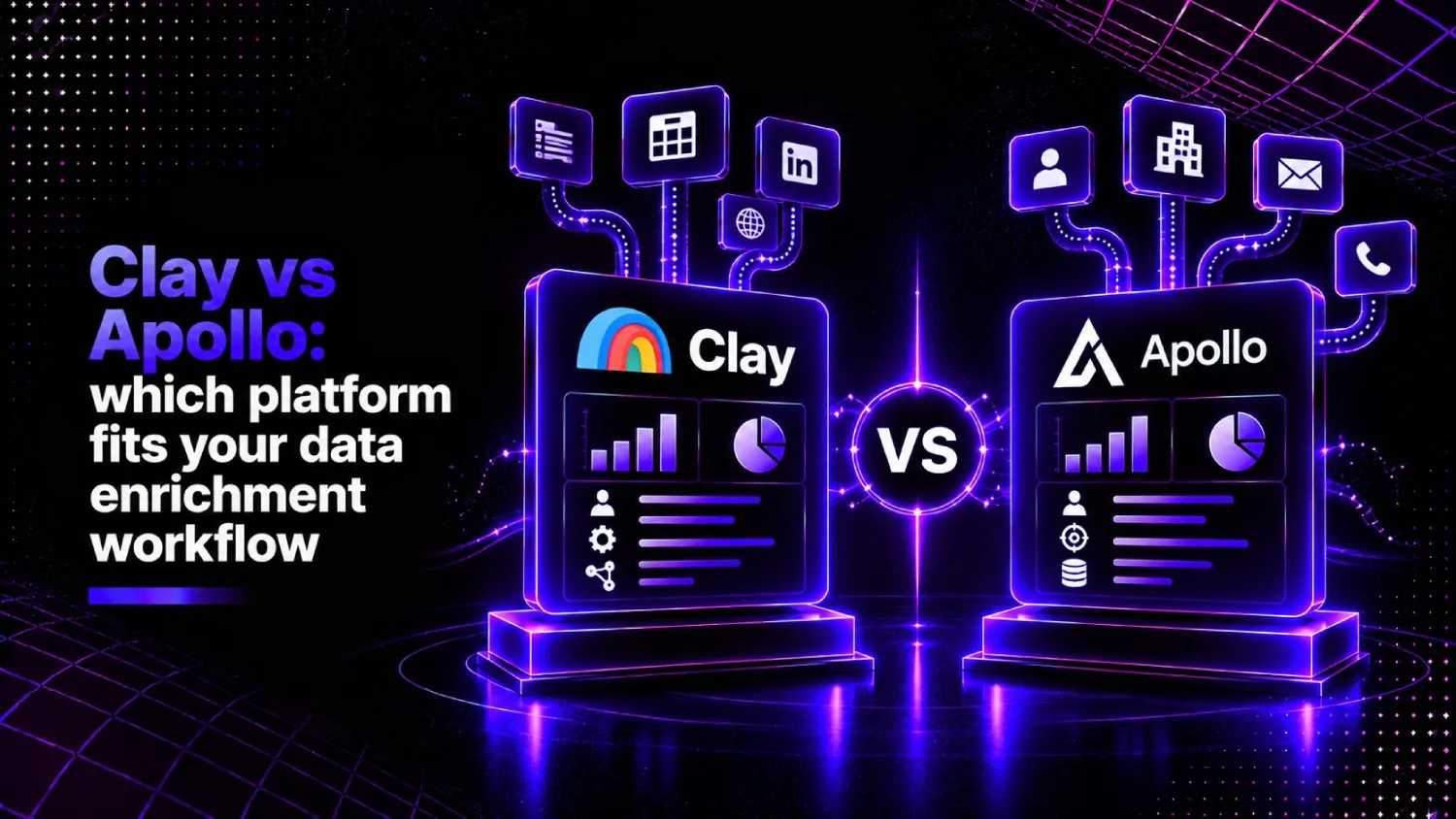
Apollo is an all-in-one prospecting and sequencing platform with its own contact database. Clay is a data enrichment workflow builder that runs multiple providers in sequence and returns the best result. They are not direct competitors: Apollo replaces a prospecting stack, while Clay augments the data layer of a stack you already have. The right choice depends on whether your problem is finding leads or trusting the data you already have on them.
In this guide
What Is the Core Difference Between Clay and Apollo?
The confusion between these two tools is understandable because both surface contact data. The difference is where that data comes from and what you do with it afterward.
Apollo maintains its own proprietary database of contacts and companies. When you search for a VP of Engineering at a Series B fintech, Apollo queries its own index, returns a match, and lets you sequence that person in the same tab. The whole workflow lives inside one interface. That is its appeal.
Clay owns no data. Instead, it acts as an orchestration layer. You bring a list of companies or contacts, and Clay runs that list against dozens of enrichment providers in a defined sequence. If Provider A returns a valid phone number, Clay stops there. If not, it falls to Provider B, then Provider C. This is called waterfall enrichment, and it is the core mechanism Clay is built around. You pay per successful enrichment, not per lookup attempt.
In practice, this means Clay can return higher data coverage on a difficult list, but requires more setup. Apollo is faster to deploy for standard outbound prospecting, but gives you less control over data sourcing when coverage matters.
How Does Apollo’s Prospecting Model Actually Work?
Apollo combines three functions in one product: a contact and company database, an email verification layer, and a sales engagement sequencer. Sales reps can filter by job title, geography, industry, headcount, funding stage, and technology stack, then push those contacts directly into an email or call sequence.
The database contains hundreds of millions of contacts, though coverage varies by region and seniority level. Apollo’s data quality has historically been criticized for stale records, particularly for mobile numbers. That criticism has become a standard part of any Apollo evaluation conversation on forums like Reddit and G2.
What Apollo does well is speed to sequence. A new SDR can log in, find 500 accounts in a target segment, and have a cadence running the same afternoon. That matters in environments where sales velocity is the constraint, not data precision.
Apollo’s pricing, per its public pricing page, starts with a free tier (limited monthly credits), a Basic plan at $49/month per user, a Professional plan at $99/month per user, and an Organization plan priced by quote. Credits govern how many records you can export or enrich per month, and they roll over with caveats depending on plan tier.
How Does Clay’s Waterfall Enrichment Model Work?
Clay’s model requires a conceptual shift for teams used to single-source data tools. You do not search for contacts in Clay. You import a list, define which data points you need (work email, mobile, LinkedIn URL, company revenue, tech stack), and configure which providers to query and in what order.
The providers Clay integrates with include Clearbit, People Data Labs, Hunter, Apollo (yes, Apollo’s API is one of Clay’s sources), Prospeo, Lusha, and dozens more. A typical waterfall for email enrichment might check Hunter first, then Prospeo, then fall back to Apollo’s API. Clay charges a credit per row per provider lookup when a match is returned. Failed lookups cost fewer or no credits depending on the provider integration.
This architecture solves a specific problem: no single data provider has 100% coverage. By chaining providers, Clay significantly increases the probability of returning a valid, verified record. For teams running account-based motions where every target account matters, this coverage improvement justifies the added complexity.
Clay’s pricing, per its public pricing page and pricing calculator, is credit-based and tiered. Plans start at a free tier with limited credits, with paid plans from $149/month for Starter, scaling up through Explorer, Pro, and Enterprise tiers. Credits are the pricing unit, and how many you consume depends on which providers you activate per row. This makes total cost of ownership variable and worth modeling before committing.
Teams evaluating multiple enrichment sources alongside Clay may also want to review the best data enrichment APIs for developers and RevOps to understand the provider territory Clay sits on top of.
Clay vs Apollo: Side-by-Side Feature Comparison
| Capability | Apollo | Clay |
|---|---|---|
| Owns contact database | Yes | No (orchestrates third-party providers) |
| Waterfall enrichment | No | Yes (100+ providers) |
| Built-in sequencing | Yes (email + phone + LinkedIn) | No (exports to your sequencer) |
| AI personalization | Basic templates | Yes (Claygent, GPT-4 row-level prompts) |
| CRM sync | HubSpot, Salesforce (native) | HubSpot, Salesforce, webhooks |
| Free tier available | Yes | Yes (limited credits) |
| Paid plans start at | $49/month per user | $149/month (not per user) |
| Setup complexity | Low (self-service) | Medium to high (workflow configuration) |
| Best fit | SDR-led outbound with speed as priority | RevOps-led enrichment with quality as priority |
What Does Clay vs Apollo Data Accuracy Look Like in Practice?
Data accuracy comparisons between Clay and Apollo are tricky to run cleanly because Clay’s output depends on which providers you activate in your waterfall, not Clay itself.
Say a demand-gen team has a list of 1,000 target accounts in the enterprise segment. They need verified work emails and direct-dial phone numbers for the VP of Sales at each account. Running that list through Apollo’s native database might return emails for 700 of those contacts, with a meaningful portion bouncing or going to former employees. Running the same list through a Clay waterfall that sequences Hunter, Clearbit, and Apollo’s API in order can push coverage higher and reduce bounce rate, because each provider’s gaps get filled by the next in line.
The accuracy advantage Clay creates is structural, not magical. Waterfall enrichment wins on coverage when the underlying providers are well chosen and sequenced. Apollo wins on speed and simplicity when the list is within its coverage strength, typically US-based SMBs and mid-market companies in technology, sales, and marketing verticals.
Which Tool Fits a Small Team with Limited RevOps Bandwidth?
For a team of one to five people without a dedicated MOps or RevOps operator, Apollo is the faster path. The SDR or AE can build their own lists, verify their own contacts, and launch sequences without touching a spreadsheet or configuring a workflow. The free tier is genuinely usable for limited prospecting. Basic at $49/month opens enough monthly credits for most individual contributors.
Clay’s power comes at a cost in time. Someone has to build and maintain the enrichment tables, define the waterfall logic, connect the integrations, and debug when a provider changes its schema. That work is not prohibitive, but it is real. Teams without someone willing to own that configuration will get less value from Clay than the use-case demos suggest.
RevOps teams already managing HubSpot enrichment workflows, CRM hygiene rules, and routing logic will find Clay more natural. It fits the same problem-solving pattern. The best lead enrichment and routing tools for RevOps teams covers how tools like Clay fit into a broader enrichment strategy alongside routing logic.
The AboutMartech Stack-Fit Test for Clay vs Apollo
Before spending on either tool, run this four-check test. It is designed to short-circuit the vendor demo cycle by forcing an honest diagnosis of where your outbound motion actually breaks down, not where you wish it did.
- Data source check: Does your outbound motion rely on a single provider’s data, or do you need coverage across multiple sources because no one provider covers your target segment? Single source points to Apollo. Multi-source points to Clay.
- Operator availability check: Is there someone on your team who can build and maintain enrichment workflows without a tutorial every time a provider updates its API? If no, Apollo’s self-service interface is more durable.
- Stack integration check: Do you already have a sequencer (Outreach, Salesloft, Instantly, Smartlead)? Clay requires one. Apollo replaces the need for one. If you have no sequencer, Apollo is a simpler starting point.
- Budget structure check: Can you predict monthly credit consumption, or will variable usage create budget unpredictability? Apollo’s per-seat model is easier to forecast. Clay’s per-credit model requires usage modeling before committing.
Two or more “points to Clay” answers suggest Clay. Three or more “points to Apollo” answers suggest Apollo. Teams that answer evenly may want to run both: Apollo for discovery and sequencing, Clay for enriching the accounts that enter an account-based motion. The Stack-Fit Test does not tell you which tool is better in the abstract, it tells you which tool matches the team you have today.
How Do Clay and Apollo Pricing Compare at Scale?
At the individual contributor level, Apollo wins on price. The Basic plan at $49/month per user covers standard prospecting volume. Clay’s Starter plan at $149/month is not per-user, which changes the math at team scale, but the per-credit cost for enrichment can compound quickly depending on list size and provider depth.
At the team level, the comparison shifts. Apollo’s per-seat model means cost scales with headcount. A ten-person SDR team on Apollo Professional runs roughly $1,000/month. Clay’s credit model means cost scales with enrichment volume, not headcount. A ten-person team sharing one Clay workspace might spend $149 to $500/month depending on how aggressively they enrich.
Where Clay gets expensive is in high-volume enrichment with premium providers. Some providers within Clay’s waterfall charge higher credits per match. If your waterfall relies on Lusha or Cognism-level data sources for mobile numbers, the per-row cost rises. Model your expected monthly row volume and provider mix before choosing a Clay tier.
For teams evaluating how enrichment tools connect to broader CRM operations, the best HubSpot data enrichment tools review covers how Clay and Apollo compare specifically in the HubSpot context.
Can Clay and Apollo Be Used Together?
Yes, and this is actually the most common configuration among mature RevOps teams. Apollo handles prospecting discovery, its database surfaces candidates in a target segment, and those records get exported as a list. That list feeds into Clay for deeper enrichment: mobile numbers, technographic data, recent hiring signals, AI-generated research summaries via Claygent. The enriched records then route into Outreach or Salesloft for sequencing.
In this setup, Apollo’s database is one of Clay’s waterfall providers, used when other sources fail. Teams effectively pay Apollo for discovery access and use Clay to validate and deepen what Apollo returns. This is not redundant; it is layered quality control.
The limitation is cost. Running both tools plus a sequencer creates a stack with three paid layers. For early-stage teams with limited budget, this is probably too much. For teams running serious outbound at scale, the enrichment quality improvement typically justifies the combined spend.
What Is Clay’s AI Personalization Capability, and Does Apollo Match It?
Clay introduced Claygent, an AI agent that runs research tasks row by row in a table. For each contact on a list, Claygent can browse a company’s website, summarize recent news, identify a trigger event (funding, hiring surge, leadership change), and write a personalized first line for an outbound email. All of this runs in the enrichment table before any outreach fires.
Apollo has added AI-assisted messaging features to its sequence builder, but they operate at the template level rather than the row-by-row research level. Apollo generates variable-driven templates; Clay generates contact-specific research. The gap between those two capabilities is meaningful for teams running account-based campaigns where generic personalization does not convert.
For context on how AI layers interact with outbound and data workflows more broadly, the best RevOps tools for revenue operations covers the AI enrichment and automation category in detail.
Frequently Asked Questions
Is Clay a direct competitor to Apollo?
Not exactly. Apollo is an all-in-one prospecting and sequencing platform with its own contact database. Clay is a data enrichment workflow builder that pulls from third-party providers, including Apollo’s own API. They address different layers of the same problem: Apollo handles discovery and outreach, while Clay handles multi-source data quality and enrichment depth. Many teams use both in the same workflow rather than choosing one.
What is Clay’s pricing model?
Clay charges on a credit basis. Each row enriched consumes credits, with the number depending on which providers are activated in your waterfall. Clay’s public pricing page lists plans starting at a free tier, Starter at $149/month, and scaling up through Explorer, Pro, and Enterprise tiers. The variable nature of credit consumption means total monthly cost depends on list volume and provider depth. Clay’s pricing calculator on their site lets you estimate this before committing.
How much does Apollo cost per month?
According to Apollo’s public pricing page, plans include a free tier with limited credits, Basic at $49/month per user, Professional at $99/month per user, and Organization at custom pricing. Credits control how many contacts you can export or enrich per month. The per-seat model means cost scales with team size, which makes Apollo predictable to budget for headcount-driven teams.
What is waterfall enrichment and why does it matter?
Waterfall enrichment is a sequential lookup strategy where multiple data providers are queried in a defined order. If the first provider returns a valid result, the waterfall stops. If not, it tries the next provider in the sequence. This approach increases data coverage because no single provider has complete data on all contacts. Clay is built around this model, which is why it often returns higher coverage than tools that query a single database.
Which tool is better for a small outbound team without a RevOps operator?
Apollo. Its self-service interface lets an SDR or AE build a prospect list, verify contacts, and launch a sequence in one tool without workflow configuration. Clay requires someone to build enrichment tables, configure provider sequences, and maintain integrations over time. That overhead is manageable for a team with a RevOps or MOps operator, but it creates friction for small teams where the rep owns the entire prospecting workflow.
Does Apollo have worse data quality than Clay?
Apollo’s data quality varies by segment and reflects its single-database architecture. Mobile phone coverage and data freshness have drawn criticism in buyer reviews. Clay’s quality depends entirely on which providers you activate in the waterfall, meaning Clay can outperform Apollo on coverage for difficult lists but requires deliberate provider configuration to do so. Clay does not have inherently better data; it has a structure that lets you compensate for any one provider’s gaps by chaining alternatives.
Can you use Apollo as a data source inside Clay?
Yes. Apollo’s API is available as one of Clay’s enrichment provider integrations. Teams sometimes use Apollo’s database as a lower-cost fallback within a waterfall that leads with higher-precision providers. This means an Apollo subscription can serve two functions simultaneously: direct prospecting through Apollo’s interface, and API-level enrichment coverage inside a Clay waterfall.
What kind of team gets the most value from Clay?
Teams running account-based outbound at volume, where data coverage and personalization depth matter more than speed to sequence. RevOps or MOps operators who can build and maintain enrichment workflows. Companies whose target accounts fall in segments where Apollo’s database has known coverage gaps, such as international markets, niche verticals, or senior executives at private companies. Clay also rewards teams willing to invest in Claygent for AI-driven research at scale.
The Verdict: Which Platform Fits Your Enrichment Workflow?
Apollo and Clay solve real but distinct problems. Conflating them as competing enrichment tools leads teams to buy the wrong one, then blame the category when the results disappoint. Apollo is a prospecting machine. Clay is a data quality machine. Choosing between them starts with an honest diagnosis of where your outbound motion actually breaks down.
If leads are hard to find and your team lacks the time or skill to stitch together multi-source enrichment workflows, Apollo handles the whole job acceptably well. If you already have lists, a sequencer, and a CRM, but the data populating those systems is incomplete or unreliable, Clay addresses the actual failure point. For teams running a mature outbound motion where both discovery and data quality matter, the answer is frequently both, used together as described above. The best B2B intent data providers are worth evaluating alongside either tool if your motion depends on buying signal triggers rather than static lists.
The decision ultimately reflects organizational maturity, not budget. Apollo scales with headcount. Clay scales with workflow sophistication. Start with the tool that matches where your team actually is, not where you plan to be in eighteen months.