TLDR
- LeanData is the category default for Salesforce lead routing, but several tools cover the same ground at lower price points or with simpler setup.
- The core capabilities to compare are lead-to-account matching, round-robin assignment, territory routing, and flow-based orchestration inside Salesforce.
- Traction Complete, Kubaru, and LeadAngel target mid-market teams that find LeanData’s implementation weight excessive.
- Default and Distro cover inbound-first workflows where real-time speed matters more than complex territory logic.
- Salesforce’s native assignment rules handle basic routing for free, but break down past simple round-robins or account hierarchies.
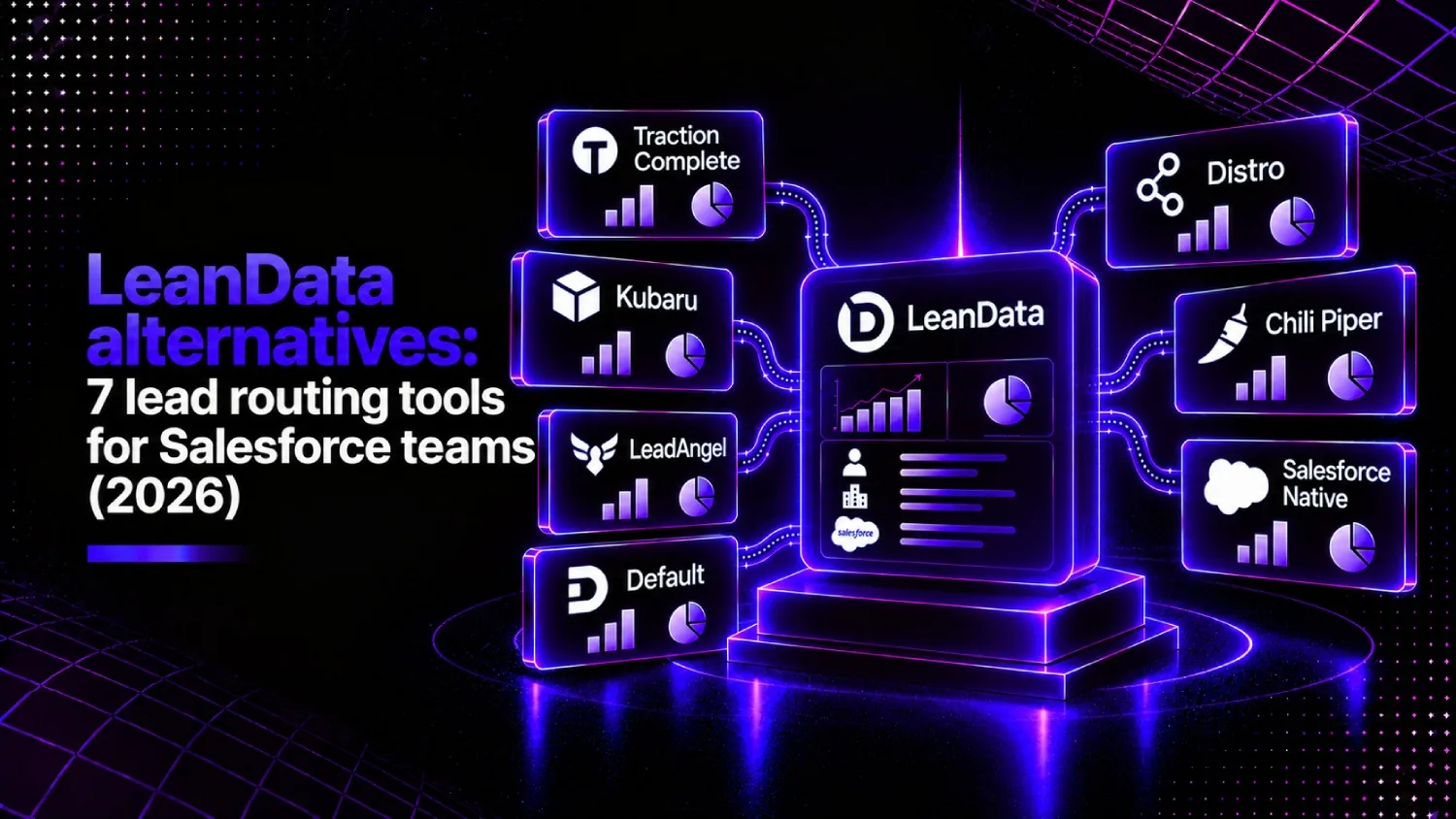
The strongest LeanData alternatives for Salesforce teams are Traction Complete, Kubaru, LeadAngel, Default, and Distro. Each runs natively in or alongside Salesforce and covers lead-to-account matching, round-robin assignment, and territory-based routing. Traction Complete suits enterprise account hierarchies; Kubaru and LeadAngel fit mid-market budgets; Default and Distro are fastest for inbound-heavy teams that need web-to-Salesforce routing without a long implementation.
In this guide
Why are teams looking for LeanData alternatives right now?
LeanData built the category. Its visual flow builder, lead-to-account matching engine, and deep Salesforce metadata integration remain genuinely difficult to replicate. But the complaints on forums like the Salesforce subreddit and RevOps communities follow a consistent pattern: implementation takes months, ongoing admin overhead is high, and pricing is quote-based and typically out of reach for teams under 100 seats.
That gap created a market. A wave of narrower tools launched between 2020 and 2023, each targeting a specific pain point: matching accuracy, setup simplicity, inbound speed, or price. For teams evaluating the category today, the real decision is not “LeanData or not” but which specific routing problem you are solving and which tool is built for exactly that.
This article covers seven alternatives, what each one does well, and the buyer profile each fits. It does not include general RevOps suites or CRM platforms. For a broader RevOps tooling perspective, the best RevOps tools roundup covers that adjacent ground.
What does LeanData actually do, and where does it fall short?
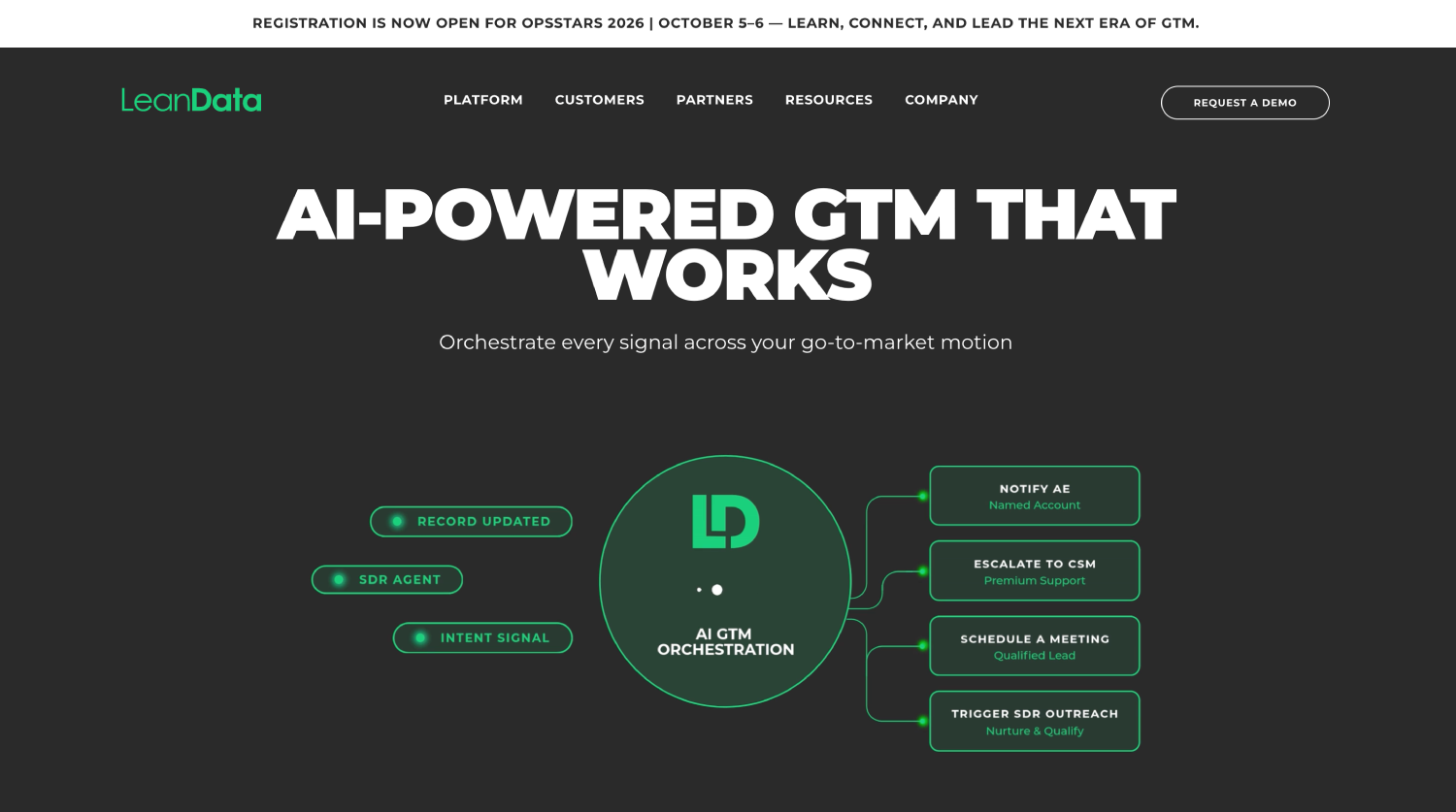
LeanData is a Salesforce-native go-to-market platform built around three functions: lead-to-account matching, lead routing via a visual flow builder, and revenue orchestration across contacts, accounts, and opportunities. It connects a new lead to an existing account record using fuzzy domain matching, firmographic signals, and custom matching logic, then routes that lead to the correct rep based on territory, account ownership, round-robin rules, or rep availability.
Where it falls short depends on your team size. Large enterprise teams with complex account hierarchies, custom territories, and multiple sales segments generally find LeanData’s depth worth the cost. Teams with simpler routing logic, under 50 reps, or without a dedicated MOps admin often find the implementation burden and contract size disproportionate. According to Default’s public pricing analysis, LeanData’s pricing is not publicly disclosed and is typically contract-negotiated, which makes it harder to budget for teams without procurement cycles.
The other structural limitation is flexibility. LeanData’s flow builder is powerful but Salesforce-dependent. Teams running hybrid stacks with HubSpot on top of Salesforce, or teams routing leads from multiple web forms and outbound sequences simultaneously, sometimes find the tool too narrowly scoped to their CRM layer.
The AboutMartech Routing-Fit Test: four checks before you switch
Before evaluating any alternative, run these four checks against your current situation. This framework exists to prevent the common mistake of switching tools to solve a process problem.
Check 1: Matching complexity. Do you need fuzzy account matching across subsidiaries, parent-child hierarchies, and international entities? If yes, you need a purpose-built matching engine, not a routing tool with basic domain matching bolted on.
Check 2: Routing logic depth. Count your active routing rules. If you have fewer than 20 rule paths and no territory overlaps, Salesforce native assignment rules or a lightweight tool will cover it. If you have hundreds of rules with conditional branching, you need a visual flow builder.
Check 3: Stack touchpoints. Does routing need to trigger actions outside Salesforce, such as Slack alerts, Outreach sequences, or calendar links? Tools built around Salesforce flows handle this differently from tools that operate as middleware layers.
Check 4: Admin capacity. Who owns routing maintenance? A team with a full-time Salesforce admin can handle LeanData’s configuration surface. A team where MOps and sales ops share one person needs something that self-manages after setup.
LeanData alternatives comparison: pricing and core capabilities
| Tool | Salesforce Native | Lead-to-Account Matching | Round Robin | Territory Routing | Public Pricing | Best For |
|---|---|---|---|---|---|---|
| Traction Complete | Yes | Yes (advanced) | Yes | Yes | Quote-based | Enterprise Salesforce teams |
| Kubaru | Yes | Yes | Yes | Yes | Quote-based | Mid-market, faster setup |
| LeadAngel | Yes | Yes | Yes | Yes | Starts at $550/month (public page) | Mid-market, price-sensitive |
| Default | Integration | Basic | Yes | Limited | Starts at $900/month (public page) | Inbound-heavy GTM teams |
| Distro | Integration | Basic | Yes | Limited | Starts at $500/month (public page) | Fast inbound routing, lean ops teams |
| Chili Piper | Integration | Limited | Yes | Limited | Starts at $30/user/month (public page) | Inbound scheduling and routing |
| Salesforce Native Rules | Yes | No | Limited | Basic | Included in Salesforce license | Simple routing, no matching needed |
Pricing sourced from each vendor’s public pricing page where available, current as of mid-2025. Quote-based vendors do not disclose contract minimums publicly.
Which tool should replace LeanData for a mid-market Salesforce team?
1. Traction Complete
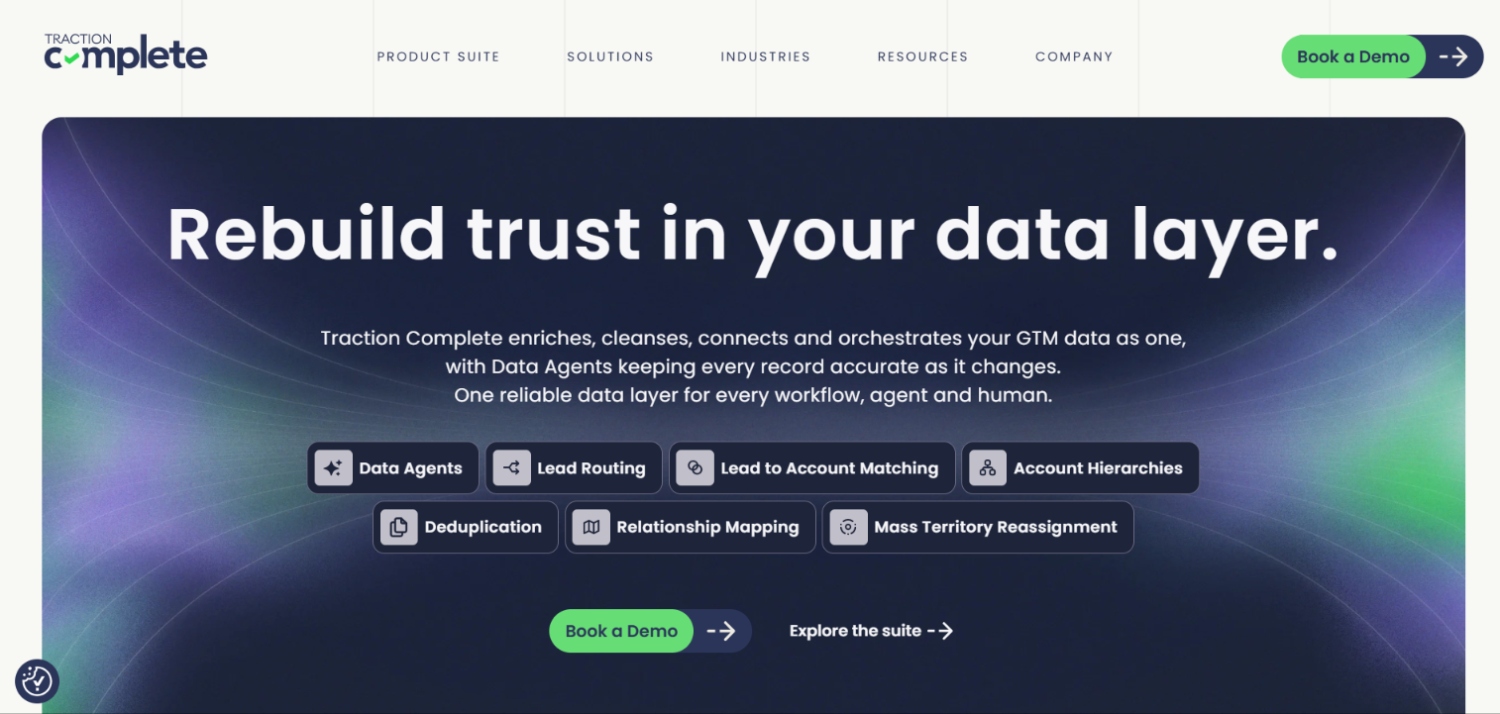
Traction Complete is the closest functional replacement for LeanData across the full feature set. It runs natively in Salesforce as a managed package, covers lead-to-account matching with account hierarchy support, and includes a visual flow builder for routing logic. Implementation is faster than LeanData according to user reviews on G2 and Salesforce AppExchange, partly because it requires less custom configuration to handle standard routing patterns.
The matching engine handles subsidiary relationships and parent-child account structures, which matters for enterprise teams selling into large organizations where a single company operates under a dozen legal entities. Traction Complete does not publicly disclose pricing, so expect a sales conversation. It competes most directly with LeanData at the enterprise segment and is not meaningfully cheaper, but teams report faster time-to-value.
Best for: Salesforce-heavy enterprise teams that want LeanData depth with less implementation friction. Not the right fit if budget reduction is the primary reason you are leaving LeanData.
2. Kubaru
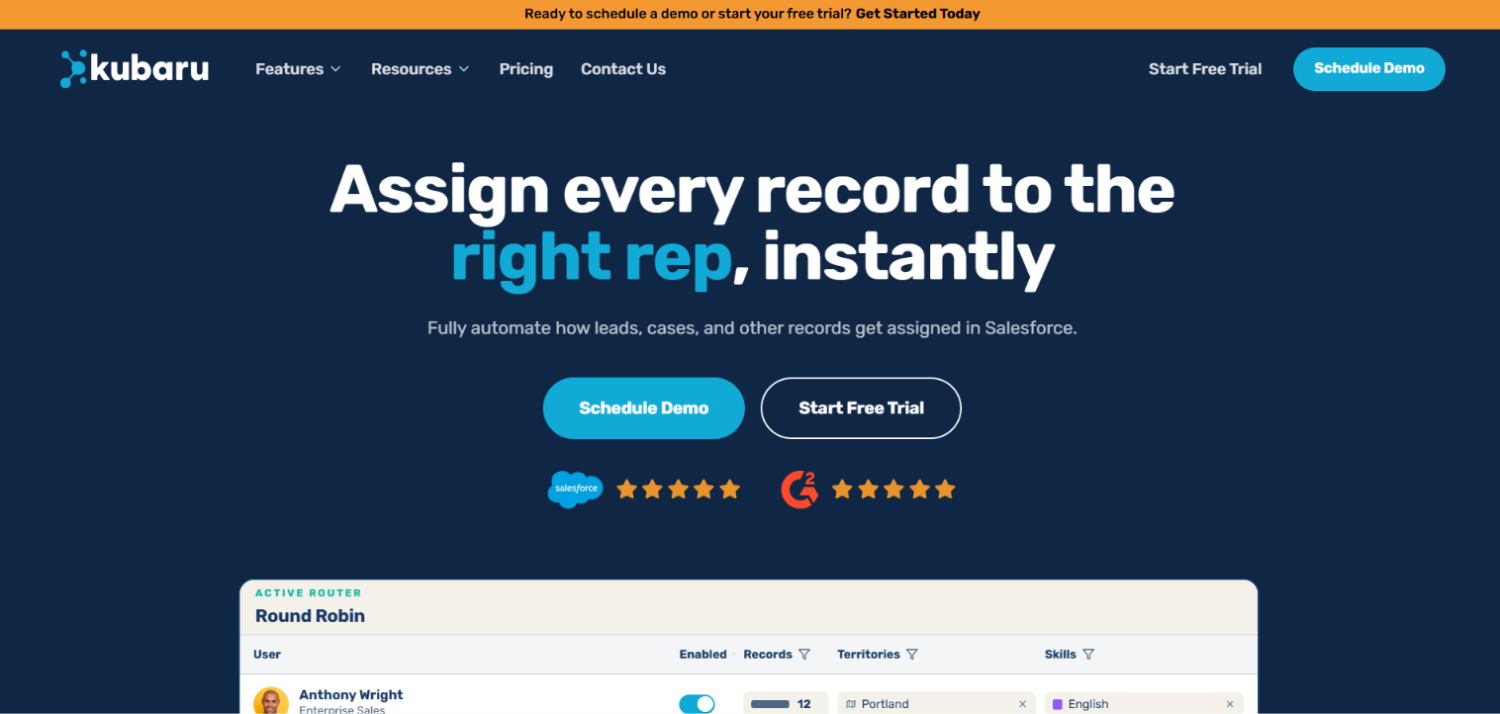
Kubaru is a Salesforce-native routing tool designed for mid-market teams that find LeanData over-engineered. It handles lead-to-account matching, round-robin assignment with rep availability controls, and territory-based routing. The setup time is measurably shorter than LeanData, and the interface is simpler because it does not try to cover enterprise orchestration edge cases.
Consider a B2B SaaS team with 30 account executives, three segments (SMB, mid-market, enterprise), and a basic territory map by region. Kubaru covers that pattern out of the box without requiring a consulting engagement. Where it thins out is in highly complex territory overlays, such as named account lists intersecting with geographic territories across multiple product lines. Pricing is quote-based, but the company positions itself as accessible to teams that would not qualify for LeanData enterprise contracts.
Best for: Mid-market teams with 10 to 100 reps, standard territory structures, and limited MOps capacity.
3. LeadAngel
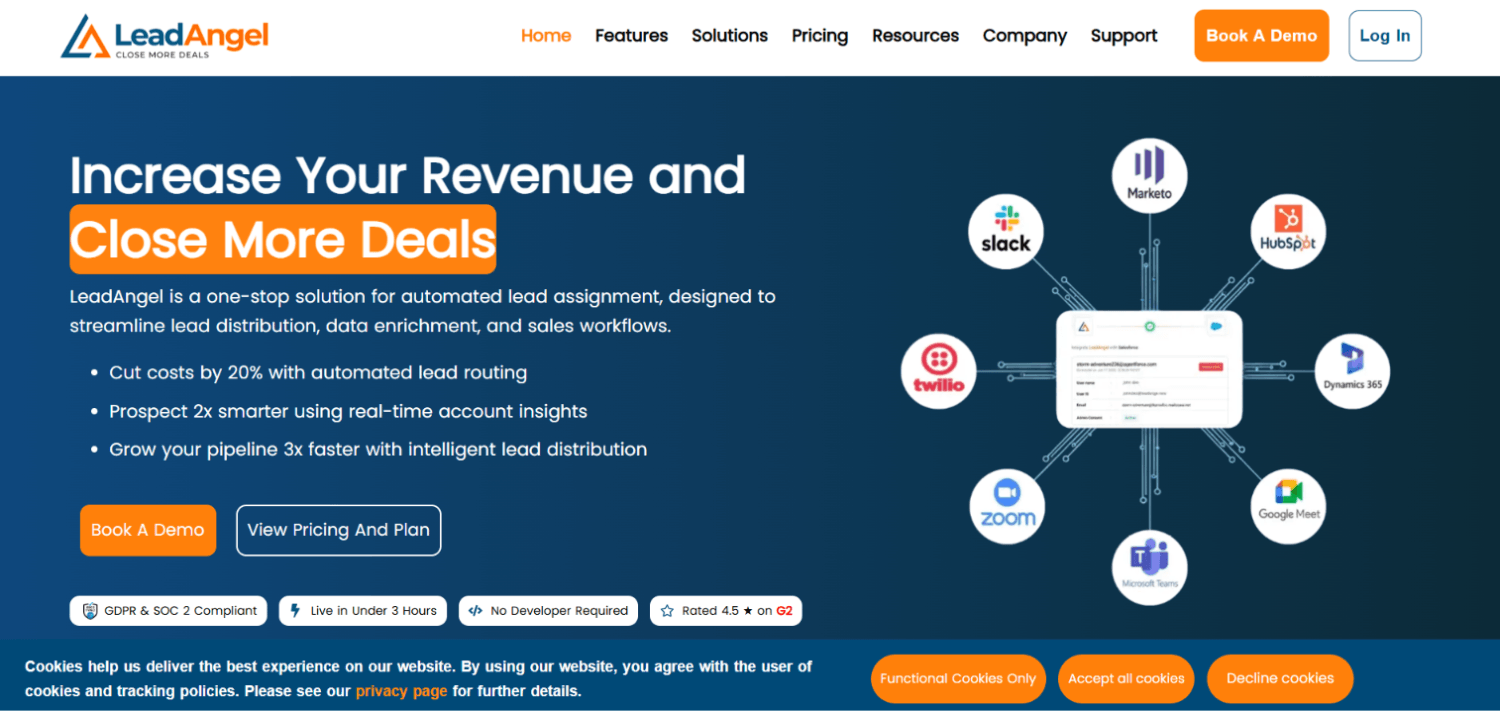
LeadAngel is the most price-transparent option in the matching and routing category. According to its public pricing page, plans start at $550 per month, which makes it one of the few tools in this space with a published entry price. It offers lead-to-account matching, account fuzzy matching, round-robin routing, and territory assignment inside Salesforce.
The trade-off for that price point is configuration depth. LeadAngel’s matching logic is solid for standard cases but has fewer tuning options than LeanData or Traction Complete for edge cases like international subsidiaries or non-standard domain structures. For teams that need matching to work for a clean mid-market account list, that gap rarely shows up in practice. For teams with messy, legacy Salesforce data, it surfaces quickly.
LeadAngel also supports HubSpot, which matters for teams running a hybrid stack where marketing lives in HubSpot and sales works in Salesforce. This lead-to-account matching software comparison covers the technical differences in matching approaches across tools including LeadAngel.
Best for: Price-sensitive mid-market teams with clean data, or teams that need matching across both HubSpot and Salesforce.
4. Default
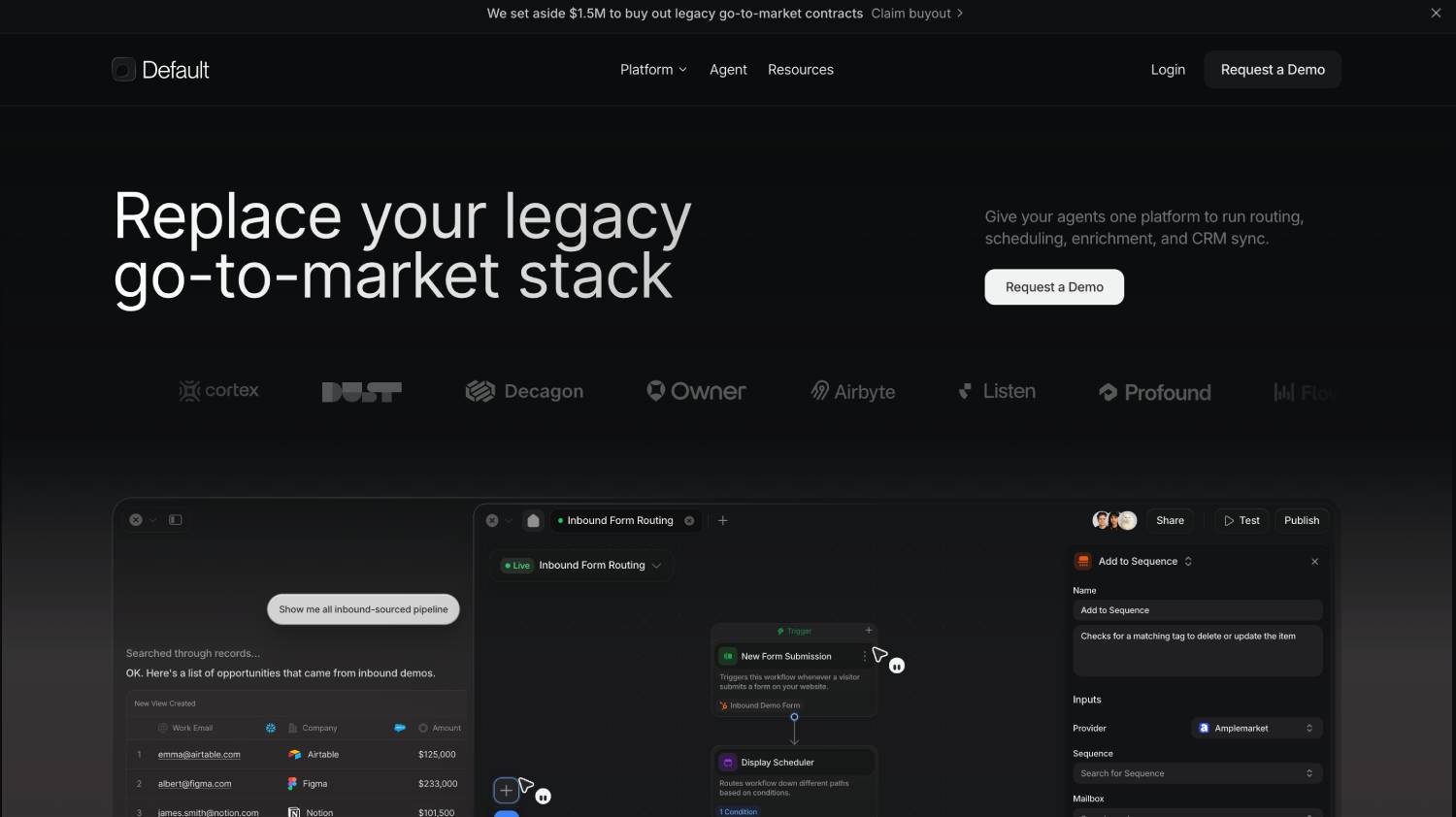
Default approaches routing from the inbound conversion layer rather than the CRM data layer. It captures web form submissions, qualifies them against your ICP criteria in real time, routes the lead to the correct rep, and books the meeting immediately. The Salesforce sync happens after the routing decision, not before.
That architecture makes Default faster for inbound-first teams where speed-to-lead is the metric that matters. It is not a replacement for LeanData’s full orchestration suite. Lead-to-account matching is more basic, and territory logic is less configurable. According to Default’s public pricing page, plans start at $900 per month. The company also publishes a detailed analysis of LeanData’s pricing on its blog, which is worth reading as primary context for what LeanData contracts typically include.
Best for: GTM teams where most routing happens from web forms, demo requests, or inbound SDR sequences, and where live meeting booking is the primary routing outcome.
5. Distro
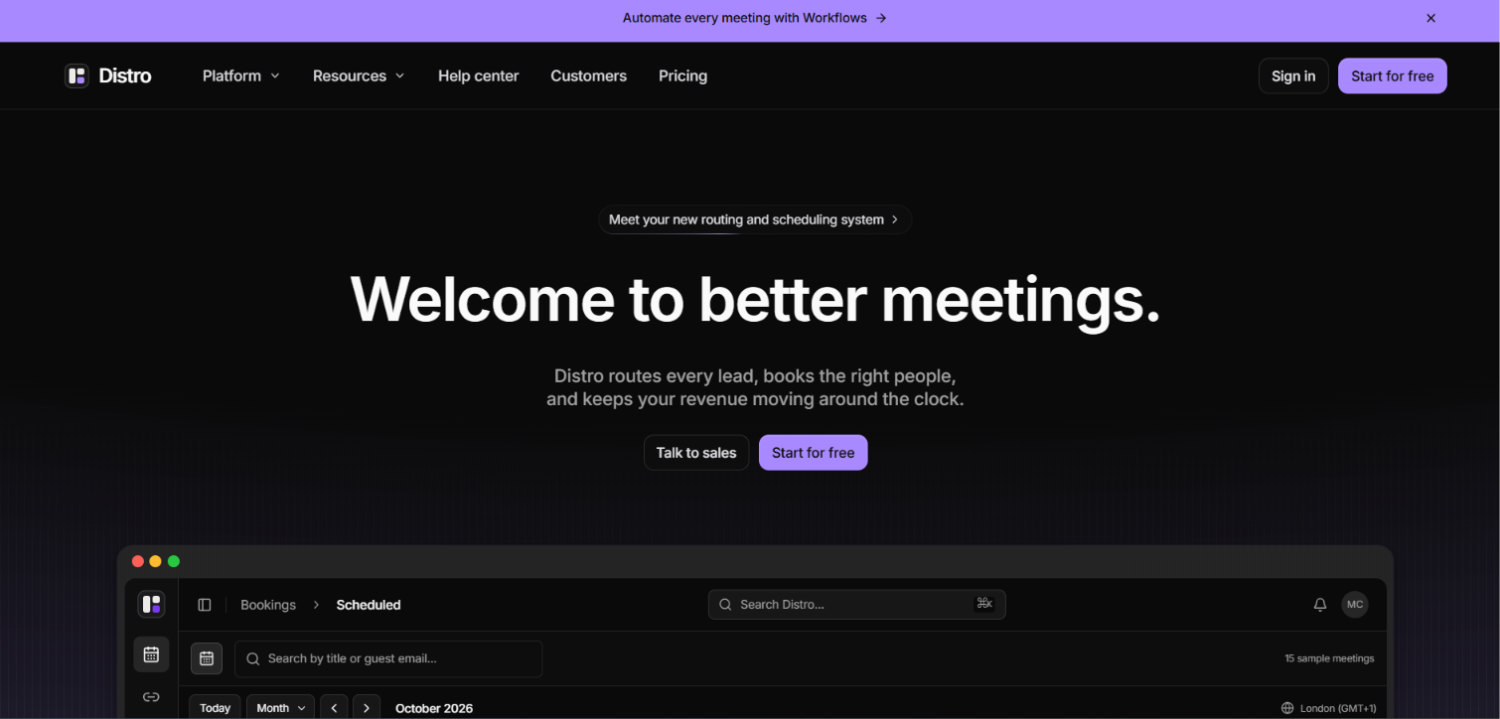
Distro by Salesbricks targets lean RevOps teams that need Salesforce routing logic without Salesforce flow complexity. It uses a no-code rule builder to handle round-robin, territory-based, and criteria-based routing with Salesforce as the system of record. According to its public pricing page, plans start at $500 per month.
Distro’s scope is narrower than LeanData. It does not try to handle complex orchestration across opportunity stages or multi-step sales motions. What it does well is handle inbound lead assignment cleanly, quickly, and without requiring Salesforce admin involvement for each rule change. Marketing ops teams that own routing but cannot write Apex code find this meaningful. The lead-to-account matching is basic compared to purpose-built matching tools.
Best for: Teams with straightforward routing logic that want marketing or sales ops to own routing changes without Salesforce admin tickets.
6. Chili Piper
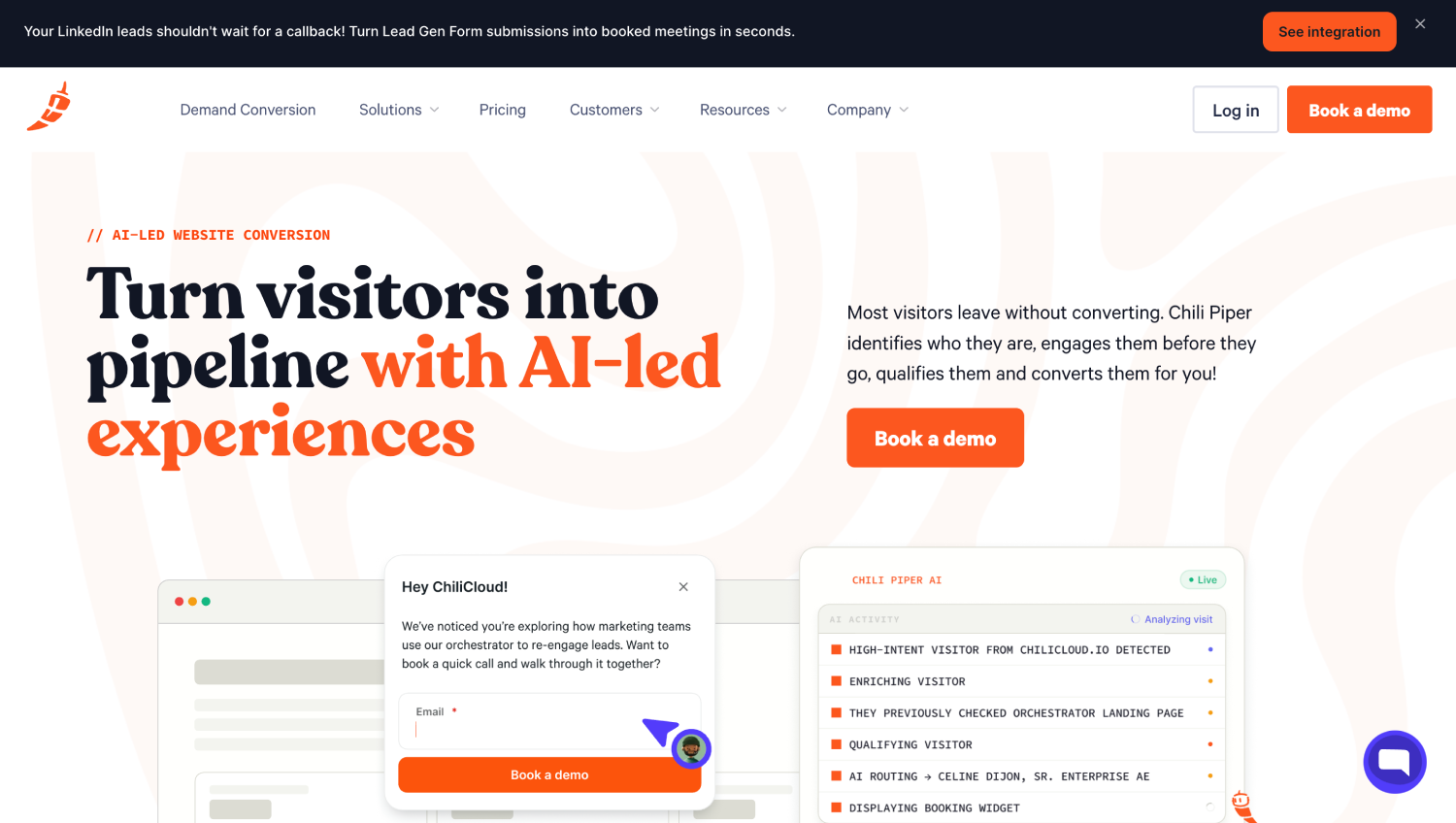
Chili Piper is the most widely known name in this space outside of LeanData, primarily because of its scheduling and inbound conversion product. Its Concierge product handles form-to-meeting routing with round-robin assignment and some territory logic. The Salesforce integration is solid for syncing meeting and routing data.
Chili Piper is not a lead-to-account matching tool and should not be evaluated as a full LeanData replacement. It solves a specific slice of the problem: converting an inbound form fill into a booked meeting with the right rep. Teams comparing it to LeanData are usually coming from a different workflow, specifically one where the bottleneck is inbound conversion speed rather than data matching or territory assignment accuracy. According to its public pricing page, the Concierge product starts at $30 per user per month.
Our detailed breakdown of the LeanData vs Chili Piper comparison covers how the two tools differ architecturally and which use cases fit each.
Best for: Teams that primarily need form-to-meeting routing and are not running complex territory or account-matching workflows.
7. Salesforce Native Assignment Rules
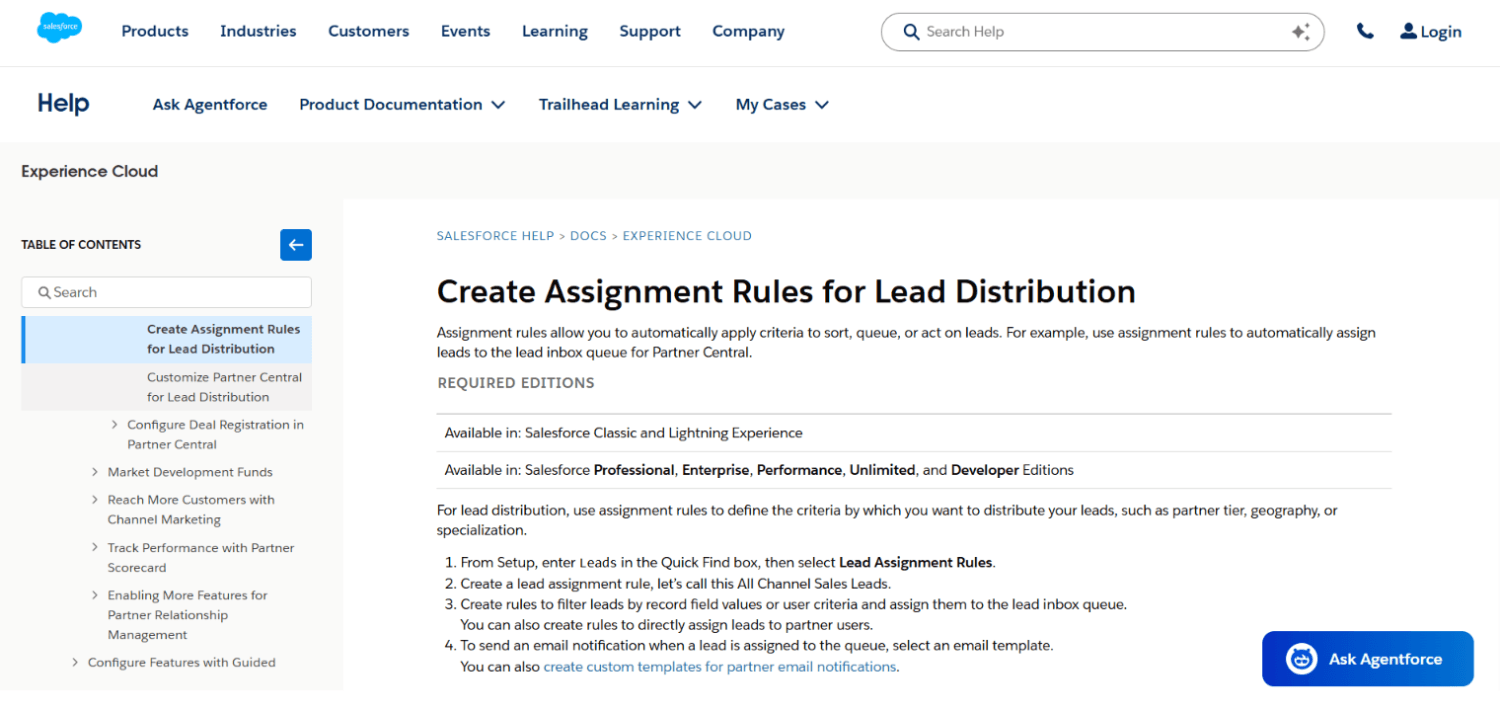
Worth naming explicitly: Salesforce’s built-in lead assignment rules are free with any Salesforce license. They support criteria-based routing (route by industry, company size, geography) and basic round-robin through apex triggers. They do not support lead-to-account matching, cannot handle weighted round-robins natively, and break down with more than a few dozen rules because of performance and maintainability issues.
For teams with a single sales segment, fewer than 10 reps, and no account matching requirement, native rules handle routing without additional cost. The moment a team adds territory complexity, rep availability logic, or needs to match leads to existing accounts and contacts, native rules create technical debt faster than they save money. This is the decision point that pushes most growing teams toward purpose-built tools.
Best for: Early-stage teams (under 10 reps) with simple criteria-based routing and no account matching requirement.
How does lead-to-account matching actually work, and why does accuracy matter?
Lead-to-account matching is the process of comparing a new lead record’s attributes (email domain, company name, phone number, IP address) against existing account records to determine whether the lead belongs to a known company. A match means the lead routes to the account owner. A miss means the lead goes into a generic queue and may never reach the right rep.
Matching approaches fall into two camps. Deterministic matching uses exact signals like verified email domains or account IDs to create a definitive link. Probabilistic matching uses fuzzy logic to score similarity across multiple signals and route based on confidence thresholds. LeanData, Traction Complete, and LeadAngel all use some combination of both. Tools with only domain-based matching fail on personal email addresses, subsidiaries with different domains, and any company that uses a domain inconsistently.
The practical cost of poor matching is MQL-to-SQL leakage. A lead that does not reach the right rep within the expected SLA often loses context, cools off, or gets worked by the wrong rep who lacks the account history to have a productive conversation. For teams running account-based programs, this is the most expensive operational failure in the revenue cycle. The lead enrichment and routing tools guide covers how enrichment data feeds into matching accuracy.
What about the tools that did not make this list?
Several tools appear frequently in competitor lists but serve adjacent categories. Clay is an excellent data enrichment and workflow tool, not a Salesforce routing tool. Adobe Marketo Measure (formerly Bizible) is a B2B attribution platform, not a routing platform. Knock AI addresses buyer intent, not lead assignment. Listing them as LeanData alternatives conflates different problems.
This list also excludes general RevOps suites that include routing as one feature among many. If you are evaluating platforms like Salesloft or Outreach, routing is a secondary consideration. The focus here is single-category tools built specifically to replace LeanData’s core routing and matching functions.
Frequently asked questions about LeanData alternatives
How much does LeanData cost?
LeanData does not publish pricing publicly. Contracts are quote-based and typically negotiated annually. According to analyses published by Default and other vendors, LeanData’s pricing is reported to start at a level that makes it inaccessible for most teams under 50 to 100 seats. Teams evaluating LeanData should request a formal quote and budget for implementation costs alongside license fees, as configuration often requires either LeanData’s professional services team or an outside Salesforce consultant.
Does Salesforce have a built-in lead routing tool?
Salesforce includes native lead assignment rules and Salesforce Flows, which can handle criteria-based routing and basic round-robin assignment. These built-in tools do not support lead-to-account matching, weighted round-robins, or complex territory overlays without significant custom Apex development. For teams with more than two routing conditions or any account-matching requirement, native rules quickly reach their limits and create admin overhead that exceeds the cost of a purpose-built tool.
What is the best LeanData alternative for a mid-market team?
LeadAngel is the strongest mid-market option on price transparency alone, with published plans starting at $550 per month. Kubaru fits mid-market teams that want faster implementation and a simpler interface without sacrificing matching depth. Default suits mid-market teams where inbound conversion speed is the primary metric. The right answer depends on whether your primary gap is matching accuracy, routing rule complexity, or inbound-to-meeting conversion speed.
Can these tools handle lead-to-account matching for complex account hierarchies?
Traction Complete is the strongest option for complex account hierarchies, including parent-child relationships and multi-entity accounts. LeanData handles this natively as well. LeadAngel and Kubaru cover standard hierarchy cases but may require workarounds for deeply nested corporate structures or international subsidiary matching. Default and Distro are not designed for this level of matching complexity and should not be evaluated for that use case.
What is the fastest tool to implement as a LeanData replacement?
Distro and Default have the fastest reported setup times because they do not require deep Salesforce metadata configuration. Both can route inbound leads within days of setup rather than weeks. Traction Complete and Kubaru also report faster implementation than LeanData. LeadAngel’s implementation timeline depends on data quality: clean Salesforce data shortens setup significantly. Any tool replacing a mature LeanData configuration will require rule migration time regardless of the tool’s native simplicity.
Do these tools work with HubSpot as well as Salesforce?
LeadAngel explicitly supports both HubSpot and Salesforce, making it the clearest choice for hybrid stacks. Default and Distro integrate with both CRMs but are more Salesforce-oriented in their core routing logic. Traction Complete and Kubaru are Salesforce-native and do not have equivalent HubSpot products. Teams running a true bi-directional HubSpot-Salesforce stack should verify integration depth directly with each vendor before committing.
Who are LeanData’s main competitors?
LeanData’s closest functional competitors for Salesforce routing and lead-to-account matching are Traction Complete and Kubaru. For inbound-specific routing, Default and Chili Piper are the most cited alternatives. LeadAngel competes on price in the mid-market. Salesforce’s native assignment rules represent the zero-cost baseline. Clay, Marketo Measure, and Outreach are frequently grouped with LeanData in search results but solve different problems entirely.
The right way to think about switching from LeanData
Most teams switching away from LeanData are not leaving because the product is bad. They are leaving because the implementation weight, ongoing admin load, or contract size does not match where they are in their GTM maturity. That means the switch requires honest internal accounting before vendor evaluation: which specific LeanData features are you actually using, which routing rules are active, and how clean is your Salesforce data.
Teams that skip that audit tend to switch tools and recreate the same configuration complexity in a simpler system, then discover the simpler system cannot handle their edge cases. The Routing-Fit Test earlier in this article is designed to catch that before it happens.
For teams that genuinely need LeanData-level depth but want lower cost, Traction Complete is the only realistic option. For everyone else, the field is wider than most teams realize: Kubaru, LeadAngel, Default, and Distro each cover a distinct routing pattern well. The right choice is the one that matches your routing complexity, your Salesforce data quality, and your team’s capacity to maintain configuration after the initial setup is done.