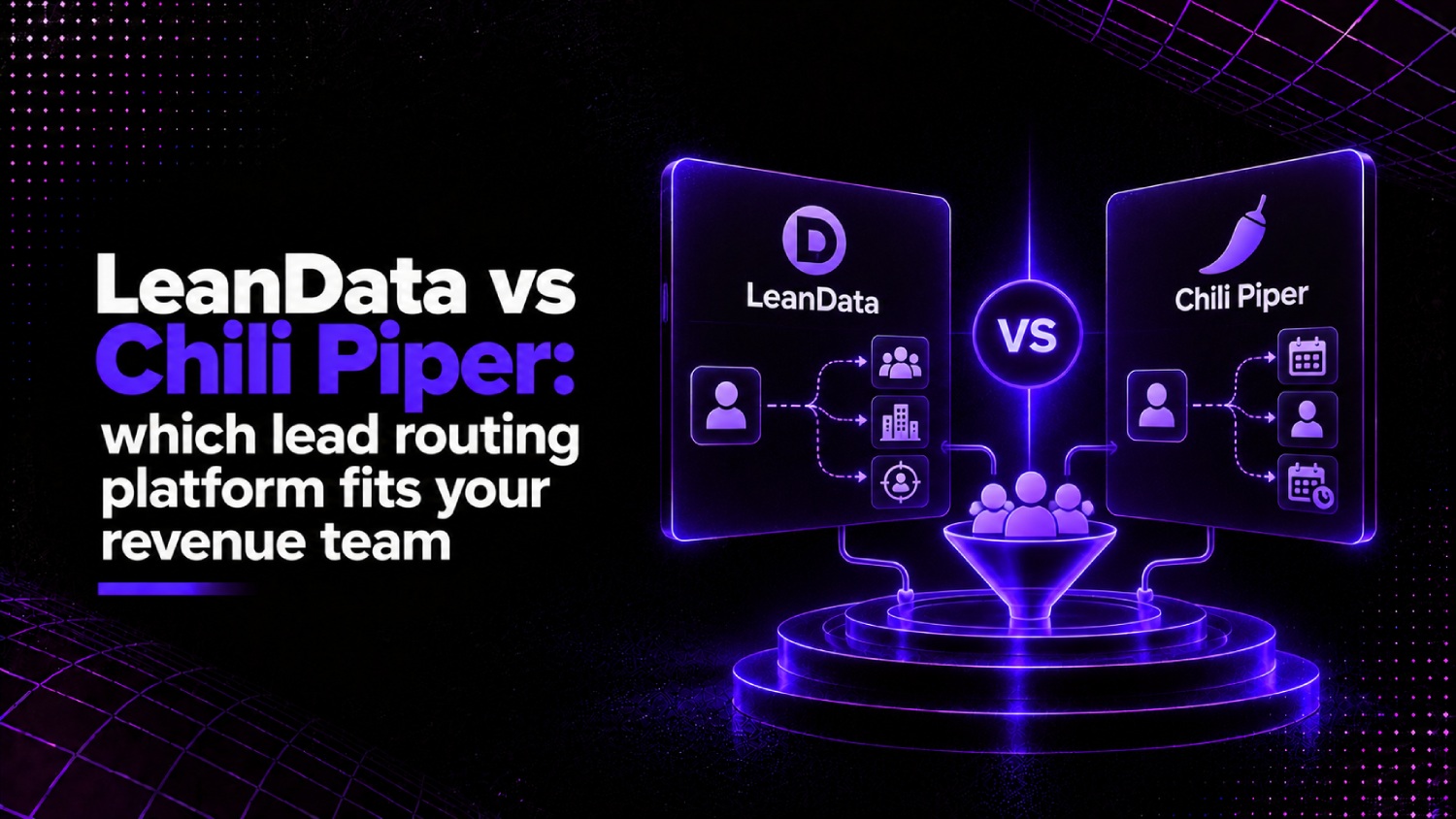
- LeanData and Chili Piper solve different problems: LeanData handles complex account-based routing inside Salesforce; Chili Piper converts inbound web traffic into booked meetings fast.
- If your routing logic depends on lead-to-account matching, territory hierarchies, or multi-object Salesforce workflows, LeanData is the stronger fit.
- If your primary goal is reducing time-to-meeting on inbound demo requests, Chili Piper’s Distro and scheduling layer will outperform LeanData on speed and simplicity.
- Both tools integrate with Salesforce, but their architectures diverge sharply: LeanData is a routing engine first; Chili Piper is a conversion tool with routing added on top.
- Pricing for both is quote-based at meaningful scale, but Chili Piper publishes starter tiers while LeanData requires a direct sales conversation.
LeanData fits Salesforce-heavy revenue teams that need precise lead-to-account matching and complex territory routing. Chili Piper fits inbound-led teams that need web visitors converted into booked sales meetings within minutes. The two products overlap on scheduling and basic assignment, but their core architectures serve different bottlenecks. Buying the wrong one means paying for capability you will not use while missing the one you actually need.
Why Most Teams Get This Choice Wrong
Most RevOps teams shopping this category assume both tools do the same thing: take a lead, assign it to a rep, done. That framing misses the architectural difference that determines which tool actually solves your problem. LeanData’s primary product is a graph-based routing engine that matches leads to accounts inside Salesforce and then executes assignment logic. Chili Piper’s primary product is a meeting-scheduling layer that sits on top of your web forms and converts inbound intent into calendar holds.
The overlap is real but narrow. Both tools can route leads and book meetings. But LeanData built its product for the complexity that shows up inside a Salesforce org with a real account hierarchy, and Chili Piper built its product for the speed that shows up when a prospect fills out a demo form at 2 p.m. and your sales team needs them on a call before 5.
Teams evaluating lead enrichment and routing tools for RevOps often conflate routing sophistication with scheduling speed. These are separate problems requiring separate architectural decisions.
What Does LeanData Actually Do?
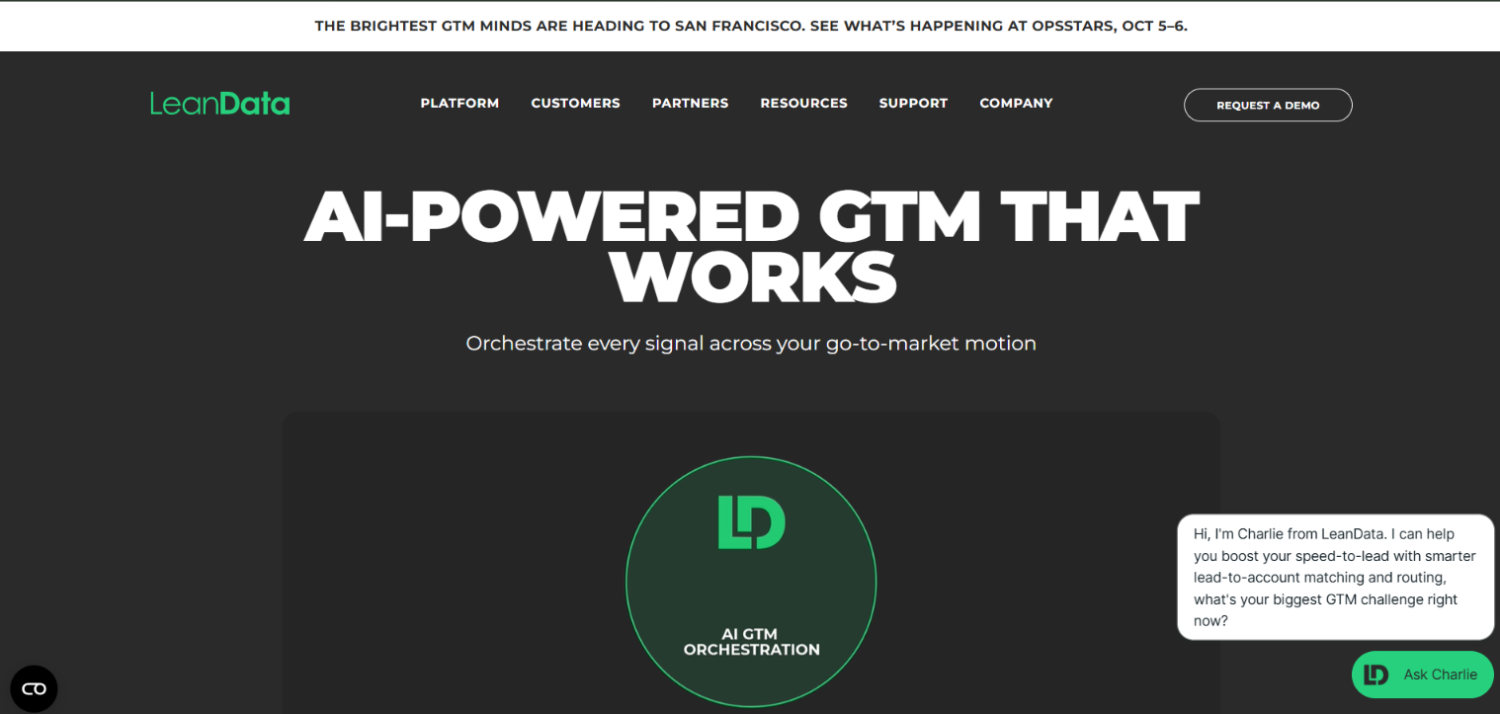
LeanData routes leads, contacts, accounts, and opportunities inside Salesforce using a visual flowchart builder. The core differentiator is lead-to-account matching: when a new lead arrives, LeanData identifies which existing account it belongs to, checks ownership, applies territory or segment logic, and routes it to the correct owner without manual intervention.
This matters because Salesforce’s native lead assignment rules are flat. They work on single-field conditions and ignore the relational data that actually determines who should own a record. LeanData replaces that with a multi-step graph traversal that checks account ownership, opportunity stage, existing contact ownership, and territory definitions before making an assignment decision.
LeanData’s routing flows support round-robin assignment with load balancing, weighted distribution, and overflow logic. The platform also includes a meeting scheduling product called Bookit, which surfaces rep availability on landing pages and inbound flows. Users on TrustRadius have noted that Bookit effectively replaced Chili Piper for teams already using LeanData for routing, consolidating both functions in one vendor
Where LeanData Shows Its Limits
LeanData’s UI has drawn consistent criticism. Multiple G2 and TrustRadius reviewers describe the flow builder as slow to load and difficult to edit for users who are not deeply familiar with the Salesforce data model. Changes to routing logic require careful testing in a sandbox environment, and the learning curve is steeper than Chili Piper’s newer Flow Builder interface.
The platform also requires meaningful Salesforce admin involvement to set up correctly. Teams without a dedicated MOps or RevOps resource will struggle to extract full value from the more advanced matching and routing configurations.
What Does Chili Piper Actually Do?

Chili Piper is best understood as two distinct products: Distro (lead routing) and Concierge (inbound scheduling). Distro routes form submissions, CRM records, and inbound signals to the right rep using rule-based logic. Concierge embeds a scheduling interface directly into web forms so a prospect can book a meeting with a qualified rep the moment they submit a demo request.
The conversion-speed premise is Chili Piper’s sharpest competitive edge. A prospect who fills out a form and immediately sees available calendar slots from the rep assigned to their territory is far more likely to book than one who gets an email 20 minutes later. Chili Piper’s entire UX is optimized around eliminating that delay.
Chili Piper released Distro 3.0 with a Flow Builder that reviewers consistently describe as more intuitive than LeanData’s routing canvas. For teams whose routing logic maps cleanly to form source, firmographic field, or territory assignment without deep account-hierarchy traversal, this matters a great deal. Building and iterating logic is genuinely faster in Chili Piper’s interface.
Where Chili Piper Shows Its Limits
Chili Piper’s account-based routing is shallower than LeanData’s. The platform does not perform native lead-to-account matching at the depth LeanData does. Teams with complex Salesforce account hierarchies, named accounts, or large partner channel structures will hit the ceiling of Chili Piper’s routing logic before LeanData users do.
Customer support has also been a recurring complaint. Multiple reviews on G2 and TrustRadius cite slow response times and difficulty getting routing issues resolved. For a product that sits on top of your inbound conversion flow, support latency is a meaningful operational risk.
LeanData vs Chili Piper: Feature-by-Feature Comparison
| Capability | LeanData | Chili Piper |
|---|---|---|
| Lead-to-account matching | Native, deep graph traversal | Basic, rule-based |
| Salesforce-native routing | Core product architecture | Integration via Salesforce connector |
| Inbound scheduling (web forms) | Bookit (add-on) | Concierge (core product) |
| Lead routing engine | Visual flow builder (complex, Salesforce-first) | Distro Flow Builder (simpler, faster iteration) |
| Round-robin with load balancing | Yes, with weighted distribution | Yes |
| Territory-based routing | Yes, including hierarchy support | Yes, rule-based |
| Account hierarchy awareness | Strong | Limited |
| UI complexity | High (Salesforce admin recommended) | Medium (RevOps self-service possible) |
| Calendar integration | Google Calendar, Outlook | Google Calendar, Outlook |
| HubSpot support | Limited (Salesforce-first) | Yes |
| Public pricing | No (quote-based) | Partial (starter tiers listed) |
How Much Does LeanData vs Chili Piper Cost?
LeanData’s pricing is not publicly disclosed. The company requires a demo and direct sales engagement before sharing numbers. Based on public G2 and TrustRadius reviews, LeanData positions as an enterprise and mid-market product, and pricing reflects that. Teams should budget for a platform that sits above starter-tier MarTech in cost.
Chili Piper publishes partial pricing. Concierge (the inbound scheduling product) starts at $30 per user per month on their public pricing page as of the time of writing. Distro (the routing product) is separately priced and generally requires a sales conversation for team-level packages. Their Fire starter tier for Concierge gives small teams a relatively low-friction entry point.
For teams evaluating the full RevOps tooling picture, the nine best RevOps tools for revenue operations covers how routing software fits into the broader stack alongside CRM, attribution, and customer success platforms.
The AboutMartech Routing Fit Matrix: Matching Architecture to Bottleneck
Feature comparisons tell you what each tool can do. The more useful question is which tool’s architecture matches the actual constraint in your pipeline. The Routing Fit Matrix below runs four diagnostic checks. Each one targets a specific point where the wrong tool choice creates configuration debt rather than revenue impact, and where the right choice resolves friction that no amount of process change can fix manually.
Check 1: Where is the lead volume coming from? If the majority of leads arrive through inbound web forms (demo requests, contact forms, trial signups), Chili Piper’s Concierge layer will generate the most immediate impact. If leads arrive through outbound sequences, field events, or partner channels where account matching is the problem, LeanData addresses the actual constraint. This check matters because both tools can technically route a form submission, but only one of them resolves the conversion gap that happens before the assignment even runs.
Check 2: How complex is your account hierarchy in Salesforce? Named account lists, parent-child account relationships, and territory hierarchies with multiple ownership layers all require LeanData-level matching logic. Flat CRM structures with straightforward assignment rules do not. A team with 2,000 named accounts and three ownership tiers will generate routing failures in Chili Piper that never appear in its demo environment.
Check 3: Who owns routing configuration? Chili Piper’s Distro can be managed by a RevOps generalist with basic Salesforce familiarity. LeanData’s advanced flows benefit from a dedicated Salesforce admin or a MOps specialist who understands the object model deeply. This is not a knock on either tool, it is a staffing reality that most purchase decisions ignore until six weeks into implementation.
Check 4: Is scheduling-to-meeting conversion your primary metric? If your pipeline leak is between form fill and first meeting held, Chili Piper’s inbound scheduling layer directly addresses that conversion gap. If your pipeline leak is between MQL creation and correct rep assignment, LeanData’s routing engine addresses that gap. Running this check against your actual pipeline data, rather than intuition, is what separates teams that get ROI quickly from teams that spend three quarters rationalizing a mis-bought platform.
Which Teams Should Choose LeanData for Salesforce Routing?
LeanData is the right pick for Salesforce-heavy revenue teams running account-based plays. The ideal buyer is a B2B SaaS company with 50-plus sales reps organized into territories, a named account program, or a meaningful number of existing accounts in CRM where lead-to-account matching failures create revenue leakage.
Consider a mid-market SaaS company with 80 AEs organized across three segments (SMB, Mid-Market, Enterprise), a list of 2,000 named accounts, and inbound volume coming from multiple sources including paid, organic, and partner referrals. When a new lead arrives with a company domain that matches an existing Salesforce account, LeanData identifies the account, checks which AE owns it, confirms the territory assignment, and routes the lead accordingly in one automated sequence. Chili Piper would not perform that multi-step account hierarchy check natively.
LeanData also makes sense for teams that already have Bookit licensed and want to consolidate scheduling into one vendor. Several TrustRadius reviewers explicitly noted making this switch and finding routing management simpler with a single platform.
Which Teams Should Choose Chili Piper for Inbound Conversion?
Chili Piper wins for inbound-led teams where the primary business problem is time-to-meeting. The prototypical buyer is a growth-stage B2B SaaS company driving significant demo request volume through paid search and content, where the sales team is losing pipeline because follow-up takes too long after form submission.
Say a team generates 400 inbound demo requests per month from a $150K annual paid search budget. If 30% of those requests never convert to a first meeting because of scheduling friction, fixing that conversion rate is worth more than optimizing routing logic. Chili Piper’s Concierge product directly attacks that conversion gap by letting prospects book immediately, eliminating the SDR follow-up lag entirely.
Chili Piper also has stronger HubSpot support, which matters for teams not running Salesforce as their primary CRM. LeanData is built almost entirely around the Salesforce data model, and teams on HubSpot will find the integration shallow by comparison.
For teams evaluating whether their current stack needs routing, scheduling, or a combination of both, the broader context on marketing attribution tools that connect pipeline to revenue clarifies how routing decisions affect attribution accuracy downstream.
What About Teams That Need Both Account Routing and Inbound Scheduling?
This is the real question for most mature revenue teams, and the honest answer is that neither tool is a perfect substitute for the other. LeanData with Bookit comes closest to a single-platform answer for Salesforce-first teams. Chili Piper with Distro plus Concierge comes closest for inbound-first teams that also need some routing logic.
A third option, often overlooked, is running LeanData for routing and Chili Piper for scheduling in parallel. The two products are not mutually exclusive, and some teams run LeanData to handle lead-to-account matching and territory assignment while using Chili Piper’s Concierge specifically for the web-to-meeting conversion layer. This adds vendor overhead but gives each function the purpose-built architecture it needs. The seven inbound lead routing tools worth switching to covers other scheduling and routing options if neither LeanData nor Chili Piper fits cleanly.
Frequently Asked Questions
Is LeanData better than Chili Piper for Salesforce?
For Salesforce-specific use cases, yes. LeanData is purpose-built around the Salesforce data model and performs lead-to-account matching, territory hierarchy routing, and multi-object assignment logic that Salesforce’s native assignment rules cannot handle. Chili Piper integrates with Salesforce but its core architecture is not Salesforce-native in the same way. Teams running complex account-based programs in Salesforce will find LeanData’s routing depth meaningfully superior.
How much does Chili Piper cost?
According to Chili Piper’s public pricing page, the Concierge product (inbound scheduling) starts at $30 per user per month. The Distro product (lead routing) is separately priced and typically requires a sales conversation for team-level packages. Pricing scales with seat count and product modules. Teams should request a full quote for any deployment covering more than a handful of users, as bundled pricing differs from per-user list rates.
Can Chili Piper replace LeanData for lead routing?
For simple routing rules based on form field values, territory assignment, or round-robin distribution, Chili Piper Distro can handle most of what teams need. For complex account-based routing that requires lead-to-account matching against existing Salesforce records, parent-child account hierarchies, or multi-object ownership lookups, Chili Piper falls short. The gap is architectural: Chili Piper does not traverse the Salesforce account graph the way LeanData does.
What is Chili Piper Distro?
Chili Piper Distro is the company’s standalone lead routing product, separate from its Concierge scheduling tool. Distro routes inbound form submissions, CRM records, and marketing-qualified leads to the correct sales rep based on rules defined in its Flow Builder interface. Distro 3.0 introduced a visual flow builder that reviewers describe as significantly more intuitive than earlier versions. It supports round-robin assignment, territory-based routing, and basic account ownership checks.
Does LeanData work without Salesforce?
LeanData is built almost entirely for Salesforce. Its lead-to-account matching, routing flows, and data model all assume Salesforce as the system of record. Teams running HubSpot as their primary CRM will find LeanData’s native integration limited and will likely get better results from Chili Piper or an alternative routing tool designed for HubSpot’s data model.
Which is better for inbound demo requests, LeanData or Chili Piper?
Chili Piper. Its Concierge product is specifically designed to embed scheduling into the moment of inbound intent, letting a prospect book a meeting directly from a demo request form without SDR follow-up. LeanData’s Bookit product handles inbound scheduling but it is an add-on to a routing platform, not the core product. For teams whose primary metric is inbound form-to-meeting conversion rate, Chili Piper’s architecture is the better fit.
What lead routing tools compete with both LeanData and Chili Piper?
The main alternatives in this category include Default, Salesloft’s routing capabilities, Calendly for lightweight scheduling, and some newer entrants building routing natively on HubSpot. For RevOps teams evaluating the full category, the best lead enrichment and routing tools for RevOps teams covers the competitive set in more depth, including how enrichment data affects routing accuracy.
The Sharpest Way to Frame This Decision
Both tools exist because Salesforce’s native assignment rules are too primitive for modern revenue teams, and email follow-up is too slow for modern buyers. LeanData solved the first problem. Chili Piper solved the second. The fact that both added features to address each other’s core use case does not mean they converged; it means each company expanded into adjacent territory while remaining strongest on its own home turf.
The mistake teams make is buying the tool with the better demo rather than the tool that solves the actual constraint. If your CRM has routing chaos because leads land on the wrong rep or never match to existing accounts, no amount of scheduling optimization will fix your pipeline. If your SDRs are doing heroic follow-up work but prospects are still ghosting because the window closed, no amount of routing sophistication will fix your conversion rate.
Running the Routing Fit Matrix honestly, against your actual data and your actual team, will produce a clearer answer than any feature comparison. For most teams with a mature Salesforce org and account-based motion, LeanData is the infrastructure decision. For most teams with a high-volume inbound motion and a conversion rate problem, Chili Piper is the conversion decision. Those are different categories of problem, and the market has given you a different tool for each.
Teams who want to understand how routing decisions ripple into attribution accuracy should also review how B2B attribution tools for long sales cycles handle multi-touch credit when lead ownership changes between routing and opportunity creation. Getting attribution right downstream depends on getting routing right upstream, and that dependency runs in both directions.