
- Most AI SEO tools are content spinners dressed up as strategy platforms. The ones worth paying for automate the research, structure, and optimization work that used to require a two-person team.
- For a solo marketer or a team of two, the right tool is whichever one collapses the most steps: keyword research, brief creation, content grading, and technical audit in a single workflow.
- Surfer SEO and Frase are the strongest end-to-end picks for lean teams on a budget. Clearscope wins for content quality scoring. Semrush and Ahrefs are still the best if your real need is competitive intelligence, not writing assistance.
- AI-generated content without AI-driven optimization is still a liability. These tools matter most when they grade output, not just produce it.
- GEO (Generative Engine Optimization) is now a real consideration alongside traditional SEO. Several tools on this list are beginning to address AI search visibility, but most are not there yet.
The best AI SEO tools for lean teams are Surfer SEO, Clearscope, Frase, Semrush, Ahrefs, NeuronWriter, MarketMuse, Alli AI, and BrightEdge. Each replaces a different slice of the traditional SEO workflow. Surfer and Frase are the strongest all-in-one picks for a solo marketer. Clearscope is the clearest choice for content quality. Semrush and Ahrefs remain the default for keyword and competitive research at any team size.
Why most AI SEO tools fail lean teams (and what the good ones do differently)
A one-person marketing team does not have a content manager, an SEO specialist, and a technical analyst. They have one person who has to be all three. That is the actual problem these tools need to solve, and most of them do not.
The typical AI SEO tool pitch goes like this: paste a keyword, get an outline, generate a draft, publish. That workflow produces content that reads like content. Google has been downranking exactly this kind of output since the Helpful Content updates, and AI Overviews are accelerating the pressure. Thin, generic articles that used to rank on volume now get absorbed into an AI summary or pushed below the fold entirely.
What separates the tools on this list from the noise is a specific capability: they close the loop between research and grading. They do not just help you write faster. They tell you whether what you wrote is likely to rank, and why. That feedback loop is what replaces the SEO strategist that a lean team cannot afford to hire.
One more thing to flag before the list: if you are also thinking about visibility in ChatGPT, Perplexity, and Google’s AI Overviews, that is a different discipline called GEO (Generative Engine Optimization). The tools here address traditional search engine rankings primarily. For AI citation tracking and GEO strategy, the best AEO and GEO tools are a separate category worth evaluating in parallel.
The AboutMartech Workflow-Replacement Test: how we evaluated these tools
Every tool on this list was evaluated against what we call the Workflow-Replacement Test: four questions that determine whether a tool genuinely reduces headcount dependency or just adds another tab to your browser.
- Brief collapse: Does it turn a keyword into a complete content brief without manual research? A brief includes intent analysis, competitor gaps, required subtopics, and a target word count.
- Grade on publish: Does it score content against real ranking signals, not just keyword density? Tools that only count mentions are not grading anything meaningful.
- Technical surface: Does it flag on-page and technical issues without requiring a separate Screaming Frog crawl or a developer?
- Iteration speed: How fast can a single marketer move from keyword to optimized draft? Under two hours is the benchmark for a tool that actually replaces workflow rather than adding to it.
No tool on this list scores perfectly on all four. But every tool earns its spot by scoring high on at least two, and the picks are ordered to reflect what a lean team typically needs most.
Which AI SEO tools actually replace workflows for a lean team?
| Tool | Best for | Brief collapse | Content grading | Technical audit | Starting price |
|---|---|---|---|---|---|
| Surfer SEO | End-to-end content + optimization | Yes | Yes (Content Score) | Partial | $99/mo (public pricing) |
| Clearscope | Content quality and editor workflow | Partial | Yes (A to F grading) | No | $199/mo (public pricing) |
| Semrush | Competitive research + full suite | Yes (via ContentShake AI) | Yes (On Page Checker) | Yes (Site Audit) | $139.95/mo (public pricing) |
| Ahrefs | Keyword research + backlink data | Partial | Partial | Yes (Site Audit) | $129/mo (public pricing) |
| Frase | Budget-conscious brief + draft | Yes | Yes | No | $45/mo (public pricing) |
| NeuronWriter | Semantic NLP optimization | Yes | Yes (NLP scoring) | No | $23/mo (public pricing) |
| MarketMuse | Content authority and topic modeling | Yes | Yes (Topic Authority) | No | $149/mo (public pricing) |
| Alli AI | Technical SEO automation at scale | No | No | Yes (bulk auto-fix) | $299/mo (public pricing) |
| BrightEdge | Enterprise reporting + AI recommendations | Partial | Yes | Yes | Quote-based |
Surfer SEO: best all-in-one pick for a lean content team
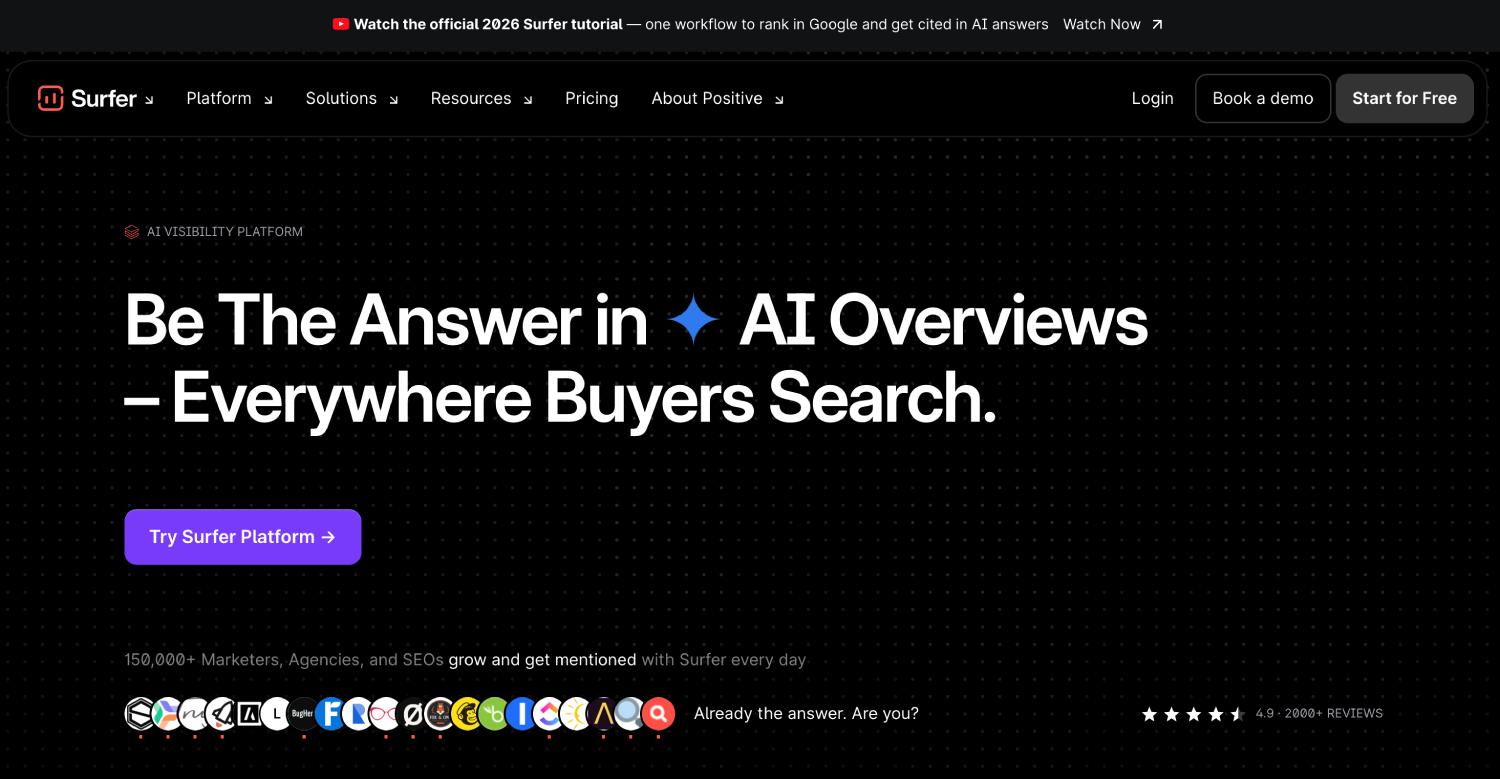
Surfer SEO is the closest thing to a full SEO content workflow in a single tool. From a keyword, it generates a brief with recommended headings, NLP-driven term suggestions, and a real-time Content Score that updates as you write. The score is built on a comparison against the top-ranking pages for that query, not a fixed rubric.
The Surfer AI writer can generate a full draft from a brief in one click, though the raw output needs editing before it resembles something a person would actually read. Where Surfer earns its place for lean teams is the editor: a solo marketer can open the editor, write or paste content, and see exactly which semantic terms are missing and which sections need more depth. That eliminates the feedback cycle that normally requires an SEO strategist to review the draft.
At $99 per month on the Essential plan (as of Surfer’s public pricing page), it is not cheap for a two-person team, but it is the price of one hour of a freelance SEO consultant per month. The value calculation is straightforward. The main limitation is technical SEO: Surfer does not crawl your site or flag broken links, so you will still need a lightweight audit tool alongside it.
Clearscope: best for content grading and editor integration
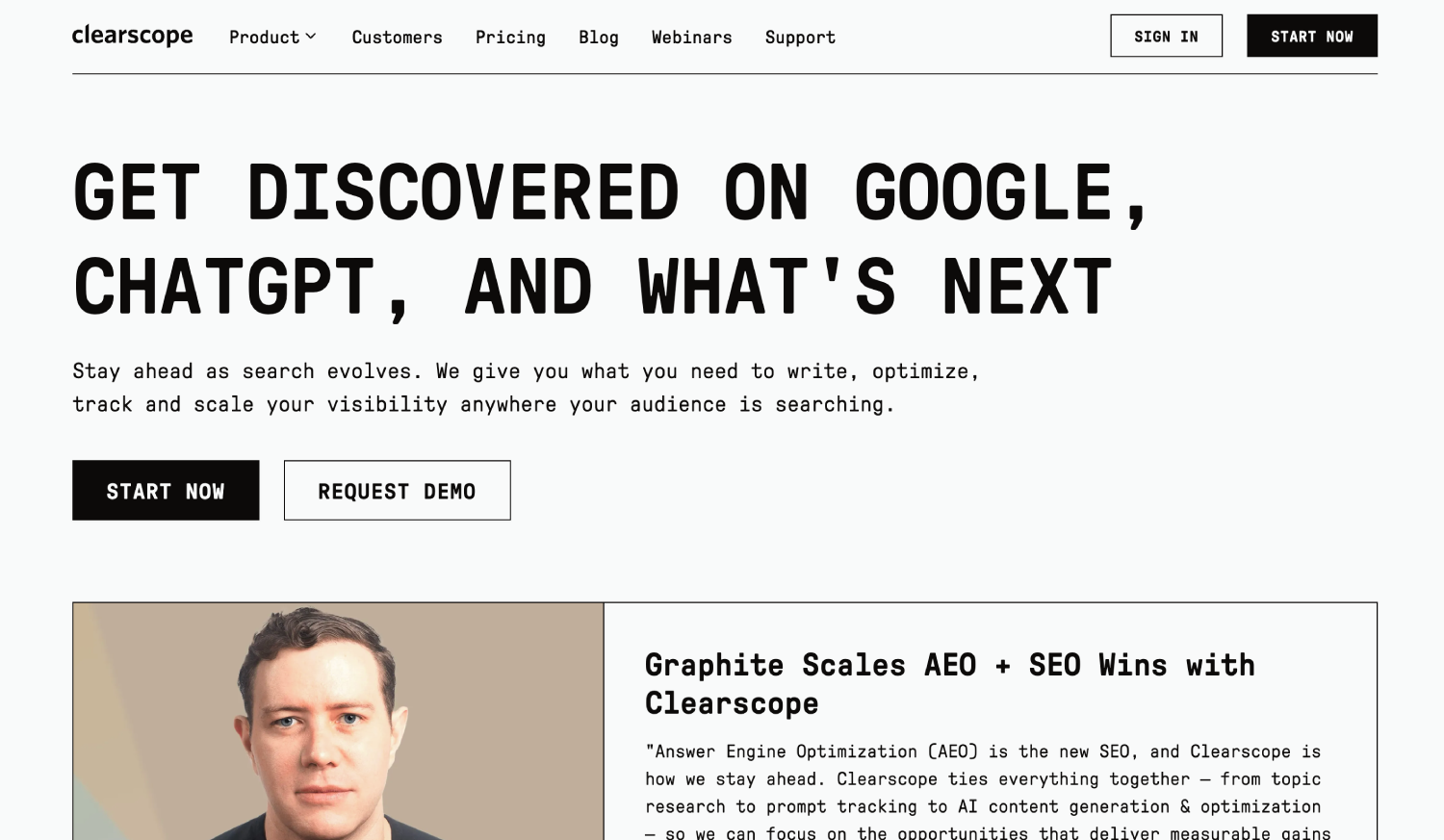
Clearscope does one thing exceptionally well: it tells you how good a piece of content is relative to what is ranking. The grading system runs from D to A+, based on term usage, readability, and word count benchmarks derived from the current SERP. That grade is not a vanity metric. Pages that score at A or above on Clearscope consistently outperform those that do not, according to case studies published by the company.
Clearscope integrates directly with Google Docs and WordPress, which matters more than it sounds. A lean team’s content process usually lives in Google Docs. Having the grade visible in the same window where the writer is working eliminates the copy-paste loop between a separate grading tool and the draft.
The $199 per month starting price is the main friction point. Clearscope does not include a built-in AI writer, so you are paying for the research and grading layer only. For a team that already uses a separate drafting tool, that specialization is a feature. For a team that needs everything in one place, Surfer or Frase will go further at a lower price.
Semrush: best if competitive intelligence matters as much as content
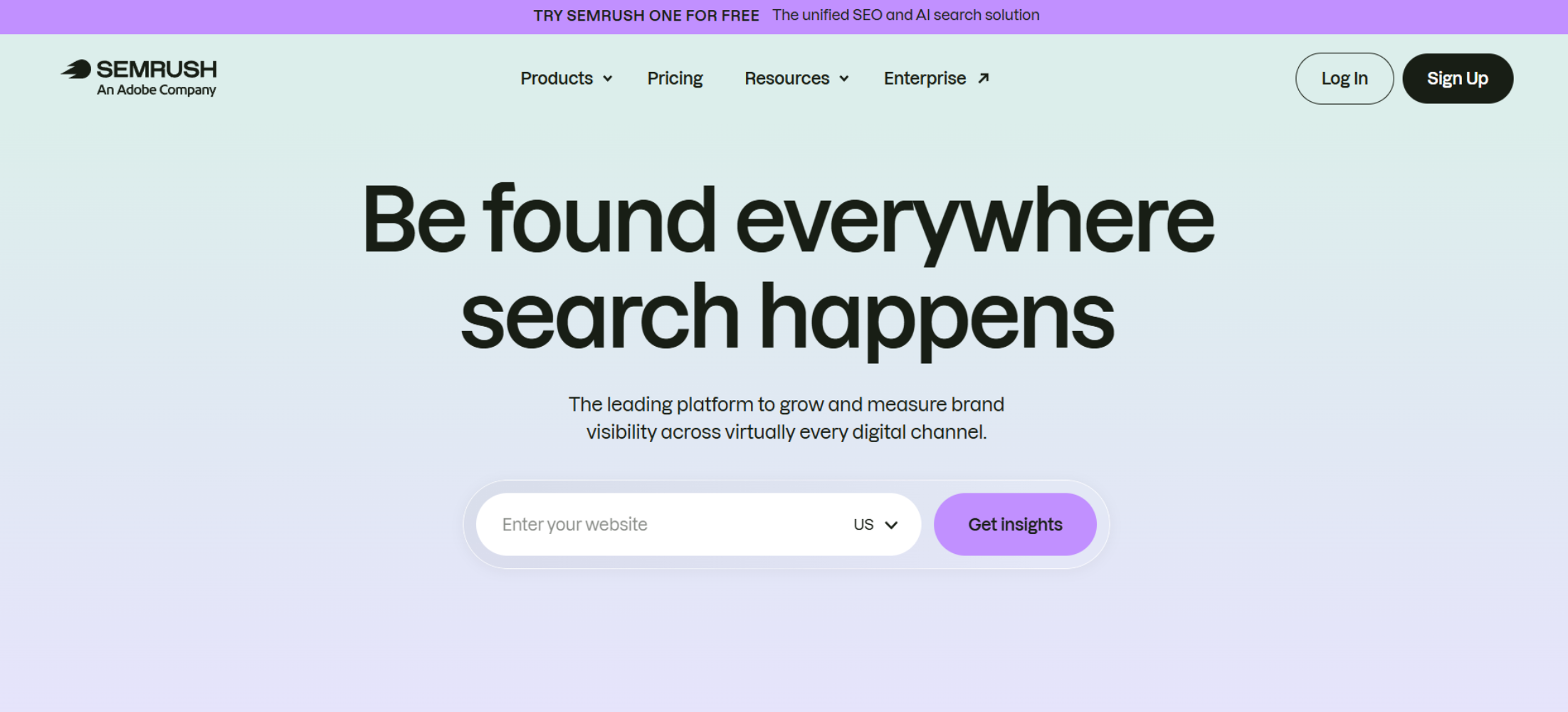
Semrush is the broadest platform on this list. The keyword research database, the backlink gap analysis, the position tracking, and the on-page audit are all among the strongest in their category. The addition of ContentShake AI means a lean team can move from keyword research to AI-assisted draft within the same platform, which reduces context-switching significantly.
The honest caveat: Semrush is designed for teams that have someone who can actually use all of it. A solo marketer will find large portions of the platform sitting idle. The Pro plan at $139.95 per month gives access to the core research tools, but ContentShake AI is an add-on. If your primary need is content workflow rather than competitive research, Semrush charges you for capabilities you may not touch for months.
It earns a place on this list because for growth teams that are actively running competitor keyword gap analysis, tracking rank movements, and building links, there is no single-platform alternative that covers all three at the same depth. If you need all of that, paying for three separate tools costs more than Semrush does.
Ahrefs: best for keyword research and backlink analysis
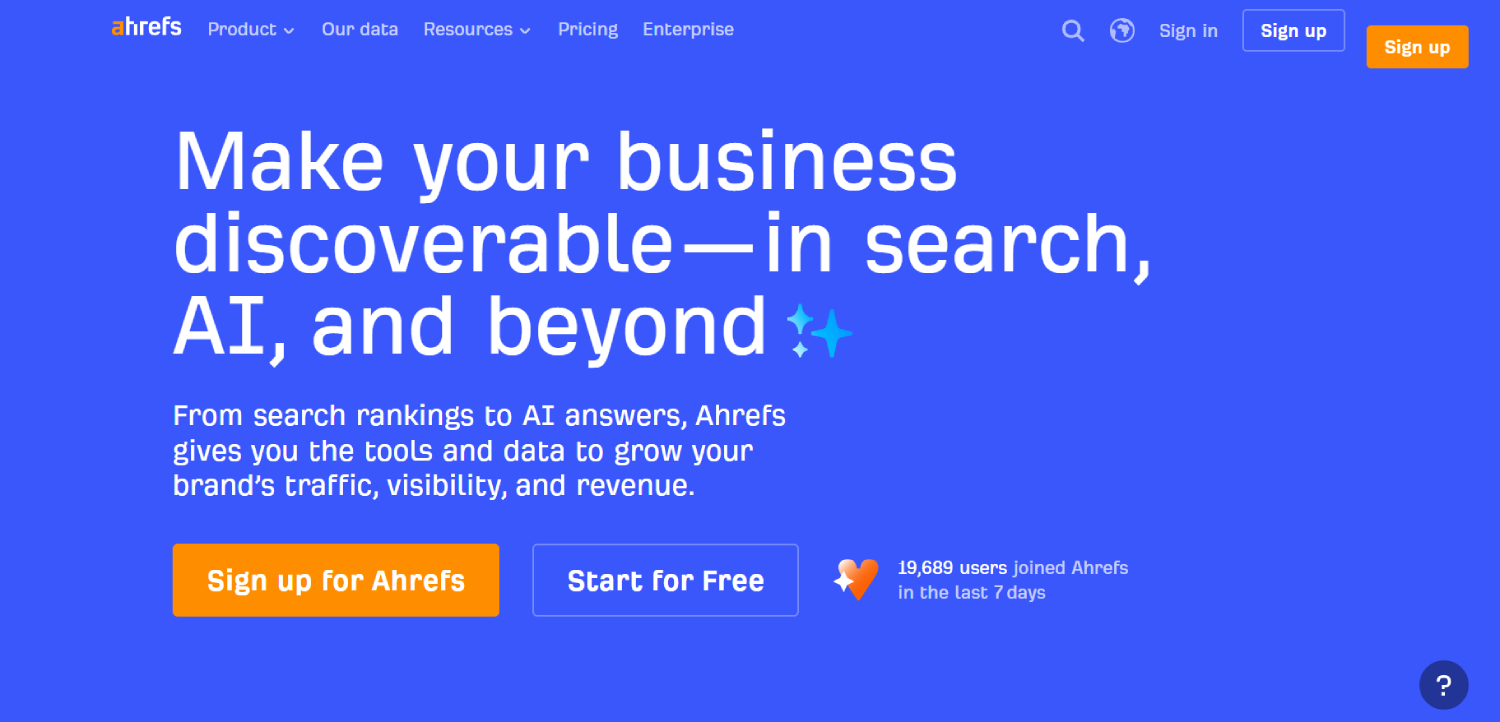
Ahrefs has the most trusted backlink index in the industry, and its keyword research tooling is the benchmark that other tools are measured against. The Site Audit feature is genuinely useful for a lean team: it crawls your site, surfaces technical issues with severity ratings, and presents them in plain language that does not require a developer to interpret.
Where Ahrefs falls short for a lean team is the content creation layer. There is no AI writer, no content grading like Clearscope or Surfer, and no brief generation that approaches what Frase or MarketMuse produce. Ahrefs excels at telling you what to target and why. It does not help you write the thing.
At $129 per month on the Lite plan (as of Ahrefs’ public pricing page), it is the right standalone research tool for a team that is pairing it with a content-focused platform. On its own, it leaves a significant gap in the workflow.
Frase: best budget pick for solo marketers
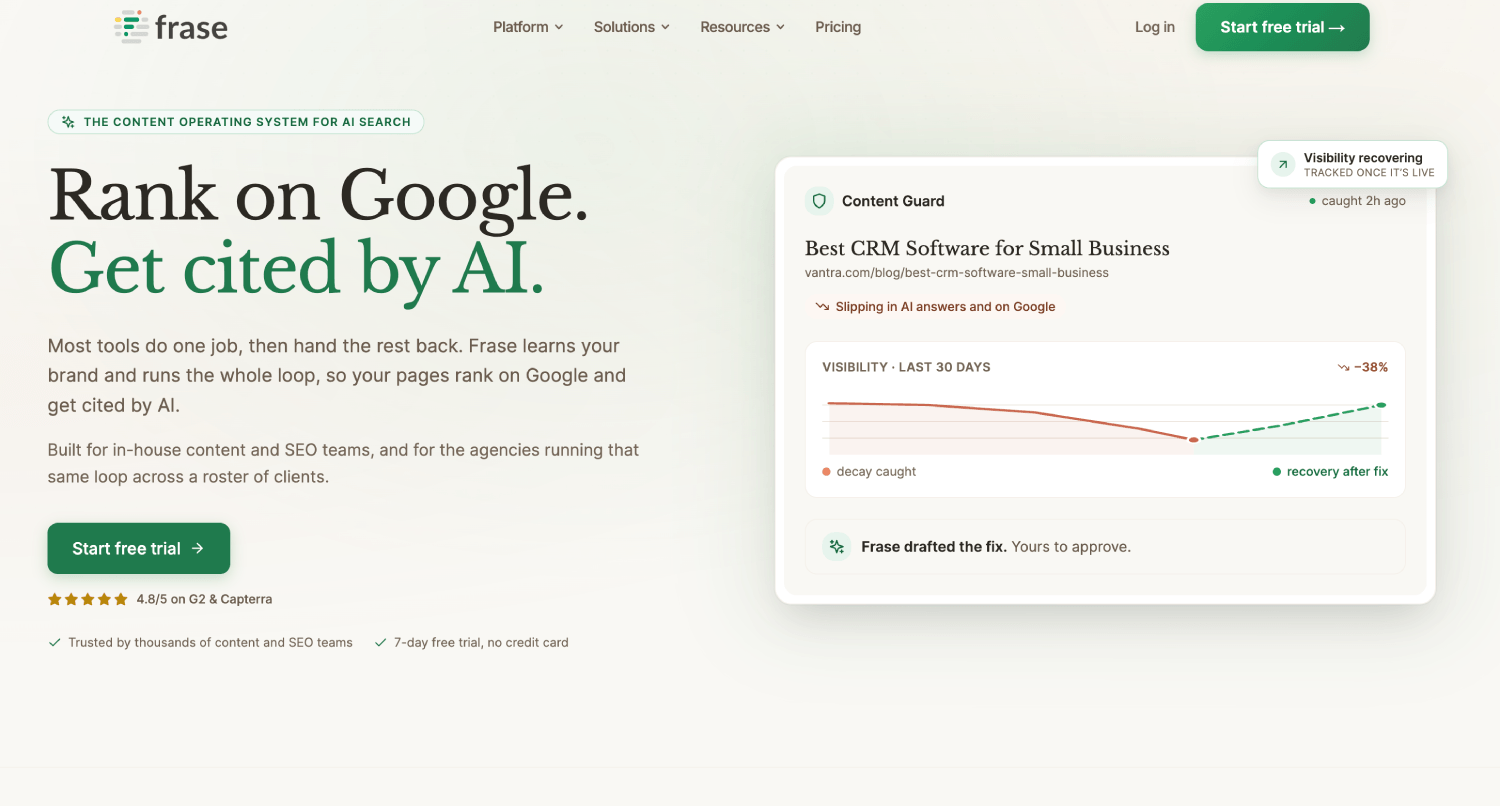
Frase is the strongest argument against the idea that AI SEO tools are only for teams with enterprise budgets. At $45 per month, it pulls the top-ranking pages for a keyword, extracts the questions, headings, and terms they cover, and builds a brief automatically. That brief becomes the foundation for the AI draft, which Frase generates inline.
The content scoring in Frase is not as granular as Surfer’s Content Score, but it covers the core requirements: term frequency, topic coverage relative to competitors, and word count. For a solo marketer publishing two to four articles per month, Frase collapses the research-to-draft step into a single session without requiring a second tool.
The output quality from Frase’s AI writer is serviceable but not exceptional. Every draft will need editing. That is true of every AI writer on this list, and it is worth saying plainly: no AI SEO tool produces publish-ready content without a human pass. Frase at $45 per month is not paying for a writer. It is paying for the research and structure that makes the writing faster.
NeuronWriter: best for NLP-driven semantic optimization
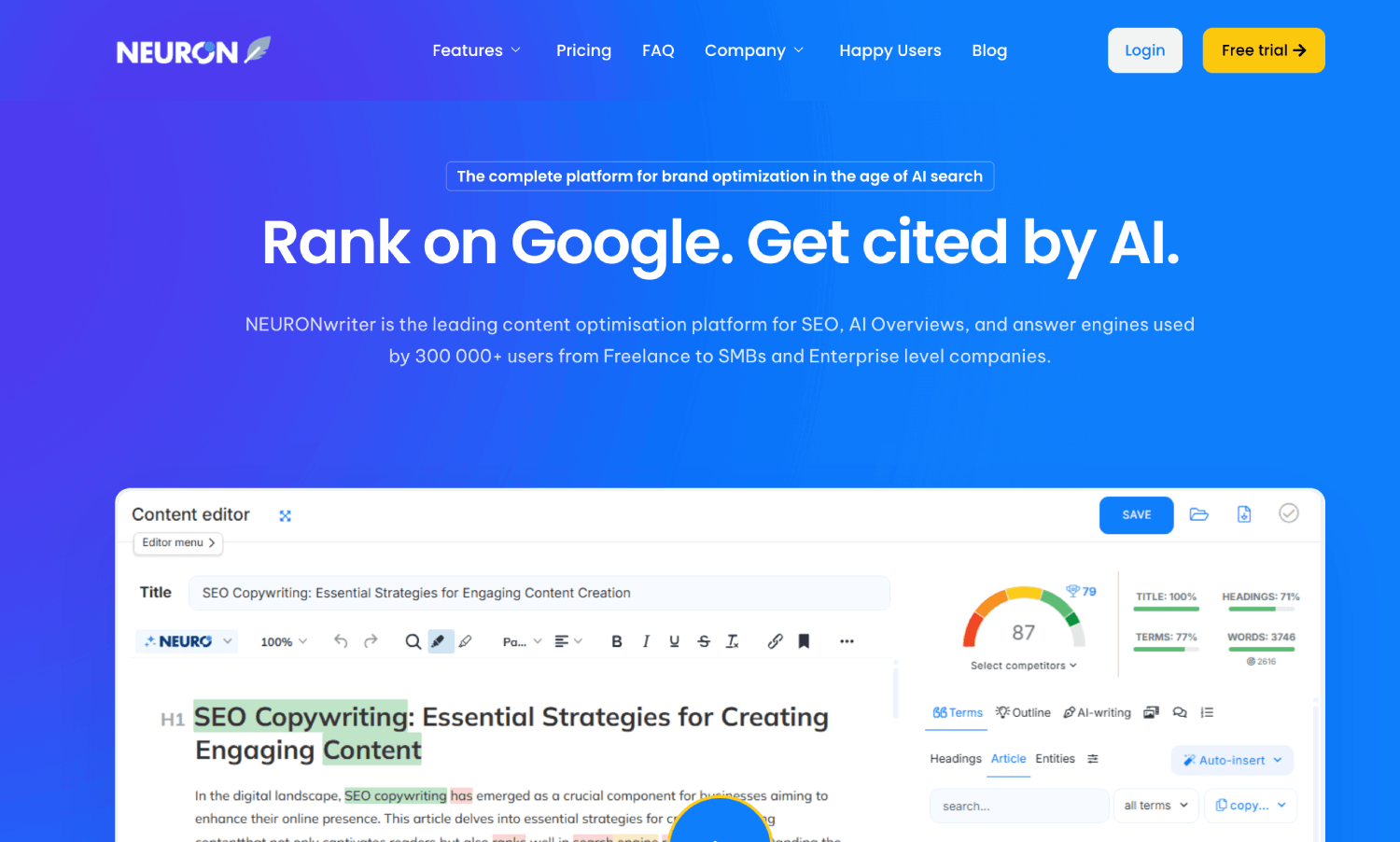
NeuronWriter uses Google NLP (Natural Language Processing) data to score content against the semantic signals that Google’s algorithms weight. That is a meaningful technical distinction from tools that simply count keyword mentions. It surfaces related entities, semantically relevant terms, and contextual phrases that are correlated with top-ranking content for a query.
At $23 per month on the Bronze plan (as of NeuronWriter’s public pricing page), it is the cheapest credible option on this list. The interface is less polished than Surfer or Clearscope, and the AI writer is more limited, but the NLP scoring is genuinely useful for a marketer who understands that keyword density stopped being the primary ranking signal years ago.
NeuronWriter works best as a secondary optimization layer: write in Google Docs or another editor, then paste into NeuronWriter to check semantic coverage before publishing. Teams already using Frase for brief creation can use NeuronWriter for the final optimization pass at a combined cost well under $100 per month.
MarketMuse: best for building topic authority across a content program
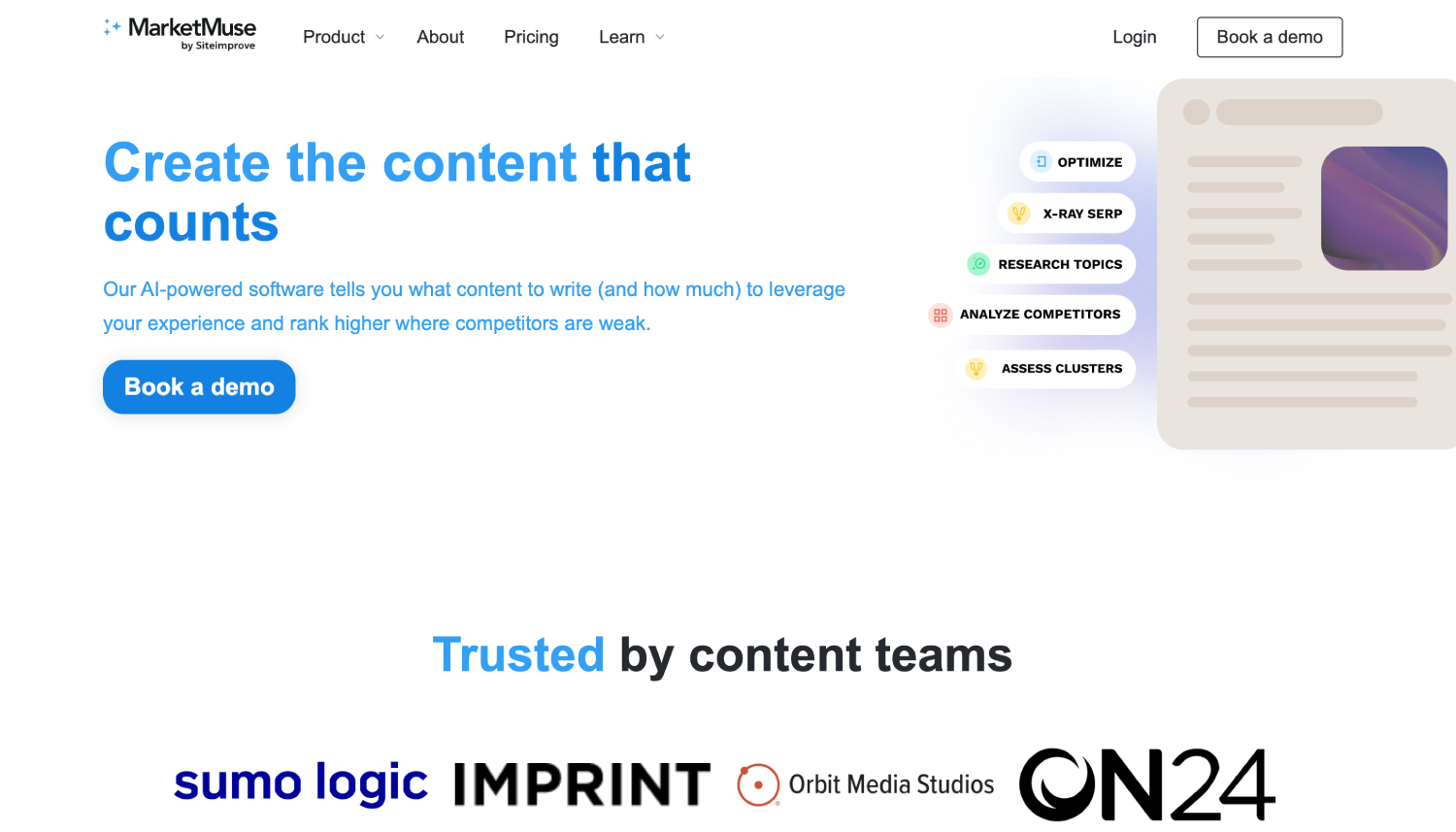
MarketMuse operates at a level above individual articles. Its Topic Authority model analyzes your existing content against a topic cluster and tells you where your site has authority, where it has gaps, and which new content would deliver the highest return based on current coverage. That is a content strategy function, not just a writing assist.
For a lean team managing a blog with 50 or more existing articles, MarketMuse surfaces which pages need updates and which topics are worth pursuing next. That prioritization work normally takes an SEO consultant several hours of analysis. At $149 per month on the Optimize plan (as of MarketMuse’s public pricing page), that is a reasonable trade.
The limitation is that MarketMuse assumes you have existing content to analyze. A team starting from zero gets less value from it in the first six months than a team with an established site. Start with Frase or Surfer if you are building a content program from scratch, and revisit MarketMuse once you have a library worth auditing. The broader question of how content attribution actually feeds pipeline is worth reading about separately , the best marketing attribution tools cover that gap in detail.
Alli AI: best for technical SEO automation without a developer
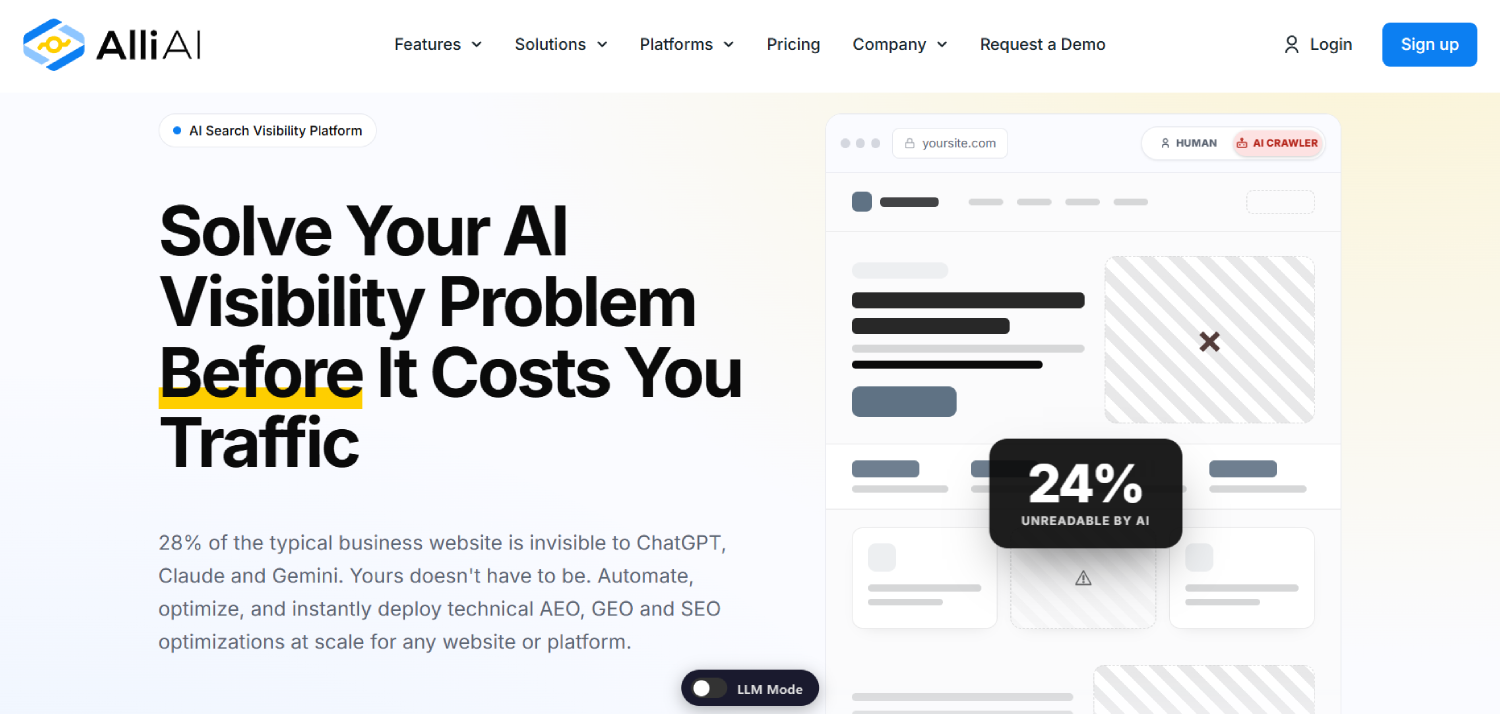
Alli AI takes a different approach from every other tool on this list. Instead of helping you create content, it automates on-page technical changes at scale: bulk meta title and description rewrites, schema markup deployment, internal linking adjustments, and page speed recommendations, all pushed live without touching the CMS directly.
For a lean team managing a large site (hundreds or thousands of pages), that automation is the difference between a technical backlog that never gets addressed and one that gets resolved systematically. At $299 per month on the Starter plan, it is priced for teams that have already identified technical debt as a real traffic problem.
Alli AI is not the right tool if your primary constraint is content creation. It earns its place on this list for a specific buyer: a growth marketer at a company with a CMS-heavy site who cannot get developer time to fix 400 pages of missing meta descriptions. That scenario is common at companies that have scaled content production faster than their engineering team can support, and Alli AI resolves the backlog without a single engineering ticket.
BrightEdge: best enterprise option when reporting to leadership matters
BrightEdge is an enterprise SEO platform with AI-driven recommendations built into its reporting layer. Its Data Cube gives access to organic search data at a scale that smaller tools cannot match, and its Share of Voice reporting lets marketing leaders show SEO’s contribution to business outcomes in the language that CFOs understand.
Pricing is quote-based and not publicly disclosed. Based on publicly available reviews and vendor positioning, BrightEdge is designed for teams with at least a dedicated SEO function and a budget to match. A lean team of one or two people will find the platform’s depth more than they can operationalize.
It belongs on this list because some “lean” marketing teams sit inside mid-market or enterprise companies where leadership requires formal reporting and the platform needs to integrate with Salesforce, Adobe Analytics, or a data warehouse. In that context, BrightEdge is often the only platform that satisfies both the technical and the political requirements. For teams thinking about how SEO data connects to their broader stack, the best customer data platforms for B2B are a related evaluation worth running in parallel.
What about AI-generated content and Google’s stance?
Google has stated publicly that it does not penalize AI-generated content as a category. What it penalizes is low-quality content, regardless of how it was produced. That distinction matters for how you use these tools. AI SEO software that produces a draft you publish without editing is a liability. AI SEO software that produces a structured draft you edit, optimize, and fact-check is just a faster workflow.
The practical implication: every tool on this list is more valuable for what it does before and after the writing than for the writing itself. Brief generation, semantic optimization, and content grading are where the real workflow compression happens. The AI writer is a starting point, not a deliverable.
There is also a growing category of AI content tools that operate separately from SEO-specific platforms. For a broader view of what teams are actually using for content production, the AI content tools marketers actually use covers that category with hands-on context.
Frequently asked questions about AI SEO tools
What is the best AI SEO tool for a one-person marketing team?
Frase at $45 per month is the strongest starting point for a solo marketer. It handles brief creation, competitor research, and content scoring in a single workflow without requiring a companion tool. If budget allows, pairing Frase with NeuronWriter at $23 per month gives you semantic NLP scoring on top of the brief-to-draft workflow for under $70 per month combined. Surfer SEO at $99 per month is the best single-tool option if budget is not the primary constraint.
Do AI SEO tools actually improve rankings?
They improve the inputs that correlate with rankings: semantic relevance, topic coverage, and content depth relative to what is currently ranking. Tools like Surfer SEO, Clearscope, and MarketMuse produce measurable improvements in organic traffic for teams that use them consistently, based on case studies those vendors publish. No tool guarantees ranking positions. The primary benefit is replacing the manual analysis work that would otherwise require an experienced SEO strategist.
What is the difference between AI SEO tools and AI content tools?
AI content tools, such as Jasper or Copy.ai, focus on producing written output. AI SEO tools focus on research, optimization, and grading. The best AI SEO platforms include a writing layer, but their core value is the data-driven brief and the scoring system that tells you whether what you wrote is likely to rank. Using an AI content tool without an SEO optimization layer produces faster content, not better-ranking content.
Can AI SEO tools handle technical SEO?
Most cannot. Surfer SEO, Frase, Clearscope, NeuronWriter, and MarketMuse focus on on-page and content optimization. Semrush and Ahrefs include genuine technical audit capabilities. Alli AI is the only tool on this list purpose-built for technical SEO automation at scale. For a lean team, the practical path is using a content-focused AI SEO tool for the writing workflow and a lightweight crawler like Screaming Frog (which offers a free tier) for periodic technical audits.
How much should a lean team budget for AI SEO software?
A realistic budget for a two-person team that needs brief creation, content grading, and keyword research is $100 to $200 per month. Frase plus Ahrefs Lite covers most of the workflow for around $174 per month. Surfer SEO’s Essential plan at $99 per month handles brief creation and content grading in one tool, but you would need to add a research tool alongside it. Enterprise platforms like BrightEdge are quote-based and designed for budgets well above that range.
Do these tools help with AI search visibility, not just Google rankings?
Most tools on this list are designed for traditional search engine optimization and do not directly address visibility in ChatGPT, Perplexity, or Google’s AI Overviews. That is a distinct discipline called GEO (Generative Engine Optimization). For teams that need to track and improve their brand’s presence in AI-generated answers, the best AI visibility tools for tracking brand mentions in ChatGPT and Perplexity cover that category specifically.
Is Semrush or Ahrefs better for a small team?
Ahrefs is better if your primary need is backlink analysis and keyword research with a clean interface. Semrush is better if you need competitive research, a site audit, and content workflow in a single platform, and you are willing to spend time learning the tool. Both are more than a two-person team can fully use. If the budget is the constraint, Ahrefs Lite at $129 per month gives more research depth per dollar than Semrush’s comparable plan, but Semrush’s ContentShake AI and On Page Checker add content workflow value that Ahrefs does not match.
What should a lean team avoid when buying AI SEO software?
Avoid tools that only generate content without scoring it against real ranking signals. Avoid platforms priced for enterprise teams with seat-based pricing that scales quickly past what a small team can justify. Avoid buying both a keyword research platform and a content optimization platform before confirming whether one of the all-in-one options covers 80% of your actual workflow. Most lean teams overbuy on feature surface area and underuse what they pay for.
The single most important thing a lean team can do with these tools
The biggest gain for a small team is not the AI writer. It is the brief. A content brief built from real SERP analysis, with the right subtopics, the right questions answered, and the right semantic terms flagged, produces better output from any writer, human or AI. Tools like Frase, Surfer, and MarketMuse compress what used to be two hours of manual research into a ten-minute process. That is where the actual time savings live.
The second-order benefit is consistency. A solo marketer working without a brief produces wildly variable content. With a systematized brief process, every article starts from the same analytical foundation. That is the difference between a content program and a content backlog.
Teams that are also thinking about how organic content feeds into pipeline attribution should know that SEO data rarely lives in the same reporting layer as revenue data. Connecting those two signals is a real infrastructure problem, and it is one the best B2B attribution tools for long sales cycles are specifically built to address. SEO is not a channel that operates in isolation, and the teams that treat it that way tend to undercount its actual contribution.