- ChurnZero targets mid-market and enterprise CS teams with deep automation, segmentation, and a configuration overhead to match. Vitally targets product-led and early-stage SaaS teams that need a fast setup and a cleaner interface.
- ChurnZero’s pricing is quote-based and skews toward larger organizations with dedicated CS operations staff. Vitally’s pricing is also custom, but public signals suggest a lower entry point for smaller teams.
- Vitally wins on time-to-value: lighter implementation, a modern UI, and native integrations that a two-person CS team can configure without a solutions engineer on retainer.
- ChurnZero wins on automation depth: multi-step playbooks, in-app engagement, and health scoring that can handle complex, multi-segment customer books.
- If your team has fewer than five CS reps and no dedicated RevOps support, Vitally is the more pragmatic starting point. ChurnZero pays off once the complexity arrives to justify it.
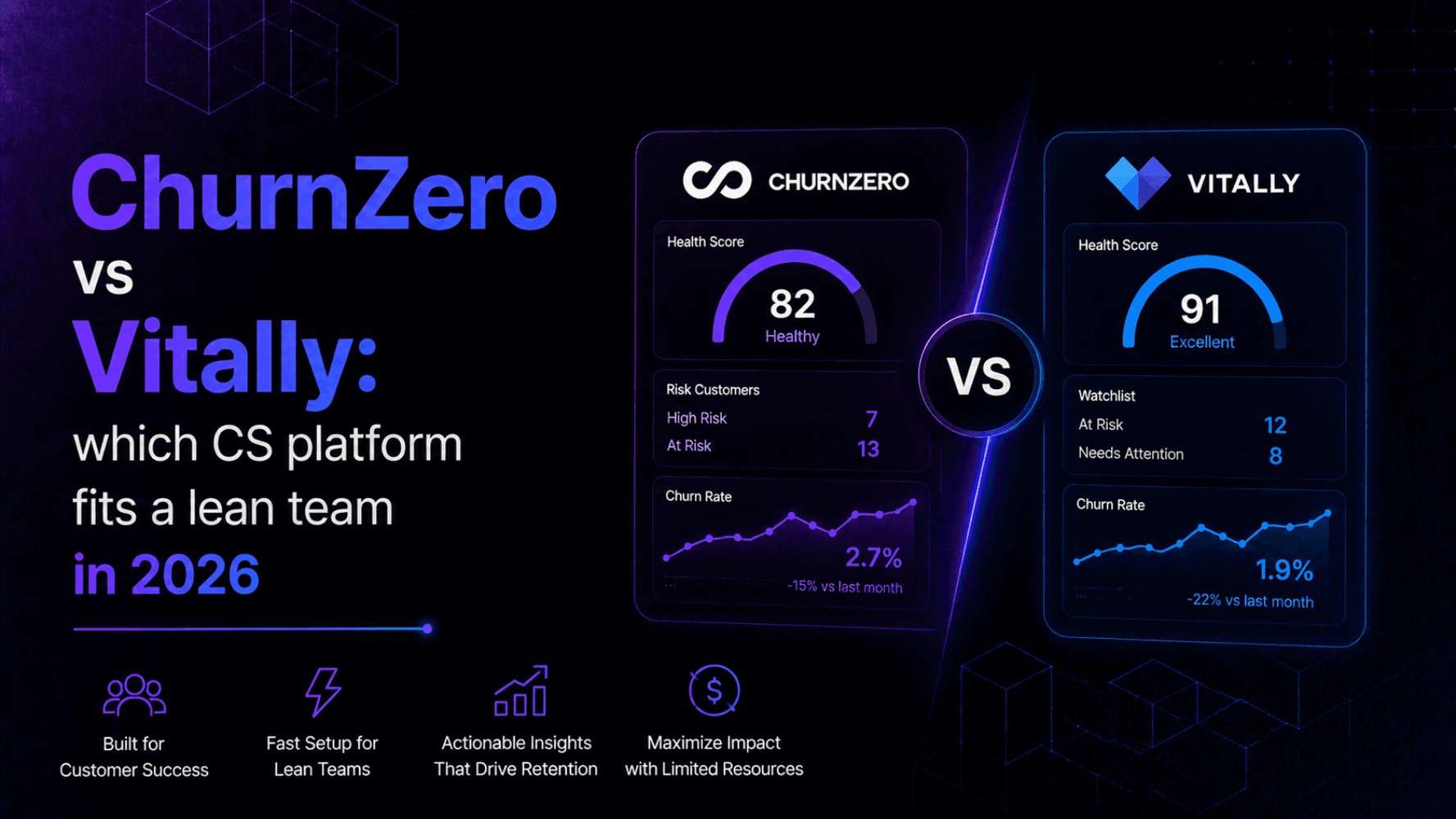
The ChurnZero vs Vitally decision comes down to operational maturity, not feature counts. ChurnZero and Vitally are both purpose-built customer success platforms for B2B SaaS, but they serve different team profiles. ChurnZero fits established CS organizations with complex playbook needs and the ops bandwidth to configure them. Vitally fits lean or early-stage teams that need fast deployment, a readable interface, and core health-scoring and renewal workflows without a multi-month implementation project.
Why Most CS Platform Comparisons Miss the Real Dividing Line
Most comparisons of ChurnZero and Vitally focus on feature checklists: health scores, playbooks, NPS, in-app messaging. Both platforms have all of those. The actual dividing line is operational weight, meaning how much internal lift the platform demands before it starts returning value.
ChurnZero was built during an era when customer success was formalizing into its own department. It reflects that: structured configuration, hierarchical segmentation, deep playbook logic, and a UI that rewards investment. Vitally came later, architected for teams that were already running lean SaaS operations and wanted CS tooling that felt more like a modern product than an enterprise configuration project.
That distinction matters enormously for a team of two CS reps managing 300 accounts differently from a team of 15 reps with segmented enterprise and SMB books. The platform that fits one is actively painful for the other.
What Does Each Platform Actually Do Well?
ChurnZero: depth for complex CS operations
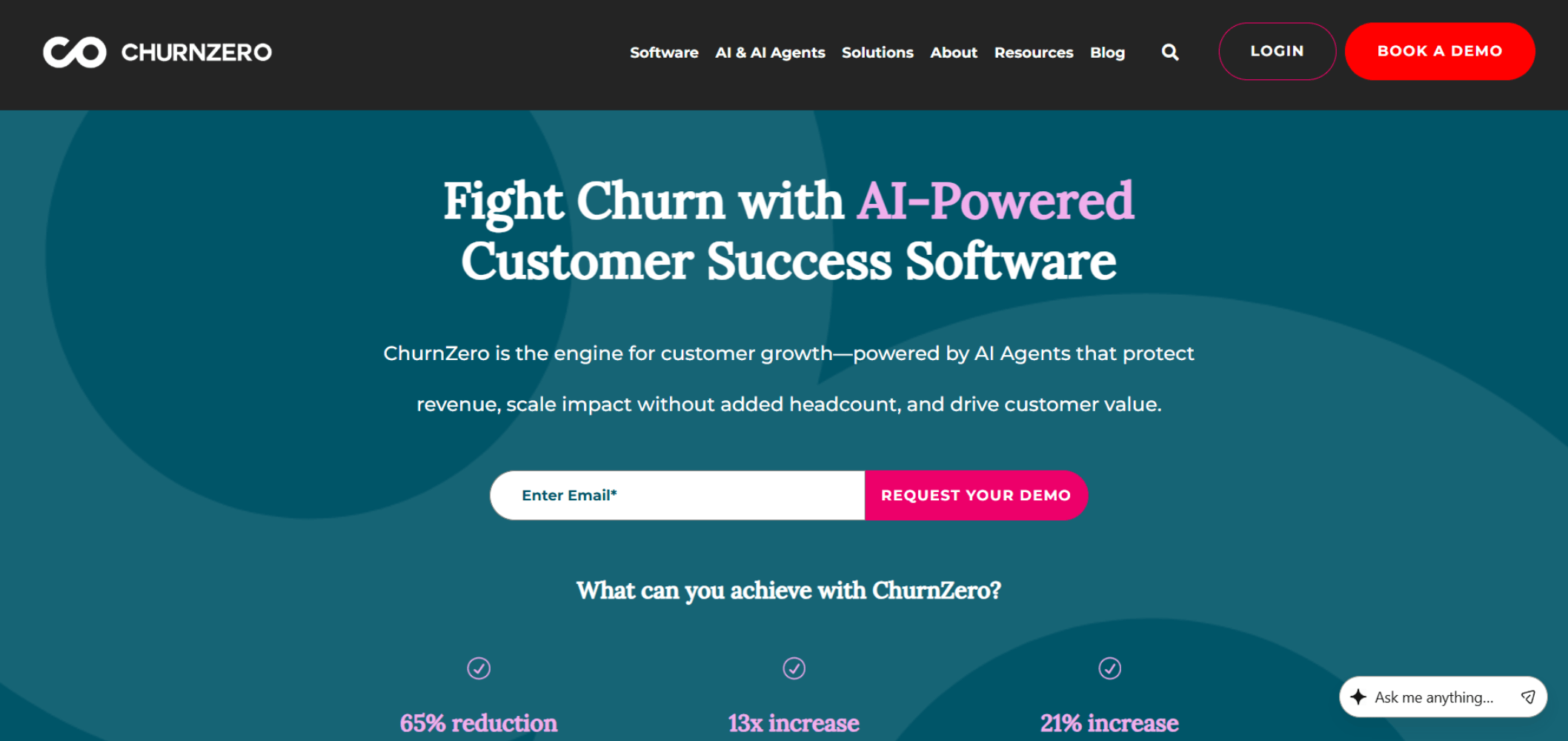
ChurnZero’s core strengths are its playbook engine and its in-app engagement layer. Playbooks in ChurnZero support multi-condition branching, time-based triggers, and task assignment across CSMs, making them usable for organizations that have documented their CS motions and need to enforce them at scale. The in-app widget and NPS delivery let CS teams engage customers without relying on engineering resources or a separate in-app messaging tool.
Health scoring in ChurnZero is configurable across multiple dimensions: product usage, support ticket volume, NPS response, contract data, and custom signals from your CRM. That configurability is genuinely useful, but it also requires someone to design the scoring model deliberately. A team without that ops capacity tends to leave the defaults in place, which is a waste of the platform’s real capability.
ChurnZero also has ChurnZero Segments, a customer segmentation layer that lets you build dynamic lists based on behavioral and firmographic criteria and push different playbooks to different segments simultaneously. For a VP of CS managing both a high-touch enterprise tier and a low-touch SMB tier, that’s meaningful. For a two-person CS team covering one product tier, it’s overhead.
Vitally: speed and usability for lean teams
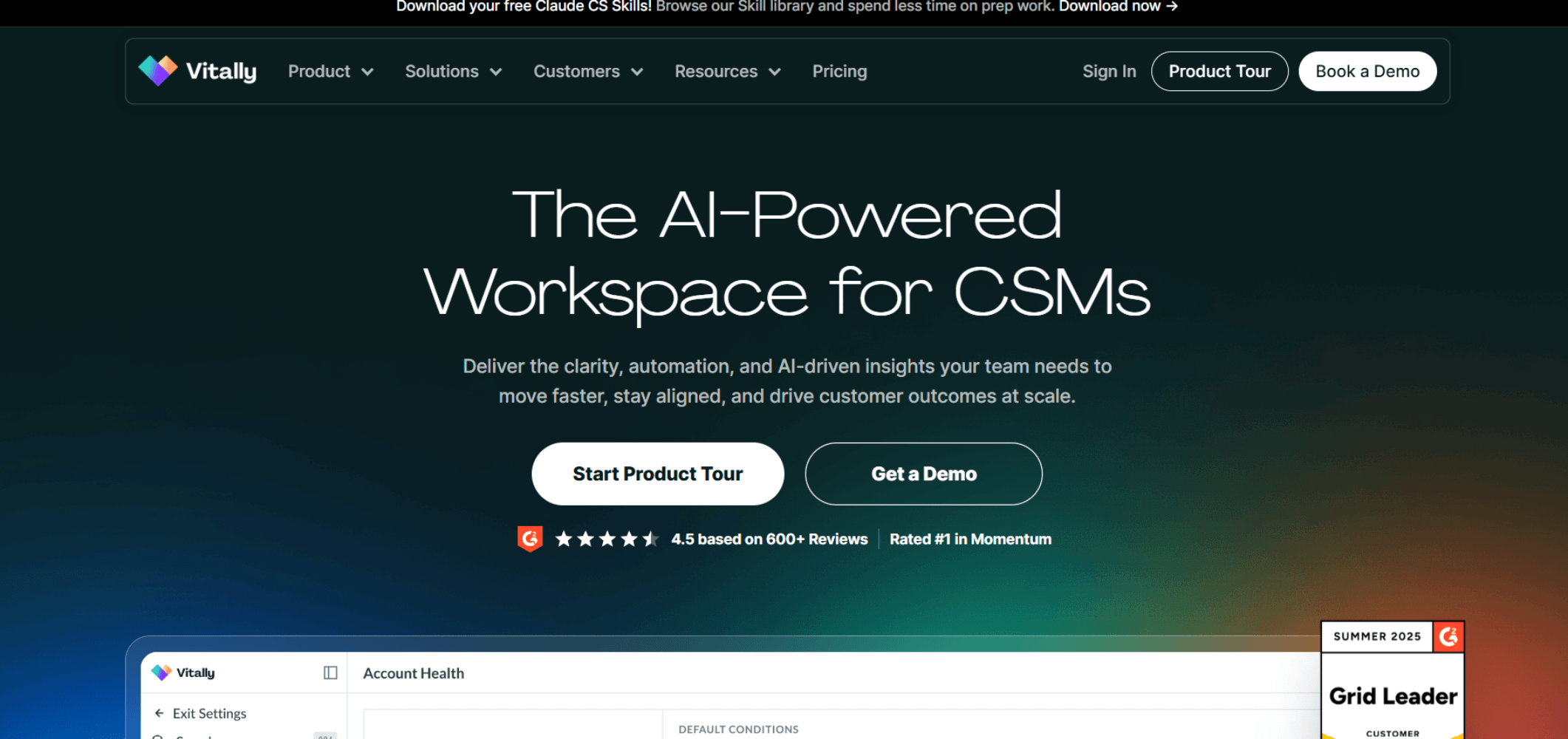
Vitally’s design philosophy is closer to a modern SaaS product than a legacy enterprise platform. Dashboards are readable out of the box. Customer profiles pull in product usage data, CRM data, and support tickets in a unified view that a new CSM can pick up on their first day. Setup for a standard integration stack (Salesforce or HubSpot, Segment or Intercom, Zendesk) runs in days rather than weeks.
The platform’s Docs feature lets CS teams build internal playbooks and customer-facing success plans inside the tool, reducing the Notion-plus-spreadsheet-plus-CS-platform fragmentation that plagues early-stage CS operations. It is a small feature that eliminates real friction. Vitally also surfaces account health scores with less configuration required at the start, using sensible defaults that a small team can iterate on rather than build from scratch.
Vitally’s project and task management is tighter than ChurnZero’s for teams running structured onboarding and QBR workflows. If your CSMs are managing discrete customer milestones rather than running large-scale automated sequences, Vitally’s project-based view is more natural to work inside daily.
The Lean Team Litmus Test: Four Checks Before You Commit
The AboutMartech Lean CS Stack Test is a four-part filter for CS teams evaluating platforms when they lack a dedicated RevOps or CS-ops function. It is designed to surface configuration risk before you sign a contract.
- Integration path. Does the platform connect to your CRM and data source natively, without a custom middleware build? ChurnZero and Vitally both support Salesforce and HubSpot natively, but Vitally’s Segment integration is tighter for product-led teams already using Segment for event tracking. If you are routing customer data through a B2B customer data platform, verify that the CS platform can ingest that data without a reverse ETL workaround.
- Time-to-first-insight. How many days until your team has a populated health score for at least 80% of accounts? Vitally typically reaches this in one to two weeks for a team with clean Salesforce and Segment data. ChurnZero’s richer model takes longer to configure meaningfully.
- Maintenance overhead. Who owns playbook updates when your product changes? In ChurnZero, playbook logic can get complex quickly, creating a dependency on whoever built it. In Vitally, simpler automation means a CSM can maintain workflows without ops support.
- Seat economics. Both platforms price per seat. At fewer than five CS seats, the minimum contract size relative to your team’s ARR per rep matters more than feature breadth. Request a breakdown of the minimum contract value, not just the per-seat rate.
Running these four checks surfaces the real cost of ownership, not just the sticker price. A platform that fails checks two and three will consume CSM time on tool maintenance rather than customer work.
How Do ChurnZero and Vitally Compare on Core Features?
| Feature | ChurnZero | Vitally |
|---|---|---|
| Health scoring | Highly configurable, multi-signal, requires intentional setup | Configurable with workable defaults, faster to deploy |
| Playbook automation | Multi-step, branching logic, strong for complex CS motions | Simpler automation, better for discrete milestone tracking |
| In-app engagement | Yes, native in-app widget and NPS delivery | Limited; relies on integrations for in-app messaging |
| Success plans / docs | Supported via tasks and templates | Native Docs and project-based success plans |
| CRM integrations | Salesforce, HubSpot (native) | Salesforce, HubSpot (native) |
| Product data ingestion | Via integrations; setup complexity varies | Segment native, cleaner PLG-stack alignment |
| Customer segmentation | Deep, multi-tier, rule-based segments | Standard segmentation, adequate for most SMB use cases |
| Onboarding complexity | High; typically requires vendor implementation support | Moderate; most teams self-implement with available docs |
| UI modernity | Functional but dense; CSMs typically require a full onboarding cycle to work fluently | Clean, intuitive; faster CSM adoption |
| Pricing model | Quote-based; skews mid-market and up | Quote-based; lower reported entry point |
| Best for | Mid-market to enterprise CS teams with ops support | Lean teams, PLG companies, early-stage CS orgs |
What Does Pricing Actually Look Like for Each Platform?
Neither ChurnZero nor Vitally publishes list pricing. Both platforms operate on quote-based models, and both require you to engage a sales representative to get numbers. That said, the market signals are consistent enough to characterize directionally.
ChurnZero’s contracts are widely reported to start in the range where mid-market SaaS companies feel the decision: meaningful budget, meaningful ROI expectation, meaningful implementation timeline. The platform is not designed for a team writing its first CS playbook. The contract structure typically includes an implementation fee on top of the annual subscription, which is worth surfacing early in your vendor conversation.
Vitally’s entry point is reported to be more accessible for smaller teams, though it is still not a self-serve signup. If you are evaluating Vitally, request a minimum-seat quote explicitly, because the platform’s pricing can scale in ways that are not immediately obvious at the initial demo stage.
For both platforms, the total cost of ownership calculation should include CSM time spent on platform administration. A platform that requires 20% of a CSM’s week to maintain is effectively more expensive than a costlier platform that demands 5%. Run that math against your team’s current hourly cost before comparing sticker prices.
Which Integrations Matter Most, and Who Has the Edge?
Both platforms connect to Salesforce and HubSpot without custom engineering. For teams on those CRMs, the integration question comes down to data fidelity: how much of your CRM record syncs, how frequently, and in which direction.
ChurnZero’s Salesforce integration is more mature in terms of bidirectional data flow, particularly for writing health score data back into Salesforce fields for sales visibility. That matters for organizations where CS and sales share account ownership and need a single source of truth in the CRM. Teams using reverse ETL to activate warehouse data into their CS platform should verify how each vendor handles external data sources: ChurnZero supports custom data imports, but the configuration burden can be significant without ops support.
Vitally’s product data integration is its sharpest edge for product-led growth teams. Native Segment support means that if your product team is already tracking events through Segment, Vitally can ingest those events without a custom pipeline. For a PLG SaaS company where expansion is driven by product usage signals rather than high-touch CSM activity, that removes a meaningful integration friction point.
For teams building onboarding automation that sits between the CS platform and the product itself, it is worth reading how customer onboarding tools connect to CS platforms before locking in your integration architecture.
A Worked Scenario: 12-CSM Team Managing 600 Accounts
Consider a B2B SaaS company with $8M ARR, 12 CSMs, and 600 accounts split across a high-touch enterprise tier (80 accounts) and a low-touch SMB tier (520 accounts). They have a Salesforce CRM, Segment for product analytics, and Zendesk for support. Their CS team currently manages everything in Salesforce and a shared Google Sheet.
For this team, ChurnZero makes sense on paper: the segmentation engine can handle two distinct playbook tracks, the health score can incorporate Zendesk ticket volume alongside product usage, and the in-app NPS delivery removes the need for a separate survey tool. The realistic implementation timeline is eight to twelve weeks before the system is running meaningfully. Someone on the team, likely a CS ops manager or a senior CSM, will own the configuration work as a near-full-time project during that period.
Vitally gets this team to a working health dashboard in two to three weeks. The SMB playbooks will be simpler, which is a real constraint for the high-touch enterprise tier, but the team starts getting signal on at-risk accounts in week three rather than week ten. If the company is pre-Series B and the CS team is still refining its own motion, that speed advantage compounds.
The inflection point where ChurnZero’s depth justifies its configuration cost tends to arrive when a CS team has documented playbooks it wants to enforce consistently at scale, not when it is still discovering what those playbooks should be.
How Do Reporting and Analytics Compare?
ChurnZero’s reporting layer is comprehensive but requires intentional setup. Out-of-the-box dashboards cover churn risk, renewal forecasting, and CSM activity tracking. Custom reports are available, but building them well requires someone who understands both the platform’s data model and the business metrics they are trying to track. For a CS leader preparing a board-level churn analysis, ChurnZero’s data depth is an asset. For a CSM trying to pull a quick at-risk account list before a weekly team meeting, the interface can slow them down.
Vitally’s reporting defaults are more immediately readable. Team-level dashboards show account health distribution, renewal pipeline, and CSM workload without custom configuration. The trade-off is analytical ceiling: Vitally does not match ChurnZero’s depth for multi-variable cohort analysis or complex renewal forecasting models. Teams that need to connect CS metrics to revenue attribution data should also read about how attribution tools connect upstream marketing signals to retention outcomes, because neither platform handles cross-channel attribution natively.
Frequently Asked Questions
Is ChurnZero or Vitally better for a small CS team?
Vitally is the better starting point for a small CS team. Its implementation is faster, its defaults are workable without a dedicated CS-ops function, and its interface is easier for CSMs to adopt without extensive training. ChurnZero’s depth becomes an advantage once a team has documented CS motions it needs to enforce at scale across multiple customer segments, which most small teams have not yet reached.
Which platform is easier to implement without a dedicated RevOps resource?
Vitally. Most teams with clean CRM and product analytics data report self-implementing Vitally in one to three weeks. ChurnZero’s richer configuration options create a corresponding implementation burden: most teams require vendor-led onboarding support and several weeks of internal setup work before the platform reflects their actual CS motion. Without a RevOps or CS-ops resource to own that process, ChurnZero implementations tend to stall or end up under-configured.
Does ChurnZero have native in-app messaging?
Yes. ChurnZero includes a native in-app engagement layer that lets CS teams deliver NPS surveys, in-app announcements, and targeted messages to customers without engineering involvement. Vitally does not offer equivalent native in-app messaging and relies on integrations with tools like Intercom or Customer.io for in-app engagement. For teams that want a single platform handling in-app communication and CS workflows, that is a meaningful functional difference in ChurnZero’s favor.
How does each platform handle customer health scoring?
Both platforms support multi-signal health scoring, but they differ in defaults and configurability. ChurnZero’s health score is highly configurable across product usage, CRM data, support metrics, and custom signals, but requires intentional design to work well. Vitally provides workable default health score templates that a small team can deploy quickly and refine over time. For teams starting from scratch, Vitally’s defaults reduce the time-to-first-signal significantly.
Can either platform connect to a data warehouse?
Both platforms support data imports from external sources, but neither natively functions as a warehouse-native CS tool. ChurnZero accepts custom data feeds and has API access for warehouse-sourced data, but configuration is non-trivial. Vitally supports Segment as a data pipeline, which covers most PLG teams, and offers an API for custom data. Teams building a warehouse-native stack should evaluate how the CS platform fits alongside their broader data infrastructure before committing.
What is the minimum contract size for ChurnZero and Vitally?
Neither platform publishes minimum contract sizes. Both are quote-based, and both require a sales conversation before pricing is disclosed. ChurnZero’s market positioning and feature set suggest a higher floor than Vitally’s, with implementation fees that can add meaningfully to the first-year cost. Vitally’s reported entry point is lower, but still represents a substantive annual commitment. Request a minimum-seat scenario explicitly in your first vendor call rather than waiting for the formal proposal.
Which CS platform fits a product-led growth company better?
Vitally. Its native Segment integration, cleaner product-usage-driven health scoring, and faster implementation align better with PLG companies where customer expansion is driven by in-product behavior rather than high-touch CSM intervention. ChurnZero’s in-app engagement layer can partially close this gap, but its overall architecture reflects a sales-led CS motion more than a product-led one. PLG teams that want to connect CS data back to their broader customer success platform evaluation should pressure-test Vitally’s PLG integrations specifically during the demo.
Verdict: Which Platform Should You Choose?
The decision reduces to one honest question: does your CS team currently know what its playbooks should be, or is it still figuring that out? ChurnZero is worth its configuration overhead only if you have documented CS motions to put inside it. A team building its first health score model, writing its first renewal playbook, and still learning which product signals predict churn will not use 60% of ChurnZero’s capability in year one, and will spend meaningful CSM time managing the platform rather than working accounts.
Vitally gets a lean team operational faster. The reporting ceiling is lower, the automation is less sophisticated, and in-app messaging requires an additional tool. Those are real trade-offs. But for a team under ten CS seats without dedicated CS-ops support, faster time-to-signal and lower administrative drag beat theoretical depth that requires a specialist to configure.
The case for ChurnZero sharpens when you have a CS-ops resource, a segmented customer book with meaningfully different playbooks by tier, and a need to deliver in-app engagement from the CS platform rather than a separate tool. At that maturity level, ChurnZero’s investment in configuration pays back through automation that would otherwise require human intervention. Get there first, then make the switch if Vitally’s ceiling becomes the actual constraint. It is a better problem to have than a platform you bought ahead of your team’s ability to use it.