
- Profound is the stronger platform for teams that need prompt volume data and enterprise-grade citation tracking across ChatGPT, Perplexity, and Google AI Overviews.
- Peec AI is a leaner, more affordable entry point for mid-market teams tracking brand mentions across AI search without needing query-frequency intelligence.
- The decision hinges on one question: does knowing how often users ask a prompt change what your content team actually builds?
- Profound’s pricing reflects its enterprise positioning; Peec AI does not publicly disclose tiered pricing, so budget comparisons require direct outreach to both vendors.
- Neither platform replaces a GEO content strategy. They measure visibility; they do not create it.
Profound is the better fit for most mid-market B2B SaaS marketing teams that need prompt volume data to prioritize content investments. Peec AI suits teams that want lightweight citation monitoring across AI engines without the complexity or cost of a full-featured intelligence layer. If your team makes content decisions based on which prompts users actually type into ChatGPT, Profound’s query-volume data is the capability that separates the two platforms.
Why Are Mid-Market Teams Even Comparing These Two Platforms?
AI search has changed who gets discovered. When a buyer types “best project management software for engineering teams” into ChatGPT or Perplexity, the response pulls from a citation layer that most marketing teams cannot see, measure, or influence without dedicated tooling. That created a new software category: AI visibility platforms.
Profound and Peec AI both sit inside that category, but they approached it from different directions. Profound built toward enterprise teams first, with a data model centered on prompt-level query volume. Peec AI launched as a more accessible monitoring tool, tracking where brands appear in AI-generated responses without the same depth of search-frequency data.
The overlap is real. Both platforms track citations across major AI engines, both surface competitor mention rates, and both are competing for the same budget line at companies between 50 and 500 employees. That is exactly why teams researching one inevitably end up evaluating the other.
What Does Each Platform Actually Track?
Profound’s tracking model
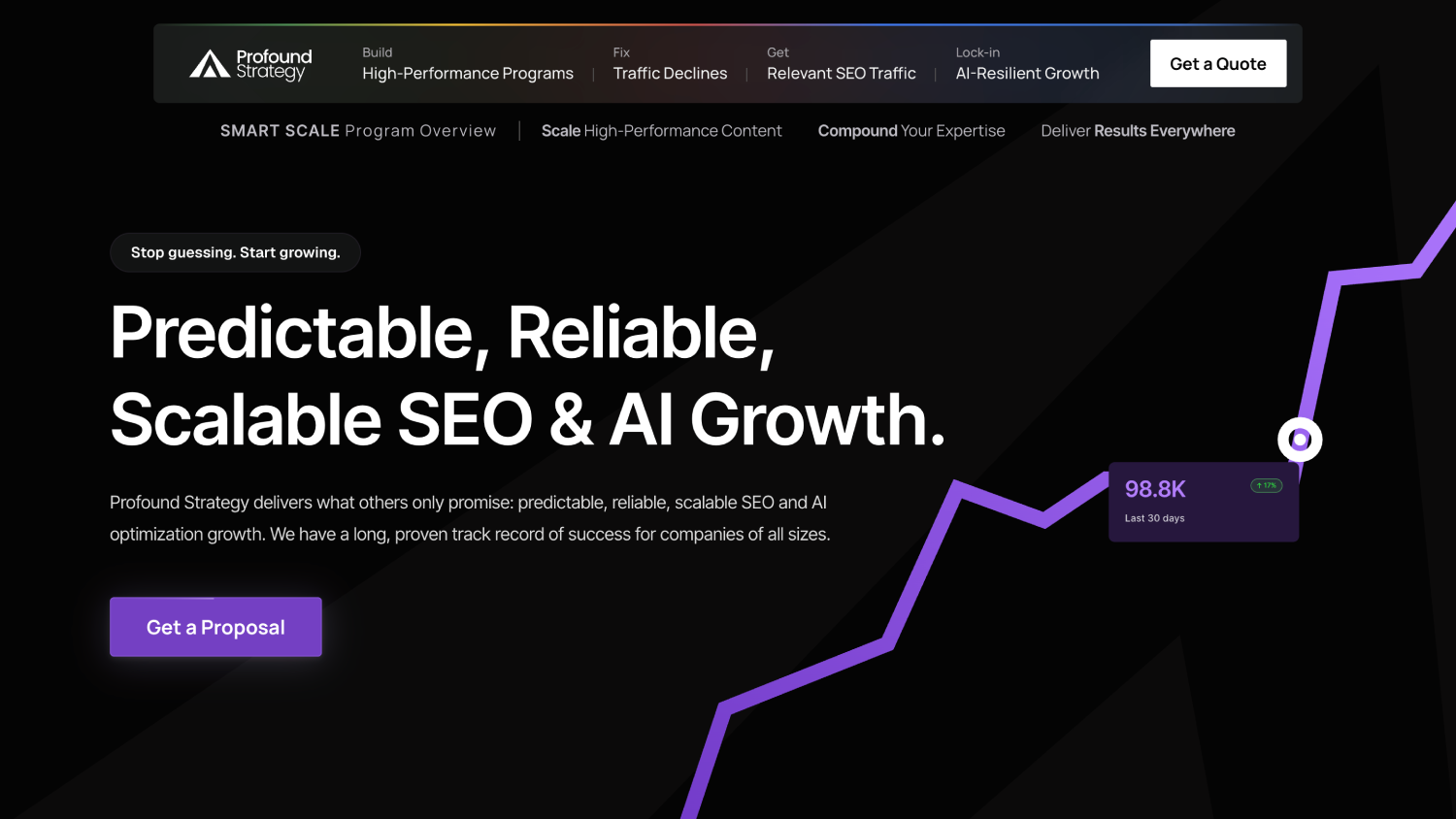
Profound monitors brand mentions across ChatGPT, Perplexity, Google AI Overviews, and Gemini. Its core differentiator is prompt volume data: the platform ties citation tracking to actual query-frequency signals, so marketers can see not just whether their brand appears in a response, but how often users ask the prompts that trigger those responses. That shifts the platform from a reporting tool to a prioritization tool.
Profound also tracks sentiment and share-of-voice across competitors within a category, and it surfaces which sources AI engines are citing when they mention your brand. That source-level attribution matters because it tells content teams where to publish, not just what to write. For teams running a GEO strategy alongside traditional SEO, that is a meaningful data layer.
Peec AI’s tracking model
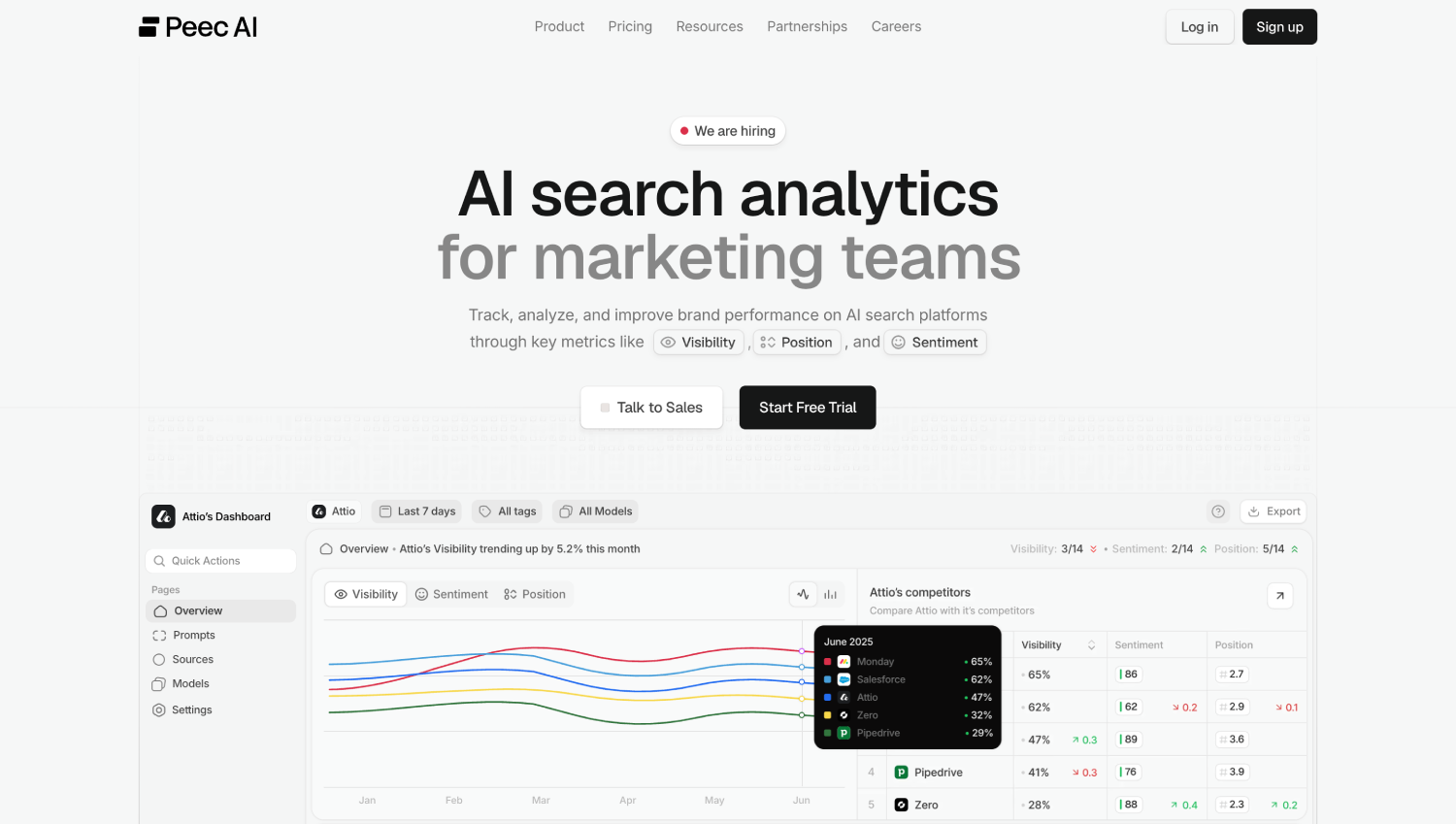
Peec AI monitors brand mentions across a similar set of AI engines and surfaces citation frequency, competitor comparisons, and sentiment signals. Where it differs from Profound is in the absence of native prompt volume data. Peec shows you whether you appear in responses to a given prompt, not how many users are asking that prompt per month.
For teams that are early in AI visibility measurement, that distinction may not matter yet. If the goal is simply to establish a baseline, understand which prompts surface your brand versus a competitor, and monitor changes over time, Peec AI covers the core use case. The platform’s interface is reported to be more approachable for teams without a dedicated MOps or analytics function running the tool.
How Do Profound and Peec AI Compare on Features?
| Feature | Profound | Peec AI |
|---|---|---|
| Citation tracking (ChatGPT) | Yes | Yes |
| Citation tracking (Perplexity) | Yes | Yes |
| Google AI Overviews tracking | Yes | Yes |
| Gemini tracking | Yes | Reported partial |
| Prompt volume / query frequency data | Yes (core feature) | Not natively available |
| Competitor share-of-voice | Yes | Yes |
| Source-level citation attribution | Yes | Limited |
| Sentiment tracking | Yes | Yes |
| Custom prompt testing | Yes | Yes |
| Reporting / export | Yes | Yes |
| API access | Yes (enterprise tiers) | Not publicly confirmed |
| Public pricing | Quote-based | Not publicly disclosed |
The table above reflects publicly available information and product documentation as of mid-2025. Feature availability may vary by tier; both vendors should be contacted directly for current scope confirmation.
Is Peec AI Cheaper Than Profound?
Neither platform publishes transparent pricing tiers. Profound’s pricing is quote-based, consistent with its enterprise positioning. Peec AI does not publicly disclose pricing either, which makes a clean dollar-for-dollar comparison impossible without engaging both sales teams.
What the positioning signals: Peec AI is generally marketed to smaller teams and appears designed to convert on shorter sales cycles. Profound’s sales process, from available evidence, involves a more structured discovery call and is oriented toward teams with existing analytics infrastructure and named accounts to track. If budget is the primary constraint, requesting trials or demos from both vendors simultaneously is the only reliable way to compare total cost of ownership at your specific volume of prompts and competitors.
Teams evaluating this category more broadly can benchmark against the 13 best AI visibility tools to track your brand in ChatGPT and Perplexity, which covers pricing structure across a wider set of platforms.
Does Prompt Volume Data Actually Change Content Decisions?
This is the central question in the Peec AI versus Profound debate, and the answer depends on how your content team operates.
Consider a B2B SaaS marketing team at a company selling to operations leaders at mid-size manufacturers. They run a monthly content sprint and want to use AI visibility data to decide which prompts to write toward. Without prompt volume data, they can see that they appear in responses to “best inventory management software for manufacturers” but not in responses to “how do manufacturers reduce carrying costs with software.” They know the gap. They do not know which gap is worth closing first.
With Profound’s prompt volume layer, the same team can see that the second prompt is asked significantly more often. That changes the prioritization call. It is the difference between measuring a problem and having enough information to triage it.
For a team running two to three content pieces per month with limited editorial bandwidth, that prioritization signal is the difference between a platform that informs strategy and one that only reports outcomes. For a team that publishes constantly regardless of prompt data, Peec AI’s lighter monitoring footprint may be sufficient.
Which Platform Fits a Lean Mid-Market Marketing Team?
The AboutMartech Stack-Fit Test for AI visibility platforms runs four checks: coverage breadth (which AI engines are tracked), signal depth (does it include query-volume data), team bandwidth (does someone have time to act on the output), and integration path (can the data flow into existing dashboards or content workflows).
Profound passes all four for a mid-market team with a marketing ops function or an analyst who owns the platform. The prompt volume data is only valuable if someone reviews it on a cadence and translates it into editorial decisions. A team without that capacity will pay for a capability they never use.
Peec AI passes checks one and three most reliably. The coverage is solid for core AI engines, and the lighter interface means a content manager can run the tool without dedicated analyst support. It fails check two by design, and check four depends on whether the vendor has built integrations your team’s stack can actually use.
The contrarian read: a mid-market team that has not yet built a GEO content strategy should not over-invest in measurement infrastructure. Buying Profound before your team knows how to act on prompt data is like buying a full attribution suite before you have campaign tagging discipline. For teams still building the foundation, our guide on how to get your brand cited by ChatGPT, Claude, and Perplexity is the better starting point.
How Do Both Platforms Handle Competitor Tracking?
Competitor share-of-voice in AI-generated responses is table stakes for both platforms. Where they differ is in the granularity of that tracking.
Profound tracks competitor citations at the prompt level, so you can see that Competitor A dominates responses to one prompt cluster while your brand leads another. That granularity lets demand-gen teams identify specific topical areas where share-of-voice is recoverable rather than defending everywhere at once.
Peec AI surfaces competitor mention rates and sentiment comparisons, but the absence of prompt volume data means the competitive signal is broader. You see market-level comparisons rather than prompt-level opportunity maps. For competitive intelligence in a category with three to five named players, that may still be enough to flag when a competitor is gaining ground in AI responses.
Teams tracking brand visibility across AI engines as part of a broader GEO and AEO program should also review the 9 best AEO and GEO tools to get cited by AI for context on how citation tracking tools fit alongside content optimization platforms.
Peec AI vs Profound for B2B SaaS: A Worked Scenario
Say a B2B SaaS company in the contract management space has 200 employees, a three-person marketing team, and is tracking 15 competitors. The CMO wants to prove that AI visibility work is moving the needle before the next board review.
With Profound, the team identifies the 10 highest-volume prompts in their category, checks share-of-voice on each, and builds a quarterly content plan around the five prompts where they are most under-cited relative to traffic potential. The board deck shows prompt-level share-of-voice trends over 90 days. That is a boardroom-ready narrative because the data has denominator information: not just “we appear in 40% of responses” but “we appear in 40% of responses that are asked 12,000 times a month.”
With Peec AI, the same team tracks citation frequency and flags that a competitor gained ground in AI responses during a product launch month. They adjust their content calendar in response. The feedback loop works, but the team cannot rank which prompts deserve the most attention beyond their own editorial judgment. That is workable. It is also a slower path to the board narrative the CMO wants.
How Does This Comparison Relate to Profound vs Otterly?
Readers who have already reviewed the Profound vs Otterly head-to-head will notice a pattern: Profound consistently wins on data depth, and the alternatives compete on accessibility and price. Peec AI fits that pattern. It is not trying to out-feature Profound; it is trying to be the platform a team can start using in an afternoon without a procurement process.
Otterly and Peec AI occupy a similar position in the market, which means teams that ruled out Otterly on feature grounds will likely reach the same conclusion on Peec. The differentiating variable is interface preference and vendor relationship, not categorical capability difference.
What Do GEO and AI Visibility Mean for B2B Attribution?
One underappreciated problem with AI visibility platforms is the attribution gap they create. A buyer discovers your brand through a Perplexity response, visits your site through direct traffic, and converts three weeks later. Neither Profound nor Peec AI closes that loop natively. They measure presence in AI responses; they do not track the downstream conversion path.
That matters for mid-market teams with CFOs asking for ROI proof. AI visibility platforms are top-of-funnel measurement tools, not attribution systems. Teams expecting them to replace or integrate with marketing attribution platforms will find the integration layer thin or nonexistent today. Budget and expectation-setting both need to account for that gap.
Frequently Asked Questions
Does Peec AI have prompt volume data like Profound?
Peec AI does not natively offer prompt volume or query-frequency data. Profound’s prompt volume layer, which shows how often users ask specific prompts in AI engines, is one of its primary differentiators. If your content strategy depends on understanding which prompts drive the most AI-search traffic, Profound is the platform that supports that workflow. Peec AI tracks citations and share-of-voice but does not provide the frequency denominator that makes prompt-level prioritization possible.
Is Peec AI cheaper than Profound?
Neither platform discloses public pricing tiers. Profound is quote-based and positioned toward enterprise and well-funded mid-market teams. Peec AI is positioned as a more accessible option but also does not publish pricing. Any budget comparison requires direct outreach to both vendors. Do not assume Peec is cheaper based on positioning alone; contract terms vary significantly by company size, number of prompts tracked, and competitor volume.
Which platform is better for a small B2B marketing team without a MOps function?
Peec AI is the more practical choice for a team without dedicated marketing operations support. The platform is designed for lower-friction onboarding and does not require an analyst to extract value from the data. Profound’s full capability set, particularly prompt volume analysis, is most useful when someone owns the platform and connects its output to content planning workflows. Without that ownership, the additional data depth becomes shelf-ware.
Can either platform help me get cited more by ChatGPT or Perplexity?
Both platforms measure citation presence; neither platform directly improves it. They are measurement tools, not optimization engines. Improving your citation rate requires a GEO content strategy: publishing on high-authority sources, structuring content AI engines can extract, and covering the specific prompts where competitors currently dominate responses. The measurement data from Profound or Peec AI informs that strategy but does not execute it.
How is Peec AI different from Otterly?
Peec AI and Otterly occupy a similar market position as lighter-weight AI visibility tools relative to Profound. Both offer citation tracking and competitor share-of-voice without native prompt volume data. The meaningful differences are in interface design, supported AI engines, and vendor support model rather than foundational capability architecture. Teams that evaluated Otterly and chose not to proceed should run the same feature checklist against Peec AI before assuming the outcome will differ.
Does Profound track Google AI Overviews?
Yes. Profound tracks citation presence across Google AI Overviews alongside ChatGPT, Perplexity, and Gemini. For B2B teams where organic search still drives significant pipeline, the Google AI Overviews tracking layer matters because it bridges traditional SEO measurement and the emerging AI-response visibility gap. Peec AI also tracks Google AI Overviews, though coverage depth across all four major engines should be confirmed with each vendor for your specific use case.
Which platform produces better reports for a CMO or board audience?
Profound’s prompt volume data produces boardroom-ready narratives because it pairs presence metrics with frequency context. Telling a board “we appear in 60% of AI responses to the top 10 prompts in our category, which are asked over 30,000 times monthly” is a stronger argument than “our citation rate increased.” Peec AI’s reporting covers trend lines and competitor comparisons, which are useful for internal content teams but carry less weight in budget conversations that require denominator data.
Which Platform Should a Mid-Market Team Actually Buy?
Buy Profound if your team has the bandwidth to act on prompt volume data and your CMO needs to quantify AI visibility for board-level reporting. The platform’s query-frequency layer is not a marginal feature; it is what turns AI visibility from an awareness metric into a content investment framework. Teams that use it well can rank which prompts to write toward in the same way SEOs use search volume to prioritize keywords. That is a fundamentally different use of the tool than simple citation monitoring.
Buy Peec AI if your team is in the early stages of AI visibility measurement and wants to establish a monitoring baseline without the procurement overhead or platform complexity of an enterprise-grade solution. It covers the core tracking use case, it is operationally lighter, and it gets a team into the data fast. The limitation is real but not disqualifying for teams that do not yet have the editorial infrastructure to act on prompt-level prioritization signals.
The reader belief that the best-funded platform is automatically the better choice does not hold here. Profound is almost certainly better-capitalized, and it is genuinely the stronger platform for teams that use its full capability set. But a Profound subscription that goes underused because the team lacks the analyst capacity to work with prompt volume data is worse than a Peec AI subscription that gets reviewed every two weeks by a content manager who adjusts the editorial calendar based on what they see. Fit is not about features in a vacuum. It is about which features your team will actually use.