- Managed server-side GTM hosting turns a multi-day infrastructure project into a same-afternoon configuration task, with no DevOps hire required.
- Ad blockers and ITP kill a measurable share of client-side tags; server-side tagging routes signals through your own subdomain, recovering events that would otherwise disappear.
- Cookie lifetime extension, first-party data enrichment, and Consent Mode v2 integration all depend on the same underlying sGTM container, so the hosting provider you choose shapes your entire measurement architecture.
- Stape and Addingwell dominate the self-serve market for different reasons: Stape wins on raw feature depth, Addingwell wins on UI polish and support responsiveness.
- Self-hosting on Google Cloud Run or AWS costs less per month but adds ongoing maintenance overhead that most marketing teams cannot actually absorb.
The best server-side tagging providers for most marketing teams are Stape, Addingwell, Adswerve, MeasureMinds, TraceDock, Piwik PRO Tag Manager, and MetaRouter. Stape and Addingwell suit self-serve buyers who want managed sGTM hosting with cookie lifetime extension and Consent Mode v2 support out of the box. Adswerve and MeasureMinds serve teams that need implementation support alongside infrastructure. TraceDock targets privacy-first DTC brands. Piwik PRO is built for regulated industries. MetaRouter is enterprise-grade event-stream infrastructure.
Why Server-Side Tagging Went from Engineering Project to Marketing Decision
Three years ago, running a server-side GTM container meant provisioning a Cloud Run instance, configuring a load balancer, managing SSL certificates, and setting up autoscaling rules. Most marketing teams handed that ticket to engineering and waited weeks. The result was that server-side tagging stayed theoretical for most companies outside the Fortune 500.
Managed hosting changed the math entirely. Providers like Stape and Addingwell abstract the infrastructure layer, provision the container in minutes, and handle uptime, scaling, and updates. A marketing ops professional with no GCP experience can configure a working sGTM setup in an afternoon. That shift is what makes this buying decision belong to marketing, not IT.
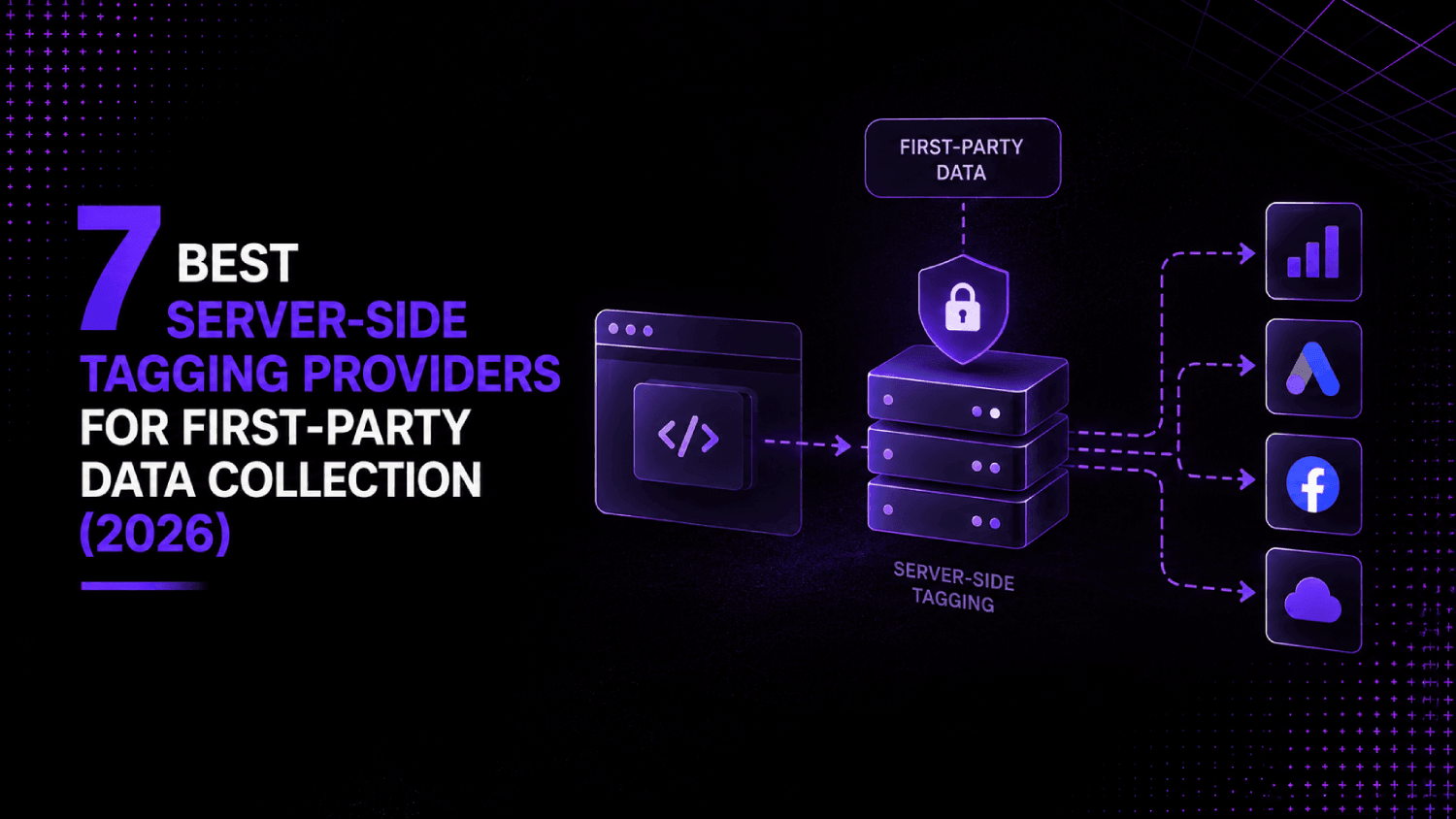
The underlying business case has also sharpened. Client-side tags fire in the browser, which means every ad blocker, privacy extension, and Safari Intelligent Tracking Prevention policy can intercept them. Server-side tagging moves tag firing to a server you control under your own subdomain, so the request looks like a first-party call from the browser’s perspective. The practical outcome is more complete event streams reaching Google Ads, Meta, and your analytics stack. If you are trying to measure marketing ROI without third-party cookies, a working sGTM setup is the infrastructure layer that makes that possible.
What Should You Actually Compare When Evaluating sGTM Hosting Providers?
The AboutMartech Container-Fit Checklist distills the decision into five checkpoints. Run every provider on this list through all five before signing up.
- Custom domain routing: Does the provider support your own subdomain (e.g., analytics.yourdomain.com) so requests appear first-party to browsers and ad blockers? Some budget providers route through shared domains, which defeats the purpose.
- Cookie lifetime extension: Can the provider write cookies server-side with a longer expiry than the 7-day ITP cap on client-side JavaScript cookies? This is the core mechanism for improving attribution windows on Safari traffic.
- Consent Mode v2 compatibility: Does the setup pass Google’s Consent Mode v2 signals correctly through the server container? Required for EU compliance and Google’s own conversion modeling.
- Data residency and region selection: Where does the container run? EU-based teams with GDPR obligations need a provider that can host in a European region with contractual data processing agreements.
- Autoscaling and SLA: Does the provider handle traffic spikes (think Black Friday or a product launch) without manual intervention, and is there a published uptime commitment?
No single provider wins every checkpoint for every team. The sections below map each provider to the teams it actually fits.
The 7 Best Server-Side Tagging Providers Compared
| Provider | Best For | Pricing Model | Custom Domain | Cookie Lifetime Extension | Consent Mode v2 | EU Hosting |
|---|---|---|---|---|---|---|
| Stape | Self-serve teams, agencies, Shopify | From $10/mo (public pricing page) | Yes | Yes | Yes | Yes |
| Addingwell | Teams prioritizing UI and support | From €29/mo (public pricing page) | Yes | Yes | Yes | Yes |
| Adswerve | Mid-market needing implementation help | Quote-based | Yes | Yes | Yes | Varies by contract |
| MeasureMinds | UK/EU teams needing managed services | Quote-based | Yes | Yes | Yes | Yes |
| TraceDock | DTC brands, privacy-first | Quote-based | Yes | Yes | Yes | Yes |
| Piwik PRO Tag Manager | Regulated industries, healthcare, finance | Free tier; enterprise quote-based | Yes | Yes | Yes | Yes |
| MetaRouter | Enterprise event-stream orchestration | Quote-based | Yes | Yes | Yes | Yes |
1. Stape
Stape is the most feature-dense managed sGTM host available at a self-serve price point. It provisions a Google Cloud-based server container, handles custom subdomain setup, and ships a set of “power-ups” (their term) that add server-side first-party cookies, user data enrichment, and data layer manipulation without writing custom code. The pricing starts at $10/month according to Stape’s public pricing page, which makes it accessible to single-site operators and agencies managing dozens of client containers at volume discounts.
Stape’s cookie lifetime extension is its most-cited feature: it writes a first-party cookie server-side, bypassing Safari’s ITP cap and giving your attribution window a realistic chance of capturing returning visitors. For Shopify merchants specifically, Stape offers a Shopify-native integration that maps data layer events to the sGTM container without custom JavaScript. That is why it consistently appears as the default recommendation in Shopify analytics communities.
The trade-off is documentation quality. Stape’s knowledge base is extensive but uneven, and the UI has accumulated enough features that new users sometimes struggle with sequencing. Support is primarily async. Teams that need hand-holding during setup will find Addingwell or a managed-service provider a better fit.
2. Addingwell
Addingwell is the provider that wins on experience over raw feature count. Its onboarding flow is notably more guided than Stape’s, and the dashboard surfaces container health, request volume, and cookie status in a single view that non-technical marketers can actually read. Pricing starts at €29/month per their public pricing page, with EU hosting included by default.
Addingwell’s Consent Mode v2 integration is tightly built. It reads consent signals from the most common CMPs (Cookiebot, OneTrust, Axeptio) and passes them correctly through the server container to Google’s downstream systems, which matters for European advertisers who need compliant conversion modeling. Cookie lifetime extension works on the same server-side mechanism as Stape, so the technical outcome is equivalent.
Where Addingwell lags is the breadth of additional integrations. Stape ships more pre-built server-side templates for destinations like Reddit, TikTok, and Pinterest. Addingwell’s template library is growing but still smaller. Teams running a narrow set of ad platforms (Google, Meta, GA4) will not notice the gap. Teams with a broader martech stack might.
3. Adswerve
Adswerve is a Google Marketing Platform partner that bundles sGTM hosting with implementation services. Unlike Stape and Addingwell, which are pure hosting products, Adswerve sells a managed engagement: they configure the container, set up conversion tracking, build the data layer, and hand it off. Pricing is quote-based and reflects that services component.
This model suits marketing teams at mid-market companies (roughly 100 to 500 employees) where there is budget for a one-time implementation but no in-house tagging expertise to maintain the setup afterward. The risk is cost creep: change requests post-launch go back to Adswerve’s services team rather than being self-served. Teams that want ongoing control without a retainer should consider Stape or Addingwell instead.
4. MeasureMinds

MeasureMinds is a UK-based measurement consultancy that operates its own managed sGTM hosting infrastructure. Like Adswerve, the value proposition is implementation plus hosting in a single engagement. MeasureMinds has a particular depth in Google Analytics 4 migration work, and teams that need both a GA4 audit and a server-side tracking setup can consolidate those projects with one vendor.
EU/UK data residency is a first-class consideration in MeasureMinds engagements, which makes it a natural fit for UK and European brands post-Brexit navigating GDPR obligations. Pricing is quote-based and varies significantly by project scope. For teams that need execution rather than a tool to self-configure, MeasureMinds is worth a discovery call.
5. TraceDock
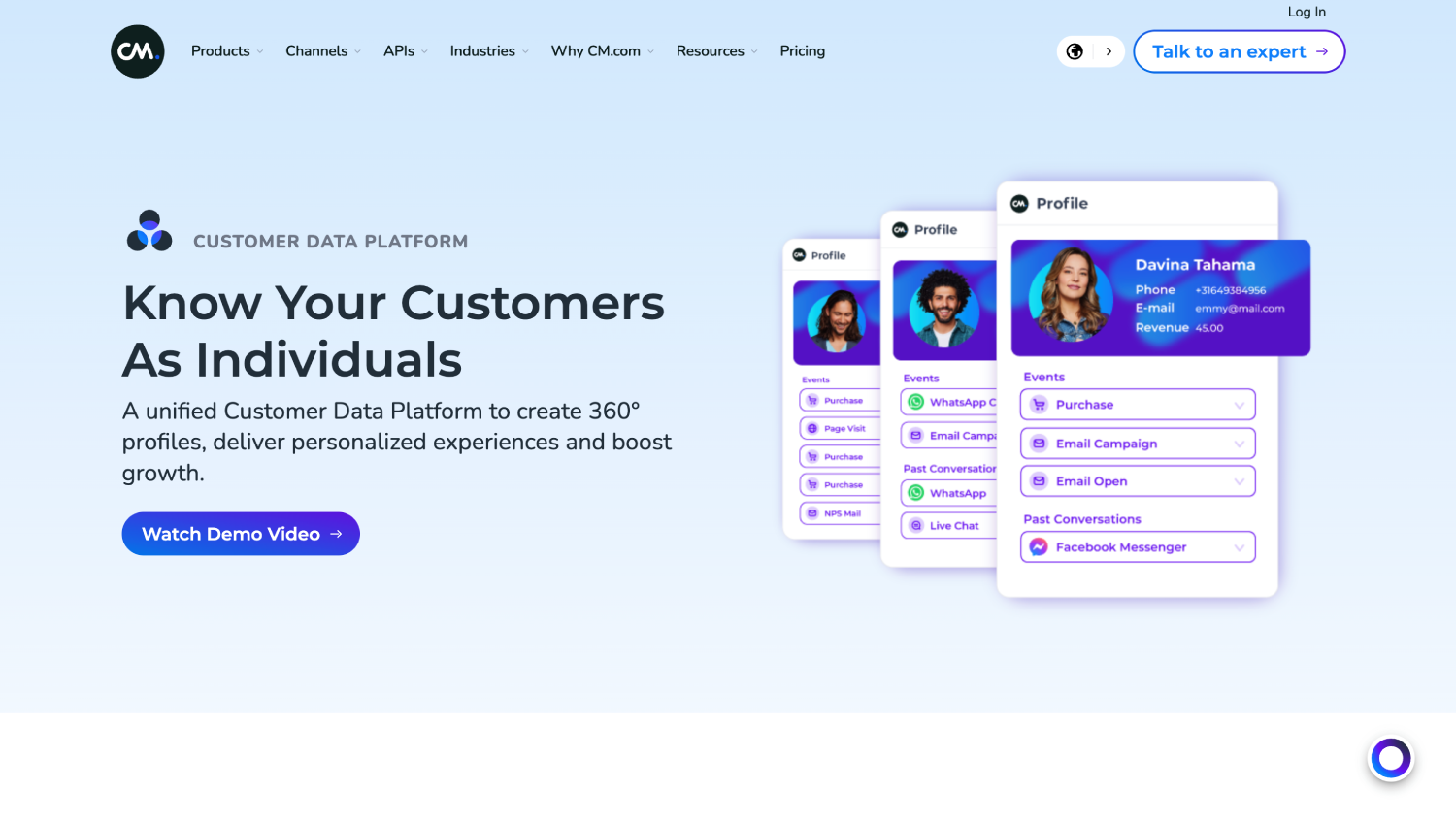
TraceDock positions itself as a first-party data infrastructure layer rather than a GTM hosting utility. It intercepts requests client-side, routes them through a server-side container on your own domain, and enriches the event stream with first-party signals before sending to ad platforms and analytics. The architecture is designed explicitly around ad-blocker resilience and ITP bypass.
TraceDock works well for DTC e-commerce brands where cart abandonment, product view, and checkout events have a direct revenue value, and where losing 20 to 30 percent of those events to client-side blocking creates measurable budget waste. Pricing is quote-based. The vendor does not publish a rate card, but the positioning suggests mid-market and above. Smaller Shopify stores will likely find Stape’s self-serve tier more accessible.
6. Piwik PRO Tag Manager
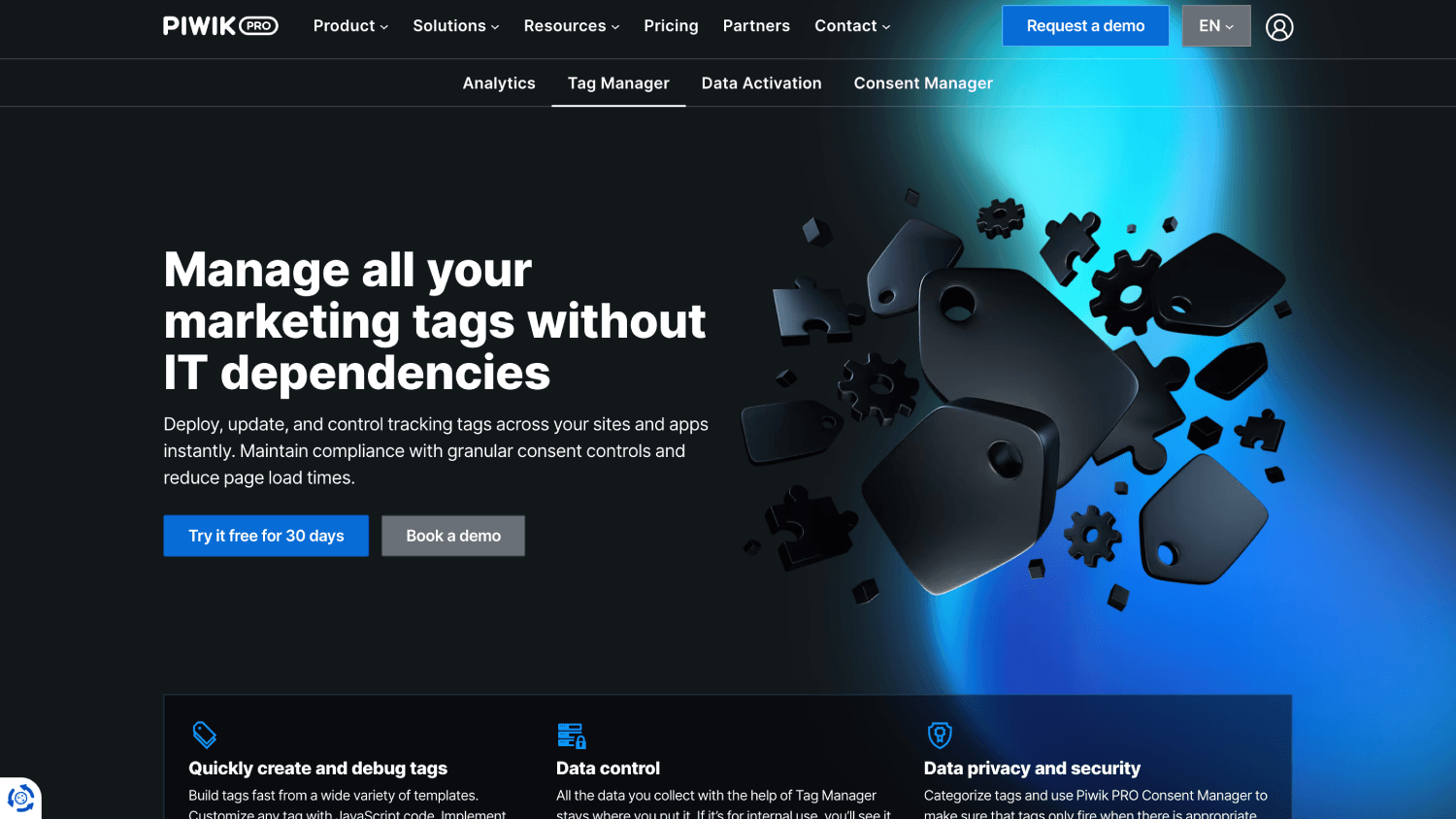
Piwik PRO Tag Manager is the server-side tagging option for organizations where data sovereignty is non-negotiable. Healthcare, financial services, government, and education buyers who cannot route data through US-headquartered infrastructure will find Piwik PRO’s EU-hosted, GDPR-by-design architecture the primary draw. A free tier exists for lower-traffic sites; enterprise pricing is quote-based.
Piwik PRO Tag Manager integrates natively with Piwik PRO Analytics Suite and its built-in consent manager. Teams already inside the Piwik PRO stack get a coherent setup without stitching together separate tools. Teams on GA4 or Mixpanel will face more integration work. If your analytics layer is Piwik PRO, the Tag Manager is an obvious addition. If it is not, the hosting-only use case may not justify switching.
7. MetaRouter

MetaRouter operates at a different scale than every other provider on this list. It is an enterprise event-stream platform that handles server-side tag management as one function within a broader data orchestration architecture. Think of it as the intersection of a CDP’s event pipeline and a server-side tagging layer. As noted in existing market coverage, MetaRouter is built for large-scale data orchestration rather than SMB self-serve.
Pricing is entirely quote-based and enterprise-level. The buyer profile is a head of data or VP of engineering at a company processing hundreds of millions of events monthly, not a marketing ops manager at a 50-person SaaS company. MetaRouter’s presence on this list is for completeness: if your event volume has outgrown the scalability ceilings of managed sGTM hosting, MetaRouter is where that conversation goes. For most teams reading this article, Stape or Addingwell is the correct starting point. MetaRouter is what you graduate to when you have a dedicated data engineering team and a reason to treat your event pipeline as a competitive asset. If you are already thinking about that trajectory, the broader conversation about customer data platforms for B2B teams and how a data activation layer fits into that picture is relevant context.
Self-Hosting vs. Managed Hosting: Which Actually Makes Sense?
Self-hosting a server-side GTM container on Google Cloud Run or AWS is possible. Google’s own documentation walks through the setup, and the infrastructure cost for a low-traffic site can run under $10/month in compute. That number is real. The total cost of ownership is not that number.
Consider what self-hosting actually requires: initial GCP or AWS setup, SSL certificate provisioning, load balancer configuration, autoscaling rules, container updates when Google releases a new sGTM image, and incident response when the container crashes at 2 a.m. on the day of a campaign launch. For a team with a dedicated DevOps engineer who already manages cloud infrastructure, none of that is a serious obstacle. For a marketing ops team of two people running paid media, analytics, and email automation simultaneously, it is a significant ongoing tax on bandwidth.
Managed hosting providers charge a margin over infrastructure cost, but what they sell is the elimination of that maintenance overhead. At Stape’s entry price of $10/month, the managed option is not materially more expensive than self-hosting for a single container. At higher container counts (agencies managing 20 to 50 clients), Stape’s volume pricing structures make it competitive with the DIY path even on pure cost. The self-hosted path is defensible for companies with strong engineering capacity and a philosophical preference for infrastructure control. For everyone else, managed hosting is the correct default.
How Does Server-Side Tagging Actually Improve Conversion Tracking Accuracy?
The mechanism is specific and worth understanding before you buy anything. When a tag fires client-side in a browser, it is subject to every browser-level privacy intervention in that session: uBlock Origin, Privacy Badger, Brave’s shield, Safari’s ITP rules, Firefox’s Enhanced Tracking Protection. Any of these can block the tag from firing, or allow it to fire but then strip the third-party cookie the tag tries to write. The result is a conversion event that happened but was never recorded.
Server-side tagging changes the architecture. The browser sends one request to your own subdomain (analytics.yourdomain.com, for example). That request hits your sGTM container, which then fans out to Google Ads, Meta CAPI, GA4, and any other endpoint you have configured. From the browser’s perspective, it made a first-party call to your own domain, which ad blockers and ITP do not treat as a tracking request. The cookie written by the server response is a first-party cookie on your domain, so it is not subject to ITP’s 7-day cap on third-party cookies.
The practical lift in event recovery varies by traffic composition. Sites with high Safari traffic (often over 30 percent of sessions on consumer-facing e-commerce and media properties) and audiences that skew toward technically sophisticated users (higher ad blocker adoption) see the largest gains. A useful illustrative scenario: say a DTC brand drives 50,000 monthly sessions, roughly 35 percent on Safari, with an estimated 15 percent of sessions running an ad blocker. Client-side tagging is missing a meaningful portion of those purchase events. Server-side routing recovers a significant share of them, with the exact percentage depending on setup quality, tag configuration, and which specific blockers are in use. The improvement in data completeness shows up in lower CPA estimates in Google Ads and better match rates in Meta’s Conversions API, because the signal reaching the platform is more complete.
This is also why server-side tagging connects directly to attribution quality. If you are investing in marketing attribution tools, the data layer feeding those tools needs to be complete first. Incomplete event streams produce attribution models that systematically undercount assisted conversions.
Stape vs. Addingwell: Which Is Actually Better?
This is the most-searched comparison in the sGTM hosting market, and the answer differs by team type rather than being interchangeable. Stape wins on three dimensions: template library breadth, power-up feature depth, and Shopify-specific integration quality. Addingwell wins on three different dimensions: UI clarity, Consent Mode v2 implementation quality for EU CMP workflows, and support responsiveness for non-technical users.
The practical decision point is implementation confidence. If your team includes someone who has configured GTM containers before and is comfortable reading documentation to troubleshoot, Stape’s additional features are accessible and valuable. If your team is primarily media buyers or growth marketers without a dedicated analyst, Addingwell’s guided setup and cleaner dashboard reduce the risk of a misconfiguration that silently drops events. A misconfigured sGTM container that appears to work but misroutes consent signals is worse than no server-side setup at all, because it gives false confidence in data quality.
For Shopify brands specifically: Stape’s native Shopify integration and its community of Shopify-focused documentation make it the default recommendation. For EU-based brands with complex CMP setups: Addingwell’s Consent Mode v2 workflow is worth the slight premium in template library limitations.
What Does Server-Side GTM Cost?
Cost breaks into two components: the hosting fee and the implementation cost. Hosting fees for self-serve managed providers range from roughly $10/month (Stape’s entry tier, per their public pricing page) to €29/month (Addingwell’s entry tier, per their public pricing page). Both scale with request volume and container count. At low traffic volumes, the monthly hosting cost is not a meaningful budget line item.
Implementation cost is where the real variation appears. Setting up a single-container sGTM deployment with custom domain, GA4 routing, Google Ads conversion tracking, and Meta CAPI integration is a 4 to 8 hour project for an experienced implementation consultant. Consulting rates for sGTM specialists range widely, but expect $150 to $250/hour for competent independent specialists and higher for agency engagements. A fully configured setup through Adswerve or MeasureMinds as a project engagement will cost materially more but includes ongoing support.
The build-vs-buy calculation for implementation also depends on whether your team will maintain the container ongoing. Templates require updates when ad platforms change their event schemas. Consent Mode configurations need to be validated after CMP updates. A marketing team that treats sGTM as a fire-and-forget infrastructure investment will find the container degrading in accuracy over 12 to 18 months without maintenance. Budget for quarterly audits, not just initial setup.
Server-Side Tagging for Shopify: What Works and What Doesn’t
Shopify’s native tracking stack runs through its own pixel system, which adds a layer of complexity that does not exist on custom-built sites. Shopify’s checkout pages restrict direct JavaScript injection in ways that standard GTM setups assume are available. Server-side tagging solves some of these problems but not all of them.
What works well: routing Shopify’s server-side pixel events through an sGTM container to Google Ads and Meta CAPI. Shopify emits purchase, add-to-cart, and checkout events server-side natively, and Stape’s Shopify integration maps these to sGTM variables without requiring a client-side data layer. This gives you server-to-server event transmission for your highest-value conversion events, with no browser dependency at all.
What requires careful setup: product view and add-to-cart events on non-checkout pages still benefit from a hybrid approach, using a client-side GTM container to capture browse-level events and the server container to forward them. Shopify headless deployments (Hydrogen, for example) require custom data layer implementation that sits outside what any managed sGTM provider handles for you. For a broader look at the SMS and retention tooling that goes alongside Shopify’s tracking infrastructure, the roundup of SMS marketing apps for Shopify covers the retention side of the stack.
How Does Server-Side Tagging Fit into a First-Party Data Strategy?
Server-side tagging is the collection layer of a first-party data strategy, not the strategy itself. It answers the question “how do we get clean, complete event data into our systems?” The downstream questions, what to do with that data, how to activate it, and how to model it, require additional infrastructure.
A complete first-party data stack typically has four layers: collection (sGTM), storage (a data warehouse like BigQuery or Snowflake), activation (reverse ETL tools that push warehouse data back to ad platforms and CRMs), and measurement (attribution and analytics). Server-side tagging improves the fidelity of the collection layer, which propagates upstream improvements to everything that depends on clean event data. Gaps at collection produce compounding errors in storage, activation, and measurement. The guide on building a first-party data stack after cookie deprecation maps all four layers in detail. For the activation layer specifically, reverse ETL tools handle the job of pushing enriched first-party data from your warehouse back to ad platforms and CRMs.
Frequently Asked Questions
What is server-side GTM, and how is it different from standard GTM?
Standard Google Tag Manager runs a JavaScript container in the user’s browser, where it is subject to ad blockers, browser privacy settings, and ITP restrictions. Server-side GTM runs a container on a server you control, typically under your own subdomain. The browser sends one first-party request to your server, and the container forwards that event to Google Ads, GA4, Meta, and other endpoints. The result is better ad-blocker resilience, longer cookie lifetimes, and more control over what data leaves your infrastructure.
Is server-side tagging legal under GDPR?
Server-side tagging is a data transport mechanism, not an exemption from consent requirements. GDPR and ePrivacy rules apply to the data being collected and shared, not specifically to whether the tag fires client-side or server-side. A properly configured sGTM setup with Consent Mode v2 will gate event forwarding to third-party platforms on user consent, the same as a client-side setup. The legal obligation is on the data controller to confirm consent signals are honored. Routing data server-side without a working consent integration does not make tracking more legal; it may make it less visible to auditors.
How much does Stape cost?
According to Stape’s public pricing page, the entry tier starts at $10/month per container and scales based on request volume and the number of active containers. Agencies managing multiple client accounts can access volume pricing. Stape also charges separately for some power-up features beyond the base hosting. The total monthly cost for a single-site operator with moderate traffic stays in the low double digits; agencies with 20 or more active containers should get a quote for volume rates directly from Stape.
Can I self-host sGTM instead of using a managed provider?
Yes. Google’s documentation covers deployment on Google Cloud Run and App Engine. The infrastructure cost for low-volume sites is typically under $10/month. The real cost is setup time and ongoing maintenance: container updates, SSL management, autoscaling configuration, and incident response. Teams with dedicated DevOps capacity and a preference for infrastructure control can self-host effectively. Marketing teams without that capacity will spend more time on infrastructure maintenance than on the measurement work the infrastructure is supposed to support.
Does server-side tagging actually improve conversion tracking accuracy?
Yes, with the caveat that the magnitude depends on your traffic composition. Sites with high Safari traffic and audiences with above-average ad blocker adoption see the largest gains, because those are the segments where client-side tags fail most often. Server-side routing recovers events that ad blockers suppress and writes cookies with longer lifetimes than ITP allows client-side. The improvement shows up as higher event match quality in Meta’s Conversions API and more complete conversion data in Google Ads, both of which feed into better automated bidding performance.
Which server-side tagging provider is best for Shopify?
Stape is the most practical choice for most Shopify merchants. It has a native Shopify integration that maps Shopify’s server-side pixel events to an sGTM container without custom JavaScript, supports custom subdomain routing, and publishes Shopify-specific documentation. Addingwell is a reasonable alternative for EU-based Shopify stores with complex consent requirements. Headless Shopify deployments require custom data layer work that goes beyond what any managed provider handles automatically, and typically need an implementation specialist regardless of which hosting provider you choose.
What is cookie lifetime extension, and why does it matter?
Cookie lifetime extension refers to writing a first-party cookie via a server-side HTTP response rather than via JavaScript in the browser. Safari’s ITP limits JavaScript-written cookies to a 7-day expiry in most cases. A cookie written by a server response on your own domain can have a much longer expiry, typically set by the vendor to 365 days or more. For attribution purposes, this means a user who clicks an ad today and purchases three weeks later can still be attributed to that original session, rather than appearing as direct traffic because the cookie expired under ITP rules.
The Hosting Decision Is Also an Architecture Decision
Choosing among server-side tagging providers is not just picking a place to run a container. It is choosing the architecture that governs how your event data flows, how consent signals propagate, and how much maintenance burden your team absorbs over the next two to three years. A provider switch after a fully configured deployment is possible but painful: custom templates, data layer variables, and tag configurations do not transfer automatically between hosting environments.
The practical implication is that teams should choose a provider that matches their current technical capacity, not their aspirational one. If the team cannot maintain a self-hosted setup today, self-hosting to save $15/month is a false economy. If Stape’s feature depth requires more documentation time than the team has, Addingwell’s cleaner UX is worth the slightly smaller template library. The right provider is the one that produces a working, maintained, audited container in production, not the one with the best feature list on a comparison table.
The longer-term insight is that server-side tagging is the foundation of a measurement modernization project, not the endpoint. Once the collection layer is reliable, the conversation shifts to what to do with clean data at scale: warehouse storage, enrichment, and activation. That is where the tools covered in the broader modern marketing data stack for RevOps teams become relevant. Server-side tagging earns its place in that stack by making everything downstream trustworthy.