Most teams that look for Hightouch alternatives are not unhappy with the sync engine. They are reacting to what Hightouch has become: a Composable CDP and an Agentic Marketing Platform sold as separate, usage-based products, with no public paid price and the marketer-facing Customer Studio limited to the Business tier (Hightouch pricing, Hightouch docs). If you only need warehouse data in Salesforce or HubSpot, that can be more platform than you need. If marketers are the main users, you may want a different audience builder or a bill you can predict.
We read the pricing pages, docs and G2 profiles of Hightouch and six alternatives on November 11, 2026, and compared them on who each one is built for, how it bills, what is free and what the switch involves. For the wider market, start with our list of reverse ETL tools.
TLDR
Short answer: If you only need reverse ETL and already load data with Fivetran, move to Fivetran Activations (formerly Census). If engineers own the pipeline and you also need event collection, pick RudderStack. If marketers own activation and want a no-code audience builder, shortlist GrowthLoop or DinMo, or RudderStack’s new Lookout. Pick Polytomic for two-way syncs and self-hosting, and stay with Twilio Segment if you already pay for it.
- How Hightouch bills: active syncs, not rows or tracked users. Free covers 2 active syncs a month, Self-serve 10, both limited to hourly syncs. Business adds a platform fee and add-ons.
- Lowest published paid prices: Twilio Segment Team from $120 a month, RudderStack Growth $265 a month, Polytomic from $500 a month.
- Newest marketer option: RudderStack Lookout, from $12,000 a year with 40,000 activated records, billed once per person, per audience, per destination.
- No public price: GrowthLoop and DinMo, both composable CDPs built for marketers.
- G2 ratings: Hightouch 4.6 (425 reviews); DinMo 4.9 (18), Polytomic 4.8 (58), GrowthLoop 4.7 (112), RudderStack 4.7 (52), Twilio Segment 4.5 (567).
In this guide
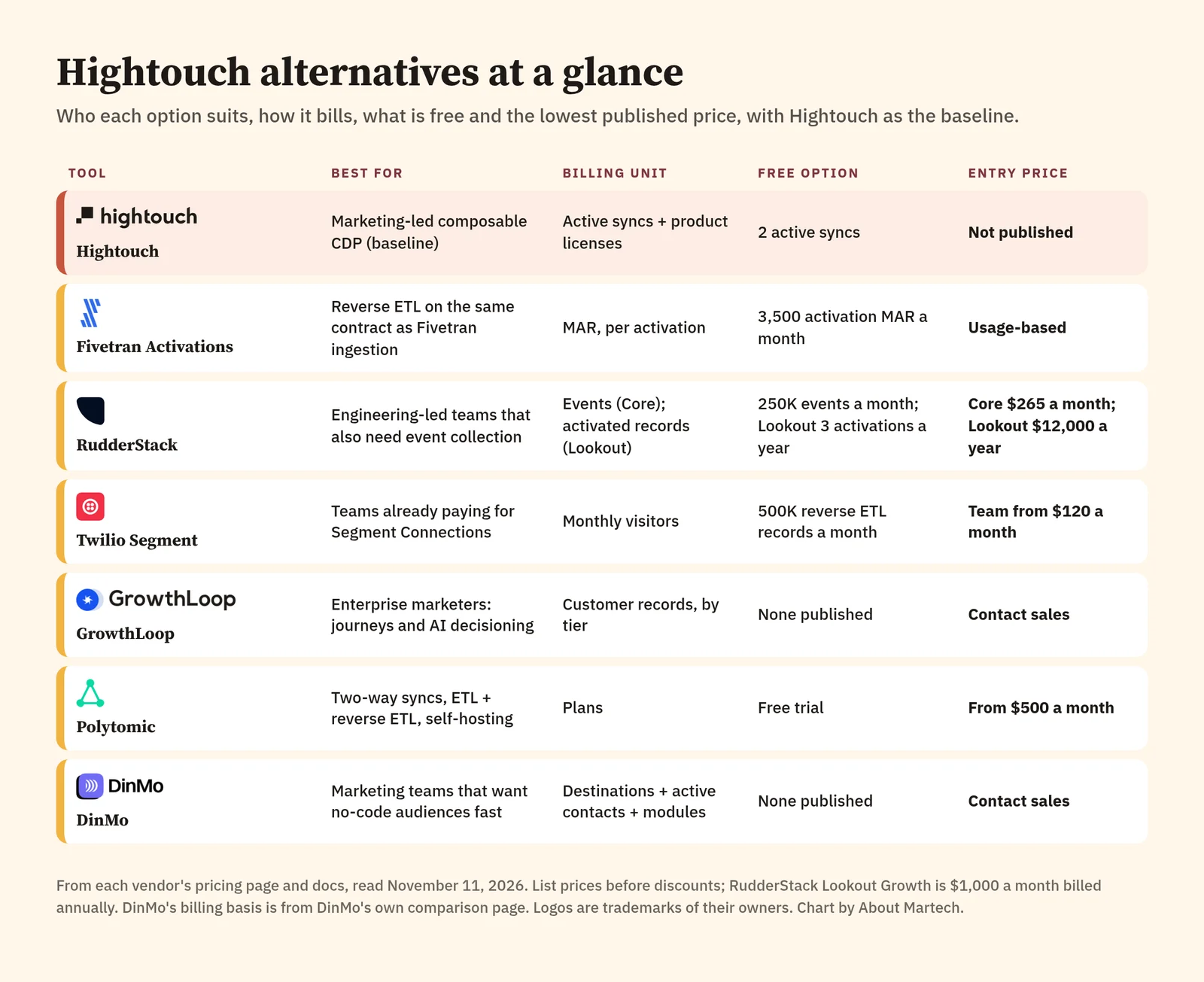
Hightouch alternatives at a glance
| Tool | Best for | Billing unit | Free option | Lowest published price |
|---|---|---|---|---|
| Hightouch (baseline) | Marketing-led composable CDP | Active syncs, plus product licenses | 2 active syncs | Not published |
| Fivetran Activations | Teams already on Fivetran | Monthly active rows (MAR), per activation | 3,500 activation MAR a month | Usage-based; estimator only |
| RudderStack | Engineering-led teams that also need event collection | Events (Core); activated records (Lookout) | 250,000 events a month; Lookout 3 activations a year | Core Growth $265 a month; Lookout $12,000 a year |
| Twilio Segment | Teams already paying for Segment | Monthly visitors, with reverse ETL records included | 1,000 visitors and 500,000 reverse ETL records a month | Team from $120 a month |
| GrowthLoop | Enterprise marketers who want journeys and AI decisioning | Customer records, by tier | None published | Contact sales |
| Polytomic | Two-way syncs, ETL plus reverse ETL, self-hosting | Plans | Free trial | From $500 a month |
| DinMo | Marketing teams that want no-code audiences fast | Destinations, monthly active contacts and modules | None published | Contact sales |
Sources: Hightouch, Fivetran, RudderStack, Twilio Segment, GrowthLoop, Polytomic, DinMo, read November 11, 2026.
Why teams look for a Hightouch alternative
Hightouch is not a weak product. Gartner put it straight into the Leaders quadrant on its first appearance in the January 2026 Magic Quadrant for Customer Data Platforms, praising its early lead in warehouse-native CDPs (CX Today), and it holds a 4.6 out of 5 rating from 425 G2 reviews (G2). The reasons people switch are about fit and billing:
- The product grew past reverse ETL. Hightouch now sells a Composable CDP (Reverse ETL, Events, Customer Studio, Identity Resolution, Match Booster, Real-time Personalization) and an Agentic Marketing Platform (Ad Studio, Lifecycle Studio, AI Decisioning), and it can now send email, SMS and push messages itself (Hightouch pricing, Hightouch docs). One Reddit user who had used Hightouch at a previous job called it “honestly too powerful” for a Series A startup (Reddit).
- No public paid price. Business tier pricing “typically includes” a platform fee, which can include consumption pricing on active syncs, plus optional add-ons such as Customer Studio (Hightouch Business tier docs).
- Marketer features sit on the Business tier. Customer Studio, the no-code audience builder, is only available on Business plans (Hightouch docs). Free and Self-serve are limited to hourly syncs and one workspace (Hightouch self-serve docs).
- Data work stays with you. Gartner’s caution is that Hightouch makes data engineering the customer’s job, which suits mature data teams but not buyers who expect the vendor to model data (CX Today). G2 reviewers say the same: one wrote that without a well-modeled warehouse the software is “essentially unusable” (G2).
How Hightouch counts usage
An active sync is any sync that ran at least once in the previous calendar month, including syncs you later paused or deleted, and the count resets monthly (Hightouch). Destinations, seats and sync runs are unlimited on self-serve plans, with a cap of 100 million operations a month. Hightouch says it has “no MTU (Monthly Tracked Users) limits” (Hightouch pricing). Some comparison pages still describe Hightouch as billing on tracked users or rows, which does not match its current pricing page.

The billing unit matters more than the list price. On Hightouch, two audiences each synced to Meta and Braze are four syncs. On RudderStack Lookout, one customer who is in both audiences and synced to both tools is four activated records, but only the first time. On Fivetran, Snowflake to Salesforce and Snowflake to HubSpot are two activations, each on its own cost curve.
6 Hightouch alternatives compared
1. Fivetran Activations (formerly Census): best for reverse ETL on the same contract as ingestion
| Best for | Teams that already load their warehouse with Fivetran |
| Entry price | Free up to 3,500 activation MAR a month; paid is usage-based |
| Billing unit | Monthly active rows, counted per activation |
Census, Hightouch’s oldest rival, is now Fivetran Activations: managed reverse ETL pipelines that send warehouse data to business tools without code (Fivetran docs). Usage is measured in monthly active rows (MAR), tracked per activation, and each activation follows its own cost curve, with the per-row cost falling as usage grows. The Free plan includes 3,500 activation MAR a month across the account, and every new activation gets a 14-day trial (Fivetran usage-based pricing).
Standard lists 15-minute syncs and 200+ managed activation destinations. Audience Hub, the no-SQL segment builder, and 1-minute syncs are Enterprise features. Annual contracts save up to 22% (Fivetran pricing). If you run old Census scripts, note that Activations API V1 and workspaces retire on January 15, 2027 (Census migration FAQ).
Where it beats Hightouch: one vendor and one bill for ingestion and activation. Where it falls short: the marketer builder is Enterprise-only, and many small activations can cost more per row than one large one. Our Census alternatives guide works through Fivetran’s pricing examples, and Hightouch vs Census compares the two head to head.
2. RudderStack: best for engineering teams that also need event collection
| Best for | Data teams that want event streaming, reverse ETL and a marketer layer from one vendor |
| Entry price | Core free (250,000 events a month); Growth $265 a month; Lookout from $12,000 a year |
| Billing unit | Events (Core); activated records (Lookout) |
RudderStack now sells two products. RudderStack Core collects, governs and streams customer data and includes reverse ETL. Free covers 250,000 events a month with 16 SDK sources and 200+ cloud destinations. Growth costs $265 a month for 1 million events, with 25 reverse ETL connections and 30-minute warehouse syncs, and annual billing saves 15%. Enterprise adds 5-minute syncs, Profiles, HIPAA and SSO (RudderStack pricing).
Lookout is new and aimed squarely at Hightouch’s Customer Studio: an AI agent that analyzes warehouse data, builds audiences in plain English and syncs them to ad platforms, CRMs and engagement tools, with read-only warehouse access and an MCP server (RudderStack Lookout). It bills once per person, per audience, per destination; attribute updates, re-syncs and removals are not billed. Free includes 3 activations a year with up to 5,000 records per sync, Growth starts at $1,000 a month billed annually with 40,000 activated records a year, and Lookout does not require RudderStack Core (RudderStack pricing).
Where it beats Hightouch: published prices, a free plan that includes reverse ETL, and a marketer tool you can price before a sales call. Where it falls short: Growth caps reverse ETL at 25 connections, and G2 reviewers describe RudderStack as developer-friendly but harder for less technical users (4.7 out of 5 from 52 reviews, G2). See RudderStack vs Hightouch for a deeper comparison.
3. Twilio Segment: best for teams already paying for Segment
| Best for | Companies that already collect events with Segment Connections |
| Entry price | Free; Team from $120 a month |
| Billing unit | Monthly visitors, with reverse ETL records included |
Segment’s Connections plans include reverse ETL. Free covers 1,000 visitors and 500,000 reverse ETL records a month, with 2 sources and one warehouse destination. Team starts at $120 a month for 10,000 visitors and 1,000,000 reverse ETL records. Business is custom, and Twilio labels the page “pricing current as of October 2026” (Twilio Segment pricing). The full CDP, with Unify profiles and Engage audiences and journeys, is sold by quote (Segment CDP pricing).
Gartner rates Twilio a Niche Player, crediting more than 700 prebuilt connectors and its consent integrations, but noting limited account hierarchy support for B2B and uncertainty about standalone CDP investment (CX Today). Segment holds 4.5 out of 5 from 567 G2 reviews (G2).
Where it beats Hightouch: if you already pay for Segment, warehouse syncs may cost nothing extra up to the record limit. Where it falls short: the bill follows visitor volume, so it rarely makes sense to adopt Segment only for reverse ETL. Read Hightouch vs Segment and our Segment pricing breakdown.
4. GrowthLoop: best for enterprise marketers who want journeys and AI decisioning
| Best for | Large B2C marketing teams on BigQuery, Snowflake or Databricks |
| Entry price | Contact sales |
| Billing unit | Customer records: up to 1 million, up to 10 million, or 10 million+ |
GrowthLoop calls itself an agentic, composable CDP. Marketers build audiences in a no-code interface, run multi-step, batch or real-time journeys, and use AI agents that suggest audiences and journeys, all on data that stays in BigQuery, Snowflake, Databricks or Redshift (GrowthLoop). Its pricing page lists three tiers by customer records, Basic (up to 1,000,000), Growth (up to 10,000,000) and Enterprise (10,000,000+), each with unlimited users, audiences and destinations, and every tier says “Contact Us” (GrowthLoop pricing).
GrowthLoop holds 4.7 out of 5 from 112 G2 reviews, with an average reported implementation time of 2 months. Reviewers praise how quickly non-SQL users build audiences; one said dataset setup “can be a bit tricky to configure correctly” (G2).
Where it beats Hightouch: the marketer workflow is the core product, and pricing tiers by customer records rather than sync counts. Where it falls short: no free tier or public price, and it is built for enterprise marketing teams, not a data team that only needs a few CRM syncs.
5. Polytomic: best for two-way syncs and self-hosting
| Best for | RevOps and data teams that sync in both directions or need to self-host |
| Entry price | From $500 a month |
| Billing unit | Standard and Enterprise plans, via a sales call |
Polytomic runs ETL, ELT, CDC streaming, reverse ETL and general syncs in one product, between warehouses, databases, SaaS apps, spreadsheets and HTTP APIs. It offers self-hosted deployment, fine-grained role-based permissions, audit logs and Terraform configuration, and says it is SOC 2, GDPR, CCPA and HIPAA compliant (Polytomic). Pricing “begins at $500/month”; Enterprise adds on-prem deployment, SSO, a dedicated engineer and phone support (Polytomic pricing).
Polytomic has 4.8 out of 5 from 58 G2 reviews, where support response time is the most common praise. One reviewer said they move more than 120 million rows a month through it; another called the UI “a bit clunky” (G2).
Where it beats Hightouch: true two-way syncs, ingestion and reverse ETL on one contract, and a self-hosted option. Where it falls short: no free plan, no marketer audience builder, and both plans need a sales call for a final price.
6. DinMo: best for marketing teams that want no-code audiences fast
| Best for | Marketing and acquisition teams, especially multi-brand groups |
| Entry price | Contact sales |
| Billing unit | Contracted destinations, monthly active contacts and selected modules |
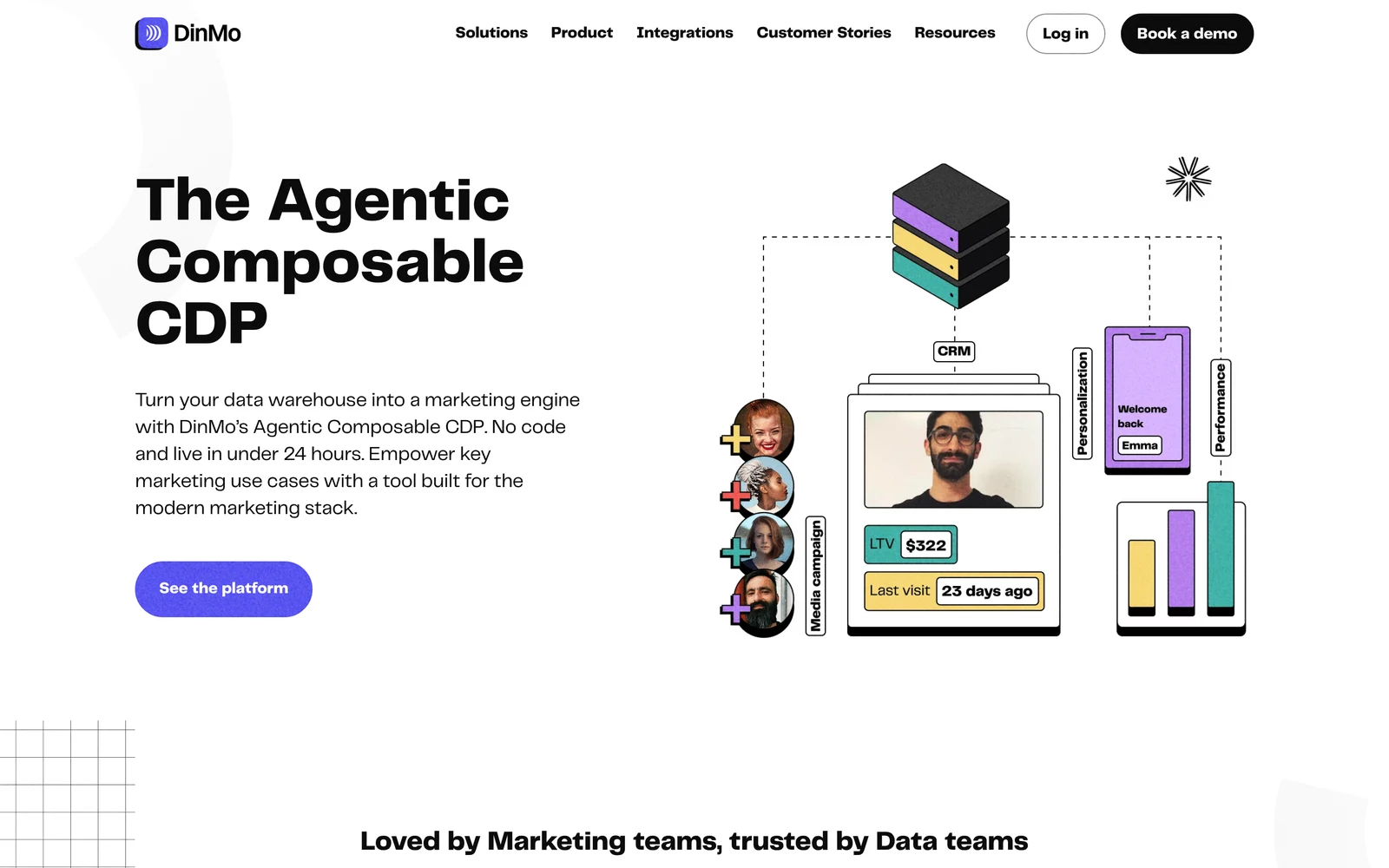
DinMo is an agentic, composable CDP that says teams can go live “in under 24 hours” (DinMo). It reads from BigQuery, Snowflake, Redshift, PostgreSQL and Databricks, includes a visual audience builder on every plan, and offers identity resolution on Business and Enterprise plans. Its journeys and Customer Hub sit in the Enterprise module (DinMo).
DinMo says it prices on contracted destinations, monthly active contacts and the modules you choose, not on the number or frequency of sync runs, so a contact synced repeatedly to the same destination in a month counts once. That claim comes from DinMo’s own comparison page, which also concedes Hightouch leads on connector breadth (300+ integrations), CDC and event streaming, and Git-based deployment (DinMo). It holds 4.9 out of 5 from 18 G2 reviews (G2).
Where it beats Hightouch: no-code audiences on every plan, and a pricing basis that does not grow with sync frequency. Where it falls short: a smaller destination catalog, fewer reviews, and no public price.
Which Hightouch alternative should you choose?
| Your situation | What we would shortlist |
|---|---|
| Fivetran already loads your warehouse and you need CRM or ad syncs | Fivetran Activations |
| Engineers own the pipeline and you also need event collection | RudderStack Core |
| Marketers want to build and price audiences without a sales call | RudderStack Lookout |
| Enterprise marketing team that wants journeys, experiments and AI decisioning | GrowthLoop |
| Marketing team that needs no-code audiences in days, across brands or countries | DinMo |
| You need two-way syncs, CDC or a self-hosted deployment | Polytomic |
| You already pay for Segment Connections | Twilio Segment reverse ETL |
| You need more than 300 destinations, CDC and Git-based controls | Stay on Hightouch |
Still deciding between building on your warehouse and buying a packaged CDP? Our guides to warehouse-native CDPs and warehouse-native activation explain the trade-offs, and reverse ETL pricing covers how costs scale.
How to migrate off Hightouch
Your dbt models and warehouse tables stay where they are, so a move is mostly about rebuilding syncs and audiences. A safe order:
- Inventory everything. List every model, audience, sync, destination object, sync key, mode and schedule, plus who owns each one.
- Check destination coverage. Confirm each destination and write mode exists in the new tool, especially ad platforms and Salesforce objects.
- Rebuild identity and audience logic. If you use Hightouch Identity Resolution or Customer Studio traits, recreate those rules first, before you move any audience syncs.
- Run in parallel. Point the new tool at the same models, sync to a test audience or sandbox, and compare record counts and match rates.
- Cut over one destination at a time. Pause the Hightouch sync before the new one writes to the same field, so two tools never overwrite each other.
- Time it to your contract. Business tier contracts are quote-based, so plan the switch around your renewal date.
For identity rules, our guide to identity resolution tools compares warehouse-first options.
How we chose these Hightouch alternatives
We read the pages that rank and get cited for “Hightouch alternatives”, including Reddit threads, vendor comparisons and G2. We kept tools that activate modeled warehouse data in business tools today, and split them into reverse ETL tools and marketer-first composable CDPs, since that is the real choice most Hightouch buyers face. We left out packaged CDPs that store their own copy of the data, which our Segment alternatives guide covers. Every price comes from the vendor’s pricing page or docs, read on November 11, 2026; where a vendor does not publish a price we say so. DinMo’s pricing basis comes from its own comparison page. We did not test each tool with production data, and no vendor paid to be included.
Frequently asked questions
What is the best Hightouch alternative?
It depends on who runs activation. For data teams that only need reverse ETL, Fivetran Activations (formerly Census) or RudderStack are the closest replacements. For marketing teams that want a no-code audience builder, GrowthLoop, DinMo and RudderStack Lookout compete with Hightouch Customer Studio.
How does Hightouch pricing work?
Hightouch prices on active syncs, meaning syncs that ran at least once in the previous calendar month. The Free plan includes 2 active syncs and the Self-serve plan 10, both limited to hourly syncs. Business tier pricing is quote-based and typically includes a platform fee plus add-ons such as Customer Studio.
Is there a free Hightouch alternative?
Yes. RudderStack Core is free for 250,000 events a month and includes reverse ETL, Twilio Segment Free includes 500,000 reverse ETL records a month, and Fivetran’s Free plan includes 3,500 activation MAR a month. RudderStack Lookout also has a free plan with 3 activations a year.
Is Census still a Hightouch competitor?
Yes, as Fivetran Activations. Fivetran acquired Census in 2025 and now sells it on monthly active rows, counted per activation. Census API V1 and workspaces retire on January 15, 2027.
What is the cheapest Hightouch alternative?
Among published prices, Twilio Segment Team starts at $120 a month, RudderStack Growth at $265 a month and Polytomic at $500 a month. GrowthLoop and DinMo do not publish prices, and Fivetran Activations is usage-based.
Does Hightouch charge per tracked user?
No. Hightouch says its usage-based pricing has no MTU (Monthly Tracked Users) limits and no caps on sources, destinations or seats. Self-serve plans bill on active syncs and cap operations at 100 million a month.
What is RudderStack Lookout?
Lookout is a RudderStack product for marketers that analyzes warehouse data, builds audiences in plain English and syncs them to ad platforms, CRMs and engagement tools. It bills once per person, per audience, per destination, and Growth starts at $1,000 a month billed annually with 40,000 activated records a year.
Do I lose data if I switch from Hightouch?
No. Hightouch reads from your warehouse and does not become the system of record, so your tables and models stay where they are. You rebuild sync configuration, audiences and any identity rules in the new tool.