- A CDP and a data warehouse are not interchangeable. One stores your data where you control it; the other copies it to a vendor’s infrastructure to use it.
- Where data physically lives determines your compliance exposure, your compute costs, and how fast a campaign audience can go from query to send.
- Zero-copy activation means the activation tool queries your warehouse directly, without pulling a replica to a separate system. That distinction matters for GDPR, HIPAA, and data residency requirements.
- Reverse ETL and warehouse-native CDPs solve the same problem differently. Reverse ETL is a pipe; a warehouse-native CDP adds identity resolution, audience management, and governance on top of that pipe.
- SQL-fluent marketing teams and engineering-light teams need different tooling from the same warehouse. The architecture choice should precede the vendor shortlist.
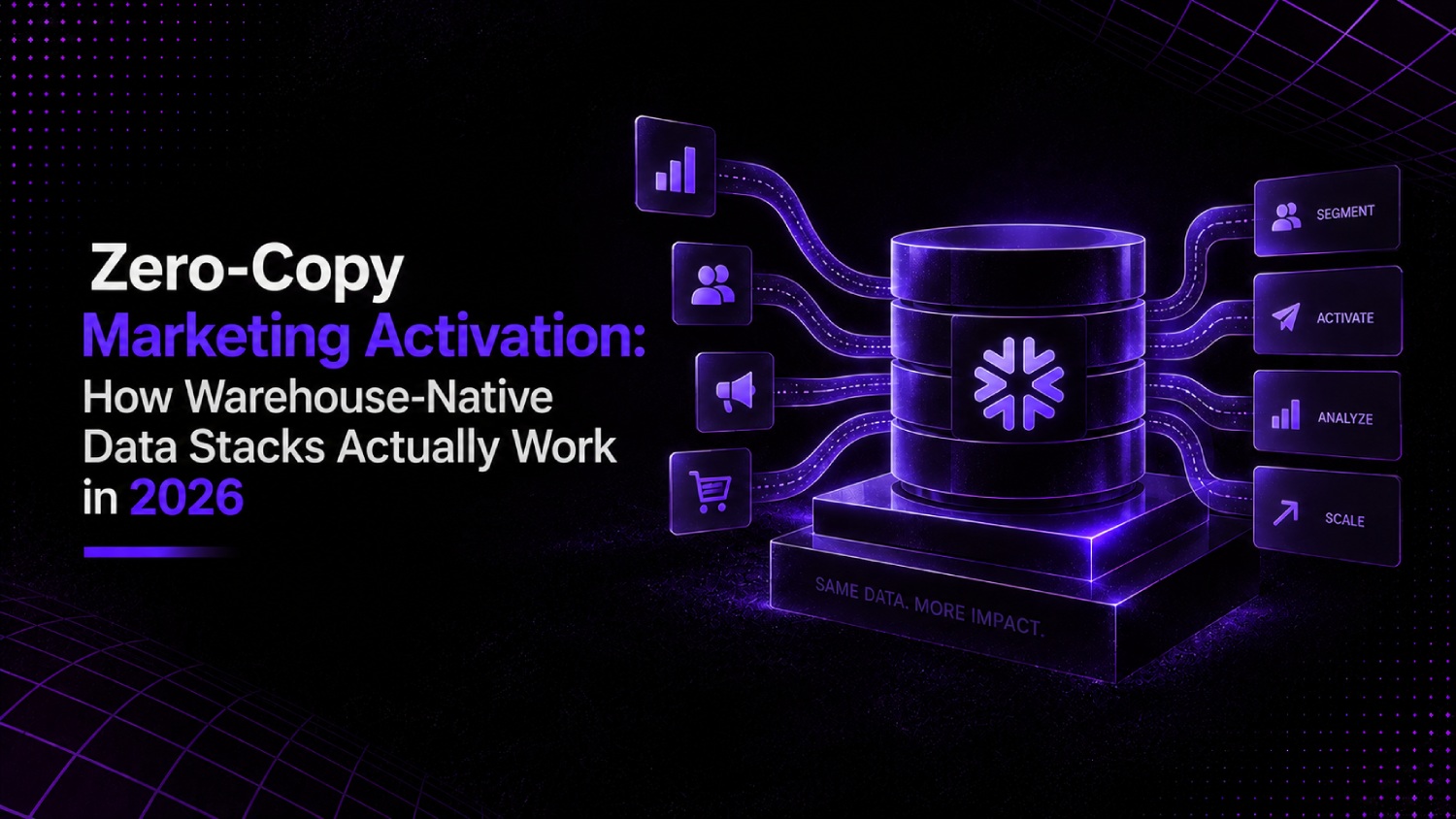
Warehouse-native activation means running marketing audience logic, segmentation, and sync operations directly against your existing data warehouse (Snowflake, BigQuery, Databricks, Redshift) without copying that data into a separate customer data platform. The activation layer reads from the warehouse in place, so the same row of customer data serves analytics, compliance reporting, and campaign execution without duplication. This approach reduces data staleness, eliminates a class of GDPR deletion-propagation problems, and changes cost structure from per-profile storage to compute-on-query.
What Most Teams Get Wrong About the CDP vs. Warehouse Debate
Most marketing leaders frame the decision as CDP or warehouse. That framing misses the actual question, which is whether the vendor needs its own copy of your data to do its job. A traditional CDP (think early Segment, or a standalone Salesforce CDP) ingests your customer records into its own managed infrastructure. Your warehouse still exists, but the CDP holds the authoritative profile for marketing purposes. You now have two sources of truth.
That duplication is not an accident. It was the business model. Vendors charged per profile in their system. The more data you sent them, the more you paid. When GDPR arrived and companies needed to delete a customer record, that deletion had to propagate across every system holding a copy, which often meant filing a support ticket with the CDP vendor and hoping.
The warehouse-first shift changes that calculus entirely. If the warehouse is the only place customer data lives, deletion happens once. Governance policies enforced at the warehouse level apply automatically to every downstream tool that queries it. The activation layer becomes stateless relative to your customer data, because it holds a reference, not a replica.
For RevOps teams building a modern stack, the modern marketing data stack now treats the warehouse as the center of gravity, with activation tools orbiting it rather than duplicating it./s
What Does Zero-Copy Activation Actually Mean in Practice?
Zero-copy is a borrowed term from systems programming, where it describes transferring data between memory buffers without creating intermediate copies. In a marketing context, it describes a warehouse-native activation architecture where your customer data never leaves the warehouse environment to be processed by a vendor. The vendor’s compute runs inside your cloud account or queries your warehouse via a secure connection, but your data does not move to their servers.
The practical difference is easiest to see in a deletion scenario. Say a customer emails your privacy team requesting erasure. In a copy-based architecture, your ops team must identify every system holding a replica of that record: the CDP, the email platform’s synced audience, the ad platform’s matched list, the analytics warehouse snapshot. In a zero-copy architecture, the warehouse record is the canonical record. Delete it there, and every downstream query that referenced it returns nothing. The propagation is logical, not operational.
Zero-copy also affects data freshness. A traditional CDP sync runs on a schedule, often hourly or daily. If a customer upgrades their plan at 9:00 AM and your CDP sync runs at midnight, any campaign triggered by “plan = enterprise” will miss that customer for the entire day. A warehouse-native activation tool that queries on demand sees the upgrade the moment the warehouse row is updated.
Where Zero-Copy Has Real Limits
Zero-copy is not universally achievable. Most downstream destinations (Facebook Custom Audiences, Google Ads Customer Match, Salesforce CRM fields) require data to be transmitted to their servers. The activation layer cannot make those destinations zero-copy by definition. What zero-copy means in the warehouse-native context is that the vendor does not hold a persistent copy of your data on their side, even if they must transmit records to a destination during a sync operation.
Some vendors use the term loosely. Snowflake’s Secure Data Sharing and Data Marketplace features are architecturally zero-copy in the strictest sense, because a consumer account queries the provider’s storage directly without any data movement. Activation products that run “on” Snowflake but still extract rows to a processing layer outside the Snowflake environment are not zero-copy in the same way, even if they market themselves as warehouse-native.
Our article on zero-copy CDPs vs. data replication documents which vendors actually query the warehouse in place versus which ones pull a working copy to their own infrastructure under the hood.
How Does Warehouse-Native Activation Differ from Reverse ETL?
Reverse ETL is a pipeline pattern. It runs SQL against your warehouse on a schedule or trigger, takes the result set, and writes those rows to a destination system: your CRM, your email platform, your ad network. Tools like Hightouch and Census are purpose-built reverse ETL platforms. They do one job and they do it well. A marketer writes (or selects) a SQL model that defines an audience or attribute, and the tool handles the mechanics of syncing that result to the destination.
A warehouse-native CDP extends that pattern with a product layer on top. It adds a visual audience builder so marketers can define segments without writing SQL, an identity graph that stitches anonymous and known profiles, built-in consent and suppression management, and often an orchestration layer that sequences sends across channels. The warehouse remains the data store, but the CDP provides the tooling that non-technical marketers need to use it.
The distinction matters for team composition. A team with SQL-fluent marketers or an embedded analytics engineer can often run warehouse-native activation through a reverse ETL tool and get 80 percent of what a warehouse-native CDP offers at a fraction of the cost. A team where marketing operates independently from data will need the abstraction layer a warehouse-native CDP provides.
| Pattern | Where data lives | Who defines audiences | Identity resolution | Best for |
|---|---|---|---|---|
| Traditional CDP | Vendor infrastructure | Marketers (visual) | Vendor-managed | Teams without a warehouse |
| Reverse ETL | Your warehouse | SQL authors | DIY in the warehouse | Data-fluent teams, point syncs |
| Warehouse-native CDP | Your warehouse | Marketers (visual) or SQL | Vendor logic, warehouse-stored | Teams wanting marketer autonomy without data duplication |
| Zero-copy activation | Your warehouse (queried in place) | SQL or visual | Warehouse-resident | Regulated industries, high data-volume teams |
For a deeper comparison of the underlying patterns, ETL vs. reverse ETL vs. CDP walks through the data flow differences without the vendor marketing language.
Do You Actually Need a CDP If You Already Have a Snowflake or BigQuery Warehouse?
Not necessarily, but the answer depends on what is already in the warehouse and who needs to use it. A warehouse is extraordinarily good at storing and querying data. It is not opinionated about how that data is structured for marketing, who has permission to act on it, or how consent signals are honored when building an audience. A CDP, warehouse-native or otherwise, imposes those opinions as product features.
If your warehouse already has a clean customer entity table with resolved identities, consent flags, and well-maintained segment definitions managed by a data team, a reverse ETL tool may be all you need to push those audiences to your execution platforms. Hightouch, Census, and RudderStack all handle this use case without requiring a separate CDP contract.
If the warehouse has raw event data but no identity resolution, no consent management, and marketing needs to self-serve segments without filing data requests, a warehouse-native CDP makes sense. Vendors like Hightouch (which now spans both reverse ETL and CDP functionality) and dedicated warehouse-native CDPs sit on top of Snowflake or BigQuery and handle the identity stitching and audience management without extracting the data. For teams evaluating this category, the best warehouse-native CDPs comparison covers the current vendor options in detail.
The Cost Arithmetic of Duplicating Data
Consider a B2B SaaS company with 2 million customer records, 500 MB of event data per day, and a marketing team that runs 15 active segments. In a traditional CDP model, all 2 million profiles live in the CDP’s storage, all 500 MB of daily events are ingested, and the team pays per profile per month. CDP pricing in this range is not publicly standardized , vendors rarely publish per-profile rates and most contracts are negotiated , but as a purely illustrative example: at a hypothetical $0.01 per profile per month (a rough approximation; actual pricing varies and is often significantly different based on contract terms), that would imply $20,000 per month in profile storage alone, before platform fees, destination fees, or event overage charges. Treat that figure as directional, not predictive. The actual number for your stack depends on negotiated rates, tier structure, and which features are bundled.
In a warehouse-native model, those 2 million profiles never leave Snowflake. The activation layer runs queries against Snowflake when a sync is triggered. Storage costs are consolidated at the warehouse tier. The activation tool (reverse ETL or warehouse-native CDP) charges for syncs or compute rather than for profile counts. For high-volume teams, that cost structure is materially different, though the exact delta depends on query frequency and warehouse compute costs, which vary by plan and usage.
How Do Marketing Teams Actually Build Audiences in SQL Without Engineering Support?
This is the friction point that slows warehouse-native adoption. SQL audience building works well when the marketer either knows SQL or has an embedded analyst. Most marketing teams have neither on demand. The warehouse-native CDP category exists specifically to bridge this gap.
Products like Hightouch, Census Audience Hub, and GrowthBook provide visual segment builders that translate marketer inputs into warehouse queries under the hood. A marketer selects “customers who purchased in the last 30 days and have not opened an email in 7 days,” and the tool generates and runs the corresponding SQL against their Snowflake or BigQuery instance. The marketer never touches a query editor.
The practical requirement is that the underlying data model is clean enough for the visual builder to make sense of it. If the warehouse has 47 event tables with inconsistent naming conventions and no unified customer entity, even the best visual builder will produce confused outputs. The data modeling work has to happen first. dbt is the dominant tool for this, and most warehouse-native activation vendors have built-in dbt integrations or assume dbt as part of the stack.
The AboutMartech Activation Readiness Test
Before a team can run warehouse-native activation without engineering bottlenecks, four conditions need to be true. We call this the Activation Readiness Test , a pre-evaluation framework for determining whether your warehouse is actually ready to power campaign execution, or whether foundational data work needs to happen first.
- Resolved identity: There is a single customer ID that connects event data, product data, CRM data, and transactional data. Anonymous-to-known stitching has been done, and the result lives as a table or view in the warehouse.
- Consent parity: Opt-out and consent signals from every collection point (web, mobile, email, CRM) are reflected in the warehouse record and update within your required propagation window (typically 24-72 hours for GDPR compliance).
- Semantic modeling: At least a basic customer entity model exists (customer attributes, segment flags, event aggregates) that non-technical users can reason about without understanding raw schema.
- Destination credentials: The team has API access or OAuth credentials for the destinations they need to sync to, and someone owns the connection maintenance when tokens expire or APIs change.
If conditions one and two are not met, adding an activation layer will produce bad audiences and compliance risk simultaneously. Conditions three and four are fixable in weeks; conditions one and two may take months.
What Breaks When a Traditional CDP Copies Your Warehouse Data?
Data duplication creates three categories of operational problems that compound over time.
Schema drift is the first. Your warehouse schema evolves as your product evolves. New event types appear, table structures change, columns get renamed. A CDP that ingested your schema six months ago now holds a stale copy. Syncing the new schema requires mapping work on both ends. Teams that have maintained a traditional CDP alongside an active engineering organization know this problem: the CDP’s data model is always slightly behind the warehouse’s data model, and the gap widens every quarter.
Deletion propagation is the second. Under GDPR Article 17 and CCPA, a deletion request must be honored across every system holding a copy of that person’s data. A traditional CDP holds a copy. The CDP vendor must process the deletion on their side, often with a documented SLA of 30-90 days. That creates a compliance window where your warehouse has honored the deletion but the CDP has not, and any campaign that runs during that window using CDP data is technically operating on data you no longer have the right to use.
Cost opacity is the third. Traditional CDPs charge on ingested event volume and stored profile counts. Both grow as your product grows. Unlike infrastructure costs tied to actual compute, CDP costs often scale faster than the business value derived from them, because every new event type and every new user gets counted regardless of whether marketing actually uses that data for campaigns. For healthcare marketing teams specifically, this creates a secondary problem: HIPAA-regulated data sent to a CDP’s infrastructure requires a Business Associate Agreement, and not every CDP vendor offers one. The HIPAA-compliant CDP guide covers which vendors can actually accept PHI and which ones cannot.
How Do Snowflake Activation and BigQuery Activation Actually Work?
Snowflake and BigQuery are the two dominant warehouse platforms in enterprise marketing stacks, and activation works differently on each due to their compute architectures.
On Snowflake, activation tools typically connect via a dedicated service account with role-based access controls. The tool issues a SELECT query to pull an audience result set, which Snowflake processes using its virtual warehouse (compute cluster). The result is returned to the activation tool, which then writes it to the destination. Snowflake’s separation of storage and compute means you pay for compute only when queries run, which makes frequent small syncs more economical than they would be on older architectures. Snowflake’s Snowpark also lets activation vendors run Python or Java code directly inside Snowflake’s processing environment, enabling more complex transformation logic without data extraction.
On BigQuery, the architecture is serverless by default. There is no virtual warehouse to size. Queries are billed by bytes scanned, which changes the cost optimization strategy: clustering and partitioning tables by the fields most commonly used in audience filters (customer_id, event_date, subscription_status) dramatically reduces per-sync cost. Tools like Hightouch and Census both support BigQuery natively and have documentation on recommended table partitioning strategies for cost efficiency.
Databricks occupies a third position, increasingly common in companies where the data team already runs ML pipelines. The Unity Catalog governance layer means access controls defined by the data team propagate automatically to activation queries, which is a meaningful governance advantage for teams with strict data access policies.
Is Data Residency a Real Constraint, or a Compliance Excuse?
Data residency requirements are real and legally binding for specific company types and geographies. The EU’s GDPR and Germany’s stricter Bundesdatenschutzgesetz both restrict the transfer of personal data outside defined zones under certain conditions. Healthcare organizations in the US face HIPAA restrictions on where PHI can be processed. Companies in regulated financial services often face similar constraints from SOC 2 audit requirements or sector-specific regulators.
A warehouse-native or zero-copy architecture addresses residency directly, because the authoritative data never leaves the warehouse environment, which is typically deployed in a specific cloud region you control. A traditional CDP sends data to the vendor’s infrastructure, which may run in a different region or cross-region. Getting a CDP vendor to guarantee single-region processing often requires enterprise contract negotiation and may not be available on mid-market plans.
For teams where residency is a hard constraint rather than a preference, the architecture decision is already made: the warehouse is the only compliant data store, and the activation layer must be able to operate without extracting records outside the approved region. This is the strongest argument for warehouse-native tooling in healthcare, financial services, and any company selling to the EU public sector.
Identity resolution is the related problem these teams hit next. Stitching anonymous events to known users requires running probabilistic or deterministic matching logic, and that logic has to run inside the approved environment. The best identity resolution tools for warehouse-first stacks covers which vendors can run their matching logic inside your warehouse versus which ones require sending data to their cloud.
What Does a Composable Stack Actually Look Like in Production?
The term “composable” gets used loosely. In practice, a composable marketing data stack has four distinct layers, each replaceable without rebuilding the others.
The collection layer gathers events and traits from web, mobile, and backend systems. RudderStack, Segment, and server-side tag management tools handle this. The output is a stream of raw events landing in the warehouse. For teams focused on first-party data collection without third-party JavaScript risk, server-side tagging is the relevant pattern here.
The transformation layer models raw events into usable customer entities. dbt is the standard. This is where anonymous events get stitched to known users, where lifetime value gets calculated, where subscription status gets normalized across billing systems. The output is a set of clean tables the activation layer can query.
The activation layer is where warehouse-native tooling lives. It takes the clean tables, applies audience logic (either SQL or visual), and syncs results to destinations. This is the layer this article is about.
The execution layer is the destination: email platform, CRM, ad network, SMS tool, push notification service. The activation layer does not replace these tools; it feeds them with accurate, warehouse-resident audience data.
The important insight is that each layer has a different replacement cost. Swapping an execution layer tool (moving from one email platform to another) is painful but feasible. Swapping the transformation layer requires rebuilding data models. Swapping the activation layer requires rebuilding audience definitions. The warehouse itself is the hardest to change. Decisions get harder and more expensive the lower in the stack they are, which is why the architecture question precedes the vendor question.
Reverse ETL Pricing: What Do These Tools Actually Cost?
Pricing structures across the reverse ETL and warehouse-native activation category vary widely and are not always comparable on a per-feature basis.
| Vendor | Pricing model | Public starting price | Notes |
|---|---|---|---|
| Hightouch | Free tier + paid tiers by destination/volume | Free for 1 destination; paid plans quote-based | Spans reverse ETL and warehouse-native CDP |
| Census | Connector-based tiers | Free tier available; paid from $300/month (per public pricing) | Strong dbt integration |
| RudderStack | Free open-source + cloud pricing by MTUs | Free self-hosted; cloud plans quote-based | Covers collection and reverse ETL in one platform |
| Segment Connections | MTU-based | Free up to 1,000 MTUs; Team from $120/month (per public pricing) | Traditional CDP architecture, not warehouse-native |
The reverse ETL pricing comparison tracks current plan structures for Hightouch, Census, RudderStack, and Segment with direct links to each vendor’s pricing page.
Frequently Asked Questions
What is warehouse-native activation?
Warehouse-native activation means running marketing segmentation and audience sync operations directly against your data warehouse (Snowflake, BigQuery, Databricks, Redshift) without copying customer data into a separate vendor system. The warehouse remains the authoritative data store. The activation tool queries it in place, applies audience logic, and syncs results to execution destinations like email platforms, CRMs, and ad networks.
Is reverse ETL the same as a warehouse-native CDP?
No. Reverse ETL is a pipeline pattern: it runs SQL against a warehouse and writes results to a destination on a schedule. A warehouse-native CDP adds a product layer on top of that pattern, including visual audience building for non-SQL users, identity resolution, consent management, and often orchestration across channels. Both keep data in the warehouse. The CDP layer is for teams where marketing needs self-serve access without SQL skills or engineering support.
What breaks when a CDP copies my warehouse data?
Three things break over time. Schema drift occurs as your warehouse evolves and the CDP’s ingested copy falls behind. Deletion propagation becomes a compliance problem because GDPR and CCPA deletion requests must be honored in every system holding a copy, and CDP vendors often have 30-90 day SLAs for deletion. Cost scales with ingested volume and stored profiles, independent of whether marketing actually uses that data for campaigns, creating spend that grows faster than business value.
Can I build SQL audiences without an engineer on my marketing team?
Yes, if you use a warehouse-native CDP or a reverse ETL tool with a visual audience builder. Products like Hightouch and Census Audience Hub translate marketer segment definitions into SQL queries without requiring the marketer to write SQL. The prerequisite is a clean underlying data model: a unified customer entity table with resolved identities and clear attribute naming. Without that foundation, visual builders produce confused results regardless of the tool.
Does zero-copy activation solve GDPR deletion compliance?
It simplifies it significantly but does not fully solve it. If the warehouse holds the only copy of a customer record, deleting it there removes the authoritative data. However, previously synced audience lists at downstream destinations (Google Ads Custom Audiences, Salesforce, email platform contact records) may still hold that person’s data and require separate deletion. Zero-copy architecture reduces the number of deletion propagation points, but teams still need a documented process for suppressing and deleting records at every execution destination.
Which data warehouses support warehouse-native activation today?
Snowflake, Google BigQuery, Amazon Redshift, and Databricks are the four platforms with broad activation tool support. Most reverse ETL vendors (Hightouch, Census, RudderStack) support all four. Snowflake has the deepest integration options, including native app integrations through the Snowflake Marketplace that allow activation vendors to run compute inside the Snowflake environment. BigQuery is standard in Google Cloud shops. Databricks is increasingly common in companies running ML pipelines alongside marketing activation.
Do I need a separate consent management platform if I use a warehouse-native stack?
Yes. A consent management platform (CMP) handles the collection of consent signals at the point of contact: cookie banners, email preference centers, mobile opt-ins. That data then needs to flow into the warehouse so the activation layer can honor it when building audiences. The CMP and the warehouse-native activation stack are complementary, not substitutes. The best consent management platforms comparison covers which CMPs have native warehouse connectors versus which require a custom pipeline to get consent signals into the warehouse.
How does warehouse-native activation affect marketing attribution?
Positively, because attribution models can run against the same customer data that drove the campaign, without reconciling two divergent data sets. When campaign membership, conversion events, and revenue data all live in the same warehouse, attribution queries join across complete, consistent records. Traditional CDP architectures often force attribution to run on the CDP’s data export, which may lag the warehouse or exclude data the CDP was not configured to ingest. For teams investing in multi-touch or marketing mix modeling, a warehouse-native stack makes the attribution layer significantly cleaner.
Where the Architecture Decision Actually Lives
Every vendor in this space wants to be evaluated on features: connector count, visual builder quality, sync speed, support tier. Those comparisons matter, but they are second-order decisions. The first-order decision is where your customer data lives, who controls it, and what governance constraints apply. That decision determines which class of activation tool is even eligible for your shortlist.
Teams that have built a clean warehouse and have a data team maintaining it are often surprised to find that a $300-per-month reverse ETL tool does more useful work than a six-figure CDP contract did. Teams that have a warehouse but no data modeling layer find that even the best activation tool produces garbage audiences, because the inputs are unresolved and the schema is opaque to non-technical users. The activation layer is only as good as the warehouse layer beneath it.
The broader implication is that warehouse-native activation is not a product category you evaluate in isolation. It is an architectural commitment that touches collection, modeling, governance, and execution simultaneously. Buy the warehouse-native activation tool before resolving the data model, and you will own an expensive query engine pointed at unusable tables. Get the model right first, and the activation choice becomes almost secondary. That ordering is the insight most vendor comparisons omit, because vendors have no incentive to tell you to fix your data model before you buy their product.