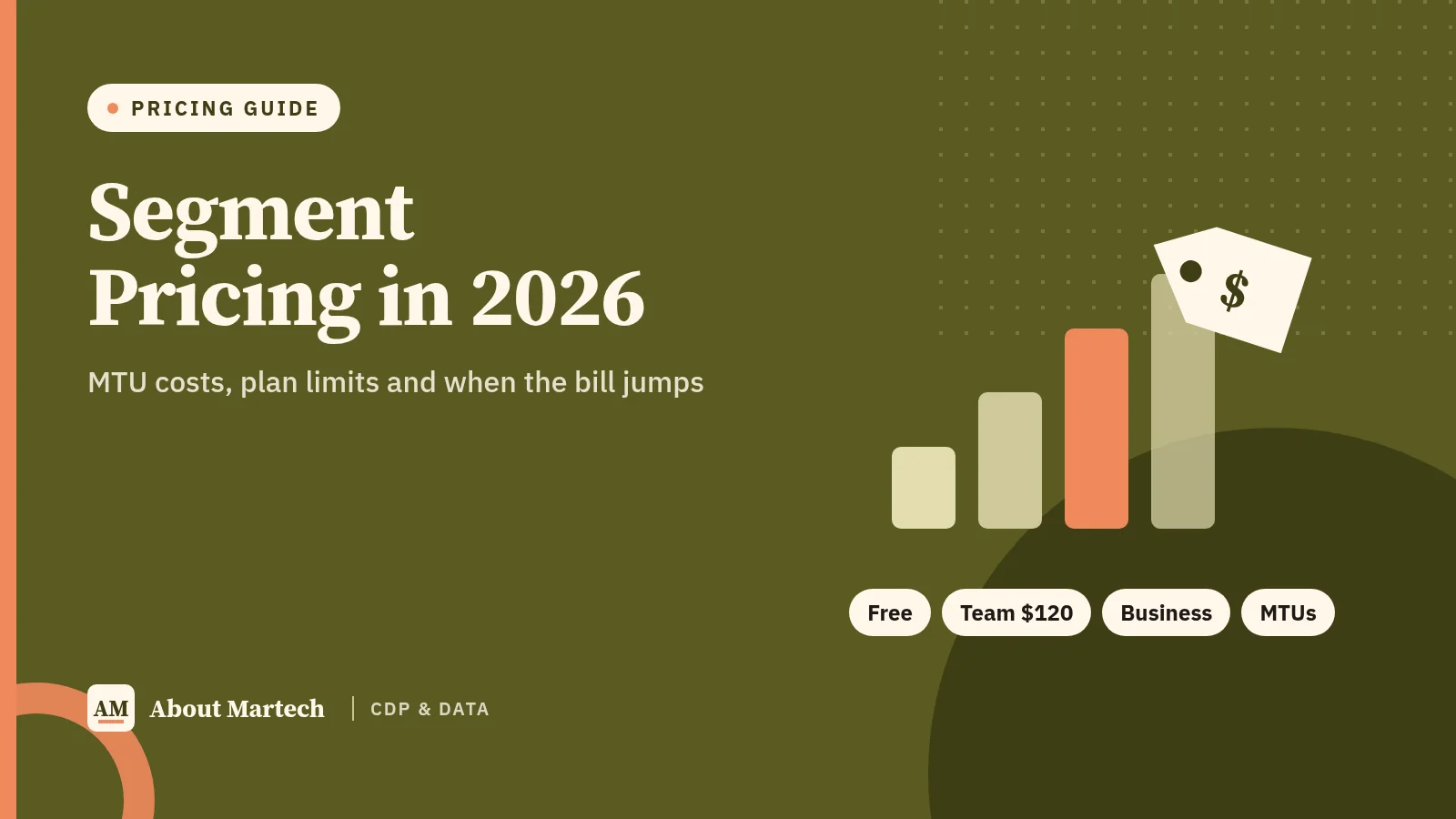
Twilio Segment publishes a price for exactly one paid plan. Team starts at $120 a month for 10,000 monthly tracked users (MTUs), and every extra 1,000 users adds $10 to $12. Business, Unify and Engage are quote-only. We read the Connections pricing page, Twilio’s help center and the Segment billing docs on November 2, 2026, then did the math at every volume from 10,000 to 1 million MTUs so you can see where the bill starts to climb.
This is a pricing guide. If the numbers below push you toward a switch, our Segment alternatives roundup compares the tools teams move to.
TLDR
Short answer: Segment costs $0 for up to 1,000 MTUs, $120 a month for 10,000 MTUs on Team, about $575 a month at 50,000 MTUs and $1,125 a month at 100,000 MTUs at list price. Business pricing is custom, and the median buyer on Vendr pays about $55,600 a year.
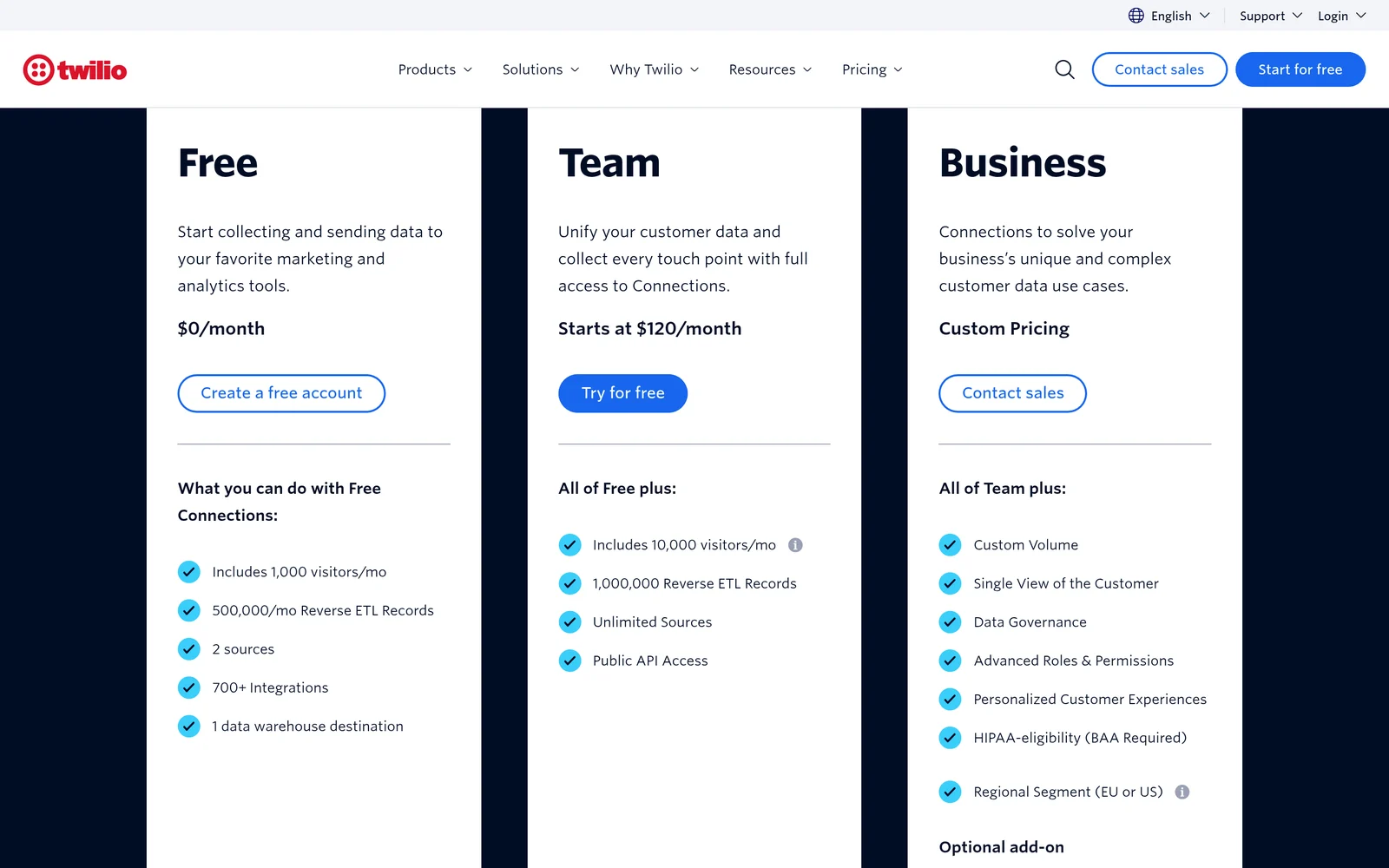
- Free: $0, up to 1,000 MTUs, 2 sources, 1 warehouse synced once a day (Twilio).
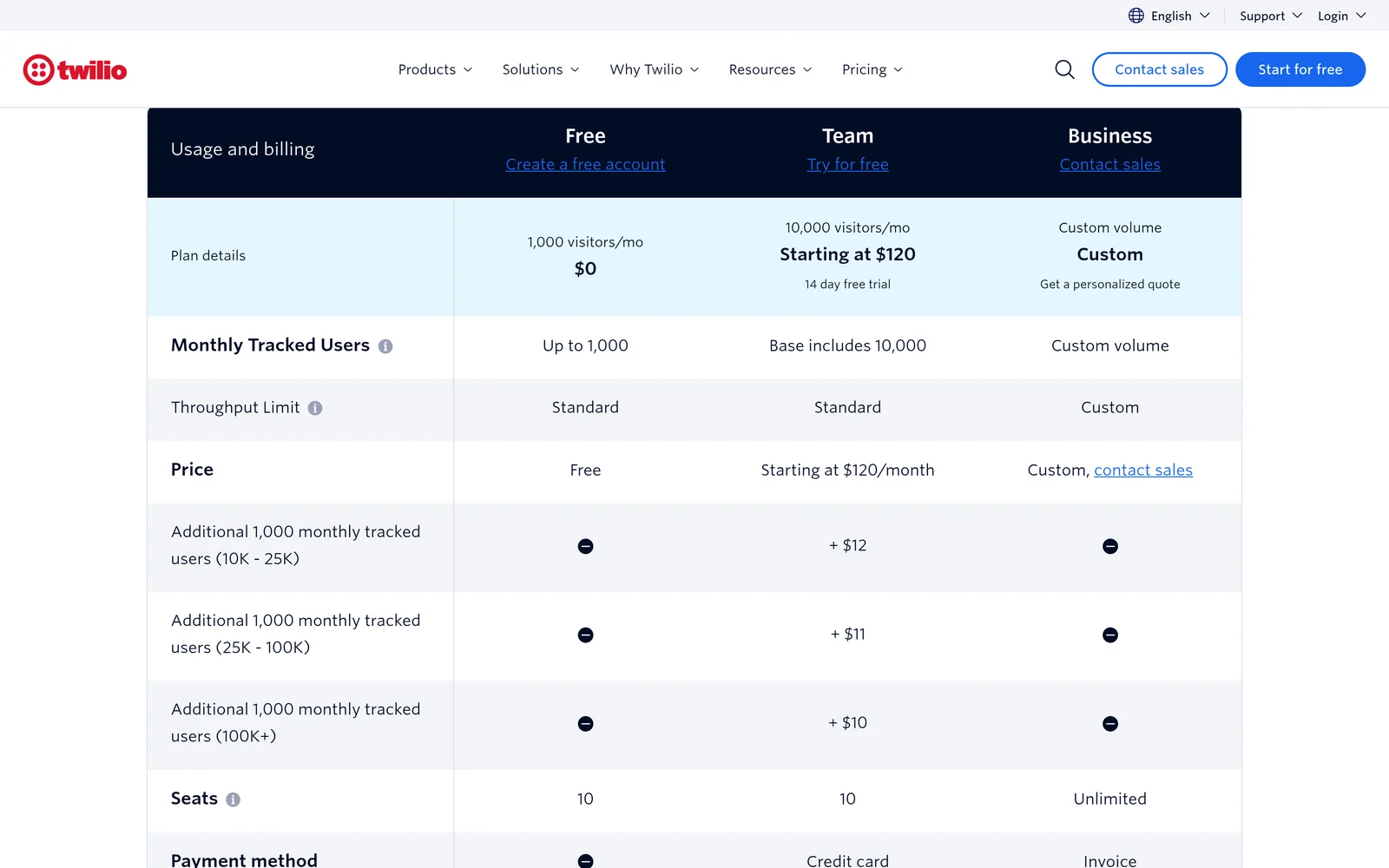
- Team: from $120 a month with 10,000 MTUs, then $12 per 1,000 up to 25,000, $11 up to 100,000 and $10 above that. Annual billing saves up to 20%.
- Business: custom pricing. Destination filters, Protocols, SSO, HIPAA eligibility and unlimited warehouses live here.
- CDP (Unify and Engage): sales only. Identity resolution and profiles are not in Team.
- The bill jumps when anonymous traffic, bots or cookie resets create MTUs you never meant to pay for.
In this guide
Segment pricing at a glance (as read on November 2, 2026)
Twilio’s page says the prices are “current as of October 2026”. Every number below comes from that page unless we say otherwise.
| Free | Team | Business | |
|---|---|---|---|
| Price | $0 | From $120 a month | Custom quote |
| MTUs included | Up to 1,000 | 10,000 | Custom volume |
| Extra 1,000 MTUs | Not available | $12 (10K to 25K), $11 (25K to 100K), $10 (100K+) | Negotiated |
| Sources | 2 | Unlimited | Unlimited |
| Warehouses and sync | 1 warehouse, 1 sync a day | 1 warehouse, 2 syncs a day | Unlimited, custom schedule |
| Reverse ETL records | 500,000 a month | 1,000,000 a month | Custom |
| Functions | 50 hours | 50 hours | Custom |
| Seats | 10 | 10 | Unlimited |
| Billing | None | Credit card, monthly or annual | Invoice |
| Governance and security | Basic | Public API access | Destination filters, SSO, granular roles, Protocols (add-on), HIPAA eligibility (add-on), Regional Segment EU or US |
How Segment pricing works: MTUs, not events
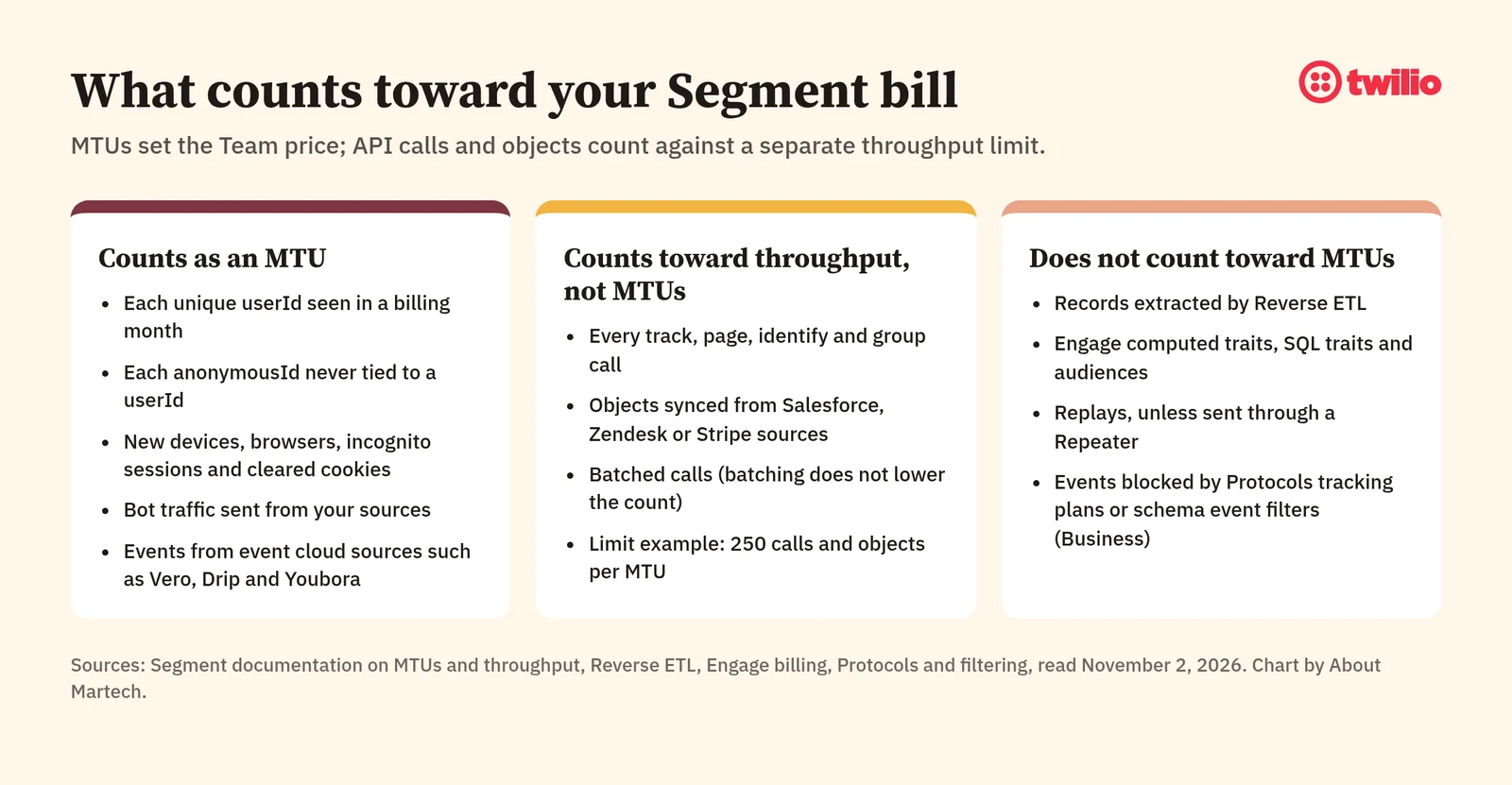
Segment bills Connections on monthly tracked users. Twilio defines an MTU as a unique user Segment collects data on in a billing month, identified or anonymous (pricing FAQ). The docs are more precise: Segment counts every unique userId, plus every anonymousId that never gets tied to a userId, across all your sources, and each person counts once per month (MTU docs).
That definition has three consequences for your bill:
- Anonymous visitors count. A blog reader who never signs up is still an MTU if your website source tracks them.
- One person can count twice. If the same person visits on a second browser, in incognito mode or after clearing cookies, and never logs in, Segment sees a new anonymousId.
- Events per user do not matter for MTUs. A user who fires 5 events and one who fires 500 both count once. Volume shows up in a different meter, throughput.
Throughput: the second meter
Each plan also carries a throughput limit, listed as “Standard” on Free and Team. Segment’s docs give an example of 250 API calls and objects per paid MTU, so a 10,000 MTU plan could send 2.5 million calls and objects a month (Segment docs). Batching does not help: batched calls are unpacked and counted one by one.
Cloud sources split here. Object sources such as Salesforce, Zendesk and Stripe do not add MTUs but every record they pull counts toward throughput, even when the same record is pulled more than once. Event sources such as Vero, Drip and Youbora can create new MTUs because each event carries a user ID.
What Segment Team really costs at your volume
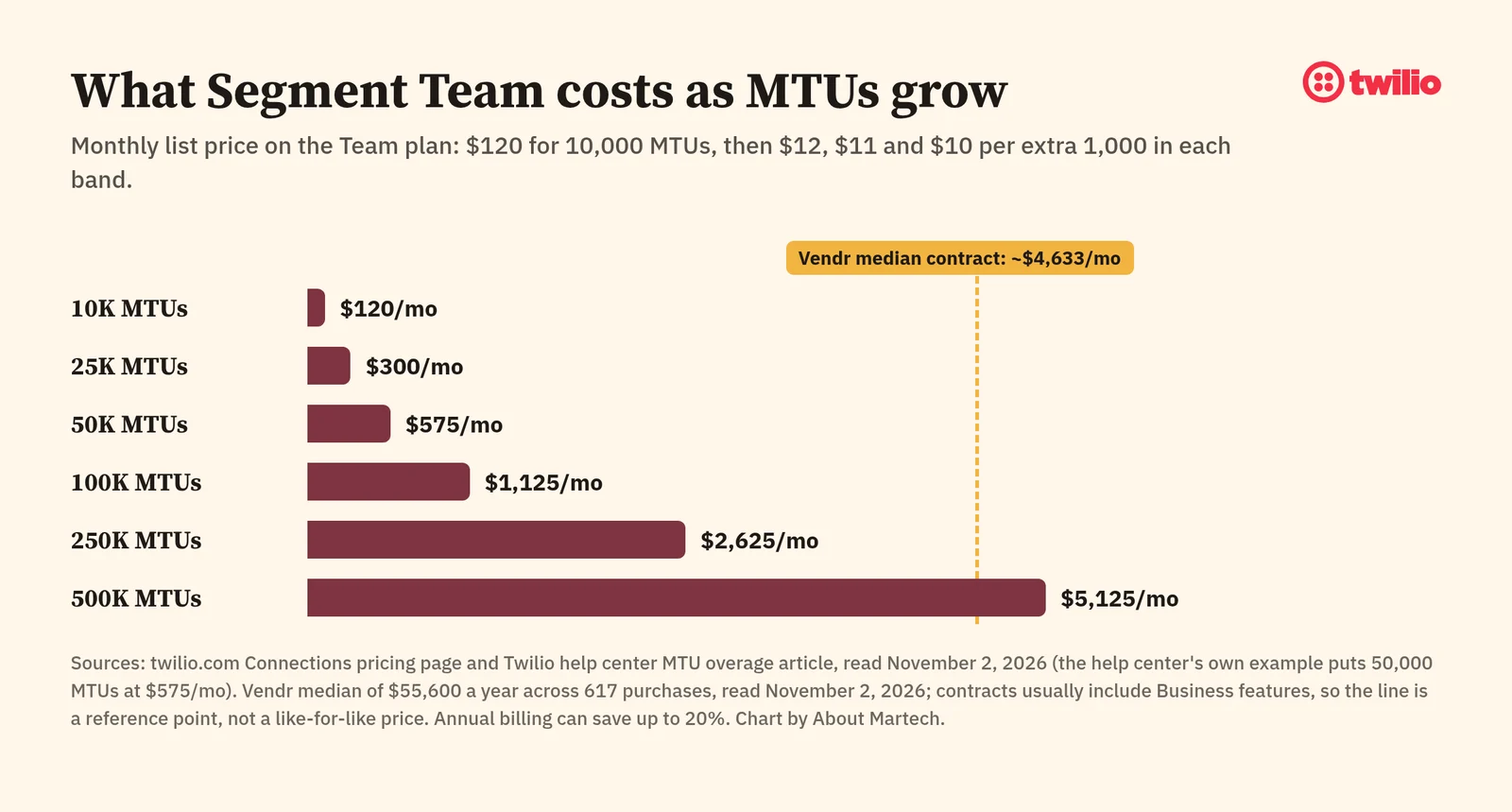
Twilio’s help center confirms the overage bands stack, like tax brackets. You pay $12 for each 1,000 MTUs between 10,001 and 25,000, then $11 for each 1,000 up to 100,000, then $10 beyond that. Its own example puts 50,000 MTUs at $575 a month: $120 base, plus 15 x $12, plus 25 x $11 (Twilio help center).
We applied the same bands to common volumes. These are monthly list prices on Team, before any annual discount:
| MTUs a month | Monthly list price | Yearly at monthly rates | Cost per 1,000 MTUs |
|---|---|---|---|
| 10,000 | $120 | $1,440 | $12.00 |
| 25,000 | $300 | $3,600 | $12.00 |
| 50,000 | $575 | $6,900 | $11.50 |
| 75,000 | $850 | $10,200 | $11.33 |
| 100,000 | $1,125 | $13,500 | $11.25 |
| 250,000 | $2,625 | $31,500 | $10.50 |
| 500,000 | $5,125 | $61,500 | $10.25 |
| 1,000,000 | $10,125 | $121,500 | $10.12 |
Two patterns stand out. The effective rate falls slowly, from $12 per 1,000 at 10,000 MTUs to about $10.13 at 1 million, so Team never gets much cheaper at scale. And annual billing helps by at most 20%, which Twilio describes as “save up to 20% annually” (Twilio). On 100,000 MTUs that is a ceiling of $2,700 off a $13,500 year.
Watch the pricing page FAQ
The FAQ on the same pricing page says Team “adds $10 per 1,000 visitors beyond” 10,000. Read literally, that would put 50,000 MTUs at $520, not $575. The plan table and the help center both use the $12, $11 and $10 bands, so budget with the bands and treat the FAQ line as a simplification (pricing page, help center).
How to estimate your MTUs before you buy
Twilio’s advice is to tally monthly unique visitors and users across every site and app you plan to connect, and to start conservative because overshooting is common (pricing FAQ). In practice, run the estimate in three parts:
- Logged-in users. Monthly active users from your product analytics. Each one is a single MTU if your app calls identify with a stable userId.
- Anonymous visitors. Monthly unique visitors on every page that loads the Segment snippet and never log in. This is usually the biggest number on a marketing site.
- Event cloud sources. Any connected tool that sends events with user IDs can add people you do not track yourself.
Worked example: a B2B SaaS company
Say your app has 8,000 monthly active users who all log in, and your marketing site gets 60,000 unique visitors a month, of whom 2,000 sign up and are identified. Segment would count 8,000 product users plus 58,000 anonymous visitors, or 66,000 MTUs.
At Team list prices that is $751 a month. If you loaded Segment only on the app and the sign-up flow and left the blog to your web analytics tool, the count would drop to the 8,000 product users plus whoever reaches sign-up, close to the 10,000 included in the $120 base. Where the snippet loads matters more than which plan you pick.
Free vs Team vs Business: when to move up
| Move to | When | Why |
|---|---|---|
| Team | You pass 1,000 MTUs, need more than 2 sources, twice-daily warehouse syncs or Public API access | Twilio’s own FAQ lists these as the reasons to upgrade from Free |
| Business | You need destination filters, Protocols, SSO, granular roles, HIPAA eligibility or more than one warehouse | None of these are sold on Team |
| Business plus Unify and Engage | You want identity-resolved profiles, audiences or journeys inside Segment | Unify is a Business add-on and is required for Engage |
Team includes a 14-day free trial, and monthly Team billing starts the day after it ends. Cancelling during the trial costs nothing (billing docs).
Business, Unify and Engage pricing
Anything above Team is a sales conversation. Business is “Custom Pricing” with custom MTU volume and adds governance, security and support features. Twilio sells the full Customer Data Platform as Connections plus Unify plus Engage, again through sales (Twilio CDP pricing).
- Unify (identity resolution and profiles) is an add-on to the Connections Business tier and is required for Engage (Segment docs). The Connections pricing page lists identity resolution and profiles as “Available with CDP Plans”.
- Engage data, including computed traits, SQL traits and audiences, is left out of MTU and throughput billing. Engage uses compute credits instead: one per computed trait or audience, and half a credit per Journeys step (Segment docs).
- Protocols, HIPAA eligibility (with a BAA) and professional services are add-ons on top of Business.
What buyers actually pay
Vendr, which negotiates software contracts, reports a median of $55,600 a year for Twilio Segment across 617 purchases, with a range of $14,830 to $199,400 and average savings of 17% (Vendr, read November 2, 2026). Those contracts usually bundle Business features, so they are not a like-for-like Team price.
Our comparison: $55,600 a year is about $4,633 a month, which matches Team list price at roughly 451,000 MTUs. So a typical negotiated contract costs about what a large Team account would, and buys features Team does not have. If you are near that volume on Team and want governance or SSO, ask for a Business quote before your next renewal.
Hidden costs that make Segment expensive
- Anonymous and duplicate MTUs. Segment lists traffic spikes, new tracking, different browsers, incognito sessions, cleared cookies and calls to analytics.reset() as causes of MTU spikes (Segment docs).
- Bots. Segment has no built-in bot filter for your sources, and filtering at the destination still counts the MTU. By policy, Segment does not refund bot-related MTU spikes, though you can petition in extenuating cases (Segment docs).
- Throughput overages. Object cloud sources count every retrieved record, including duplicates. Segment suggests asking support for a less frequent sync if this drives overages (Segment docs).
- Functions. Free and Team include 50 hours. Usage is billed in milliseconds, and Segment’s own example shows 1 million events at 100ms using about 28 hours (Segment docs, pricing page).
- Annual prepay. Annual Team is billed upfront when the trial ends, overages are billed monthly, and Segment does not refund the prepaid portion (billing docs).
- The Free plan lock. Go over 1,000 MTUs once in six months and Segment locks the account but keeps data flowing. Do it twice and data stops until you upgrade (billing docs).
- Add-ons. Protocols, HIPAA eligibility, Unify and Engage all sit on top of a custom Business contract.
How to keep your Segment bill down
Some controls work on any plan. Others need Business, which matters if you are trying to stay on Team.
| Control | Plan | Effect on the bill |
|---|---|---|
| Identify users early and avoid calling analytics.reset() without need | All plans | Fewer orphan anonymousIds, so fewer MTUs |
| Drop bot traffic in your own code before it reaches Segment | All plans | The only way to keep bot visits out of the MTU count |
| Track only the sources and pages you use | All plans | Fewer anonymous MTUs from low-value traffic |
| Integrations object in code | All plans | Controls which destinations get an event, but the MTU still counts |
| Schema event filters (block events) | Business | Blocked events do not count toward MTUs |
| Protocols tracking plan blocking | Business (add-on) | Blocked events do not count toward MTUs |
| Destination filters, selective sync | Business | Cut downstream volume and warehouse costs, not MTUs |
| Annual billing | Team | Up to 20% off, but no refund on the prepaid part |
Plan details from Segment’s filtering docs and the MTU docs. Reverse ETL extraction does not add MTUs unless you send the data through the Segment Connections destination (Segment docs), so if activation is your main use case, compare costs in our reverse ETL pricing breakdown.
When Segment is cheap and when it gets expensive
- Cheap: logged-in products with low anonymous traffic. If most users identify, MTUs track real customers and Team at 10,000 to 25,000 MTUs costs $120 to $300 a month.
- Fair: B2B SaaS with modest marketing sites. At 50,000 MTUs, $575 a month buys event collection, 550+ destinations and Reverse ETL.
- Expensive: content-heavy or ad-driven sites where most visitors stay anonymous. 500,000 MTUs is $5,125 a month on Team before you add any CDP features.
- Expensive in a different way: teams that need governance, SSO, HIPAA or identity resolution, because all of it pushes you into a custom Business contract.
If you are in the expensive group, the usual move is a warehouse-first setup. See our warehouse-native CDPs list, the Hightouch vs Segment comparison and RudderStack vs Hightouch.
Frequently asked questions about Segment pricing
How much does Segment cost per month?
Segment is free for up to 1,000 MTUs. Team costs $120 a month for 10,000 MTUs, then $12 per extra 1,000 up to 25,000, $11 up to 100,000 and $10 beyond. That is $300 at 25,000 MTUs, $575 at 50,000 and $1,125 at 100,000. Business is custom.
What is an MTU in Segment?
An MTU, or monthly tracked user, is a unique user Segment collects data on in a billing month. Segment counts each unique userId plus each anonymousId never tied to a userId, across all sources, once per month. The number of events a user sends does not change the MTU count.
Is Twilio Segment free?
Yes, up to a point. The Free plan costs $0 and covers 1,000 MTUs, 2 sources and one warehouse synced once a day. If you exceed 1,000 MTUs once in six months, Segment locks the account but data still flows. Exceed it twice and data stops until you upgrade.
How are Segment MTU overages billed?
On the monthly Team plan, overages are tiered. MTUs between 10,001 and 25,000 cost $12 per 1,000, between 25,001 and 100,000 cost $11 per 1,000, and above 100,000 cost $10 per 1,000. Twilio’s help center example puts 50,000 MTUs at $575 a month.
How much does Segment Business cost?
Twilio does not publish Business prices. Vendr reports a median Twilio Segment contract of about $55,600 a year across 617 purchases, ranging from $14,830 to $199,400. Business adds destination filters, SSO, unlimited warehouses and optional Protocols and HIPAA eligibility.
Does Segment charge for bots?
Bot traffic that reaches Segment counts toward MTUs. Segment has no built-in bot filter for sources, and filtering at the destination does not remove the MTU. Segment does not refund bot-related MTU spikes as a policy, though you can petition in extenuating circumstances.
Does Reverse ETL count toward Segment MTUs?
No, not on its own. Records extracted by Reverse ETL do not count toward MTUs unless you send them through the Segment Connections destination. Free includes 500,000 Reverse ETL records a month and Team includes 1,000,000.
Is annual Segment billing cheaper?
Twilio says annual Team billing saves up to 20%. The trade-off is that the year is billed upfront when the 14-day trial ends, MTU overages are still billed monthly, and Segment does not refund the prepaid portion if you cancel.
The verdict
Segment Team is easy to price and fair for products where most users log in. The bill gets expensive when anonymous traffic drives MTUs, because the per-1,000 rate barely falls with volume and the controls that stop junk events from counting are Business-only.
Before you renew, pull your MTU count by source, check how much of it is anonymous, and price the same volume on Team and on a Business quote. If neither works, our Segment alternatives guide lists the tools that bill on rows, events or warehouse compute instead.