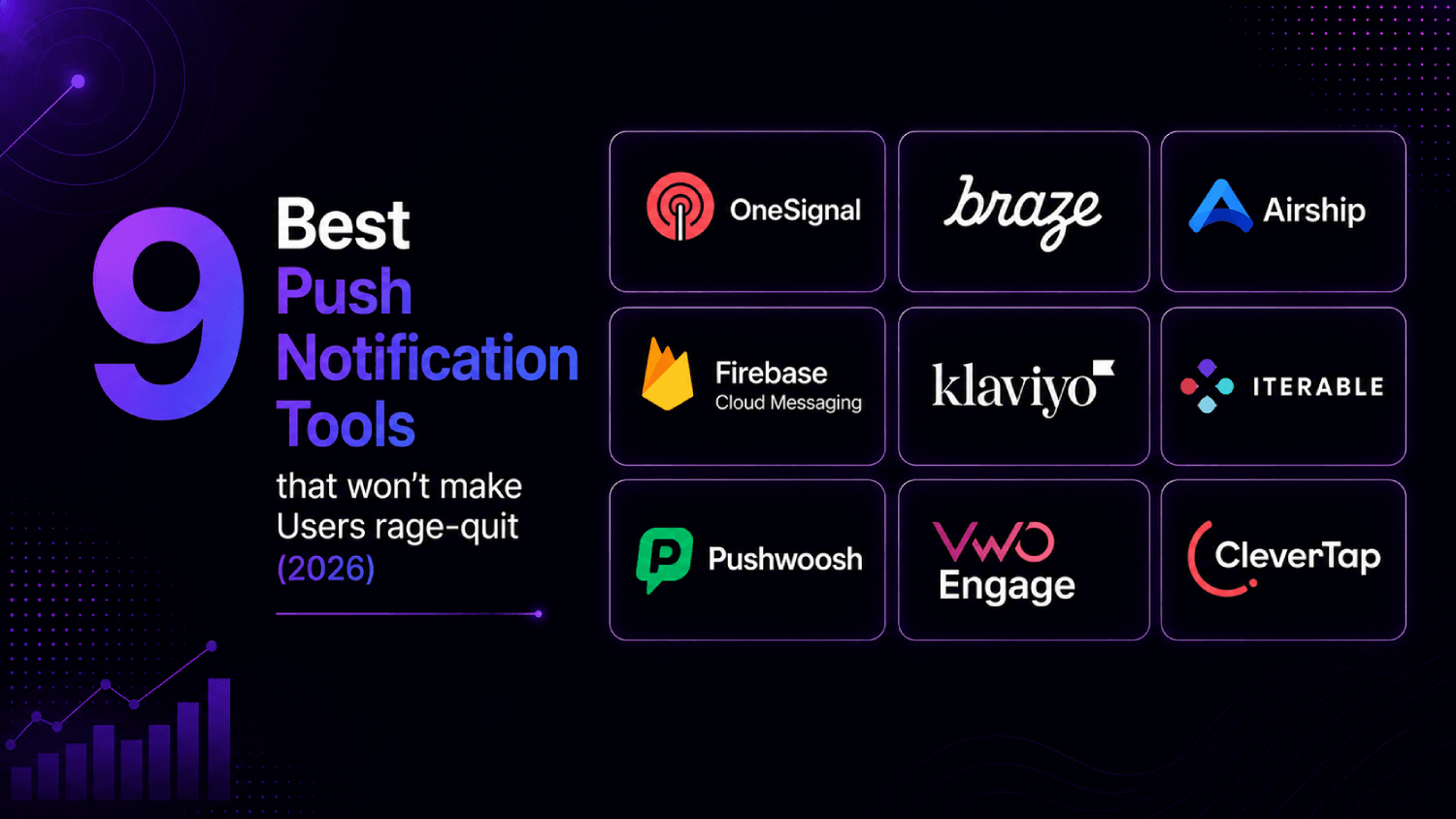

- Most push notification failures come from bad segmentation, not the channel itself. A well-timed behavioral trigger outperforms a broadcast blast by a wide margin.
- OneSignal is the default choice for teams that need to ship fast and keep costs low. Braze and Airship are for teams that need push woven into a full cross-channel orchestration layer.
- Web push and mobile push have different permission models and different delivery mechanics. A tool that does one well does not automatically do both well.
- Pricing varies from free (OneSignal, FCM) to quote-only enterprise contracts (Braze, Airship). The right tool depends as much on your stack as on your budget.
- The AboutMartech Signal-Fit Test asks four questions about your data layer, channel mix, team size, and trigger logic complexity. Answering them honestly will eliminate half the options on this list before you book a single demo.
The best push notification software in most situations is OneSignal for self-serve teams, Braze for cross-channel enterprise orchestration, and Airship for mobile-first brands with complex app messaging needs. The right choice depends on whether you are sending web push, mobile push, or both, how much behavioral data you can pipe in for targeting, and whether push is a standalone channel or one leg of a multi-channel program.
Why most push notification strategies fail before the tool choice matters
Push notifications have an opt-in rate problem that no software vendor will put in their pitch deck. Users are more protective of their notification permissions than any other browser or OS-level setting. Broadcast a generic “Hey, check this out” message at 9 a.m. to your entire subscriber list and you will not just get ignored , you will get opted out, and that permission is gone permanently.
The teams that see push actually move retention metrics are doing something specific: they are triggering notifications from behavioral events, not from a calendar. A user who viewed a product three times without converting is a different audience than someone who last opened the app 14 days ago. Treating them identically is the most common mistake, and it is a strategy problem, not a tool problem.
That said, the tool still matters. Some platforms give you granular behavioral segmentation out of the box. Others require you to pipe in warehouse data before you can build anything meaningful. A few are essentially dumb broadcast pipes with a friendly UI. What follows is an honest breakdown of where each platform sits on that spectrum.
The AboutMartech Signal-Fit Test: four questions before you evaluate any push tool
The Signal-Fit Test is a four-question framework designed to map your actual operating constraints to the tools built for them. Run through it before booking any demo. It works by surfacing the four variables that most reliably predict tool fit: data layer maturity, channel architecture, team composition, and trigger complexity. Each question has a low-end and a high-end answer, and the combination of your four answers points to a clear tier of tooling.
- Data layer: Can you pass behavioral event data into the push tool in real time, or are you working from batch exports? Tools like Braze and Iterable are built for event streaming. Tools like VWO Engage work fine with basic properties.
- Channel mix: Is push a standalone channel or part of a coordinated program that includes email, SMS, and in-app? If it is the latter, a dedicated push tool creates orchestration debt. A platform like Klaviyo or Iterable handles all channels from one place.
- Team size and engineering access: A solo marketing operator cannot wrangle an Airship integration without help. OneSignal and Pushwoosh have SDKs designed for fast self-serve setup. Braze and Airship assume an engineering team and a dedicated martech operator.
- Trigger logic complexity: Do you need simple time-based sends, or are you building multi-step drip sequences based on in-app actions, purchase history, and predictive churn scores? The former fits almost any tool. The latter rules out most entry-level options.
Score yourself. If you answered “real-time streaming,” “cross-channel,” “engineering team available,” and “complex triggers” to all four, you are buying Braze or Airship. If you answered “batch,” “push only,” “solo marketer,” and “simple,” you are buying OneSignal or Pushwoosh and spending a fraction of the budget. Most teams land somewhere in between, which is where the nuance in the tool reviews below matters most.
What is the best push notification service? The 9 tools evaluated
| Tool | Best For | Web Push | Mobile Push | Free Tier | Pricing Model |
|---|---|---|---|---|---|
| OneSignal | Self-serve, fast setup | Yes | Yes | Yes | Subscriber-based |
| Braze | Enterprise cross-channel | Yes | Yes | No | Quote-only |
| Airship | Mobile-first brands | Yes | Yes | No | Quote-only |
| Firebase Cloud Messaging | Developers building custom infra | Yes | Yes | Yes (free) | Free |
| Klaviyo | eCommerce email + push together | Yes | No | Yes | Contact-based |
| Iterable | Growth teams, multi-channel flows | Yes | Yes | No | Quote-only |
| Pushwoosh | Budget-conscious app teams | Yes | Yes | Yes | Device-based |
| VWO Engage | Web push with A/B testing | Yes | No | Yes (limited) | Subscriber-based |
| CleverTap | Mobile retention, global scale | Yes | Yes | Yes (limited) | MAU-based |
1. OneSignal
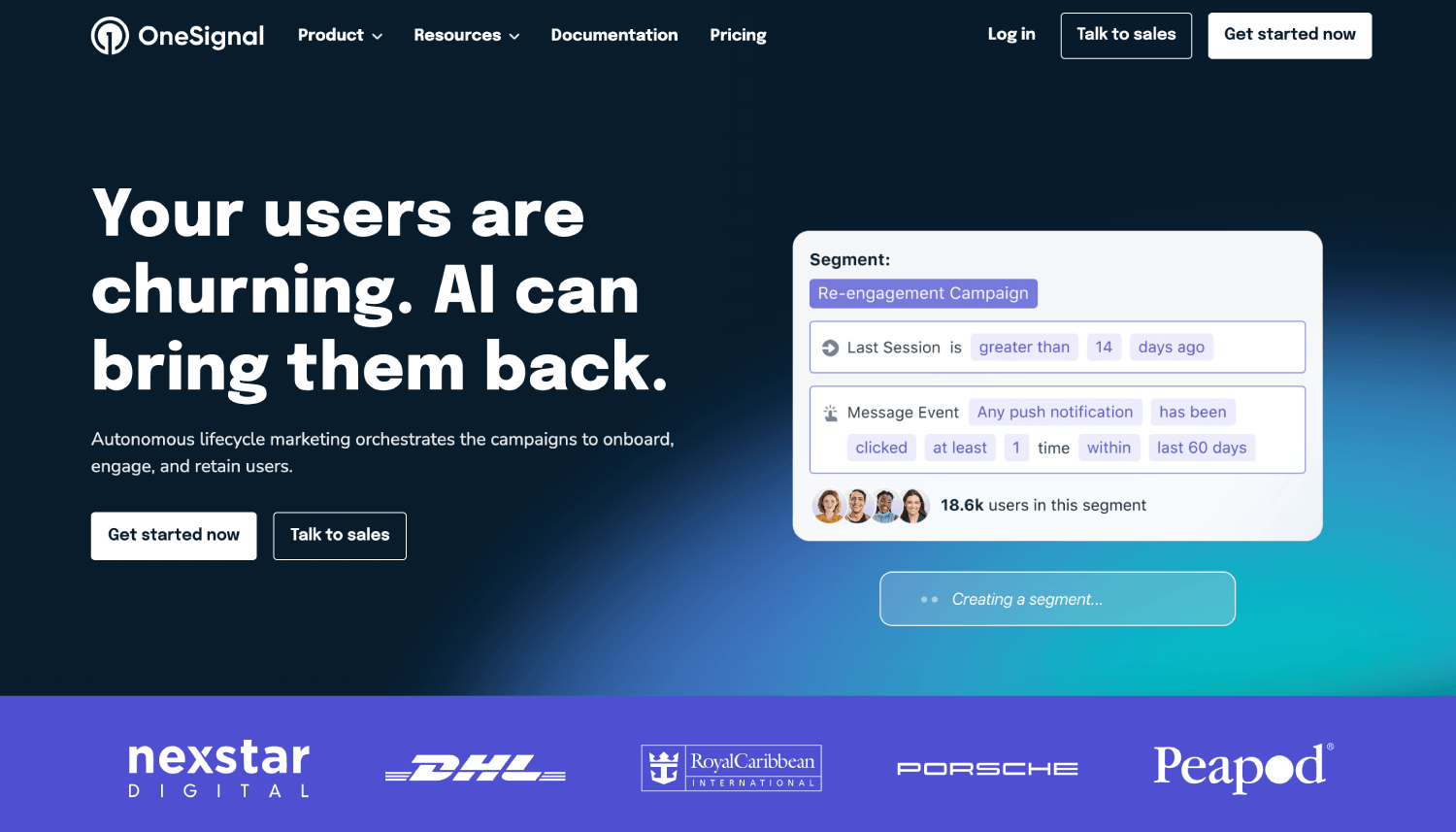
OneSignal is the most widely used push notification service for good reason: the free tier supports unlimited web push subscribers and up to 10,000 email subscribers, the SDK integrates in an afternoon, and the segmentation tools are good enough for most mid-market use cases without requiring a data engineering team. It covers web push, mobile push (iOS, Android), email, SMS, and in-app messaging from one dashboard.
Where OneSignal starts to show limits is in sequence sophistication. You can build automated sequences, but they lack the depth of Braze’s Canvas or Iterable’s Workflow Studio. If your push strategy involves branching logic built from real-time event streams, you will hit the ceiling. OneSignal’s analytics are also surface-level compared to the enterprise platforms , you get delivery rates and click-through rates, but not the kind of cohort-level retention attribution that a growth team runs analysis on.
Paid plans start at $9 per month on their public pricing page, scaling by subscriber count. For a team that needs to launch fast and does not have a six-figure martech budget, OneSignal is the honest default.
2. Braze
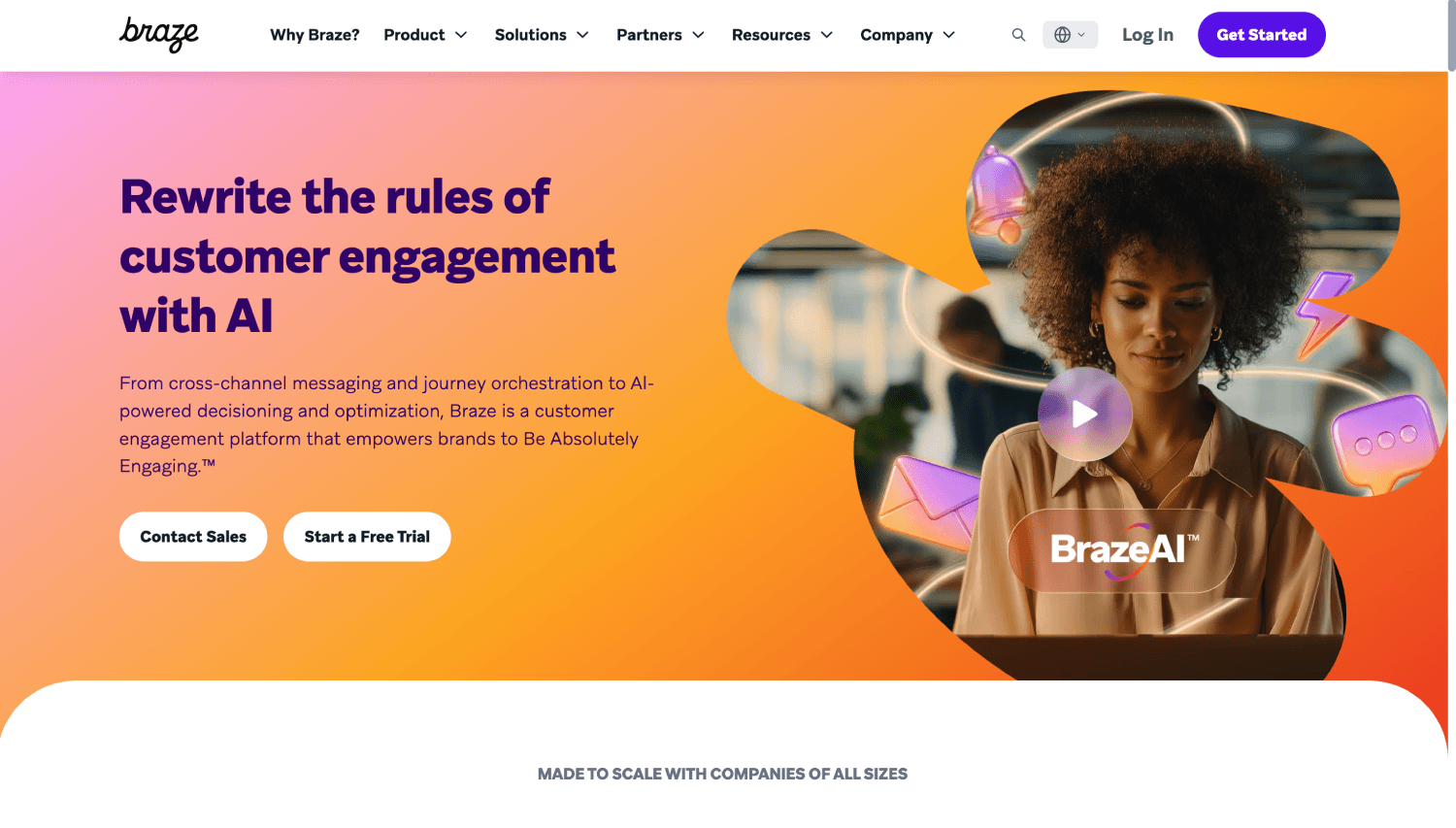
Braze is not a push notification tool. It is a customer engagement platform that happens to be very good at push. That distinction matters because Braze’s entire value proposition is cross-channel orchestration , push, email, SMS, in-app, content cards, and webhooks all running from the same Canvas flow builder, all reacting to the same event stream. If you are only sending push, you are significantly over-buying.
Braze’s Liquid templating language lets you personalize notification content at a level of granularity that most tools cannot approach. A message can pull in a user’s first name, last viewed product, loyalty tier, and predicted churn score in a single notification body , all resolved at send time. The Intelligent Timing and Intelligent Channel features use machine learning to pick both the right moment and the right channel for each user.
Pricing is quote-only and enterprise-tier. Braze does not publish pricing publicly. Budget conversations typically start in the low six figures annually for companies at meaningful scale. For teams already evaluating a customer data platform to unify their behavioral data, Braze is a natural downstream destination for that data once it is clean.
3. Airship
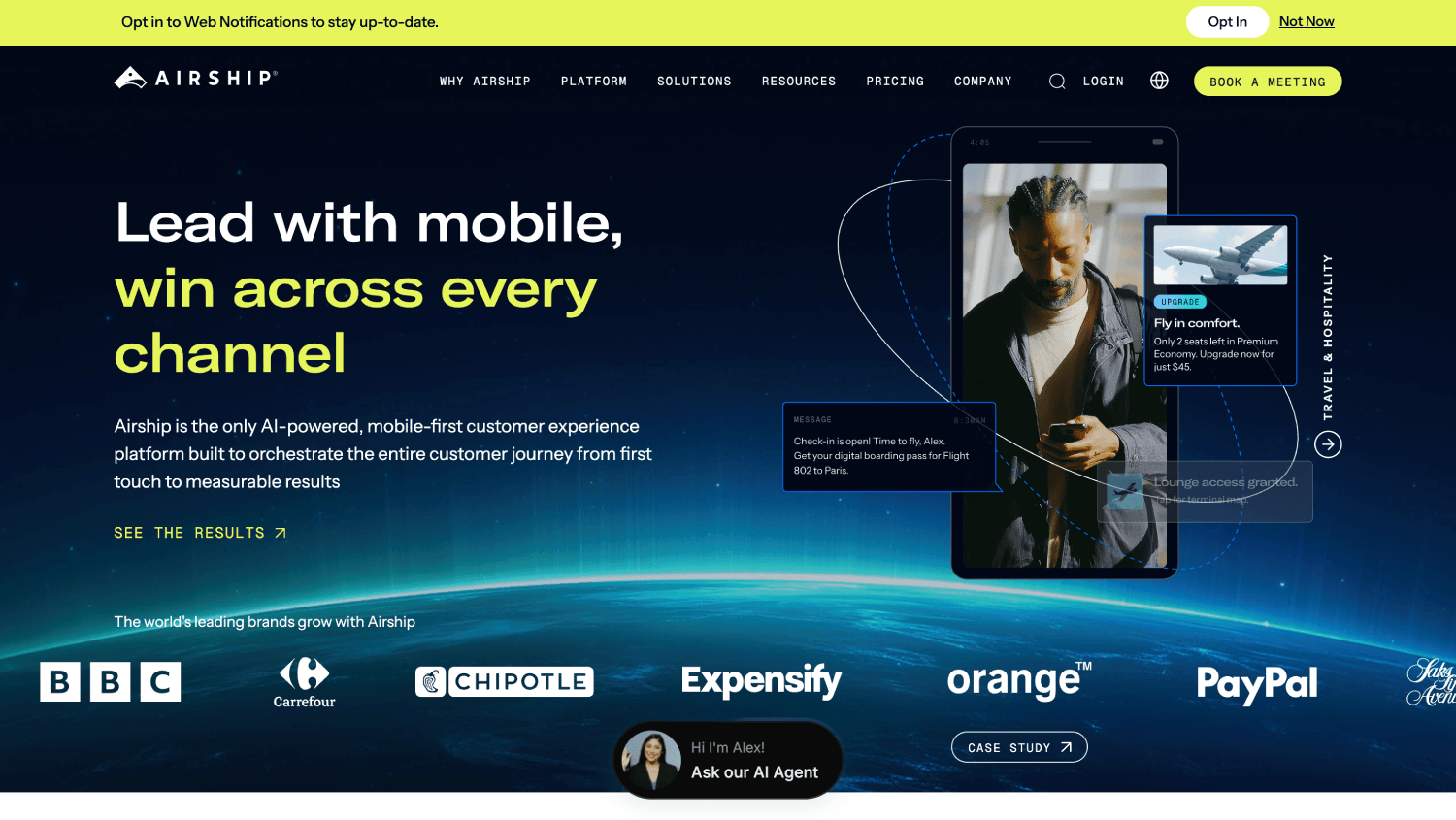
Airship has been doing mobile push longer than almost anyone else in the market , the company was founded in 2009 and built its reputation on high-volume, high-reliability mobile messaging for major consumer apps and media brands. That heritage shows in the platform’s delivery infrastructure and its depth on mobile-specific features: rich push with images and action buttons, notification center management, live activities on iOS, and A/B testing baked into every send.
Airship added web push and a journey builder over time, but mobile is still where it is sharpest. The AXP (Airship Experience Platform) also includes in-app automation and preference management , useful for brands trying to give users control over what they receive, which tends to reduce opt-out rates. Pricing is quote-only, and Airship positions itself alongside Braze in enterprise conversations. Teams choosing between the two often find Airship wins on mobile depth and Braze wins on cross-channel breadth.
4. Firebase Cloud Messaging (FCM)
Firebase Cloud Messaging is free, forever, with no subscriber limits. It is Google’s push delivery layer and it underpins many of the other tools on this list , OneSignal, for instance, routes Android pushes through FCM. FCM itself is not a marketer-facing tool. It is an API. You write the code, you manage the device tokens, you build the segmentation, you handle delivery receipts.
The teams that should be using FCM directly are engineering-led teams building a custom notification system where they want full control over the delivery pipeline and are willing to build the campaign tooling on top. For most marketing teams, FCM is infrastructure, not software. Consider it a component, not a solution.
5. Klaviyo
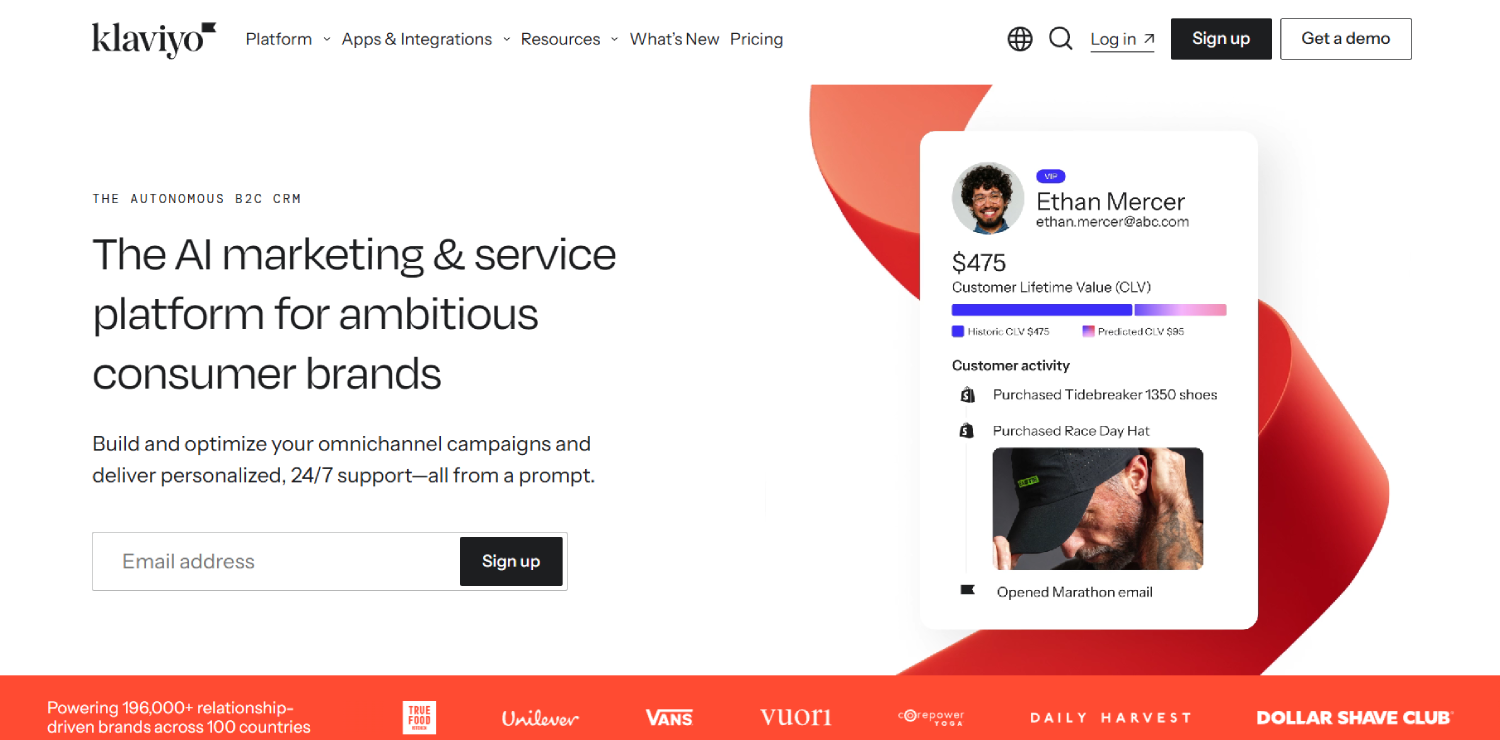
Klaviyo added web push notifications to its platform, which is a significant move for eCommerce teams already using it for email and SMS. If your team is already running Klaviyo flows for cart abandonment and post-purchase sequences, adding push within the same platform means you can include a push step in an existing flow without switching tools or syncing audiences across systems.
The limitation is that Klaviyo’s push support is web-only as of its current feature set , no native mobile push SDK for iOS or Android app notifications. For direct-to-consumer brands whose customers are primarily engaging through a website rather than a dedicated app, that gap does not matter. For app-first brands, it is a dealbreaker. Klaviyo’s pricing is contact-based and published on their website, starting free and scaling significantly at larger lists. Teams weighing SMS and push together should also look at the top SMS platforms for Shopify to understand how Klaviyo stacks against dedicated SMS tools before consolidating.
6. Iterable
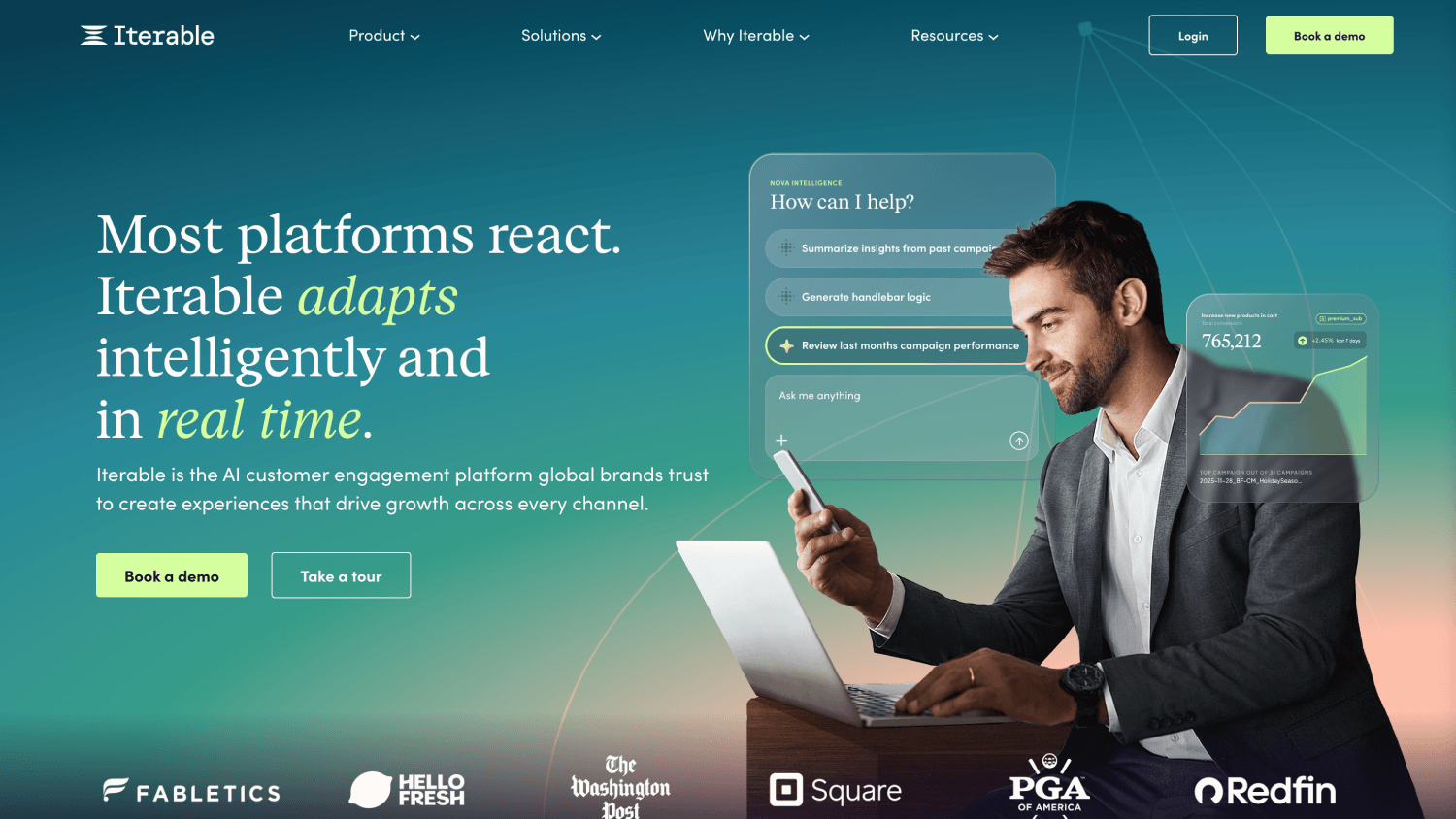
Iterable sits in similar territory to Braze , a cross-channel marketing platform with solid push support , but tends to attract growth teams at B2B SaaS and consumer tech companies rather than the largest enterprise accounts. The Workflow Studio is genuinely powerful for multi-step behavioral sequences, and Iterable’s data model handles complex event schemas better than most mid-market tools.
Push is one channel in Iterable’s multi-channel stack alongside email, SMS, in-app, and direct mail. Segmentation is event-driven and can ingest from warehouse sources via reverse ETL connectors. Teams thinking about how their push platform connects to their broader data infrastructure should understand how reverse ETL tools activate warehouse data for downstream tools like Iterable. Pricing is quote-only, and Iterable’s sweet spot is companies that have outgrown a single-channel tool but do not yet need Braze-level enterprise support.
7. Pushwoosh
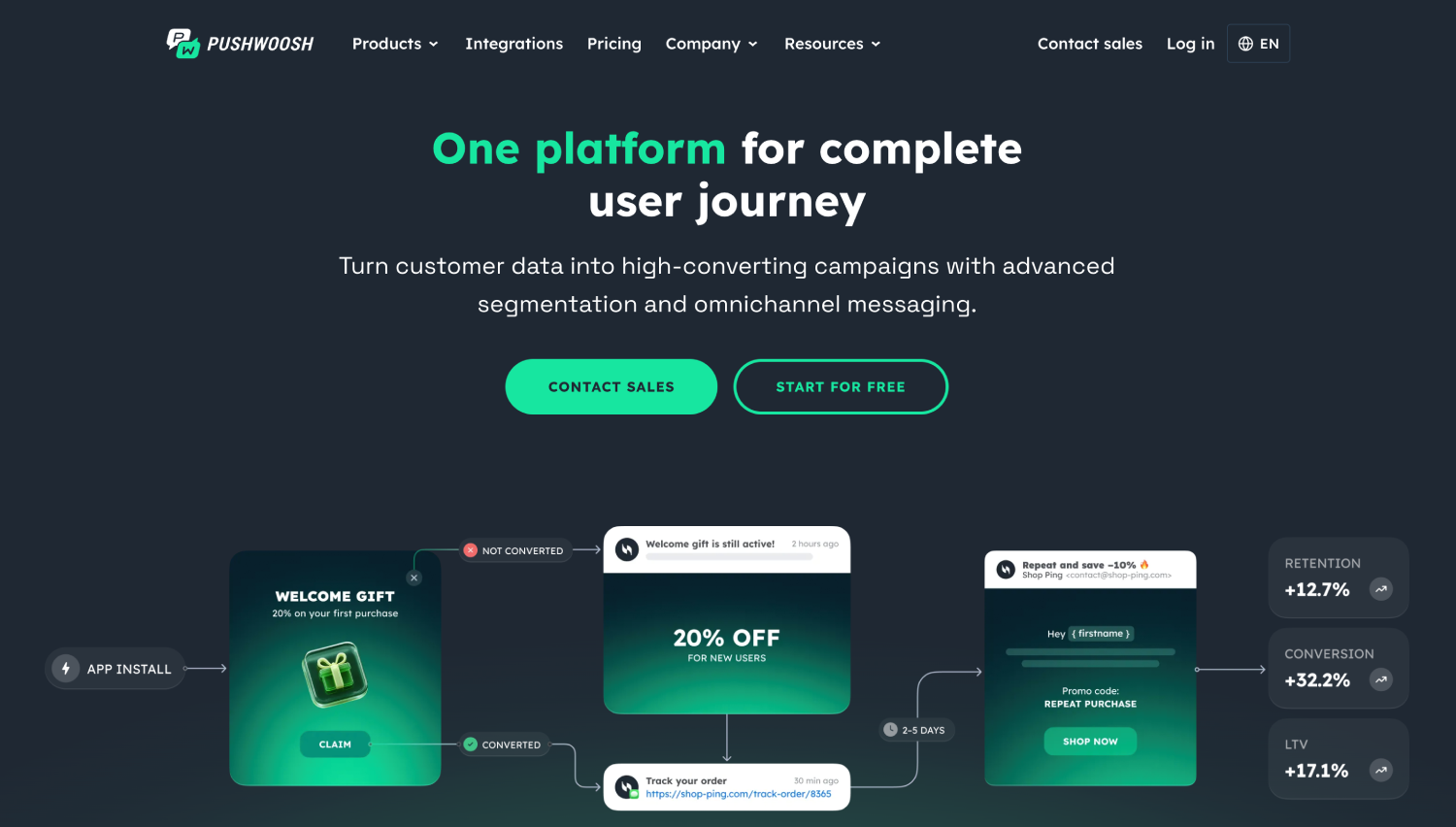
Pushwoosh is the least-known tool on this list and also one of the more practical choices for mobile app teams with budget constraints. It covers iOS, Android, and web push, includes a journey builder, and offers a free tier capped at 1,000 devices. Paid plans are device-based and published on their pricing page, making cost modeling predictable before you sign anything.
Pushwoosh does not have the brand recognition of OneSignal or the feature depth of Braze, but it is a complete tool for teams that need basic-to-intermediate push functionality without enterprise pricing. The segmentation covers standard behavioral attributes and custom tags, which is enough for most app retention use cases. The reporting is functional rather than sophisticated , you will not get multi-touch attribution from Pushwoosh.
8. VWO Engage
VWO Engage, formerly known as PushCrew, is a web push notification tool from the same company behind the VWO experimentation platform. The most relevant feature for conversion-focused teams is native A/B testing on push notifications , headline copy, timing, and send frequency , which most standalone push tools treat as an afterthought. If your team already uses VWO for website experiments, Engage integrates tightly with that workflow.
VWO Engage is web push only. It does not support mobile app push. The subscriber-based pricing is available on their public pricing page. For a content publisher or eCommerce brand focused on web re-engagement without app infrastructure, it is a practical and underrated choice. Teams that also run multivariate testing on landing pages will find the combined VWO suite worth exploring.
9. CleverTap
CleverTap is a mobile marketing platform built around retention analytics and behavioral segmentation for global consumer apps. Its pricing is MAU-based, which benefits teams with large but infrequently active user bases compared to platforms that charge on message volume. CleverTap’s RFM segmentation (recency, frequency, monetary value) is particularly mature , it surfaces automatically-generated audience segments based on user behavior patterns, which can feed directly into push campaigns without manual list building.
CleverTap is strongest for mobile-first apps with significant international audiences, particularly in Southeast Asia, Latin America, and India. The platform has deep roots in those markets and its infrastructure reflects that. Western enterprise teams evaluating CleverTap against Braze should note that Braze has broader North American enterprise support and more third-party integrations, while CleverTap wins on analytics depth and MAU-based cost efficiency at scale. There is a limited free tier for testing, with paid tiers on a quote basis for production usage.
How should you think about push notification pricing models?
Push notification tools charge on one of four models: subscriber count (how many users have opted in), device count (distinct registered devices), MAU (monthly active users), or flat-rate seats. Each model has a different implication for your budget as you scale.
Subscriber-based pricing (OneSignal, VWO Engage) rewards list hygiene , if you prune inactive subscribers, your bill drops. Device-based pricing (Pushwoosh) can climb quickly if users install your app on multiple devices. MAU-based pricing (CleverTap) works well for apps with seasonal or bursty engagement patterns. Seat-based or quote-only pricing (Braze, Airship, Iterable) decouples cost from list size, which matters at very large scale but makes early budgeting harder.
One underappreciated factor: delivery volume limits. Some tools cap monthly notification sends on lower tiers, not just subscriber counts. Check the actual send limits before you assume a free or entry tier is sufficient for your use case.
What is the difference between web push and mobile push notification services?
Web push notifications arrive through the browser , Chrome, Firefox, Edge, and Safari (with limitations on iOS Safari). They require users to grant permission through a browser prompt, they work even when the user is not on your website, and they display as OS-level notifications on desktop and Android. They do not require an app. The opt-in rates for web push are lower than email but the conversion rates on clicked notifications can be competitive because the user has to actively dismiss or click.
Mobile push notifications require a native app installed on the device. They are delivered through Apple Push Notification Service (APNs) for iOS and Firebase Cloud Messaging for Android. Mobile push has a higher perceived urgency , it appears on the lock screen , which is both its strength and the reason users disable it aggressively if the content is not relevant. Mobile push also gives you access to rich media, action buttons, and deep links into specific app screens, none of which are available in web push.
Teams building a retention strategy around an app need mobile push. Teams with a content site or eCommerce store and no app should focus on web push tools. Teams with both need a platform that handles each channel’s delivery mechanics correctly , APNs authentication, FCM token management, and browser permission flows all have edge cases that matter at production volume. Teams evaluating rich messaging as a complement or alternative to push for transactional and media-rich messages should also review the options covered in the RCS business messaging platforms roundup.
Which push notification platform works best for app retention?
Consider a consumer app with 500,000 MAUs and a 30-day retention problem: users install, engage for a week, then go quiet. The temptation is to blast the dormant segment with a re-engagement push. The teams that actually move the retention metric instead identify the behavioral signals that precede churn , say, three consecutive days with no session , and trigger a push at day two, before the user has fully lapsed. That requires real-time event ingestion, not batch segmentation.
For that scenario, CleverTap’s automated RFM segmentation and behavioral analytics will surface the at-risk cohort without manual configuration. Braze gives you full control to define the trigger event and build a multi-step sequence. Airship handles the delivery reliability at scale. OneSignal gets you started in an afternoon but will not automatically identify the at-risk cohort for you. The right tool depends on whether you want the platform to surface the audience or whether your team will define it from your own data model.
For teams whose data lives in a warehouse and who are already using a customer data platform to manage identity, the push platform becomes a downstream execution layer. That changes the evaluation criteria significantly , you care less about the platform’s own segmentation and more about its webhook and API reliability. Teams running warehouse-native CDPs should specifically verify whether a given push tool accepts real-time event streams from their warehouse before committing to an integration.
Frequently Asked Questions
What is the best push notification software for small teams?
OneSignal is the most practical choice for small teams. The free tier includes unlimited web push subscribers, the SDK integrates quickly without engineering support, and the paid plans start at $9 per month per their public pricing page. Pushwoosh is a close second if the team is primarily focused on mobile app push and wants predictable device-based pricing. Both tools give you behavioral segmentation, A/B testing, and basic sequence automation without enterprise contract requirements.
Does push notification software work for web browsers?
Yes. Web push notifications work on Chrome, Firefox, and Edge on desktop and Android. Safari support exists on macOS and has expanded to iOS Safari with some limitations introduced in recent Apple updates. Tools like OneSignal, VWO Engage, Klaviyo, and all the enterprise platforms support web push. The opt-in flow is browser-native, meaning users see a browser-level permission prompt rather than a custom in-app dialog. Opt-in rates vary significantly by how and when you present that prompt.
How do push notification open rates compare to email?
Push notification click-through rates are generally reported as higher than email click rates, though direct comparisons are difficult because the metrics measure different things. Email open rates measure a pixel load; push click rates measure an intentional tap or click. The more meaningful metric is downstream conversion from the notification, which depends almost entirely on the relevance of the message and the targeting precision, not the channel itself. A poorly targeted push will underperform a well-targeted email every time.
What is the difference between Braze and OneSignal?
OneSignal is a push notification service with some cross-channel features, built for fast self-serve setup. Braze is a full customer engagement platform where push is one of many channels inside a sophisticated orchestration engine. Braze requires an engineering team for implementation and carries enterprise-level pricing. OneSignal can be set up by a single marketer in a day and has a free tier. If you are only sending push and do not need to coordinate it with email, SMS, and in-app in real time, OneSignal is likely the right call.
Is Firebase Cloud Messaging free?
Yes, Firebase Cloud Messaging is free with no published limits on message volume. It is Google’s underlying push delivery API, and it requires developer implementation. There is no campaign UI, no segmentation tool, and no analytics beyond basic delivery acknowledgment. Teams that want FCM without building their own tooling on top of it typically use a platform like OneSignal or Iterable, both of which route through FCM on the Android side. FCM is infrastructure; the other tools on this list are the interface layer on top of it.
How do I reduce push notification opt-out rates?
Opt-out rates drop when timing and relevance improve. The most effective change most teams can make is moving from scheduled broadcast sends to behavioral triggers , a notification sent because of something the user did is almost always more relevant than one sent because it is Tuesday at 10 a.m. Frequency capping, which limits how many pushes a single user receives in a given time window, also reduces opt-outs significantly. Most tools on this list support frequency capping as a basic feature. Preference centers, which let users choose notification categories, are available in Airship and Braze and reduce blanket opt-outs by giving users control.
Can push notification tools integrate with a CDP?
Most enterprise push platforms accept event data via REST APIs, SDKs, or reverse ETL connectors from warehouse tools. Braze, Iterable, and CleverTap have published integrations with major CDPs and data warehouses. For teams running Segment, Rudderstack, or a warehouse-native CDP, the push platform typically appears as a destination. The quality of that integration , whether it supports real-time event streaming or only batch syncs , determines how sophisticated your behavioral trigger logic can be. Teams evaluating their full data stack should understand how warehouse-native CDPs fit into this architecture before choosing a push tool.
What push notification features matter most for eCommerce?
For eCommerce, the highest-value push use cases are cart abandonment recovery, back-in-stock alerts, price drop notifications, and post-purchase re-engagement. These all require product catalog integration and user-level purchase event tracking. Klaviyo handles all of these natively for Shopify stores within a single platform. OneSignal supports them with some data plumbing. Braze handles them at scale with full personalization. The most important feature is not the notification template itself , it is the platform’s ability to fire the right trigger from the right event in your commerce data layer.
The verdict: match the tool to the problem, not the feature list
Push notification software is one of the few martech categories where the entry-level tool (OneSignal) is genuinely good, and the enterprise tools (Braze, Airship) are genuinely complex enough to justify the price. The mistake most teams make is buying in the middle , a tool with enough features to require real implementation work, but not enough depth to replace the simpler alternative they already have.
Run the Signal-Fit Test before you evaluate anything. If your answers cluster toward self-serve, web push only, simple triggers, and limited engineering access, OneSignal or VWO Engage will handle your use case without the overhead. If your answers point toward real-time event streaming, cross-channel orchestration, and a dedicated martech operator, Braze and Iterable are built for exactly that, and the investment in proper implementation pays off in targeting precision that a lighter tool cannot replicate.
The underlying truth about push as a retention channel is that the notification is the last step, not the first. Before any tool can send a relevant push, your team needs clean behavioral data, a coherent segmentation model, and a clear definition of what action you want the user to take. No platform automates that thinking. The best push notification software is whichever one your team will actually configure correctly , and that almost always comes down to implementation complexity relative to the team you have, not the feature checklist in the vendor’s demo.