TLDR
- Pick DoubleVerify if you want pre-bid fraud segments you can switch on yourself inside your DSP, with MRC pre-bid IVT accreditation that includes CTV.
- Pick IAS if you buy through DV360 or Amazon DSP and want one set of IAS settings synced across pre-bid and post-bid, or you need SSAI video metrics on CTV.
- Pick HUMAN if you run a DSP, SSP or exchange and want IVT predictions by API, or you are an advertiser who wants reason codes on every pass or fail.
- Run two of them only if you need a cross-check, for example HUMAN on the platform side and IAS or DoubleVerify on the buy side.
- Both IAS and DoubleVerify charge a fee per thousand impressions measured, and both filings show that fee falling while volume grows.
- The March 2025 Adalytics bot study named all three vendors. Read the vendor and MRC responses below before you treat pre-bid filtering as the whole answer.
IAS, DoubleVerify and HUMAN all hold Media Rating Council (MRC) accreditation for sophisticated invalid traffic (SIVT) detection and for pre-bid invalid traffic detection, so the real difference is who can use each signal and where. DoubleVerify sells pre-bid segments that advertisers turn on through their DSP. IAS does the same, though its pre-bid IVT accreditation does not cover CTV. HUMAN sells mainly to the platforms themselves.
IAS vs DoubleVerify in one paragraph: DoubleVerify has the wider MRC listing, including accredited pre-bid IVT detection on CTV and the first MRC accreditation for TikTok video viewability, and partners report its viewability data within about 4 to 6 hours. IAS fits buyers who run Amazon DSP or DV360 and want one Quality Sync rule set from bid to report, and it holds accreditation for SSAI video metrics on CTV. Both price per thousand impressions measured under contract, per the IAS and DoubleVerify SEC filings. HUMAN is a different kind of vendor, built mainly for platforms, so it is covered as the third option below.
This comparison is for programmatic buyers, agency ad ops teams and platform leads who need to pick, renew or add an ad verification vendor. Every accreditation, price and date below comes from an MRC document, vendor page, DSP help page or company filing read on November 1, 2026, linked next to the claim. If you want a wider list that includes app and affiliate fraud tools, see our guide to ad fraud detection software.
In this guide
IAS vs DoubleVerify vs HUMAN at a glance
The table sums up the three vendors on the points buyers ask about most. The sections after it go into the detail, with the source for each row. Swipe sideways on a phone to see every column.
| IAS | DoubleVerify | HUMAN | |
|---|---|---|---|
| Main buyer | Advertisers, agencies, publishers and platforms | Advertisers, agencies, platforms and publishers | DSPs, SSPs and exchanges, plus advertisers since June 2026 |
| MRC SIVT accreditation | Desktop, mobile web, in-app, CTV | Desktop, mobile web, in-app, CTV | Desktop, mobile web, in-app, CTV |
| MRC pre-bid IVT accreditation | Desktop, mobile web, in-app (granted June 2026) | Desktop, mobile web, in-app, CTV | Desktop, mobile web, in-app, CTV |
| How buyers use pre-bid | Segments in the DSP | Segments in the DSP, or filtration for enterprise clients | API to DSPs and SSPs only |
| Ownership in 2026 | Private, owned by Novacap; CEO Lidiane Jones since July 2026 | Public, deal to be acquired by Nielsen | No public filings found |
| Pricing model | CPM on impressions measured, per contract; may add minimums, tiered overages or flat fees | Fixed fee per thousand impressions measured; capped where platforms charge a percent of media | None found |
| Public price | None; one DSP lists 2.9% of media cost for display brand safety | None; one DSP lists 4% of media cost for display brand safety | None found |
Sources: MRC digital accreditation list, MRC statement on pre-bid IVT, Choozle brand safety pricing, Novacap, IAS, Nielsen, and the IAS and DoubleVerify 10-K filings.
IAS vs DoubleVerify head to head
Most buyers searching this comparison are choosing between IAS and DoubleVerify for a buy-side contract. This table puts the two side by side on the points that come up in renewals. Each row links to its source, and rows marked as partner data come from DSP help pages, not from the vendors.
| IAS | DoubleVerify | Source | |
|---|---|---|---|
| MRC pre-bid IVT detection | Desktop, mobile web, in-app; not CTV | Desktop, mobile web, in-app, CTV | MRC list |
| Social reporting | MRC listings for Facebook and YouTube | Facebook, Instagram, YouTube; first MRC accreditation for TikTok video viewability, April 2026 | MRC list, DV release |
| Pricing model | CPM times impressions measured; contracts may add minimum commitments, tiered overages or flat fees | Measured Transaction Fee per thousand impressions, fixed for most solutions | IAS 10-K, DV 10-K |
| Latest fee trend | Measurement CPMs down 9% in the first nine months of 2025, optimization CPMs up 8% | Fee per thousand down 4% in the first nine months of 2026, volume measured up 11% | IAS 10-Q, DV 10-Q |
| Post-bid viewability data delay (partner data) | About 28 hours after the impression | About 4 to 6 hours | FreeWheel, AIDEM |
| Post-bid video viewability on AIDEM DSP | Not available | Available | AIDEM |
| Customer disclosure | 248 large advertisers spending at least $200,000 a year (September 30, 2025) | 131 customers paying at least $1 million a year (2025), over 2,500 customers in total | IAS 10-Q, DV 10-K |
| Leadership and ownership | Private under Novacap; Lidiane Jones CEO since July 7, 2026 | Public; Nielsen deal expected to close by Q1 2027 | IAS, Nielsen |
| G2 rating | 4.3 out of 5 from 10 reviews | 4.1 out of 5 from 78 reviews | G2, rfp.wiki G2 snapshot |
Two cautions on this table. The customer counts use different thresholds, so they do not show which vendor is bigger; revenue does that, and DoubleVerify reported more. The G2 sample is small, especially for IAS, so treat the ratings as a weak signal. G2 blocked our direct page read on November 1, 2026, so the DoubleVerify figure comes from rfp.wiki’s summary of its G2 listing.
MRC accreditation compared
MRC accreditation is the closest thing ad verification has to an independent audit. It is granted metric by metric and environment by environment, so a vendor can be accredited for SIVT on CTV but not for pre-bid detection on CTV. Figure 1 maps the lines that matter for fraud and quality buying.
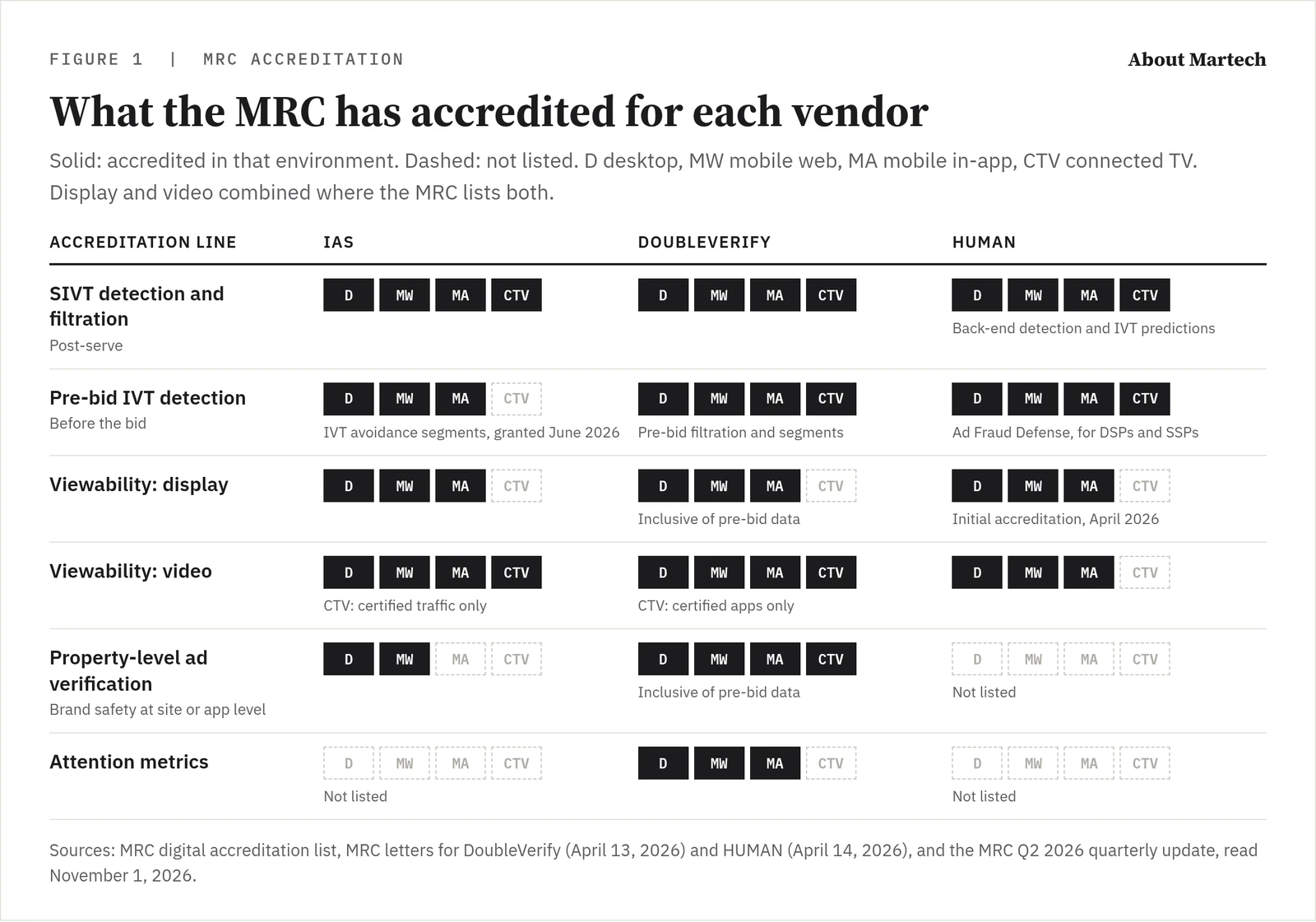
Here is each vendor’s current MRC position, with a link to the MRC document behind it.
| Vendor | Accredited service (MRC name) | Key 2026 change | MRC source |
|---|---|---|---|
| IAS | Campaign Monitor, Firewall and Viewability systems; Pre-bid Optimization Service | Accreditation granted in June 2026 for pre-bid viewability segments and IVT avoidance segments on display and video, desktop, mobile web and in-app | MRC Q2 2026 update |
| DoubleVerify | Pinnacle platform (Quality and Performance dashboards), listed as DoubleVerify Quality Analytics Platform | Continued accreditation on April 13, 2026, with new ad verification languages including Hebrew, Kannada, Malayalam, Marathi and Telugu | MRC letter, April 13, 2026 |
| HUMAN | Ad Fraud Sensor (post-bid) and Ad Fraud Defense (pre-bid) | Continued accreditation on April 14, 2026, plus initial accreditation for HUMAN viewability measurement on desktop, mobile web and in-app | MRC letter, April 14, 2026 |
Two details matter when you read these listings. First, IAS’s pre-bid IVT accreditation covers IP and user agent based segments, user agent only segments and a Fraud IP List, per the MRC listing. Second, the MRC says in its April 11, 2025 statement that it audits pre-bid detection, not the decision to bid. That decision always sits with the DSP or SSP.
Both IAS and DoubleVerify also hold separate MRC listings for third-party reporting on Facebook and YouTube data. DoubleVerify adds Instagram newsfeed placements, and its in-app accreditation includes ads served to TikTok. HUMAN has no social platform reporting listed.
Pre-bid vs post-bid vs CTV coverage
Pre-bid tools stop you from buying a bad impression. Post-bid tools measure or block what was served and give you the data to claim credits. CTV is where coverage differs most. This matrix uses the MRC environment codes and the DSP help pages linked below it.
| Coverage | IAS | DoubleVerify | HUMAN |
|---|---|---|---|
| Post-bid SIVT detection | Accredited on desktop, mobile web, in-app and CTV | Accredited on desktop, mobile web, in-app and CTV | Accredited on desktop, mobile web, in-app and CTV |
| Pre-bid IVT detection | Accredited on desktop, mobile web and in-app; not CTV | Accredited on desktop, mobile web, in-app and CTV | Accredited on desktop, mobile web, in-app and CTV |
| Pre-bid on YouTube in DV360 | Not supported; post-campaign measurement only | Not covered in sources read | Not a DV360 pre-bid vendor |
| CTV video viewability | Accredited, certified traffic only | Accredited, certified apps only | Not accredited for CTV |
| CTV in DV360 | Ad Fraud Prevention, Brand Safety, Context Control Avoidance and Quality Sync available | Not covered in sources read | Not a DV360 pre-bid vendor |
Sources: MRC digital accreditation list, DV360 help on IAS and the DV360 third-party verification file reference.
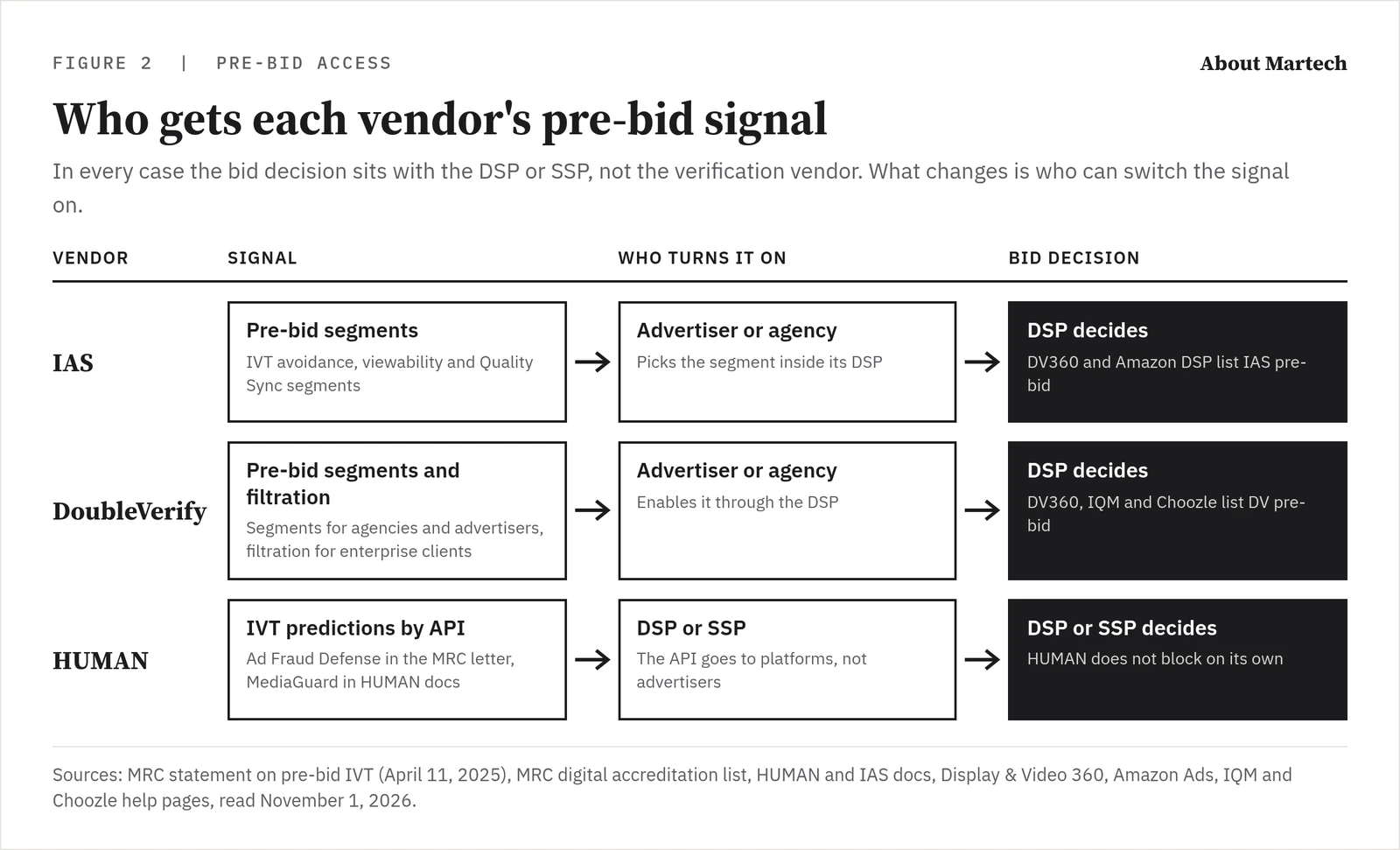
The access model is the biggest practical split. The MRC statement says HUMAN gives its IVT suggestions through an API only to DSPs and SSPs, not to advertisers or agencies, and that HUMAN does not filter or block requests itself. DoubleVerify offers pre-bid segments to DSPs and SSPs and to advertisers and agencies through their DSP. HUMAN’s docs add that the pre-bid model retrains every two hours, and lets 0.5% of traffic flagged as SIVT through so post-bid detection can check the call.
Brand safety and suitability compared
Fraud is only half of what buyers pay these vendors for. The other half is keeping ads away from content a brand does not want next to it. Brand safety means avoiding content that is unsafe for any advertiser, such as hate speech or terrorism. Brand suitability is the brand-specific layer, where each advertiser sets its own risk thresholds.
| IAS | DoubleVerify | HUMAN | |
|---|---|---|---|
| How suitability is set | Low, medium and high risk tiers across 12 content categories, plus Context Control for page-level semantic analysis | Authentic Brand Suitability segment, usable in pre-bid alongside individual pre-bid segments | Brand safety and suitability added in the June 2026 Ad Integrity Suite |
| Extra controls listed by Choozle | Granular contextual analysis | Can exclude apps by average app store review rating | Not listed |
| Source | IAS overview | MRC list, Choozle | HUMAN release |
IAS says in its brand safety overview that its suitability tiers follow the GARM framework, and that its models score image, audio and text, and video frame by frame. Note that the World Federation of Advertisers discontinued GARM on August 9, 2024, so ask any vendor which category taxonomy its tiers follow today and how it maps your old GARM settings.
Where the risk sits also matters. IAS’s 21st Media Quality Report, released July 9, 2026, found that mobile web display carried 45.1% of impressions but 54.9% of brand suitability violations and 71.9% of made-for-advertising (MFA) impressions. If most of your budget runs on mobile web, test suitability settings there first.
DSP and SSP integrations
A vendor is only useful if it plugs into the platforms you already buy on. This list comes from DSP and vendor documentation, not marketing claims. It is not complete, so confirm your own DSP before you sign.
| Platform | IAS | DoubleVerify | HUMAN | Source |
|---|---|---|---|---|
| Display & Video 360 (DSP) | Pre-bid vendor; labels include TRAQ score and viewability tiers | Pre-bid vendor; labels include fraud and invalid traffic avoidance | Not listed | Google developers |
| Amazon DSP | Verification by server-to-server tag; Quality Sync pre-bid segment | Verification by server-to-server tag | Not listed | Amazon Ads, IAS |
| IQM (DSP) | Not listed | Only pre-bid partner for fraud, brand suitability and viewability | Not listed | IQM help |
| Choozle (DSP) | Pre-bid brand safety | Pre-bid brand safety | Not listed | Choozle help |
| OpenX (SSP) | Not covered in sources read | Not covered in sources read | Launch partner for Ad Integrity Suite for Platforms, October 2026 | HUMAN release |
| AWS Marketplace | Not covered in sources read | Fraud and invalid traffic avoidance listing, contract pricing | Not covered in sources read | AWS |
IQM’s DoubleVerify segment list shows how granular the DSP-side options get. Buyers can avoid sites and apps by fraud and invalid traffic thresholds of 25%, 50%, 75% and 100%, and can add supply refinement segments for made-for-advertising inventory.
Reporting speed, video support and what users say
Accreditation lists do not tell you how a vendor feels to work with day to day. These details come from DSP help pages and public user comments, so they show one platform or one person’s view, not a full test.
- Reporting delay. FreeWheel and AIDEM both tell buyers to expect IAS post-bid viewability data about 28 hours after the impression, and DoubleVerify data about 4 to 6 hours after measurement. If you optimize campaigns within the same day, that gap matters.
- Video measurement. AIDEM’s viewability partner page says IAS post-bid measurement for video is not available on its platform and points buyers to DoubleVerify or Moat. It also advises using the same partner for pre-bid and post-bid so the numbers line up.
- G2 ratings. IAS shows 4.3 out of 5 from 10 reviews on G2. DoubleVerify shows 4.1 out of 5 from 78 reviews, per rfp.wiki’s G2 snapshot. Both samples are too small to settle the choice.
Practitioners split in a December 2024 r/programmatic thread titled IAS or DoubleVerify. These are individual Reddit user comments, not verified customer reviews:
- One commenter recommended IAS as “much more user friendly” and said both vendors are weaker on non-English content.
- Another said “DV offers much friendlier reporting and setup”, adding that IAS lists handled through support “can take days”.
- A third said results were similar between the two and preferred IAS for its interface and account reps.
The takeaway from those comments is that results tend to look alike, and the deciding factors are reporting speed, setup workflow and service. Ask both vendors for a trial on the same line items and compare those three things directly.
The three vendors up close
Integral Ad Science (IAS)
IAS sells ad fraud, brand safety and suitability, contextual targeting, viewability and attention products, per its solutions page. Its ad fraud page says IAS was the first verification provider to receive MRC SIVT accreditation for CTV, and that it earned TAG Platinum Status in 2024. A Threat Lab team works on fraud research with law enforcement and academia.
For programmatic buyers, the key product is Quality Sync. IAS describes it as one pre-bid segment that bundles brand safety, invalid traffic, suitability, MFA protection and blocklists, and it is available in Amazon DSP. One limit to know: DV360 says IAS pre-bid does not cover YouTube, where IAS offers post-campaign measurement only.
On July 7, 2026, IAS named Lidiane Jones chief executive, succeeding Lisa Utzschneider. Jones previously ran Bumble and Slack. Two days later, IAS released its 21st Media Quality Report. The UK edition shows CTV invalid traffic of 9.1% on non-optimized campaigns against 0.1% on campaigns optimized with IAS in Q2 2026, per the report PDF. Treat that as IAS’s own data on its own product.
Best for: buyers on DV360 and Amazon DSP who want one rule set across pre-bid and post-bid, and teams that need CTV and SSAI video measurement. Not for: buyers who need MRC accredited pre-bid IVT detection on CTV, which IAS does not list.
DoubleVerify
DoubleVerify, or DV, has the widest MRC listing of the three. Its Pinnacle platform is accredited for SIVT, pre-bid IVT detection, property-level ad verification and video viewability across desktop, mobile web, in-app and CTV, plus attention metrics, per the April 2026 MRC letter. Its fraud avoidance listing names bot fraud, site fraud, app fraud, data center traffic, hijacked devices and emulators.
DV is also the largest by reported revenue. Its full-year 2025 results show revenue of $748.3 million, up 14%, with activation revenue of $427.3 million and a record 9.5 trillion billable media transactions. On August 6, 2026, Nielsen agreed to acquire DV for $13.60 a share in cash, an enterprise value of about $2.15 billion. Nielsen expects to close by the first quarter of 2027, and DV will keep its name and brand.
Two 2026 product updates are worth knowing. In April, DV became the first measurement provider with MRC accreditation for TikTok video viewability reporting. In September, it launched Ask Neura, a conversational AI tool inside DV Pinnacle that lets users query media quality and performance data in plain language.
Best for: advertisers and agencies that want to switch on accredited pre-bid fraud segments themselves, including on CTV. Not for: buyers who want to avoid a vendor in the middle of an ownership change until the Nielsen deal closes.
HUMAN
HUMAN’s accredited pre-bid product is built for platforms. Its MediaGuard docs describe a pre-bid model that predicts whether an ad opportunity is invalid traffic from the OpenRTB bid request, and it runs alongside a post-bid tag called FraudSensor. The MRC letter names the accredited pre-bid platform Ad Fraud Defense and the post-bid product Ad Fraud Sensor.
In June 2026, HUMAN launched the Ad Integrity Suite for advertisers and agencies. It covers IVT, AI brand safety and suitability, and viewability, with reason codes and URL-level visibility for every classification. HUMAN says its network analyzes more than a quadrillion digital interactions a year. In October 2026 it added a platform version with OpenX as launch partner, with more features due in the first half of 2027.
Best for: DSPs, SSPs and exchanges that want to filter supply before it reaches buyers, and advertisers who want explainable pass or fail reasons. Not for: advertisers who want to pick a HUMAN pre-bid segment inside their DSP, since the MRC statement says that pre-bid feed goes to platforms only.
How much do IAS, DoubleVerify and HUMAN cost?
None of the three publishes a rate card. Pricing is quoted per contract and depends on volume, channels and products. DV’s AWS Marketplace listing also says pricing is set by contract. The SEC filings of IAS and DoubleVerify do explain how the fee is built, which is the most reliable public view of what you will be billed for.
How DoubleVerify charges
DV’s 2025 10-K says advertisers pay a Measured Transaction Fee per thousand impressions measured, and that the price of most of its solutions is fixed. On platforms that charge a percent of media spend, DV says its pricing includes caps that mirror its standard fixed fees. In 2025, advertiser revenue grew 13%, driven by a 15% rise in impressions measured and partly offset by a 3% fall in the fee per thousand, excluding an introductory fixed fee deal for one large customer.
The trend continued in 2026. DV’s third-quarter 2026 10-Q, filed October 30, 2026, reports revenue of $205.6 million, up 9%. Over the first nine months, impressions measured rose 11% while the fee per thousand fell 4%.
How IAS charges
IAS’s 2024 10-K says revenue is the CPM multiplied by impressions measured, under usage-based contracts where the CPM usually stays the same for the contract term. Contracts can also include minimum commitments, overages based on tiered pricing, or flat fees. In its last public quarterly report before going private, the third-quarter 2025 10-Q, measurement CPMs fell 9% over the first nine months of 2025 as impressions grew 22%, while optimization CPMs rose 8%.
The pattern is the same at both vendors. Unit prices on measurement are falling while volumes grow, so a buyer with real volume has room to negotiate the per-thousand rate.
What one DSP passes on
One DSP does publish what it passes on. Choozle’s help center lists DoubleVerify pre-bid brand safety at 4% of media cost for display and 2.5% for video, and IAS at 2.9% for display and 2.5% for video. Treat these as one platform’s resale prices for brand safety, not the vendors’ direct prices for fraud detection. We found no published HUMAN price.
Four things move the bill in a direct contract:
- Who bills you. Ask whether the fee is charged by the DSP, as on Choozle, or by the vendor directly.
- Channels. CTV, social and YouTube reporting are separate MRC listings, so check whether each is a separate line in your quote.
- Volume. Large advertisers and platforms usually get custom terms, so ask for a quote at your real impression volume.
- Contract shape. IAS filings mention minimum commitments and tiered overages, so check what happens if your volume comes in under or over plan.
The Adalytics bot study and how the vendors responded
On March 28, 2025, ad research firm Adalytics published a report on pre-bid bot filtration that named IAS, DoubleVerify and HUMAN. It is the most widely covered public test of these vendors, so buyers should know what it claimed and what the vendors said back.
What Adalytics reported
- Adalytics studied ads served to three bot sources: HTTP Archive, a declared bot listed on the IAB Tech Lab bots list since 2013, URLScan.io, which does not declare itself, and an unnamed crawler vendor.
- It reported that IAS’s publisher pixel labeled the declared HTTP Archive bot as valid traffic 16% of the time across 2022 to 2024 crawls, and URLScan.io traffic as valid 77% of the time.
- It found brand ads served to bots that carried code references to DoubleVerify bot avoidance and IAS Quality Sync segments, and ads served by platforms that announced HUMAN partnerships.
AdExchanger and the Wall Street Journal covered the report. On March 28, Senator Mark Warner asked the FTC and the Attorney General to look into whether verification vendors including DoubleVerify, IAS and HUMAN misrepresented their bot detection.
How IAS, DoubleVerify, HUMAN and the MRC responded
- IAS called the claims unsubstantiated and misleading. It said it classified HTTP Archive traffic as general invalid traffic, and that the publisher tag Adalytics studied measures traffic and does not block it by design. It set out its multi-tiered approach to ad fraud in a follow-up post.
- DoubleVerify said in its statement that in every example shared with it before publication, it had correctly identified the bot traffic, and that those impressions are removed from billable counts. In May 2025, DV sued Adalytics in federal court in Maryland. In April 2026, a judge let DV’s defamation by implication and false advertising claims proceed and dismissed a third claim without prejudice. Adalytics argued in that case that its report covered only pre-bid services.
- The MRC said in its statement that Adalytics did not contact it, and that the industry standard relies on post-serve filtration as well as pre-bid detection.
- HUMAN had no direct public response that we could find on November 1, 2026.
What it means for buyers
AdExchanger’s follow-up listed possible reasons bots got through, including DSPs not passing the user agent to the verification vendor, sampling, and out-of-date IP lists. Jay Friedman, CEO of Goodway Group, told AdExchanger: “You’re going to get your CPM back from the vendors, but that doesn’t pay you back for the media, data costs and everything else.”
That is the practical lesson. A credit from the verification vendor does not cover the media, data and other costs of an impression served to a bot. Ask each vendor three questions: whether your DSP passes the full user agent and IP to its pre-bid check, what share of traffic it samples, and what you get back when post-bid finds invalid traffic.
Ownership and scale in 2026
Ownership changed for two of the three vendors in the last year, which matters for roadmaps and contract terms.
- IAS was taken private by Novacap on December 23, 2025, in a deal that valued IAS at about $1.9 billion. Its last public full-year figure was 2024 revenue of $530.1 million, up 12%. Lidiane Jones became CEO on July 7, 2026.
- DoubleVerify reported 2025 revenue of $748.3 million and third-quarter 2026 revenue of $205.6 million, up 9%. It has agreed to be acquired by Nielsen, with closing expected by the first quarter of 2027.
- HUMAN has no public financial filings that we found. It cites scale instead, with more than a quadrillion interactions a year in its June 2026 release.
Which should you pick? Rules of thumb
Use these rules to narrow the choice, then test the shortlist on a live campaign.
- Pick DoubleVerify if you need accredited pre-bid IVT detection on CTV and want to manage segments yourself in your DSP.
- Pick DoubleVerify if your DSP is IQM, since IQM lists DV as its only pre-bid partner for fraud, suitability and viewability.
- Pick IAS if you buy heavily on Amazon DSP or DV360 and want Quality Sync to carry one set of rules across pre-bid and post-bid.
- Pick IAS if you need accredited SSAI video metrics on CTV.
- Pick DoubleVerify if you optimize within the same day, since partners report DV viewability data in hours rather than about a day.
- Pick DoubleVerify if TikTok is a big channel, since it holds the first MRC accreditation for TikTok video viewability.
- Pick HUMAN if you are a DSP, SSP or exchange that needs IVT predictions on bid requests before they reach buyers.
- Pick HUMAN if you are an advertiser who wants reason codes and URL-level detail behind every verification call.
- Skip pre-bid on YouTube with IAS, since DV360 supports only post-campaign IAS measurement there.
If your main problem is fake clicks on Google or Microsoft search ads, a verification vendor is the wrong tool. Look at click fraud protection software instead. If you would rather hand app install campaigns to specialists, see our list of mobile app marketing agency options.
Frequently asked questions about IAS, DoubleVerify and HUMAN
Is IAS or DoubleVerify better?
Neither is better for every buyer. DoubleVerify has the wider MRC listing, including pre-bid IVT detection on CTV and attention metrics. IAS holds accreditation for SSAI video metrics on CTV, and its Quality Sync segment syncs pre-bid and post-bid rules in Amazon DSP and DV360. Pick based on your DSPs and channels.
What is the difference between DoubleVerify and HUMAN?
DoubleVerify sells mainly to advertisers and agencies, who switch on its pre-bid segments in their DSP. HUMAN’s accredited pre-bid product gives DSPs and SSPs IVT predictions by API, and the MRC says that pre-bid feed is not offered to advertisers. HUMAN added an advertiser suite in June 2026.
Are IAS, DoubleVerify and HUMAN MRC accredited?
Yes. The MRC lists all three as accredited for sophisticated invalid traffic detection on desktop, mobile web, in-app and CTV, and for pre-bid IVT detection. IAS’s pre-bid IVT accreditation was granted in June 2026 and does not cover CTV. DoubleVerify and HUMAN include CTV in their pre-bid accreditation.
Does HUMAN block ads?
No. The MRC states that HUMAN provides IVT suggestions to DSPs and SSPs through an API and does not filter requests, prevent ad serving or enable blocking. The DSP or SSP decides whether to bid. HUMAN also does not offer post-serve blocking, according to the same MRC statement.
How much does DoubleVerify cost?
DoubleVerify does not publish a rate card. Its 10-K says advertisers pay a fixed fee per thousand impressions measured for most solutions, capped on platforms that charge a percent of media. One DSP, Choozle, lists DoubleVerify pre-bid brand safety at 4% of media cost for display and 2.5% for video.
How do IAS and DoubleVerify charge?
Both charge per thousand impressions measured. IAS bills a CPM times impressions measured, and contracts can add minimum commitments, tiered overages or flat fees. DoubleVerify charges a Measured Transaction Fee per thousand impressions, fixed for most solutions. Both filings show unit fees falling while measured volume grows.
Which reports viewability faster, IAS or DoubleVerify?
Partner documentation favors DoubleVerify. FreeWheel and AIDEM both say to expect DoubleVerify post-bid viewability data about 4 to 6 hours after measurement, and IAS data about 28 hours after the impression. AIDEM also says IAS post-bid video measurement is not available on its platform.
What did the Adalytics report say about IAS and DoubleVerify?
The March 2025 Adalytics report said ads using IAS and DoubleVerify pre-bid tools were served to declared and undeclared bots. IAS called the claims unsubstantiated and misleading. DoubleVerify said it caught the bot traffic and removed it from billable counts, then sued Adalytics. The MRC said post-serve filtration is part of the standard.
Is DoubleVerify being acquired?
Yes. Nielsen agreed on August 6, 2026, to acquire DoubleVerify for $13.60 a share in cash, an enterprise value of about $2.15 billion. Nielsen expects the deal to close by the first quarter of 2027, subject to shareholder and regulatory approval. DoubleVerify will keep operating under its own name and brand.
Who owns IAS now?
IAS is owned by Novacap, a North American private equity firm. The acquisition closed on December 23, 2025, in an all-cash deal that valued IAS at about $1.9 billion. IAS shareholders received $10.30 a share, and IAS stock is no longer listed on the Nasdaq.
The verdict
For most advertisers and agencies, the real choice is IAS or DoubleVerify, and the deciding factor is your DSP stack. DoubleVerify fits buyers who want accredited pre-bid fraud segments on every screen, including CTV. IAS fits buyers who live in Amazon DSP or DV360 and want one rule set from bid to report. On price, both charge per thousand impressions under contract, and both filings show room to negotiate that rate down.
HUMAN is the pick for platforms that need fraud predictions on bid requests, and a newer option for advertisers who want explainable verification. Whichever you choose, ask for the MRC letter that covers the exact products you are buying. For a wider shortlist, our ad fraud prevention platforms guide covers app and affiliate fraud tools too.