- Jasper’s Creator plan starts at $49/month per seat as of its public pricing page, making it one of the pricier AI writing tools for teams that don’t need its full brand-voice and campaign workflow features.
- Several alternatives including ChatGPT Plus, Writesonic, and Rytr produce comparable or better output for specific content types at a fraction of that cost.
- The right Jasper alternative depends on workflow fit: Claude wins on long-form reasoning, Anyword wins on performance-optimized copy, and Notion AI wins if your team already drafts in Notion.
- Most teams overpay for Jasper because they use only 20 to 30 percent of its feature set. Identifying which features you actually use narrows the shortlist fast.
The best alternatives to Jasper AI are ChatGPT Plus, Copy.ai, Writesonic, Rytr, Notion AI, Claude, and Anyword. Each beats Jasper on price for comparable output quality, with ChatGPT Plus at $20/month and Rytr offering a free tier. Claude excels at long-form and nuanced copy, Anyword adds predictive performance scoring, and Writesonic covers SEO-focused content with Surfer integration. The best pick depends on your content type and existing tools.
Why Are Teams Looking for Jasper Alternatives in the First Place?
Jasper built its reputation as the enterprise AI writing platform when GPT-3 was still a novelty and purpose-built writing tools had a real edge over raw models. That edge has narrowed significantly. OpenAI, Anthropic, and Google have shipped model improvements fast enough that the gap between Jasper’s curated experience and a well-prompted Claude or ChatGPT session is much smaller than it was two years ago.
Pricing is the sharper complaint. Jasper’s public pricing page lists the Creator plan at $49/month per seat (billed annually), the Pro plan at $69/month per seat, and a Business tier that is quote-based. For a five-person content team, that’s $245 to $345 per month before you hit the enterprise tier. Teams that primarily need long-form drafts, ad copy, or email sequences are finding they can cover those use cases for less.
The other friction point is template lock-in. Jasper’s workflow is built around its own campaign and document editor. If your team writes in Google Docs, Notion, or a CMS, you’re context-switching constantly. That’s a real productivity cost that doesn’t show up in a feature comparison.
The AboutMartech Output-Fit Test: How to Pick the Right Jasper Alternative
Before comparing tools, run what we call the AboutMartech Output-Fit Test: four checks drawn from how editorial and demand-gen teams actually evaluate AI writing tools in practice, designed to filter noise from the alternatives list in under ten minutes.
- Content type match. Long-form SEO articles, short ad copy, email sequences, and social posts have different model requirements. A tool optimized for conversion copy (Anyword) will underperform on a 3,000-word thought-leadership piece compared to Claude.
- Workflow surface. Where does your team write? If the answer is Notion, Notion AI is cheaper and faster than switching to a new tool. If the answer is “everywhere,” a browser extension or API matters more than a proprietary editor.
- Brand-voice depth. Jasper’s primary differentiator is its brand-voice training. If you have a mature style guide and consistent tone requirements across dozens of writers, that feature has real value. If you’re a team of three, a well-crafted system prompt in Claude achieves 90 percent of the same result.
- Output verification need. If your copy goes live with minimal human review, Anyword’s predictive performance scoring and Writesonic’s Surfer SEO integration are worth paying for. If a skilled editor reviews everything, raw model quality matters more than scoring overlays.
Run these four checks first. Your shortlist goes from seven tools to two or three.
Which Tools Actually Beat Jasper on Price and Output?
| Tool | Starting Price | Best For | Key Trade-off vs. Jasper |
|---|---|---|---|
| ChatGPT Plus | $20/month | Versatile long-form, research, code | No purpose-built marketing templates |
| Copy.ai | Free tier; $36/month (Starter) | GTM workflows, sales and marketing copy | Weaker brand-voice controls than Jasper |
| Writesonic | Free tier; $16/month (Individual) | SEO content with Surfer integration | Output volume limits on lower tiers |
| Rytr | Free tier; $9/month (Saver) | Budget teams, high-volume short copy | Less capable on nuanced long-form |
| Notion AI | $10/member/month add-on | Teams already in Notion | Not a standalone writing tool |
| Claude | Free tier; $20/month (Pro) | Long-form reasoning, nuanced copy | No marketing-specific templates |
| Anyword | $49/month (Starter) | Performance-optimized ad and email copy | Same price as Jasper Creator; narrower use case |
Prices sourced from each vendor’s public pricing page. Verify before purchasing as vendors update pricing frequently.
ChatGPT Plus: The Default Challenger
ChatGPT Plus at $20/month is the most direct attack on Jasper’s value proposition. GPT-4o handles blog posts, email sequences, ad copy, and persona-based messaging without any template scaffolding. The model’s instruction-following has improved to the point where a well-written system prompt replicates much of what Jasper’s brand-voice feature does.
The honest limitation: ChatGPT is a conversation interface, not a campaign workflow tool. If your team needs a shared asset library, approval queues, or SEO scoring built into the writing experience, you’ll bolt those on separately. For individual writers or small teams drafting and editing in a doc environment, that’s a non-issue.
ChatGPT’s web browsing and code interpreter make it more versatile than Jasper for teams that mix content work with research or data analysis. That’s a genuine differentiator Jasper hasn’t closed.
Copy.ai: The GTM Workflow Play
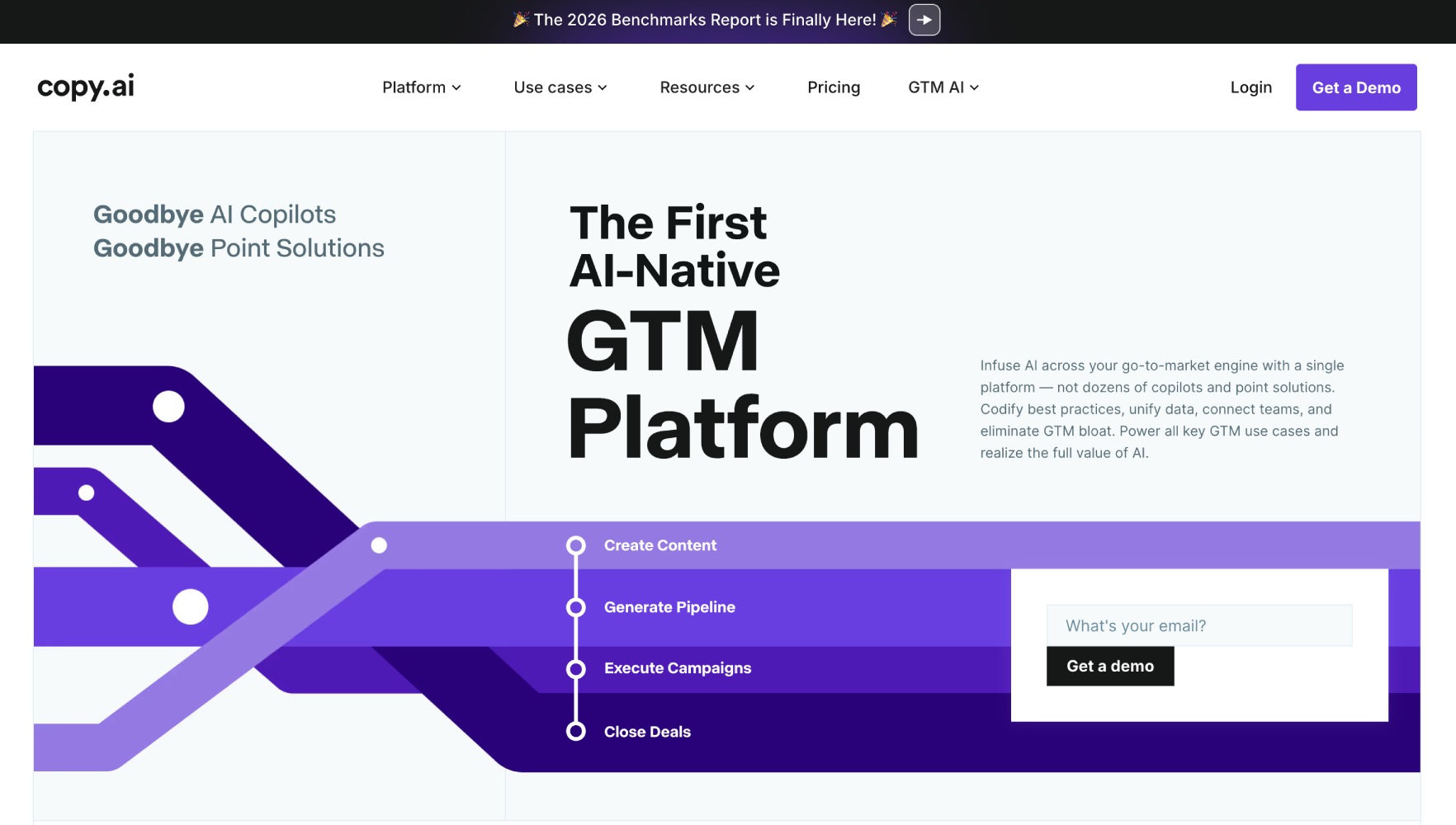
Copy.ai has repositioned from a simple copywriting tool to a go-to-market platform, and the pivot is substantive. Its workflows layer connects prospecting research, persona targeting, and copy generation into a single pipeline. For demand-gen teams running ABM sequences or SDR-to-AE handoff content, that workflow architecture is worth more than Jasper’s brand-voice training.
The free tier is genuinely usable, not a stripped demo. The Starter plan at $36/month (billed annually, per their public pricing page) includes unlimited words and brand voice. That positions Copy.ai well below Jasper’s per-seat cost for solo operators or small teams.
Copy.ai’s weakness shows up in nuanced long-form content. A 2,500-word analyst-style piece requires more editing than the equivalent Claude or ChatGPT output. If SEO content volume is your primary use case, Writesonic or a direct model is faster.
Writesonic: The SEO Content Machine
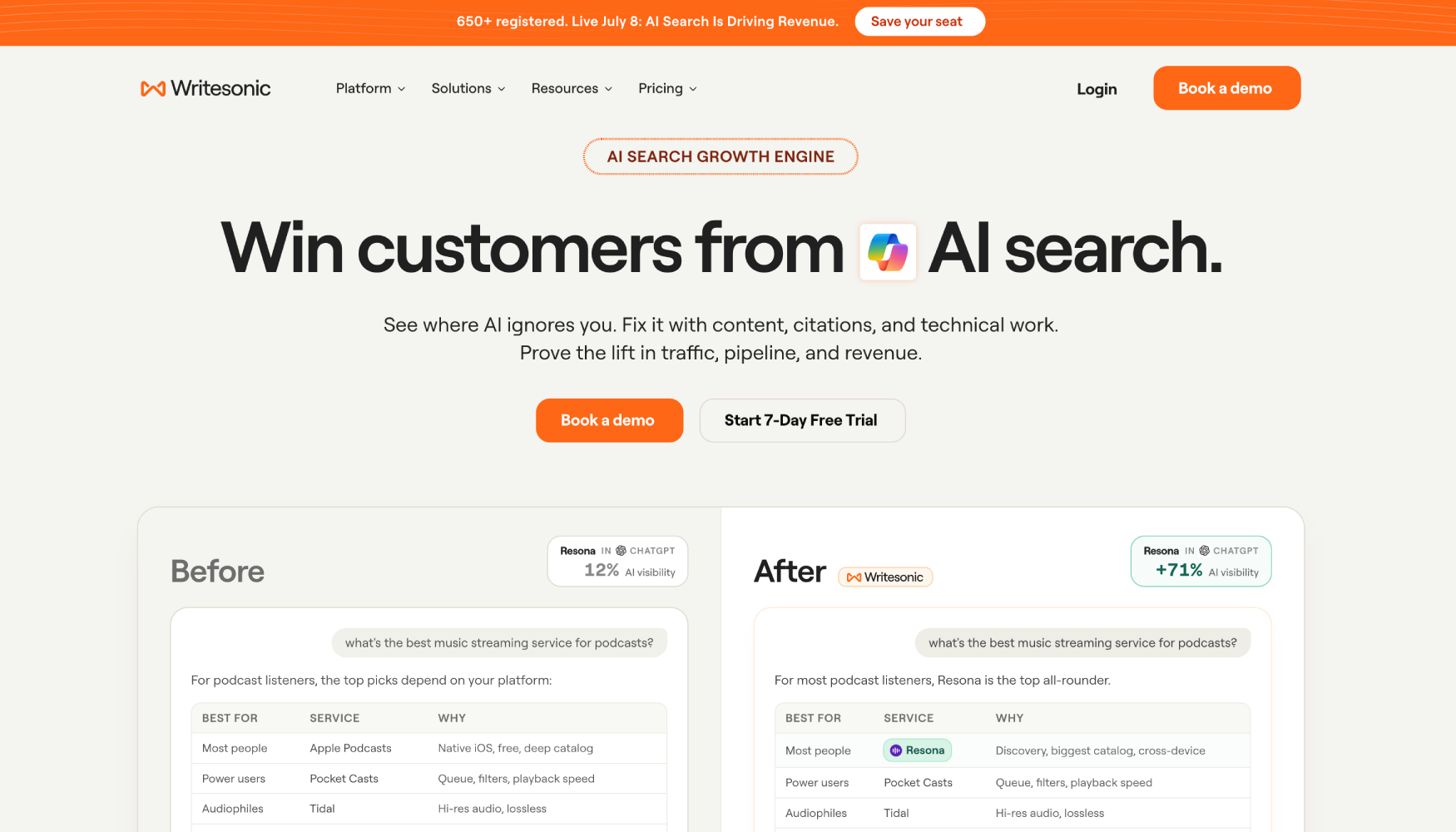
Writesonic competes directly with Jasper on price and takes a sharp angle on SEO content. Its native integration with Surfer SEO means you can generate, score, and optimize a blog post inside a single tool without a separate subscription. Jasper has a Surfer integration too, but it requires both tools separately. Writesonic bundles the workflow at a lower starting price.
The Individual plan starts at $16/month (billed annually) based on Writesonic’s public pricing page, though output quality varies by tier since higher-quality AI models are reserved for higher plans. Teams generating high volumes of SEO content should test the model tier they’ll actually use before committing, not just the entry price.
Writesonic’s Chatsonic feature wraps a GPT-4-level chat interface with web access, which closes one of the gaps teams find in dedicated writing tools. It’s not as capable as Claude for nuanced reasoning, but for factual accuracy checks during content creation, web access in the writing session matters.
Rytr: When Budget Is the Primary Constraint
Rytr is the clearest answer to “is there a cheaper tool than Jasper that still gets the job done?” The Saver plan runs $9/month (billed annually), and the free tier allows 10,000 characters per month. For teams that primarily need product descriptions, social captions, short email copy, or FAQ drafts, Rytr’s output quality is adequate and the price is hard to argue with.
The trade-off is real though. Rytr’s underlying models are less capable than GPT-4o or Claude 3 on complex or nuanced copy. A Rytr draft of a thought-leadership piece will require more editing than the equivalent from a frontier model. Treat it as a first-draft accelerator for defined, repeatable content types, not a full-service writing environment.
Teams that produce high volumes of templated content, think e-commerce product pages or localized email variants, will find Rytr’s character limits and template library hit a ceiling. At that volume, Writesonic’s unlimited plans become more economical.
Notion AI: The Zero-Friction Option for Notion Teams
Notion AI isn’t trying to replace Jasper. It exists to serve teams already living in Notion, and for those teams it’s the most friction-free AI writing add-on available. At $10/member/month added to any Notion plan, it’s significantly cheaper than Jasper for most team sizes.
Notion AI drafts, edits, summarizes, and translates inside the pages your team already uses. There’s no export, no switching context, no pasting between tools. For teams that manage editorial calendars, campaign briefs, and content drafts in Notion, that integrated surface is worth more than template libraries in a separate SaaS tool.
Its limitations are structural rather than quality-based. Notion AI isn’t built for standalone content creation campaigns, doesn’t have SEO scoring, and has no ad copy performance prediction. Use it inside Notion, don’t try to stretch it into territory it wasn’t designed for.
Claude: The Best Alternative for Long-Form and Nuanced Copy

Claude from Anthropic is the strongest Jasper alternative for teams producing long-form content that requires sustained argument, nuance, or a consistent editorial voice. Claude’s context window handles large documents without losing coherence, and its instruction-following on tone and style is arguably better than GPT-4o for prose-heavy content.
Claude Pro costs $20/month, matching ChatGPT Plus. The free tier is more limited but usable for light workloads. Neither plan includes marketing-specific templates or SEO scoring, so Claude suits teams with strong editors who want a capable writing partner rather than a guided content factory.
One underrated use case: Claude performs well on sensitive or regulated copy where precision matters more than speed. Financial services, healthcare, and legal-adjacent content teams that find AI writing tools too sloppy should test Claude specifically.
As AI-generated content increasingly surfaces in AI search environments, the quality ceiling of your model matters more than it used to. The AEO and GEO tools teams use to track citation in AI search increasingly reward content that reads as authoritative, and Claude’s output tends to score better on those dimensions than lighter models.
Anyword: When You Need Copy That’s Been Scored Before It Runs
Anyword is the one tool in this list that matches Jasper’s Creator-plan price at $49/month (Starter, billed annually, per Anyword’s public pricing page) and justifies it with a different capability: predictive performance scoring. Every piece of copy Anyword generates comes with a predicted engagement score based on its training on ad and email performance data. For paid social, display, and email subject lines, that scoring layer is functionally different from anything Jasper offers.
The use case is narrow but real. If your team runs paid ads at meaningful volume, the difference between a subject line with a predicted score of 62 and one scoring 81 is worth more than the subscription cost in recovered media spend. Anyword was built for performance marketers, not content teams, and the product shows that focus.
Teams looking for a general-purpose AI writing tool should look elsewhere at this price point. But for a demand-gen team that A/B tests copy at scale, Anyword offers a capability none of the cheaper alternatives replicate.
How Do These Alternatives Compare on Brand-Voice Features?
Brand voice is Jasper’s most cited differentiator, and it’s worth being precise about what that actually means. Jasper lets you upload brand guidelines, define tone parameters, and have those applied across all outputs. The implementation is more structured than a system prompt, and it’s easier to enforce across a larger team without relying on each writer to prompt correctly.
The alternatives handle this differently. Copy.ai’s brand voice feature is the closest functional equivalent. Claude and ChatGPT can replicate brand voice through system prompts or custom GPTs, but that setup requires prompt engineering knowledge and ongoing maintenance. Anyword and Writesonic have brand-voice features of varying depth, but neither matches Jasper’s controls for large multi-writer teams.
If you’re running a content operation with ten or more writers producing brand-sensitive output, Jasper’s brand-voice tooling has a real ROI case. For teams under that threshold, a well-structured system prompt in Claude or ChatGPT delivers comparable consistency at a fraction of the cost.
What Should You Actually Do If You’re Switching from Jasper?
Start with a two-week parallel test, not a hard cutover. Pick your top two or three content types by volume, produce identical briefs, and run them through your Jasper shortlist alternatives. Score outputs on the same rubric your editors use for revision cycles. The tool that produces the least editing time wins, regardless of what a feature comparison says.
Export your Jasper templates, brand-voice documents, and any custom instructions before you cancel. Most of that material translates directly into system prompts for Claude or ChatGPT custom instructions. You’re not starting from zero; you’re porting institutional knowledge from one format to another.
For teams managing complex martech stacks, the AI writing layer rarely sits in isolation. If your content operations connect to a CDP, CRM, or analytics pipeline, factor in integration requirements. The B2B customer data platforms we cover increasingly have AI content hooks that reduce the need for a standalone writing tool entirely.
Frequently Asked Questions
Is there a free alternative to Jasper AI?
Yes. Claude, ChatGPT, Writesonic, Copy.ai, and Rytr all offer free tiers. Rytr’s free tier includes 10,000 characters per month. Claude and ChatGPT free tiers have usage limits but provide access to capable models. For teams that need unlimited output, the paid plans of these tools still cost significantly less than Jasper’s $49/month Creator plan.
Which Jasper alternative produces the best long-form content?
Claude produces the strongest long-form content among Jasper alternatives. Its large context window maintains coherence across lengthy documents, and its instruction-following on tone and editorial style is well-suited for articles, white papers, and thought-leadership pieces. ChatGPT Plus with GPT-4o is a close second. Both cost $20/month, less than half of Jasper’s entry plan.
Can any of these alternatives match Jasper’s brand-voice controls?
Copy.ai comes closest with a dedicated brand-voice feature. Claude and ChatGPT can replicate brand voice through custom system prompts or custom GPTs, but those require prompt engineering effort. For teams with ten or more writers producing regulated or brand-sensitive content at volume, Jasper’s brand-voice tooling still has an edge. For smaller teams, the system-prompt approach covers most use cases.
Which alternative is best for paid ad copy and email performance?
Anyword. Its predictive performance scoring on ad and email copy is a genuine capability that none of the cheaper alternatives replicate. It matches Jasper’s Starter price at $49/month but is specifically built for performance marketers running paid social, display, and email campaigns at scale. If performance scoring isn’t a priority, Copy.ai or ChatGPT cover ad copy at lower cost.
Is Writesonic actually cheaper than Jasper for SEO content teams?
At the Individual plan level ($16/month billed annually per Writesonic’s public pricing page), yes, significantly cheaper. But the comparison depends on which AI model tier you need. Writesonic reserves its best model quality for higher-tier plans, so teams that need GPT-4-level output should verify the exact tier pricing rather than assuming the entry price applies. For SEO teams that use Surfer, Writesonic’s native integration removes a workflow step that Jasper requires you to handle externally.
What is the main reason teams leave Jasper?
Price-to-value fit, especially as frontier AI models have improved. Teams that adopted Jasper when purpose-built tools had a clear quality edge over raw models now find that a well-prompted Claude or ChatGPT session produces comparable output for $20 to $30 less per seat per month. The second most common reason is workflow friction from Jasper’s proprietary editor when teams write primarily in other tools.
Do any Jasper alternatives integrate with marketing attribution tools?
Most AI writing tools don’t integrate directly with attribution platforms, but the content they produce feeds into the channels those platforms measure. If you’re evaluating how AI-generated content performs against revenue metrics, a proper attribution layer matters more than which writing tool you use. Our guide to marketing attribution tools that connect content to revenue covers the platforms that close that loop.
The Bottom Line on Jasper Alternatives
Jasper built a real product and still has the most structured brand-voice and campaign workflow tooling in this category. The case for staying is strongest for large content teams with mature brand guidelines and a workflow that fits Jasper’s editor. That’s a real but narrow use case.
For everyone else, the math has shifted. Claude and ChatGPT Plus deliver frontier model quality at $20/month. Copy.ai handles GTM workflows at $36/month with a usable free tier. Rytr covers high-volume short copy at $9/month. Anyword earns its $49/month for performance marketing teams. Notion AI is the obvious call if your team already runs on Notion.
The durable lesson from the Output-Fit Test: most teams switching from Jasper aren’t looking for a better AI writing tool in the abstract. They’re looking for a tool that fits how their team actually works, at a price that doesn’t require justifying to finance every quarter. Run the four checks, test the shortlist in parallel, and the right tool becomes obvious before you’ve committed a dollar.