
- Most marketing teams have no idea which LLMs crawl their site, how often, or which pages they index , because standard analytics tools filter bots out entirely.
- Purpose-built AI crawler analytics tools read server logs or sit inline as reverse proxies, surfacing GPTBot, ClaudeBot, PerplexityBot, and a dozen others as named, measurable entities.
- The data these tools surface is the foundation of any serious generative engine optimization (GEO) effort , you cannot optimize for AI citation if you cannot see AI crawl behavior.
- A small number of vendors are now adding pay-per-crawl and crawler firewall features, turning what was a passive measurement problem into an active monetization and access-control decision.
- Cloudflare and Fastly are excluded from this list. Both offer bot management, but neither is purpose-built for AI crawler analytics at the depth this category now requires.
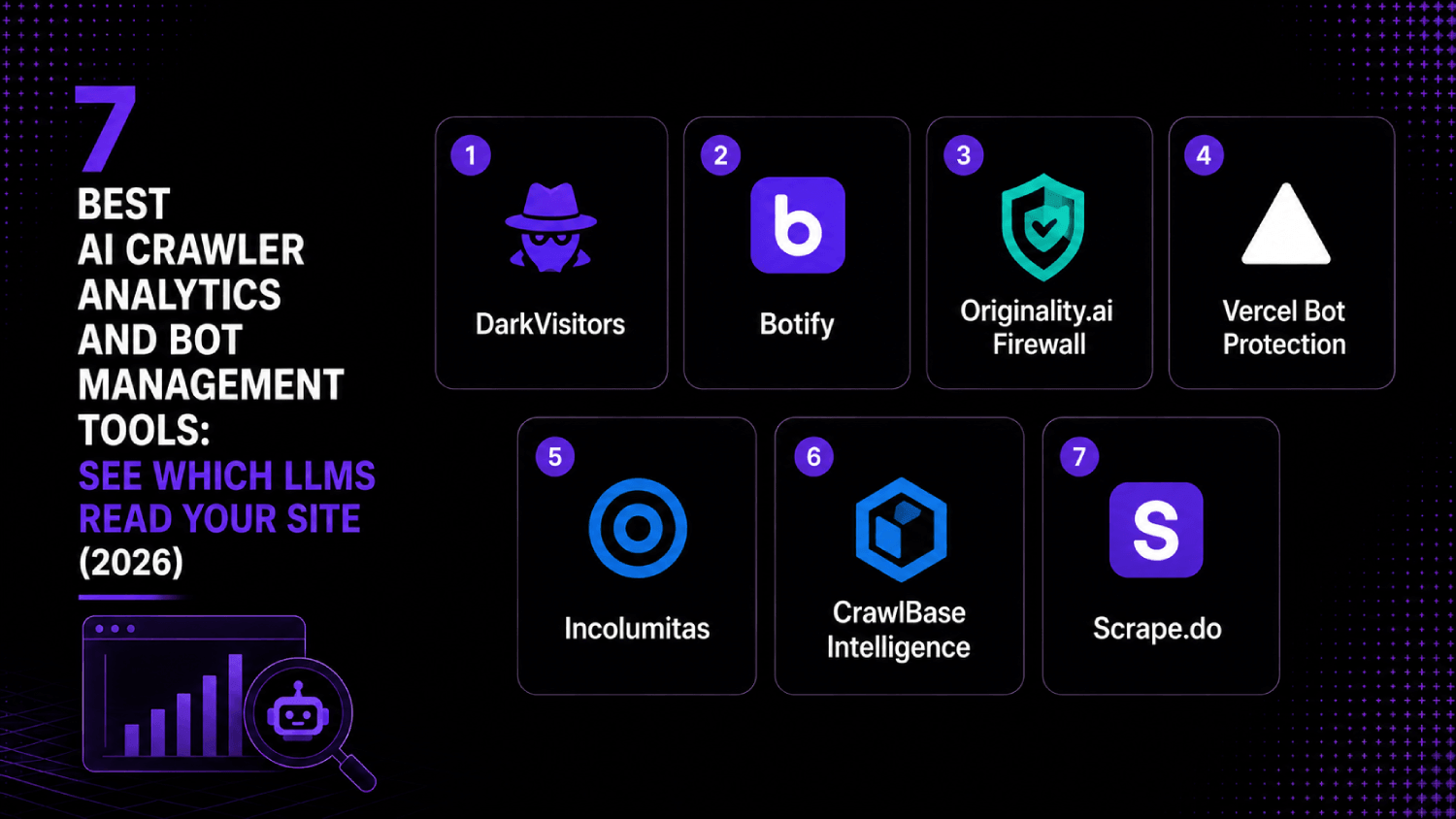
The best tools for tracking AI crawler traffic are purpose-built log analyzers and reverse-proxy agents that identify GPTBot, ClaudeBot, PerplexityBot, and other LLM crawlers by user-agent string, then report crawl frequency, page depth, and content coverage in a marketing-readable dashboard. The top options in 2026 are Scrape.do’s Log Analyzer, Botify, Originality.ai’s Firewall, Vercel’s Bot Protection layer, Incolumitas, DarkVisitors, and CrawlBase Intelligence. Each serves a different part of the stack.
Why standard analytics tools miss AI crawler traffic entirely
Google Analytics 4, Mixpanel, and most tag-based analytics platforms are designed to measure human sessions. They fire JavaScript on page load , and crawlers do not execute JavaScript. The result is that GPTBot can index your entire content library, visit daily, and leave zero trace in your GA4 property.
Server logs are the only place AI crawler traffic reliably appears, because logs record every HTTP request at the infrastructure level regardless of whether JavaScript executes. The problem is that raw access logs are not a marketing tool. They require grep commands, log rotation management, and enough familiarity with user-agent strings to know that Mozilla/5.0 AppleWebKit/537.36 (KHTML, like Gecko); compatible; GPTBot/1.1 belongs to OpenAI and not a human Chrome user on macOS.
This is the gap the tools in this list close. They either sit upstream of your web server (reverse proxy or CDN layer) or consume your existing log files, then classify bot traffic by LLM source, report on crawl patterns, and in some cases let you act on that data by blocking, rate-limiting, or charging for access. If you are working on improving how AI models cite your brand, the step-by-step guide to getting cited by ChatGPT, Claude, and Perplexity picks up exactly where this measurement layer leaves off.
The AboutMartech Crawler Signal Stack: how to evaluate these tools
Because this category barely existed two years ago, vendor marketing is thin and comparison content is almost nonexistent. To cut through the noise, every tool in this list was evaluated against a four-part framework we call the Crawler Signal Stack: Identification (which bots does it detect and by what method?), Granularity (page-level detail vs. domain-level aggregates?), Action Layer (can you block, rate-limit, or monetize?), and Integration Fit (log-based, proxy-based, or API-based , and which infrastructure does that require?).
A tool can score well on identification but fail on granularity. Botify, for instance, identifies crawlers with exceptional precision but its primary use case is technical SEO, not AI-specific analytics. DarkVisitors is the opposite: purpose-built for AI bot taxonomies but thinner on raw traffic volume reporting. Knowing where a tool sits on the Signal Stack tells you whether it fits your use case before you start a trial.
What does AI crawler analytics data actually tell you?
Crawl frequency by bot tells you which LLMs treat your content as a live source versus a one-time index target. OpenAI’s GPTBot and Anthropic’s ClaudeBot both publish their user-agent strings and IP ranges, so detection is deterministic, not probabilistic. Perplexity’s bot is documented on their site. Google’s own AI-related crawler, Google-Extended, is separate from Googlebot and signals specifically that your content may feed into Gemini’s training or grounding data.
Page-level crawl data tells you which content AI systems care about. If GPTBot visits your pricing page twice a week but never touches your blog, that is a signal about where your structured, factual content sits relative to your narrative content. Crawl depth tells you whether a bot is skimming your homepage or working through paginated archives. These patterns directly inform GEO decisions , knowing that ClaudeBot consistently crawls your comparison pages but ignores your product feature pages suggests where to concentrate schema markup and citation-ready formatting.
For teams already running GEO alongside SEO, it is worth reading how GEO and SEO diverge in 2026 , because the optimization signals are structurally different even when they start from the same crawl data.
The 7 best AI crawler analytics and bot management tools
1. DarkVisitors
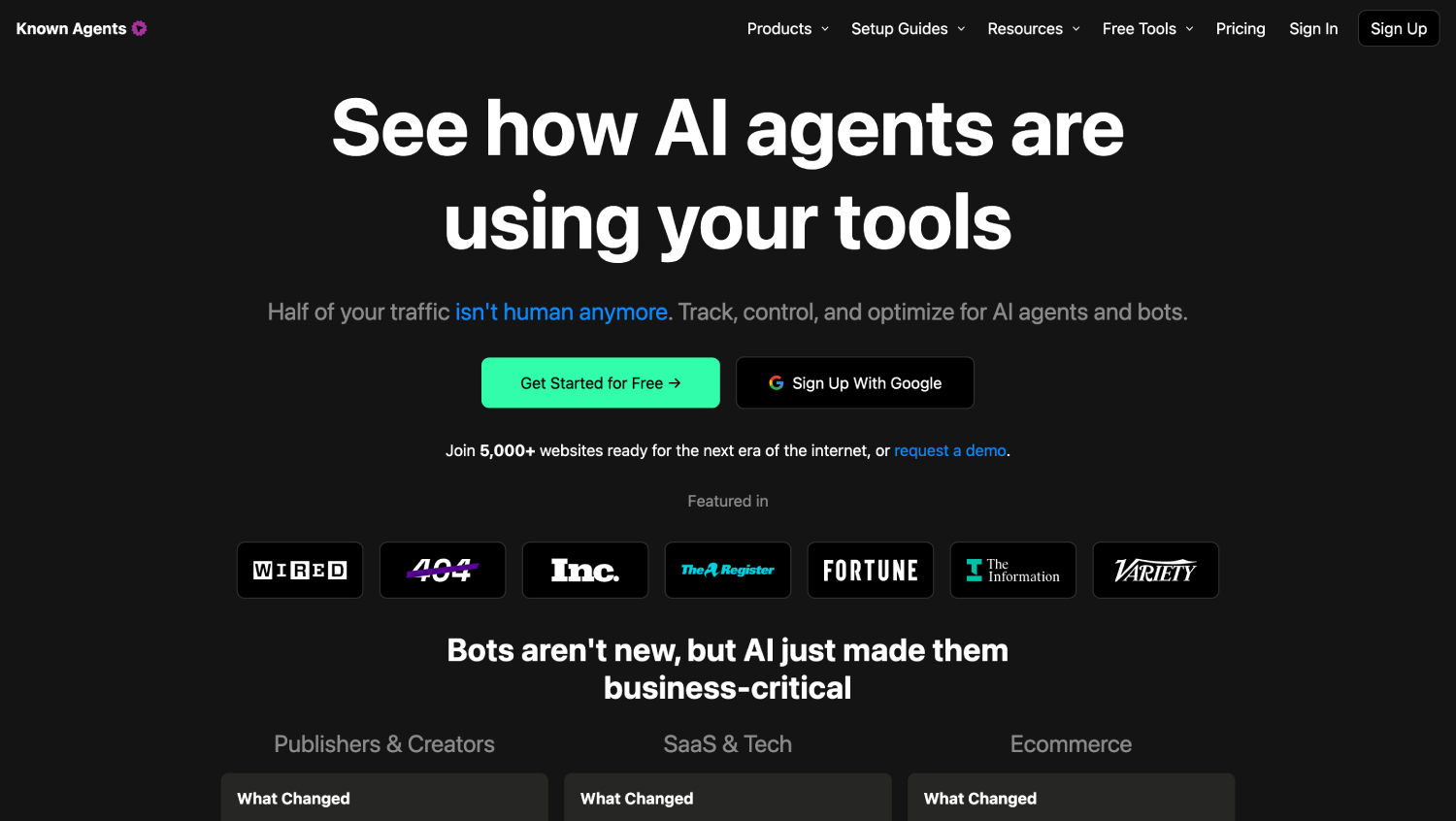
DarkVisitors is the most complete public taxonomy of AI agents and crawlers available, and it ships with a live tracking component that identifies bots by user-agent string against its maintained registry. The registry covers GPTBot, ClaudeBot, PerplexityBot, Google-Extended, Amazonbot, YouBot, and dozens of others, including lesser-known training crawlers that most log analyzers miss entirely.
The tool’s core value is its maintained, up-to-date agent database. When a new LLM company launches a crawler, DarkVisitors typically documents it faster than any other source. For teams that want to generate a comprehensive robots.txt block list for AI crawlers, DarkVisitors auto-generates one from its registry. The analytics layer shows crawl frequency and page coverage, though reporting depth is lighter than infrastructure-native tools like Botify.
DarkVisitors is the right starting point for any team that does not yet have log infrastructure in place. It works via a lightweight JavaScript tag for basic detection or through log file upload for deeper analysis. Pricing is publicly available on their site with a free tier for small sites.
2. Botify
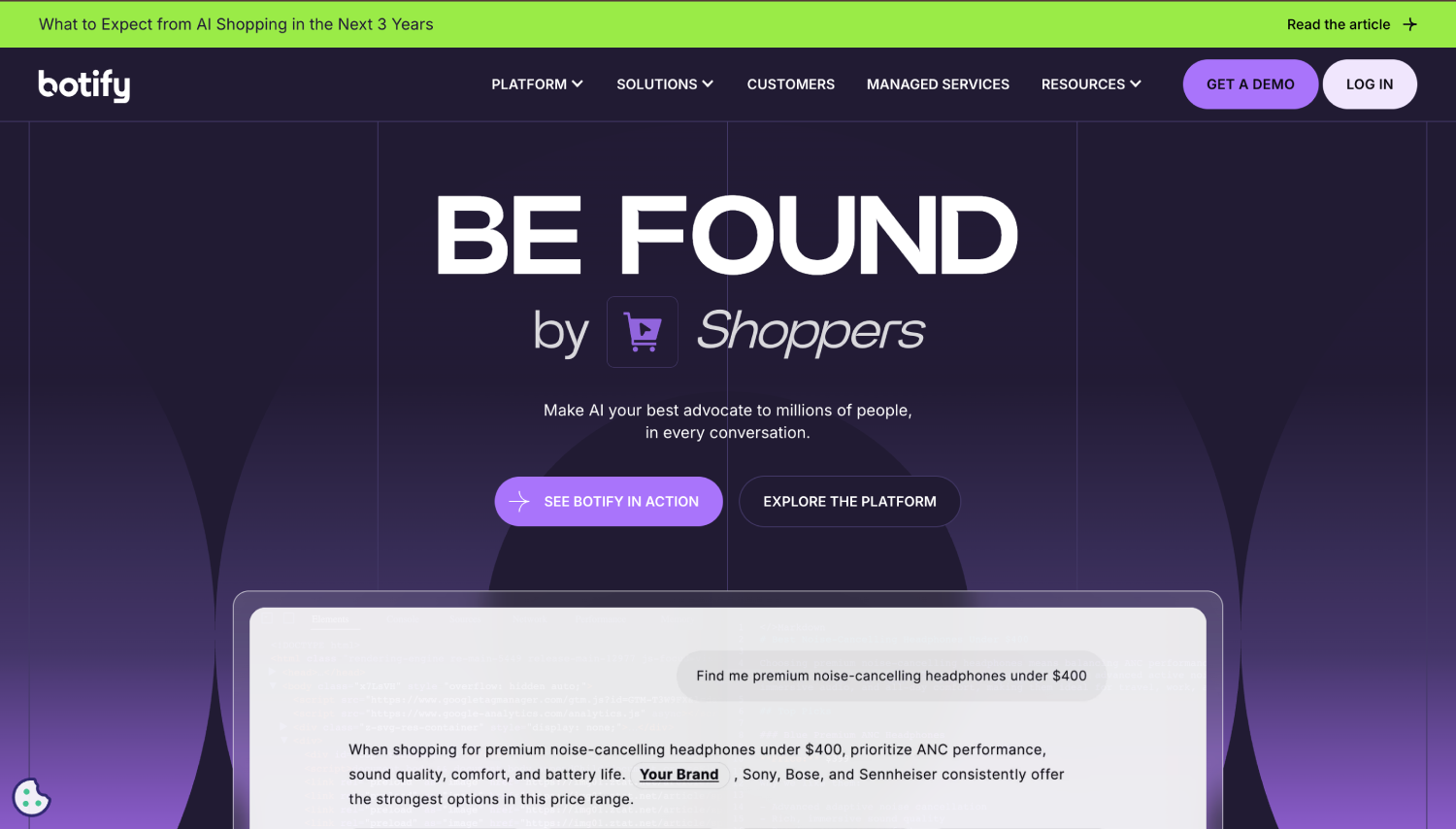
Botify is an enterprise technical SEO platform that has evolved into one of the most precise server-log crawl analytics tools available. Its LogAnalyzer module ingests raw server logs and segments traffic by bot type, crawl frequency, crawl budget waste, and page-level coverage. Botify has expanded its bot classification library over time to explicitly label AI crawlers as a distinct segment alongside search engine bots and monitoring bots.
For large-scale sites with hundreds of thousands of URLs, Botify’s crawl budget reporting surfaces the most granular data available. You can see exactly how many of your pages GPTBot has reached versus how many Googlebot has, which surfaces structural gaps in how your site is accessible to AI systems. The tradeoff is cost: Botify is enterprise-priced and requires a sales conversation. It is not a tool you trial over a weekend.
Botify fits best for teams that already run it for SEO and want to extend the same log infrastructure to AI crawler visibility. If you are starting fresh without a log analytics platform, the cost-to-value ratio for AI tracking alone is harder to justify.
3. Originality.ai Firewall
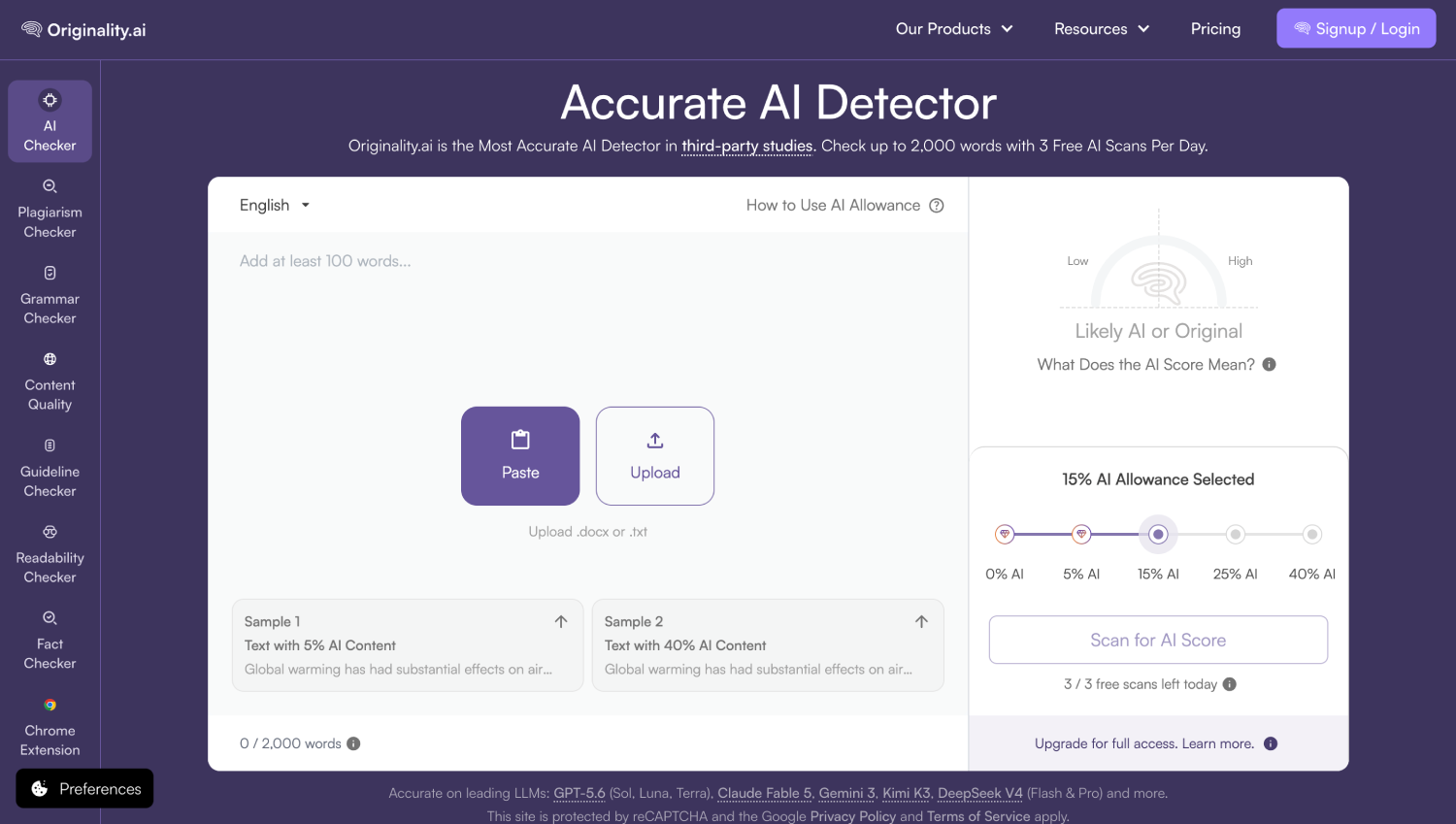
Originality.ai is best known as an AI content detection tool, but its Firewall product addresses a different problem: controlling which AI crawlers can access your content and under what terms. The Firewall sits in front of your origin server and intercepts requests from known AI user-agents, giving you options to block, allow, or redirect to a paywall or licensing agreement page.
This is the most developed implementation of the pay-per-crawl concept currently available to non-enterprise teams. The idea is that if OpenAI’s crawler is ingesting your original research, you should be able to charge for that access rather than simply blocking it. Originality.ai’s Firewall routes crawler traffic to a terms page where you can define licensing conditions , though actual payment infrastructure requires custom integration at this stage.
The analytics layer shows which crawlers attempted access, what they requested, and how your rules responded. For content-heavy publishers and research-driven B2B sites, this is the closest thing to a monetization layer for AI crawl traffic that exists in 2026. The tool is worth evaluating alongside AI visibility tools that track your brand mentions in ChatGPT and Perplexity , they measure different sides of the same AI-attention equation.
4. Vercel Bot Protection (with Edge Middleware)
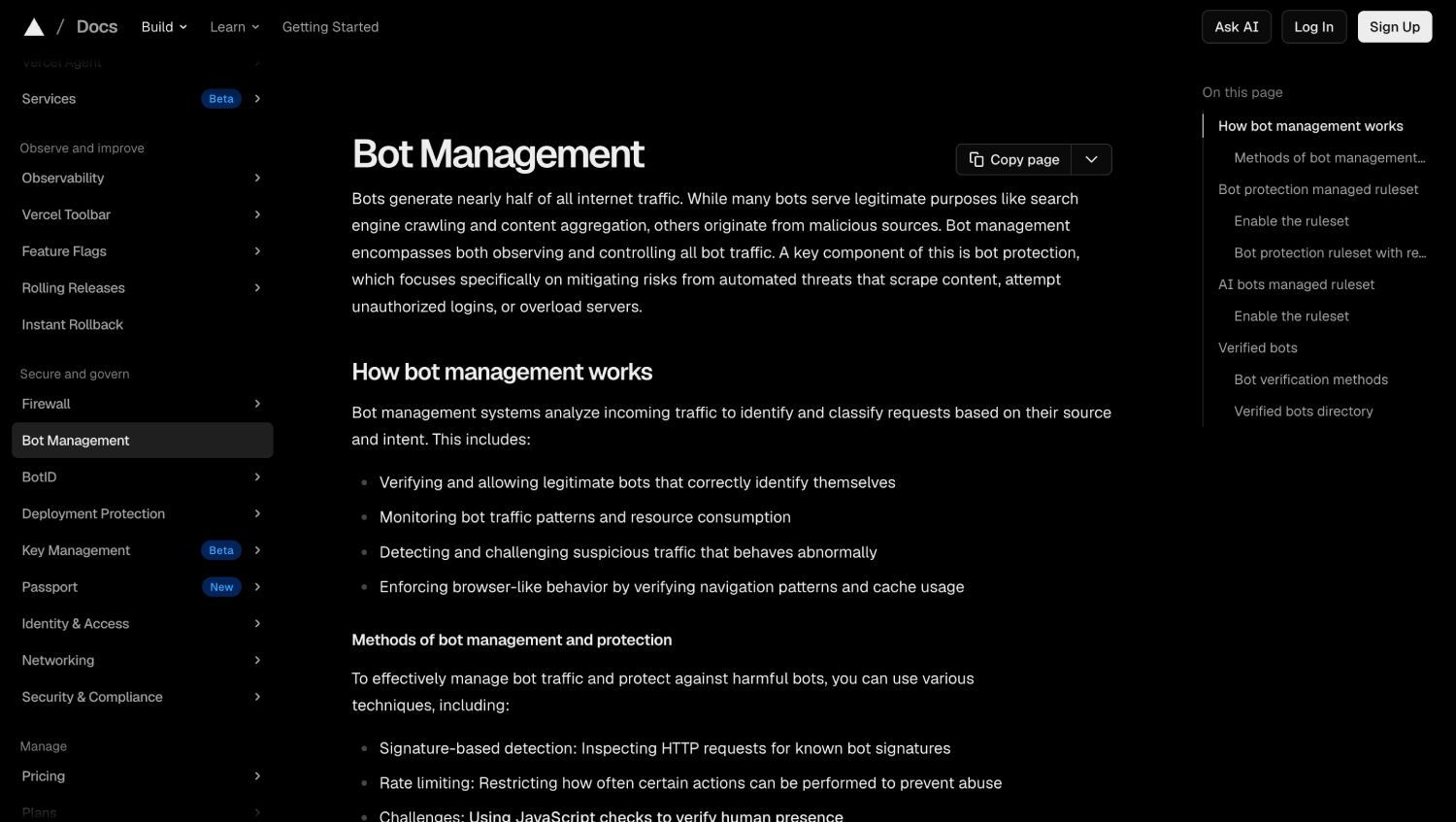
Vercel’s Bot Protection feature, available on Pro and Enterprise plans, operates at the edge before requests reach your application. It classifies traffic by bot type using a combination of user-agent analysis, IP reputation, and behavioral signals. AI crawlers appear as a distinct category in Vercel’s traffic analytics, and Edge Middleware lets you write custom logic to handle them differently from search engine bots or human traffic.
The key advantage here is infrastructure-native integration. If your site or application already runs on Vercel, enabling bot detection adds zero latency penalty and requires no third-party script or log pipeline. The analytics are available in the Vercel dashboard and exportable via their API for teams that want to pipe crawler data into a data warehouse or BI tool.
Vercel’s approach is less specialized for AI crawler taxonomy than DarkVisitors, but its coverage of known LLM user-agents is solid and it updates with Vercel’s security team cadence rather than a community-maintained list. For engineering-led teams already on Vercel infrastructure, this is the lowest-friction path to AI crawler visibility.
5. Incolumitas
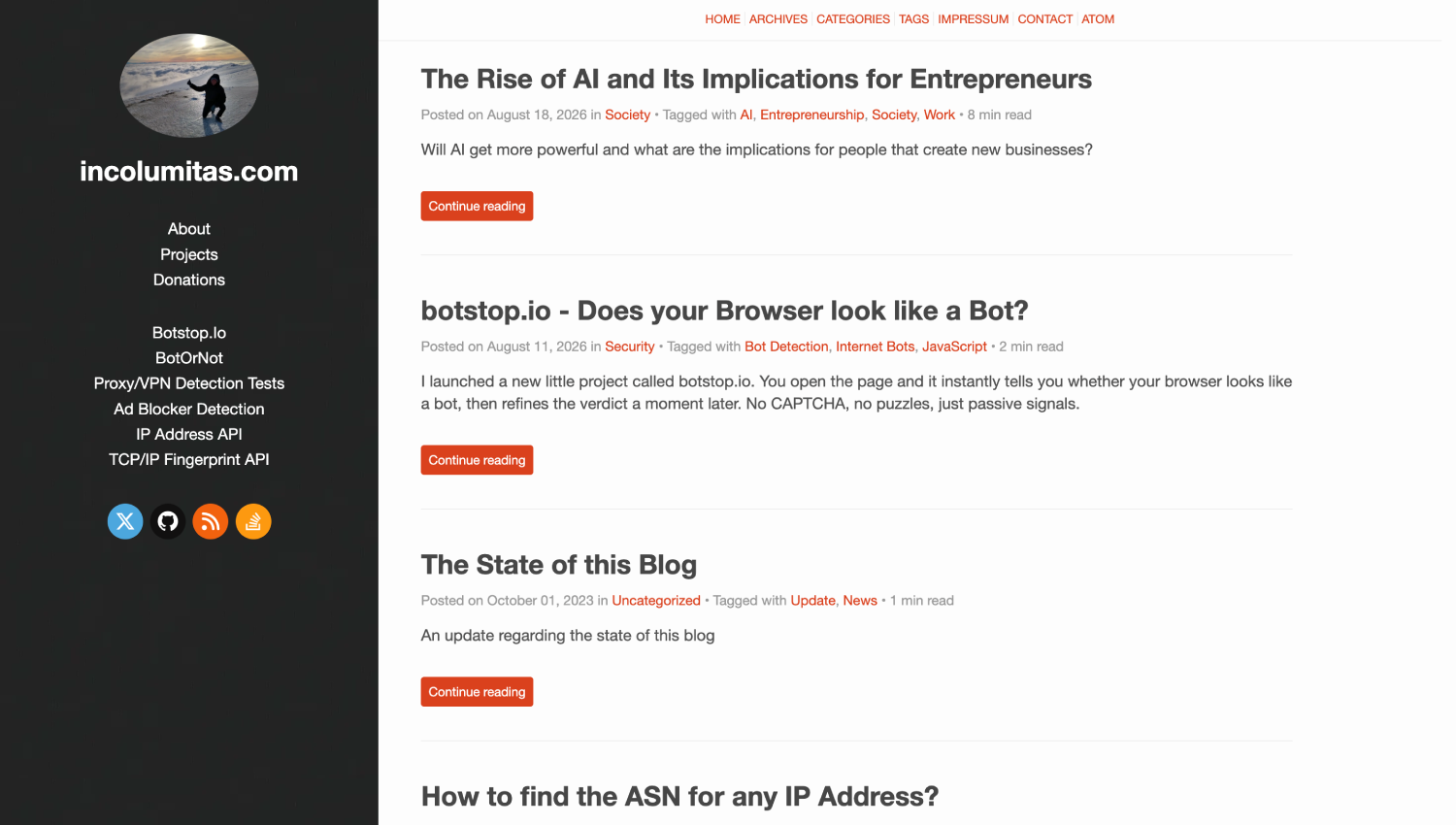
Incolumitas is a bot detection API and research platform run by security researcher Nikolai Tschacher, who publishes detailed documentation on AI crawler behavior, IP ranges, and user-agent strings. The commercial product offers an API that classifies incoming requests in real time, including AI bots, with detailed metadata about the requesting entity.
What sets Incolumitas apart from the other tools on this list is its research depth. The platform publishes its own studies on how specific LLM crawlers behave , crawl rates, geographic origin of requests, deviation between declared user-agents and actual behavior. For teams that want to understand AI crawler behavior at a mechanistic level, not just log it, Incolumitas is the most technically honest source available.
The API is developer-first, with no polished marketing dashboard. Teams without engineering resources to integrate an API and build reporting around it will find it rough. But for an MOps or RevOps team that feeds data into a warehouse anyway, the API model is actually ideal , pipe the classifications into your existing product analytics stack and build custom crawler dashboards in whatever BI tool you already use.
6. CrawlBase Intelligence
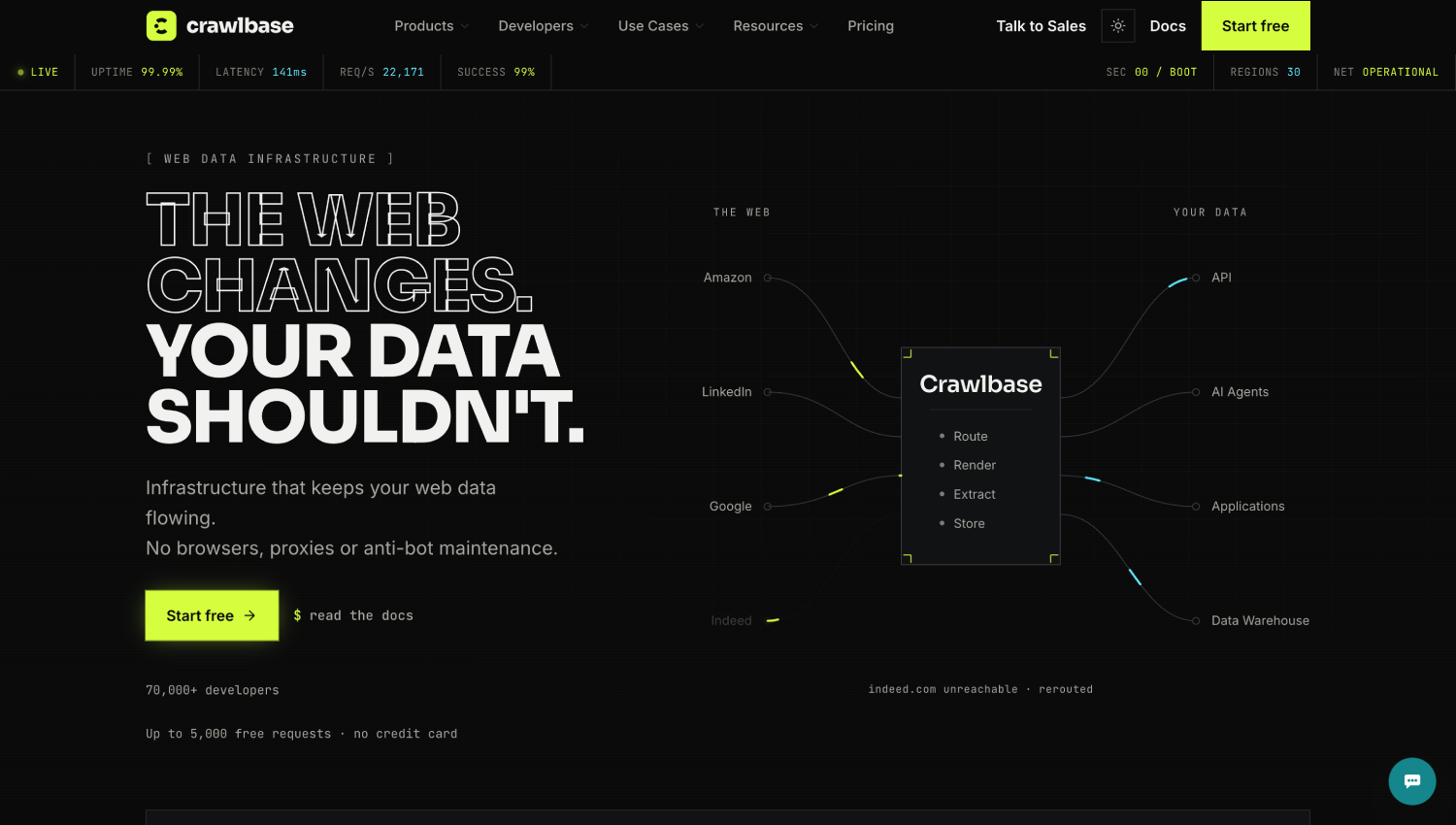
CrawlBase is primarily a web scraping infrastructure provider, but its Intelligence layer includes a bot analytics module that logs and classifies incoming crawler traffic to sites using its proxy or monitoring infrastructure. For teams that already use CrawlBase for competitive intelligence or content monitoring, the AI crawler analytics layer comes as an extension of existing infrastructure rather than a separate tool purchase.
The reporting covers known AI crawler user-agents with crawl frequency, page hit maps, and request header analysis. CrawlBase’s coverage of lesser-known or emerging AI crawlers depends on its internal classification updates, which are less transparent than DarkVisitors’ public taxonomy. The platform is more useful for teams in the scraping and data extraction space who need to understand how AI systems interact with monitored domains as part of a broader intelligence workflow.
Pricing is consumption-based, which suits teams with variable crawl monitoring needs better than a flat SaaS subscription. Contact their sales team for current enterprise pricing; small-to-mid volume plans are listed on their public pricing page.
7. Scrape.do Log Analyzer
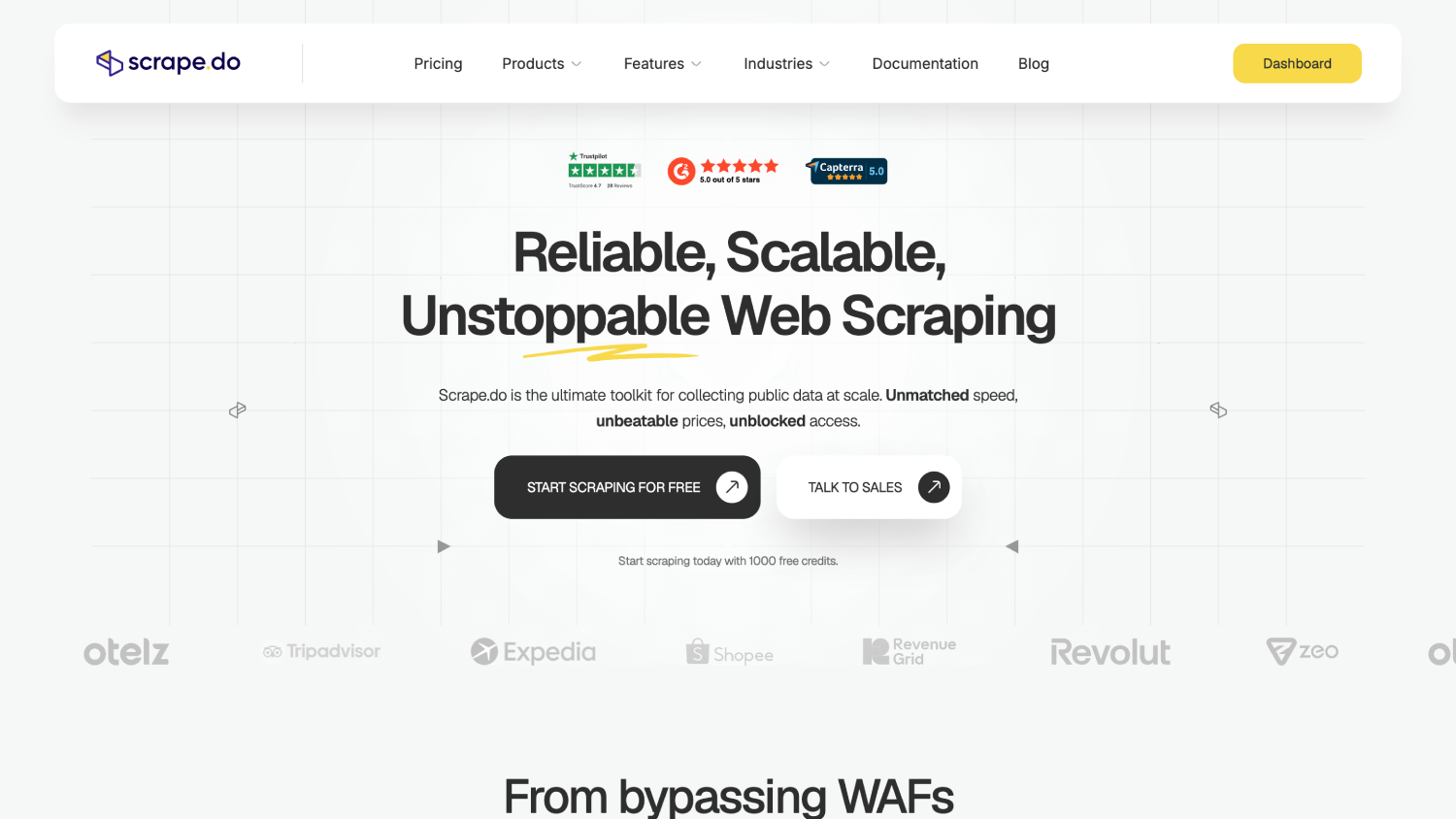
Scrape.do offers a log analysis module that ingests Apache, Nginx, or CDN access logs and produces a breakdown of AI bot traffic alongside traditional crawler traffic. The tool classifies GPTBot, ClaudeBot, PerplexityBot, and other known AI user-agents, then surfaces visit frequency, crawled URL lists, and time-series data for each bot type.
Scrape.do’s strength is its accessibility. Uploading a log file requires no infrastructure changes, no proxy setup, and no API integration. For teams that want to audit historical AI crawler activity without committing to an ongoing tool, the log upload workflow is the fastest path to an answer. The limitation is that it is reactive rather than real-time , you are always looking at logs from the past rather than monitoring live traffic.
For teams at the beginning of building a GEO measurement practice, Scrape.do’s log analyzer is a reasonable diagnostic first step. Run a month of logs through it, understand your current crawl picture, then decide whether you need a real-time layer from one of the proxy-based tools above.
AI crawler analytics tools compared: data-granularity breakdown
| Tool | Detection Method | Page-Level Granularity | Real-Time Monitoring | Block/Rate-Limit Controls | Pay-Per-Crawl Support | Best For |
|---|---|---|---|---|---|---|
| DarkVisitors | JS tag + log upload | Yes | Partial | robots.txt generator | No | Bot taxonomy + robots.txt management |
| Botify | Server log ingestion | Yes (deep) | No (log-based) | No (analytics only) | No | Enterprise SEO + crawl budget analysis |
| Originality.ai Firewall | Reverse proxy | Yes | Yes | Yes (block/redirect) | Yes (early stage) | Content publishers, pay-per-crawl |
| Vercel Bot Protection | Edge middleware | Yes | Yes | Yes | No | Teams already on Vercel infrastructure |
| Incolumitas | API (real-time classification) | Yes | Yes | Via API logic | No | Engineering-led teams, warehouse integration |
| CrawlBase Intelligence | Proxy/monitoring layer | Yes | Yes | Partial | No | Scraping-adjacent data workflows |
| Scrape.do | Log file upload | Yes | No | No | No | One-time audit, no infrastructure changes |
Should you block AI crawlers, allow them, or charge for access?
The default answer most teams operate on is “allow everything” , primarily because robots.txt blocks are easy to ignore and there is no enforcement mechanism beyond the honor system. OpenAI, Anthropic, and Google have all publicly committed to respecting robots.txt, but that commitment depends on those companies maintaining that policy and their crawlers correctly reading your directives.
Blocking makes sense in three specific situations. First, if you produce original research or proprietary data that represents your competitive moat, unlimited free ingestion by LLM training systems is a direct cost you are absorbing without compensation. Second, if your content is time-sensitive and you have observed that LLMs are surfacing outdated versions of your pages to users, blocking training crawlers while allowing grounding crawlers (like Bing’s crawler feeding Copilot) is a calibrated choice. Third, if your server infrastructure cannot absorb high-frequency crawl traffic without performance impact, rate-limiting is a legitimate operational decision independent of any commercial consideration.
The pay-per-crawl model is still early. Originality.ai’s Firewall is the most functional implementation available today, but the market of LLM companies actually paying for crawl access on a per-request basis does not yet exist at scale. The more defensible posture for most B2B content teams in 2026 is to measure first, block tactically where justified, and watch the pay-per-crawl market for the next 12 to 18 months before building licensing infrastructure around it.
How to read AI crawler logs without an infrastructure background
If you want to start with raw logs before committing to any tool, the key fields in an Apache or Nginx access log are the IP address, the timestamp, the requested URL, the HTTP status code, and the user-agent string. AI crawler identification happens entirely in the user-agent field. OpenAI publishes the full user-agent string for GPTBot in their documentation. Anthropic publishes ClaudeBot’s string. Perplexity publishes PerplexityBot’s string. Google publishes Google-Extended separately from Googlebot documentation.
A simple grep command , grep -i "GPTBot" access.log , will pull every GPTBot request from a log file. From there, you can count unique URLs hit, look at request frequency by date, and identify which sections of your site received the most attention. This is a 10-minute exercise that will tell you more about your AI crawler exposure than six months of staring at GA4 data.
The tools in this list automate that process, add visualization, and extend it to the full taxonomy of known AI bots. But understanding the underlying signal , user-agent string in an HTTP request log , is what lets you evaluate vendor claims intelligently and catch gaps in any tool’s bot classification library.
How does AI crawler traffic connect to GEO strategy?
Crawl data is the upstream input to AI citation. If a bot never reaches a page, that page cannot contribute to an LLM’s responses about your brand or your category. Crawl frequency correlates with how often a model’s grounding data refreshes , a page that GPTBot visits weekly is more likely to appear in current-context answers than one last visited six months ago.
The practical GEO application is straightforward: identify your highest-value pages (product comparisons, research reports, pricing pages, case studies), confirm they are being crawled by the relevant AI bots using the tools above, and then audit their structure for the citation-readiness signals that matter , named entities, clear factual claims, structured data, and direct answers to questions users ask LLMs. For teams building this practice from scratch, the top AEO and GEO tools for AI citation in 2026 address the content-side of the equation that crawl analytics alone cannot.
The two disciplines are sequential, not parallel. Measure crawl behavior first. Then optimize the content that is getting crawled. Optimizing uncrawled content for AI citation is effort with no downstream effect.
Frequently asked questions about AI crawler analytics
How do I see which AI crawlers visit my site without reading raw server logs?
DarkVisitors offers the lowest-friction entry point for teams without log infrastructure , it provides a JavaScript tag for basic detection and a log upload option for historical analysis, with a pre-built taxonomy of known AI agents. Vercel Bot Protection works at the edge for teams already on Vercel. If you have Apache or Nginx logs available, uploading them to Scrape.do’s log analyzer takes under five minutes and produces an immediate breakdown of AI bot traffic by user-agent type with no infrastructure changes required.
Which AI crawler user-agent strings should I be tracking?
The documented primary crawlers are GPTBot (OpenAI), ClaudeBot (Anthropic), PerplexityBot (Perplexity AI), Google-Extended (Google, distinct from Googlebot), Amazonbot (Amazon), YouBot (You.com), and Meta-ExternalAgent (Meta). Most of these companies publish their user-agent strings and IP ranges in their official documentation. DarkVisitors maintains a public registry that extends to dozens of additional AI agents including training-specific crawlers that do not correspond to consumer-facing products.
Can I actually charge AI companies for crawling my site?
In practice, the pay-per-crawl model is nascent. Originality.ai’s Firewall is currently the most functional tool for redirecting AI crawlers to a licensing or terms page. However, no major LLM company has yet built a real-time payment infrastructure for per-crawl access at scale. The more realistic near-term path for most publishers is licensing negotiation with LLM companies for bulk content access , similar to the deals some media companies have reached with OpenAI and Google , rather than automated per-request billing.
Does blocking AI crawlers in robots.txt actually work?
For companies like OpenAI, Anthropic, and Google, which have publicly committed to honoring robots.txt directives, yes , it works on an honor-system basis. There is no technical enforcement mechanism in the HTTP protocol itself that prevents a crawler from ignoring robots.txt. Proxy-based tools like Originality.ai’s Firewall and Vercel Bot Protection enforce blocks at the infrastructure level, which is more reliable than robots.txt alone because they return a 403 or redirect regardless of whether the crawler checks your directives.
How is GPTBot different from ChatGPT’s browsing feature?
GPTBot is OpenAI’s web crawler that proactively indexes content for training data and knowledge base updates. ChatGPT’s browsing feature, when activated by a user, makes on-demand requests to specific URLs during a conversation. These are separate processes with separate user-agent strings and separate purposes. Blocking GPTBot in robots.txt does not prevent ChatGPT from visiting your site during a live user browsing session , they are distinct systems with distinct behavior.
What server log format do I need to use these tools?
Most tools in this list accept Apache Combined Log Format and Nginx default access log format, which are the two most common server log formats. Scrape.do and DarkVisitors both support these natively on upload. If your infrastructure uses a CDN like AWS CloudFront or Akamai, both generate access logs in formats that can be converted to standard formats with minor preprocessing. Botify handles the widest range of log formats and can ingest logs directly from cloud storage buckets, which matters at enterprise scale where manual log uploads are impractical.
How often do AI crawlers typically visit a site?
Crawl frequency varies significantly by site authority, content freshness, and the specific LLM company’s crawl budget policies. Based on publicly observed behavior reported by Incolumitas and DarkVisitors’ research documentation, well-trafficked content sites see GPTBot visits ranging from daily to several times per week. Smaller or newer sites may see visits monthly or less. Perplexity’s crawler tends to crawl more aggressively than the others on content it identifies as recently updated, likely because Perplexity relies on near-real-time grounding rather than periodic training data updates.
Should I track AI crawler analytics separately from my regular SEO analytics?
Yes. The behavioral patterns, optimization signals, and action levers are different enough that conflating them creates noise in both datasets. Traditional SEO analytics optimize for Googlebot crawl efficiency and human user engagement signals. AI crawler analytics optimize for content coverage, citation-readiness, and access control decisions. A tool like Botify can serve both purposes at enterprise scale, but most teams will run a dedicated AI crawler analytics layer alongside rather than inside their existing SEO platform. For teams wanting to track the output side , whether AI systems are actually citing your brand , AI brand visibility tracking tools cover that monitoring function separately.
The measurement gap that still exists in 2026
Every tool in this list measures inbound crawler behavior , what bots visit, how often, and which pages they reach. None of them close the loop to the output side: whether those visits resulted in your content appearing in an LLM’s response to a user query. That attribution chain from crawl to citation to user interaction remains genuinely unsolved at the technical level. Separate tooling handles AI answer monitoring, and the two data streams have to be joined manually by analysts who understand both.
The category will consolidate. Some of the tools listed here will add answer monitoring. Some of the AI visibility platforms will add crawl analytics. The vendors that figure out how to connect crawl data to citation data in a single interface will define what GEO analytics looks like in 2027. Until then, the stack is two-layer: measure crawl behavior with the tools in this list, and measure citation behavior with dedicated AI monitoring platforms.
The teams building measurement practices now, even with imperfect tooling, will have 12 months of crawl behavior data that their competitors do not have when the market matures. That historical baseline , which AI systems care about which content, at what frequency, and responding to what site changes , is the asset worth building today.