
- Google Analytics tracks sessions and traffic sources. Product analytics tools track what individual users do inside your product, which features they use, where they drop off, and why they churn.
- Amplitude, Mixpanel, and PostHog are the three platforms that come up in nearly every serious evaluation. They differ significantly on pricing model, data ownership, and which team is expected to run them.
- Heap’s autocapture approach eliminates instrumentation gaps, but that convenience trades against query performance at scale.
- Self-hosted options like PostHog and ClickHouse-backed stacks have become genuinely competitive with cloud vendors on features, not just cost.
- The right tool depends on whether your analytics consumer is a product manager, a data engineer, or a growth marketer. Those three personas need different things from the same data.
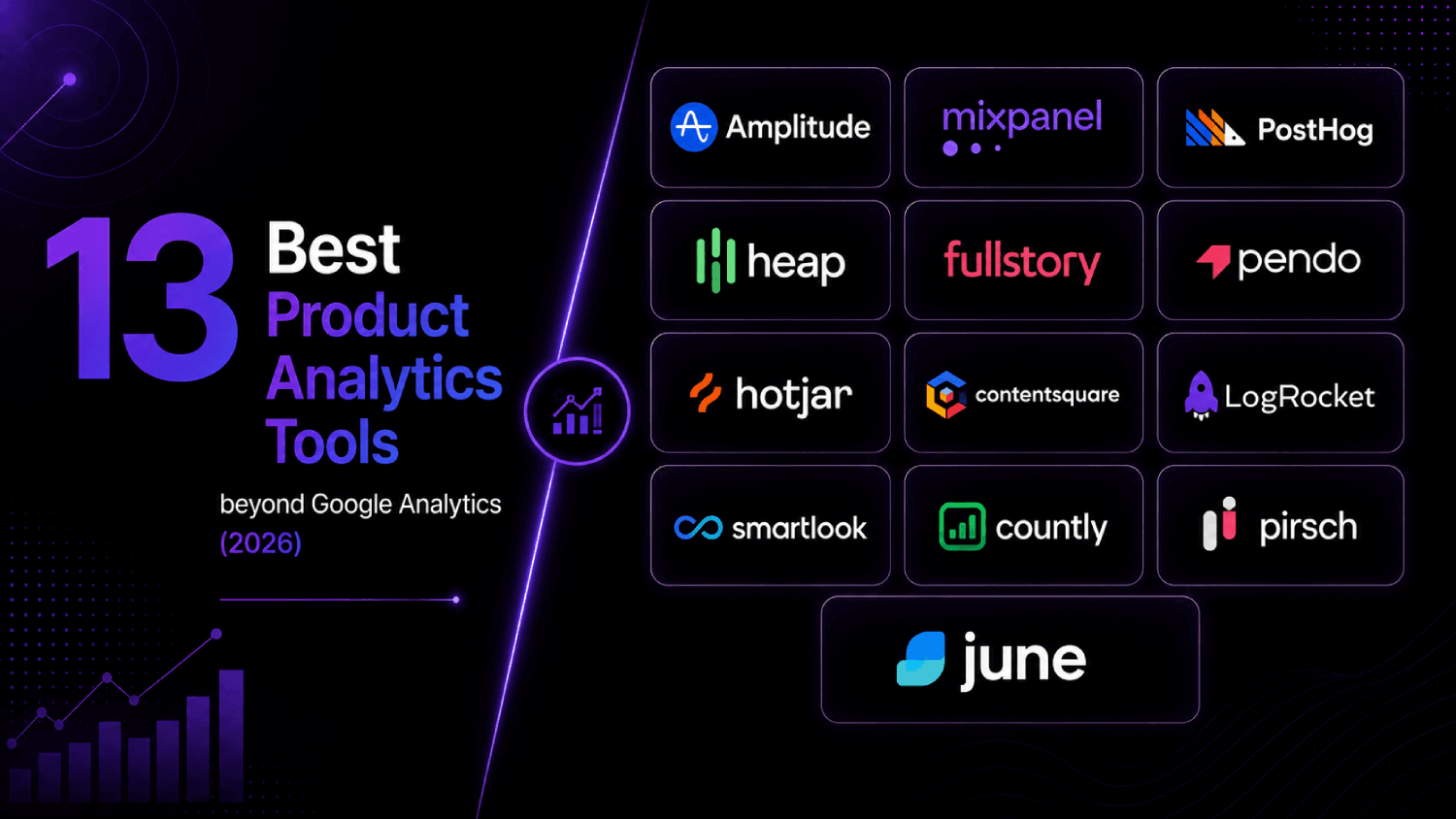
The best product analytics tools beyond Google Analytics are Amplitude, Mixpanel, PostHog, Heap, FullStory, Pendo, Hotjar, Contentsquare, LogRocket, Smartlook, Countly, Pirsch, and June. Each captures in-app user behavior at the event or session level. GA4 shows you that traffic arrived and converted. These tools show you what happened in between, which features were touched, where users abandoned flows, and which cohorts retained.
Why Google Analytics Cannot Answer Product Behavior Questions
GA4 is a web analytics tool built around sessions, traffic sources, and goal completions. It was designed to answer marketing questions: where did visitors come from, did they convert, what did the acquisition channel look like. Those are legitimate questions, but they stop at the login screen.
Product analytics starts where GA stops. Inside a logged-in product, you need to know which features a specific user touched in their first seven days, whether a cohort of users who completed onboarding step three retained at a higher rate, and whether a UI change to the dashboard caused a measurable drop in a downstream action. GA4 cannot surface any of those answers reliably. Its session model collapses multi-step in-app behavior into flat page views, its identity resolution breaks across devices without deterministic matching, and its funnel tools do not support the retroactive cohort analysis that product teams run constantly.
The tools below are purpose-built for behavioral analytics on identified users. Some also cover marketing sites. But their core competency is the authenticated product experience, not the anonymous acquisition funnel.
How to Evaluate Product Analytics Tools Before Buying
Most evaluations stall on feature lists. A more useful frame is what AboutMartech calls the Instrumentation-to-Insight Ratio: how much engineering time does a tool require before a non-engineer can extract a meaningful answer? Every product analytics platform forces a trade-off between instrumentation flexibility and time-to-first-insight. Understanding where each tool sits on that axis determines whether it will actually get used.
Three other checks before a purchase decision: Does the pricing model penalize growth (per-event or per-MTU)? Does the vendor allow data export to your warehouse, or does it lock behavioral data inside its own walls? And who is the assumed operator, a product manager clicking a UI or a data analyst writing SQL?
If your team also evaluates where your behavioral data should live relative to your CDP, the comparison between customer data platforms built for identity resolution versus behavioral activation is worth reading alongside this evaluation.
The 13 Best Product Analytics Tools, Compared
| Tool | Best For | Pricing Model | Self-Host Option | Autocapture |
|---|---|---|---|---|
| Amplitude | Enterprise product teams | MTU-based; free tier available | No | Partial |
| Mixpanel | Growth and product combined teams | Event-based; free up to 20M events/mo | No | No |
| PostHog | Engineering-led teams, startups | Usage-based; generous free tier | Yes | Yes |
| Heap | Teams with limited instrumentation resources | Quote-based | No | Yes (full) |
| FullStory | DX data and session replay | Quote-based | No | Yes |
| Pendo | Product-led growth with in-app guides | Quote-based | No | Yes |
| Hotjar | UX research on marketing sites | Free tier; paid from $32/mo | No | Heatmaps/replays |
| Contentsquare | Enterprise DX analytics | Quote-based | No | Yes |
| LogRocket | Engineering and product debugging | Free tier; paid plans available | No | Yes |
| Smartlook | Mobile and web combined | Free tier; paid from $55/mo | No | Yes |
| Countly | Privacy-first mobile/web | Free community; Enterprise quote-based | Yes | Partial |
| Pirsch | Lightweight, privacy-first web analytics | From $5/mo (public pricing page) | Yes | No |
| June | B2B SaaS company-level analytics | Free tier; paid plans available | No | No |
1. Amplitude
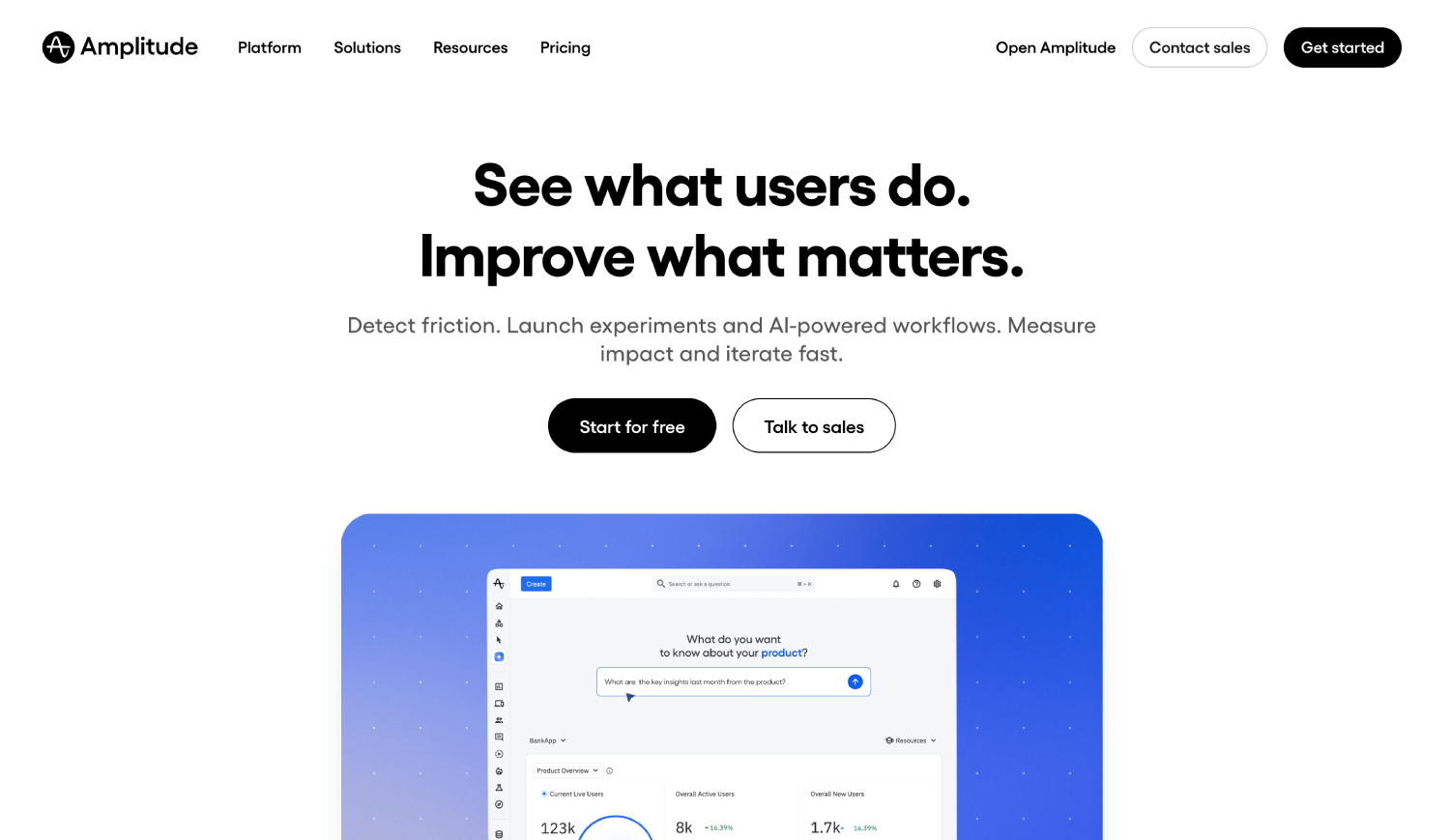
Amplitude is the default choice for mid-market and enterprise product teams that want a complete behavioral analytics platform without standing up infrastructure. Its Behavioral Cohorts feature lets analysts segment users by sequences of actions, not just properties, which is the core capability that separates product analytics from web analytics. The Journeys and Pathfinder charts surface unexpected user paths that funnel analysis would miss.
Amplitude charges by monthly tracked users (MTUs). A free tier covers up to 50,000 MTUs, which is sufficient for most early-stage teams. Beyond that, pricing is quote-based and scales steeply with volume. The platform does not offer self-hosting, so regulated industries or teams with strict data residency requirements need to evaluate that constraint early. Amplitude does support warehouse sync via its Data Warehouse destinations, so behavioral data can flow to Snowflake, BigQuery, or Redshift without vendor lock-in on the storage layer.
The assumed operator is a product manager or a growth analyst. SQL access exists but it is not the primary interface. For teams where the data engineering function owns analytics infrastructure, PostHog or a warehouse-native approach may fit better.
2. Mixpanel
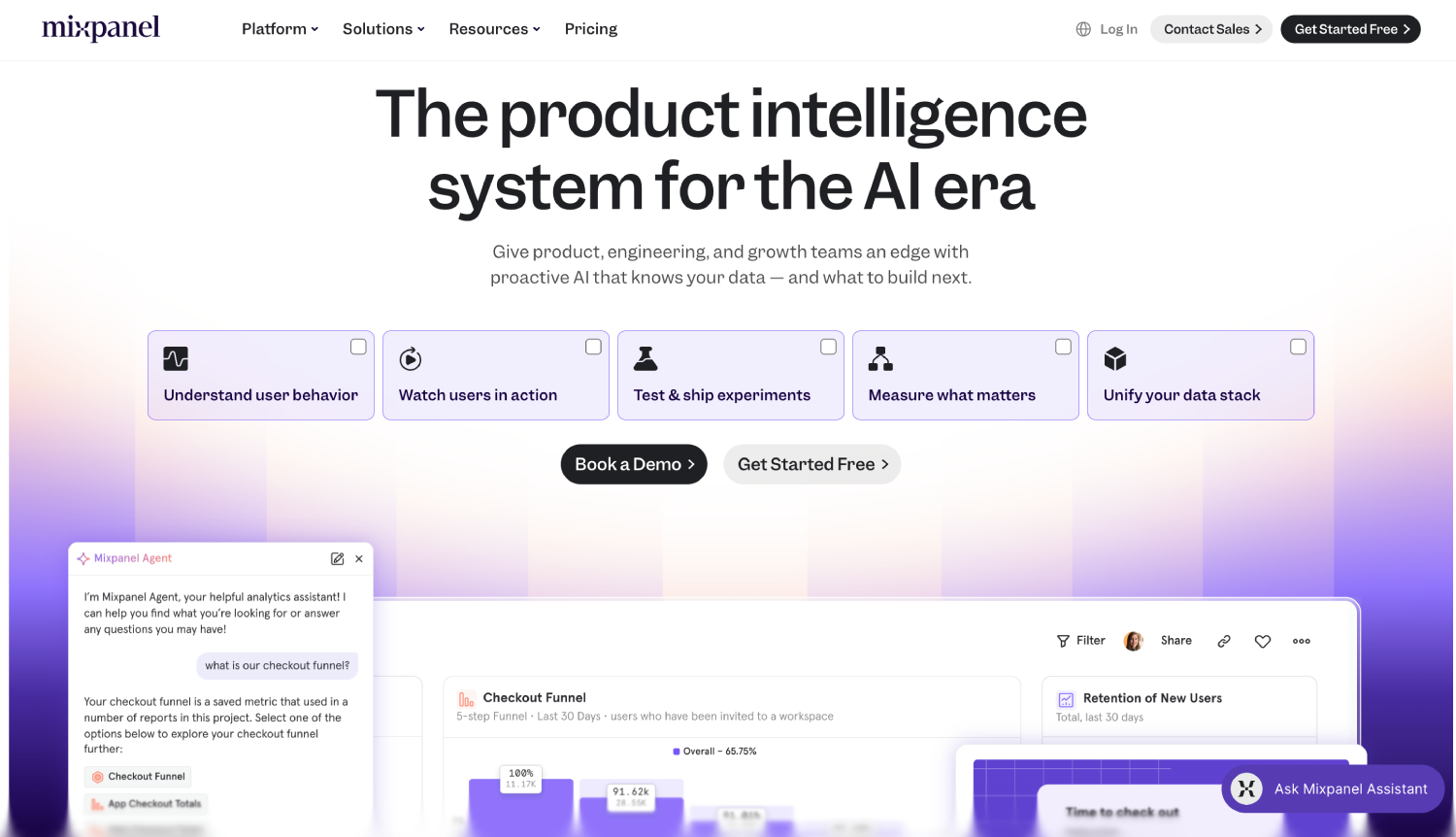
Mixpanel built its reputation on event-based analytics with a reporting interface that product managers and growth marketers can use without SQL. Its Flows report (similar to Amplitude’s Pathfinder) and retention tables are genuinely fast to build, and the free tier covers up to 20 million events per month, which covers most small products entirely.
The event-based model is both Mixpanel’s strength and its friction point. Every tracked action must be explicitly instrumented. There is no autocapture. That means Mixpanel is only as good as the tracking plan behind it, and gaps in instrumentation create gaps in visibility that cannot be backfilled. Teams with weak tracking plans consistently underuse the platform. Mixpanel does offer Lexicon, a data dictionary tool for managing event definitions, which helps but does not eliminate the instrumentation discipline requirement.
Mixpanel’s pricing page shows an events-based model with a free tier, a Growth plan, and an Enterprise plan. Growth and Enterprise pricing is quote-based above the free tier threshold. Data export to warehouses is supported on paid plans.
3. PostHog
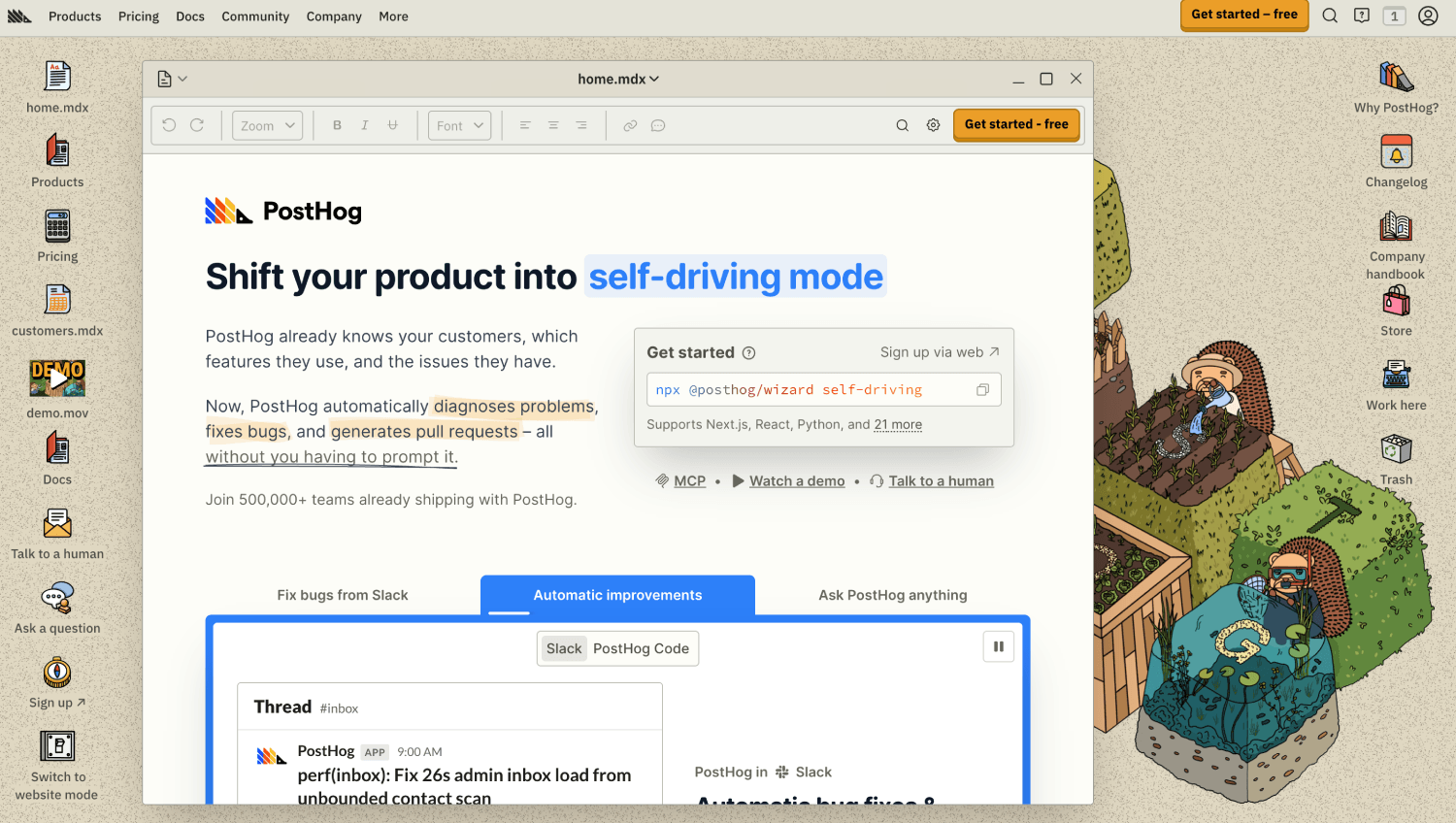
PostHog is the most complete open-source product analytics platform available and the only tool in this category that packages analytics, session replay, feature flags, A/B testing, and a CDP into a single deployable product. For engineering-led teams, the value proposition is unusually strong: one vendor, one SDK, and a self-hosted option that keeps data entirely within your own infrastructure.
PostHog’s cloud offering uses a usage-based pricing model with a free tier that covers one million events per month. Beyond that, pricing is consumption-based and published transparently on their pricing page. The self-hosted version is open source under an MIT license for most features. Autocapture is available and works well for web products, though mobile autocapture has historically had limitations that the team has been actively closing.
The platform appeals most to seed-through-Series-B companies where engineering owns the stack and wants to avoid a separate vendor for every analytics use case. Larger organizations sometimes find the UI less polished than Amplitude or Mixpanel for non-technical stakeholders, but PostHog’s SQL access and warehouse export make it a strong fit for data-forward teams.
4. Heap
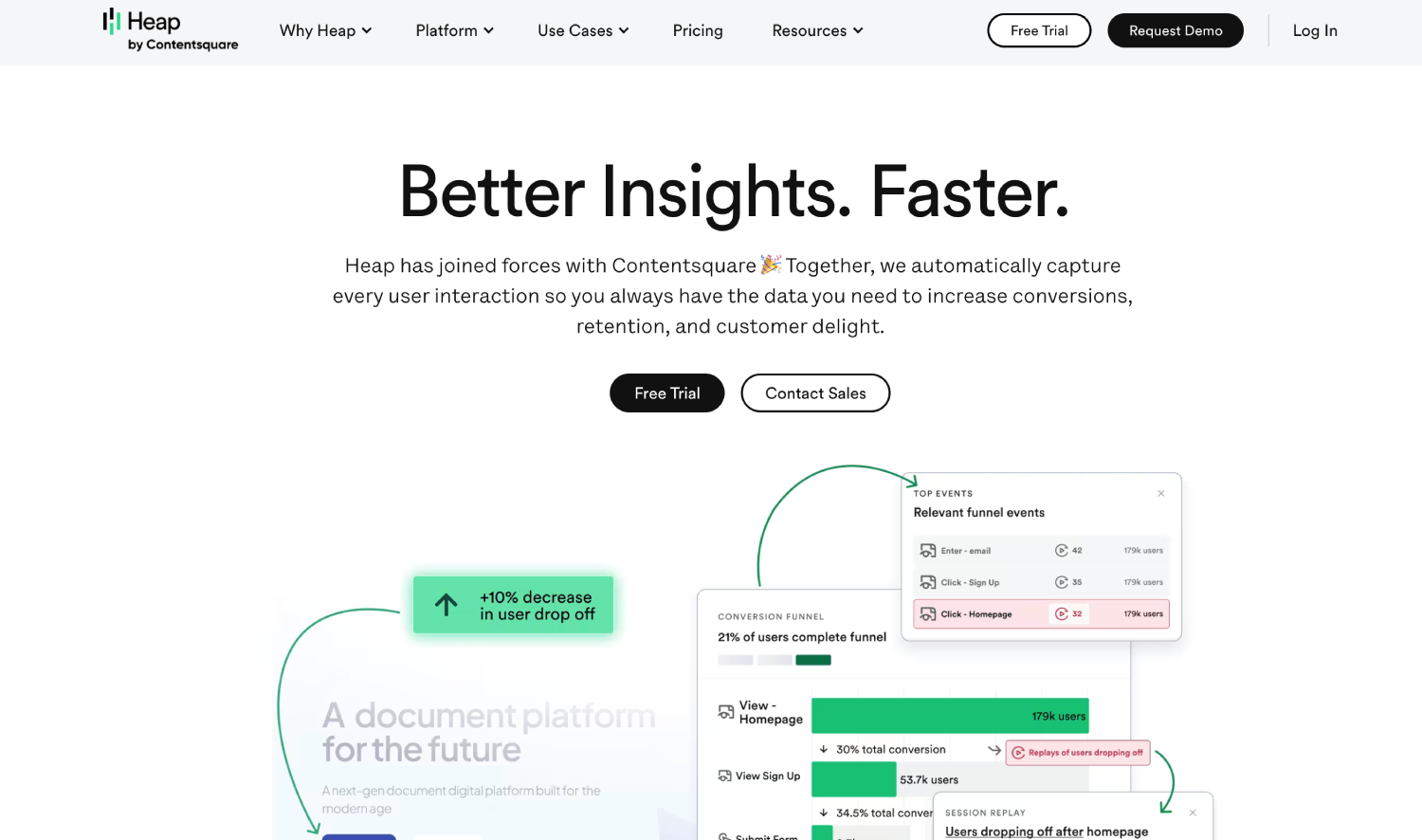
Heap (acquired by Contentsquare in 2023) takes a fundamentally different approach to instrumentation. Rather than requiring developers to instrument events before analysis can begin, Heap captures every user interaction automatically from day one. You define the events you care about retroactively in the UI, which means you can go back and analyze behavior that preceded your awareness that the behavior mattered.
That retroactive analysis capability is Heap’s genuine differentiator. Teams that switch from Mixpanel frequently describe the first month of Heap as being able to answer questions they did not know they needed to ask. The trade-off is query performance. Full autocapture generates extremely high event volumes, and complex queries on large datasets can be slow. Heap’s pricing is quote-based and not publicly disclosed. It skews toward mid-market and enterprise buyers.
Because Heap is now part of Contentsquare, the two platforms are increasingly integrated, which is useful for teams that want both quantitative funnel data and qualitative session replay under one contract.
5. FullStory
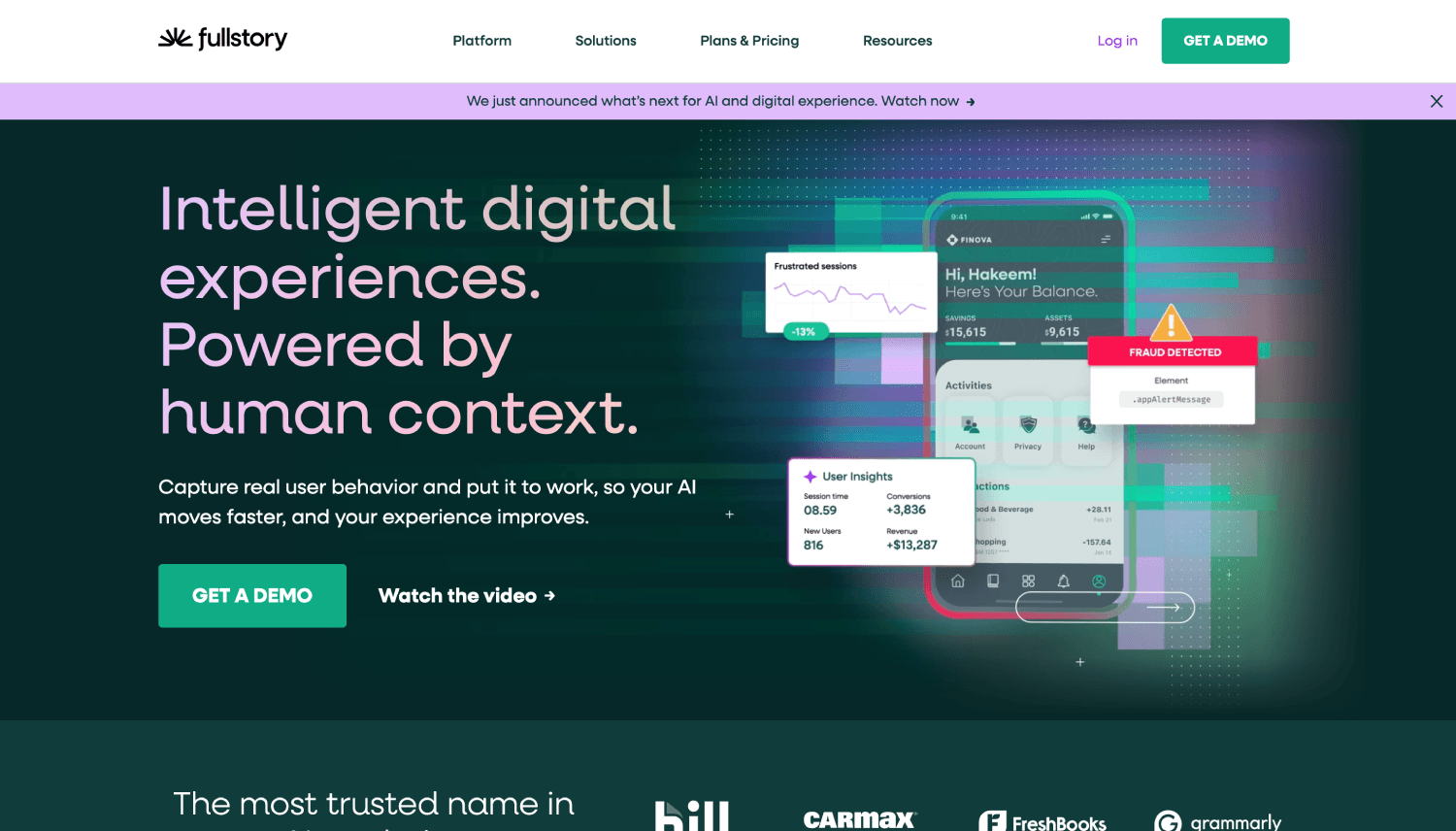
FullStory positions itself around Digital Experience Data (DXData), a category it coined. The core product captures every user interaction, replays sessions with pixel-level fidelity, and surfaces frustration signals like rage clicks, dead clicks, and thrash. Where Amplitude and Mixpanel answer quantitative funnel questions, FullStory answers qualitative UX questions: why did this user abandon this flow, and what did they actually do on that page?
Pricing is quote-based and enterprise-oriented. FullStory is not a GA replacement for marketing teams. It fits product and UX teams who need to understand the qualitative texture of user behavior, often in combination with a quantitative tool like Amplitude.
6. Pendo
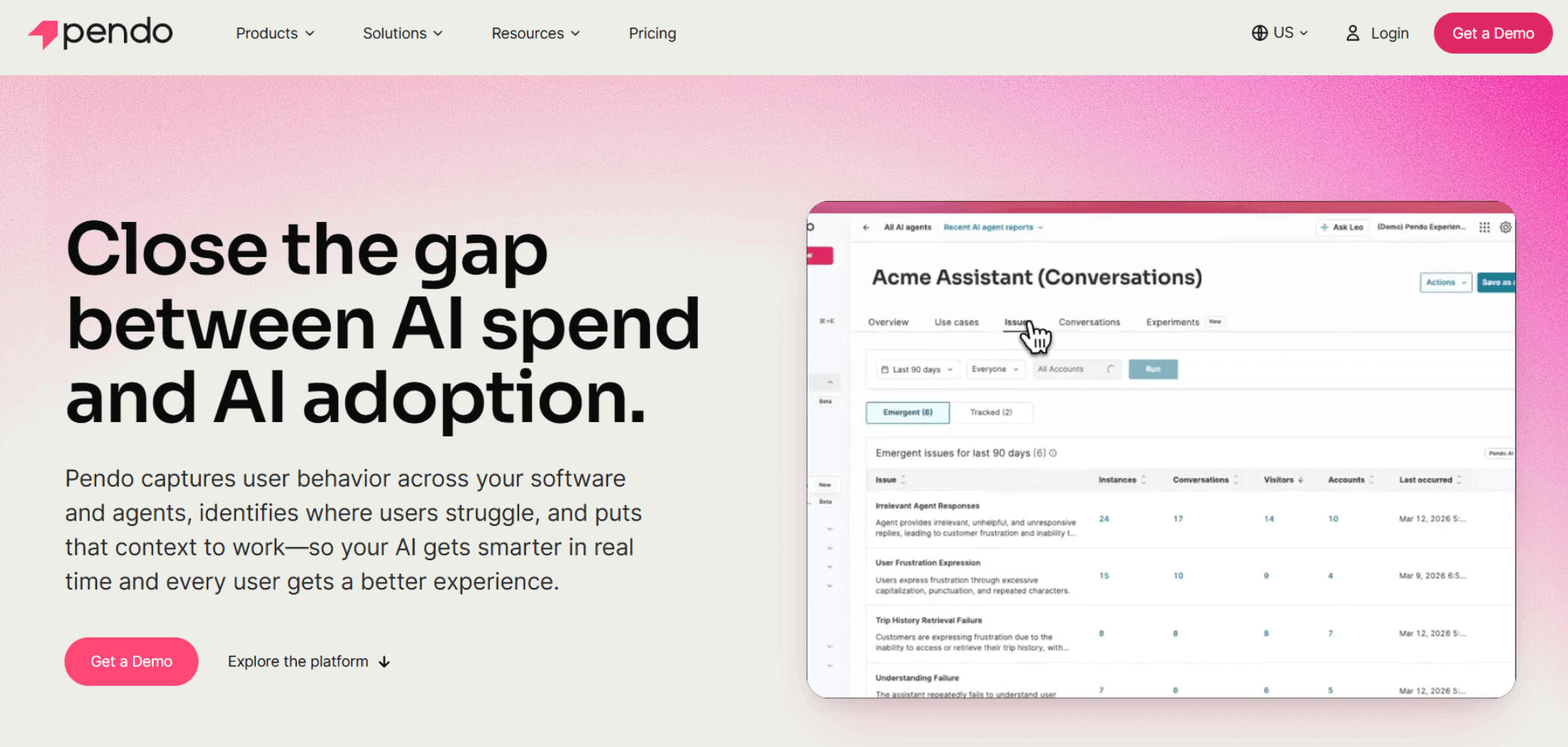
Pendo combines product analytics with in-app guidance, NPS surveys, and user feedback collection in a single platform. The analytics layer is solid, covering feature adoption, path analysis, and retention. But Pendo’s real differentiation is the ability to close the loop from analytics to action without a developer: you can identify users who have not discovered a feature and send them an in-app tooltip or walkthrough without a code deployment.
For product-led growth companies where onboarding and feature adoption drive revenue, Pendo competes directly with tools like Appcues and Intercom Product Tours, but with a more mature analytics foundation underneath. Pricing is quote-based. The platform targets mid-market through enterprise. Teams at early-stage companies often find Pendo’s pricing prohibitive relative to alternatives.
If Pendo’s customer success angle interests you, the comparison between customer success platforms built for B2B SaaS retention covers adjacent tooling that often gets evaluated alongside Pendo.
7. Hotjar
Hotjar is the approachable end of this category. Its heatmaps, session recordings, and on-site surveys are easy to install, easy to interpret, and priced accessibly, with a free tier and paid plans starting at $32 per month according to their public pricing page. It is not a product analytics platform in the full sense: it lacks event funnels, retention cohorts, or behavioral segmentation at the user level.
Hotjar belongs in a stack alongside a tool like Amplitude or Mixpanel, not instead of one. Marketing and UX teams use it for rapid qualitative insight on landing pages and onboarding flows. Product teams use it to spot UI friction. It does the job it was designed for efficiently.
8. Contentsquare
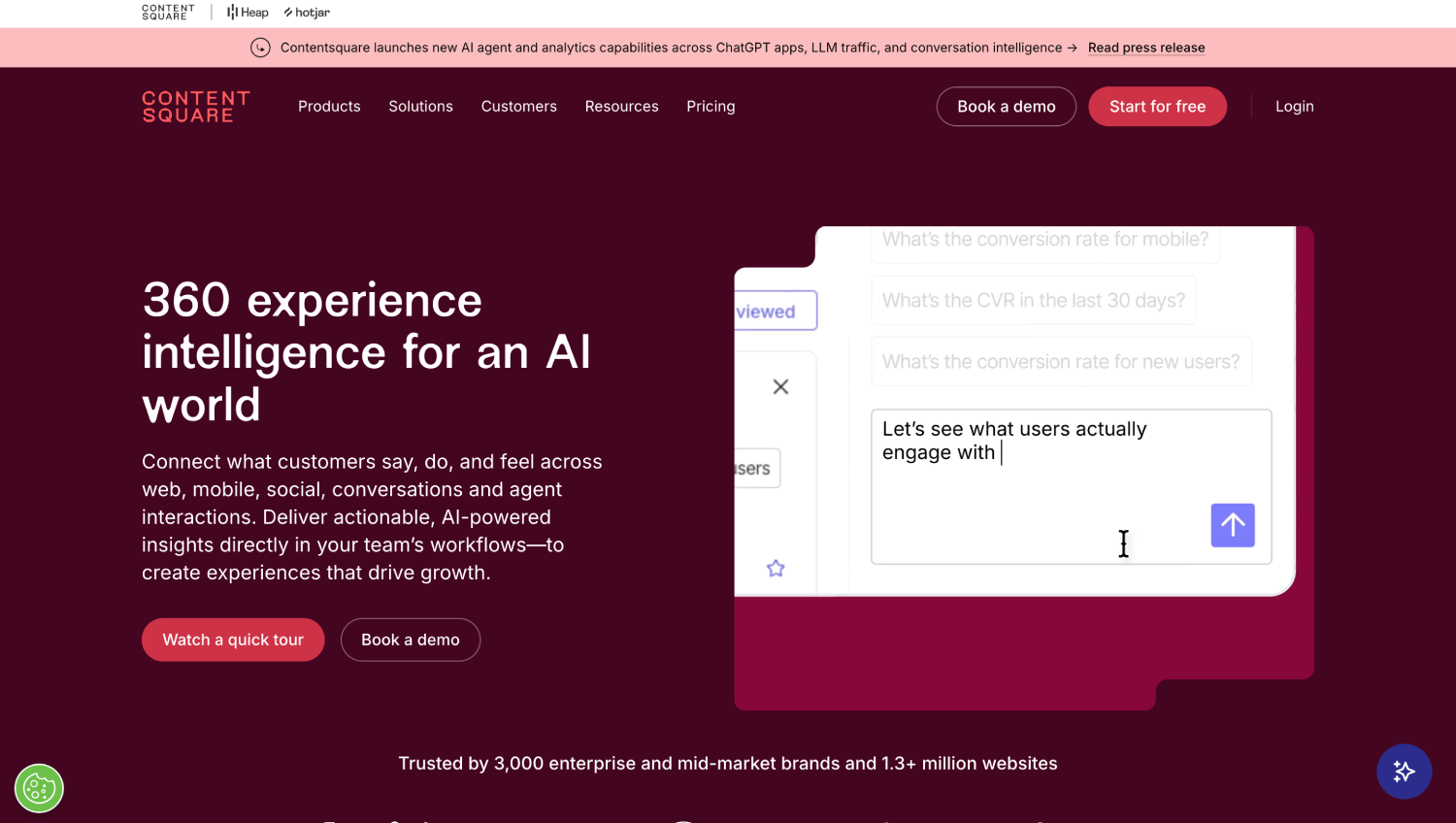
Contentsquare is the enterprise-grade digital experience analytics platform. It covers session replay, heatmaps, path analysis, frustration detection, and performance monitoring across web and mobile. As the parent company of Heap, Contentsquare increasingly offers both quantitative product analytics and qualitative DX data under one umbrella.
Pricing is quote-based and enterprise-oriented. Contentsquare competes most directly with FullStory at the top of the market. Teams evaluating it should expect a sales-led process and contracts that reflect its enterprise positioning.
9. LogRocket
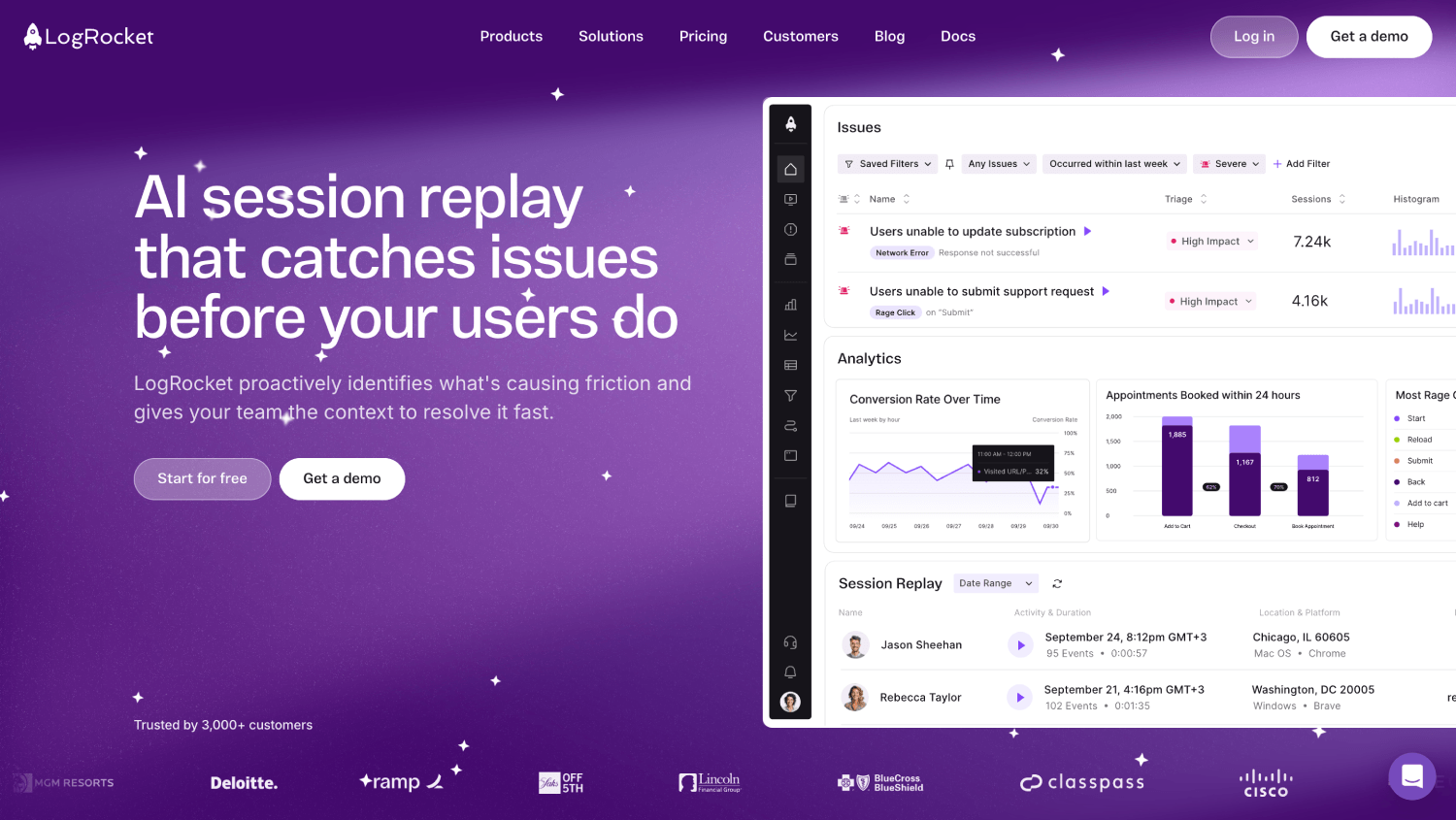
LogRocket started as a session replay and error monitoring tool for engineering teams and has expanded into product analytics. The platform captures sessions, surfaces JavaScript errors correlated with those sessions, and provides funnel and retention analysis. The combination of technical debugging and product analytics in one place is useful for teams where engineers and PMs share a single analytics workflow.
LogRocket offers a free tier and paid plans. Pricing details are available on their public pricing page. It is not a direct Amplitude or Mixpanel replacement for teams that need deep behavioral cohort analysis, but for teams that spend as much time debugging as analyzing, the consolidated view has real value.
10. Smartlook

Smartlook covers web and mobile session replay with event-based funnels and heatmaps. It is positioned as a more affordable alternative to FullStory and Hotjar combined, with plans starting at $55 per month according to their public pricing page. Native mobile SDKs for iOS, Android, React Native, and Flutter make it one of the stronger options for mobile app teams that want session replay alongside funnel analytics.
Feature depth on the analytics side is lighter than Amplitude or Mixpanel. Smartlook is a pragmatic choice for smaller product teams that need visual debugging and basic funnels without enterprise pricing.
11. Countly
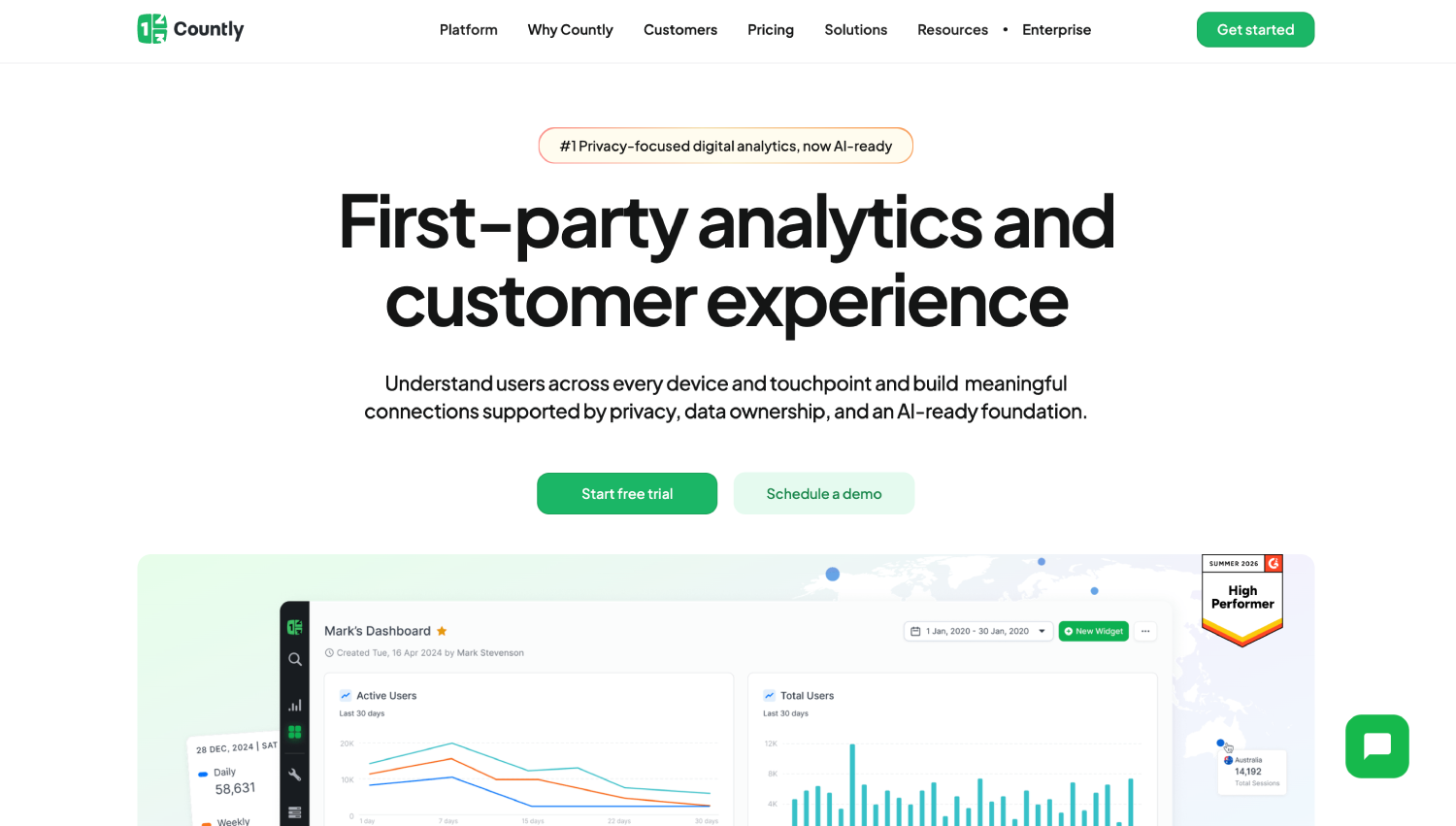
Countly is an open-source product analytics platform designed for mobile and web with self-hosting as a first-class deployment option. It covers event tracking, funnels, cohorts, retention, and push notifications. A Community Edition is freely available. Enterprise pricing is quote-based.
Countly’s primary audience is companies with strict data sovereignty requirements, regulated industries (healthcare, fintech), or teams in geographies where sending behavioral data to US-based cloud vendors creates compliance complexity. The feature set is narrower than Amplitude, but the control over infrastructure is complete. For privacy-first stacks, it is one of the few tools in this category that can be fully air-gapped.
12. Pirsch
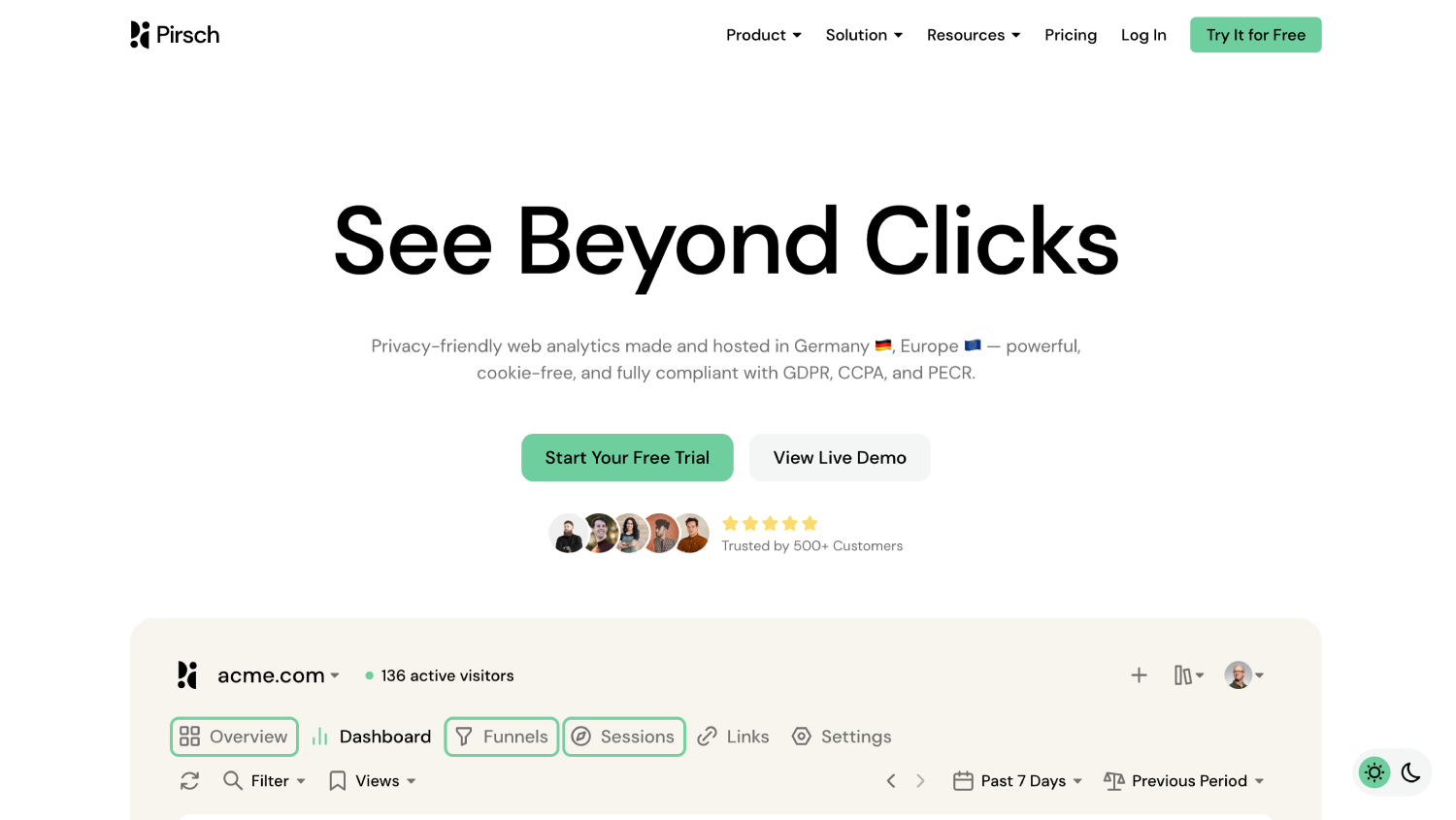
Pirsch occupies a different part of the category than the tools above. It is a lightweight, privacy-first web analytics tool built on ClickHouse, without cookies, without fingerprinting, and without GDPR consent banners. Plans start at $5 per month according to their public pricing page. A self-hosted version is available.
Pirsch does not replace Amplitude or Mixpanel. It replaces Google Analytics for teams that want simple traffic and pageview data without the compliance overhead or the GA4 complexity. For a SaaS marketing site that does not need behavioral product analytics, Pirsch is a clean, fast alternative. Pairing it with PostHog for in-product analytics covers both surfaces without either tool doing the other’s job.
If privacy-first web analytics is your primary concern, the roundup of GA4 alternatives built for teams who want simpler, cleaner data covers several options in this tier.
13. June
June is purpose-built for B2B SaaS and takes a company-level analytics approach that most product analytics tools handle poorly. Where Amplitude and Mixpanel default to user-level analysis, June surfaces metrics at the account level: which companies are activating, which are expanding, which are contracting. It connects to Segment or directly instruments via SDK.
June offers a free tier. Paid plans are available and priced on their website. It is not a full replacement for a tool like Amplitude at scale, but for early-stage B2B SaaS companies where the sales team needs to see company health and the product team needs activation data, June provides a fast path to both without a complex implementation. Teams that eventually need warehouse-native behavioral data often use June early and migrate to a more complete stack as volume grows.
Which Product Analytics Tool Should You Actually Buy?
Say a B2B SaaS team has 15,000 monthly active users, a two-person data team, and product managers who need to run retention cohorts and funnel analysis without writing SQL. Amplitude’s free tier covers the entire user base with room to grow, the UI is learnable without training, and the data can export to their Snowflake instance if they later want warehouse-native queries. That is a clean match.
Now say the same company is engineering-led, has a strong DevOps culture, and wants to avoid sending behavioral data to a third-party cloud. PostHog self-hosted covers analytics, session replay, feature flags, and A/B testing, all inside their own infrastructure, with MIT-licensed source code. The engineering team can audit every component. That is also a clean match, for a different company.
The teams that struggle are the ones who buy Heap or Mixpanel without a tracking plan in place, then wonder why the platform does not surface useful answers six months later. Heap’s autocapture works, but it still requires a structured approach to defining meaningful events retroactively. Mixpanel without disciplined instrumentation is an expensive dashboard with no data in it.
For teams building data infrastructure around behavioral analytics, the architecture decision between a CDP and a warehouse-native approach often happens in parallel with this evaluation. The comparison of warehouse-native CDPs against traditional cloud CDPs covers that trade-off in depth.
What Does Product Analytics Software Cost?
Pricing varies widely and most platforms above a startup scale are quote-based. Here is what is publicly available:
| Tool | Free Tier | Paid Entry Point | Enterprise |
|---|---|---|---|
| Amplitude | Up to 50,000 MTUs | Quote-based | Quote-based |
| Mixpanel | Up to 20M events/mo | Quote-based (Growth) | Quote-based |
| PostHog | 1M events/mo | Consumption-based (see pricing page) | Custom |
| Heap | Limited free plan | Quote-based | Quote-based |
| Hotjar | Yes | From $32/mo | Quote-based |
| Smartlook | Yes | From $55/mo | Quote-based |
| LogRocket | Yes | See pricing page | Quote-based |
| Pirsch | No | From $5/mo | See pricing page |
| Countly | Community Edition (self-hosted) | Quote-based | Quote-based |
| June | Yes | See pricing page | Quote-based |
| FullStory | No | Quote-based | Quote-based |
| Pendo | Limited free | Quote-based | Quote-based |
| Contentsquare | No | Quote-based | Quote-based |
MTU-based pricing (Amplitude) tends to favor products with high event-per-user ratios. Event-based pricing (Mixpanel, PostHog) tends to favor products with lower event density. Running the math on your specific event volume and user count before entering a sales conversation is worth 30 minutes of work. Vendors will negotiate differently based on which model benefits them more in your case.
Attribution tools face a similar pricing complexity. If your team is also evaluating how to connect product behavior to revenue attribution, the roundup of marketing attribution tools built for proving revenue impact covers that buying decision.
Frequently Asked Questions About Product Analytics Tools
What separates product analytics from web analytics?
Web analytics (GA4, Pirsch, Plausible) tracks anonymous sessions: traffic sources, pageviews, conversions. Product analytics tracks identified users: which features they used, in what sequence, across which sessions, and whether they returned. The distinction is user identity and behavioral depth. Web analytics answers acquisition questions. Product analytics answers retention and engagement questions. You typically need both, pointed at different surfaces of your product.
Can Mixpanel or Amplitude replace Google Analytics entirely?
For an authenticated product experience, yes. For a public marketing site where you need Google Search Console integration, anonymous traffic attribution, and ad conversion tracking, no. Most teams run GA4 or a lightweight alternative on their marketing site and Amplitude or Mixpanel inside the logged-in product. The tools serve different surfaces and replacing one with the other entirely creates gaps. A dual-tool approach is standard at companies that take both surfaces seriously.
Which product analytics tool works best for B2B SaaS?
June is the only tool in this category designed specifically for company-level analytics in B2B SaaS, which matters when your unit of analysis is an account, not an individual user. For teams that need both company-level and user-level analysis, Amplitude with account-level grouping or Mixpanel with Group Analytics covers the gap. PostHog also supports group analytics natively. The right answer depends on whether your sales and CS teams need account health views or your product team primarily cares about user behavior.
What is autocapture and when does it matter?
Autocapture means the analytics SDK records every user interaction (clicks, form submissions, page views) without explicit event instrumentation. Heap and PostHog both support it. The benefit is zero instrumentation gaps from day one. The risk is high event volume and noisy data that requires retroactive cleanup. Autocapture is most valuable for teams that cannot dedicate engineering time to maintaining a tracking plan. Teams with strong data engineering capacity often prefer explicit instrumentation because it produces cleaner, more intentional datasets.
How do product analytics tools handle data privacy and GDPR?
Cloud-based tools (Amplitude, Mixpanel) process data on vendor infrastructure, which means data transfer agreements and vendor data processing addendums are required for GDPR compliance. Self-hosted tools (PostHog, Countly) keep data within your own infrastructure, eliminating third-party data transfer entirely. All tools in this list offer some form of data deletion API for GDPR right-to-erasure compliance. Privacy-first tools like Pirsch and Countly avoid fingerprinting and cookies at the collection layer, which reduces consent overhead on the marketing site surface.
What is the Instrumentation-to-Insight Ratio and why does it matter?
The Instrumentation-to-Insight Ratio is AboutMartech’s framework for evaluating how much engineering time a product analytics tool requires before a non-engineer can answer a behavioral question. Tools with full autocapture (Heap, PostHog, FullStory) score high on this ratio: insight is available from day one. Tools requiring explicit instrumentation (Mixpanel) score low until the tracking plan matures. This ratio predicts whether a tool gets used consistently, not just purchased. A platform that requires six months of instrumentation work before delivering value often gets abandoned before it ever does.
Should product analytics data live in the tool or in the data warehouse?
Both. Keeping behavioral data only inside a vendor’s platform creates analytical silos: your product data cannot join your CRM data, your support data, or your revenue data. All serious product analytics platforms support exporting raw events to Snowflake, BigQuery, or Redshift. Teams building a modern data stack should treat the analytics tool as the collection and exploration layer and the warehouse as the system of record. Reverse ETL tools can then push enriched segments back into the analytics tool or CRM. That architecture gives analysts the full picture without replacing any single tool.
How do session replay tools differ from product analytics platforms?
Session replay tools (FullStory, Hotjar, LogRocket) record the actual screen experience of individual users and let you watch what they did. Product analytics platforms (Amplitude, Mixpanel, PostHog) aggregate behavioral events across thousands of users and surface statistical patterns. Session replay is qualitative and specific. Product analytics is quantitative and aggregate. Several tools in this list offer both, including PostHog, LogRocket, and Heap via Contentsquare, but the mental models for using each are different and the questions they answer are different.
The Verdict
Product analytics is not a single category. FullStory and Hotjar are fundamentally different tools from Amplitude and Mixpanel, even though vendors and buyers often group them together. The cleanest way to think about the market is three tiers: quantitative behavioral analytics (Amplitude, Mixpanel, PostHog, Heap), digital experience and session replay (FullStory, Contentsquare, LogRocket, Smartlook), and lightweight privacy-first analytics (Pirsch, Countly, June for B2B). Most mature product stacks include one tool from the first tier and one from the second.
PostHog has become the most interesting platform in the category for engineering-led companies specifically because it collapses all three tiers into one product. That is a meaningful advantage when vendor sprawl is itself a cost. For teams that cannot or will not run self-hosted infrastructure, Amplitude remains the reference implementation for enterprise-grade quantitative analytics, and Mixpanel remains the most accessible entry point for growth teams that instrument deliberately.
The single insight that changes most buying decisions: the analytics tool you choose is only as good as the tracking plan behind it. Heap buys you time by deferring that work. Every other tool on this list bills you for events or users while your instrumentation gaps stay unresolved. Fix the tracking plan first, then choose the tool that fits how your team works.