Triple Whale, Northbeam and Rockerbox are the three names that come up most when a direct-to-consumer brand outgrows the numbers inside Meta Ads Manager and Google Ads. All three track the customer journey with their own first-party pixel, split credit for each order across ad touchpoints and report one de-duplicated view of performance. They differ in what they cost, how they assign credit, how long setup takes and which channels they can see.
We read each vendor’s pricing page, help documentation and Shopify App Store listing on November 4, 2026, and captured each homepage the same day. Every price, model and timeline below comes from those primary sources, and we point out where other comparisons repeat figures that no longer match. For the wider market, including cheaper and B2B-focused options, see our guide to ecommerce attribution tools.
TLDR
Short answer: Pick Triple Whale if you sell on Shopify and want attribution, reporting and an AI analyst in one subscription, starting from a free plan. Pick Northbeam if paid social and search are your main growth channels and you can budget at least $1,500 a month for more rigorous multi-touch attribution. Pick Rockerbox if TV, streaming, direct mail or podcasts take a large share of spend and you want attribution, marketing mix modeling and incrementality testing on one data foundation.
- Price: Triple Whale has a free plan and quotes paid plans by annual GMV. Northbeam lists Starter from $1,500 and Professional from $3,500 a month. Rockerbox publishes no prices.
- Models: Triple Whale and Northbeam each document seven attribution models. Rockerbox offers four attribution types plus custom credit allocation.
- Windows: Triple Whale offers 1, 7, 14 or 28 days or Lifetime. Northbeam offers 1 to 90 days or LTV. Rockerbox applies a fixed window per channel, up to 150 days for clicks.
- Setup: Triple Whale says most brands are running in 15 minutes. Northbeam quotes 2 to 4 weeks on Shopify. Rockerbox quotes 6 to 8 weeks for attribution or MMM.
- Ownership: DoubleVerify bought Rockerbox in a deal that closed March 13, 2025.
In this guide
Triple Whale vs Northbeam vs Rockerbox at a glance
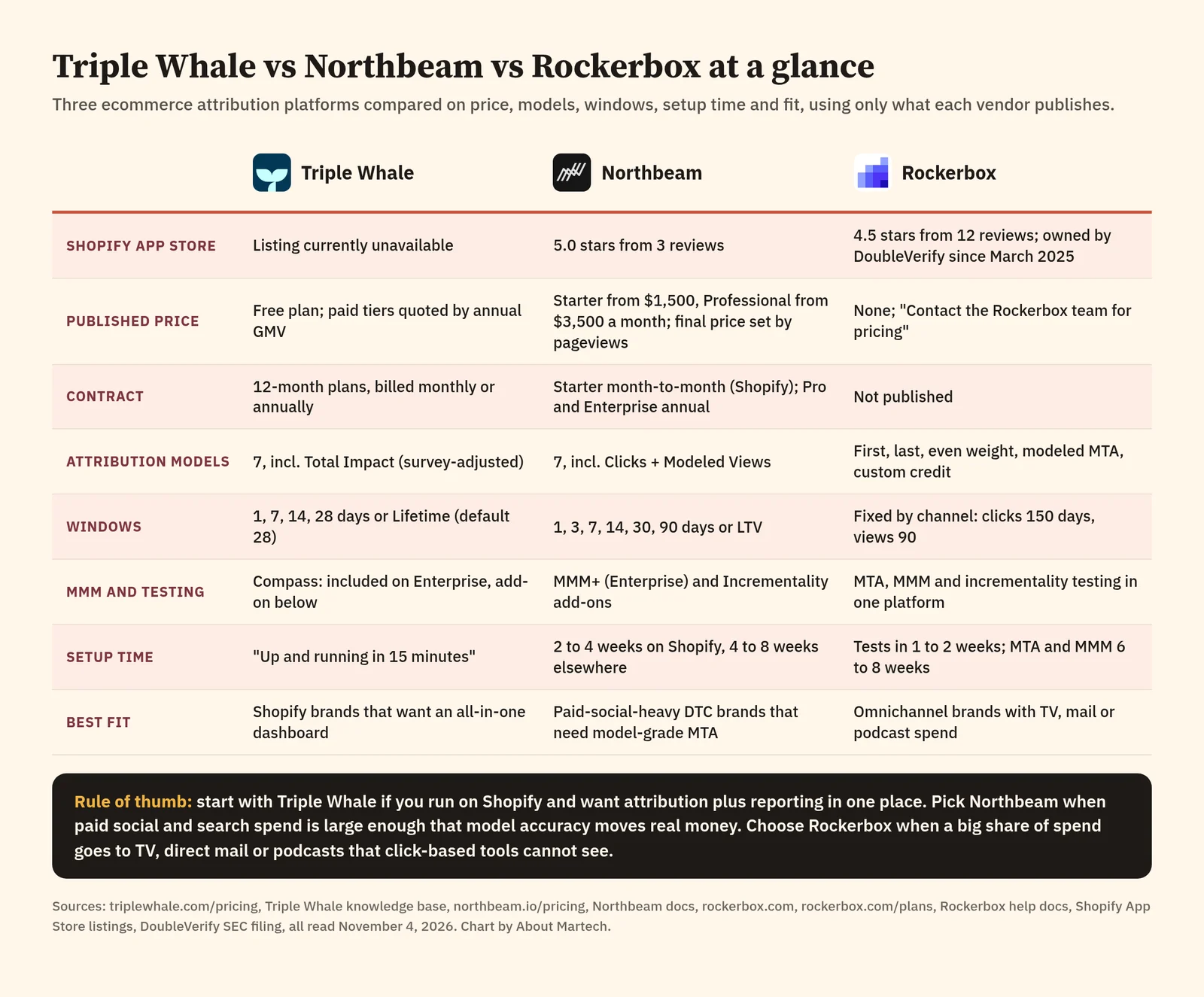
| Triple Whale | Northbeam | Rockerbox | |
|---|---|---|---|
| Built for | Shopify and DTC brands that want measurement, BI and AI in one place | DTC brands with significant paid media spend | Brands with a wide channel mix, including offline media |
| Published price | Free plan; Foundation, Automate and Enterprise quoted by annual GMV | Starter from $1,500; Professional from $3,500 a month; Growth and Enterprise custom | Not published |
| Contract | Paid plans are 12-month subscriptions | Starter month to month (Shopify); Professional and Enterprise annual | Not published |
| Attribution models | 7 (including Total Impact) | 7 (including Clicks + Modeled Views) | 4 types plus custom credit |
| Attribution windows | 1, 7, 14, 28 days or Lifetime | 1, 3, 7, 14, 30, 90 days or LTV | Fixed by channel |
| MMM | Compass, included on Enterprise, add-on on Foundation and Automate | MMM+, optional on Enterprise | Included in the platform |
| Incrementality testing | Compass add-on | Optional from Professional | Included, fully managed |
| Sends attribution back to ad platforms | Sonar Send and Sonar Optimize, in every paid plan | Northbeam Apex | DV Relay for Meta |
| Setup time (vendor estimate) | 15 minutes for most brands | 2 to 4 weeks Shopify, 4 to 8 weeks other platforms | 1 to 2 weeks for testing, 6 to 8 weeks for MTA or MMM |
Sources: Triple Whale pricing, Triple Whale attribution models, Northbeam pricing, Northbeam attribution models, Northbeam implementation guide, Rockerbox, Rockerbox plans, Rockerbox attribution types, read November 4, 2026.
Pricing: what each vendor actually publishes
Pricing is where most comparisons go out of date fastest, so here is only what each vendor shows today. For prices across B2B and ecommerce tools, see our marketing attribution software pricing guide.
- Triple Whale lists four plans: Free, Foundation, Automate and Enterprise. The pricing page does not print a dollar figure for paid plans. It says all prices are based on a combination of your brand’s annual GMV and the package you choose, and that every paid plan includes unlimited users and as many stores as you need. Paid plans are 12-month subscriptions billed monthly, or annually with two months free, and if your revenue grows you move to the matching tier automatically (Triple Whale pricing).
- Northbeam prices by ad spend band. Growth is a custom quote through an agency partner for brands spending under $200,000 a month on ads. Starter shows $1,500 for brands spending less than $1.5 million a year on ads. Professional shows $3,500 a month for brands spending up to $500,000 a month. Enterprise is custom, for teams spending more than $500,000 a month. The FAQ explains that these are starting rates, and that your monthly price is informed by the volume of data in your business, measured in pageviews (Northbeam pricing).
- Rockerbox lists its plans without prices and asks you to request a demo (Rockerbox plans). Its Shopify listing says to contact the Rockerbox team for pricing information per product (Shopify App Store).
A caution on figures you may see elsewhere. Several comparisons quote a Triple Whale Foundation price from its Shopify App Store listing, and others quote a Triple Whale entry price of about $129 a month. When we checked on November 4, 2026, the Shopify listing said the app is not currently available on the Shopify App Store (Shopify App Store), and the pricing page showed a free plan and quote-based paid tiers. Treat any Triple Whale dollar figure you have not been quoted directly as unverified.
Year-one cost floor from published prices
| Plan | Published starting price | Year-one floor at that rate | Term |
|---|---|---|---|
| Triple Whale Free | $0 | $0 | No commitment |
| Triple Whale paid plans | Quoted by annual GMV | Ask for a quote | 12 months |
| Northbeam Starter | $1,500 | $18,000 | Month to month, Shopify brands |
| Northbeam Professional | $3,500 a month | $42,000 | Annual |
| Northbeam Growth and Enterprise | Custom | Ask for a quote | Growth via agency; Enterprise annual |
| Rockerbox | Not published | Ask for a quote | Not published |
Year-one floor is the published starting rate times 12, before add-ons such as Northbeam Incrementality or MMM+, or Triple Whale Compass. Because Northbeam’s rate depends on pageviews and Triple Whale’s on GMV, your quote can be higher. If you need a wider view of costs across vendors, our guide on how to choose attribution software includes a buyer’s checklist for pricing calls.
Attribution models and windows compared
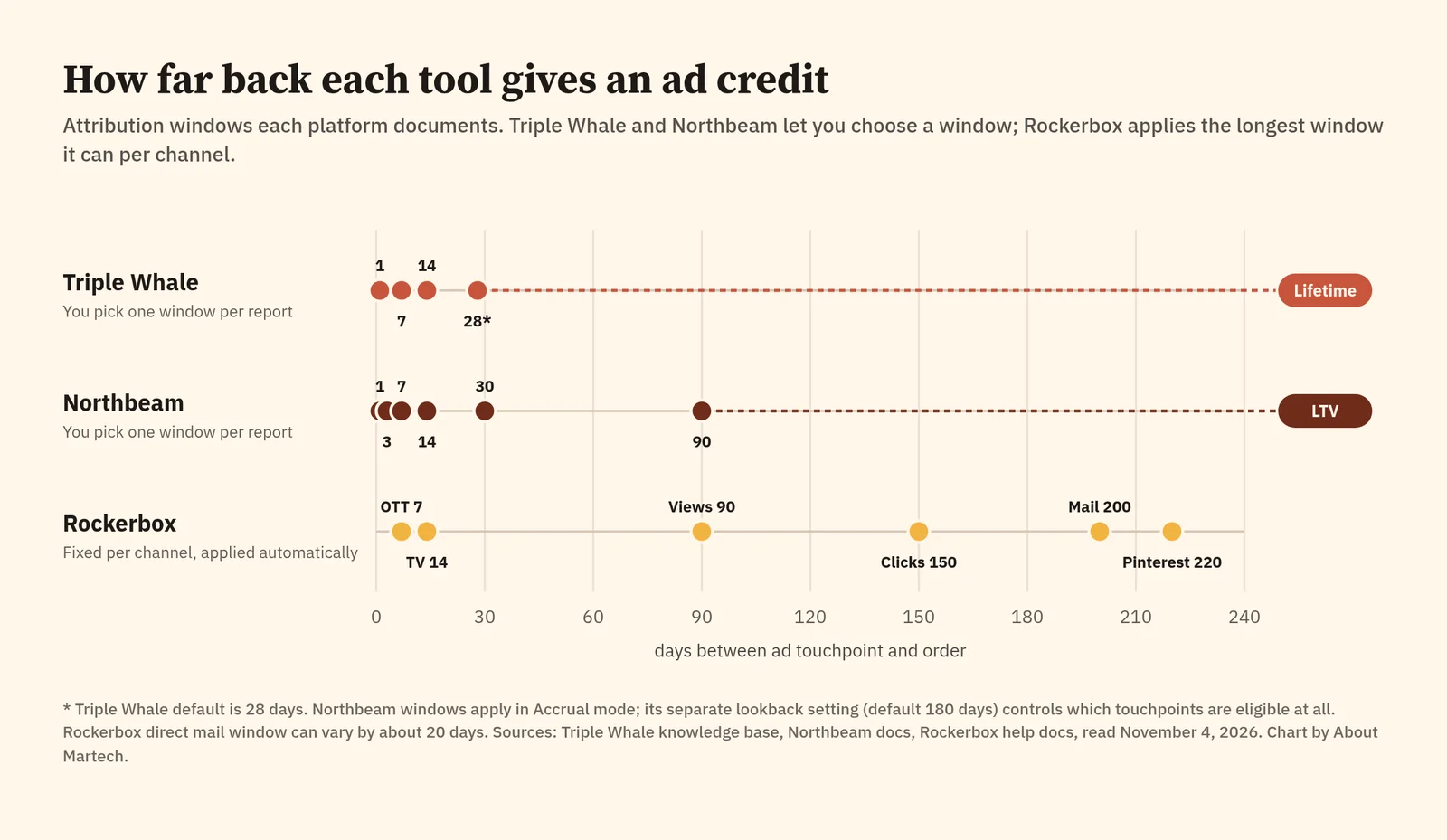
All three tools start from the same raw material: a first-party pixel on your site plus order data from your store. The difference is how they split credit and how far back they look.
Triple Whale
Triple Whale documents seven models. Two are single touch (First Click and Last Click). Five are multi-touch: Clicks and Deterministic Views, Linear (All and Paid), Triple Attribution, Triple Attribution plus Platform Views, and Total Impact. Four of these are Triple Whale’s own proprietary models. You can pick a 1, 7, 14 or 28 day window or Lifetime, and the default is 28 days (Triple Whale knowledge base).
Two details matter in practice. Total Impact blends pixel data with post-purchase survey answers, uses a fixed 7-day window, needs at least 7 days of data and enough survey volume, and is not available on the Free plan (Total Impact model). Clicks and Deterministic Views gives credit to ad views reported by Meta, TikTok, Pinterest, Snapchat, AppLovin and Vibe; click credit halves every 7 days and view credit halves every day (Clicks and Deterministic Views). The Free plan is limited to first and last click on a lifetime window (pricing).
Northbeam
Northbeam also lists seven models: First Touch, Last Touch, Last Non-Direct Touch, Linear, Clicks-Only, Clicks + Modeled Views and Clicks + Deterministic Views (Northbeam attribution models). Click-based models offer 1, 3, 7, 14, 30 and 90 day windows plus LTV, and windows are only available in the Accrual accounting mode (attribution windows).
Northbeam separates two ideas other tools blur. The attribution window is a reporting lens on credit already assigned, while the lookback window decides which touchpoints can earn credit at all. You can set the lookback to 90 days, 180 days, 1 year or 10 years, the default is 180 days, and changing it restates your historical data (lookback windows). Northbeam also warns on its pricing page that your ad performance will look different from in-platform numbers, by design (pricing FAQ).
Rockerbox
Rockerbox offers four attribution types: first touch, last touch, even weight and modeled multi-touch, which builds fractional credit from your own data. Custom Credit Allocation lets you go further (attribution types). Instead of letting you pick a window, Rockerbox applies the longest window it can for each channel: 150 days for clicks across search, social, email, SMS and affiliate, 90 days for deterministic display views, 14 days for linear TV, 7 days for OTT, about 200 days for direct mail and 220 days for Pinterest view-throughs (attribution window methodology). That makes it the strongest of the three for long consideration cycles and offline media, but it also means you cannot shorten windows to match how an ad platform reports.
Setup time and what each tool needs from you
| Triple Whale | Northbeam | Rockerbox | |
|---|---|---|---|
| Vendor timeline | Most brands running in 15 minutes, no engineer required | Shopify: 2 to 4 weeks. Other platforms: 4 to 8 weeks | Testing: 1 to 2 weeks. MTA or MMM: 6 to 8 weeks |
| Tracking | Triple Pixel | Northbeam Pixel on every page; on Shopify in the theme head plus a Custom Pixel for checkout | Rockerbox pixel; on Shopify, the Shopify API adds a backup data source |
| Other requirements | No engineer required, per Triple Whale | DNS record for first-party tracking, required UTMs, admin access to ad accounts, Orders API off Shopify | Timeline depends on data readiness and complexity |
| Validation | Step-by-step guide plus implementation specialists | At least 3 fully tracked days; target pixel tracking of 85% of web orders | Not documented publicly |
Sources: Triple Whale pricing FAQ, Northbeam implementation guide, Northbeam pixel docs, Rockerbox FAQ, Rockerbox Shopify tracking docs, read November 4, 2026.
Northbeam is the most explicit about the work involved. UTMs are required, adding them may reset ads into a learning phase, and Northbeam says the longer UTMs are delayed, the longer implementation takes. Starter customers get ticket support and documentation, while Professional and Enterprise add a Customer Success Manager and a Media Strategy team (implementation guide). If you are moving away from third-party cookies at the same time, our playbook on measuring marketing ROI without cookies covers server-side and survey-based signals that feed all three tools.
MMM, incrementality and sending data back to ad platforms
Multi-touch attribution is only one way to measure. Each vendor now pairs it with marketing mix modeling (MMM), incrementality tests or both. If MMM is new to you, our guide to marketing mix modeling software explains how it differs from MTA.
- Triple Whale Compass combines MTA, MMM and incrementality testing, including holdouts and geo-lift tests. The pricing table lists MMM and incrementality as add-ons on Foundation and Automate, and Enterprise adds them as part of the package (Triple Whale pricing).
- Northbeam MMM+ retrains daily, models promotions and seasonality, and can take Northbeam’s own MTA data as an input (MMM+). Incrementality is an option from Professional, and MMM+ is an option on Enterprise (pricing).
- Rockerbox sells MTA, MMM and incrementality testing on one SOC 2 data foundation with more than 100 integrations, and can export data to BigQuery, Redshift and Snowflake (Rockerbox).
All three can also feed their attribution back into ad platforms so bidding algorithms optimize against your numbers rather than the platform’s own. Northbeam Apex sends Northbeam-attributed performance for each ad to partner platforms and runs alongside your existing pixel and conversions API setup (Northbeam Apex). Rockerbox’s DV Relay for Meta uploads attribution daily to power Meta Custom Attribution, which Meta unlocks 14 days after the first high-quality event (DV Relay for Meta). Triple Whale includes Sonar Send and Sonar Optimize in every paid plan (pricing FAQ).
Triple Whale
| Best for | Shopify brands that want attribution, BI and an AI analyst in one tool |
| Entry point | Free plan; paid plans quoted by annual GMV |
| Standout | Total Impact model blends pixel and post-purchase survey data |
| Watch out for | No public prices; 12-month terms on paid plans |
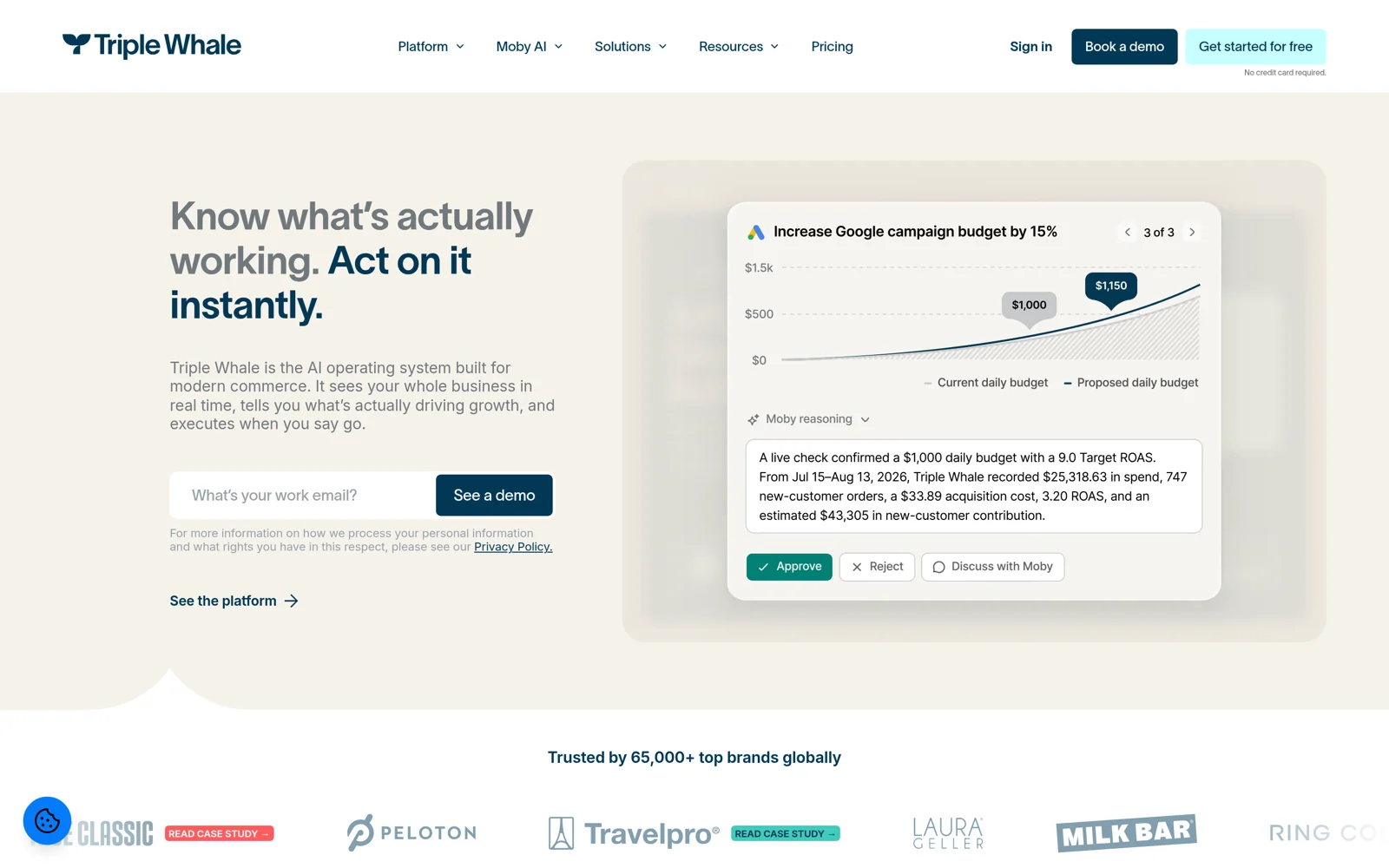
Triple Whale positions itself as an AI operating system for commerce, and attribution is one part of a broader product with dashboards, a SQL editor, cohort and creative analysis, and Moby, its AI agent. The homepage says it is trusted by more than 65,000 brands (Triple Whale). That breadth is the main reason to choose it: one subscription can replace a reporting tool and a separate attribution tool for a Shopify team.
- Strengths: free plan for testing, fastest stated setup, unlimited users on paid plans, survey-adjusted attribution, SOC 2 on every tier.
- Limits: paid pricing only on request, Free plan limited to first and last click, MMM and incrementality cost extra below Enterprise, and its Shopify App Store listing was unavailable when we checked.
Northbeam
| Best for | Paid-media-heavy DTC brands that want rigorous multi-touch attribution |
| Entry point | Starter from $1,500; Professional from $3,500 a month |
| Standout | Separate lookback and attribution windows; Apex sends attribution to ad platforms |
| Watch out for | 2 to 8 week setup; required UTMs; add-ons for incrementality and MMM+ |
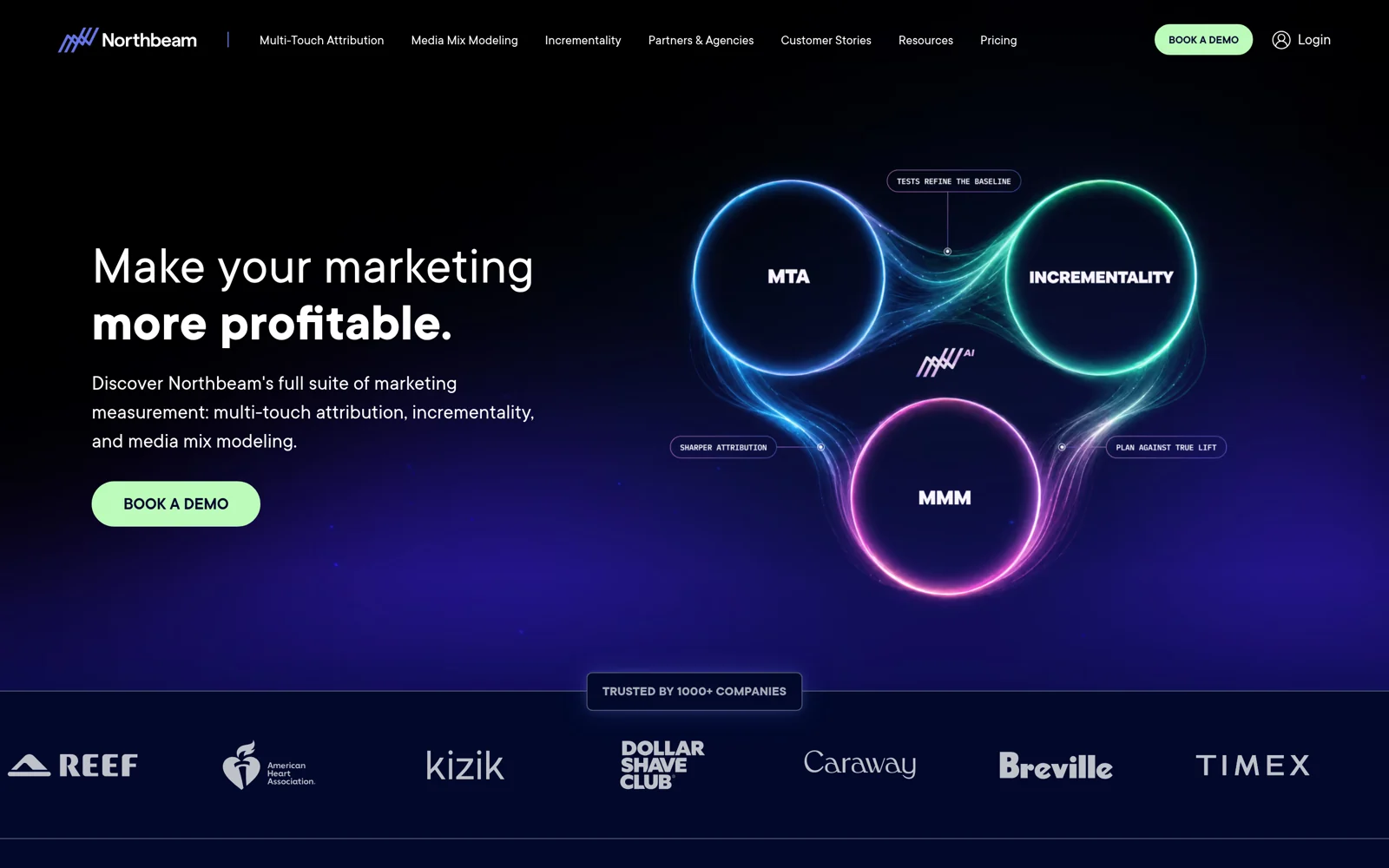
Northbeam focuses on measurement rather than all-in-one analytics. Its homepage pitches a suite of multi-touch attribution, incrementality and media mix modeling and says it is trusted by more than 1,000 companies (Northbeam). It is the only one of the three that publishes dollar figures, which makes budgeting easier, and its documentation is the most detailed about models, windows and implementation steps.
- Strengths: transparent starting prices, clear model and window documentation, month-to-month Starter for Shopify brands, Media Strategy support on higher tiers.
- Limits: real cost scales with pageviews, setup takes weeks, and its Shopify listing has only 3 reviews, all from August 2023 (Shopify App Store).
Rockerbox
| Best for | Omnichannel brands with TV, streaming, direct mail or podcast spend |
| Entry point | Quote only |
| Standout | Long per-channel windows and offline tracking via promo codes and surveys |
| Watch out for | No published prices; 6 to 8 weeks for MTA or MMM |
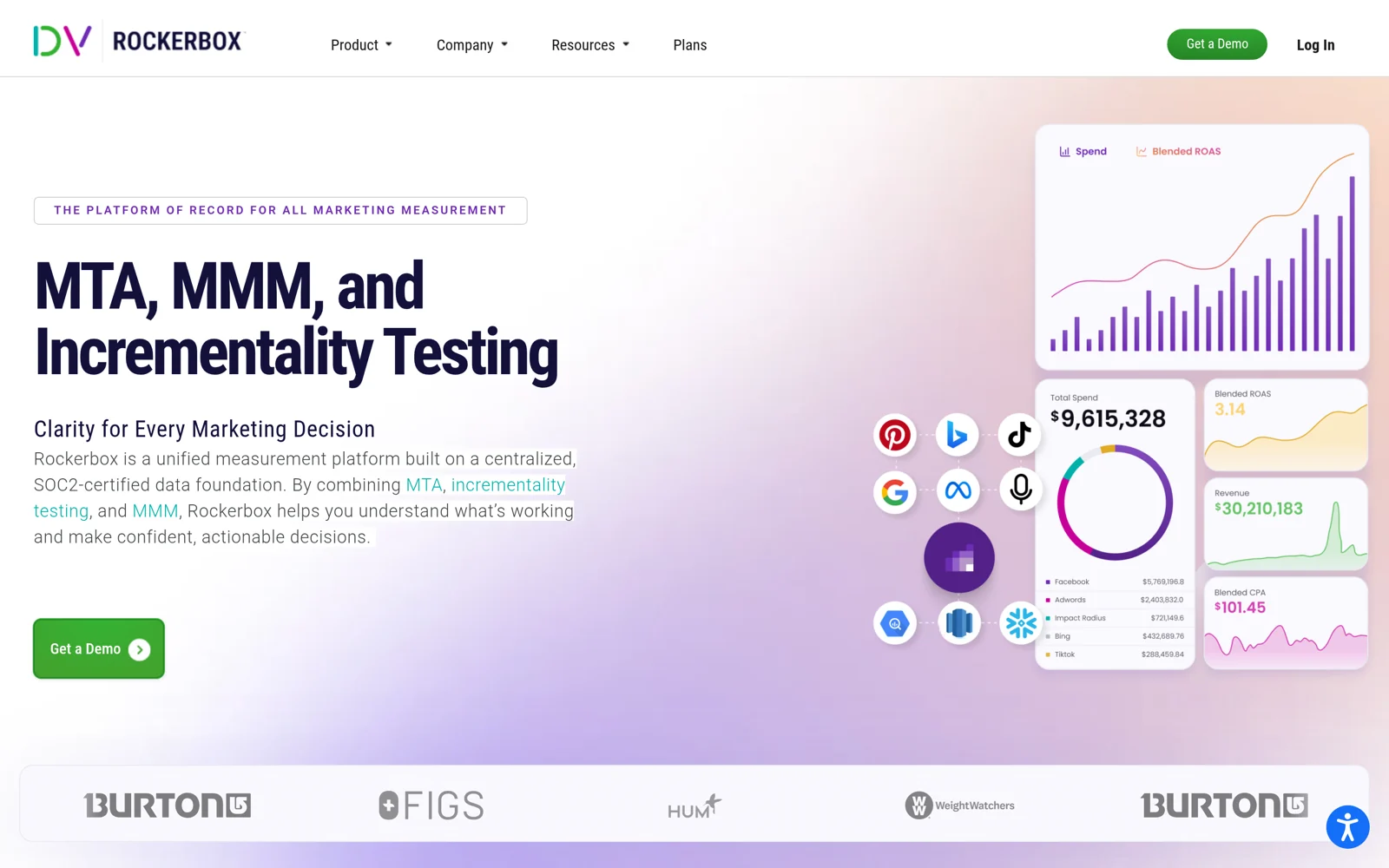
Rockerbox describes itself as a unified measurement platform built on a centralized, SOC 2 certified data foundation. It tracks clicks and views across paid social, search, display and video, plus CTV, linear TV, direct mail and podcasts through promo codes and post-purchase surveys (Rockerbox). DoubleVerify announced the purchase of Rockerbox on February 26, 2025 in a cash deal valued at $85 million (DoubleVerify) and completed it on March 13, 2025 for $82.3 million, net of cash acquired (DoubleVerify SEC filing). Rockerbox now carries DV branding, and its Meta integration is called DV Relay. For more on DoubleVerify itself, see our comparison of IAS vs DoubleVerify vs HUMAN.
- Strengths: widest channel coverage, MTA, MMM and testing on one dataset, warehouse exports, long windows that suit considered purchases.
- Limits: no public pricing, longer setup for attribution and MMM, fixed windows you cannot shorten, and a Shopify listing whose most recent review is from July 2023 (Shopify App Store).
Which should you pick?
- Pick Triple Whale if you run on Shopify, want to start free, and value dashboards, BI and AI automation as much as attribution itself.
- Pick Northbeam if Meta, Google and TikTok carry most of your growth, you can fund $1,500 a month or more, and you want documented models, configurable lookback and a measurement team behind you.
- Pick Rockerbox if a meaningful share of your budget goes to TV, streaming, direct mail or podcasts, you want MTA, MMM and testing on one dataset, and you can wait 6 to 8 weeks for full attribution.
- Pick something else if you sell B2B or your journeys run through a CRM. Start with our list of marketing attribution software instead.
Whichever you choose, run it alongside platform reporting for a few weeks before moving budget, and decide in advance which model you will use for decisions. Our guide to multi-touch vs last-touch attribution explains how the choice of model changes which channels look best.
How we compared these tools
On November 4, 2026 we read the pricing pages and FAQs for Triple Whale, Northbeam and Rockerbox, Triple Whale’s knowledge base, Northbeam’s documentation on models, windows, pixels and implementation, Rockerbox’s help documentation on attribution types, windows and DV Relay, each vendor’s Shopify App Store listing, and DoubleVerify’s press release and SEC filing on the Rockerbox deal. We captured each homepage the same day. We did not run the three tools on the same store, so we make no claims about which one is more accurate, and setup times are the vendors’ own estimates.
Frequently asked questions
What is the difference between Triple Whale and Northbeam?
Triple Whale is an all-in-one commerce analytics platform with attribution, BI and an AI agent, a free plan and paid tiers quoted by annual GMV. Northbeam focuses on measurement, with seven documented attribution models, configurable lookback windows and published starting prices of $1,500 for Starter and $3,500 a month for Professional.
How much does Northbeam cost?
Northbeam’s pricing page shows Starter from $1,500 for brands spending under $1.5 million a year on ads and Professional from $3,500 a month for brands spending up to $500,000 a month. Growth and Enterprise are custom. The final price is informed by your pageview volume.
How much does Triple Whale cost?
Triple Whale has a free plan. Its Foundation, Automate and Enterprise plans are priced by a combination of annual GMV and package, and the pricing page does not list dollar amounts. Paid plans are 12-month subscriptions billed monthly or annually.
Does Rockerbox publish its pricing?
No. Rockerbox lists its plans without prices and asks you to request a demo, and its Shopify listing says to contact the Rockerbox team for pricing.
Who owns Rockerbox?
DoubleVerify. It announced the acquisition on February 26, 2025 and completed it on March 13, 2025 for $82.3 million, net of cash acquired.
Which is best for TV and direct mail attribution?
Rockerbox. It tracks linear TV, OTT, direct mail and podcasts, using promo codes and post-purchase surveys for hard-to-track channels, and applies windows of 14 days for linear TV, 7 days for OTT and about 200 days for direct mail.
How long does it take to set up Northbeam?
Northbeam estimates 2 to 4 weeks for Shopify brands and 4 to 8 weeks for other platforms. It also needs at least 3 fully tracked days before data validation, with a target pixel tracking rate of 85% of web orders.
Why do Triple Whale, Northbeam and Rockerbox show different numbers than Meta Ads Manager?
Each tool uses its own pixel, de-duplicates conversions across channels and assigns credit with its own model and window, while each ad platform credits itself. Northbeam says its numbers will differ from in-platform reporting by design.