- Most attribution vendor pitches lead with the same five model names. The real differentiator is how each vendor handles identity resolution, data latency, and your specific channel mix , not which models they support.
- The AboutMartech Attribution Fit Score (introduced below) gives you a weighted 100-point framework to compare vendors on the criteria that actually predict regret.
- Data ownership is the most overlooked contract clause in attribution deals. If you cannot export your raw event data, you are renting insight, not building it.
- The right attribution vendor for a 90-day B2B sales cycle is structurally different from the right one for a DTC brand with a 3-day purchase window. Evaluating both against the same checklist produces bad decisions.
- Before you score a single vendor, you need a clear answer to one prior question: does your measurement problem require multi-touch attribution, marketing mix modeling, or both?
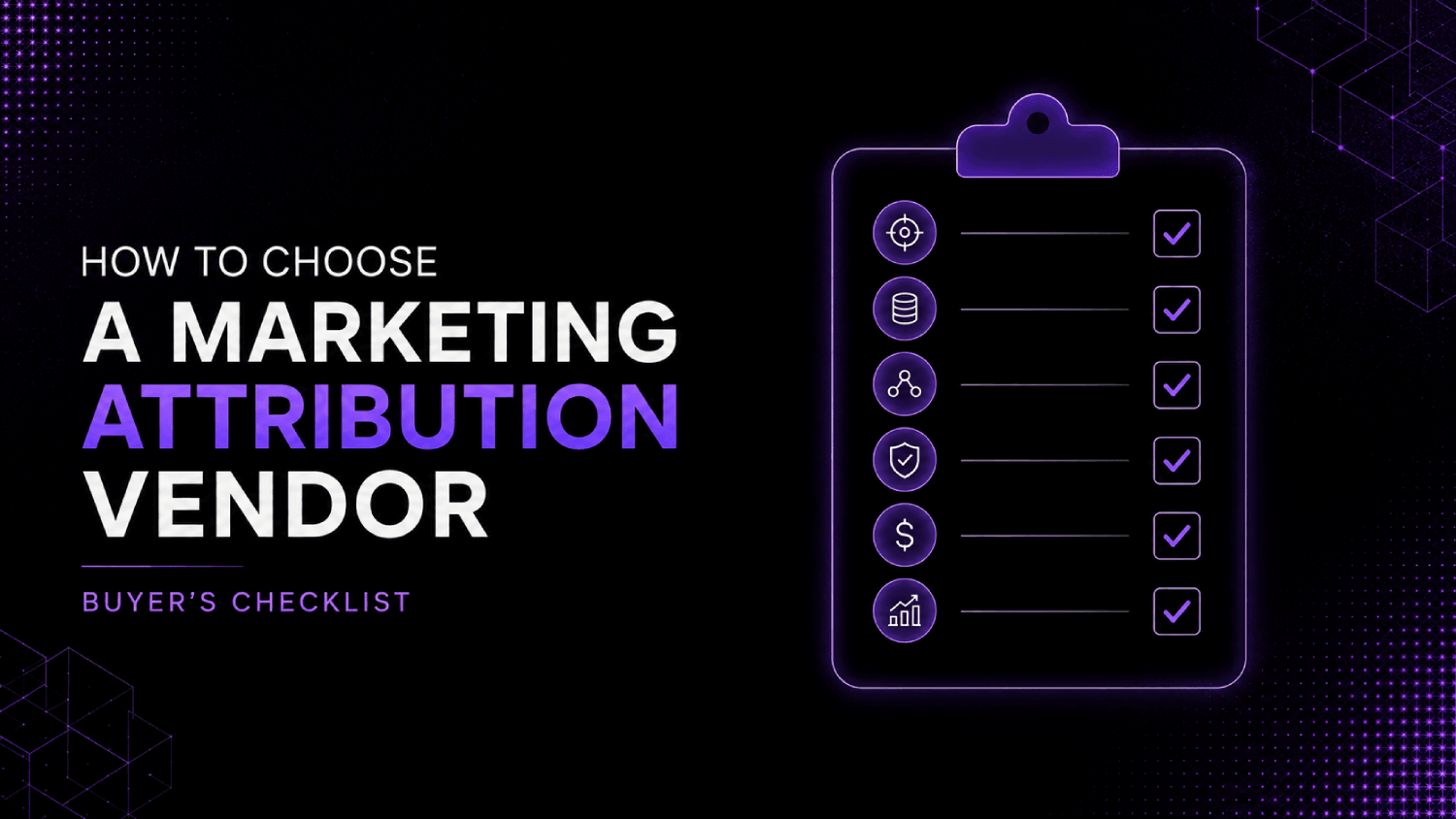
Knowing how to choose attribution software starts with defining your measurement problem (multi-touch, MMM, or incrementality testing), then evaluating vendors on six criteria: data connectivity and identity resolution, attribution model flexibility, channel coverage, reporting depth, data ownership and portability, and total cost of ownership including implementation. Score each vendor on a weighted basis before entering a trial or a procurement conversation.
Why Every Attribution Pitch Sounds Identical
Walk into any vendor demo and you will hear the same deck: “We support first-touch, last-touch, linear, time-decay, U-shaped, W-shaped, and custom ML models.” That list tells you almost nothing. Supporting a model algorithmically and surfacing useful insight from it are entirely different capabilities.
The vendors that fail in production fail on plumbing, not on mathematics. They fail because their JavaScript tag fires inconsistently on SPAs. They fail because they cannot stitch an anonymous web visitor to a CRM contact after a form submission. They fail because their Salesforce connector refreshes data every 24 hours and your sales team works in real time. These are the things vendor pitches never address, and they are exactly what your evaluation should surface.
This guide runs through each evaluation criterion in order of the failure risk it represents, then gives you a scoring template you can use in an actual procurement cycle. If you want to see which vendors clear the bar, the 11 best marketing attribution tools roundup applies these same criteria to specific products.
What Is Your Actual Measurement Problem?
Before scoring vendors, answer this question with precision: are you trying to allocate credit across touchpoints, measure incremental revenue lift from spending, or understand macro channel performance? These are three different problems with three different solution architectures.
Multi-touch attribution (MTA) traces individual customer paths across touchpoints and distributes credit using a chosen model. It requires deterministic identity resolution at the person or account level, which means cookies, first-party IDs, or a CRM match. It breaks down in high-privacy environments and with offline channels.
Marketing mix modeling (MMM) uses aggregate spend and revenue data to estimate channel contribution statistically. It does not require person-level tracking, works across offline and online channels, and is resurging because it does not depend on third-party cookies. The trade-off is latency: MMM typically needs weeks of data to update, so it is a planning tool, not a campaign optimization tool.
Incrementality testing uses holdout groups or geo-based experiments to measure whether a channel actually drives lift. It is the most epistemically defensible method but requires controlled traffic volumes and statistical patience. Some attribution platforms run incrementality experiments natively; most do not.
Buying an MTA platform when your measurement problem is actually channel-mix planning is the single most common expensive mistake in this category. Our guide to marketing mix modeling tools for post-cookie measurement covers the MMM-specific vendor field if that is where your problem lives.
The AboutMartech Attribution Fit Score: A 100-Point Vendor Evaluation Framework
The six criteria below are weighted by how frequently each one drives buyer regret. Score each vendor from 0 to the maximum points for that criterion, then sum for a total out of 100.
| Criterion | Max Points | What to Evaluate |
|---|---|---|
| Data connectivity and identity resolution | 25 | Native connectors, ID stitching method (deterministic vs probabilistic), handling of anonymous-to-known transitions |
| Model flexibility and transparency | 20 | Supported models, ability to customize, whether ML models are explainable or black-box |
| Channel and touchpoint coverage | 20 | Paid, organic, offline, partner/affiliate, in-product events |
| Data ownership and portability | 15 | Raw event export, warehouse sync, contract lock-in, API access |
| Reporting depth and activation | 12 | CRM and ad platform write-back, dashboard granularity, latency |
| Implementation cost and support quality | 8 | Time to first insight, professional services fees, support SLA |
A vendor scoring below 55 is a high-risk purchase. Between 55 and 74 means conditional fit with documented trade-offs. Seventy-five and above is a strong candidate. Do not let a sales process collapse your scoring before you complete it. Run the framework on at least two vendors simultaneously.
How Should You Evaluate Data Connectivity and Identity Resolution?
This criterion gets the highest weight for a reason. An attribution platform is only as accurate as its ability to identify the same user across sessions, devices, and channels. That identification problem has three layers: pre-conversion anonymous tracking, cross-device stitching, and CRM-to-web matching.
Deterministic matching uses a known identifier, such as an email address from a form submission, to link touchpoints. It is precise but misses a large share of the path that happens before the user identifies themselves. Probabilistic matching uses device fingerprints, IP addresses, behavioral signals, and statistical inference to stitch IDs without a hard match. It covers more of the funnel but introduces error rates that vendors rarely disclose clearly.
Ask every vendor to describe their methodology for resolving anonymous-to-known identity transitions. Specifically: when a user who visited your site three times anonymously then fills out a demo form, how far back does the platform retroactively attribute those anonymous sessions? The answer tells you how much of the top-of-funnel path the platform actually captures.
For B2B teams, account-level identity resolution is a separate requirement. Individual-contact attribution misrepresents how B2B buying actually works: multiple people from the same company interact with your content at different times, and the deal is won or lost at the account level. Vendors differ significantly in how they handle this. Dreamdata, for example, is purpose-built around account-level identity and maps touchpoints across every contact at an account throughout the sales cycle. Rockerbox and Northbeam are primarily designed for DTC and e-commerce, where individual-level tracking is more tractable. The best B2B attribution tools for long sales cycles covers the account-based identity problem in detail.
Which Attribution Models Should You Require and Which Can You Skip?
Every mature platform supports the standard rule-based models: first-touch, last-touch, linear, time-decay, and position-based (U-shaped, W-shaped). These are table stakes. What separates vendors is how they handle custom models and data-driven attribution.
Data-driven attribution (DDA) uses your own conversion data to weight touchpoints by their statistical correlation with closed revenue. Google’s DDA model in GA4, for example, is an in-platform implementation of this concept. The limitation is that DDA requires substantial conversion volume to produce stable weights. Vendors will often not disclose the minimum conversion threshold required for their DDA to be statistically reliable. Ask explicitly.
Custom model flexibility matters for teams with non-standard funnels. A product-led growth company where in-product events (free-to-paid upgrades, feature adoption) are meaningful touchpoints needs a vendor that can ingest and weight those events alongside paid media. Most MTA platforms designed for DTC or lead gen cannot do this cleanly.
Model transparency is a harder thing to evaluate and is worth the effort. Some ML-based attribution models are effectively black boxes: they produce a number but cannot explain which specific signals drove the weighting. If your CFO or board will challenge the model’s output, a black box is a political liability even if the math is sound.
Does the Vendor Cover Every Channel That Matters to Your Mix?
Map your current channel mix before you evaluate coverage. Most attribution platforms handle paid search and paid social reliably. The gaps appear at the edges.
- Organic search and content: requires integration with GA4 or a dedicated SEO analytics source. Some platforms pull this natively; others require manual configuration.
- Offline channels: direct mail, events, OOH, and TV require either upload-based matching or dedicated integrations. If you run OOH campaigns, the OOH attribution vendors roundup covers the specialists in this space.
- Partner and affiliate traffic: requires UTM discipline and ideally a native affiliate network integration. If affiliate drives meaningful revenue, this is a first-class requirement, not an afterthought.
- Mobile app events: app install and in-app event attribution is a distinct technical problem, handled by mobile measurement partners (MMPs) like AppsFlyer, Adjust, and Branch. General-purpose web attribution platforms typically do not solve this. If mobile is part of your mix, the best mobile app attribution tools guide covers that specific category.
- CRM and offline conversions: closed-won deals, offline transactions, and renewal events should close the attribution loop. Vendors vary widely in how cleanly they ingest Salesforce or HubSpot opportunity data.
The practical test is to pull your last 90 days of conversion data and ask each vendor to demonstrate attribution coverage across all of your revenue-generating touchpoints. Ask them to show you actual attributed paths, not just a demo dataset.
What Should Your Contract Say About Data Ownership?
This is the section most buyers skip and most regret. Attribution platforms collect granular event data about your customers and prospects. If you cannot export that data in a portable format, you are building insight on a platform you do not control.
Three contract clauses deserve explicit negotiation before signing:
- Raw event export: can you export every tagged touchpoint event, at the row level, in a standard format (CSV, JSON, Parquet)? Some vendors export only aggregated reports, which makes it impossible to migrate or independently validate their models.
- Warehouse sync: does the platform offer a native sync to Snowflake, BigQuery, or Redshift, and is it included in your contract or priced separately? If you are building a warehouse-native data stack, this is a first-class requirement. The modern marketing data stack for RevOps explains why warehouse connectivity has become the architectural default for mature marketing operations teams.
- Data retention on cancellation: what happens to your historical attribution data if you terminate the contract? Some platforms delete your event history on contract end. Others give you a 30-day export window. Negotiate this in writing before you sign.
How Should You Score Reporting Depth and Activation?
A good attribution platform does two things with its output: it shows you what happened, and it helps you do something about it. Vendors that only surface dashboards are half a product.
Activation means writing attribution data back into the systems where decisions are made. That includes ad platforms (Meta Ads Manager, Google Ads) for bid optimization, CRM systems (Salesforce, HubSpot) for pipeline and revenue reporting, and marketing automation platforms for audience segmentation. Ask vendors to demonstrate live write-back, not a slide about integrations.
Reporting latency matters in proportion to how actively you optimize campaigns. A DTC brand adjusting Meta spend daily needs near-real-time attribution windows. A B2B team reviewing channel mix quarterly can tolerate 24-48 hour data freshness. Vendors often advertise “real-time” attribution loosely. Ask for the specific data refresh interval at each stage: raw event ingestion, touchpoint mapping, model computation, and dashboard refresh.
What Is the True Cost of an Attribution Platform?
Attribution vendor pricing is almost universally opaque. Most enterprise-grade platforms do not publish pricing publicly. To give a sense of the tier breakdown: self-serve tools aimed at smaller teams (such as Wicked Reports or lower-tier Northbeam plans) occasionally publish starting prices on their public pricing pages, while mid-market platforms like Rockerbox and Triple Whale are primarily quote-based with pricing driven by event volume and ad spend under management. Enterprise-focused platforms like Dreamdata and Marketo Measure (Bizible) are quote-only, with contracts typically including professional services, implementation fees, and data connector charges billed separately from the platform license.
The implementation cost is frequently larger than the annual software fee for organizations with complex stacks. Tagging an entire marketing property, integrating CRM and ad platforms, configuring identity resolution, and training analysts takes time. Budget for it explicitly. Ask vendors for a realistic implementation timeline and whether they provide a dedicated onboarding resource or hand you documentation and a Slack channel.
Consider the total cost of measurement, not just the attribution platform license. If the platform requires a separate BI tool to produce usable reports, that is additional cost. If it requires a data engineer to maintain the warehouse sync, that is additional cost. Some teams find that a cheaper platform with a heavier internal implementation burden costs more in total than a premium platform with strong support.
What Is the Attribution Vendor Trial Process You Should Actually Run?
A short-duration trial is not enough time to evaluate an attribution platform for a meaningful buying decision. You need to see the platform on your own data, across a complete attribution window that matches your sales cycle. For B2B teams with 60-90 day cycles, this means negotiating a 60-90 day paid pilot on a reduced fee before committing to an annual contract.
During the trial, run a parallel measurement test. Keep your existing attribution logic running alongside the new vendor, then compare outputs on the same time period. Disagreements between the two are not necessarily a problem, but you need to understand where they diverge and why. Unexplained divergence in a vendor’s model is a red flag, not a feature.
Three specific things to validate during the trial period:
- Pull a sample of 20-30 closed-won opportunities from your CRM and trace each one’s attributed path in the platform. Do the paths look plausible given your sales team’s memory of those deals?
- Test the data export. Download a raw event file and confirm it contains the fields you would need to migrate if you switch platforms later.
- Run a report against a channel you know well. If paid search drove roughly X% of your revenue last quarter based on your internal analysis, does the platform’s attribution align? Large deviations warrant an explanation before you sign.
If a vendor resists a structured trial on your own data, that resistance tells you something about their confidence in their product.
An Illustrative Scoring Scenario
The scoring framework is most useful when applied to real vendors with real requirements. The scenario below uses hypothetical Vendor A and Vendor B as placeholders, but the weighting logic maps directly to how the framework would behave with actual platforms. (For scored assessments of specific products, see the 11 best marketing attribution tools roundup and the best B2B attribution tools for long sales cycles.)
Say a B2B SaaS team has a 75-day average sales cycle, runs paid search, paid social, content, and webinars, and wants account-level attribution that writes back to Salesforce. They are evaluating two vendors.
Vendor A has excellent Salesforce connectivity, supports account-level path mapping, and provides a warehouse sync to Snowflake. Their ML model is partially opaque, and their trial requires a three-month pilot minimum. They score 22/25 on connectivity, 14/20 on model flexibility (penalized for opacity), 18/20 on channel coverage, 14/15 on data ownership, 10/12 on reporting, and 6/8 on implementation. Total: 84/100.
Vendor B has a cleaner UI and broader model selection but lacks native Salesforce opportunity write-back (they require a Zapier workaround), does not support account-level attribution, and does not offer a raw event export. They score 13/25 on connectivity, 17/20 on model flexibility, 16/20 on channel coverage, 7/15 on data ownership, 9/12 on reporting, and 7/8 on implementation. Total: 69/100.
For this team, Vendor A is the correct choice despite the opaque ML model, because the connectivity and ownership deficiencies in Vendor B represent recurring operational friction for years. The scoring framework makes that trade-off explicit rather than leaving it to gut feel.
Frequently Asked Questions
What is the difference between multi-touch attribution and marketing mix modeling?
Multi-touch attribution assigns fractional credit to individual touchpoints in a customer’s path using person-level or account-level data. Marketing mix modeling uses aggregate spend and outcome data to estimate channel contribution statistically, without requiring individual tracking. MTA is better for campaign-level optimization with sufficient identity data. MMM is better for macro channel planning, offline channels, and post-cookie environments where person-level tracking is degraded. Some modern measurement stacks use both in parallel.
How long does attribution software take to implement?
Implementation time ranges from a few days for self-serve platforms with pre-built connectors to several months for enterprise deployments requiring custom tagging, identity resolution configuration, CRM integration, and analyst training. The most common underestimate is the time required to audit and standardize UTM parameters across all paid channels before ingestion. Budget at minimum four to eight weeks for a mid-market B2B deployment to produce reliable output.
Can attribution software work without third-party cookies?
Yes, but the accuracy of person-level multi-touch attribution degrades in cookieless environments because anonymous path stitching becomes harder. Vendors respond to this differently: some have invested in probabilistic ID graphs, others lean on first-party server-side data collection, and others have pivoted toward incrementality testing and MMM as complementary methods. The playbook for measuring marketing ROI without cookies covers how teams are adapting their measurement infrastructure.
What data does an attribution platform need access to?
At minimum: website event data (via JavaScript tag or server-side event stream), ad platform data (impressions, clicks, spend from Google, Meta, LinkedIn, etc.), and conversion data from your CRM or backend. For closed-loop B2B attribution, you also need CRM opportunity data including revenue amounts and close dates. The richer your data inputs, the more accurate the output. Vendors with a broader set of native connectors generally require less engineering work to reach this baseline.
Should a B2B company use the same attribution platform as a DTC brand?
Not necessarily. DTC attribution prioritizes high-volume, short-cycle transaction data, pixel-based tracking, and ad platform integration for ROAS optimization. B2B attribution requires account-level identity resolution, CRM opportunity mapping, and tolerance for long attribution windows of 30 to 180 days or more. Platforms like Triple Whale and Northbeam are built around the DTC use case. Platforms like Dreamdata and Bizible (now part of Marketo Measure) are built around B2B. Buying a DTC-native tool for a B2B motion produces systematically inaccurate credit assignment.
What should I look for in an attribution vendor contract?
Three things matter most. First, raw event data export rights: you should be able to download your complete event history in a machine-readable format. Second, data retention after cancellation: confirm in writing that your historical data is accessible for a defined period post-termination. Third, volume overage terms: attribution platforms that price on event volume can generate significant overage charges during high-traffic periods. Cap the overage rate or negotiate a traffic buffer into your base tier before signing.
How do I know if an attribution model is actually working?
Run a parallel measurement test for at least one full attribution window. Compare the platform’s credit assignment against your existing measurement approach on the same closed deals. Additionally, check model coherence: if your email nurture program receives significant credit but you know from sales conversations that prospects rarely cite it as a deciding factor, the model may have a data quality or recency bias problem. Triangulate attribution output against qualitative sales intelligence and incrementality tests where possible.
What is the typical price range for attribution software?
Pricing varies significantly and most enterprise vendors do not publish rates publicly. Self-serve or SMB-oriented tools may publish starting tiers on their pricing pages. Mid-market and enterprise platforms are generally quote-based, with pricing influenced by event volume, number of seats, connected data sources, and contract length. Implementation and professional services fees are often charged separately. Request a fully loaded annual cost estimate, including implementation, before comparing vendors on price.
The Harder Problem Attribution Vendors Won’t Tell You About
The conversation about which attribution model is correct is less important than the conversation about whether your data quality is high enough for any model to be meaningful. Inconsistent UTM tagging, missing Salesforce campaign objects, and ungated content consuming a share of your touchpoints all degrade attribution accuracy below the threshold where model selection matters. The best attribution platform in the market running on dirty data produces confident-sounding misinformation.
Before any vendor evaluation, spend a week auditing your tagging discipline across paid channels, your CRM campaign data hygiene, and your identity resolution coverage across device types. That audit will surface the data requirements you need to hand to vendors, and it will surface the gaps that no vendor can fix for you.
Attribution software is infrastructure, not insight. The insight comes from analysts who understand the model’s assumptions, challenge its output, and connect it to business decisions. The vendors that acknowledge this openly tend to be the ones worth buying from.