WalkMe vs Whatfix is the shortlist most enterprise IT, HR and digital transformation teams end up with when they need employees to actually use Salesforce, Workday, SAP or ServiceNow. Pendo usually joins the conversation from the other side of the building, because the product team already uses it for analytics and in-app guides. All three call themselves digital adoption platforms. They are not built for the same job.
We read each vendor’s pricing, product and company pages on November 1, 2026, mapped which features sit on which plan, and pulled real contract ranges from Vendr’s buyer data, because none of the three publishes a list price for paid plans. Below: who each platform is for, what it really costs, how they compare on the apps you need to cover, and a simple way to pick. For the wider market, including lighter tools for SaaS onboarding, see our guide to digital adoption platforms.
TLDR
- WalkMe is the broadest employee DAP: overlays for Salesforce, Workday, Microsoft Dynamics 365, ServiceNow and SuccessFactors, workflow and form analytics, license optimization and an AI Action Bar. It is now an SAP company. Quote only; Vendr’s median buyer pays $39,000 a year (Vendr).
- Whatfix is the employee DAP with the clearest packaging. Its pricing page shows Standard, Premium and Enterprise plans, a free Standard tier of Product Analytics, and Mirror app replicas for hands-on training. Vendr’s median contract is $31,950 a year (Whatfix pricing).
- Pendo is product analytics first, with in-app guides on every plan. It is the only one of the three with a free plan (500 monthly active users) and is priced by MAU, not by app or seat. Vendr’s median buyer pays $48,500 a year (Pendo pricing).
- Rule of thumb: rolling out software you bought to employees, shortlist WalkMe and Whatfix. Improving adoption inside software you build, start with Pendo.
- Budget for services. Implementation, content building and ongoing upkeep are usually quoted on top of the license for all three.
In this guide
WalkMe vs Whatfix vs Pendo at a glance
Everything below comes from each vendor’s own pages, read on November 1, 2026, unless it is marked as Vendr data. “Not listed” means we did not find it on the plan pages, not that it can never be bought.
| WalkMe | Whatfix | Pendo | |
|---|---|---|---|
| Best for | Large enterprises guiding employees across many third-party apps | Enterprises rolling out CRM, ERP, HCM and procurement software, with training built in | Product teams that need analytics plus in-app guides inside their own product |
| Primary user | Employees (customer offering also sold) | Employees (customer-facing apps also supported) | Customers of your product (employee use also sold) |
| Plans | WalkMe for employees, WalkMe for customers | Standard, Premium, Enterprise | Free, Base, Core, Ultimate |
| Public price | None, quote only | None, demo then quote | Free up to 500 MAUs; paid plans quote only |
| Pricing unit | Users, apps covered, term | Platform fee plus users (employee apps) or MAUs (customer apps) | Monthly active users and bundle |
| Vendr median per year | $39,000 | $31,950 | $48,500 |
| Apps covered | Web, desktop and mobile; packaged solutions for Salesforce, Workday, Dynamics 365, ServiceNow, SuccessFactors | Web, desktop (Windows, Mac), mobile, Citrix and Azure Virtual Desktop on Premium | Web and mobile apps you instrument |
| Analytics | Application usage, workflow and form analytics, license optimization | Guidance analytics on every plan; Product Analytics module (Standard tier free) | Full product analytics with retroactive data, session replay on Core and up |
| AI | Contextual AI: pinned AI, Action Bar, WalkMe Menu, AI analytics | Agentic AI for authoring, AI roleplay in Mirror, AI search | Leo assistant, Pendo MCP, Agent Analytics, Predict add-on |
| Company scale | About 1,600 customers, users in 42+ countries | 700+ customers in 30+ countries | 14,000+ teams |
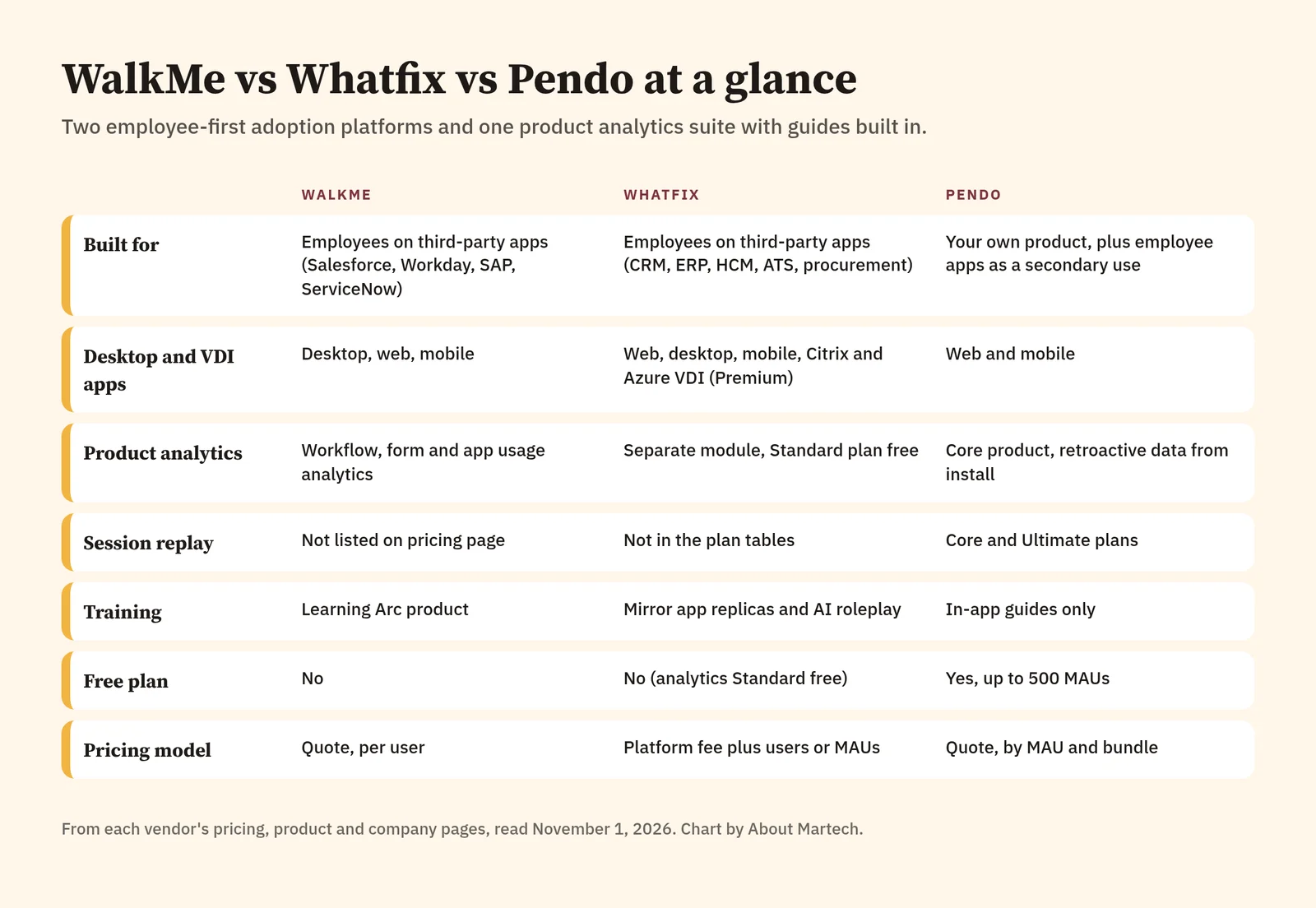
Two different jobs: employee adoption vs product adoption
Most confusion in this comparison comes from one word. “Adoption” means two different things depending on who is buying.
Employee adoption is about software you bought. IT, HR, sales ops or a transformation office rolls out Workday, Salesforce or an ERP to thousands of staff, and needs them to complete processes correctly without a training class for every change. The DAP overlays guidance on an app you do not control, so it has to cope with someone else’s interface, release schedule and security model. This is the job WalkMe and Whatfix were built for.
Product adoption is about software you build. A product or growth team wants new users to reach value faster, find features and stay. The team owns the code, installs a snippet or SDK and cares as much about analytics as guidance. That is Pendo’s home ground, and it is why Pendo usually competes with tools like Appcues and Userpilot as often as with WalkMe. Our Appcues vs Pendo comparison covers that side in depth.
All three vendors now sell into both lanes. WalkMe has a customer offering, Whatfix supports customer-facing apps on MAU pricing, and Pendo markets Pendo for Employees. But each product’s depth, pricing model and roadmap still lean one way, and that lean should drive your shortlist.
WalkMe: the broadest platform for employee software
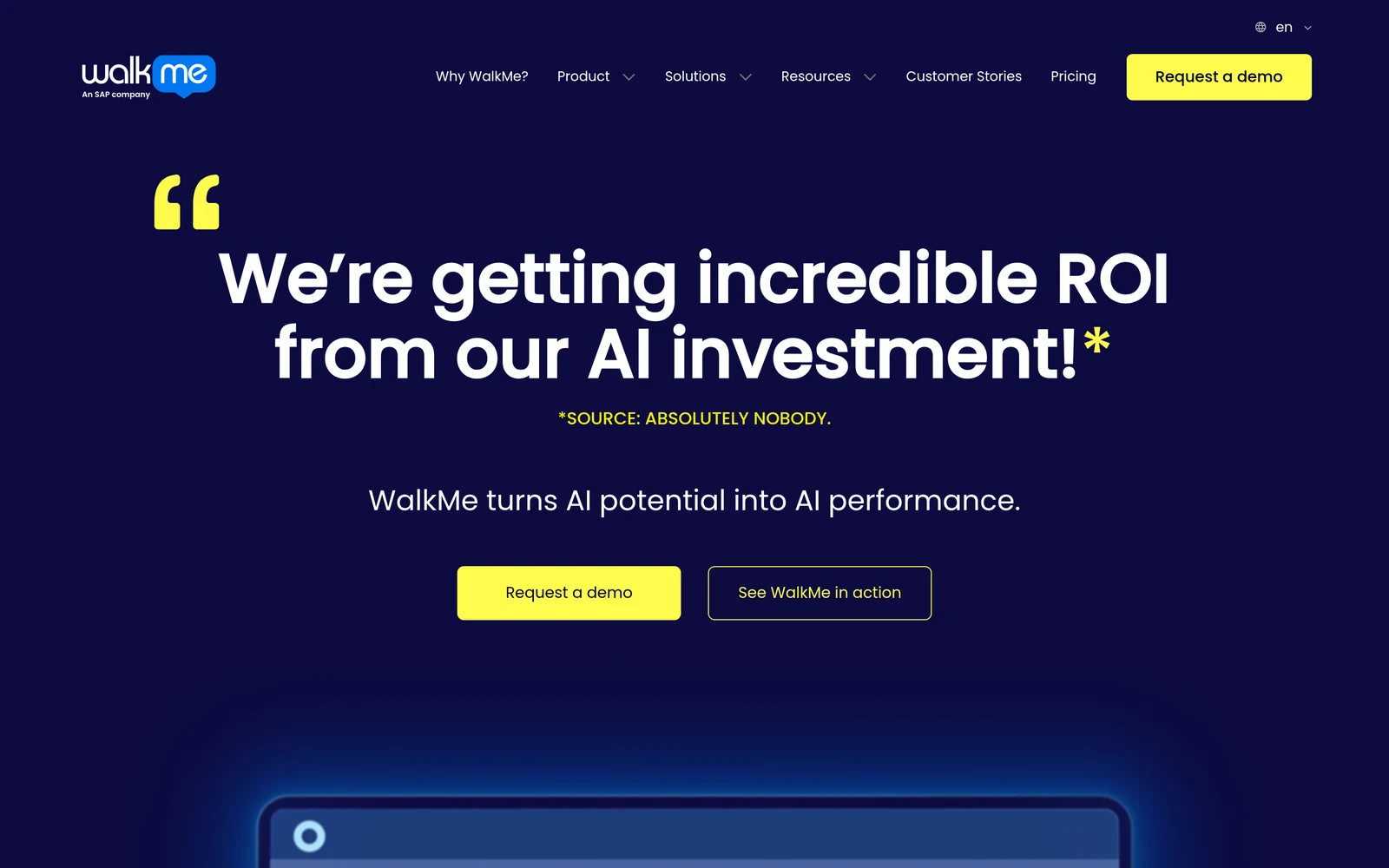
WalkMe has been in the category since 2011 and calls itself the pioneer of digital adoption platforms. Its homepage logo now reads “An SAP company”: SAP completed its acquisition of WalkMe in 2024, which matters if your estate runs on SAP and you want the DAP vendor and the ERP vendor on the same paper. WalkMe reports about 1,600 customers, 900+ employees and users in more than 42 countries, and it earned FedRAMP Ready status in 2023 (WalkMe about page).
The homepage message has moved hard toward AI. WalkMe now pitches itself as the layer that gives enterprise AI screen context across apps: an Action Bar that appears on desktop, web and mobile, AI that “follows the work” between applications, and measurement of whether the AI licences you bought are being used. Underneath, the platform is the same mature DAP: Smart Walk-Thrus, tooltips, launchers, surveys, segmentation, workflow automation, white-labeling and localization.
Its analytics lean toward the CIO’s questions rather than the product manager’s. WalkMe’s product menu lists application usage, workflow analytics, form analytics and license optimization, so you can see which apps employees actually use, where they abandon a process and which seats you are paying for without value (WalkMe pricing).
Where it fits: organisations with thousands of employees on several enterprise apps, especially Salesforce, Workday, Microsoft Dynamics 365, ServiceNow and SAP SuccessFactors, which all have packaged WalkMe solutions. Public sector buyers who need FedRAMP progress also tend to land here.
Where it falls short: it is the heaviest of the three to run. Content has to be built and maintained per application, and mature deployments usually have a dedicated digital adoption team or a partner. Pricing is fully opaque until you are in a sales cycle. For a small SaaS team guiding users through its own product, it is the wrong weight class.
Whatfix: employee adoption with training built in
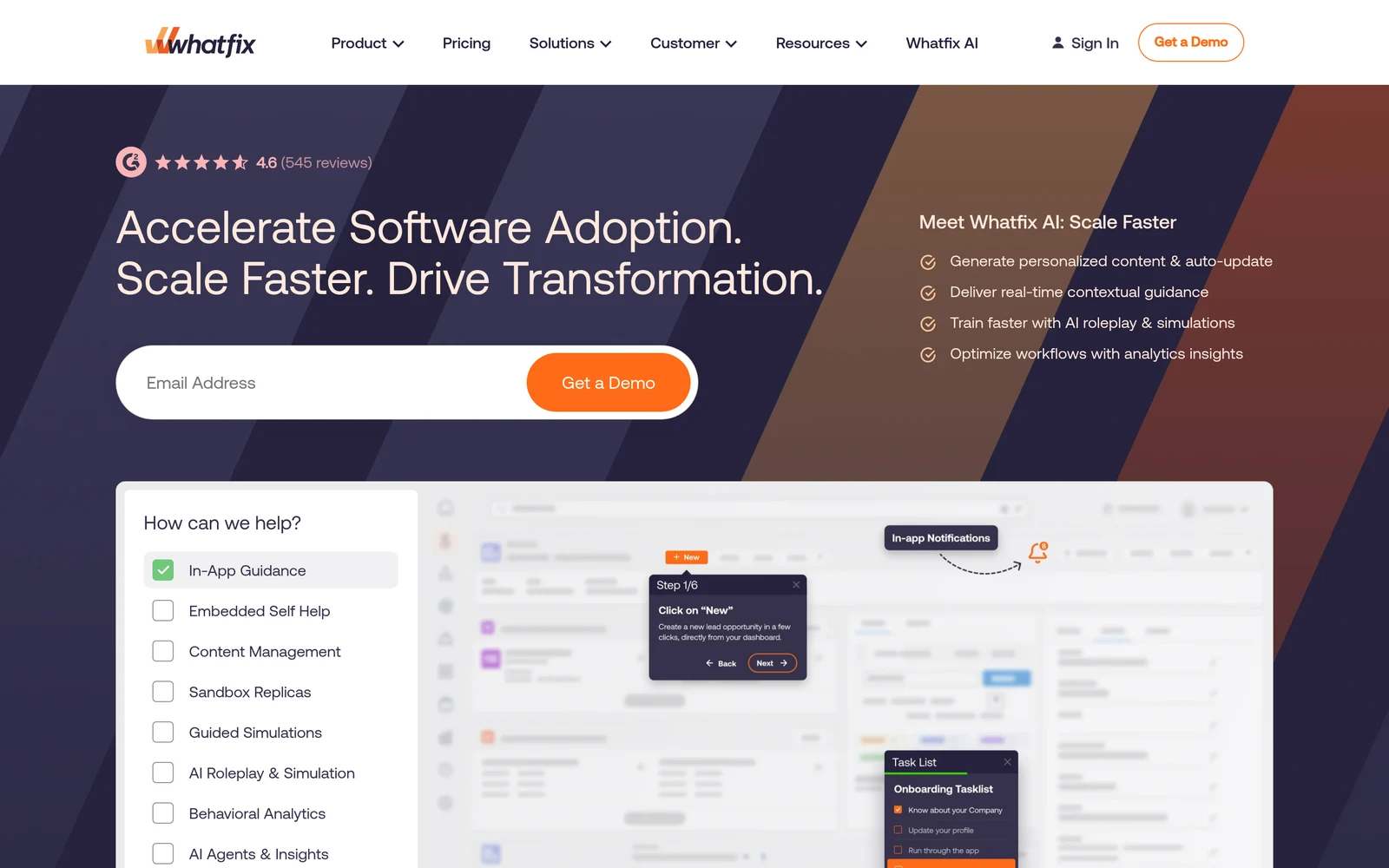
Whatfix sells three products: the Digital Adoption Platform, Product Analytics and Mirror. It reports 700+ customers in 30+ countries, a 99.5% CSAT score and 24×7 support, and says it crossed 50 Fortune 500 customers in 2021. Its navigation organises use cases by app category: ATS, CLM, CRM, ERP, HCM and S2P procurement (Whatfix about page).
The in-app layer covers the usual patterns: Flows (step-by-step walkthroughs), Smart Tips, Beacons, Pop-Ups, Task Lists, Launchers and a Self Help widget that pulls articles from your existing knowledge base. Content can be exported as videos, slide decks, PDFs and documents, which training teams like because one authoring effort feeds the LMS as well.
Mirror is the clearest difference from WalkMe. It creates replicas of an application so employees can practise a process in a safe sandbox before they touch live data, and adds AI roleplay for scenarios such as sales or service conversations. Whatfix’s own comparison page leans on this: it calls itself the only DAP that pairs simulation training with in-workflow guidance (Whatfix vs WalkMe). Treat that as the vendor’s claim, but the capability is real and well suited to regulated onboarding.
Where it fits: HR, L&D and IT teams rolling out CRM, ERP or HCM systems who want guidance, training content and simulations from one vendor, including on Citrix or Azure Virtual Desktop and on Windows and Mac desktop apps.
Where it falls short: the useful enterprise controls sit on Premium (see the plan table below), so the Standard plan is narrower than it looks. Native session replay is not part of the plan tables we read, and like WalkMe, content needs ongoing upkeep as the underlying apps change.
Pendo: product analytics with guidance included
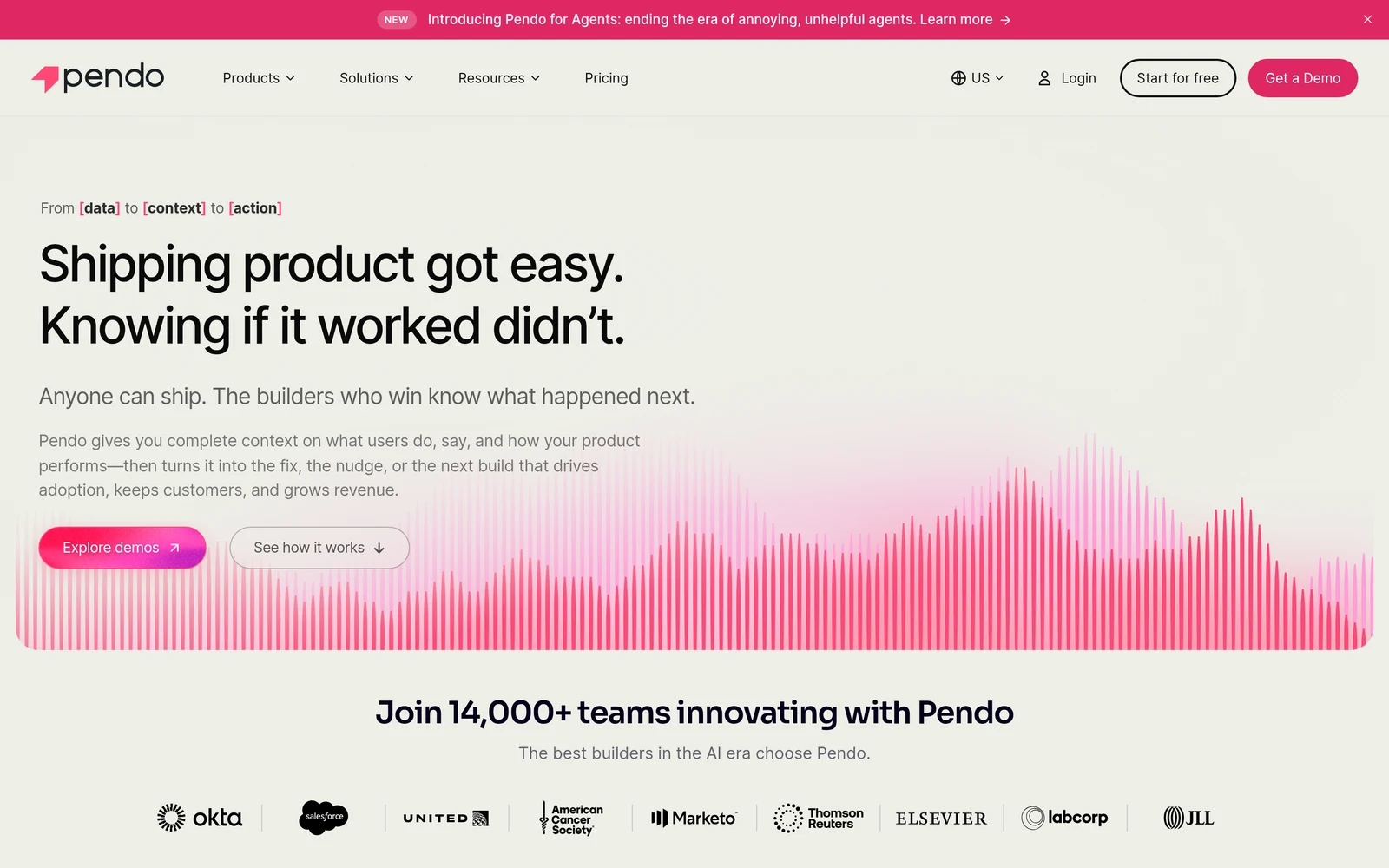
Pendo starts from data. Its homepage reports 14,000+ teams, 40 trillion events and over a billion users, and its pitch is “complete context”: what users do, what they say and how the product performs, turned into the fix, the nudge or the next build (Pendo). In-app guides are part of every plan, but the reason most teams sign is the analytics.
Two details stand out. Retroactive analytics means Pendo captures usage from the day the snippet goes in, so you can answer questions about features you never tagged. And pricing is based on monthly active users, not the number of apps or sessions, so you can run Pendo across several products without per-app fees. Pendo lists SOC 2, GDPR and HIPAA compliance and 85+ integrations.
The newer AI layer is aimed at product teams shipping with AI: Leo for natural-language questions, a Pendo MCP server, Agent Analytics to measure AI agent adoption, and Predict for churn and upsell models. Pendo is also running Novus, a free AI-native beta that instruments your product from a GitHub repo.
Where it fits: SaaS product, growth and customer success teams that need funnels, retention and feature usage data, and want to act on it with guides, NPS and roadmaps in the same tool. It also works for internal apps your company builds. If you want to compare Pendo with analytics-only tools, see our product analytics tools roundup.
Where it falls short: guiding employees through third-party software is not Pendo’s core strength. It has no equivalent of Whatfix Mirror or WalkMe’s packaged Workday and Salesforce solutions, and session replay, sentiment and journey orchestration are add-ons below the Ultimate bundle.
Pricing compared: plans, units and what buyers actually pay
None of the three posts a dollar figure for a paid plan, so the honest comparison is packaging plus real contract data. Here is what each pricing page shows.
WalkMe pricing
WalkMe’s pricing page has two tracks, WalkMe for employees and WalkMe for customers, and one action: request a quote. The employee plan lists content authoring, in-app guides and tooltips, onboarding and tours, AI-powered surveys, advanced analytics, segmentation, enterprise data privacy and security, templates, workflow automation, real-time collaboration, white-labeling, localization and Contextual AI Assistance (WalkMe pricing).
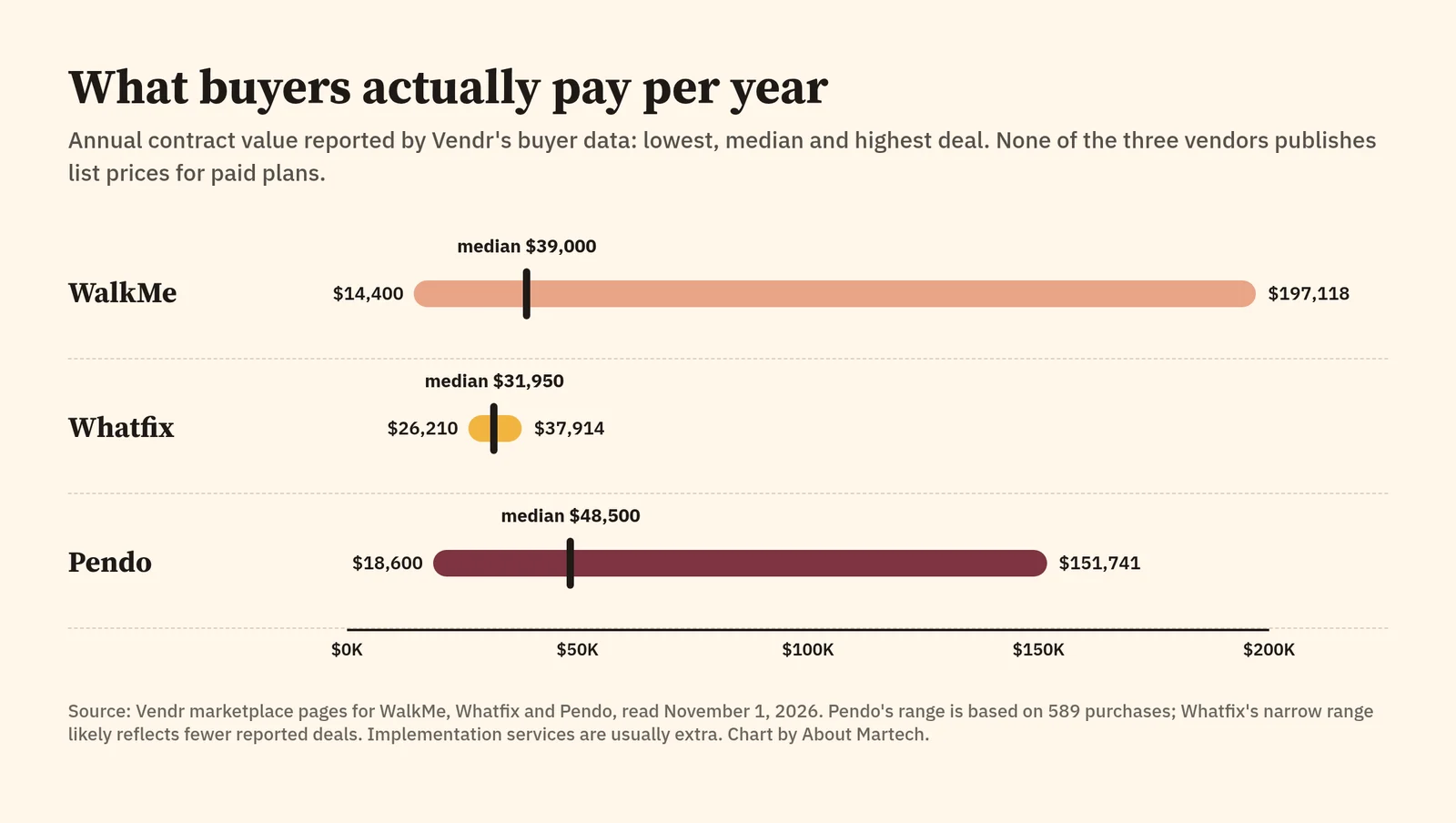
Vendr reports a median of $39,000 a year, with deals from $14,400 to $197,118. Its WalkMe guide also gives a worked example: a company with about 500 users might be quoted $15 to $35 per user per month (Vendr). At those rates 500 users works out to $90,000 to $210,000 a year, well above the median, which tells you most of Vendr’s median deals cover smaller user counts or a single app. Price your own scope, not the median.
Whatfix pricing
Whatfix shows the most structure. The Digital Adoption Platform for web and desktop apps comes in Standard, Premium and Enterprise, all through a demo. Product Analytics has a Standard plan included free, and there are separate plans for mobile apps and for Windows and Mac operating systems. Every subscription is a flat platform fee plus user licences: for employee-facing apps a licence is every user with access, and for customer-facing apps it is monthly active users. A free trial is available (Whatfix pricing).
| Whatfix DAP feature | Standard | Premium |
|---|---|---|
| In-app guidance, Smart Context, content lifecycle, guidance analytics | Yes | Yes |
| Knowledge base content aggregation | 2,000 articles | Unlimited (cap 50,000) |
| Surveys | Out-of-the-box NPS and usability | Custom surveys and quizzes |
| Translation | Manual | Auto translation |
| Integrations | Limited to 2 | Yes |
| Custom roles, engagement dashboard, auto testing | No | Yes |
| IP whitelisting | No | Yes |
| Offline mode and virtual desktop (Citrix, Azure) | No | Yes |
| SSO, audit logs, data residency | Yes | Yes |
| 24/5 support, named CSM, author training | Yes | Yes |
| Deployment | Cloud and self-hosted | Cloud and self-hosted |
Enterprise is positioned for multi-app or unlimited deployments. Vendr’s median Whatfix contract is $31,950 a year, with a range of $26,210 to $37,914; the narrow range suggests a small sample, so expect large multi-app deals to sit well above it (Vendr).
Pendo pricing
Pendo is the only one with a free plan. Pendo Free covers up to 500 monthly active users with product analytics, in-app guides, Pendo-branded NPS and roadmaps, and unlimited web and mobile app keys. Paid plans are quoted by MAU volume (Pendo pricing):
| Pendo plan | What is included | Add-ons |
|---|---|---|
| Free | Analytics and guides for up to 500 MAUs; Pendo-branded NPS | Session replay |
| Base | Product analytics and in-app guides, custom MAU volume | Session replay, discovery, sentiment, orchestration |
| Core | Base plus session replay | Discovery, sentiment, orchestration |
| Ultimate | Core plus sentiment (NPS, PMF, CSAT), Orchestrate, Listen and Data Sync | Pendo AI products such as Predict |
Pendo says the per-MAU price falls as volume rises and that exceeding your MAU limit on a paid plan does not switch anything off; your rep will discuss a contract change. A 30-day trial of the full platform is available through sales. Vendr’s median Pendo buyer pays $48,500 a year, based on 589 purchases, with a range of $18,600 to $151,741 (Vendr). To compare what Pendo costs with PostHog, Mixpanel, Amplitude and Heap, see our product analytics pricing guide.
Whichever you shortlist, ask each vendor to quote the same scope: number of employees or MAUs, the apps you need covered, contract length, and implementation and content services as separate lines. That is the only way to compare three quote-only products fairly.
Which is best for Salesforce, Workday and SAP rollouts?
This is the most common enterprise question, and the answer is mostly WalkMe or Whatfix.
| Rollout | WalkMe | Whatfix | Pendo |
|---|---|---|---|
| Salesforce | Packaged solution page | CRM app category | Possible as an internal app, not a focus |
| Workday | Packaged solution page | HCM app category | Not a focus |
| SAP and SuccessFactors | SAP-owned; SuccessFactors solution page | ERP and HCM app categories | Not a focus |
| ServiceNow and Dynamics 365 | Packaged solution pages | Supported via app categories | Not a focus |
| Desktop and VDI apps | Desktop, web, mobile | Windows and Mac, Citrix, Azure Virtual Desktop (Premium) | Web and mobile |
| Hands-on practice before go-live | Learning Arc training product | Mirror replicas and AI roleplay | No |
Pick WalkMe if the rollout spans several of these platforms, your estate is SAP-heavy, or license optimization across the app portfolio is part of the business case. Pick Whatfix if training is the bottleneck and you want simulations plus guidance, or you need Citrix and desktop coverage. Use Pendo here only if the “enterprise app” is one your company builds.
Implementation and upkeep
The license is rarely the biggest cost of a DAP. The work is building guidance for each process and keeping it working every time the underlying app ships a UI change.
- WalkMe deployments in large enterprises commonly run for weeks to months and often use a certified partner. Plan for a digital adoption owner on your side.
- Whatfix includes a named customer success manager and author training on every plan, and its Premium Auto Testing checks that Flows still work after app changes, with emailed reports. That feature alone can save a lot of broken-walkthrough tickets.
- Pendo is the fastest to start: install the snippet, data begins flowing and historical analysis works retroactively. Guides still need an owner, but there is no third-party interface to chase.
If your adoption programme sits inside a broader customer onboarding motion, our guide to customer onboarding software covers the project and portal tools that handle the human side of onboarding.
How to choose
- Choose WalkMe if you are a large enterprise guiding employees across many third-party apps, you want cross-app usage and license data for the CIO, and you are comfortable with an enterprise contract and a dedicated adoption team.
- Choose Whatfix if you are rolling out CRM, ERP or HCM software and training is as important as guidance, you need desktop or VDI coverage, or you want clearer plan packaging and a free analytics tier to start.
- Choose Pendo if you build the software, product analytics is the main reason you are buying, and you want guides, NPS and roadmaps on the same data. Start on Pendo Free if you have under 500 MAUs.
- Consider something lighter if you are a SaaS team under a few thousand MAUs that only needs tours and checklists. Our list of Appcues alternatives covers tools with published pricing.
Frequently asked questions about WalkMe vs Whatfix vs Pendo
What is the difference between WalkMe and Whatfix?
Both are enterprise digital adoption platforms for guiding employees through third-party software such as Salesforce, Workday and SAP. WalkMe, now an SAP company, is broader across apps and adds application usage, workflow analytics and license optimization. Whatfix has clearer plan packaging, a free Standard tier of Product Analytics and Mirror app replicas for hands-on training and AI roleplay.
Is Pendo a digital adoption platform?
Pendo is a product analytics platform with in-app guides included on every plan, and it does market itself for digital adoption. It is strongest inside software you build. For guiding employees through third-party enterprise apps, WalkMe and Whatfix are more specialised.
How much does WalkMe cost?
WalkMe does not publish prices; every plan is quoted. Vendr reports a median of $39,000 a year, with deals from $14,400 to $197,118, and gives an example of $15 to $35 per user per month for about 500 users. Implementation and content services are usually extra.
How much does Whatfix cost?
Whatfix’s Standard, Premium and Enterprise plans are quoted after a demo. Vendr reports a median contract of $31,950 a year, with a range of $26,210 to $37,914. The Standard plan of Whatfix Product Analytics is included free.
Does Pendo have a free plan?
Yes. Pendo Free covers up to 500 monthly active users with product analytics, in-app guides and Pendo-branded NPS surveys and roadmaps. Paid plans, Base, Core and Ultimate, are quoted by MAU volume. Vendr’s median Pendo buyer pays $48,500 a year.
Which DAP is best for Salesforce?
WalkMe has a packaged Salesforce solution and is the common pick for multi-app enterprise rollouts. Whatfix covers Salesforce under its CRM app category and adds simulation training through Mirror. Pendo is not built mainly for guiding employees through Salesforce.
Which DAP is best for Workday?
WalkMe and Whatfix both support Workday rollouts. WalkMe has a dedicated Workday solution page; Whatfix supports it under its HCM app category. Choose Whatfix if hands-on practice before go-live matters, and WalkMe if Workday is one of many apps you need to cover.
Is WalkMe owned by SAP?
Yes. SAP completed its acquisition of WalkMe in 2024, and WalkMe’s logo now reads “An SAP company”. WalkMe still sells across non-SAP apps such as Salesforce, Workday, ServiceNow and Microsoft Dynamics 365.
The verdict
WalkMe wins on breadth for employee software: the most packaged enterprise app solutions, portfolio-wide usage and license analytics, and now SAP behind it. Whatfix wins on packaging and training: published plan tables, a free analytics tier and Mirror simulations that no other option here matches. Pendo wins whenever the software is your own, because the analytics are the product and the guides come with them, starting free.
Get quotes for the same scope from the two that fit your lane, ask each for the implementation plan in writing, and run a pilot on one real process before you sign a multi-year deal. For more options across both lanes, see our full list of digital adoption platforms.