- Ad platform ROAS numbers are inflated by design. Meta, Google, and TikTok each claim credit for the same sale, so dedicated ecommerce attribution tools exist to show you what actually happened.
- Triple Whale, Northbeam, and Rockerbox are the most-referenced names among Shopify-native DTC brands. Each takes a different approach to solving the same double-counting problem.
- The right tool depends on your ad spend mix, reliance on influencer and affiliate channels, and whether you need raw data access or a polished dashboard your media buyer can act on today.
- Post-iOS 14 signal loss means probabilistic and modeled attribution is now table stakes, not a premium. Any tool still relying solely on click-based tracking is working with a fraction of true conversion data.
- Most DTC teams overbuy attribution. If you spend under $50K/month on ads, a $200/month tool outperforms a $2,000/month one for your use case.
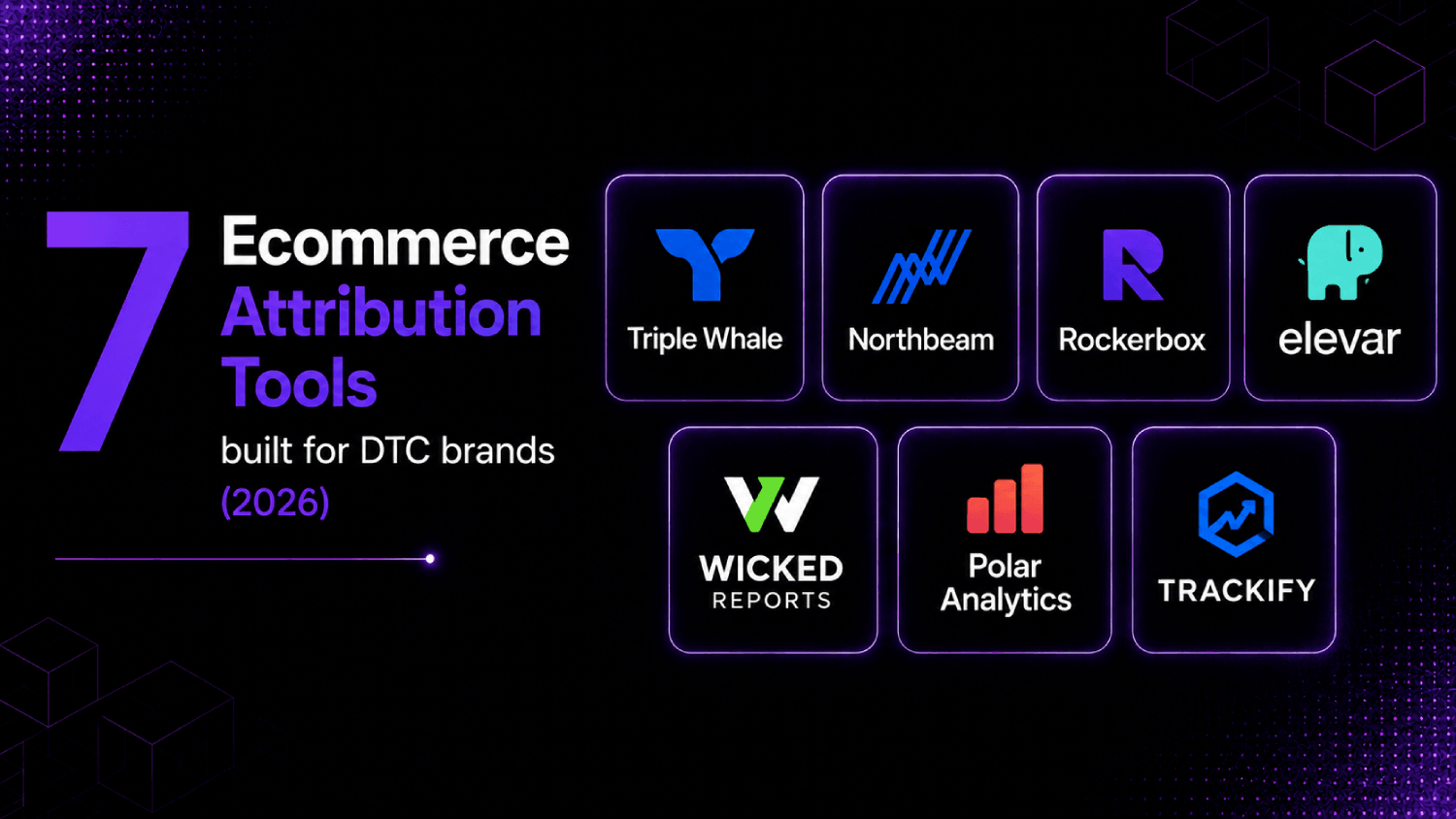
The best ecommerce attribution tools for DTC brands are Triple Whale, Northbeam, Rockerbox, Elevar, Wicked Reports, Polar Analytics, and Trackify. These platforms address the core problem that Meta Ads Manager, Google Ads, and TikTok Ads Manager each claim full credit for conversions that only happened once, inflating reported ROAS across every channel simultaneously. DTC-specific attribution software reconciles those platform numbers against actual Shopify order data to show net revenue by channel, not reported revenue by platform.
Why Platform-Reported ROAS Is Unreliable for DTC Brands
Every ad platform runs its own attribution window, its own conversion counting logic, and its own definition of “credit.” Run a campaign across Meta, Google, and TikTok simultaneously and ask each platform how many sales it drove. Add those numbers up. They will almost always exceed your actual order count in Shopify, often by a wide margin. This is not a bug in the platforms. It is a structural incentive.
Post-iOS 14, the problem compounded. Apple’s App Tracking Transparency framework reduced the signal available to pixel-based tracking, so Meta in particular shifted to modeled conversions, which statistically estimates conversions it can no longer observe directly. That modeling favors Meta’s own channels. A DTC brand running $100K/month in ads can easily look at platform dashboards and see $400K in attributed revenue while Shopify shows $180K in actual orders.
Dedicated ecommerce attribution tools solve this by anchoring to a source of truth, the Shopify order, and working backward to assign credit. They pull actual transaction data, match it to ad exposure data via first-party pixels, server-side events, or probabilistic modeling, and produce a single blended view. The result is a number you can make decisions from. This same reconciliation challenge is explored in our comparison of multi-touch vs last-touch attribution models, which applies to both B2B and DTC contexts.
The AboutMartech DTC Attribution Fit Test
Before evaluating any specific tool, run four checks against your stack. This is the AboutMartech DTC Attribution Fit Test , a consistent framework for cutting through vendor marketing claims.
- Source-of-truth anchoring: Does the tool pull directly from Shopify order data (or your order management system) as the revenue baseline, not from platform-reported conversions?
- Signal method: Does it use server-side tracking, a first-party pixel, or probabilistic modeling to recover post-iOS 14 signal loss? Click-only tools undercount by design.
- Channel breadth: Does it natively support every channel you actually spend on, including Meta, Google, TikTok, Pinterest, Snap, email, SMS, and affiliate or influencer spend?
- Decision latency: How quickly does it surface usable data? A tool that refreshes daily is fine for weekly budget reviews. A tool that refreshes hourly matters if you do same-day bidding adjustments.
Any tool that fails the first check is not an attribution tool for DTC. It is a dashboard for ad platform data, which you already have for free.
Which Ecommerce Attribution Tools Are Worth Considering?
| Tool | Best For | Attribution Method | Shopify Native | Starting Price (public) |
|---|---|---|---|---|
| Triple Whale | Growth-stage DTC, $20K+ ad spend | First-party pixel + probabilistic | Yes | From $129/month (public pricing page) |
| Northbeam | Multi-channel brands, $100K+ spend | Multi-touch, ML-modeled | Yes | Quote-based; vendor does not publicly disclose pricing |
| Rockerbox | Omnichannel DTC, TV/streaming buyers | Multi-touch + MMM | Yes | Quote-based; vendor does not publicly disclose pricing |
| Elevar | Shopify tracking infrastructure | Server-side tagging | Yes (Shopify-only) | From $0 (limited) / $200/month (full) |
| Wicked Reports | Email-heavy, subscription DTC | Multi-touch, LTV-weighted | Yes | From $250/month (public pricing page) |
| Polar Analytics | Lean teams wanting a unified BI view | Data connector + dashboards | Yes | From $300/month (public pricing page) |
| Trackify | Meta-first DTC on tight budgets | First-party pixel (Meta) | Yes | From $29/month (public pricing page) |
Triple Whale: Best All-in-One Shopify Attribution Dashboard

Triple Whale became the default attribution tool for growth-stage DTC brands partly through aggressive community marketing and partly because it actually solves the right problem. Its “Pixel” product installs a first-party pixel on your Shopify storefront that fires independently of Meta’s or Google’s pixel, capturing purchase events and hashing customer email addresses for probabilistic matching. The result is a ROAS figure anchored to actual Shopify orders, not platform-reported ones.
The platform’s “Summary” dashboard gives media buyers a single-screen view of blended ROAS, new customer acquisition cost, and return on ad spend by channel. The “Moby” AI layer, added more recently, attempts to surface budget recommendations based on historical performance. According to Triple Whale’s public pricing page, plans start at $129/month for Shopify stores under $1M in annual revenue, scaling by store revenue tier rather than by ad spend.
The main limitation is that Triple Whale’s probabilistic matching works best when email capture rates are high, typically above 30% of orders. Brands with low email capture or heavy cash-on-delivery volumes in international markets will see weaker match rates and less reliable attribution.
Northbeam: Best for High-Spend Multi-Channel DTC Attribution
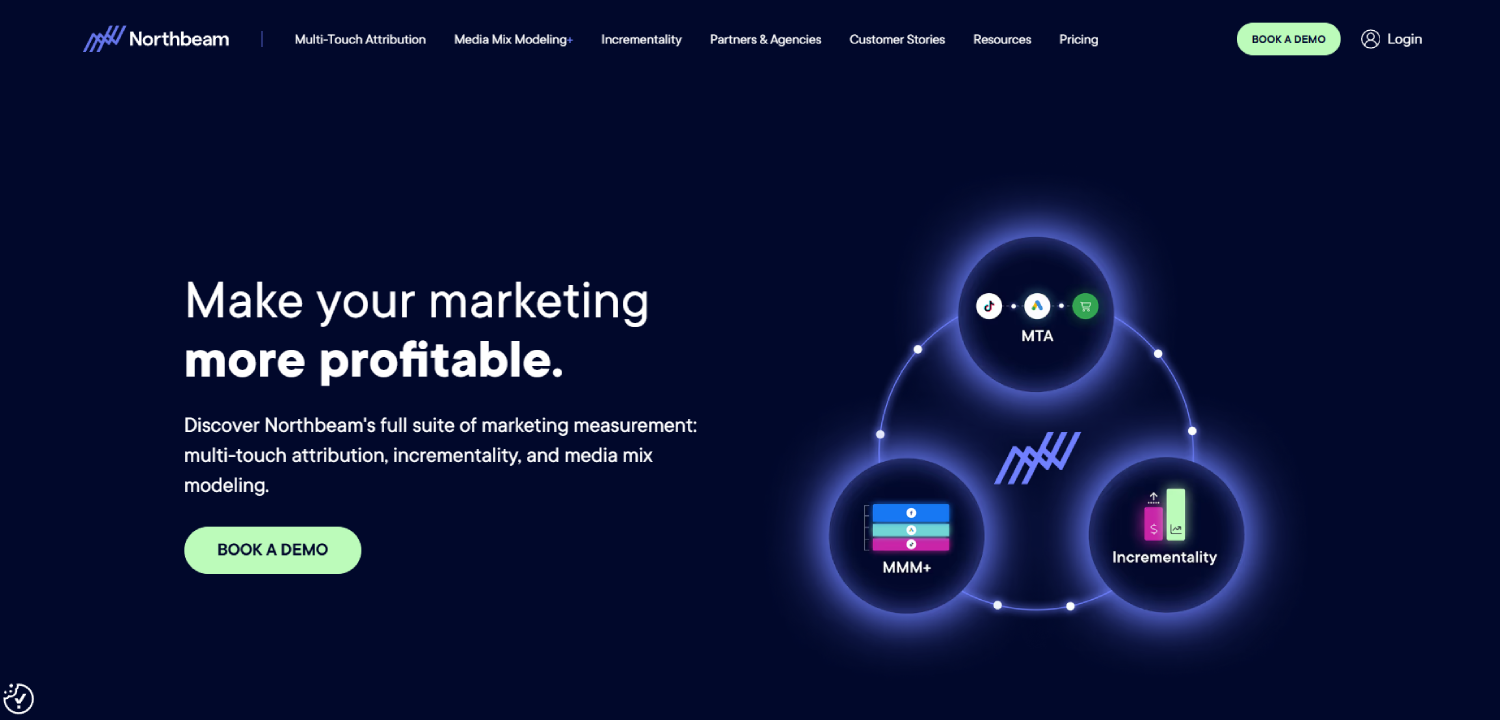
Northbeam targets brands spending $100K or more per month on paid channels. Its architecture is notably different from Triple Whale’s. Rather than relying primarily on a pixel, Northbeam ingests raw ad spend data from every connected platform and uses machine learning to model attribution across the full customer path, including view-through events, not just clicks.
Northbeam’s “custom attribution model builder” lets performance marketers assign fractional credit to touchpoints based on their own assumptions about customer path value, then compare those models against each other. This is genuinely useful for brands that run long consideration cycles, think skincare or high-ticket apparel, where last-click radically undervalues top-of-funnel spend.
Northbeam does not publicly disclose pricing and requires a sales conversation, which practically means it targets brands with enough ad spend to justify a four-figure monthly contract. Teams under $50K/month in spend will find the cost difficult to justify against alternatives.
Rockerbox: Best for DTC Brands Buying Offline or Streaming Channels
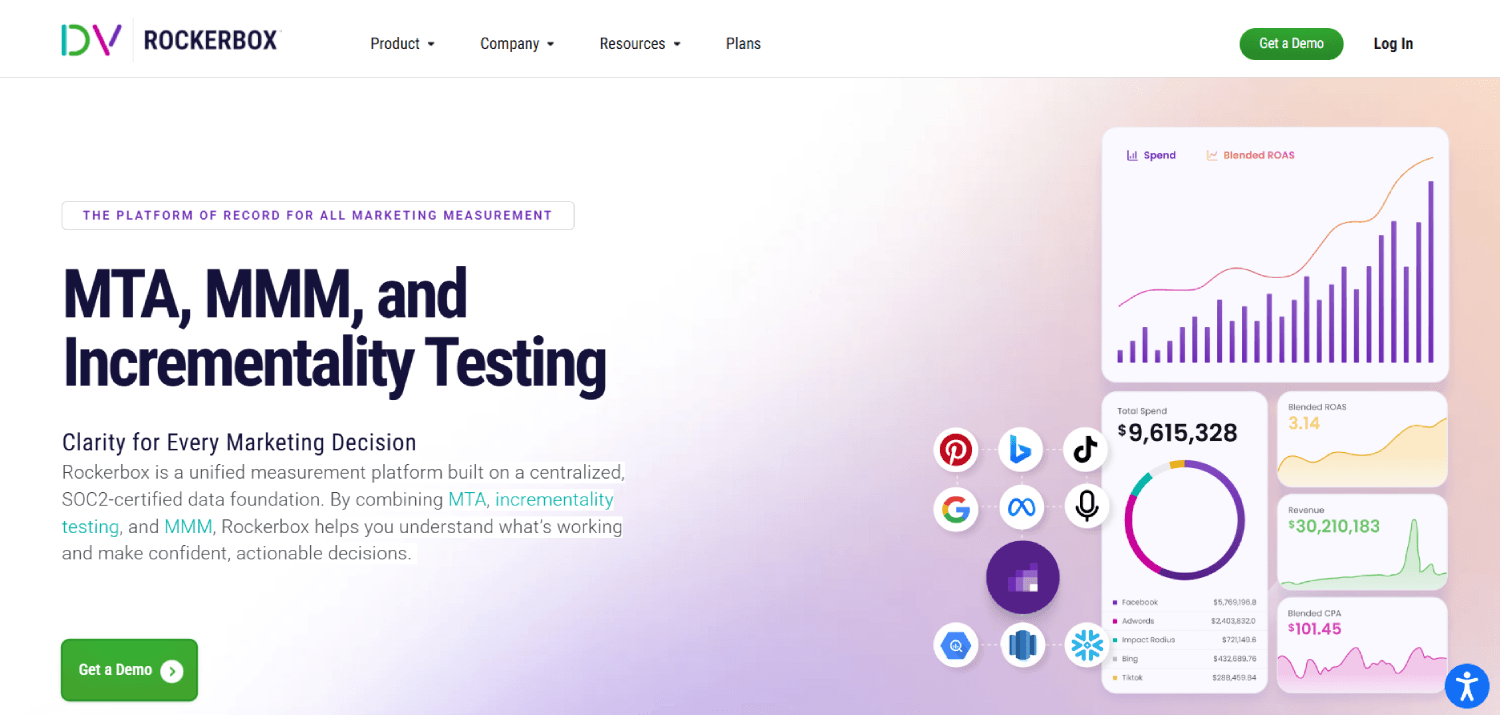
Rockerbox occupies a distinct position: it is the only tool in this list with native support for TV, streaming, direct mail, and podcast spend alongside digital channels. Brands that have expanded beyond Meta and Google, into connected TV, linear TV, or influencer spend that does not produce a trackable click, need a different architecture than pixel-based tools provide.
Rockerbox combines multi-touch attribution for digital channels with marketing mix modeling (MMM) for offline and upper-funnel spend. The two outputs sit in the same interface, which means a DTC CMO can see paid social performance alongside a streaming TV effectiveness estimate without switching tools. Our overview of marketing mix modeling tools covers the broader category if you are evaluating MMM as a standalone investment.
Rockerbox does not publicly disclose pricing. Based on how the vendor positions itself, it sits above the SMB tier and is built for brands that have already outgrown dashboard-only tools and need to answer harder questions about incremental reach.
Elevar: Best for Fixing Shopify Tracking Before You Do Anything Else

Elevar (also audiense) is not an attribution platform in the traditional sense. It is server-side tracking infrastructure for Shopify, and many brands should buy it before or instead of a dedicated attribution tool. Elevar installs a server-side tag management layer that fires conversion events directly from Shopify’s servers to Meta’s Conversions API, Google’s Enhanced Conversions, and other platform endpoints, bypassing browser-level signal loss entirely.
The practical effect is meaningful. Brands using Elevar typically recover a significant portion of purchase events that browser-based pixels miss due to ad blockers, browser privacy settings, and iOS restrictions. Better event data flowing into Meta’s algorithm improves campaign optimization even before you layer any attribution modeling on top.
Elevar’s free plan covers basic tracking. The paid tier, starting at around $200/month according to their public pricing page, includes full server-side event firing, data layer management, and integrations with Meta CAPI, Google Enhanced Conversions, TikTok Events API, and Pinterest. It is Shopify-exclusive, which is a real constraint for brands on BigCommerce or headless architectures.
Wicked Reports: Best for Email-Heavy or Subscription DTC Brands
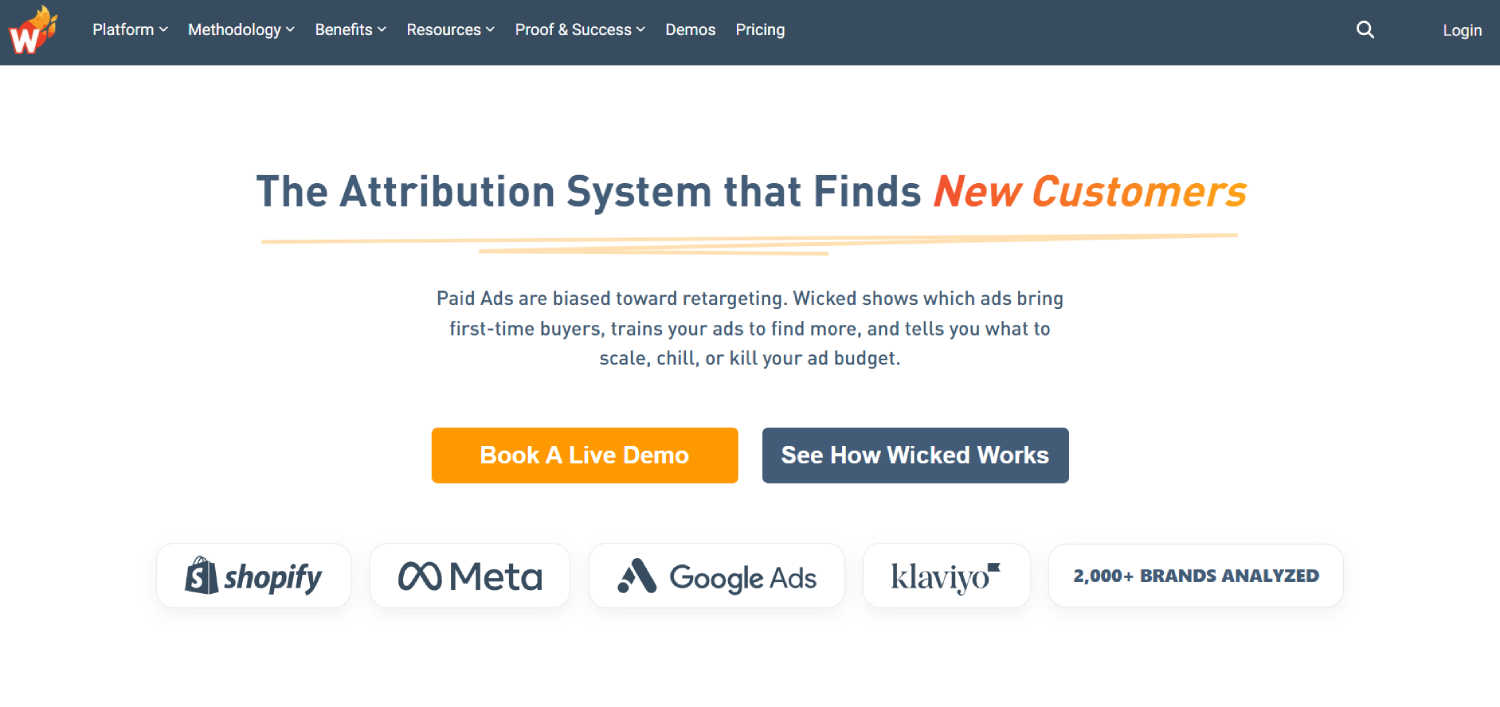
Wicked Reports solves a specific problem that Triple Whale does not handle particularly well: attributing revenue across long customer paths where email is a major reactivation channel and where lifetime value matters more than first-order ROAS. It pulls email click data from Klaviyo, Mailchimp, and other ESPs and weaves those touchpoints into the attribution model alongside paid media events.
For subscription DTC brands, this is consequential. A customer who sees a Meta ad, ignores it, then converts through a Klaviyo winback email three weeks later should generate different attribution signals than a customer who clicks through immediately. Wicked Reports handles that multi-step path. According to their public pricing page, plans start at $250/month.
The trade-off is interface maturity. Wicked Reports’ dashboards are functional but less visually polished than Triple Whale or Polar Analytics. Brands that prioritize data depth over presentation, typically those with an in-house analyst running the numbers, will find it more useful than brands that need a dashboard their media buyer can read at a glance.
Polar Analytics: Best for DTC Teams That Want a Data Warehouse Lite Experience
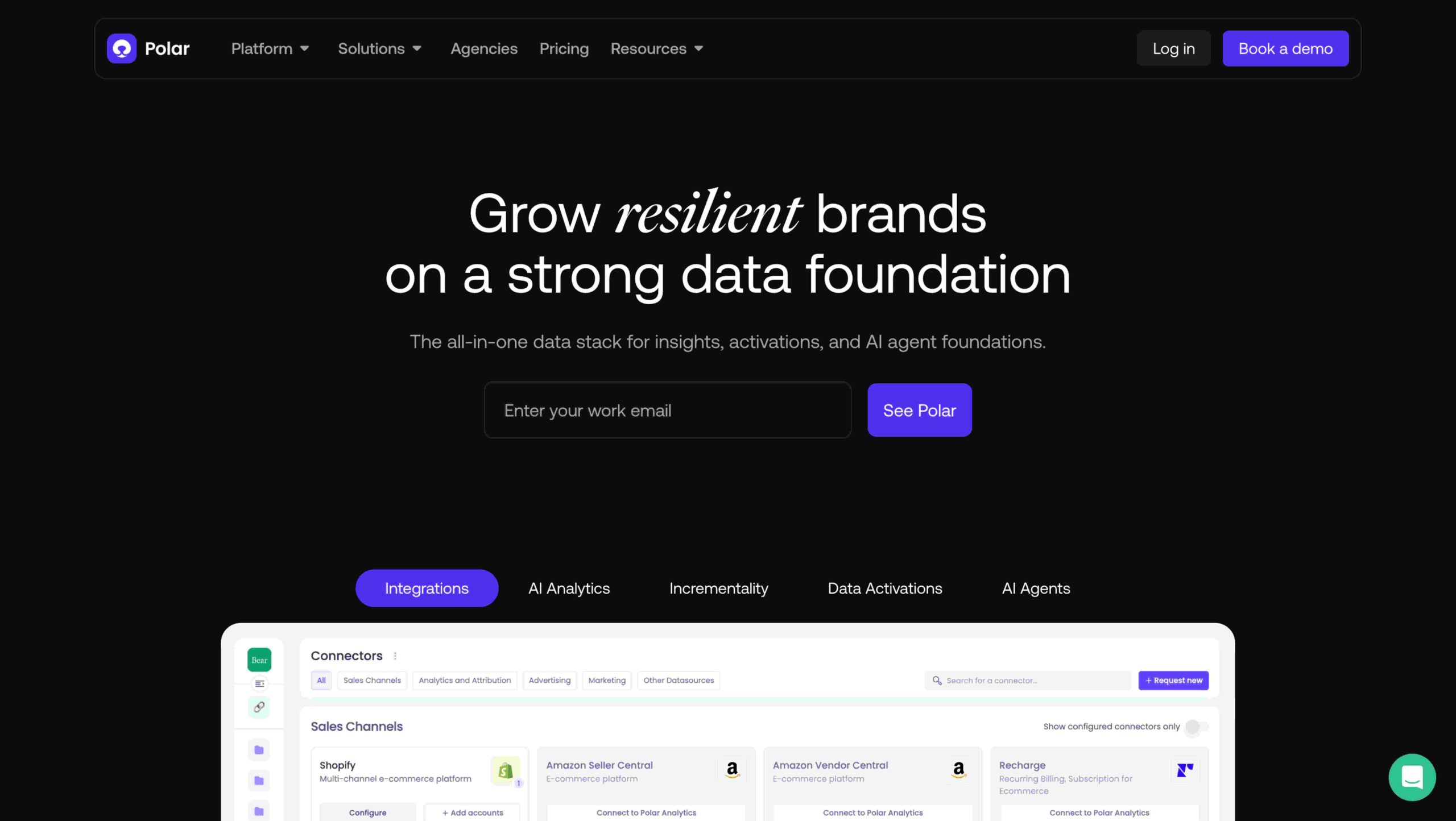
Polar Analytics operates differently from the other tools here. It is primarily a data connector and business intelligence layer that pulls from Shopify, Meta, Google, Klaviyo, and other sources into a centralized data model, then surfaces that in pre-built and custom dashboards. It does not offer its own pixel or first-party tracking. It works with the data your existing platforms produce.
That makes Polar Analytics genuinely useful for lean marketing teams that want consolidated reporting without hiring a data engineer. The tool handles the pipeline work that would otherwise require a warehouse-native setup. Brands that want true warehouse-native control should read our comparison of warehouse-native CDPs before deciding between Polar and building their own stack.
According to Polar Analytics’ public pricing page, plans start at $300/month. The ceiling on what Polar can do is lower than Northbeam or Rockerbox, but so is the implementation complexity. A two-person marketing team can be up and running in a day, not a month.
Trackify: Best for Meta-First DTC Brands on Limited Budgets
Trackify is the narrowest tool on this list. It focuses on improving Meta’s pixel data quality for Shopify brands, specifically by recovering signal lost to iOS 14 restrictions and browser privacy controls. It is not a multi-channel attribution solution.
For brands that run 80% or more of their paid media on Meta and want to recover match quality without a complex server-side setup, Trackify gets the job done at a price that is accessible to earlier-stage brands. Public pricing starts at $29/month. Brands at this stage that also need solid SMS marketing infrastructure alongside attribution should review our breakdown of the best SMS marketing apps for Shopify to build the surrounding channel stack.
Trackify is a starting point, not a destination. Brands scaling past $30K/month in Meta spend will find its reporting layer too thin and should migrate to Triple Whale or Northbeam at that point.
How Do These Tools Handle the Post-iOS 14 Attribution Problem?
Every tool in this list approaches iOS 14 signal loss differently, and the method matters more than the marketing copy around it.
- Server-side event firing (Elevar, Northbeam): sends conversion events directly from the server to platform endpoints, bypassing the browser entirely. Most accurate for purchase events.
- First-party pixel with probabilistic matching (Triple Whale): captures hashed email addresses and uses statistical matching to connect ad exposures to orders. Works well at scale, degrades with low email capture rates.
- Machine learning modeling (Northbeam, Rockerbox): builds statistical models of conversion probability across observed touchpoints. Less deterministic but more complete for view-through and upper-funnel attribution.
- Data connector aggregation (Polar Analytics): surfaces what platforms report without correcting for over-attribution. Honest about this limitation, and useful for consolidated reporting rather than true attribution.
Understanding first-party data infrastructure more broadly matters here. The mechanics of how these tools capture and match user data sit within the larger problem of building durable measurement post-cookie deprecation, covered in depth in our guide to building a first-party data stack.
What Should DTC Brands Expect to Pay for Attribution Software?
Pricing models vary more than the marketing suggests. Triple Whale scales by store revenue, which advantages high-volume, lower-margin brands. Northbeam and Rockerbox scale by ad spend or contract size, which advantages lower-volume, higher-margin brands. Wicked Reports charges a flat monthly rate that does not scale by revenue or spend, making it predictable for subscription businesses with stable MRR.
Consider a concrete scenario. A DTC brand doing $3M/year in Shopify revenue, spending $40K/month across Meta, Google, and TikTok, with Klaviyo as their email platform and no offline spend would be a strong fit for Triple Whale at the mid-tier plan, or Wicked Reports if email reactivation is a meaningful revenue driver. Northbeam and Rockerbox would be priced above what this brand needs. Elevar as a complement to either, not a replacement, makes sense regardless of which attribution tool they choose.
Frequently Asked Questions About Ecommerce Attribution Tools
What is an ecommerce attribution tool and how does it differ from ad platform reporting?
An ecommerce attribution tool reconciles actual order data from your store (typically Shopify) against ad exposure and click data from every channel you run, then assigns revenue credit across those channels using a defined model. Ad platform reporting, by contrast, counts any conversion that occurred within its own attribution window, regardless of whether another platform also claimed it. The practical effect is that adding up platform-reported revenue almost always exceeds your actual order revenue. Attribution tools close that gap.
Do I need a separate attribution tool if I already use Shopify Analytics?
Shopify Analytics shows last-click attribution by default, meaning it gives full credit to the final touchpoint before purchase. That model systematically undervalues awareness channels like Meta video, TikTok, and streaming ads, and overvalues branded search and email. If you run any paid media beyond branded search, last-click attribution will systematically misallocate your budget. A dedicated attribution tool applies multi-touch or modeled credit to surface what actually contributed to a sale, not just what the customer clicked last.
How does iOS 14 affect DTC attribution and can these tools fix it?
iOS 14’s App Tracking Transparency framework restricted Meta’s ability to track conversions across apps and websites for users who opted out of tracking. Brands saw reported purchase events drop significantly in Meta Ads Manager, and Meta’s algorithm had less signal to optimize against. Tools like Elevar address this by sending server-side conversion events directly to Meta’s Conversions API, bypassing the browser entirely. Triple Whale uses probabilistic matching to recover additional signal. Neither fully restores pre-iOS 14 measurement, but both materially improve on a browser-pixel-only approach.
What is the difference between multi-touch attribution and marketing mix modeling for DTC?
Multi-touch attribution (MTA) assigns fractional credit to individual touchpoints in a known customer path. It requires user-level data, so it works well for digital channels where you can track events. Marketing mix modeling (MMM) is a statistical approach that correlates aggregate spend with aggregate revenue over time, without needing user-level data. MMM is used for channels that are hard or impossible to track at the user level, such as TV, radio, and direct mail. Northbeam and Rockerbox offer both. Triple Whale and Wicked Reports are MTA-focused. For a deeper comparison of these approaches, our overview of marketing attribution software covers both the B2B and DTC applications.
Which ecommerce attribution tool works best for Shopify brands under $1M in revenue?
Triple Whale’s entry-tier plan is the most common starting point, given its Shopify-native integration and price floor around $129/month per their public pricing page. Trackify is a reasonable option if Meta is your only significant paid channel and you want improved pixel data quality without a full attribution platform. Elevar’s free or low-cost tier is worth installing regardless, since better server-side tracking improves the underlying data quality that any attribution tool depends on.
Can these tools track influencer and affiliate spend accurately?
Tracking influencer and affiliate spend varies by tool. Rockerbox has native affiliate and influencer tracking integrations. Triple Whale supports UTM-based tracking for influencer links and integrates with affiliate networks, though the depth of native integration is more limited than Rockerbox’s. Northbeam handles affiliate attribution well at the enterprise tier. The fundamental limitation for influencer spend without a trackable link (organic stories, verbal callouts) is that no pixel-based tool can measure it without a custom UTM or promo code structure in place.
How long does it take to implement a DTC attribution tool?
Elevar can be installed in a few hours if your Shopify theme is standard. Triple Whale typically takes one to two days to install the pixel, connect ad platforms, and calibrate the attribution window. Northbeam and Rockerbox involve onboarding calls and setup processes that typically run two to four weeks before the data is reliable enough to act on. Any tool running probabilistic attribution also needs a calibration period of two to four weeks of historical data before its models stabilize.
Which Ecommerce Attribution Tool Should You Actually Buy?
Triple Whale is the right default for Shopify brands between $1M and $10M in annual revenue who want a reliable, single-dashboard view of paid media performance without a complex implementation. It solves the problem most DTC brands actually have: too many platform dashboards, no single source of truth, and inflated ROAS numbers that make budget decisions unreliable.
Northbeam is the right answer when ad spend complexity demands it, specifically when you are running meaningful budgets across five or more paid channels and need to model view-through attribution with statistical rigor. Rockerbox earns its place when you have already expanded into TV, streaming, or direct mail and need one platform to model all of it together. Elevar belongs in almost every Shopify stack as infrastructure, not a replacement for the others.
Plenty of brands keep running on platform-reported ROAS until they cut a channel based on those numbers and see nothing change in actual orders. That moment tends to happen once. After it does, the real question is which attribution tool fits the complexity of your current channel mix, not the one you aspire to have. Our broader guide to marketing attribution tools covers how these decisions extend across both DTC and B2B stacks.