Census is no longer a company you can sign a contract with. Fivetran announced the acquisition on May 1, 2025, moved the product onto its own usage-based pricing as Fivetran Activations on February 1, 2026, and relaunched it inside the Fivetran interface on October 15, 2026 (Fivetran, Fivetran docs, Census migration FAQ). If you ran Census, your sync engine still works. What changed is the bill, the access model, the API and who sets the roadmap.
That is why “Census alternatives” is a live question again. We read Fivetran’s pricing, billing and migration docs plus the pricing page of every option below on November 2, 2026, and compared them on the things a Census customer actually has to decide: whether to stay, what each alternative costs to start, and how hard the move is. For the wider market, see our full list of reverse ETL tools.
TLDR
Short answer: If Fivetran already loads your warehouse, staying on Fivetran Activations is usually the cheapest path. If you want an independent activation tool, Hightouch is the closest like-for-like Census replacement. Polytomic, RudderStack, Twilio Segment, Airbyte and Weld fit narrower jobs and publish lower entry prices.
- What changed: Census now bills in monthly active rows (MAR), counted per activation, with 3,500 MAR a month free (Fivetran).
- Deadlines: month-to-month Census plans ended in March 2026. API V1 and workspaces retire on January 15, 2027.
- Closest replacement: Hightouch, free for 2 active syncs, usage-based above that (Hightouch pricing).
- Cheapest published entry points: Weld from $99 a month billed yearly, RudderStack Growth at $265 a month, Polytomic from $500 a month, plus free tiers at RudderStack, Segment and Airbyte Core.
- Biggest switching cost: your models stay in the warehouse, but sync definitions, mappings and segments have to be rebuilt in the new tool.
In this guide
What happened to Census after the Fivetran acquisition
Fivetran paid for Census with cash and equity and did not disclose the price. At the time Census had more than 50 employees and “hundreds of customers”, and co-founder Boris Jabes joined Fivetran to lead its data activation strategy (Fivetran press release). TechCrunch reported that Census had raised more than $80 million and was last valued at $630 million in 2022 (TechCrunch).
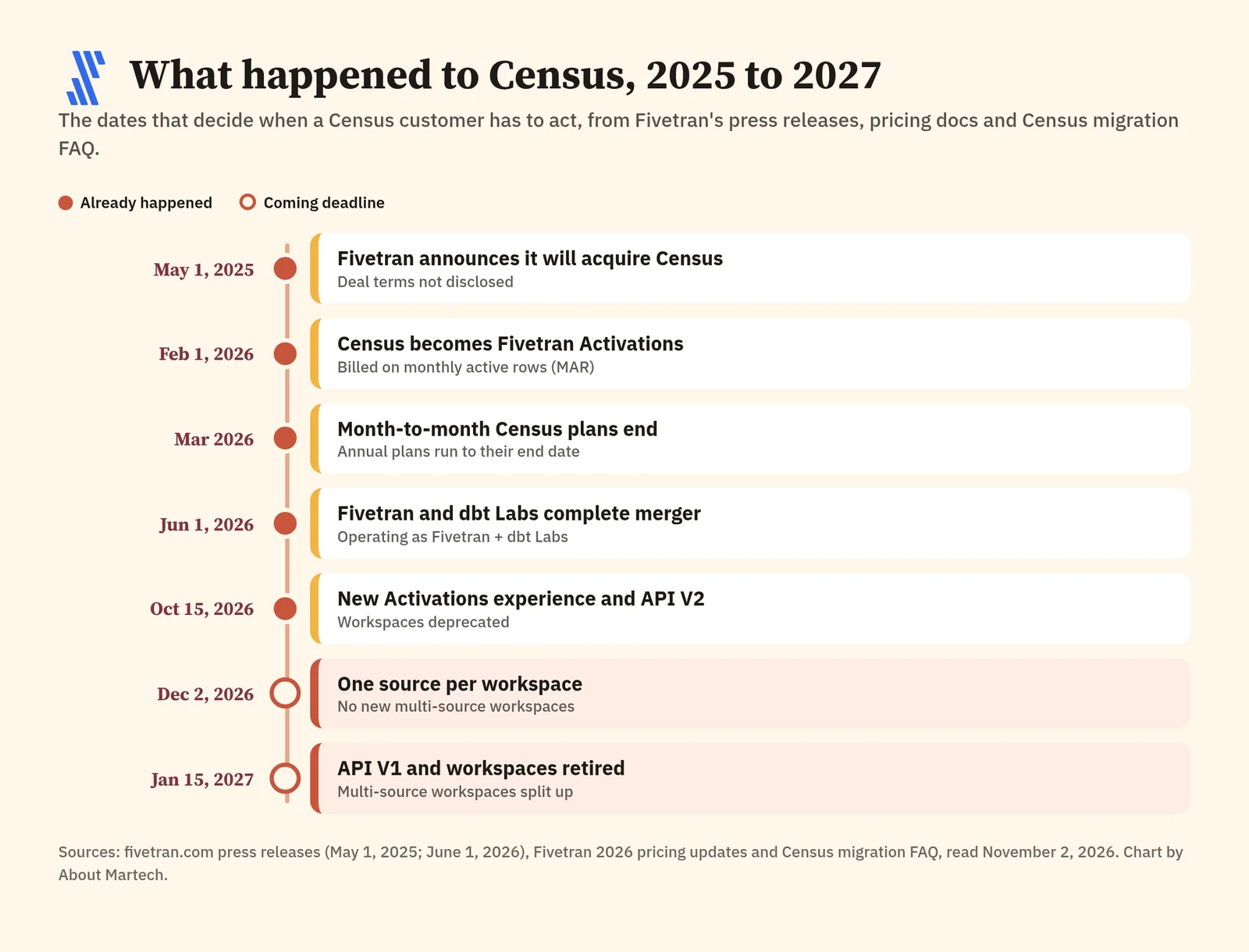
Since then the product has been folded into Fivetran step by step. These are the dates that matter for a Census customer:
| Date | What happened | Source |
|---|---|---|
| May 1, 2025 | Fivetran signs an agreement to acquire Census | Fivetran |
| February 1, 2026 | Census is sold as Fivetran Activations on Fivetran’s usage-based (MAR) pricing | Fivetran 2026 pricing updates |
| March 2026 | All month-to-month Census plans end; annual plans run to their end date | Census migration FAQ |
| June 1, 2026 | Fivetran and dbt Labs complete their all-stock merger, operating as Fivetran + dbt Labs | Fivetran |
| October 15, 2026 | New Activations interface, Fivetran access controls and Activations API V2; workspaces deprecated | Census migration FAQ |
| December 2, 2026 | Fivetran stops allowing more than one source per workspace | Census migration FAQ |
| January 15, 2027 | API V1 and workspaces are retired; multi-source workspaces are split up by source | Census migration FAQ |
What changed for Census customers
Four changes push teams to re-evaluate. None of them breaks a working sync on its own, but together they change the cost and the effort of running Census.
1. Pricing moved from a platform fee to monthly active rows
Fivetran says the move “eliminat[es] the previous flat platform fee”. You now pay for MAR: the unique primary keys added, updated or deleted and synced in a calendar month, each counted once no matter how often it changes (Fivetran blog). Two details matter for activation bills:
- MAR is counted per activation. An activation is the set of syncs from one source to one destination, so Snowflake to Salesforce and Snowflake to HubSpot are two activations. Fivetran counts keys separately by activation and by activation sync (usage-based pricing docs), and “each activation is priced on MAR and follows a separate cost curve”, with the spend rate falling as usage grows (Fivetran pricing).
- Small activations cost more per row. Fivetran’s own pricing example puts median usage for Snowflake to Salesforce at 12,007 MAR with a median list price of $202.25 a month, and Snowflake to HubSpot at 9,934 MAR for $197.96, estimated on the Standard plan for a company with 1 to 200 employees (Fivetran pricing). That works out to about $16.84 and $19.93 per 1,000 rows, or $400.21 a month for two modest activations.
The Free plan includes 3,500 activation MAR a month across the account, alongside 500,000 MAR for connections. Paid plans can be bought month to month in arrears, with a $5 minimum charge per connection that uses between 1 and 1 million MAR, or on an annual contract with a $12,000 minimum and discounts that Fivetran puts at up to 22% (Fivetran billing docs, pricing page).
2. Features are now tied to Fivetran plans
Census Free maps to Fivetran Free, Professional to Standard, and Enterprise or Enterprise Lite to Enterprise (Fivetran). Audience Hub, the self-service segment builder, is listed as an Enterprise feature, as are 1-minute syncs, custom roles and SCIM. Standard lists 15-minute syncs and 200+ managed activation destinations (Fivetran pricing).
3. Workspaces and API V1 are going away
Workspaces were deprecated on October 15, 2026 and retire on January 15, 2027, along with API V1. API V2 drops workspace API keys in favor of Activations personal access tokens, scopes everything to Fivetran group IDs and renames destination endpoints to activations, so any script that manages Census through the API needs rework (migration FAQ, API migration guide). Census also said it would start connecting from Fivetran’s IP addresses, so static IP allow lists need updating (Census changelog).
4. The roadmap belongs to a much bigger platform
Since June 1, 2026, Fivetran and dbt Labs operate as one company that says it serves more than 100,000 data teams (Fivetran). For teams already on Fivetran and dbt, that is a reason to stay. For teams that bought Census as a neutral layer next to a different ingestion tool, it is a reason to look around.
Should you stay on Fivetran Activations or switch?
Most teams should decide on how they load data today, not on features. Use these rules:
| Your situation | What we would do |
|---|---|
| Fivetran already loads your warehouse | Stay. One contract, one MAR budget and shared access controls usually beat adding a vendor. |
| Marketing owns activation and wants audiences without SQL | Trial Hightouch. Audience Hub is Enterprise-only on Fivetran. |
| You need ETL, reverse ETL and CDC in one self-hostable tool | Look at Polytomic. |
| You also need event collection from apps and websites | RudderStack or Twilio Segment, whichever you already run. |
| You run Airbyte for ingestion and sync to a few SaaS tools | Use Airbyte data activation and check each destination first. |
| Small team, predictable volume, tight budget | Weld’s flat tiers include reverse ETL. |
| Many small activations to many destinations | Model your bill. Per-activation MAR curves make small syncs expensive per row. |
Comparing Census and Hightouch head to head? Our Hightouch vs Census breakdown goes deeper on features. For how vendors price reverse ETL in general, see our reverse ETL pricing guide.
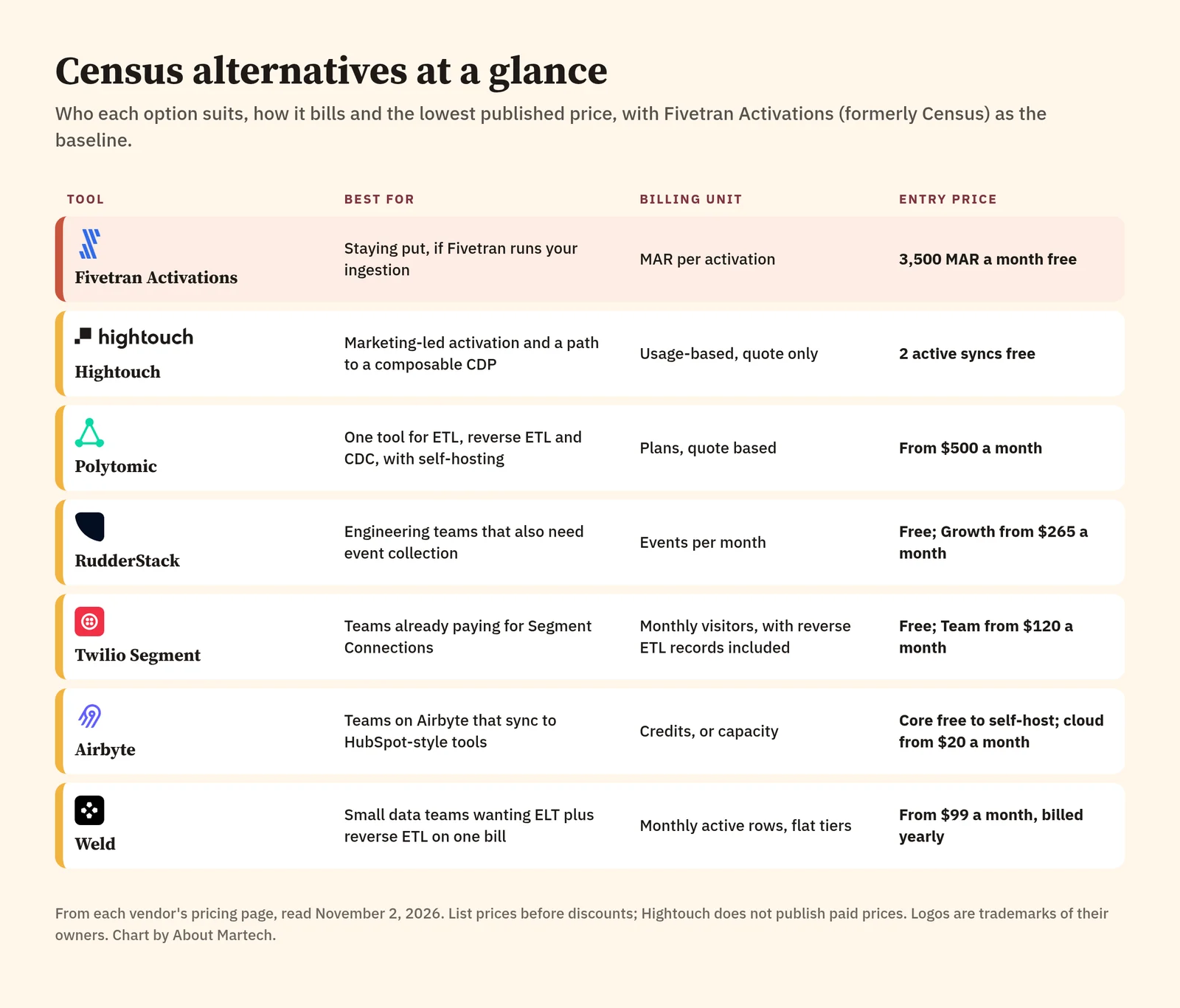
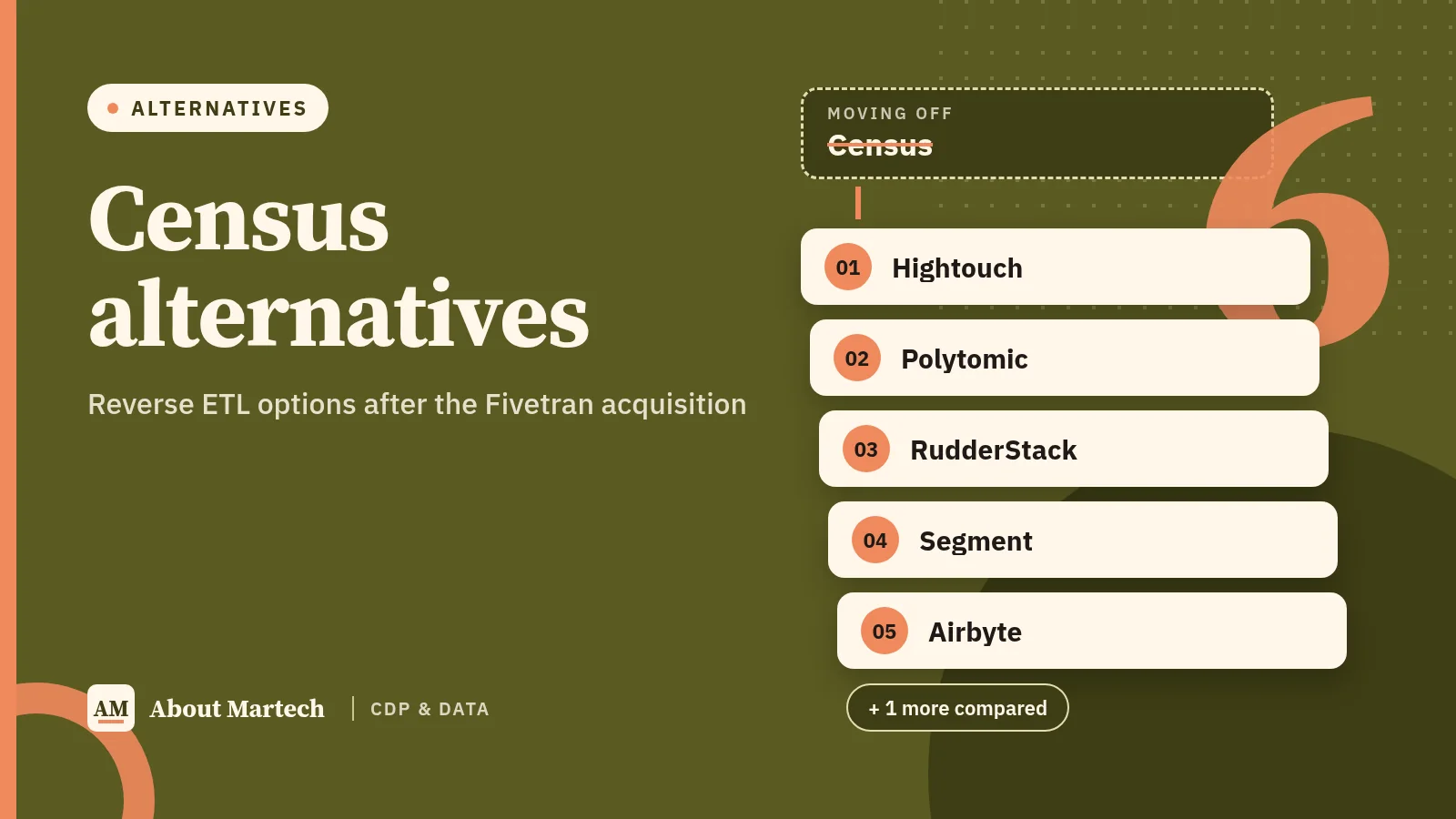
6 Census alternatives compared
| Tool | Best for | Pricing model | Lowest published price | Free option |
|---|---|---|---|---|
| Hightouch | Closest standalone Census replacement | Usage-based, quote only | Not published | 2 active syncs |
| Polytomic | ETL, reverse ETL and CDC in one tool | Standard and Enterprise plans, sales call | From $500 a month | None published |
| RudderStack | Event collection plus reverse ETL | Events per month | Growth $265 a month | 250,000 events a month, reverse ETL included |
| Twilio Segment | Existing Segment customers | Monthly visitors, reverse ETL records included | Team from $120 a month | 1,000 visitors and 500,000 reverse ETL records a month |
| Airbyte | Airbyte users syncing to a few SaaS tools | Credits (cloud) or capacity | Standard from $20 a month | Core is free to self-host |
| Weld | Small teams wanting one flat bill | Monthly active rows, tiered | $99 a month billed yearly | 14-day trial |
1. Hightouch: best for marketing-led teams that want a like-for-like Census replacement

| Best for | Marketing-led teams that want a like-for-like Census replacement |
| Entry price | Free for 2 active syncs; paid plans not published |
| Pricing model | Usage-based, by product |
Hightouch started, like Census, as a reverse ETL tool and is now sold in three layers: a free Basic Reverse ETL tier, a Composable CDP you assemble from products such as the Reverse ETL Platform, Customer Studio, Identity Resolution and Hightouch Events, and an Agentic Marketing Platform for AI-driven campaigns (Hightouch pricing). The free tier allows up to 2 active syncs with unlimited destinations and seats.
Paid pricing is usage-based with “no MTU (Monthly Tracked Users) limits, and no caps on sources, destinations, or user seats”, but you need a demo for a number (Hightouch). Its premium extensions include a dbt Cloud sync scheduler and a Fivetran sync scheduler, which matters if you plan to keep Fivetran for ingestion. Hightouch says it connects to 300+ tools and was named a Leader in Gartner’s Magic Quadrant for Customer Data Platforms, dated January 26, 2026 (Hightouch).
Where it beats Fivetran Activations: marketers get a no-code audience builder (Customer Studio) without an Enterprise plan requirement, and the company is still independent of any ingestion vendor.
Where it falls short: there is no public paid price, and features Census users took for granted can be separate products on the quote.
2. Polytomic: best for teams that want ETL, reverse ETL and CDC in one tool, with a self-hosted option
| Best for | Teams that want ETL, reverse ETL and CDC in one tool, with a self-hosted option |
| Entry price | From $500 a month |
| Pricing model | Standard and Enterprise plans, via a sales call |
Polytomic runs ETL, ELT, CDC streaming and reverse ETL in one product, and moves data between warehouses, databases, SaaS apps, spreadsheets and HTTP APIs (Polytomic). It offers a self-hosted deployment, Terraform-based configuration, fine-grained role-based permissions and audit logs, and says it is SOC 2, GDPR, CCPA and HIPAA compliant.
Pricing “begins at $500/month”. Standard adds multiple sync destinations and live chat support; Enterprise adds on-prem deployment, SSO, a dedicated engineer and phone support (Polytomic pricing). Polytomic does not list a free plan.
Where it beats Fivetran Activations: one vendor can replace both Fivetran connectors and Census syncs, and you can run it in your own cloud.
Where it falls short: there is no free tier, the destination catalog is smaller than Hightouch’s, and both plans need a sales call for a final price.
3. RudderStack: best for engineering teams that also need event collection
| Best for | Engineering teams that also need event collection |
| Entry price | Free; Growth $265 a month |
| Pricing model | Events per month |
RudderStack is a warehouse-native customer data platform that collects events from SDKs and cloud sources, streams them to 200+ destinations and includes reverse ETL on every plan (RudderStack). Reverse ETL can read from Redshift, S3, Databricks, BigQuery, MySQL, PostgreSQL, Snowflake and Trino, with SFTP and ClickHouse in beta (RudderStack docs).
The Free plan covers 250,000 events a month and includes reverse ETL. Growth starts at $265 a month for 1 million events with 25 reverse ETL connections and a 30-minute warehouse sync, and annual billing saves 15%. Enterprise is custom priced and adds 5-minute warehouse syncs, Profiles, HIPAA and SSO (RudderStack pricing).
Where it beats Fivetran Activations: you get event collection, transformations and reverse ETL on one bill, with a free plan that is useful in production rather than just a test.
Where it falls short: Growth caps reverse ETL at 25 connections, and pricing tracks events, not rows, so it suits teams that need the event pipeline too. See our RudderStack vs Hightouch comparison for how it stacks up against Hightouch.
4. Twilio Segment: best for teams that already pay for Segment Connections
| Best for | Teams that already pay for Segment Connections |
| Entry price | Free; Team from $120 a month |
| Pricing model | Monthly visitors |
Segment’s Reverse ETL runs a query you provide against your warehouse and syncs the results to destinations such as Braze, HubSpot, Salesforce Marketing Cloud or ad conversion APIs. It can also send warehouse data back into Segment as events for Twilio Engage (Segment docs).
Reverse ETL is included in Connections plans: 500,000 records a month on Free and 1,000,000 records a month on Team, which starts at $120 a month for 10,000 visitors a month. Business pricing is custom (Twilio Segment pricing).
Where it beats Fivetran Activations: if you already pay for Segment, warehouse activation is included up to a record limit, so there may be nothing new to buy.
Where it falls short: the main bill is driven by visitor volume, not by what you activate, so it rarely makes sense to adopt Segment just for reverse ETL. Our Segment alternatives roundup covers that trade-off.
5. Airbyte: best for Airbyte users who sync to a few SaaS tools
| Best for | Airbyte users who sync to a few SaaS tools |
| Entry price | Core free to self-host; cloud from $20 a month |
| Pricing model | Credits (Standard, Plus) or capacity (Pro, Enterprise Flex) |
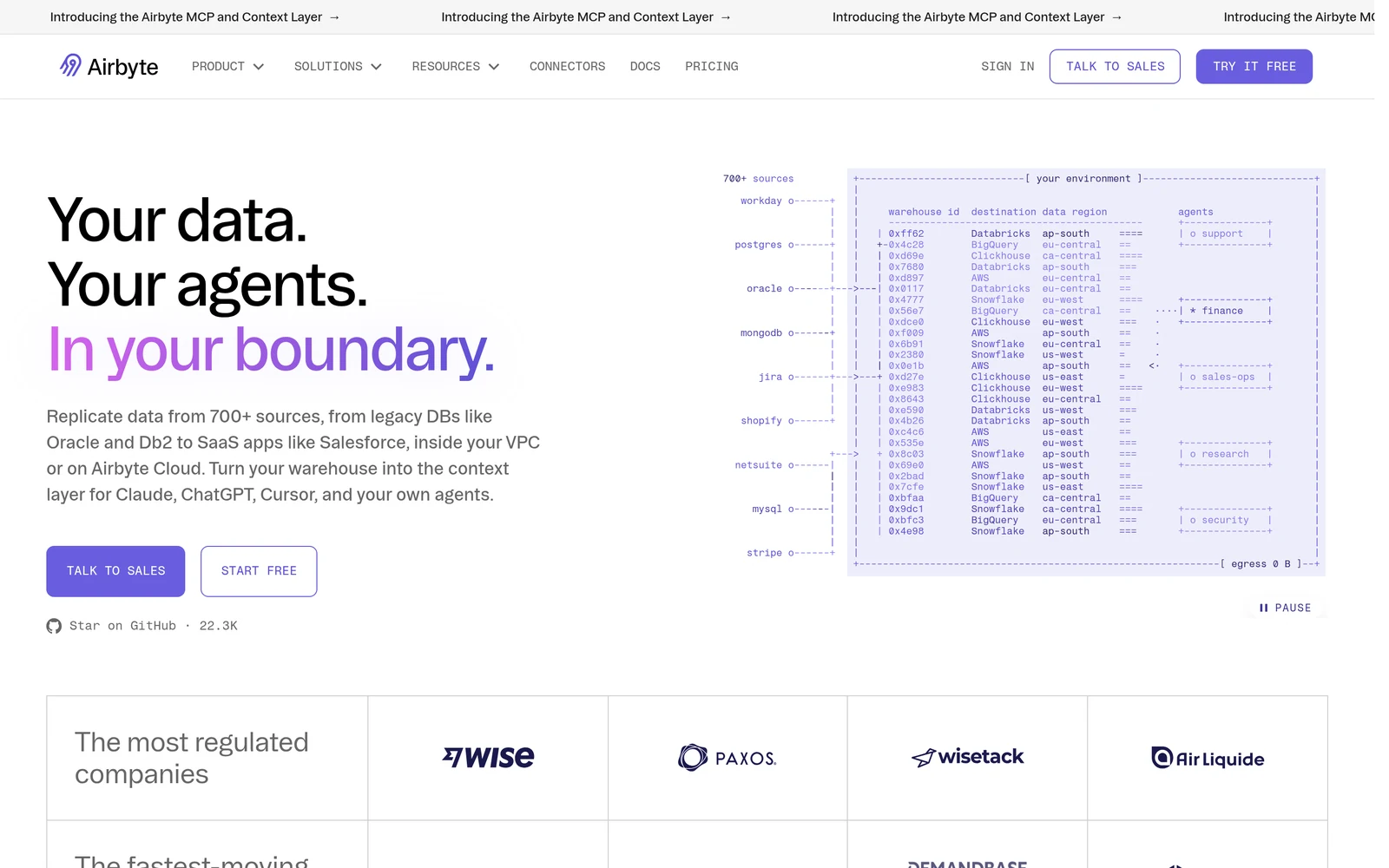
Airbyte calls reverse ETL “data activation” and runs it like any other sync, using declarative field mappings from a warehouse source to destinations such as HubSpot, Customer.io, Marketo and Zendesk (Airbyte docs). The HubSpot destination supports insert, upsert, update and soft delete, with contacts upserted on email (HubSpot destination docs). The Salesforce destination, however, is an Enterprise connector sold at additional cost (Salesforce destination docs).
Airbyte Core is free to self-host. Cloud Standard starts at $20 a month with 5 credits, about 1 GB of syncs, and Plus starts at $189 a month for 40 credits with SSO and 15-minute syncs. Pro and Enterprise Flex use capacity pricing (Airbyte pricing).
Where it beats Fivetran Activations: it is the lowest-cost way to keep ingestion and activation in one open-source tool, including fully self-hosted.
Where it falls short: the activation destination list is far shorter than Census’s 200+, and Salesforce, the most common reverse ETL target, costs extra.
6. Weld: best for small data teams that want ELT and reverse ETL on one flat bill
| Best for | Small data teams that want ELT and reverse ETL on one flat bill |
| Entry price | From $99 a month, billed yearly |
| Pricing model | Monthly active rows, tiered plans |
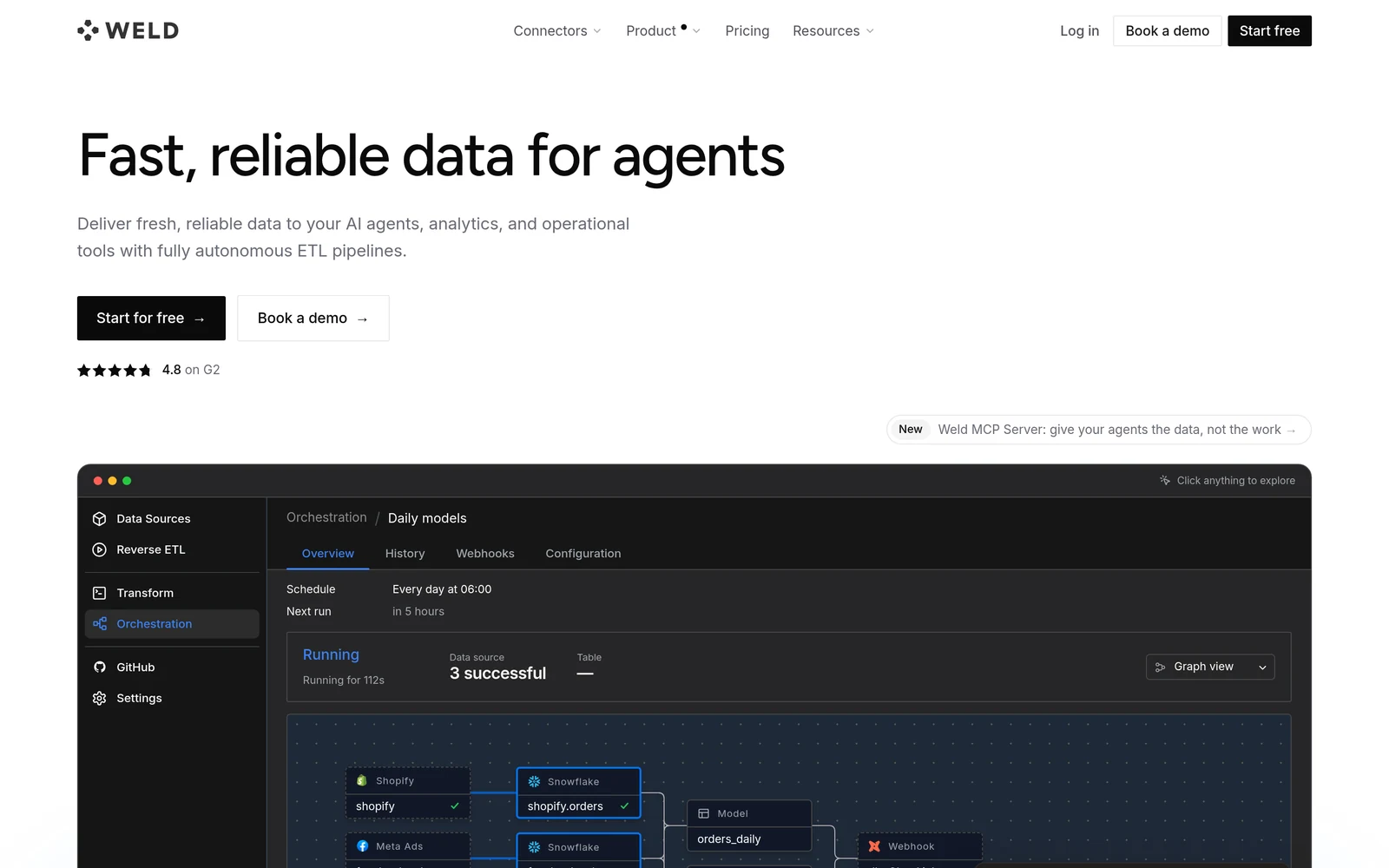
Weld combines ingestion, SQL transformation, orchestration and reverse ETL in one workspace, and reverse ETL is part of each plan (Weld, Weld pricing).
Basic is $99 a month billed yearly with 5 million MAR, 2 connectors, 1 user and daily syncs. Premium is $389 a month billed yearly with 10 million MAR, 6 connectors, hourly syncs and the dbt integration. Business is $959 a month billed yearly with 50 million MAR, 10 connectors and 15-minute syncs. Yearly billing saves 20%, and every plan has a 14-day trial (Weld pricing).
Where it beats Fivetran Activations: the price is published and flat, with millions of rows included, so a small team can budget without modelling per-activation curves.
Where it falls short: connector and user limits are tight on the lower tiers, and faster syncs cost extra or need a higher plan.
How to migrate off Census or Fivetran Activations
Your dbt models and warehouse tables stay where they are, so the move is mostly about rebuilding syncs. A safe order:
- Inventory every sync. List source model, destination object, sync key, sync mode (update or create, update only, create only, mirror) and schedule.
- Check your contract date. Annual Census plans run until their end date before moving to MAR billing, so plan the switch for that window.
- Confirm destination support. Check each destination object and write mode in the new tool before you commit, especially Salesforce and ad platforms.
- Rebuild and run in parallel. Point the new tool at the same models, sync to a sandbox or a test field first, then compare record counts.
- Fix API and network dependencies. Anything scripted against Census API V1 or workspace keys stops working on January 15, 2027, whichever way you go. Update IP allow lists for the new vendor.
- Cut over one destination at a time, then pause the old syncs so two tools never write to the same field.
If you are rethinking the whole stack rather than one tool, our guide to warehouse-native activation explains how the pieces fit, and our marketing ETL tools list covers the ingestion side.
How we chose these Census alternatives
We started from the tools that rank and get cited for “Census alternatives” and reverse ETL, and kept options that can sync modeled warehouse data into business apps today. We excluded data vendors that are not reverse ETL tools. Every price comes from the vendor’s own pricing page or docs, read on November 2, 2026; where a vendor does not publish a price we say so instead of estimating. We did not test each tool with production data, and none of these vendors paid to be included.
Frequently asked questions
Is Census still available?
Yes, but only as Fivetran Activations. Fivetran announced the acquisition on May 1, 2025, and getcensus.com now points to Fivetran. Existing annual Census plans run until their end date; month-to-month Census plans ended in March 2026.
What is the best Census alternative?
For most teams that want an independent tool, Hightouch is the closest replacement: it is warehouse-native, has a free tier with 2 active syncs and adds a no-code audience builder. If Fivetran already loads your warehouse, staying on Fivetran Activations is often simpler and cheaper.
How much does Fivetran Activations cost?
It is billed in monthly active rows, counted per activation. The Free plan includes 3,500 activation MAR a month. Fivetran’s pricing page shows a 12,007 MAR Snowflake to Salesforce activation at $202.25 a month on the Standard plan.
What happens to Census API V1?
Fivetran deprecated Activations API V1 on October 15, 2026 and will retire it, along with workspaces, on January 15, 2027. Scripts must move to API V2, which uses Activations personal access tokens and Fivetran group IDs.
Is there a free Census alternative?
Several. Hightouch is free for 2 active syncs, RudderStack Free includes reverse ETL and 250,000 events a month, Segment Free includes 500,000 reverse ETL records a month, and Airbyte Core is free to self-host.
Which Census alternative works best with dbt?
All six can sync from dbt models in your warehouse. Hightouch lists a dbt model selector and dbt Cloud sync scheduler as extensions, and Weld lists dbt integration from its Premium plan. Fivetran itself merged with dbt Labs on June 1, 2026.
Do I lose data if I switch from Census?
No. Census reads from your warehouse, so your models and tables stay where they are. What you rebuild in the new tool is the sync configuration: mappings, keys, schedules and segments.