- Intent data is only useful when you know whether it comes from first-party behavioral signals, third-party co-op panels, or review-site activity. The source determines the signal quality more than any vendor’s marketing claims.
- Bombora and TechTarget lead for third-party co-op data covering enterprise buying committees. 6sense and Demandbase lead for account-level AI scoring that combines multiple signal types into a single prioritization layer.
- G2 Buyer Intent is the highest-signal option for software categories because it captures review and comparison activity from buyers actively evaluating products, not browsing adjacent content.
- ZoomInfo is a strong option for teams already in the platform who want to add intent signals without a separate vendor contract, but as a standalone intent tool it is less granular than dedicated providers.
- First-party intent data, collected from your own site and product, is the most accurate signal you will ever have. Third-party data fills the gap when buyers research off your properties.
- Pricing ranges from free-tier access on some tools to six-figure platform contracts. Matching the right tier to your deal volume and sales motion matters more than picking the most feature-rich vendor.
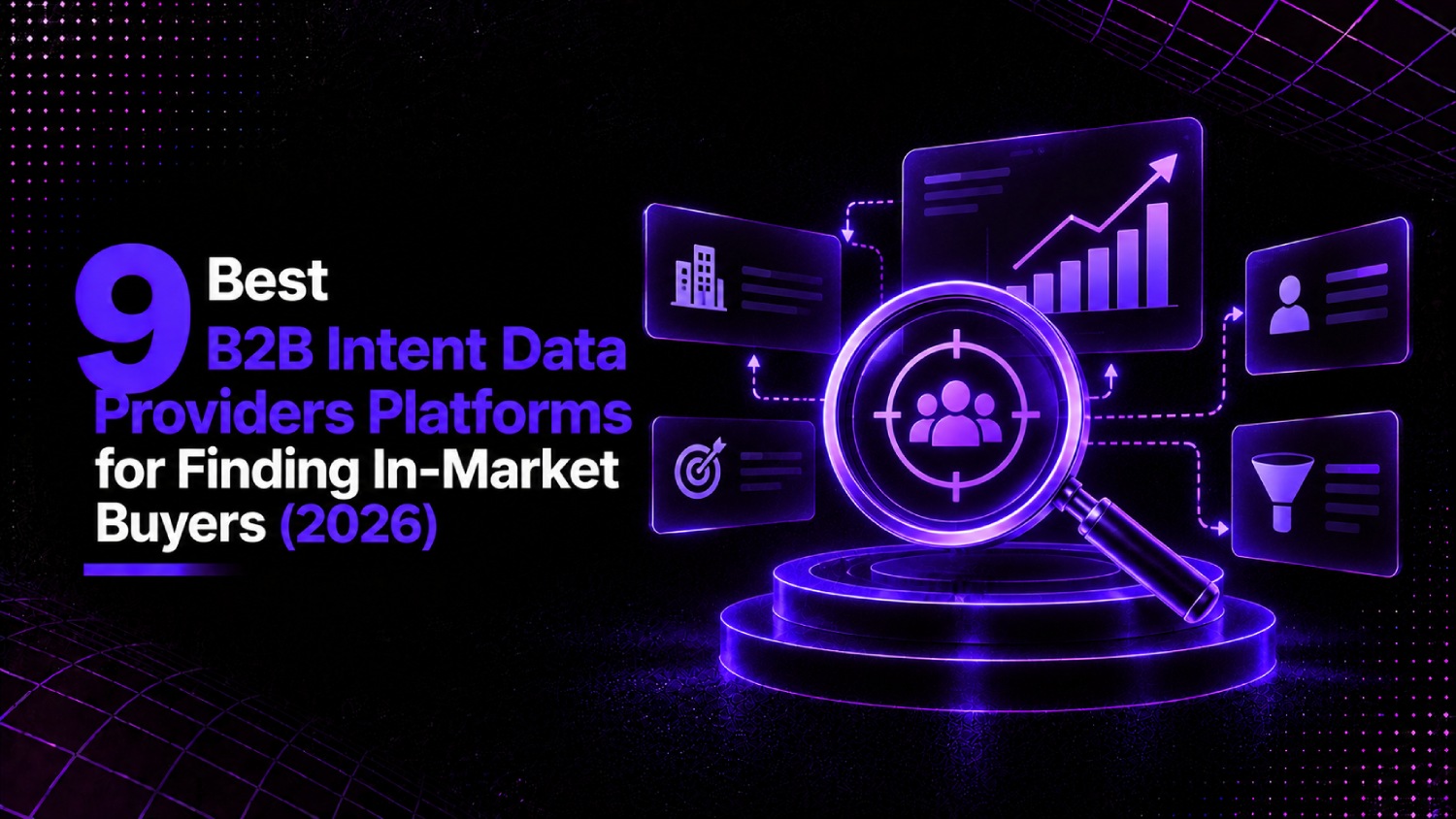
The most accurate B2B intent data providers in 2026 are Bombora for broad third-party co-op coverage, 6sense for AI-driven account scoring, G2 Buyer Intent for in-market software buyers, TechTarget Priority Engine for enterprise tech purchases, and Demandbase for ABM-focused teams. ZoomInfo, Cognism, Lead Forensics, and Foundry round out the list for specific use cases. First-party signals from your own site and product are always the most reliable. Third-party providers supplement that coverage when buyers research in places you cannot track directly.
Why most intent data feels too vague to act on
The complaint is consistent across demand-gen and sales teams: “We tried intent data and the leads were cold.” The problem is rarely the concept. It is usually a mismatch between the signal type purchased and the action taken on it.
An account “surging” on content about cloud security does not mean they are evaluating your specific product. It means someone in that organization read articles in that topic cluster, somewhere on the web, more than the baseline rate. That signal is a conversation starter, not a buying indicator on its own. Treating it like a high-intent MQL is what makes intent data feel like noise.
The teams that get real pipeline from intent data combine signal types: a third-party topic surge plus a review site comparison visit plus an ad click is a materially different trigger than a topic surge alone. The providers on this list vary significantly in how they let you layer signals, and that is the key differentiator worth evaluating before signing a contract.
First-party vs. third-party intent data: what actually changes
First-party intent data is behavioral data you collect directly: pages visited, pricing page views, demo requests, product usage patterns, and email engagement. You own it, it requires no inference, and there is no third-party accuracy problem. The limitation is obvious: it only covers buyers who have already found you.
Third-party intent data is collected outside your properties, typically through content syndication networks, publisher co-ops, B2B media sites, review platforms, and data co-operatives where vendors share anonymized behavioral signals. The value is coverage of buyers who are researching before they reach your site. The trade-off is accuracy: the signal travels through multiple inference layers before it reaches your CRM.
There is also a third category worth naming: review-site intent, which sits between the two. When a buyer visits G2 or TrustRadius to compare your product against a competitor, that is a highly specific behavioral signal. It is not first-party because you did not collect it, but it is far more precise than “content consumption on a publisher network.” G2 Buyer Intent is the dominant product in this category.
For teams building a full picture of buyer behavior, pairing first-party data infrastructure with third-party signals gives the broadest coverage. The guide to building a first-party data stack covers the infrastructure side of that equation in detail.
The AboutMartech Signal-Stack Test: how to evaluate any intent data provider
Before comparing vendors, run every candidate through four checks. This framework, which we call the Signal-Stack Test, cuts through vendor marketing and surfaces the questions that actually determine whether a tool will generate pipeline.
- Signal origin: Where does the data come from? Co-op publisher network, review site, content syndication, or a proprietary panel? The origin determines freshness and accuracy. Ask the vendor to show you their data collection methodology in writing.
- Resolution method: How does the vendor connect a behavioral signal to a named company? Deterministic matching (IP address lookup to a company record) is more reliable than probabilistic matching (clustering signals to infer company identity). Many vendors use both without distinguishing which signals get which treatment.
- Layerability: Can you combine signals? An account that triggers a topic surge and appears in a CRM contact record and visits a pricing page should score differently than an account with only one of those signals. Platforms that force a single signal type into a single score are harder to work with.
- Workflow integration: Where does the signal land? An intent alert that lands in a spreadsheet is not the same as one that triggers a Salesforce task, an Outreach sequence, or a 6sense ad suppression. The closer the signal is to the action, the faster the response time and the better the conversion rate.
The 9 best B2B intent data providers for finding in-market accounts
1. 6sense
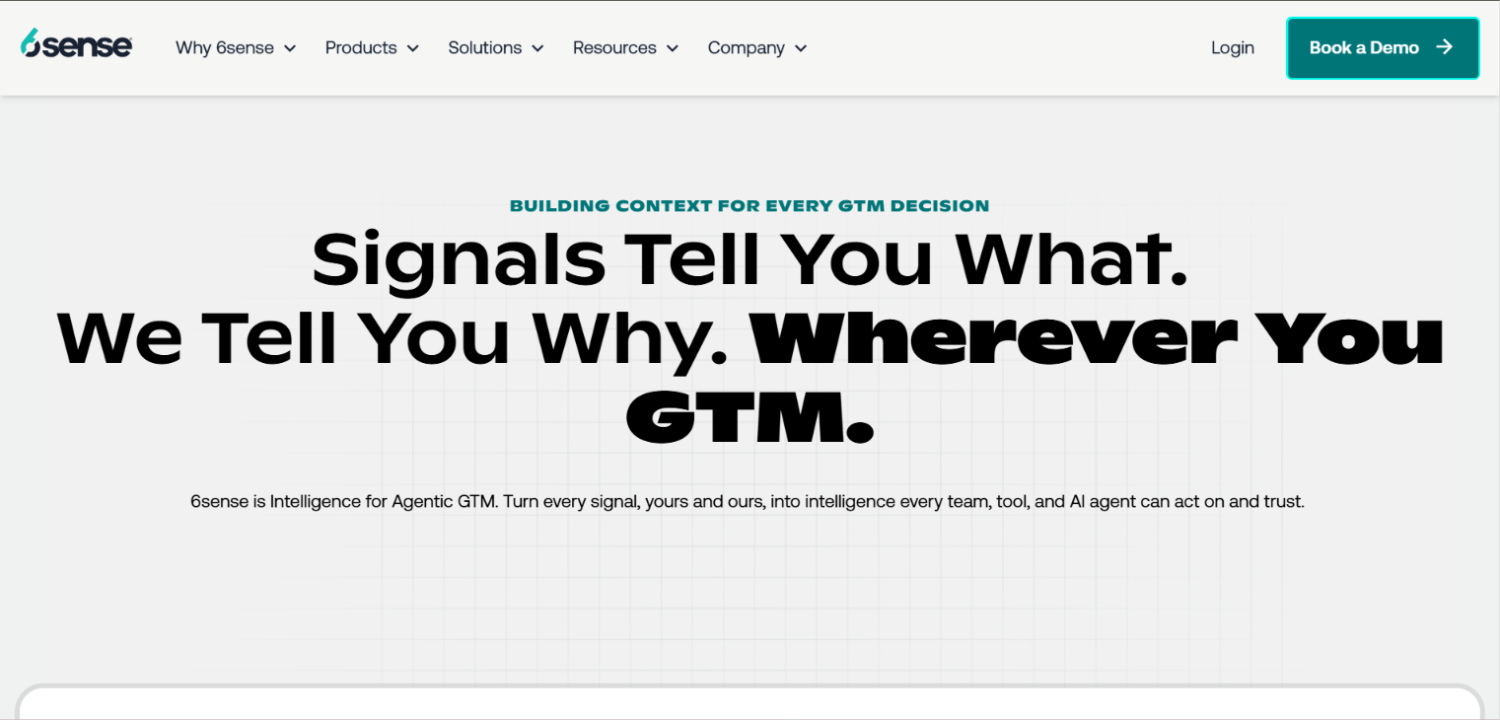
6sense is the most complete account-based buying signal platform on the market for teams with a defined ICP and a named-account sales motion. It layers third-party intent, first-party behavioral data, CRM history, and firmographic data into a single account score, then predicts where each account sits in a buying process: awareness, consideration, or decision stage.
The platform’s real differentiator is the “dark funnel” coverage. 6sense aggregates signals from across the web, including publisher networks, review sites, and its own data co-op, and uses AI to classify them into buying stage predictions. Sales teams get a prioritized account list rather than a raw signal feed, which reduces the interpretation burden on reps.
6sense integrates directly with Salesforce, HubSpot, Marketo, Outreach, and Salesloft. Pricing is not public. According to their public-facing information, they offer tiered plans including a free tier for basic contact data, with the intent and AI features sitting in higher tiers. For anything resembling a full deployment, expect a quote-based contract.
2. Bombora
Bombora operates the largest B2B intent data co-operative in the market. Their Company Surge product aggregates content consumption data from a network of over 5,000 B2B media sites and tracks topic-level spikes at the account level. When an organization’s employees consume significantly more content on a given topic than their historical baseline, Bombora flags a surge.
The co-op model is Bombora’s structural advantage. Because member publishers share data directly, Bombora sees content consumption at a scale and breadth that proprietary panels cannot match. The trade-off is that the signal is topic-level, not keyword or product-level: a surge on “zero trust security” tells you a company is thinking about the category, not necessarily your specific solution.
Bombora data is embedded in dozens of downstream tools including ZoomInfo, HubSpot, Marketo, Salesforce, and most major ABM platforms, so many teams access it indirectly without a direct Bombora contract. A direct relationship gives you full topic selection and custom surge thresholds. Pricing is quote-based.
3. G2 Buyer Intent
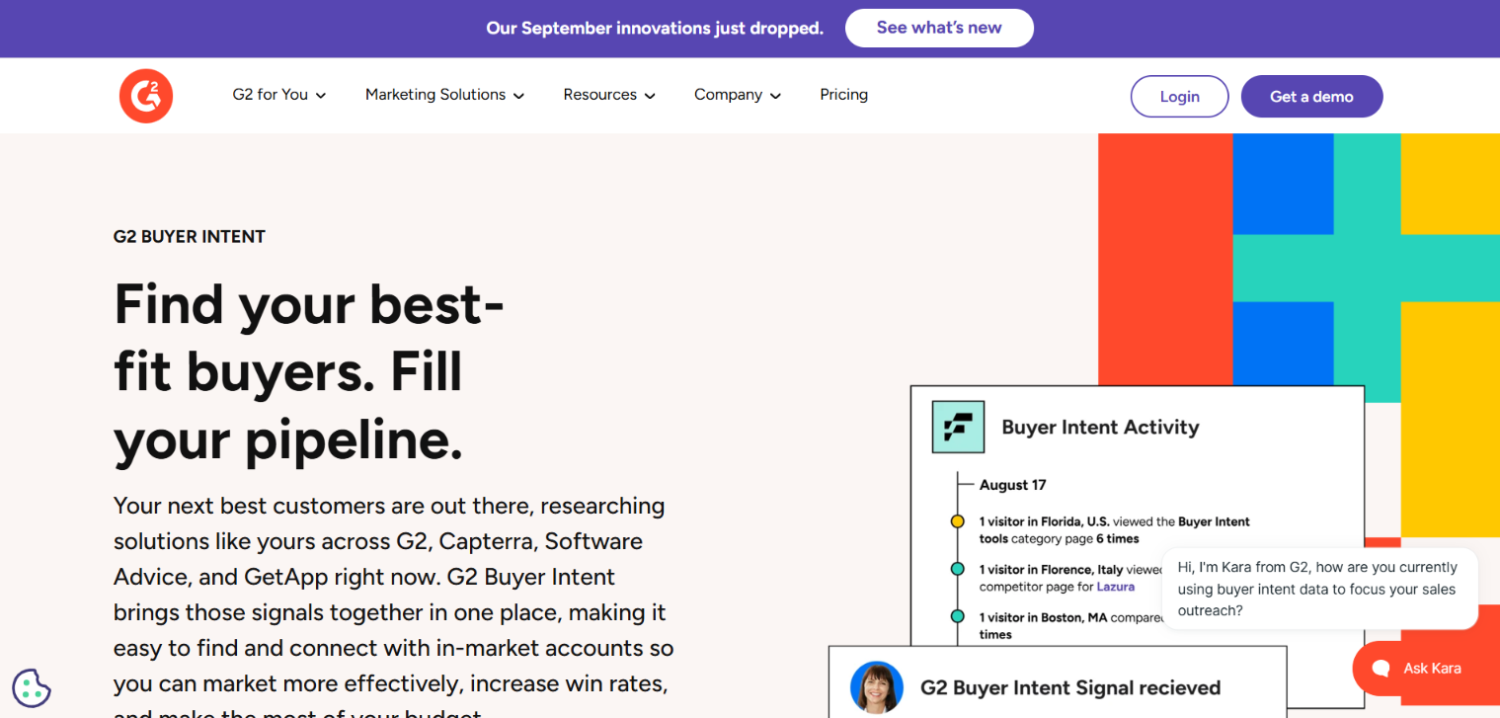
G2 Buyer Intent captures review site activity from over 60 million buyers visiting G2 annually. The signals are specific: an account viewed your product profile, compared you against a named competitor, visited your category page, or read reviews in your segment. These are buyers in active evaluation mode, not passive content consumers.
For software vendors, G2 Buyer Intent is arguably the highest-precision third-party signal available. The specificity gap between “account surging on CRM content” and “account compared your product to Salesforce on G2 today” is substantial. The limitation is reach: G2 only captures buyers who research on G2. Buyers who evaluate solely through analyst briefings, peer referrals, or competitor sites never appear.
G2 Buyer Intent integrates with Salesforce, HubSpot, Marketo, and Slack. Pricing depends on your G2 presence tier and requires a conversation with their sales team.
4. TechTarget Priority Engine
TechTarget Priority Engine is built for enterprise technology vendors selling into IT and security buying committees. TechTarget operates its own network of tech media properties including SearchSecurity, CIODive, and dozens of other titles, giving it first-party behavioral data on technology decision-makers rather than inferred co-op signals.
The platform surfaces active purchase projects with named contacts, not just anonymous account-level spikes. That individual-level resolution is rare in the intent data market and makes Priority Engine particularly useful for account-based sales teams doing multi-threaded outreach into buying committees. The vendor focus is narrower than Bombora: if your ICP is tech buyers at mid-market and enterprise companies, Priority Engine fits well. Outside that audience, coverage drops.
Pricing is quote-based. TechTarget does not publish tiers publicly.
5. Demandbase
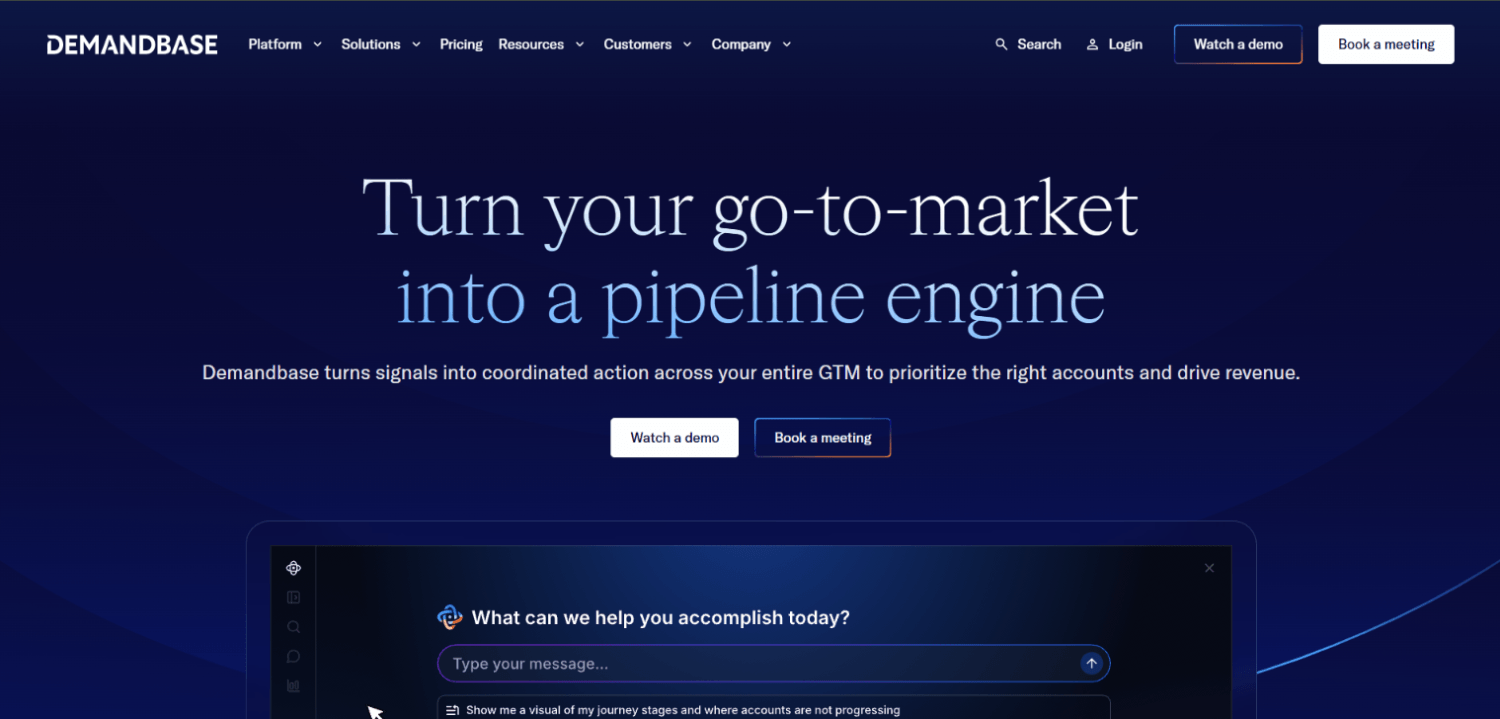
Demandbase combines an intent data layer with a full ABM platform: advertising, personalization, analytics, and CRM integration under a single contract. Their intent data pulls from Bombora’s co-op, plus their own first-party signals and third-party publisher networks, and routes those signals into account-level scores.
The platform makes the most sense for teams that want to act on intent signals through advertising immediately. Demandbase lets you suppress accounts that are not in-market, increase spend against accounts showing buying signals, and personalize website content for visiting accounts, all from a single platform. Teams that already have a dedicated ABM advertising workflow and want intent layered in will find Demandbase a tighter fit than buying Bombora separately and stitching it to an ad platform manually.
Pricing is quote-based. Demandbase offers a range of modules, and the intent layer is typically bundled with the broader platform contract.
6. ZoomInfo
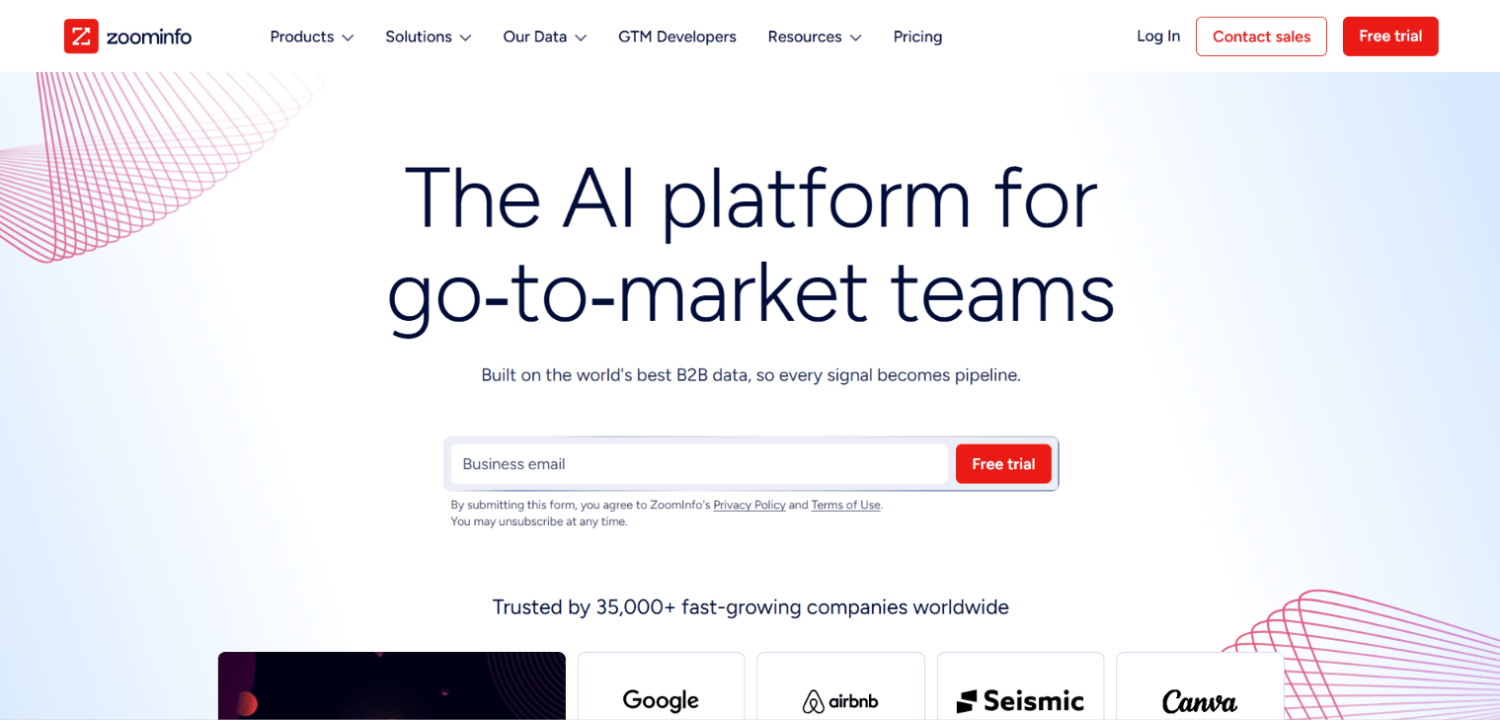
ZoomInfo includes intent data as part of its broader B2B database and sales intelligence platform. Their intent signals combine Bombora co-op data with ZoomInfo’s own signals from web activity, job postings, funding events, and technology installs. The result is intent data that sits alongside contact and company records in the same platform rather than arriving as a separate data feed that your team must enrich and route.
ZoomInfo’s intent capability is well-suited for teams already in the platform who want to add buying signal prioritization without a separate vendor contract. As a standalone intent data tool, it is not the deepest product: the signal types are less granular than going to Bombora directly, and the account scoring is less sophisticated than 6sense. But for a sales team already using ZoomInfo for prospecting, activating the intent layer is a low-friction upgrade. Pricing for intent features varies by plan and is quote-based at most tiers. Teams pairing ZoomInfo intent with a structured lead enrichment and routing workflow often see better conversion rates than those treating it as a standalone signal.
7. Cognism
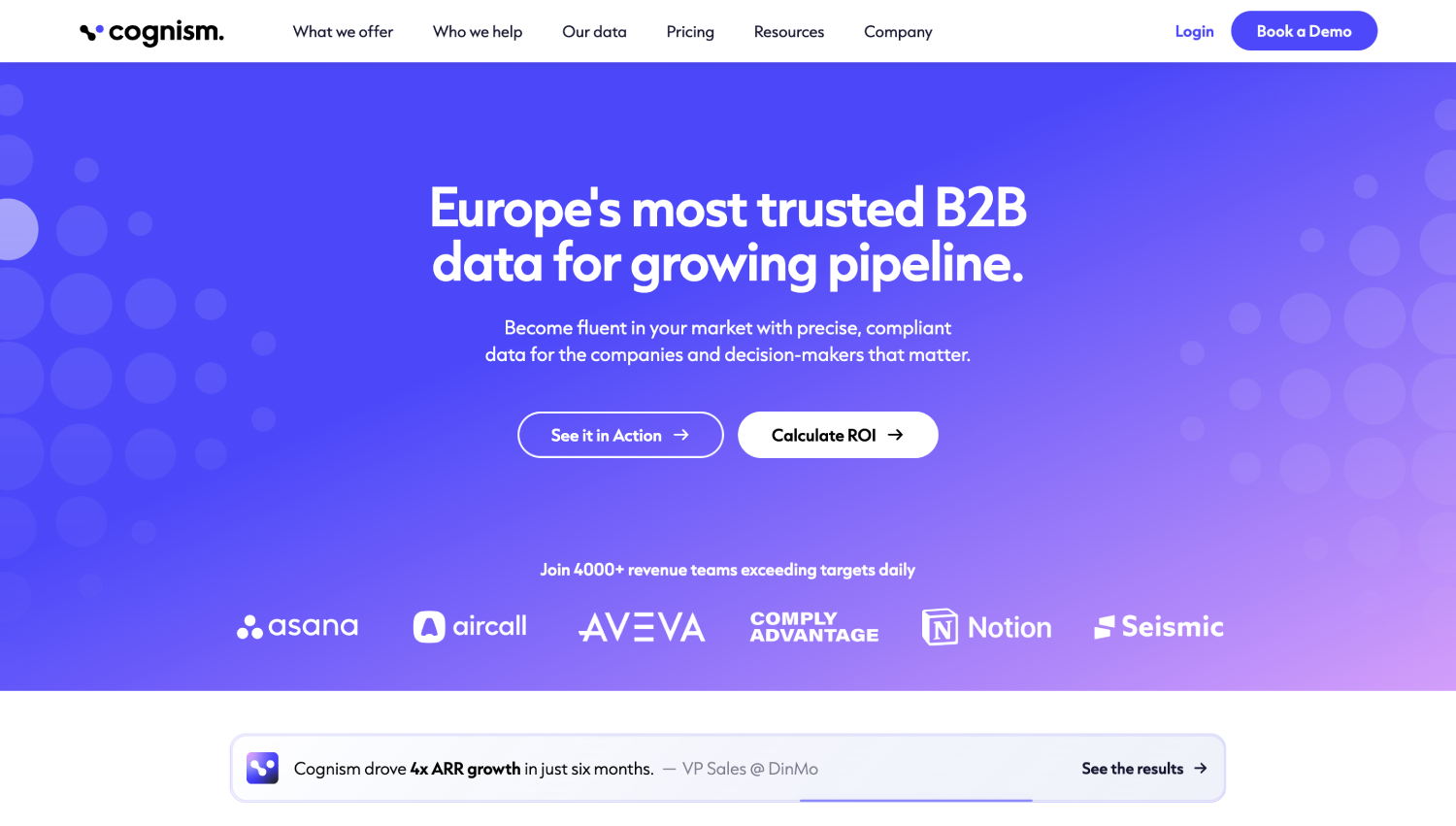
Cognism is a B2B sales intelligence platform with a strong European data footprint and GDPR-compliant contact data. Their intent data layer, powered by Bombora, surfaces company-level surge signals alongside verified mobile phone numbers and direct dials. For outbound-heavy teams that need intent data plus contact data in a single workflow, Cognism’s bundled approach reduces the number of tools in the prospecting stack.
The platform is strongest for EMEA-focused sales teams, where its data coverage and compliance posture are competitive advantages over US-centric alternatives. North American teams generally find Bombora’s co-op coverage through ZoomInfo or a direct Bombora contract gives them more signal breadth. Pricing is quote-based.
8. Lead Forensics
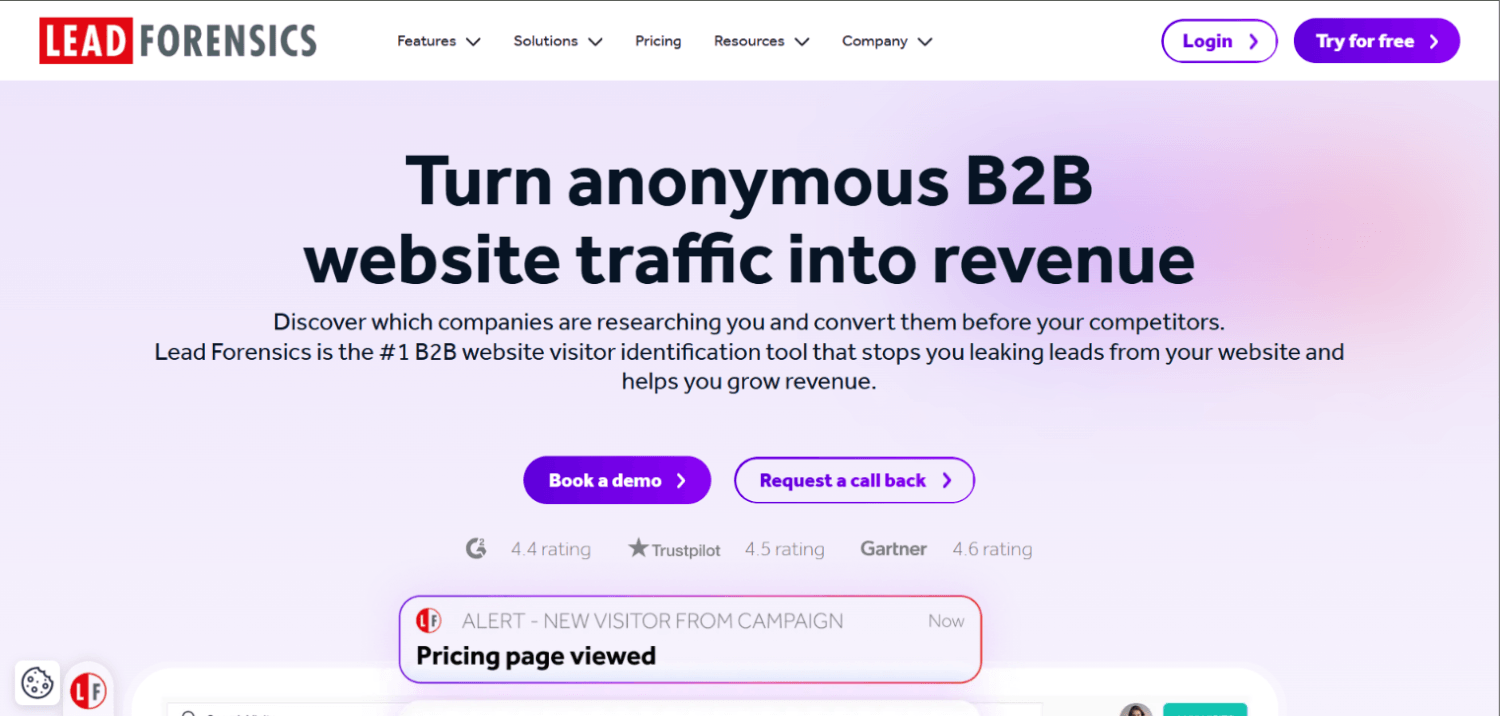
Lead Forensics takes a different approach than the co-op or review-site models. Rather than aggregating signals from external publisher networks, it identifies the companies behind anonymous website visits using IP resolution, then matches those companies against business contact databases. The intent signal is first-party , specifically your own site traffic , but the identification layer is third-party.
For teams that have meaningful website traffic but low conversion rates from unknown visitors, Lead Forensics fills a real gap. An account that visits your pricing page and careers page repeatedly in a two-week window is showing intent signals that no co-op data provider would surface, because the behavior happens on your own property. You are not inferring category interest from content consumed elsewhere; you are seeing direct engagement with your site. The limitation is that IP resolution accuracy varies, particularly for companies with distributed or remote workforces where traffic does not resolve cleanly to a corporate IP range. Teams with heavy site traffic tend to get more value than those relying on low-volume organic visits.
Pricing is not published publicly and requires a demo call. Lead Forensics is generally positioned at SMB and mid-market buyers.
9. Foundry (formerly IDG Communications)
Foundry operates a portfolio of technology media brands including CIO, Computerworld, CSO, and InfoWorld, giving it proprietary first-party intent data on senior technology decision-makers. Their intent product surfaces account-level signals from content consumption across those owned properties, combined with content syndication and event registration data.
Foundry’s differentiation is audience quality rather than breadth. The CIOs and senior IT leaders who read CIO.com are a more specific audience than the broad professional population captured in a general co-op network. Foundry can also surface named contact data from that audience rather than purely anonymous account-level signals, which puts it closer to TechTarget Priority Engine in terms of resolution depth for the IT buyer persona. For vendors selling enterprise software to the IT suite, that combination of owned-media coverage and contact-level resolution matters. Coverage outside the technology buyer persona is limited. Pricing is quote-based.
Intent data provider comparison: signal sources, resolution method, and best-fit use case
| Provider | Primary Signal Source | Resolution Method | Best For | Pricing |
|---|---|---|---|---|
| 6sense | Multi-source: co-op, review sites, first-party, web | AI-driven account scoring | ABM teams wanting AI-ranked account lists | Quote-based |
| Bombora | 5,000+ B2B publisher co-op | Deterministic + probabilistic | Broad topic-level category coverage | Quote-based |
| G2 Buyer Intent | G2 review site activity | Deterministic (logged-in + IP) | Software vendors targeting active evaluators | Quote-based (by tier) |
| TechTarget Priority Engine | TechTarget owned media network | First-party (named contacts) | Enterprise tech vendors targeting IT buyers | Quote-based |
| Demandbase | Bombora co-op + proprietary + publisher | Account-level AI scoring | ABM teams wanting intent plus ad activation | Quote-based |
| ZoomInfo | Bombora + proprietary signals + firmographic events | Account-level matching | Teams already on ZoomInfo wanting intent added | Quote-based |
| Cognism | Bombora (licensed) | Account-level matching | EMEA outbound teams needing intent + contacts | Quote-based |
| Lead Forensics | Your own site traffic (IP resolution) | IP-to-company matching | SMB/mid-market with site traffic to identify | Quote-based |
| Foundry | IDG-owned tech media + syndication | First-party (named contacts) | Enterprise tech vendors targeting senior IT roles | Quote-based |
What does intent data actually look like in a sales workflow?
Consider a B2B SaaS company selling a data integration platform. Their ICP is engineering and data engineering leaders at companies with 200 to 2,000 employees. Their average deal size is $60,000 ARR and the sales cycle runs 60 to 90 days.
Without intent data, the SDR team works off a static list sorted by company size and last contact date. With a layered signal approach, the workflow changes materially. Bombora surfaces 15 accounts showing a topic surge on “data pipeline automation” and “ETL tools.” 6sense flags three of those 15 as being in the “decision” stage based on multi-signal scoring. G2 shows that one of those three accounts visited the company’s G2 profile and compared it to a direct competitor that week.
That third account is not a cold outreach target. It is a warm sequence trigger. An SDR who reaches out with “I noticed you’ve been researching data pipeline tools” backed by a relevant case study is having a different conversation than a rep who found the contact in a prospecting list. The intent data did not close the deal. It changed the timing, the message, and the rep’s confidence in prioritizing that account above others.
The value compounds when intent signals feed into attribution models. Teams that connect intent triggers to pipeline creation can measure which signal sources actually precede closed-won deals and which generate noise. That measurement loop is what separates mature intent programs from one-time experiments. For teams building that measurement layer, pairing intent data with a proper B2B attribution framework for long sales cycles is where the feedback loop closes.
How to choose between intent data providers: three decision filters
The Signal-Stack Test identifies what to evaluate. These three filters help you narrow to one or two vendors for your specific situation.
Filter 1: Are your buyers researching on identifiable channels?
If your buyers are CIOs and VPs of IT reading tech media, TechTarget and Foundry are capturing that behavior directly. If your buyers research on G2 before buying software, G2 Buyer Intent is the most direct signal. If your buyers consume content across dozens of B2B publications without concentrating on specific media brands, Bombora’s broad co-op coverage wins on volume.
Filter 2: Do you need a data feed or a workflow platform?
Bombora and G2 Buyer Intent deliver data that your team or ops stack must act on. 6sense and Demandbase are workflow platforms where the intent data feeds into ad targeting, account scoring, rep prioritization, and website personalization within the same tool. The platform approach costs more but removes the integration work. The data-feed approach costs less but requires your RevOps team to build the activation layer. For smaller teams, the right RevOps tooling can bridge that gap without a full platform purchase.
Filter 3: Is your sales motion account-based or volume-based?
Account-based teams with named lists of target accounts benefit most from 6sense, Demandbase, and TechTarget Priority Engine, all of which are designed around account-level prioritization within a defined ICP. Volume-based outbound teams running high-rep-count SDR motions often find more immediate value in Bombora’s signals fed into ZoomInfo or Cognism, where intent filters the contact list without requiring a formal ABM program to be in place.
How does intent data connect to the broader data stack?
Intent data does not operate in isolation. The accounts that intent providers surface need to be matched against your ICP firmographic data, enriched with contact information, routed to the right rep, and sequenced in the right order. That pipeline touches your CRM, your marketing automation platform, your sales engagement tool, and potentially your customer data platform.
Teams running warehouse-native stacks can route intent signals directly from a platform like Bombora or 6sense into Snowflake or BigQuery and join them against first-party behavioral data before any signal reaches the CRM. That approach gives RevOps teams full control over scoring logic without being locked into a platform’s proprietary model. The comparison of B2B CDPs covers which platforms support that kind of intent signal ingestion natively.
Intent data tells you an account is in-market. Lead enrichment tools tell you who to call there , the specific contacts, their direct dials, and their roles in the buying committee. The two capabilities are complementary but solve distinct problems. Treating them as interchangeable is a common reason intent programs stall: the signal arrives but there is no clean contact data to act on it.
Frequently asked questions about B2B intent data providers
What is B2B intent data and how is it different from firmographic data?
Firmographic data describes a company: its industry, size, location, and technology stack. Intent data describes what that company is doing right now, specifically whether its employees are researching topics or products that suggest an active buying process. Firmographic data filters your ICP. Intent data tells you which accounts in that ICP are in-market today. You need both to prioritize outreach effectively: firmographic data defines the pool, intent data tells you who to call first.
Which intent data provider is most accurate?
Accuracy depends on what you are measuring. G2 Buyer Intent is the most precise for software evaluation intent because it captures named review site activity from buyers in active evaluation mode. TechTarget Priority Engine is most accurate for IT buyer intent within enterprise accounts because it draws from its own owned media rather than inferred co-op signals. Bombora is broadest in coverage but operates at a topic-cluster level, which introduces more inference. No provider has independent third-party accuracy benchmarks that are publicly available.
What is the difference between first-party and third-party intent data?
First-party intent data comes from your own properties: website visits, product usage, email engagement, and demo requests. You collected it directly, so there is no inference layer. Third-party intent data comes from outside your properties, typically from publisher co-ops, review sites, or content networks, and requires the provider to infer that a behavioral signal at an external property indicates buying interest in your category. First-party data is more accurate but limited to buyers who have already found you. Third-party data extends your reach to buyers who are still researching before they discover your brand.
Can small teams benefit from intent data, or is it only for enterprise ABM programs?
Small teams can benefit, but the fit depends on deal size and sales motion. If your average contract value is high enough to justify the cost of reaching a buyer before your competitors do, intent data pencils out even at small team sizes. The tools that fit lean teams best are G2 Buyer Intent (if you have a G2 presence), Lead Forensics (if you have meaningful site traffic to identify), and Bombora signals accessed through ZoomInfo or HubSpot integrations. Full platforms like 6sense and Demandbase are harder to justify under $2 million in ARR unless account-based selling is the core go-to-market motion.
How does intent data integrate with a CRM like Salesforce or HubSpot?
Most major intent data providers offer native CRM integrations that push account-level intent scores or surge alerts directly into company records. In Salesforce, intent signals typically appear as custom fields or tasks on the Account object, allowing workflow automation based on score thresholds. In HubSpot, integration quality varies by provider: Bombora, 6sense, and ZoomInfo all have native HubSpot connections, while some smaller providers require a middleware tool like Zapier or a reverse ETL layer. For teams using warehouse-native routing, a reverse ETL tool can push intent data from a data warehouse directly to CRM records without a direct vendor integration.
What is Company Surge and how does Bombora calculate it?
Company Surge is Bombora’s product name for their account-level intent scoring system. Bombora calculates a baseline content consumption rate for each topic across their co-op publisher network, then measures how much a given company’s employees deviate from that baseline in a given week. When consumption on a topic cluster is significantly above baseline for a company, Bombora flags a surge on that topic. The calculation factors in the number of content pieces consumed, the recency of consumption, and the diversity of individuals within the company showing the behavior. Scores run from 0 to 100.
What should a RevOps team ask an intent data vendor before buying?
Ask the vendor to answer five specific questions: Where does the data originate, and can they show the publisher list or co-op membership? What percentage of signals are deterministic versus probabilistic matches? How often is the data refreshed, and what is the typical lag between a behavioral signal and its appearance in your platform? What is their overlap with your specific ICP accounts? Can they provide a sample data export for a list of your current target accounts so you can evaluate coverage before committing? Vendors who cannot answer these questions with specifics are worth treating with skepticism.
The signal that matters most depends on where your buyer researches
The reason intent data so often disappoints teams is that they buy based on a provider’s market position rather than matching the signal source to their buyer’s actual research behavior. A co-op topic surge is a meaningful signal for buyers who consume B2B content at scale. A G2 profile visit is a meaningful signal for buyers who research software through review sites. An IP resolution from your own pricing page is a meaningful signal for buyers who found you through SEO or a referral. None of these is universally superior.
The providers on this list are genuinely strong at different things. Bombora and TechTarget are the right answers for different audiences: broad category coverage versus deep IT buyer specificity. 6sense and Demandbase are the right answers for different operational maturity levels: AI-ranked account lists versus intent-plus-advertising in one platform. G2 Buyer Intent is the right answer specifically when your buyers evaluate software on G2, which for most B2B SaaS companies is a significant portion of the buying committee.
The teams that extract real pipeline from intent data treat it as a prioritization layer on top of a well-defined ICP, not as a lead generation replacement. The accounts intent data surfaces still need the same quality of outreach, the same product-market fit, and the same sales execution as any other account. What changes is the timing and the confidence that the conversation is worth having right now. That shift , from guessing who to call to knowing who is in-market today , is where intent data earns its budget line.