Customer success software pricing is hard to compare because almost nobody publishes a price. Gainsight, ChurnZero, Vitally and Planhat all say “request pricing”, and each one counts something different: customer records, accounts per user, seats or a platform fee. The one exception is new. Totango rebranded as Odie in September 2026 and now lists starting prices on its pricing page.
We read every vendor’s pricing page and the Vendr purchase benchmarks on November 1, 2026, then put the numbers in one place: how each platform charges, what buyers actually pay, what implementation adds, and a first-year cost worksheet you can reuse. If you are still building a shortlist, start with our best customer success software guide.
TLDR
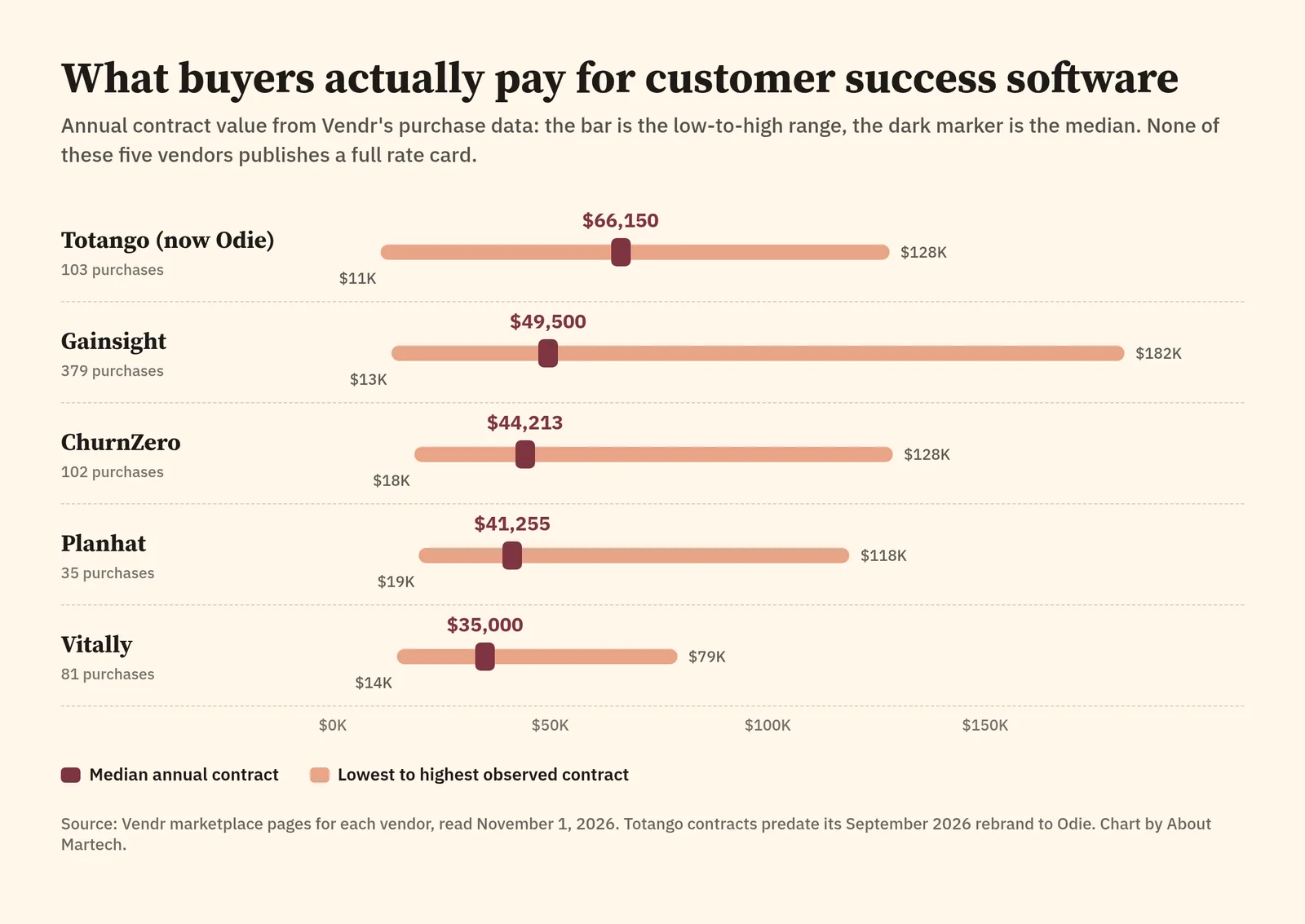
- Typical spend: Vendr’s median annual contract is $49,500 for Gainsight, $44,213 for ChurnZero, $41,255 for Planhat, $35,000 for Vitally and $66,150 for Totango (read November 1, 2026).
- Only published prices: Odie (formerly Totango) starts at $500 a month for its Customer Knowledge Engine and $1,500 a month for its Customer Operating System, with one-year minimum terms (Odie pricing).
- Implementation is the hidden line: Vendr says Gainsight services add 20% to 40% to year one, ChurnZero onboarding runs $5,000 to $25,000+, and Totango services $10,000 to $50,000+.
- Lowest friction: ClientSuccess says it charges no setup or implementation fees and is typically 30% to 50% cheaper than Gainsight (ClientSuccess pricing).
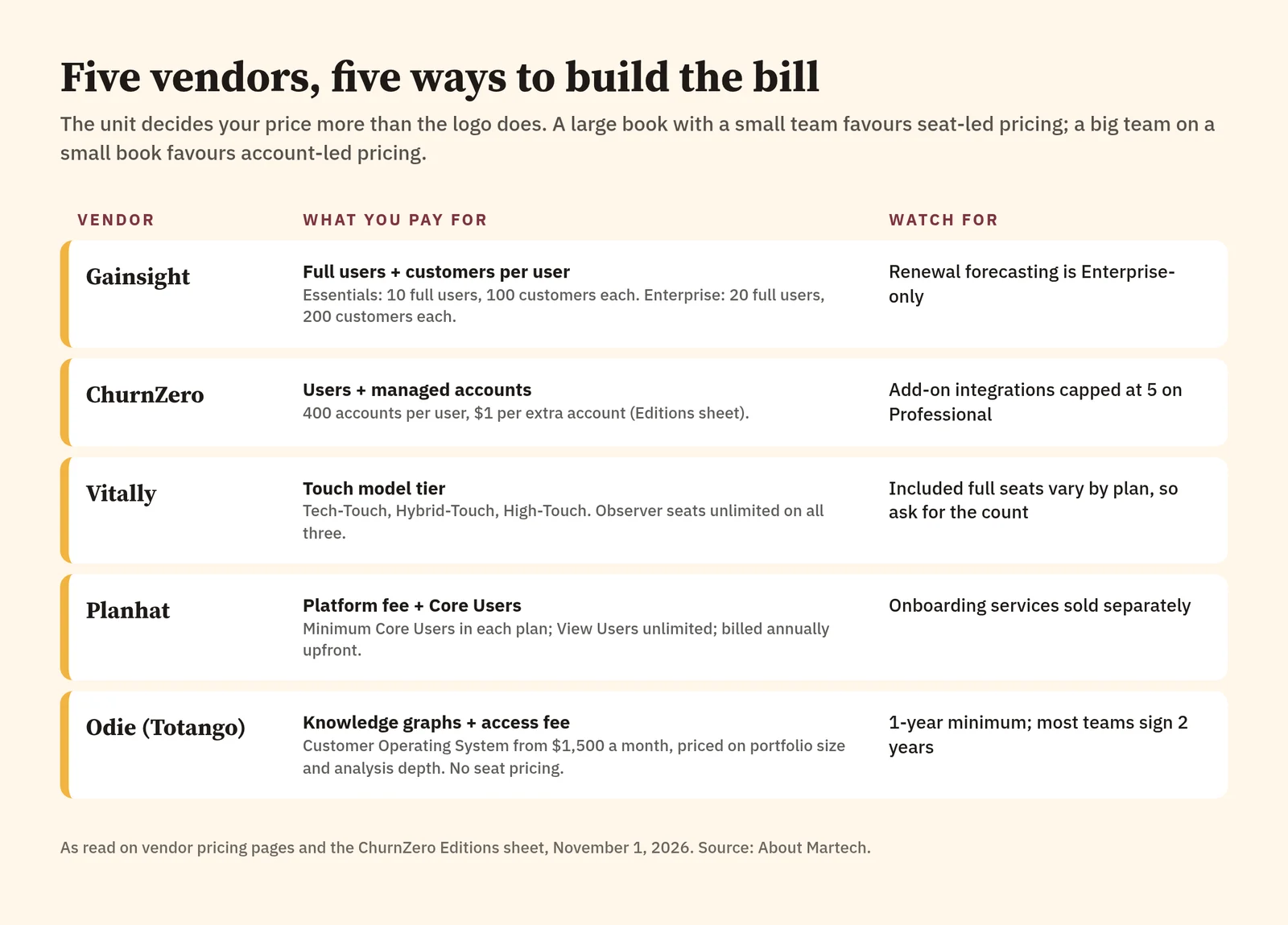
- Match the pricing unit first. ChurnZero includes 400 accounts per user with $1 per account overages, Planhat charges a platform fee plus Core Users, and Gainsight caps customers per user.
In this guide
Customer success software pricing at a glance (November 2026)
Published packaging comes from each vendor’s own page. Median and range are Vendr’s figures for annual contracts, read on the same day. “Quote” means the vendor does not publish a price.
| Platform | Published price | What you are billed on | Vendr median (range) | One-time services |
|---|---|---|---|---|
| Gainsight | Quote (Essentials, Enterprise) | Full users and customers per user, plus modules | $49,500 ($13,525 to $182,022) | Quoted separately, 20% to 40% of year one |
| ChurnZero | Quote (Professional, Enterprise) | 400 accounts per user, $1 per account overage | $44,213 ($18,821 to $128,773) | $5,000 to $25,000+ onboarding |
| Vitally | Quote (Tech-Touch, Hybrid-Touch, High-Touch) | Accounts managed and plan; observer seats unlimited | $35,000 ($14,728 to $79,264) | $2,000 to $10,000+ onboarding |
| Planhat | Quote | Platform fee plus minimum Core Users, plus Solution Extensions | $41,255 ($19,866 to $118,800) | Onboarding plans sold separately |
| Odie (Totango) | From $500 or $1,500 a month | Knowledge graphs, portfolio size and an AI Success pool | $66,150 ($11,040 to $128,000, Totango era) | $10,000 to $50,000+ (Totango era) |
| ClientSuccess | Quote | CSM licences and modules | Not listed | No setup or implementation fee |
How customer success platforms charge: four pricing models
Two quotes with the same total can scale very differently next year. Before you compare dollars, find out what the vendor counts.
| Pricing model | Who uses it | What drives the bill | What to ask |
|---|---|---|---|
| Users with a customer allowance | Gainsight, ChurnZero | Full users, with a cap on how many customers each user can manage | What happens when accounts grow faster than headcount |
| Accounts managed | Vitally, Totango (Vendr data) | The number of customer companies tracked | Whether churned or free accounts still count |
| Platform fee plus seats | Planhat | A base fee, a minimum number of Core Users, then extra users and extensions | The minimum Core User count and extension prices |
| Portfolio and AI usage | Odie | Portfolio size, analysis depth and a token or service-hour pool | How the AI pool is sized and what happens when it runs out |
Free viewers are becoming standard. Vitally and Planhat both advertise unlimited observer or view users, so executives and account executives rarely need a paid seat (Vitally pricing, Planhat pricing). Budget for the people who edit playbooks and health scores, not everyone who reads a dashboard.
Gainsight pricing
Gainsight sells customer success in two packages, Essentials and Enterprise, and neither has a public price. Essentials includes 10 full users and 100 customers per user. Enterprise includes 20 full users and adds renewal and expansion forecasting plus organizational mapping and sponsor tracking. Both include AI insights and automations, Customer 360, health scorecards, surveys and digital journeys.
- Vendr’s median Gainsight contract is $49,500 across 379 purchases, with average savings of 15% off the first quote (Vendr).
- Buyers managing 500 to 1,500 customer records often see initial quotes of $60,000 to $120,000 a year, according to Vendr.
- Implementation is quoted separately and adds 20% to 40% to first-year cost. Renewals often carry 5% to 8% annual escalators.
- Gainsight’s fiscal year ends in January, which Vendr flags as the best time to negotiate.
For the full package breakdown, add-on modules and negotiation notes, read our dedicated Gainsight pricing guide. If the quote is out of reach, compare Gainsight alternatives.
ChurnZero pricing
ChurnZero does not publish prices, and its old pricing URL no longer resolves. Its Editions sheet describes two editions, Professional and Enterprise. Neither caps the number of users, and both permit 400 accounts per user with $1 per account overages. Professional limits add-on integrations to five, while Enterprise makes them unlimited and adds deeper reporting.
- Vendr’s median ChurnZero contract is $44,213 across 102 purchases, with average savings of 22% (Vendr).
- Vendr’s bands: $15,000 to $50,000 a year for 100 to 500 accounts, $40,000 to $100,000 for 500 to 2,000 accounts, and $100,000+ above 2,000 accounts.
- Onboarding fees run $5,000 to $25,000+, and annual escalators of 3% to 7% are common.
The 400 accounts per user rule matters. A three-person team covers 1,200 accounts before overages start, so a long-tail book of business can cost more than the seat count suggests. See how it stacks up in Gainsight vs ChurnZero and ChurnZero vs Vitally.
Vitally pricing
Vitally has three plans named for your coverage model: Tech-Touch for one-to-many and product-led customer success, Hybrid-Touch for mixed models, and High-Touch for one-to-one. All three say “Request Pricing”. Every plan includes the same core features, unlimited automations, unlimited observer seats, single sign-on and the full integration library, and the page highlights unlimited full seats on one plan, so ask which.
- Vendr’s median Vitally contract is $35,000 across 81 purchases, the lowest median of the five, with average savings of 20% (Vendr).
- Vendr’s bands: $18,000 to $36,000 for 100 to 500 accounts, $36,000 to $72,000 for 500 to 2,000 accounts, and $75,000 to $150,000+ above 2,000.
- Onboarding typically costs $2,000 to $10,000+, extra seats $50 to $150+ per user per month, and new customers sign a 12-month minimum.
Older roundups still quote a self-serve Vitally plan from a few hundred dollars a month. That plan is not on the pricing page today, so treat those numbers as out of date.
Planhat pricing
Planhat now sells CRM, customer success (CSP) and professional services automation (PSA) plans. Its pricing FAQ is the clearest in the category about structure: each plan combines a platform fee with a minimum number of Core Users, then charges for extra Core Users and any Solution Extensions you add. View Users are unlimited on every plan, all plans are billed annually upfront, and tailored onboarding and implementation plans are sold separately. A dedicated CSM is included above a minimum annual spend.
- Vendr’s median Planhat contract is $41,255 across 35 purchases (Vendr).
- Vendr’s bands: $15,000 to $30,000 a year for under 500 accounts on Professional, $30,000 to $50,000 for 500 to 2,000, and $50,000 to $100,000+ above that.
- On Enterprise, Vendr warns about overage charges when automation executions or account volume exceed contracted limits.
Totango pricing (now Odie)
Totango is now Odie, and its old pricing page returns a 404. Odie’s pricing page is the only one in this group with list prices. The Customer Knowledge Engine starts at $500 a month and is priced on how many business unit, customer and employee knowledge graphs Odie maintains, plus an access fee for its MCP connection. The Customer Operating System, the replacement for a classic customer success platform, starts at $1,500 a month and is priced on portfolio size, how deeply and how often each account is analyzed, and an AI Success pool for tokens or service hours.
- No seat-based pricing, no extra cost for integrations, and no automatic overage charges on the AI pool.
- No month-to-month option. Terms start at one year, and Odie says most customers sign for two.
- Before the rebrand, Vendr recorded a $66,150 median Totango contract across 103 purchases, with services of $10,000 to $50,000+ and average savings of 30% (Vendr).
At list, the Customer Operating System floor works out to $18,000 a year before portfolio size is applied. Existing Totango customers should ask how their renewal maps to the new model. For context on the old product, see Gainsight vs Totango.
Lower-cost customer success software options
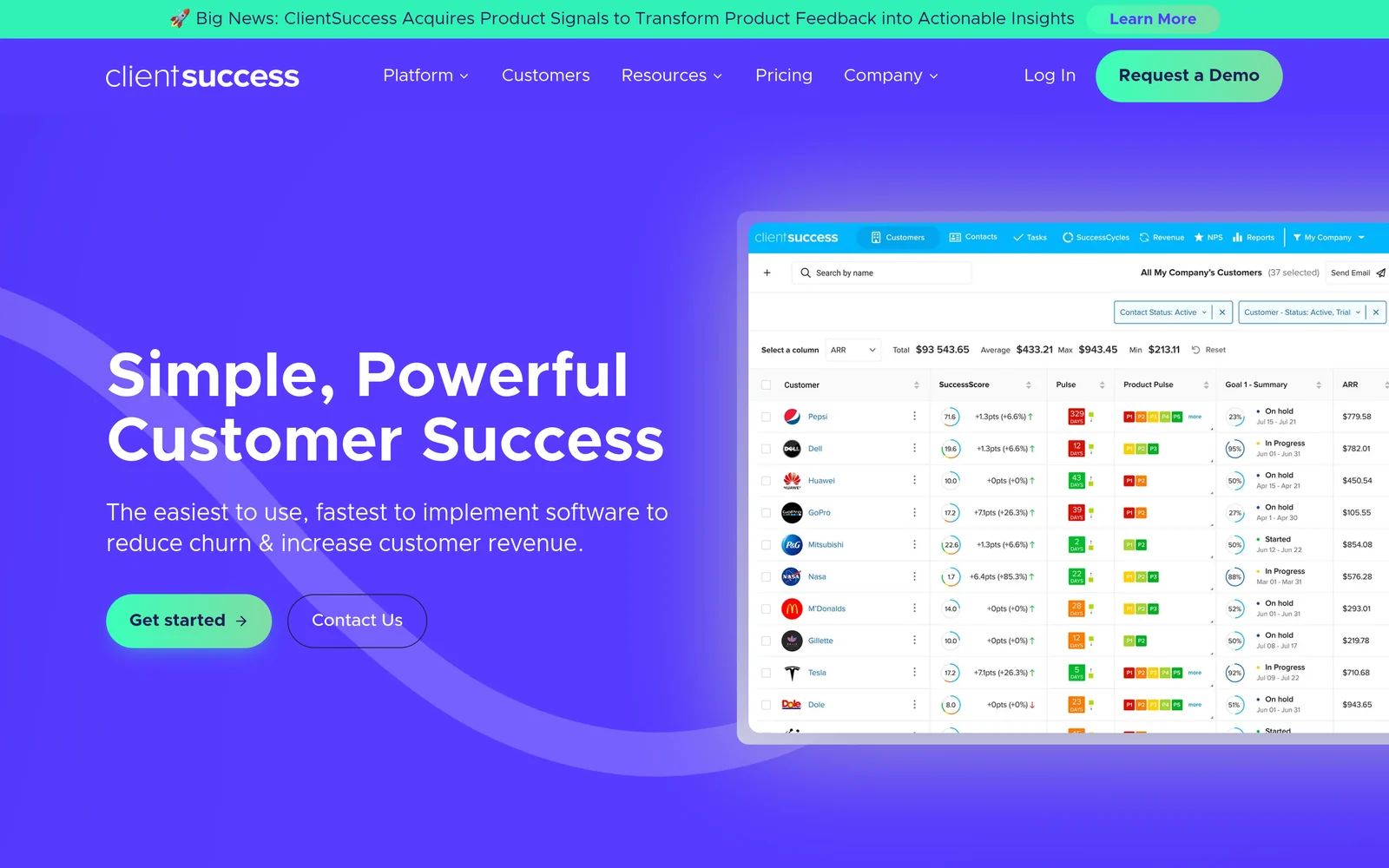
ClientSuccess publishes limits but not prices. The Startup package manages up to 500 customers with 10 full licences, Growth manages 5,000 customers with 50 licences, and Enterprise is unlimited. Its FAQ says there are no setup or implementation fees, annual contracts get 15% to 20% off month-to-month rates, most teams go live in 4 to 6 weeks, and the platform is typically 30% to 50% cheaper than Gainsight.
Custify is also quote-only. If you have fewer than a few hundred accounts, our customer success tools for startups list covers cheaper options, and CRM vs customer success platform explains when your CRM is enough.
First-year cost worksheet
Here is a worked example for a team of 8 CSMs managing 1,000 B2B accounts, using the Vendr bands and services ranges above. Year one is subscription plus one-time services. These are buyer-reported ranges, not quotes.
| Platform | Annual subscription band | One-time services | Estimated year one | Notes |
|---|---|---|---|---|
| Gainsight | $60,000 to $120,000 | 20% to 40% of subscription | $72,000 to $168,000 | Essentials covers 10 full users and 100 customers per user |
| ChurnZero | $40,000 to $100,000 | $5,000 to $25,000+ | $45,000 to $125,000 | 8 users include 3,200 accounts, so no overage |
| Vitally | $36,000 to $72,000 | $2,000 to $10,000+ | $38,000 to $82,000 | Observer seats free; extra full seats $50 to $150+ a month |
| Planhat | $30,000 to $50,000 | Quoted separately | $30,000 to $50,000 plus services | Billed annually upfront |
| Odie (Totango) | From $18,000 at list; $15,000 to $35,000 in Totango-era data | $10,000 to $50,000+ (Totango era) | $25,000 to $85,000 | Confirm how the AI pool is sized |
| ClientSuccess | Quote | None | Subscription only | Growth package covers 5,000 customers and 50 licences |
To adapt it, swap in your own account count and CSM headcount, then add the costs most teams forget: CRM and data warehouse integration work, admin time, and annual escalators of 3% to 8%. Our customer onboarding software pricing guide covers the same math for onboarding tools.
Hidden costs to budget for
- Implementation and services. The largest variable in year one, from nothing at ClientSuccess to 40% of the subscription at Gainsight.
- Account overages. ChurnZero charges $1 per account above 400 per user. Planhat Enterprise can charge for automation executions above contract.
- Integration limits. ChurnZero Professional allows five add-on integrations. Vendr reports separate fees for premium integrations on Totango-era contracts.
- Escalators. Vendr reports 5% to 8% a year at Gainsight and 3% to 7% at ChurnZero and Vitally. Cap them before you sign.
- AI usage. Odie meters on-demand AI work through a pool, and more vendors are adding AI agents as paid add-ons.
- Health score rework. Migrating means rebuilding your customer health score, which takes services hours or admin time.
How to negotiate a lower price
- Get at least two quotes. Vendr notes that ChurnZero buyers who also evaluate Gainsight or Totango get extra leverage, especially in the mid-market.
- Time the deal. Gainsight’s fiscal year ends in January, and quarter ends help with every vendor.
- Trade term for price. Multi-year deals cut per-account pricing by 15% to 35% in Vendr’s data, but lock in a flat rate or a capped escalator.
- Ask for onboarding to be bundled or waived. Vendr says Vitally onboarding fees are often negotiable or waived on larger deals.
- Size seats to editors. Use free viewer or observer seats for everyone who only reads.
Frequently asked questions about customer success software pricing
How much does customer success software cost?
Most mid-market teams pay $35,000 to $66,000 a year. Vendr’s median annual contracts on November 1, 2026 were $35,000 for Vitally, $41,255 for Planhat, $44,213 for ChurnZero, $49,500 for Gainsight and $66,150 for Totango. Implementation can add $2,000 to over $50,000 in year one.
Which customer success platform is cheapest?
Among the big five, Vitally has the lowest Vendr median at $35,000 a year. Odie, formerly Totango, has the lowest published list price at $500 a month for its Customer Knowledge Engine. ClientSuccess charges no setup fees and says it is typically 30% to 50% cheaper than Gainsight.
How much does Gainsight cost?
Gainsight does not publish prices. Vendr’s median Gainsight contract is $49,500 a year, and teams with 500 to 1,500 customer records often see first quotes of $60,000 to $120,000. Implementation adds 20% to 40% to year one.
How much does ChurnZero cost?
ChurnZero is quote-only. Vendr’s median contract is $44,213 a year, with $15,000 to $50,000 typical for 100 to 500 accounts. Both editions include 400 accounts per user and charge $1 for each extra account, and onboarding runs $5,000 to $25,000 or more.
How much does Vitally cost?
All three Vitally plans, Tech-Touch, Hybrid-Touch and High-Touch, are request pricing. Vendr’s median contract is $35,000 a year, with $18,000 to $36,000 typical for 100 to 500 accounts. Every plan includes unlimited automations and observer seats.
How much does Planhat cost?
Planhat prices each plan as a platform fee plus a minimum number of Core Users, with extra users and Solution Extensions on top. View Users are unlimited and billing is annual upfront. Vendr’s median contract is $41,255 a year.
What happened to Totango pricing?
Totango rebranded as Odie in September 2026. Odie publishes starting prices of $500 a month for the Customer Knowledge Engine and $1,500 a month for the Customer Operating System, with one-year minimum terms and no seat-based pricing.
Do customer success platforms charge implementation fees?
Most do. Vendr reports Gainsight services at 20% to 40% of year one, Totango at $10,000 to $50,000 or more, ChurnZero at $5,000 to $25,000 or more and Vitally at $2,000 to $10,000 or more. Planhat sells onboarding plans separately, and ClientSuccess says it charges none.
The verdict
If you want a published number, Odie is the only option, and its $1,500 a month floor makes the Customer Operating System easy to budget, provided you size the AI pool carefully. For a classic customer success platform at the lowest typical spend, Vitally has the lowest median contract and includes unlimited observer seats. Planhat’s platform fee plus Core Users model is the most predictable for teams that grow accounts faster than headcount. ChurnZero suits teams that can stay within 400 accounts per user. Gainsight costs the most once services are counted, but still covers the deepest enterprise needs.
Whichever you choose, compare year one including services, not the subscription alone. For product fit beyond price, go back to our customer success software comparison.