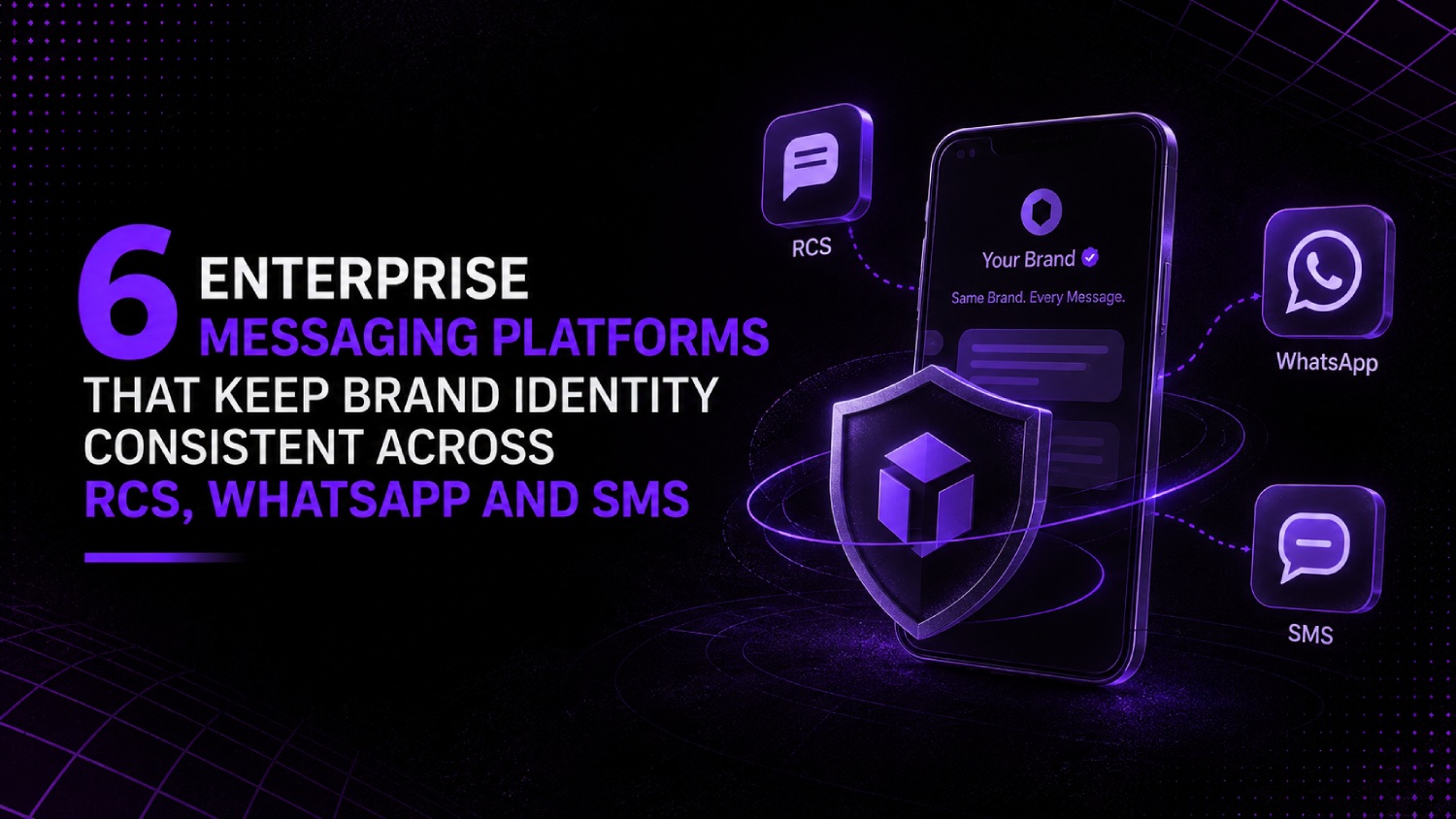
- Most enterprise brands treat cross-channel messaging consistency as a design problem. It is a platform problem: without centralized template governance, every regional team and agency will drift.
- The vendors that matter here are CPaaS and omnichannel messaging platforms with native multi-channel template libraries, approval workflows, and brand asset lockdown across WhatsApp Business API, SMS, and rich messaging channels.
- Six platforms clear that bar: Twilio, Sinch, Infobip, Vonage (now part of Ericsson), MessageBird (now Bird), and Bandwidth. Each handles it differently, and the differences determine which one fits your governance model.
- A governance feature comparison table appears later in this article, scroll to the “Enterprise Omnichannel Messaging Platform Governance Feature Comparison” section before booking any demo.
- Braze and Iterable are excluded deliberately. They excel at orchestration, but neither owns the messaging infrastructure layer where brand consistency breaks down first.
The six enterprise omnichannel messaging platforms best suited for cross-channel brand governance are Twilio, Sinch, Infobip, Vonage by Ericsson, Bird (formerly MessageBird), and Bandwidth. Each offers a unified API layer and multi-channel template management covering WhatsApp Business API and SMS, with varying depth of approval workflows, role-based asset controls, and fallback logic. The right choice depends on whether your priority is developer-native API flexibility, pre-built brand governance tooling, or regional carrier reach.
Why Brand Consistency in Messaging Is a Platform Problem, Not a Design Problem
A brand team can produce a perfect visual identity guide. It will not survive contact with a fragmented messaging stack. When WhatsApp templates are managed in one vendor portal, SMS templates in another, and rich messaging campaigns are handled by a third-party agency with its own tooling, consistency erodes at the seams. The design is fine. The governance is not.
This is the gap most platform evaluations miss. Buyers compare message throughput, pricing per SMS segment, and channel coverage. They rarely ask whether a platform can lock a logo to a specific hex value across all template types, require legal sign-off before a template goes live in a new market, or surface a diff view when a regional team edits a WhatsApp template that was approved six months ago.
Template governance is a distinct capability. It includes centralized brand asset storage (logos, colors, approved copy blocks), role-based permissions that separate template creators from approvers, version history, and channel-specific rendering previews so a marketer can see exactly how a message will look on a Samsung Galaxy before it sends. Not every enterprise CPaaS platform has all of these. Several have none of them and expect you to build governance on top of their API.
If your organization sends across WhatsApp, SMS, and other rich messaging channels, managing those as three separate template libraries is an operational guarantee that your brand will look different on each one. The platforms below are the ones that give you a way out of that trap. For a broader look at how these channels compare on revenue impact, the customer messaging channel analysis on AboutMartech covers which channels actually move revenue in practice.
How the AboutMartech Channel-Governance Fit Test Works
Before the vendor reviews, it helps to have a consistent lens for evaluation. The AboutMartech Channel-Governance Fit Test is a four-check framework for enterprise buyers evaluating any omnichannel messaging platform on brand governance depth.
Check 1: Asset Lockdown. Can brand assets (logos, color values, approved images) be stored centrally and referenced in templates without being editable by message-level users? If regional teams can upload their own images at send time, the platform has failed this check.
Check 2: Approval Chain. Does the platform support multi-step template approval, and does it log who approved what and when? Audit trails matter for regulated industries and for post-incident accountability.
Check 3: Cross-Channel Preview Parity. Can a template editor see a rendered preview for each channel the message will appear on, before publishing? A template that previews correctly on WhatsApp but wraps badly in an SMS fallback is a brand error waiting to happen.
Check 4: Fallback Brand Continuity. When a rich channel degrades to SMS because the recipient’s device or carrier does not support it, does the platform preserve brand-safe copy and strip non-compliant elements automatically, or does it fall back to raw text? This is where most platforms quietly fail.
Score each vendor against these four checks as you read the reviews below. The governance table later in this article maps how each platform performs against the full set.
Which 6 Enterprise Omnichannel Messaging Platforms Actually Deliver Brand Governance?
1. Twilio: Best for Developer-Native Teams That Want to Build Their Own Governance Layer
Twilio is the default choice for engineering-led organizations, and it earns that position for predictable reasons. Its Messaging API covers SMS, WhatsApp Business API, and other channels through a single unified endpoint. Content Template Builder allows teams to create and store WhatsApp-approved templates centrally, with channel-specific formatting constraints enforced at the API level.
The honest trade-off is that Twilio’s governance is API-first, not UI-first. A marketer without engineering support cannot set up role-based approval workflows out of the box. Twilio expects you to build those workflows in your own systems or through a partner integration. For a team with a strong marketing-operations function and engineering resources, that flexibility is a feature. For a brand team that needs a no-code approval interface, it is a gap.
Twilio’s Content API supports reusable templates that can be sent across WhatsApp and SMS, with variables defined at the content level rather than at send time. This matters for brand consistency: it means the approved template structure is locked, and only the variable values (recipient name, order number) change at send. Twilio’s public pricing is usage-based, with per-message rates that vary by channel and country, available on Twilio’s pricing page.
Twilio is the right call if your organization already runs a data-warehouse-first activation model and wants messaging to sit inside that stack. For context on how that architecture works, the warehouse-native activation guide on AboutMartech explains the zero-copy approach in detail.
2. Sinch: Best for Global Brands That Need Carrier Reach Plus Template Management
Sinch has built its enterprise positioning around carrier-grade reach combined with a growing set of brand governance tools. Its Sinch Engage platform and the underlying Conversation API give enterprise teams a single API endpoint that routes messages across SMS, WhatsApp, and other channels, with automatic fallback logic.
What separates Sinch from a pure-API CPaaS is its template management layer. Sinch’s Conversation API stores channel-specific templates and applies channel-appropriate formatting when a message routes to each destination. If a WhatsApp template with a header image falls back to SMS, Sinch strips the image and sends only the approved text component. That automated brand-safe fallback is Check 4 of the Channel-Governance Fit Test, and Sinch passes it more cleanly than most.
Sinch’s enterprise tier includes dedicated customer success and SLA-backed uptime, which matters when a brand’s messaging failure makes the evening news. Pricing is not publicly listed and is quote-based for enterprise contracts. For a direct comparison of Sinch against Twilio specifically on channel architecture, the Twilio vs. Sinch analysis on AboutMartech covers the infrastructure differences in detail.
3. Infobip: Best for Brands That Want Pre-Built Governance Without Engineering
Infobip is the platform that most clearly treats template governance as a product feature rather than an API primitive. Its Moments platform includes a visual campaign builder, a centralized media library for brand assets, and approval workflows that non-technical users can configure without writing a line of code.
The media library in Infobip’s Moments allows brand managers to upload approved assets (logos, product images, approved background images) and restrict template builders to using only those assets. A regional marketing team creating a WhatsApp promotional template cannot upload their own image. They choose from the approved library. That is Check 1 (Asset Lockdown) working as intended.
Infobip also offers cross-channel preview parity. Template editors see rendering previews for WhatsApp, SMS, and other available channels side by side before publishing. Combined with its native approval workflow functionality, Infobip is the closest thing in this list to an out-of-the-box governance solution for brand teams that operate without heavy engineering support.
Infobip’s global network spans direct carrier connections across more than 190 countries, which matters for brands sending in markets where Tier-1 carrier relationships affect deliverability. Enterprise pricing is quote-based. Infobip is the right pick when the buyer is a brand operations or marketing-ops leader, not a VP of Engineering.
4. Vonage by Ericsson: Best for Telco-Grade Reliability With Unified API Coverage
Vonage, now part of Ericsson following the 2022 acquisition, brings telco-grade infrastructure to enterprise omnichannel messaging. Its Vonage Messages API supports WhatsApp Business API, SMS, and other channels through a single API integration. The acquisition by Ericsson has strengthened its carrier-side reach, which directly affects deliverability in markets where network-level relationships matter.
Vonage’s template management sits within its Communications APIs and is developer-facing. Like Twilio, governance workflows are expected to be built on top of the API rather than configured in a pre-built UI. Where Vonage differentiates is in the enterprise support structure: dedicated technical account management, SLA-backed uptime commitments, and compliance documentation that global brands in regulated industries require.
Vonage’s Conversation API retains thread-level context across channels, so a customer who starts a conversation on WhatsApp and migrates to SMS has their history intact. This matters for brand experience consistency even when the channel changes. Pricing is not publicly listed and is contract-based for enterprise deployments. Vonage is best suited for large enterprises with in-house engineering teams and a preference for telco-backed infrastructure over startup-tier CPaaS.
5. Bird (formerly MessageBird): Best for Marketing Teams That Want Workflow and Governance in One UI
Bird, the platform formerly known as MessageBird, repositioned in 2023 toward a more marketing-oriented buyer, combining its underlying CPaaS infrastructure with a campaign management UI designed for non-technical users. Its channel coverage includes WhatsApp Business API, SMS, email, and other channels through a unified platform.
Bird’s template management allows marketing teams to build and store approved templates with variable fields defined at the template level. The platform includes workspace and team-level permission structures, so a brand manager can restrict which users have template publishing rights versus template creation rights. That maps directly to Check 2 (Approval Chain).
Bird has faced scrutiny over its pricing restructuring in 2023, which moved some previously included features to higher tiers and generated significant customer complaints. Any enterprise evaluating Bird should clarify exactly which governance features sit at which contract tier before signing. Pricing details are available by contacting Bird’s sales team, as public pricing on their site covers only smaller-volume tiers. Bird makes the most sense for mid-market and lower-enterprise buyers who want more UI than Twilio or Vonage provides but do not need Infobip’s depth of brand operations tooling.
6. Bandwidth: Best for Enterprises That Own the Carrier Relationship
Bandwidth is structurally different from the other five. It is not a CPaaS reseller sitting on top of carrier infrastructure. It is a Tier-1 carrier itself, which means enterprises contracting with Bandwidth are eliminating a layer of intermediaries from their messaging stack. That has direct implications for deliverability, latency, and cost at scale.
Bandwidth’s messaging platform supports SMS and WhatsApp Business API, with API-level access to carrier metadata that most CPaaS platforms abstract away. For brand consistency specifically, Bandwidth’s value is in reliability and deliverability rather than in pre-built template governance UI. An enterprise that runs its own marketing orchestration layer or marketing automation platform on top of Bandwidth gets carrier-grade message delivery with consistent throughput, which prevents the situation where brand-correct messages fail to deliver because of throttling or carrier filtering.
Bandwidth’s enterprise pricing is contract-based and not publicly listed. It is the right choice for very large-volume senders, typically enterprises sending hundreds of millions of messages annually, where controlling the carrier relationship reduces per-message cost and eliminates a vendor dependency. For teams evaluating Bandwidth as part of a broader messaging infrastructure decision, understanding how enterprise messaging platforms handle channel coverage and verification provides useful context.
Enterprise Omnichannel Messaging Platform Governance Feature Comparison
| Platform | Unified API (WhatsApp + SMS) | Central Template Library | Brand Asset Lockdown | Approval Workflow (UI) | Cross-Channel Preview | Brand-Safe SMS Fallback | Best For |
|---|---|---|---|---|---|---|---|
| Twilio | Yes (Content API) | Yes (Content Template Builder) | Partial (API-enforced) | No (build-your-own) | Limited | Partial (manual config) | Engineering-led teams |
| Sinch | Yes (Conversation API) | Yes | Partial | Partial | Yes | Yes (automated) | Global reach + fallback reliability |
| Infobip | Yes | Yes (Moments) | Yes (media library controls) | Yes (no-code) | Yes (side-by-side) | Yes | Brand/MOps teams without engineering |
| Vonage by Ericsson | Yes (Messages API) | Yes | Partial (API-enforced) | No (build-your-own) | Limited | Partial | Regulated enterprises, telco reliability |
| Bird | Yes | Yes | Partial (workspace controls) | Yes (permission tiers) | Yes | Partial | Mid-market, marketing-UI-first teams |
| Bandwidth | Partial (SMS-primary, WhatsApp via API) | No (API-only) | No | No | No | N/A (carrier layer only) | Very large-volume, carrier-direct senders |
A few things the table makes visible that prose tends to obscure. Infobip is the only platform in the group that clears all four checks of the Channel-Governance Fit Test without requiring engineering work. Bandwidth, by contrast, is not a brand governance platform at all. It is infrastructure. If your organization has a creative services team, a legal approval process, and regional marketing managers who need guardrails, Bandwidth is the wrong starting point. If you are a technical buyer assembling a stack with a separate orchestration layer, Bandwidth’s carrier-direct model becomes relevant.
What Does Enterprise Template Governance Actually Cost?
None of the six platforms publish enterprise-tier pricing openly for multi-channel deployments. Twilio publishes per-message rates for individual channels on its public pricing page, which gives a baseline for volume modeling. The rest are quote-based for enterprise contracts, and the final number depends on message volume, channel mix, contract length, and which platform features are included.
As a hypothetical example to illustrate the cost dynamics: imagine a global consumer brand sending 10 million messages per month across WhatsApp and SMS, split roughly 60/40, across 15 markets. At that volume, the per-message rate negotiation is the primary cost lever. Governance tooling, template management UI access, and approval workflow features are typically bundled rather than line-itemed in enterprise contracts. That bundling means buyers should specify governance requirements explicitly during procurement, not assume they are included.
A practical approach: use Twilio’s public pricing page to model baseline per-message economics, then treat the governance capability gap between Twilio and Infobip as the build-vs-buy decision. Engineering time to build custom approval workflows on top of a raw API has a real cost. For teams without engineering capacity, that cost tips the decision toward Infobip regardless of whether Infobip’s per-message rate is slightly higher.
How Do These Platforms Handle WhatsApp Template Approval Without Losing Brand Control?
WhatsApp Business API templates require approval from Meta before they can be sent. That approval process is channel-enforced and outside the platform’s control. What the platform controls is everything that happens before and after that Meta approval step.
A well-designed platform workflow looks like this: a regional marketer creates a template draft, a brand manager reviews it against the approved asset library, a legal reviewer checks copy for compliance, the platform submits the approved version to Meta for channel approval, and only then does the template become sendable. Infobip’s Moments supports this multi-step process natively. Sinch supports it partially, depending on contract tier. Twilio expects the pre-submission review to happen in your own systems.
The gap matters most for global brands with decentralized marketing teams. When a regional team in Southeast Asia is creating WhatsApp templates in a language and market the central brand team cannot review in real time, the platform’s approval workflow is the only guardrail. Without it, the brand has a policy and a prayer, not a process.
WhatsApp template governance is also relevant to campaign deliverability. Meta’s messaging quality rating system penalizes templates that generate high block rates or low engagement. A template that goes live without proper brand and copy review is more likely to generate user complaints, which feeds negatively into the quality rating, which affects future delivery. Brand governance and deliverability are not separate concerns. They are the same system.
When Should You Separate Your Messaging Infrastructure From Your Orchestration Layer?
This is the architectural question that determines whether one of these six platforms is your complete solution or just the transport layer in a larger stack.
If your organization uses a customer engagement platform like Salesforce Marketing Cloud or Adobe Journey Optimizer for campaign orchestration and audience segmentation, the messaging platform sits underneath as the delivery infrastructure. In that model, Twilio, Sinch, Vonage, or Bandwidth make sense as the API layer. Brand governance happens at the orchestration layer, not in the CPaaS platform.
If your organization does not have a separate orchestration layer, or if you are consolidating your stack, the messaging platform needs to carry the governance weight itself. That points toward Infobip or Bird, both of which have invested in campaign management and governance UI within the messaging platform.
The mistake many enterprise buyers make is assuming they need the same platform to handle both jobs. Twilio is excellent infrastructure and a mediocre campaign management tool. Infobip has genuinely good campaign management but is less flexible at the API level than Twilio. Buying the right tool for the right layer in your stack is more important than finding one platform that claims to do everything. The CDP evaluation framework on AboutMartech covers a similar architecture question for the data layer, and the same build-vs-buy logic applies here.
Frequently Asked Questions
What is an enterprise omnichannel messaging platform?
An enterprise omnichannel messaging platform is a system that sends and manages messages across multiple channels, including SMS, WhatsApp Business API, and other rich messaging formats, through a single API or unified interface. For enterprise buyers, the defining features beyond basic channel coverage are template governance, role-based access controls, approval workflows, fallback logic, and carrier-grade deliverability at scale. Platforms that only provide an API without governance tooling are CPaaS infrastructure providers, not fully formed omnichannel solutions.
How do I keep branding consistent across messaging channels?
Consistent branding across messaging channels requires a platform that enforces brand assets at the template level rather than at the send level. Central media libraries that restrict unauthorized asset uploads, locked template structures with defined variable fields, and multi-step approval workflows before a template goes live are the three mechanisms that actually work. Visual guidelines distributed via email do not. The platform either enforces consistency mechanically or it does not, and most do not.
Which CPaaS platform has the strongest central template governance?
Infobip has the most complete out-of-the-box template governance among the major enterprise CPaaS platforms. Its Moments platform includes a centralized media library with upload restrictions, a no-code approval workflow builder, and cross-channel rendering previews. Sinch handles automated brand-safe fallback more cleanly than most alternatives. Twilio offers the most flexible API for custom governance builds but provides no native approval workflow UI.
Can one platform manage WhatsApp and SMS branding together?
Yes, but with important caveats. Platforms like Infobip, Sinch, Twilio, and Bird support both WhatsApp Business API and SMS through a unified API or platform. What varies is whether the platform enforces consistent brand assets across both channels, handles fallback from WhatsApp to SMS with brand-safe copy stripping, and previews both channel renderings in a single template editor. Most platforms support the channels. Fewer handle the brand continuity between them automatically.
What is the best enterprise messaging platform for a global brand?
For a global brand with decentralized regional marketing teams and a central brand governance requirement, Infobip is the strongest choice because its governance tooling works without engineering support. For a global brand with in-house engineering and a preference for API-level control, Twilio or Sinch offer more flexibility. Bandwidth is the right choice for organizations sending at carrier-direct scale that already have a separate orchestration layer managing brand consistency upstream.
What does brand-safe SMS fallback mean, and why does it matter?
Brand-safe SMS fallback means that when a rich message (such as a WhatsApp template with a header image and call-to-action button) cannot be delivered because the recipient’s device or carrier does not support it, the platform automatically converts the message to a plain SMS that preserves approved text copy and removes any non-SMS-compatible elements. Without brand-safe fallback, the platform may send raw template markup, a broken partial message, or nothing at all. Sinch and Infobip handle this automatically. Twilio and Vonage require manual configuration.
Should I evaluate Braze or Iterable for cross-channel messaging governance?
Braze and Iterable are customer engagement platforms optimized for campaign orchestration and behavioral triggering. They are not CPaaS infrastructure platforms. Both can connect to messaging channels via integrations, but neither owns the carrier relationships, template approval submission layer, or cross-channel fallback logic that enterprise messaging governance depends on. They belong in a stack above the platforms covered in this article, not as substitutes for them.
How do enterprise messaging platforms handle multi-market template versioning?
Multi-market template versioning is one of the least-discussed but most consequential governance capabilities. A brand operating in 20 markets may have 20 language variants of a single WhatsApp promotional template, each requiring independent Meta approval and potentially independent legal review. Platforms with strong versioning show a diff view between template versions, track approval state per locale, and alert brand managers when an approved template is modified. Infobip handles this more completely than the other five platforms in this list. Most buyers do not ask about it until they are already managing 50 active templates and losing track of which version is live in which market.
The Governance Gap Most Buyers Discover After Signing
Enterprise messaging evaluations almost always start with channel coverage and throughput. They end with a procurement contract that lists every channel the platform supports and every SLA the vendor will commit to. What the contract rarely specifies is the governance layer: which user roles can publish templates, whether brand assets are locked or editable at send time, and what happens to the brand experience when a message falls back to a lower-capability channel.
By the time a brand team discovers these gaps, they are three months post-launch and looking at inconsistent message experiences across markets they cannot easily audit. The fix is to treat the Channel-Governance Fit Test as a procurement checklist, not a post-implementation review. Ask each vendor to demonstrate Asset Lockdown, Approval Chain, Cross-Channel Preview Parity, and Fallback Brand Continuity in a live product environment before signing. If a vendor cannot demonstrate it live, they do not have it.
For brands managing identity and asset governance across more than messaging, the same question applies to adjacent channels. The digital asset management evaluation guide on AboutMartech covers how brand teams handle asset governance at scale across all digital channels, and the overlap with messaging template libraries is more direct than most buyers expect. The underlying problem is the same: brand assets drift when humans have edit access and no mechanical guardrail stops them.