Google Meridian, Meta Robyn and PyMC-Marketing are the three free, open-source libraries most teams look at when they want marketing mix modeling (MMM) without paying a vendor. All three turn weekly sales and media data into channel contributions, ROI estimates and budget recommendations. They differ in how they estimate those numbers, how they use your experiments, what data they need and, in late 2026, how actively each one is still being developed.
We read each project’s GitHub repository, package registry pages, release notes and documentation on November 4, 2026, and captured each homepage the same day. Version numbers, dates and requirements below come from those primary sources. If you are still deciding whether to build MMM in house at all, start with our guide to marketing mix modeling software, which also covers paid platforms.
TLDR
Short answer: Start with Google Meridian if your team works in Python, you have regional (geo-level) data and you run or plan incrementality tests. Choose PyMC-Marketing if you have Bayesian skills and need a custom model structure or the newest calibration features. Choose Meta Robyn only if your team works in R and wants a fast, automated national model, and pin the version: its last CRAN release was July 2, 2025 and its main branch has had no commits since June 27, 2025.
- Latest releases (as of November 4, 2026): Meridian 2.1.0 (September 17, 2026), PyMC-Marketing 1.3.0 (October 22, 2026), Robyn 3.12.1 on CRAN (July 2, 2025).
- Releases since January 2025: Meridian 35, PyMC-Marketing 25, Robyn 1 on CRAN plus 1 Python beta.
- Method: Meridian and PyMC-Marketing are Bayesian; Robyn uses ridge regression with an evolutionary hyperparameter search.
- Data: Meridian asks for at least 2 years of weekly geo data or 3 years of national data; Robyn asks for at least 2 years of weekly data.
- All three are free: Meridian and PyMC-Marketing are Apache-2.0, Robyn is MIT. The real cost is analyst time.
In this guide
Meridian vs Robyn vs PyMC-Marketing at a glance
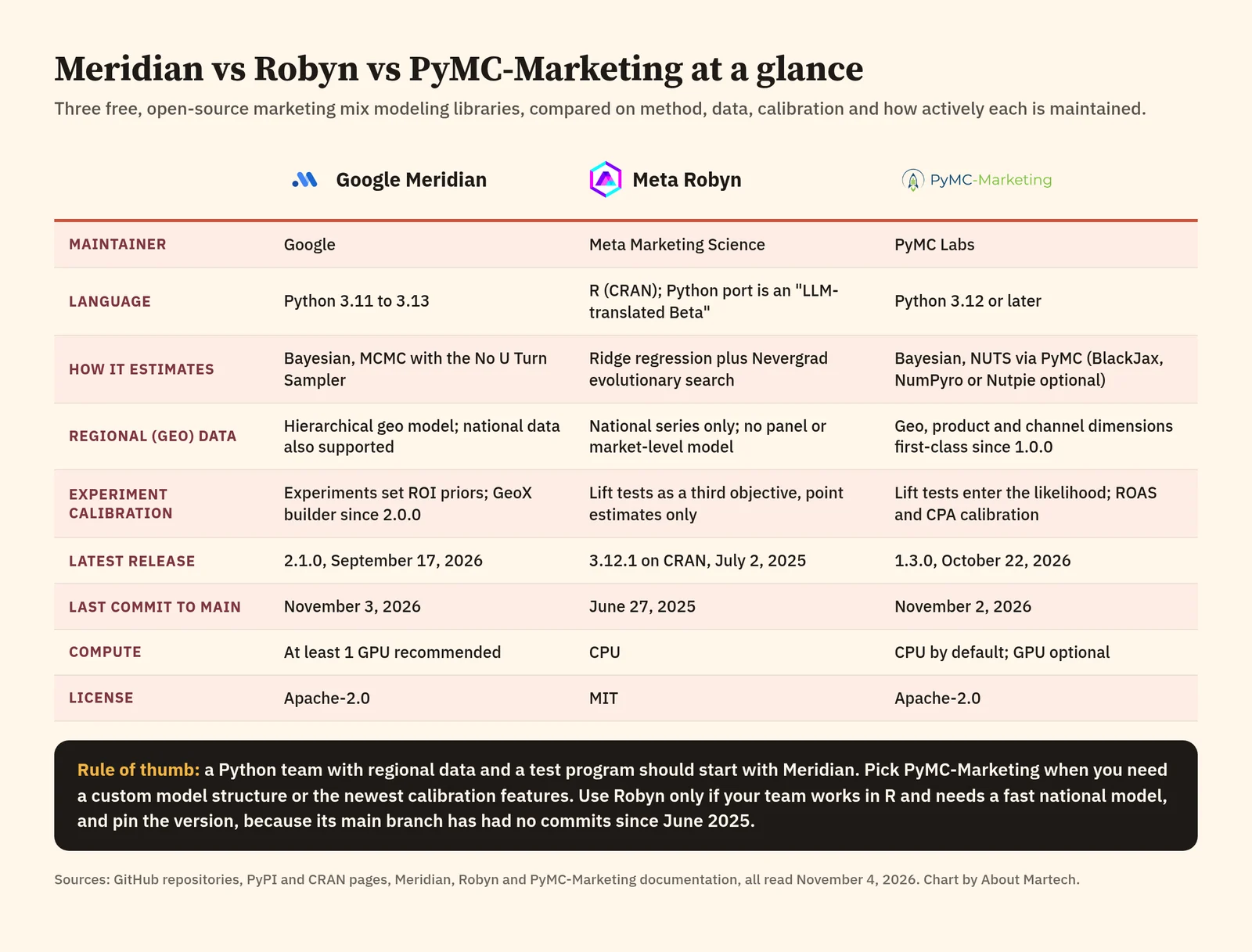
| Google Meridian | Meta Robyn | PyMC-Marketing | |
|---|---|---|---|
| Maintainer | Meta Marketing Science | PyMC Labs | |
| Language | Python 3.11 to 3.13 | R; Python port in beta | Python 3.12 or later |
| Estimation | Bayesian, MCMC (NUTS) | Ridge regression, Nevergrad search, Pareto set of models | Bayesian, NUTS via PyMC |
| Geo-level models | Yes, hierarchical | No, national only | Yes, multidimensional since 1.0.0 |
| Experiment calibration | Experiments become ROI priors; GeoX integration | Lift results as a third objective (MAPE.LIFT) | Lift tests added to the likelihood; ROAS and CPA calibration |
| Latest release | 2.1.0 (Sep 17, 2026) | 3.12.1 on CRAN (Jul 2, 2025) | 1.3.0 (Oct 22, 2026) |
| GitHub stars | 1,595 | 1,533 | 1,301 |
| License | Apache-2.0 | MIT | Apache-2.0 |
Sources: Meridian on GitHub, Meridian changelog, Robyn on GitHub, Robyn on CRAN, PyMC-Marketing on GitHub, PyMC-Marketing 1.3.0 release notes, ScanmarQED for Robyn’s national-only scope, read November 4, 2026. Star counts change daily.
Where each project stands in November 2026
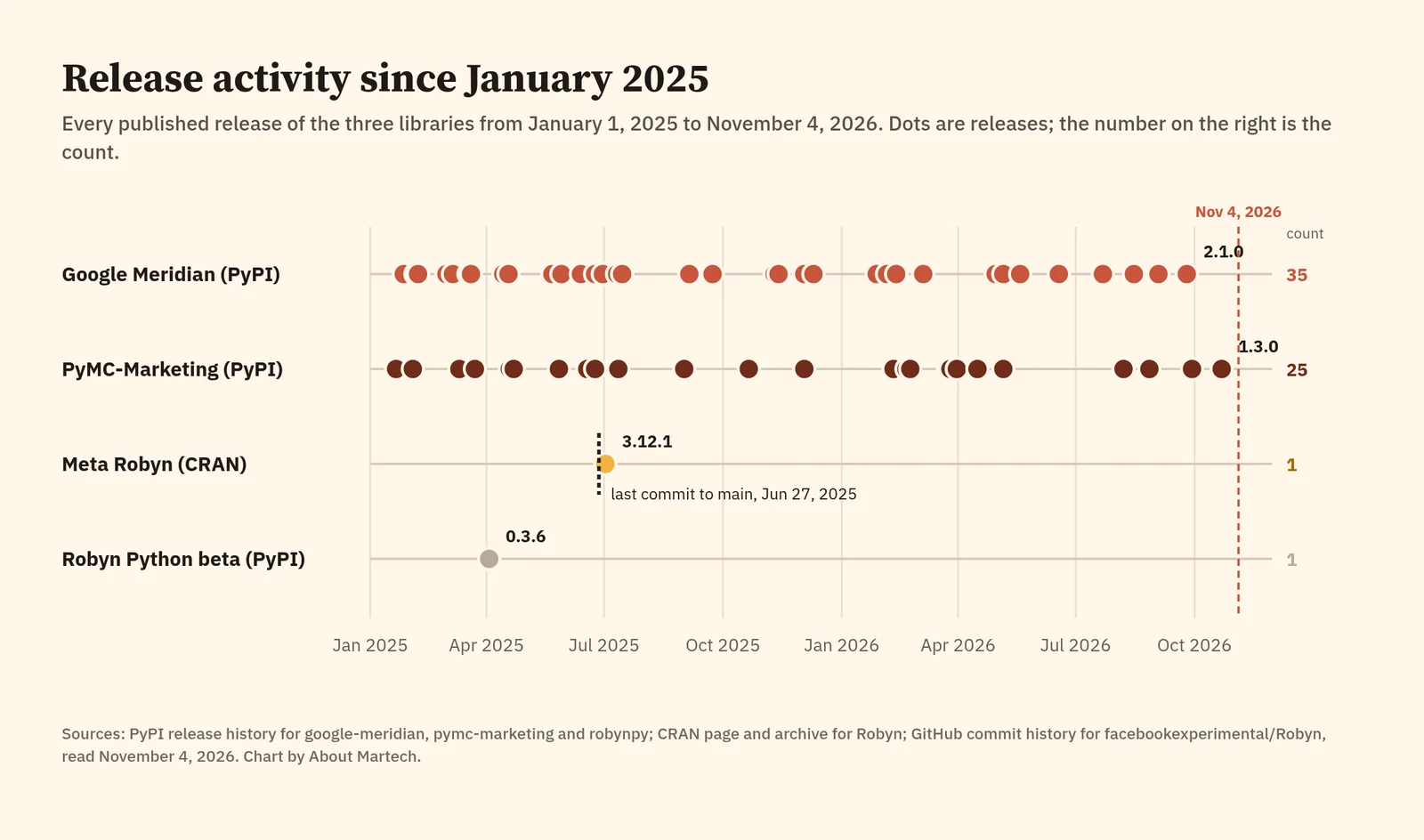
Most comparisons online were written before the latest round of releases, so this is the part most likely to be out of date elsewhere.
- Meridian moved to version 2. Meridian 2.0.0 (September 2, 2026) switched the default backend from TensorFlow to JAX, added prior calibration through incrementality experiments such as Meridian GeoX, and added channel calibration recommendations. Version 2.1.0 (September 17, 2026) lets you describe calibration windows and holdouts with channel names, geo names and dates instead of raw index arrays (Meridian changelog). PyPI lists 2.1.0 as the current package (PyPI).
- Google’s older library is retired. LightweightMMM is archived on GitHub, and Google describes Meridian as its updated version (LightweightMMM repository, Meridian migration guide). Do not start new work on LightweightMMM.
- PyMC-Marketing reached 1.0. Version 1.0.0 (August 7, 2026) made the multidimensional MMM the default, so geo, product and channel dimensions are first-class, and reported about 1.5x faster sampling (release notes). Version 1.3.0 (October 22, 2026) changed lift-test calibration to a signed Normal likelihood and added link-aware ROAS and cost-per-target calibration (release notes).
- Robyn has gone quiet. The last commit on the main branch is dated June 27, 2025 (GitHub commits). The newest R release is 3.12.1 on CRAN, published July 2, 2025 (CRAN), and the Python package robynpy has not been updated since version 0.3.6 in April 2025 (PyPI). Robyn still installs and works, but you should not expect new features or quick fixes.
Google Meridian: Bayesian, geo-first and built for calibration

Meridian is Google’s MMM framework. It is a Bayesian model sampled with MCMC using the No U Turn Sampler, and it is designed to model data at the geo level so that regions inform each other, though it also accepts national data. It can take reach and frequency as inputs for channels where you have them, which is useful for video and YouTube planning (Meridian README, Meridian introduction).
Calibration is where Meridian is strongest. Results from incrementality experiments become ROI priors, and Google provides a CalibrationBuilder that “automates the translation of incrementality experiments into calibrated ROI priors and includes direct integration for Meridian GeoX” (Meridian docs). GeoX, Google’s open-source geo experiment library, reached version 1.0.1 in September 2026 (Meridian GeoX).
The trade-off is compute and data. The README says Python 3.11 to 3.13 is required, recommends a minimum of 1 GPU and notes the project was tested on a T4 GPU with 16 GB of RAM (Meridian README). Google recommends at least two years of weekly data for geo-level models and three years for national models, or three years if you only have monthly data, and the KPI must be summable across geography and time (Meridian data guide).
| Best for | Python teams with regional data and a test program, especially heavy Google and YouTube advertisers |
| Watch out for | GPU recommended; geo data takes work to collect; version 2 changed several APIs, so older tutorials may break |
| Latest | 2.1.0, September 17, 2026; Apache-2.0 |
Meta Robyn: fast, automated and now in maintenance mode
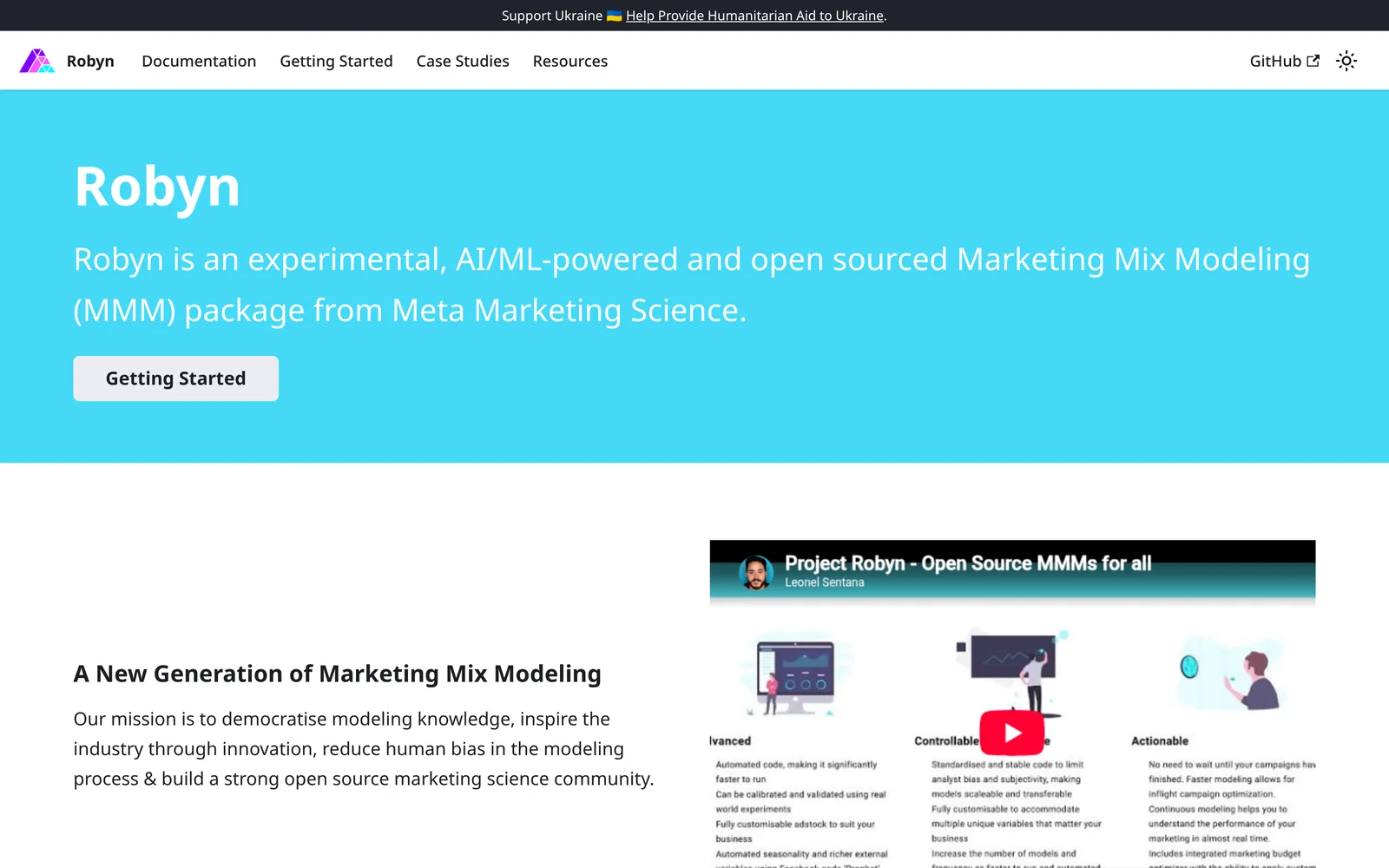
Robyn is Meta Marketing Science’s “experimental, semi-automated” MMM package. Instead of a Bayesian model it fits ridge regressions, uses the Nevergrad evolutionary optimizer to search adstock and saturation settings, and uses Prophet to decompose trend, seasonality and holidays. Meta says it is “especially suitable for digital and direct response advertisers with rich data sources” (Robyn README).
Robyn does not hand you one answer. It optimizes for prediction error (NRMSE) and a business-plausibility error (DECOMP.RSSD), and when you calibrate it adds a third objective, MAPE.LIFT, the gap between modeled and experimental lift. The output is a set of Pareto-optimal models that an analyst picks from (Robyn features). Meta recommends at least 2,000 iterations and 5 trials. Calibration takes experiment results as point estimates, not ranges (Robyn analyst’s guide).
Robyn is built for national-level models: market data is summed into one series, and it does not support panel or market-level estimation (ScanmarQED). Its guide asks for at least two years of weekly data and recommends a ratio of 1 independent variable to 10 observations (Robyn analyst’s guide). The Python version exists, but its own README calls it an “LLM-translated Beta version” that “might encounter bugs” (Robyn README).
| Best for | R teams that need a national model quickly and want automated hyperparameter search |
| Watch out for | No commits on main since June 2025; no geo hierarchy; analysts must choose among many candidate models |
| Latest | 3.12.1 on CRAN, July 2, 2025; MIT |
PyMC-Marketing: the most flexible, and the most hands-on
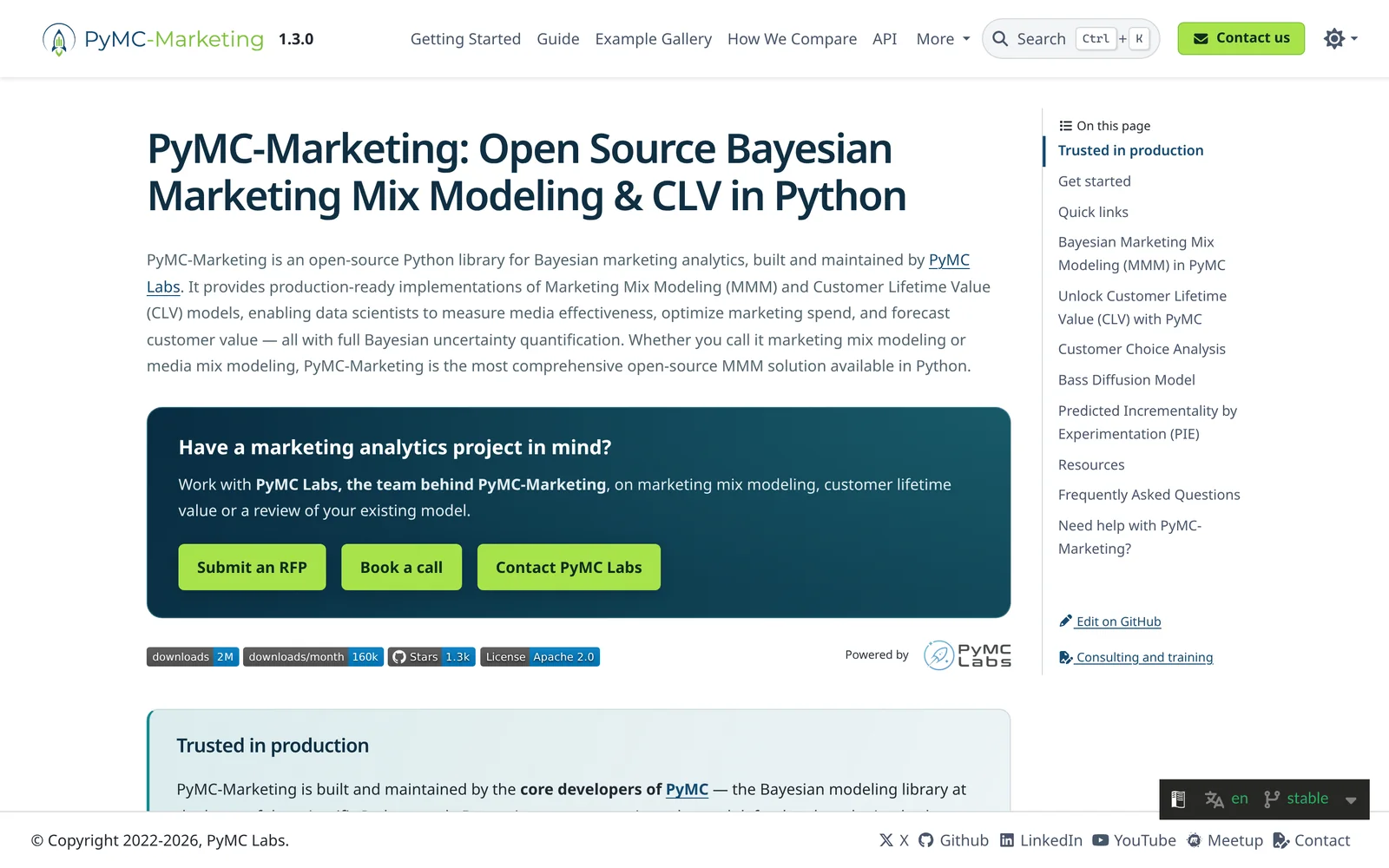
PyMC-Marketing is an open-source library from PyMC Labs built on the PyMC probabilistic programming framework. Like Meridian it is Bayesian, but it exposes far more of the model: you choose adstock and saturation functions, priors, time-varying intercepts and media effects, and samplers such as BlackJax, NumPyro or Nutpie, with GPU acceleration available through PyMC’s backends. It also includes budget optimization and customer lifetime value models (PyMC-Marketing README).
Its calibration works differently from both rivals. Lift test results are added to the model’s likelihood, so each experiment directly constrains the saturation curve of the channel it measured; since 1.3.0 the default likelihood “compares the signed estimated lift with the signed lift implied by the saturation curve” (lift test guide, 1.3.0 release notes). Version 1.0.0 also added an alpha feature that learns from geo tests, a funnel-aware MMM and long-term brand effects (1.0.0 release notes).
The cost is skill. You need Python 3.12 or later (PyPI) and someone who is comfortable setting priors and reading sampler diagnostics. PyMC Labs offers paid consulting and training around the library (README). Its own comparison page is a useful feature matrix, but it is written by the vendor, so read it with that in mind (PyMC-Marketing comparison).
| Best for | Teams with Bayesian skills that need custom structure: multiple geos and products, funnels, time-varying effects |
| Watch out for | Steeper learning curve; more choices mean more ways to build a bad model |
| Latest | 1.3.0, October 22, 2026; Apache-2.0 |
How they use your experiments
If you run conversion lift or geo tests, calibration is the most important difference between these libraries. It decides whether your test results actually change the model.
| How experiments enter the model | What that means for you | |
|---|---|---|
| Meridian | Experiment results are translated into ROI priors for the tested channel; CalibrationBuilder and GeoX integration since 2.0.0 | Tests pull the channel’s ROI toward what you measured, while uncertainty still shows in the posterior |
| Robyn | MAPE.LIFT is added as a third objective in the multi-objective search; point estimates only | Models that disagree with your tests are less likely to be on the Pareto front, but test uncertainty is ignored |
| PyMC-Marketing | Lift tests are added to the likelihood and constrain the saturation curve; ROAS and cost-per-target calibration | Most direct use of test data, and the most setup work |
Sources: Meridian, Robyn, Robyn analyst’s guide, PyMC-Marketing, read November 4, 2026.
Data you need before you start
| Requirement | Google Meridian | Meta Robyn | PyMC-Marketing |
|---|---|---|---|
| Minimum history | 2 years weekly (geo) or 3 years (national); 3 years if monthly | 2 years weekly | No fixed minimum published; same practical needs |
| Granularity | Geo-level preferred, national accepted | National only | National or multidimensional (geo, product) |
| Rule of thumb | KPI must be summable across geography and time | 1 variable to 10 observations | Depends on the priors you set |
| Experiment inputs | Incrementality results by channel and period | Lift point estimates with start and end dates | Lift tests with spend change and measured lift |
Sources: Meridian data guide, Robyn analyst’s guide, PyMC-Marketing docs, read November 4, 2026. “No fixed minimum published” means we did not find a stated minimum in the PyMC-Marketing documentation.
Time, team and compute
Free software still has a price. Robyn’s analyst guide is the only one of the three to publish an end-to-end project timeline: 1 to 2 weeks to define scope, 4 to 6 weeks for data collection, 1 to 2 weeks for data review, 4 to 8 weeks for modeling and 2 to 4 weeks for analysis and recommendations (Robyn analyst’s guide). Added up, that is 12 to 22 weeks for a first model, and it is a fair planning baseline for any of the three because most of the time goes into data, not code.
- Meridian: needs a Python analyst who understands Bayesian outputs, plus a GPU environment for reasonable run times.
- Robyn: needs an R analyst; runs on CPU; the work is choosing and defending one model from the Pareto set.
- PyMC-Marketing: needs the strongest statistics skills of the three; runs on CPU by default, with GPU optional.
If nobody on your team can own that work, an open-source library will stall. That is when a managed platform is the better buy. Our list of marketing mix modeling software compares paid options, and our guide to measuring marketing ROI without cookies explains where MMM fits next to experiments and attribution.
Which one should you pick?
- Pick Google Meridian if you work in Python, have at least two years of weekly regional data, spend heavily on Google and YouTube, or want to calibrate with geo experiments. It is the most actively released of the three.
- Pick PyMC-Marketing if you have a data scientist with Bayesian experience and need things the others do not offer, such as a custom model structure, funnel effects or the most direct use of lift tests.
- Pick Meta Robyn if your team works in R, you only have national data, you need a first model quickly, and you are comfortable maintaining a frozen version yourself.
- Pick none of them if you lack two years of clean weekly data or an analyst who can own the model. Start with marketing attribution software and incrementality tests, then come back to MMM.
How we compared these libraries
On November 4, 2026 we read the GitHub repositories, release notes and commit history for google/meridian, facebookexperimental/Robyn and pymc-labs/pymc-marketing; the PyPI pages for google-meridian, pymc-marketing and robynpy; Robyn’s CRAN page and archive; and the documentation for all three. We counted every release published from January 1, 2025 to November 4, 2026. We also captured each homepage the same day. We did not fit the three models on a shared dataset, so we make no claims about which one is more accurate.
Frequently asked questions
What is the difference between Meridian and Robyn?
Meridian is Google’s Bayesian MMM in Python. It models geo-level data and turns experiments into ROI priors. Robyn is Meta’s MMM in R. It uses ridge regression with an evolutionary search, models national data only and returns a set of candidate models. Meridian released 2.1.0 in September 2026, while Robyn’s last CRAN release was July 2025.
Is Meta Robyn still maintained?
Robyn still installs, but development has slowed. The main branch on GitHub has had no commits since June 27, 2025, the latest CRAN release is 3.12.1 from July 2, 2025, and the Python beta was last updated in April 2025.
Is PyMC-Marketing better than Robyn?
PyMC-Marketing is more flexible and actively developed, with version 1.3.0 released in October 2026, and it gives full Bayesian uncertainty. Robyn is faster to start for R users who need a national model. PyMC-Marketing asks for more statistical skill.
Does Google Meridian still use TensorFlow?
No longer by default. Meridian 2.0.0, released September 2, 2026, switched the default backend from TensorFlow to JAX.
How much data do I need for marketing mix modeling?
Meridian recommends at least two years of weekly data for geo-level models and three years for national models. Robyn recommends at least two years of weekly data and about 10 observations for every variable in the model.
Are Meridian, Robyn and PyMC-Marketing free?
Yes. Meridian and PyMC-Marketing use the Apache-2.0 license and Robyn uses the MIT license. The cost is the analyst time and compute to collect data, build and maintain the model.
What happened to LightweightMMM?
Google archived the LightweightMMM repository and describes Meridian as its updated version. New projects should use Meridian.
How long does it take to build an MMM with an open-source library?
Robyn’s analyst guide estimates 1 to 2 weeks for scoping, 4 to 6 for data collection, 1 to 2 for data review, 4 to 8 for modeling and 2 to 4 for analysis, or 12 to 22 weeks in total for a first model.