OneSignal is still the default push notification tool for a lot of apps and websites, and it is well liked: 4.7 out of 5 from 1,252 reviews on G2 (G2). What changed in 2026 is the free plan. Since September 1 for new accounts and October 1 for existing ones, the Free plan only sends mobile push and in-app messages for organizations with fewer than 1,000 monthly active users (OneSignal). Above that, you pay for Growth or you move.
We compared seven OneSignal alternatives that marketing and growth teams actually switch to, using each vendor’s pricing page and G2 ratings, all read on November 10, 2026. If you are still choosing your first push tool, start with our guide to the best push notification software.
TLDR
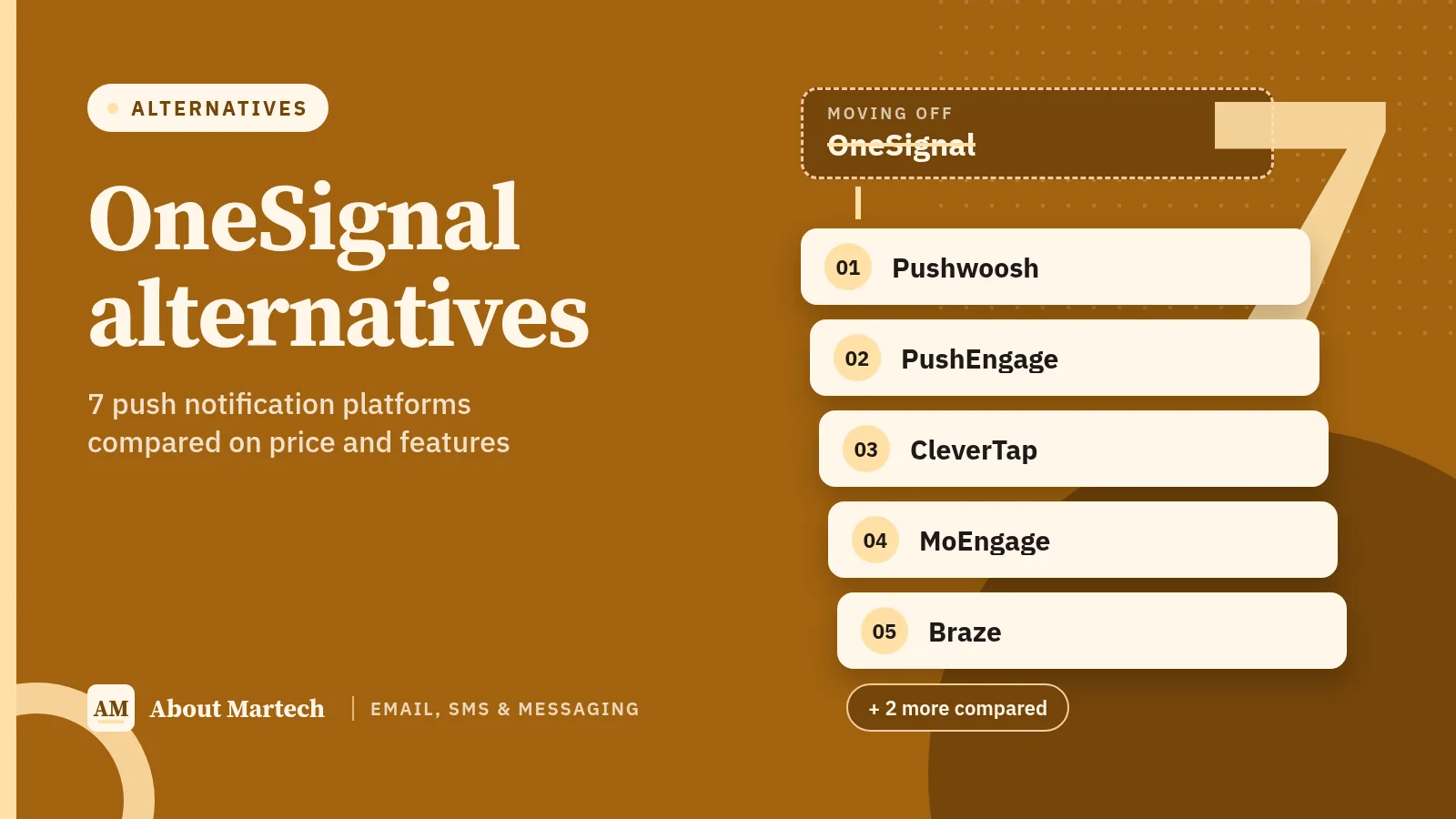
Short answer: If you send mobile push and want a published price, Pushwoosh is the closest OneSignal alternative: the first 1,000 monthly active users are free and push costs $7 per 1,000 after that, against OneSignal Growth at $19 a month plus $0.012 per mobile user. For web push on a website or store, PushEngage starts at $8 a month on a yearly plan. CleverTap, MoEngage, Braze and Airship are full engagement suites for larger apps, quoted by sales. Firebase Cloud Messaging is free, but your developers build everything above delivery.
- What changed at OneSignal: the Free plan stops mobile push and in-app messages once an organization passes 1,000 monthly active users; web push and email keep working.
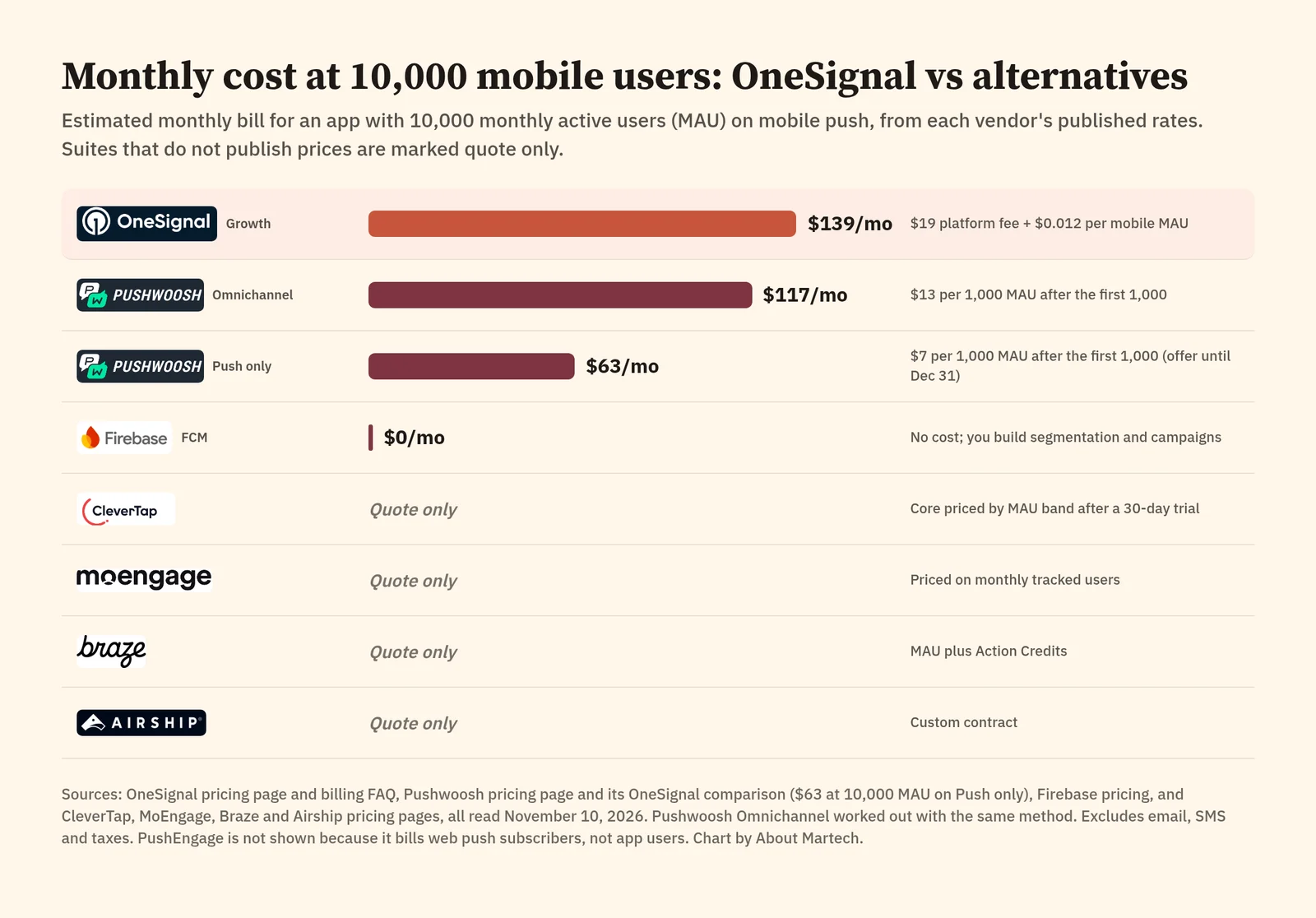
- Cost at 10,000 mobile users: about $139 a month on OneSignal Growth and $63 on Pushwoosh Push only, based on each vendor’s published rates.
- Cheapest paid web push: PushEngage Business, $8 a month for the first year on yearly billing.
- Highest G2 rating in this list: OneSignal itself (4.7); PushEngage is the top alternative at 4.6.
In this guide
OneSignal alternatives at a glance
| Platform | Best for | Entry price (published) | Bill grows with | G2 rating |
|---|---|---|---|---|
| OneSignal (for reference) | Self-serve push, in-app, email and SMS | Free under 1,000 MAU; Growth from $19 a month plus usage | Mobile MAU, web push subscribers, email sends | 4.7 (1,252 reviews) |
| Pushwoosh | Mobile apps that want a published per-user price | $0 up to 1,000 MAU, then $7 per 1,000 MAU (Push only) | Monthly active users | 4.4 (55) |
| PushEngage | Web push for sites and online stores | Free for 200 subscribers; Business from $8 a month (yearly, first year) | Subscribers | 4.6 (53) |
| CleverTap | Mobile-first brands that want analytics and journeys in one tool | Core is self-serve after a 30-day free trial; Pro and Ultimate by demo | MAU or data points | 4.5 (779) |
| MoEngage | Consumer brands running many channels | Quote (Growth and Enterprise plans) | Monthly tracked users | 4.5 (535) |
| Braze | Enterprise cross-channel orchestration | Quote (Go, Select, Pro, Enterprise); free trial offered | MAU plus Action Credits | 4.5 (1,990) |
| Airship | Large mobile apps, Live Activities and wallet | Quote; Airship Essentials is self-service | Custom contract | 4.0 (83) |
| Firebase Cloud Messaging | Developers who will build the tooling | No cost | Nothing (delivery only) | Not rated separately |
Sources: vendor pricing pages and G2 product pages, all read on November 10, 2026. MAU means monthly active users. Prices are in US dollars and billed monthly unless noted.
Why teams look for OneSignal alternatives in 2026
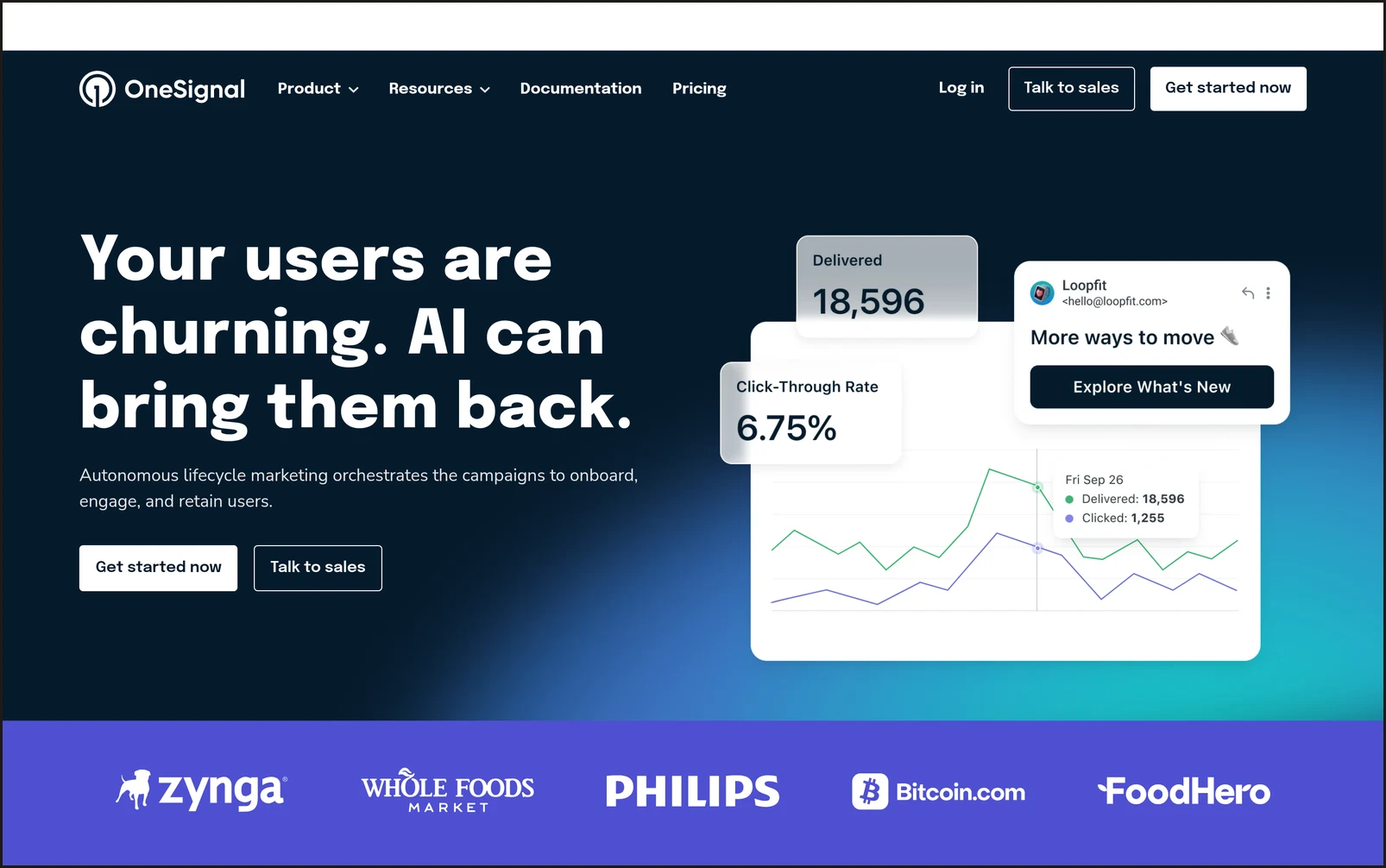
Most teams that leave OneSignal are not unhappy with delivery. The reasons are mostly about price and depth:
- The Free plan now has a mobile user cap. Organizations need fewer than 1,000 MAU to keep sending mobile push and in-app messages on Free. The count is a trailing 30 days across every app in the organization, you get 24 hours to upgrade after crossing it, and deleting users does not lower the count until that activity ages out (OneSignal billing FAQ). Web push, email and SMS keep working under the old Free limits.
- Growth is billed on every active mobile user. Growth is $19 a month plus $0.012 per mobile MAU, whether or not that user opted in to push, plus $0.004 per web push subscriber and $1.50 per 1,000 emails after 20,000 free sends (OneSignal pricing). The MAU count is per device, so one person on two phones counts twice (OneSignal billing FAQ).
- Advanced controls sit on annual plans. Growth includes 5 active Journeys and 10 segments; Professional and Enterprise are annual contracts, and frequency capping is listed only on Enterprise (OneSignal pricing). Organizations above 50,000 MAU are asked to contact sales.
- Reporting depth. G2’s summary of OneSignal reviews says users want deeper analytics that connect campaigns to conversions and revenue (G2).
Some older reviews, including earlier versions of our own guides, quote OneSignal paid plans from $9 a month. The pricing page now shows Growth starting at $19 a month plus usage (OneSignal pricing).
What to check before you switch
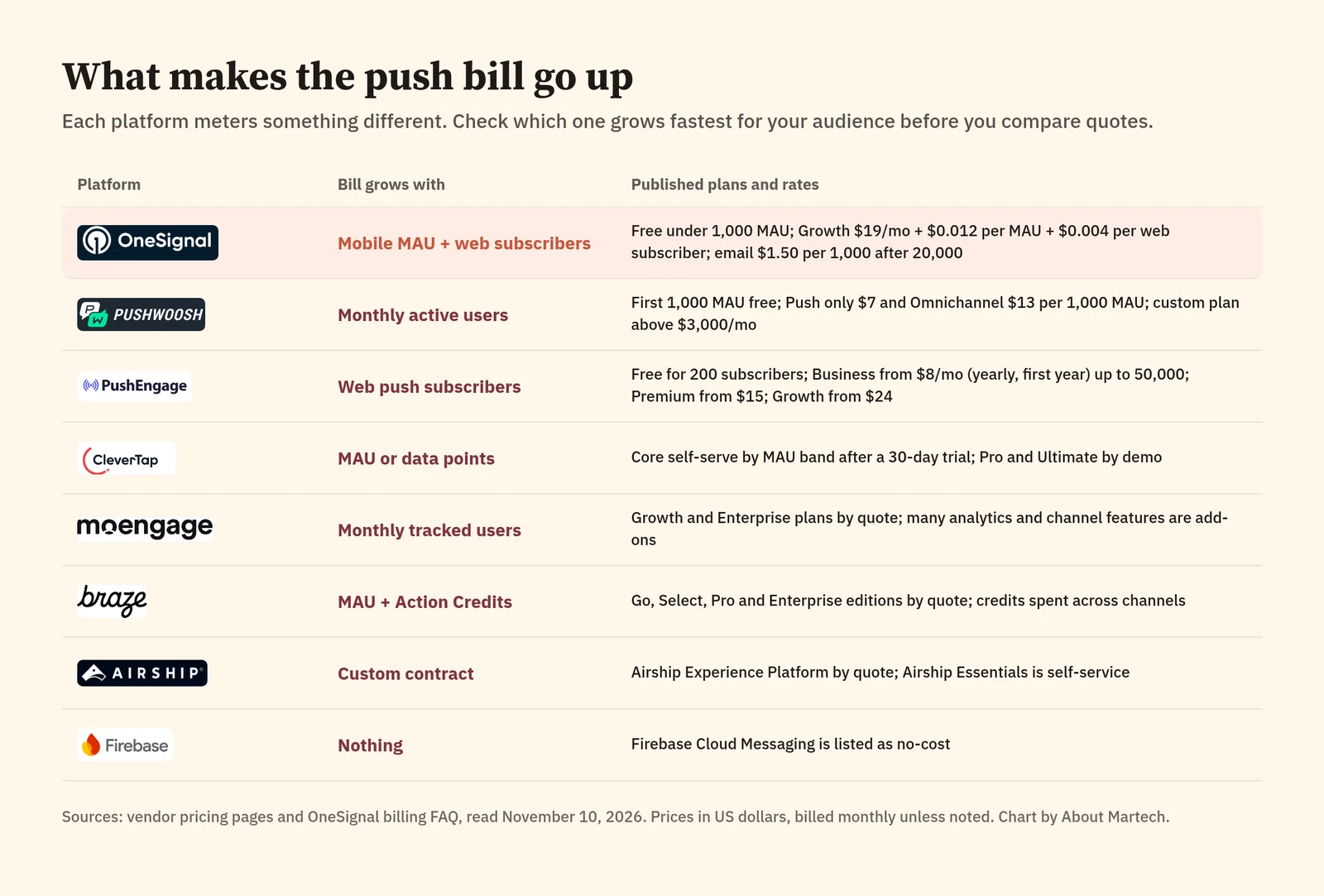
- What the bill counts. OneSignal and Pushwoosh count active mobile users, PushEngage counts web subscribers, MoEngage counts monthly tracked users, and Braze adds Action Credits on top of MAU. Run your real numbers through each meter before you compare quotes.
- Web push, mobile push or both. A website with no app can use a web-first tool like PushEngage. An app with millions of users needs SDK depth, Live Activities and in-app messages, which is where CleverTap, MoEngage, Braze and Airship compete.
- Who will run it. Self-serve tools let one marketer launch in days. G2 reviewers most often report one to three months to go live on CleverTap and Braze, and Airship’s G2 profile lists a 3-month average implementation.
- Device tokens and IDs. Push tokens belong to your app, not to OneSignal, so you can re-register devices with a new SDK. Plan how you will map OneSignal external IDs and tags to the new tool.
- Security review. If you are in a regulated industry, ask each vendor for its certifications and data residency options before you sign.
The 7 best OneSignal alternatives
1. Pushwoosh: best for mobile apps that want a published per-user price
| Best for | Mobile apps that want a published per-user price |
| Entry price | $0 up to 1,000 MAU; Push only $7 per 1,000 MAU; Omnichannel $13 per 1,000 MAU |
| Channels | Mobile and web push, in-app, email, SMS, WhatsApp and other messengers |
| G2 rating | 4.4 out of 5 (55 reviews) |
| Setup | 2 to 10 days to integrate the SDK and import users, per Pushwoosh |
Pushwoosh is the most direct swap for teams that like OneSignal’s self-serve model but not its per-user rate. Its pricing page lists one metric, monthly active users, with the whole platform on every plan: journeys, segmentation, A/B testing, API access and its ManyMoneyAI copilot (Pushwoosh pricing). The $7 Push only rate is a limited offer until December 31, locked for 24 months after signup, and covers mobile push, in-app and web push. Above $3,000 a month, Pushwoosh moves you to a custom plan.
At 10,000 monthly active users, Pushwoosh puts Push only at $63 a month (Pushwoosh), against about $139 on OneSignal Growth at OneSignal’s published rates. Buyers in government or regulated sectors should know that in November 2022, citing Reuters, The Register reported that US agencies including the Army and the CDC pulled apps running Pushwoosh code after learning that the company, which presented itself as American, is Russian (The Register). Pushwoosh now lists ISO 27001:2022, SOC 2 Type 2 and HIPAA compliance on its pricing page.
Where it beats OneSignal: a lower published price per mobile user, no feature gating between plans, and journeys, segmentation and email in the same plan.
Where it falls short: its G2 review base is small (55 reviews), reviewers mention menus that are hard to navigate, and some buyers will need extra vendor review because of the 2022 reports about its Russian roots.
2. PushEngage: best for web push for websites and online stores
| Best for | Web push for websites and online stores |
| Entry price | Free for 1 site, 200 subscribers and 30 campaigns; Business $8 a month for the first year on yearly billing |
| Paid tiers | Business up to 50,000 subscribers; Premium from $15 a month; Growth from $24 a month (first-year yearly prices) |
| G2 rating | 4.6 out of 5 (53 reviews) |
| Guarantee | 14-day money-back guarantee on paid plans |
PushEngage is built for marketers who send push from a website or store rather than an app, though it also supports Android and iOS app push. Business renews at $14 a month on yearly billing, or $19 month to month (PushEngage pricing). Premium adds drip campaigns, A/B tests and time zone sending; Growth adds WooCommerce cart abandonment, browse abandonment, back-in-stock and price drop alerts.
Pricing is set by subscriber count, starting from 1,000 subscribers, and PushEngage says it does not stop campaigns when you go over; it moves you to the next plan. G2 reviewers mostly praise ease of use and support, with some saying the dashboard is confusing at first (G2).
Where it beats OneSignal: a cheaper path for web push audiences, with ecommerce triggers that OneSignal does not package for WooCommerce stores.
Where it falls short: introductory prices rise at renewal, and it is not built for large mobile apps that need deep in-app messaging and analytics.
3. CleverTap: best for mobile-first brands that want analytics and journeys in one tool
| Best for | Mobile-first brands that want analytics and journeys in one tool |
| Entry price | Core: self-serve, priced by MAU band (from up to 5,000 MAU), billed after a 30-day free trial |
| Plans | Core, Pro and Ultimate (Pro and Ultimate by demo) |
| G2 rating | 4.5 out of 5 (779 reviews) |
| Data retention | 3 years on Core and Pro, 10 years on Ultimate |
CleverTap combines behavioral analytics, segmentation and journeys with push, in-app, web push, email and SMS. Plan pricing is based on monthly active users or data points, and Core can be started as a free trial (CleverTap pricing). WhatsApp, email and promos are add-ons on every plan; RCS and Product Experiences need Pro or Ultimate.
G2 notes that teams have moved to CleverTap from OneSignal, MoEngage and Braze, usually for stronger behavioral analytics and real-time journeys (G2). Implementation most often takes one to three months.
Where it beats OneSignal: built-in funnels, cohorts and RFM segments, so you can find at-risk users without exporting data to another tool.
Where it falls short: more setup than OneSignal, Core’s self-serve price depends on the MAU band you pick, and Pro and Ultimate need a demo, so model costs at your real user count.
4. MoEngage: best for consumer brands running many channels from one platform
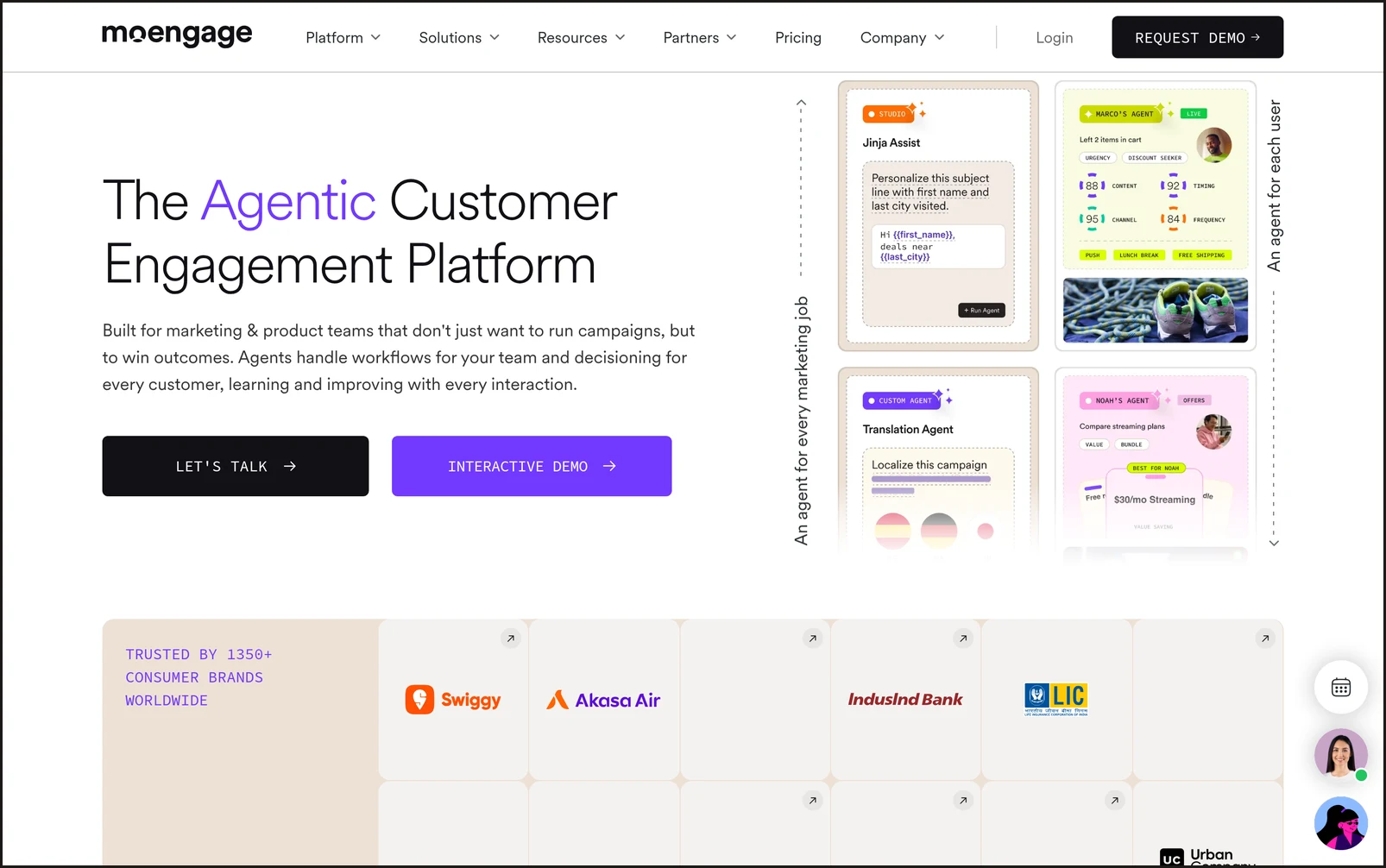
| Best for | Consumer brands running many channels from one platform |
| Entry price | Quote; Growth and Enterprise plans |
| Billing unit | Monthly tracked users (MTU) |
| G2 rating | 4.5 out of 5 (535 reviews) |
| Channels | Mobile and web push, email, SMS, in-app, on-site, cards and connected channels such as WhatsApp |
MoEngage prices on monthly tracked users: each unique user who has a session or a defined event in a calendar month, counted once (MoEngage pricing). Both plans include mobile and web push, email, SMS and in-app messages; cards, Personalize, connected channels and most deeper analytics are add-ons. MoEngage says its Push Amplification+ raises push delivery rates by up to 25%.
G2 reviewers like the segmentation and journey flexibility and say paid add-ons can make the full suite expensive; some want faster support on urgent issues (G2).
Where it beats OneSignal: cross-channel journeys and push delivery features built for large consumer apps.
Where it falls short: no published price, and several features that OneSignal includes are add-ons on MoEngage.
5. Braze: best for enterprise cross-channel orchestration
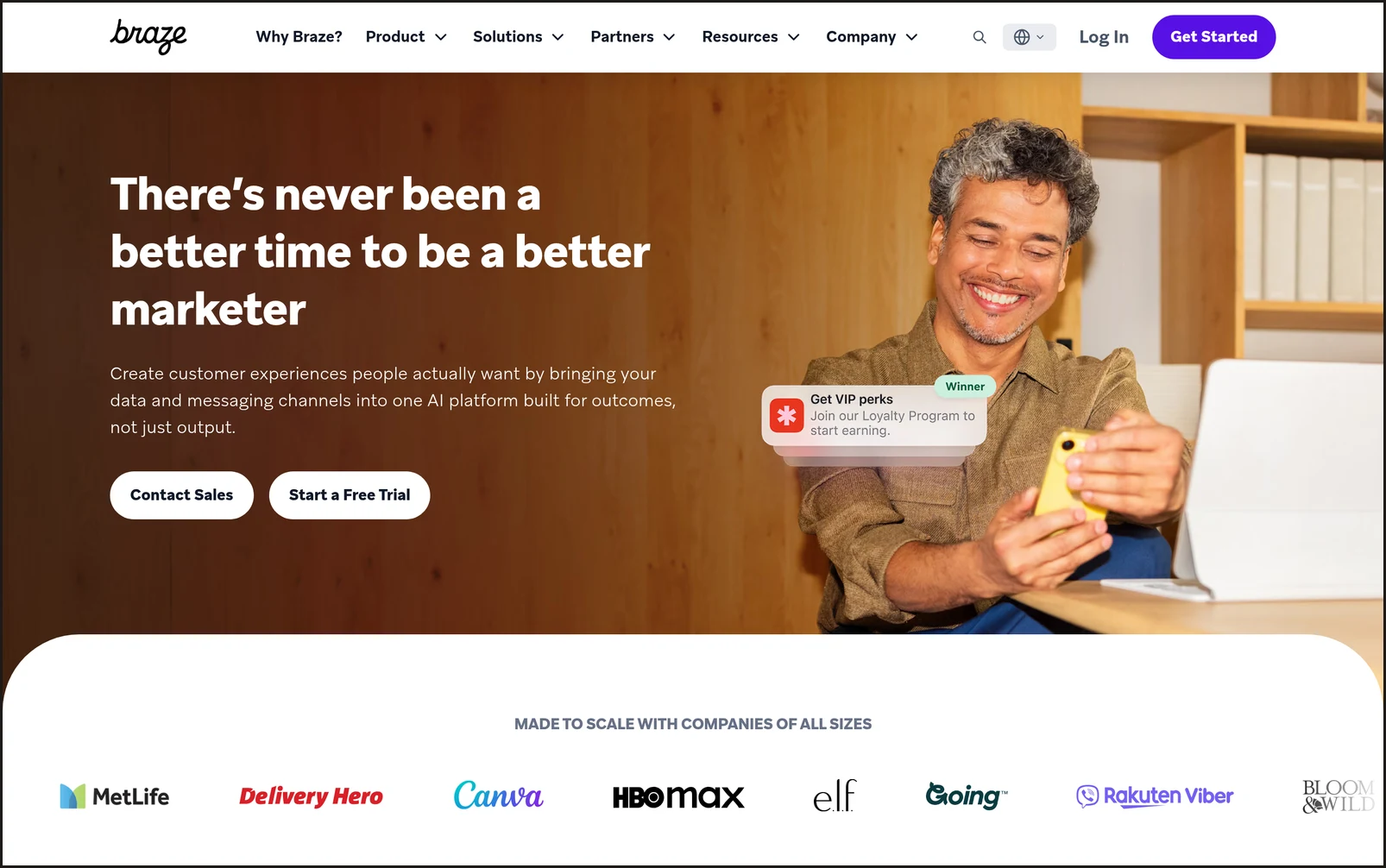
| Best for | Enterprise cross-channel orchestration |
| Entry price | Quote; Braze Go, Select, Pro and Enterprise editions; free trial offered |
| Billing unit | Monthly active users plus Action Credits for messaging |
| G2 rating | 4.5 out of 5 (1,990 reviews) |
| Typical go-live | 1 to 3 months, per G2 reviewers |
Braze is a full customer engagement platform where push is one channel among email, SMS, RCS, WhatsApp, in-app messages, Content Cards and more (Braze pricing). Pricing scales with monthly active users, and Action Credits are spent across channels and some BrazeAI products, so you can shift volume between channels without renegotiating.
Reviewers praise Canvas journeys and Liquid personalization, and mention a steep learning curve and limited native reporting (G2). Our customer messaging guide covers how push fits with the other channels Braze runs.
Where it beats OneSignal: deep journey orchestration, real-time segmentation and personalization at enterprise scale.
Where it falls short: quote-only pricing, a longer implementation, and more platform than a team that only sends push needs.
6. Airship: best for large mobile apps that use Live Activities, wallet passes and in-app experiences
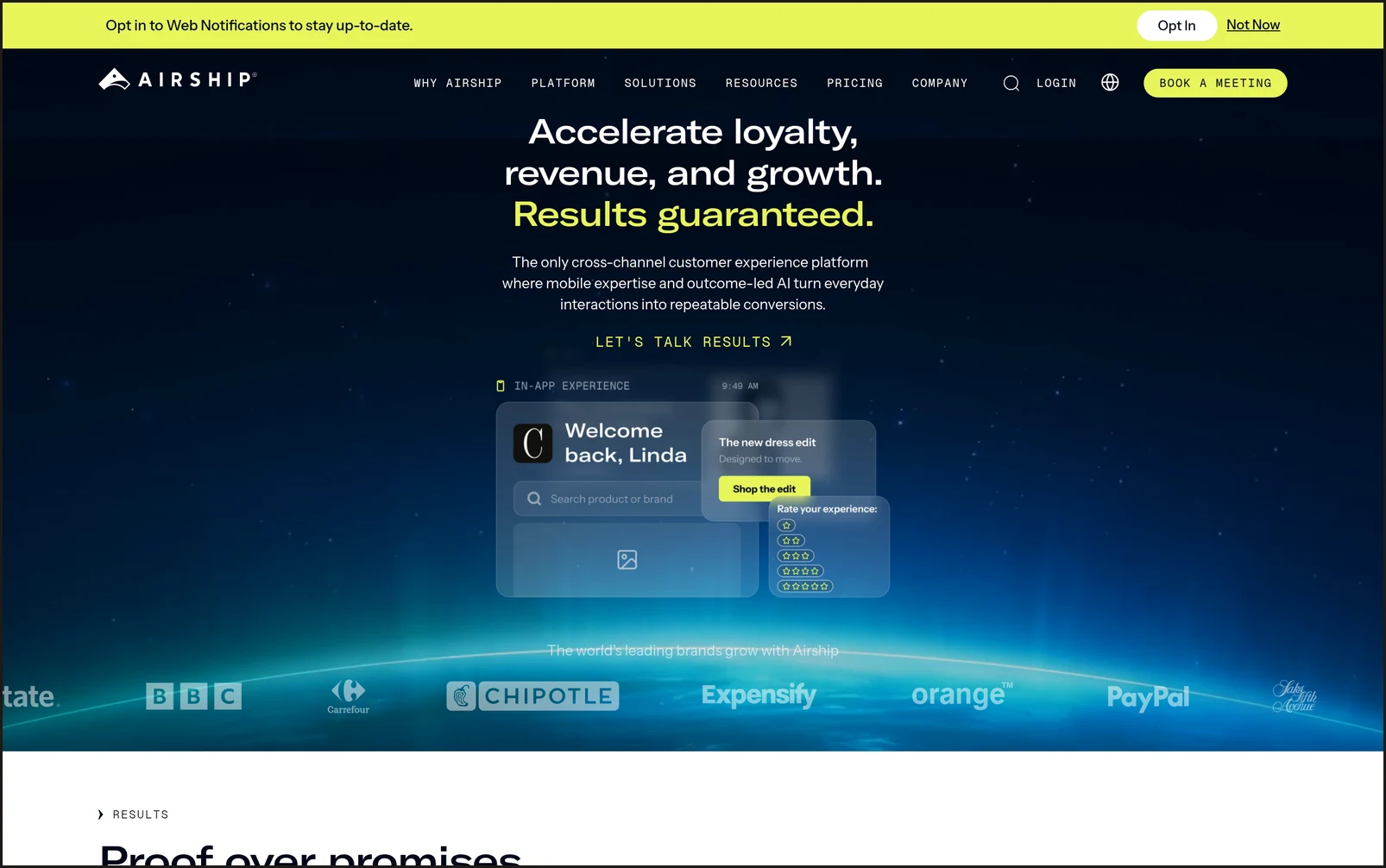
| Best for | Large mobile apps that use Live Activities, wallet passes and in-app experiences |
| Entry price | Quote for the Airship Experience Platform; Airship Essentials is a self-service, no-code option |
| Channels | Push, web notifications, email, SMS, RCS, MMS, mobile wallet, app and web |
| G2 rating | 4.0 out of 5 (83 reviews) |
| Typical go-live | 3 months, per G2 |
Airship says it delivered the industry’s first push notification (G2 profile), and it now sells a cross-channel platform with journey orchestration, testing and a no-code experience editor for app and web (Airship pricing). Pricing is by quote, and Airship Essentials is the self-service starting point for growth teams.
Its G2 rating is the lowest in this list. Reviewers like the reach and app-message tools, but several describe slow support, complex performance analytics and limited A/B testing across sequences (G2).
Where it beats OneSignal: mobile wallet passes, Live Activities and native in-app experiences that can change without an app update.
Where it falls short: no published price, a lower G2 score than the other suites, and a learning curve on reporting.
7. Firebase Cloud Messaging: best for developers who will build the tooling themselves
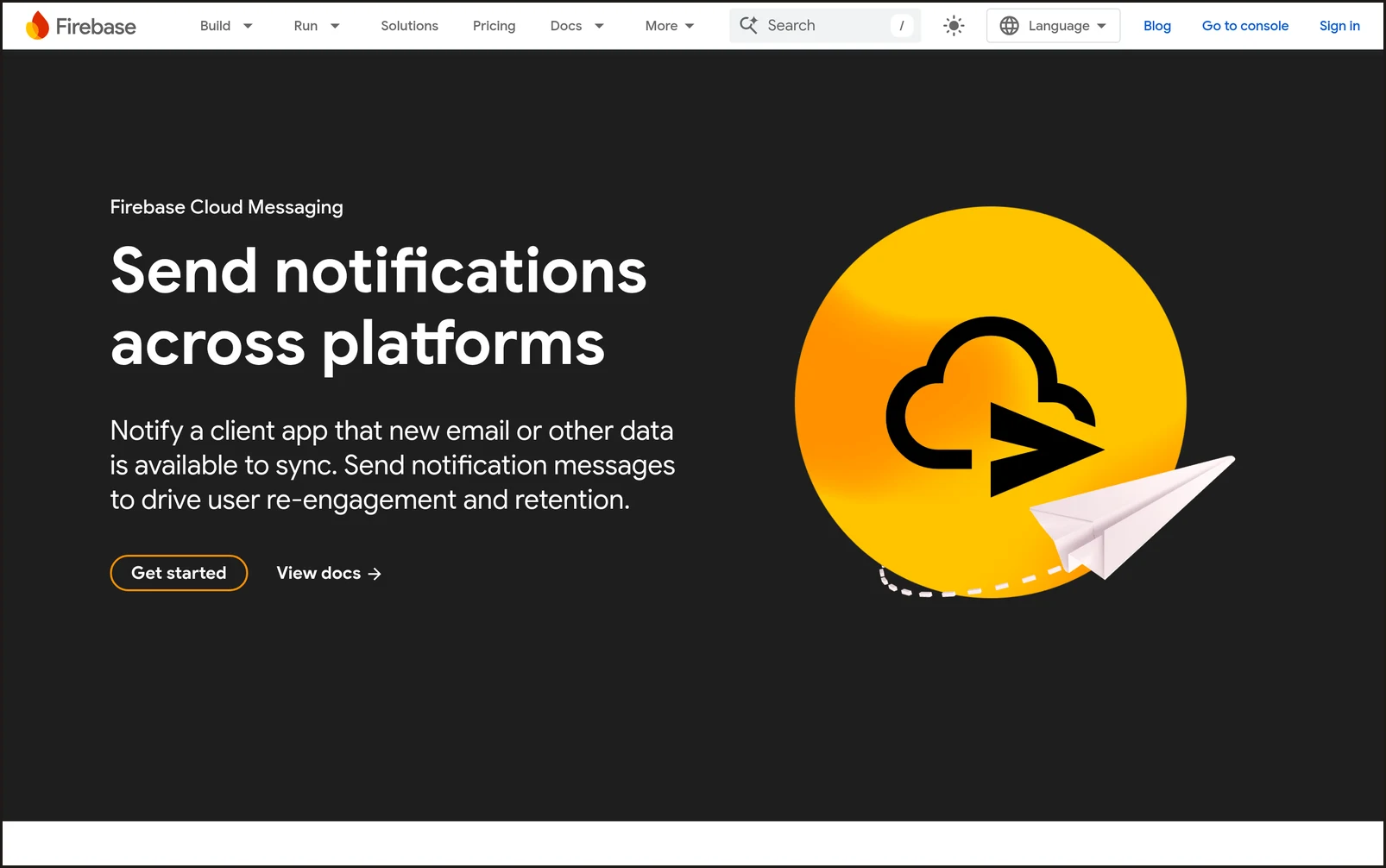
| Best for | Developers who will build the tooling themselves |
| Entry price | No cost |
| What you get | Message delivery to Android, iOS and web |
| What you build | Segmentation, scheduling, journeys, A/B tests and reporting |
| G2 rating | Not rated separately from Firebase |
Firebase Cloud Messaging is Google’s push delivery service, and Firebase lists it as no-cost (Firebase pricing). It is the right choice when your engineers already manage device tokens and you only need to send transactional alerts, such as order updates or chat messages.
For marketers it is not a like-for-like swap. Developers on Reddit put it this way: FCM is free for push, but you build more yourself (Reddit r/webdev).
Where it beats OneSignal: cost: delivery is free at any volume, with no per-user fee.
Where it falls short: there is no campaign dashboard, segmentation, journeys or analytics; you write all of it.
Which OneSignal alternative should you pick?
- Pick Pushwoosh if you run a mobile app past 1,000 MAU and want a published price per active user.
- Pick PushEngage if your audience is on a website or WooCommerce store and you mainly send web push.
- Pick CleverTap if you want analytics, segmentation and journeys in one tool for a mobile-first brand.
- Pick MoEngage if you are a consumer brand running push alongside email, SMS and WhatsApp.
- Pick Braze if you have an engineering team and need enterprise orchestration across every channel.
- Pick Airship if wallet passes, Live Activities and native app experiences matter most.
- Pick Firebase Cloud Messaging if you only need delivery and have developers to build the rest.
- Stay on OneSignal if you are under 1,000 MAU, or the Growth bill at your user count is acceptable and you value its ease of use.
Sending push next to SMS and WhatsApp? Our list of enterprise omnichannel messaging platforms compares tools that keep brand identity consistent across channels, and our Twilio alternatives guide covers the SMS side.
How to migrate off OneSignal
- Export users and tags first. Export subscriptions, external IDs and data tags from OneSignal so segments can be rebuilt in the new tool.
- Ship the new SDK before you switch off the old one. Devices re-register their push tokens with the new SDK as users open the app, so run both for at least one release cycle.
- Rebuild journeys, do not copy them. Map each OneSignal Journey and trigger to the new tool’s events and test with a small segment.
- Re-prompt web push carefully. Web push permission belongs to your domain, but each tool uses its own service worker, so check how the new vendor migrates existing browser subscribers.
- Watch your MAU during the overlap. On OneSignal, activity in the last 30 days still counts toward the Free plan limit (OneSignal billing FAQ).
If you also track app retention, our guide to mobile app analytics platforms covers tools that feed push segments.
How we chose these OneSignal alternatives
We read the pages that rank for “OneSignal alternatives” and “OneSignal competitors”. Four of the top five are written by vendors that compete with OneSignal, so we built our own list for marketing and growth teams: self-serve push tools, enterprise engagement suites and one free developer option. Every price, limit and rating comes from the vendor’s own pricing page, OneSignal’s billing documentation, or G2, read on November 10, 2026. Monthly costs at 10,000 users are worked out from published rates; your quote may differ. We did not run live trials of each tool, and no vendor paid to be included.
Frequently asked questions
What is the best alternative to OneSignal?
For mobile apps, Pushwoosh is the closest alternative with a published price: the first 1,000 monthly active users are free and push costs $7 per 1,000 MAU after that. PushEngage is better for web push on websites and stores, and CleverTap, MoEngage, Braze and Airship suit larger apps that need full engagement suites.
Is OneSignal still free?
Partly. Since September 1, 2026 for new accounts and October 1, 2026 for existing ones, the Free plan only sends mobile push and in-app messages for organizations with fewer than 1,000 monthly active users. Web push, email and SMS keep working under the Free plan limits.
How much does OneSignal cost?
OneSignal Growth starts at $19 a month plus usage: $0.012 per mobile monthly active user, $0.004 per web push subscriber and $1.50 per 1,000 emails after 20,000 free sends. Professional and Enterprise are custom annual contracts.
What happens if I go over 1,000 MAU on the OneSignal Free plan?
You get 24 hours to upgrade. After that, mobile push and in-app messages stop sending until you upgrade, and Journeys skip push and in-app steps for mobile users. MAU is counted over a trailing 30 days.
What is the cheapest OneSignal alternative?
Firebase Cloud Messaging costs nothing, but it is delivery only. Among tools with a campaign dashboard, Pushwoosh is free up to 1,000 MAU and PushEngage has a free plan for 200 subscribers and paid web push from $8 a month on a yearly plan.
Is Braze better than OneSignal?
Braze is a bigger platform, not a direct swap. It suits enterprises that need cross-channel journeys and personalization and can spend one to three months on implementation. OneSignal is easier to set up and has published self-serve pricing.
Can I keep my push subscribers when I leave OneSignal?
Yes for mobile apps, because push tokens belong to your app: devices re-register with the new SDK when users open the app. For web push, check how the new vendor migrates browser subscriptions, since each tool uses its own service worker.