Telnyx, Twilio and Sinch are the three names that come up most when a team prices an SMS or voice API in 2026. Twilio is the default most developers start on. Telnyx is the licensed carrier that undercuts it on published US rates. Sinch is the enterprise messaging network that big brands buy under contract. They price the same message and the same minute very differently, and several of the comparisons that rank for these names have not caught up with this year’s changes.
We read every rate on each vendor’s own US pricing pages, their carrier fee and 10DLC fee pages, coverage pages, support plans, G2 and Gartner’s 2026 CPaaS placements, all on November 10, 2026. If Sinch is your current provider and you want a wider shortlist, see our guide to Sinch alternatives.
TLDR
Short answer: Pick Telnyx if cost per message and per minute matters most and your traffic is mostly in North America and Europe: it lists US SMS at $0.004 a part and US outbound calls at $0.007 a minute, about half of Twilio. Pick Twilio if you want the broadest product range, documentation and integrations from one vendor and can absorb list prices of $0.0083 per SMS segment and $0.014 per outbound minute. Pick Sinch if you send high volumes across many countries and channels under an enterprise contract; its US SMS list price of $0.0078 is close to Twilio’s, and new integrations now go through its Conversation API.
- US SMS (10DLC): Telnyx $0.004 a part, Sinch $0.0078 a message, Twilio $0.0083 a segment, each plus carrier fees.
- US voice: Telnyx $0.007 out and $0.0052 in per minute (Voice API plus SIP trunk), Twilio $0.014 out and $0.0085 in, Sinch from $0.01 out.
- 100,000 texts to AT&T subscribers: $750 on Telnyx, $1,130 on Sinch and $1,180 on Twilio, before number and registration fees.
- G2: Telnyx CPaaS 4.7 (528 reviews), Twilio 4.1 (552), Sinch 3.8 (35).
- Gartner 2026: Twilio and Sinch are Leaders in the Magic Quadrant for CPaaS; Telnyx debuted as a Niche Player.
In this guide
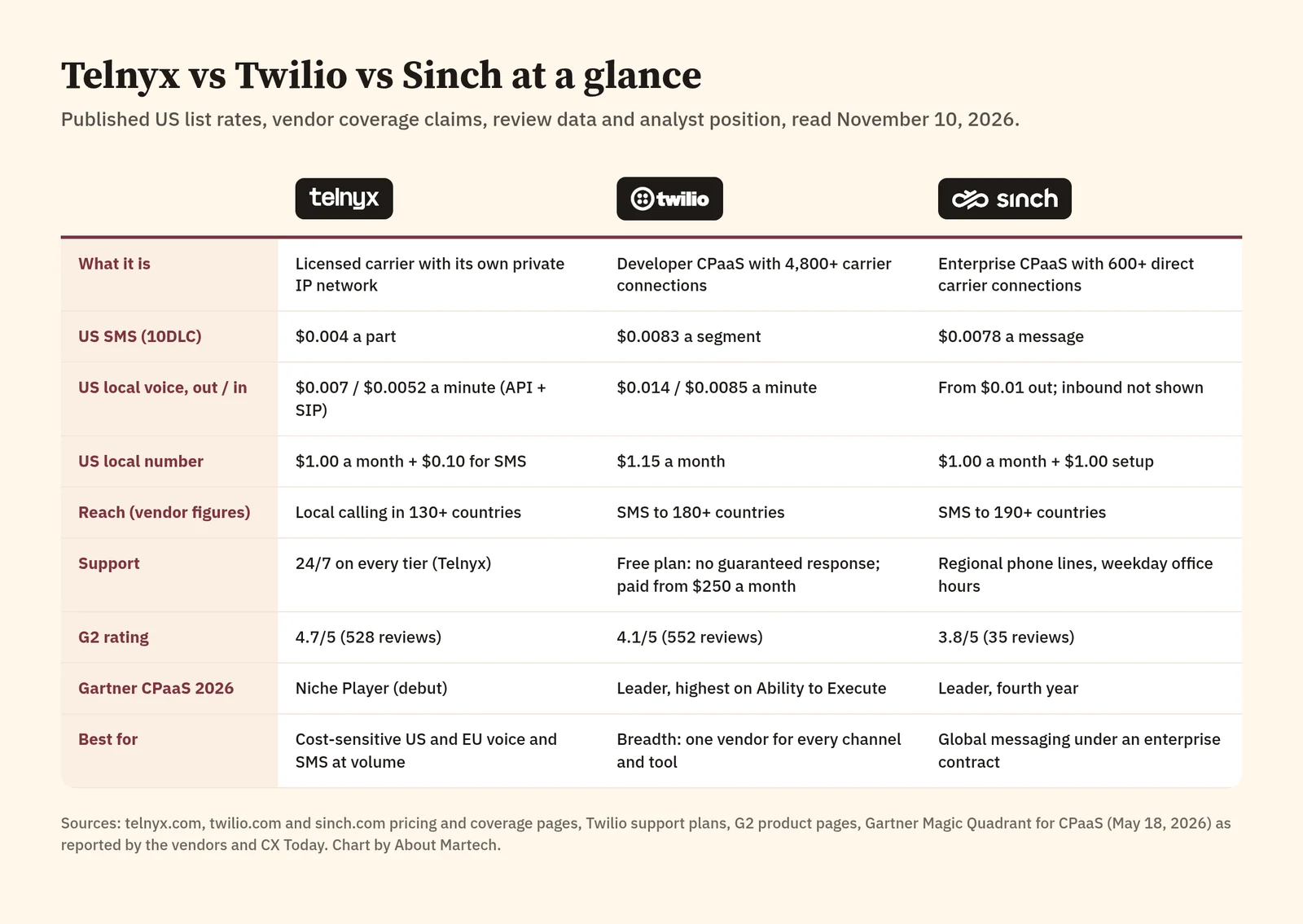
Telnyx vs Twilio vs Sinch at a glance
| Telnyx | Twilio | Sinch | |
|---|---|---|---|
| What it is | Licensed carrier with its own private IP network | Developer CPaaS with 4,800+ carrier connections | Enterprise CPaaS with direct connections to 600+ carriers |
| US SMS, 10DLC (list) | $0.004 per part | $0.0083 per segment | $0.0078 per message |
| US local voice, out / in | $0.007 / $0.0052 a minute | $0.014 / $0.0085 a minute | From $0.01 out; inbound not shown |
| US local number | $1.00 a month, plus $0.10 for SMS | $1.15 a month | $1.00 a month plus $1.00 setup |
| Reach (vendor figures) | Local calling in 130+ countries, SIP termination to 230+ | SMS to 180+ countries, numbers in 100+ locales | SMS to 190+ countries, numbers in 145 countries |
| Support | 24/7 on every tier, per Telnyx | Free plan has no guaranteed response; paid plans from $250 a month | Regional phone lines in weekday office hours |
| G2 rating | 4.7/5 (528 reviews) | 4.1/5 (552 reviews) | 3.8/5 (35 reviews) |
| Gartner CPaaS 2026 | Niche Player (first year) | Leader, highest on Ability to Execute | Leader, fourth year in a row |
| Best for | Cost-sensitive US and EU voice and SMS at volume | One vendor for every channel, with the deepest ecosystem | Global, multichannel messaging under an enterprise contract |
What changed in 2026
- Sinch closed its standalone SMS API to new customers. The standalone SMS REST API reached end of sale on April 15, 2026, and all new SMS integrations go through the Conversation API’s SMS channel (Sinch developer docs). Existing integrations keep working, but a new build should start on the Conversation API.
- Gartner’s 2026 Magic Quadrant for CPaaS (published May 18, 2026) named Twilio a Leader for the fourth year, positioned highest on Ability to Execute (Twilio), and Sinch a Leader for the fourth year (Sinch). Telnyx entered the report for the first time as a Niche Player; CX Today’s summary says Gartner credited its own network and transparent pricing but flagged limited depth and weaker support outside North America and Europe (CX Today).
- 10DLC registration got pricier. The Campaign Registry raised brand registration from $4.00 to $4.50 and standard vetting from $40.00 to $41.50 on August 1, 2025, and all three providers pass these fees through (Twilio).
- RCS is now on every price list. Twilio charges the same $0.0083 per segment for RCS Rich text as for SMS (Twilio); Telnyx lists RCS Rich text at $0.0065 per segment plus carrier fees (Telnyx). For the full picture, see our RCS business messaging pricing guide.
Telnyx: carrier-grade rates on its own network
Telnyx describes itself as a licensed carrier that owns its network, edge compute and GPUs, and says more than 14,000 companies use it (Telnyx). That ownership is how it explains its prices: every invoice shows two lines, Telnyx’s own rate and the carrier fee passed through at cost (Telnyx messaging pricing). Voice is billed the same way, as a $0.002 a minute Voice API fee plus the SIP trunk the call rides on (Telnyx Voice API pricing).
- Strengths: the lowest published US rates of the three on SMS, MMS, voice and toll-free numbers; automatic volume tiers (SMS drops to $0.002 a part beyond 100 million parts a month); SIP trunking and number porting as first-class products; and TeXML, which Telnyx says runs an existing TwiML application unchanged at the Voice API rate (Telnyx).
- Watch-outs: local calling covers 130+ countries rather than every market (Telnyx coverage), and onboarding includes identity checks that some buyers find abrupt. In one r/Telnyx thread, a small ecommerce sender said its account was blocked as soon as it added a card, with no reply for almost five days.
- Pricing: pay as you go with no platform fee, or a Growth plan with a $2,000 monthly minimum and 15% off voice, messaging and numbers, or Enterprise at a $5,000 monthly minimum (Telnyx).
Twilio: the broadest platform, at list prices
Twilio is the platform most teams already know: SMS, MMS, RCS, WhatsApp, voice, email and verification under one account, with helper libraries for Node.js, Python, C#, Java, PHP and Ruby. It says its Programmable Messaging API reaches 180+ countries and that its network monitors 4,800+ carrier connections (Twilio), and it offers phone numbers in over 100 locales (Twilio Voice pricing).
- Strengths: the largest product surface and partner ecosystem, mature documentation, compliance tooling for 10DLC and toll-free verification in the console, and add-ons such as Conversation Relay for voice AI ($0.07 a minute). G2 reviewers mention ease of use 40 times and easy integrations 30 times (G2).
- Watch-outs: it is the most expensive of the three at list price, and support with a guaranteed response time is a paid plan. On G2, “expensive” (26 mentions) and “poor customer support” (23) are its most cited drawbacks (G2).
- Pricing: pay as you go, with a $0.001 fee on every message that ends in a “Failed” status and volume or committed-use discounts through sales (Twilio SMS pricing). The free trial includes $15 of credit (Twilio).
Sinch: global messaging reach under an enterprise contract
Sinch, listed on Nasdaq Stockholm (G2 profile), says it serves more than 200,000 businesses and connects directly to carriers, with 99.99% uptime across 190+ countries (Sinch). It sells APIs for SMS, RCS, WhatsApp, voice, verification and email, plus apps such as SimpleTexting and ClickSend, and email brands Mailgun and Mailjet.
- Strengths: very wide messaging reach, 600+ direct carrier connections (Sinch), virtual numbers in 145 countries (Sinch) and one Conversation API for SMS, RCS, WhatsApp and other chat apps.
- Watch-outs: fewer self-serve prices than Telnyx or Twilio (the voice page shows outbound “from $0.01” but no inbound rate), Elastic SIP Trunking only in the US and Canada (Sinch Voice pricing), and a thin G2 base: 3.8 out of 5 from 35 reviews, with low scores for ease of setup (6.5) and support (6.7) (G2).
- Pricing: pay as you go by country, with prices updated at midnight UTC, and enterprise contracts through sales (Sinch SMS pricing).
SMS and MMS pricing compared
All three publish US messaging rates. The base rate is only one line, though: carrier fees, number rental and 10DLC registration apply at every provider, which is why the gap on a real invoice is smaller than the headline rate suggests. Our SMS marketing pricing guide explains each fee.
| US list rate | Telnyx | Twilio | Sinch |
|---|---|---|---|
| SMS, local / 10DLC (out and in) | $0.004 per part | $0.0083 per segment | $0.0078 per message |
| SMS, toll-free | $0.0055 | $0.0083 | $0.0078 |
| SMS, short code | $0.007 | $0.0083 | $0.009 |
| MMS, 10DLC (out / in) | $0.015 / $0.005 | $0.022 / $0.0165 | $0.02 / $0.02 |
| Carrier fee, 10DLC outbound: AT&T / T-Mobile / Verizon | $0.0035 / $0.0045 / $0.0045 | $0.0035 / $0.0045 / $0.005 | $0.0035 / $0.0045 / $0.005 |
| Failed-message fee | None listed | $0.001 per failed message | None listed |
| Volume discount | Automatic above 100M parts a month (local) | Through your account team | Not published |
Sources: Telnyx, Twilio, Sinch pricing pages and Sinch’s carrier pass-through fee article, read November 10, 2026. Two details are easy to miss. Telnyx lists a lower Verizon 10DLC carrier fee ($0.0045) than Twilio and Sinch ($0.005). And Telnyx’s own 10DLC fee article still shows older carrier fees (for example $0.003 for AT&T) than its pricing page, so budget from the pricing page and confirm on your first invoice.
Voice pricing compared
Telnyx splits each call into an API fee and a SIP trunk fee; Twilio quotes one per-minute rate; Sinch adds up each call leg. Compare the total per minute, not the headline number.
| US list rate | Telnyx | Twilio | Sinch |
|---|---|---|---|
| Outbound local call | $0.007 a minute ($0.002 API + $0.005 SIP) | $0.014 a minute | From $0.01 a minute |
| Inbound local call | $0.0052 a minute ($0.002 + $0.0032) | $0.0085 a minute | Not shown on the pricing page |
| Inbound toll-free call | $0.017 a minute ($0.002 + $0.015) | $0.022 a minute | Not shown |
| Call recording | $0.002 a minute, storage free | $0.0025 a minute plus $0.0005 a minute a month storage | Not shown |
| Answering machine detection | $0.002 a call (premium $0.0065) | $0.0075 a call | Not shown |
| Media streaming over WebSockets | $0.0035 a minute | $0.0044 a minute | Streams in public preview |
| Conversation Relay for voice AI | $0.05 a minute | $0.07 a minute | Voice Relay in public preview |
Sources: Telnyx Voice API and SIP trunking pricing, Twilio Voice pricing and Sinch Voice pricing, read November 10, 2026. Sinch’s page loads most US voice prices only after you pick a country, and its downloadable rate sheet came back empty when we checked, so ask for a written rate card.
Numbers and 10DLC registration fees
| Telnyx | Twilio | Sinch | |
|---|---|---|---|
| US local number | $1.00 a month, plus $0.10 a month to enable SMS and MMS | $1.15 a month ($0.50 if you bring your own) | $1.00 a month plus $1.00 setup |
| US toll-free number | From $1.00 a month | $2.15 a month | $2.00 a month plus $2.00 setup |
| Short code | $1,000 a month random, $1,500 vanity | $1,000 random or $1,500 vanity, billed quarterly, plus setup | Listed as “500 Random or 1000 Vanity” a month; confirm terms |
| 10DLC brand registration | $4.50 | $4.50 (sole proprietor or low volume), $46 standard with vetting | $4 |
| 10DLC campaign | $15 per review; $10 a month standard, $1.50 low-volume mixed | $15 vetting; $10 a month standard, $1.50 low-volume mixed | $10 a month standard |
| Campaign fee billing | First three months up front | At approval, then monthly | First three months up front |
Sources: Telnyx numbers, Telnyx 10DLC fees, Twilio SMS pricing, Twilio 10DLC fees, Sinch SMS pricing and Sinch 10DLC costs, read November 10, 2026. Sinch labels its help-center prices “only indications” and asks buyers to confirm with an account manager. If you are new to registration, start with our explainer on TCPA and 10DLC rules.
What a month actually costs
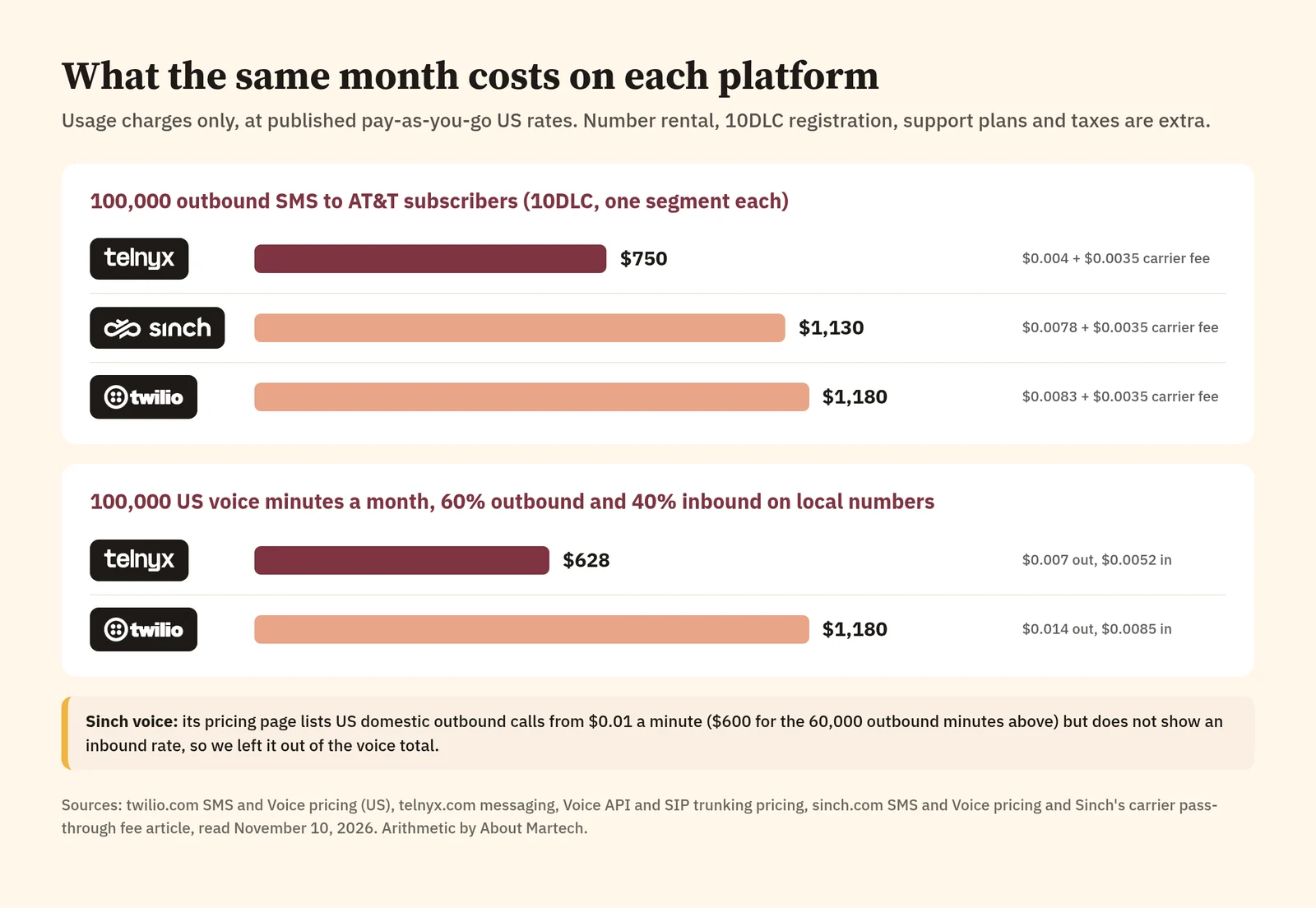
Two simple scenarios at published pay-as-you-go rates, usage only:
- 100,000 outbound single-segment texts on a 10DLC number to AT&T subscribers (carrier fee $0.0035 at all three): Telnyx 100,000 x ($0.004 + $0.0035) = $750; Sinch 100,000 x ($0.0078 + $0.0035) = $1,130; Twilio 100,000 x ($0.0083 + $0.0035) = $1,180. Telnyx is about 36% cheaper than Twilio on the total, not the 52% the base rates suggest, because the carrier fee is the same everywhere.
- 100,000 voice minutes, 60% outbound and 40% inbound on local numbers: Telnyx 60,000 x $0.007 + 40,000 x $0.0052 = $628; Twilio 60,000 x $0.014 + 40,000 x $0.0085 = $1,180. Sinch’s outbound minutes come to $600 at its “from $0.01” rate, but it does not publish the inbound rate.
Add number rental, 10DLC fees and any support plan. On Twilio, a Production support plan costs the greater of $250 or 4% of monthly spend (Twilio support plans), which would add $250 to either month above.
Coverage and reach
| Telnyx | Twilio | Sinch | |
|---|---|---|---|
| Messaging reach | Own network plus partner routes; Telnyx lists 1.3B+ messages a month | SMS to 180+ countries | SMS to 190+ countries |
| Phone numbers | 7M+ active numbers managed; porting in 50+ countries | Numbers in 100+ locales | Virtual numbers in 145 countries |
| Voice | Local calling in 130+ countries; SIP termination to 230+ | Global voice; volume pricing for US and Canada | Domestic calling in 60+ countries; Elastic SIP only in US and Canada |
| Carrier status | Licensed carrier in more than 30 countries | Connects through 4,800+ carrier connections | 600+ direct carrier connections |
| Channels on one API | SMS, MMS, RCS, WhatsApp, voice; email API in beta | SMS, MMS, RCS, WhatsApp, voice, email, verification | SMS, RCS, WhatsApp and other chat apps through the Conversation API; voice, verification, email |
All figures are the vendors’ own: Telnyx, Twilio and Twilio Voice, Sinch, Sinch numbers and Sinch Voice. A country count tells you where a route exists, not how well it delivers, so test your top destinations with real traffic before you commit. One earlier comparison says Telnyx publishes no per-country rates you can check in a browser (Samcom); its SIP trunking page now has a country picker and a downloadable global price sheet.
Support, reviews and what users report
| Telnyx | Twilio | Sinch | |
|---|---|---|---|
| G2 rating | 4.7/5 (528 reviews) | 4.1/5 (552 reviews) | 3.8/5 (35 reviews) |
| G2 ease of setup | 9.0 | 7.6 | 6.5 |
| G2 quality of support | 9.2 | 7.8 | 6.7 |
| Support model | 24/7 on every tier, per its coverage page; the Growth plan lists 24/7 chat or call | Free Developer plan (estimated 3 business days); Production from $250 a month, Business from $1,500, Personalized from $5,000 | Regional phone lines in Atlanta, Stockholm, Singapore and Melbourne, weekday office hours |
Sources: G2 compare pages for Telnyx vs Twilio and Sinch vs Twilio, Twilio support plans, Telnyx and Sinch contact details, read November 10, 2026. Sinch’s G2 base is small, so treat its scores as a weak signal. Telnyx’s two support statements do not match exactly, so ask which channels are included on pay as you go.
Practitioner threads line up with the scores. Telnyx is praised for price and its own network, with recurring complaints about account verification. In an r/SaaS thread, replies called both Twilio and Sinch solid for US and Canada, with clear docs, and warned that 10DLC registration is mandatory for marketing texts and that costs climb with volume.
Telnyx vs Twilio
This is the most common head-to-head. The trade is simple: Telnyx is about half the price per message and per minute at list rates, while Twilio covers more channels and tools and has the larger ecosystem.
| Telnyx | Twilio | |
|---|---|---|
| US SMS, 10DLC | $0.004 | $0.0083 |
| US voice out / in | $0.007 / $0.0052 | $0.014 / $0.0085 |
| US local number | $1.00 + $0.10 for SMS | $1.15 |
| 100,000 texts to AT&T | $750 | $1,180 |
| G2 rating | 4.7 (528) | 4.1 (552) |
| Gartner 2026 | Niche Player | Leader |
| Migration path | TeXML runs TwiML apps, per Telnyx | Not applicable |
Choose Telnyx if your volume is mostly in the US and Europe, you have engineers who can handle SIP and number porting, and the bill is the problem. Choose Twilio if you need email, verification, a contact center ecosystem or the widest SDK support, or your security team has already approved it. For a wider list, see our Twilio alternatives guide. One review site says Telnyx’s committed plan minimum is $500 a month (SMS Comparison); Telnyx’s pricing pages list $2,000 for Growth and $5,000 for Enterprise.
Telnyx vs Sinch
Telnyx and Sinch both lean on their networks, but for different buyers. Telnyx sells self-serve, published rates to developers. Sinch sells global reach and many channels to enterprises, often under negotiated contracts.
| Telnyx | Sinch | |
|---|---|---|
| US SMS, 10DLC | $0.004 | $0.0078 |
| US voice out | $0.007 a minute | From $0.01 a minute |
| Messaging reach | Own network plus partner routes | 190+ countries, 600+ carrier connections |
| New SMS integrations | Messaging API | Conversation API only, since April 15, 2026 |
| G2 rating | 4.7 (528) | 3.8 (35) |
Choose Telnyx for US-heavy SMS and voice at the lowest published rate. Choose Sinch if you send to many countries, need WhatsApp, RCS and other chat apps on one API, or want an enterprise contract with an account manager. Earlier comparisons say Sinch does not list its carrier fees (CommercePundit); its help center now has a single carrier fee article for the US and Canada.
Twilio vs Sinch in brief
Sinch lists US SMS slightly below Twilio ($0.0078 against $0.0083) and both are Gartner Leaders. Twilio scores higher on G2 for setup and support. We compare the two for RCS in detail in Twilio vs Sinch for RCS, and if Infobip is also on your list, see Twilio vs Infobip.
Which should you choose?
- Choose Telnyx if you send high volumes of US or European SMS or calls, want every fee itemized, run your own SIP or PBX, or are building voice AI and want lower per-minute costs.
- Choose Twilio if you want one vendor for SMS, voice, WhatsApp, email and verification, need the largest ecosystem and documentation, or already have Twilio in production and the bill is acceptable.
- Choose Sinch if you message customers in many countries, want SMS, RCS and WhatsApp on one Conversation API, and prefer an enterprise contract with negotiated rates.
- Look wider if RCS is the main goal; see the best RCS business messaging platforms.
Before you switch: a short checklist
- Re-register or import your 10DLC brand and campaigns; plan for the campaign fee being billed three months up front at Telnyx and Sinch.
- Port numbers in batches and keep the old provider live until delivery receipts match.
- Send a week of real traffic to your top destinations on both providers and compare delivery rates and latency.
- Get a written rate card for every country you send to, including inbound voice.
- Check which support channels and response times are included before you need them.
How we compared Telnyx, Twilio and Sinch
We read the pages that rank and get cited by AI answers for “Telnyx vs Twilio”, “Telnyx vs Sinch” and the three-way comparison, then checked every number against primary sources: the vendors’ US SMS, voice, SIP and number pricing pages, carrier and 10DLC fee articles, coverage pages, Twilio’s support plans, Sinch’s developer docs, G2 product and compare pages and the vendors’ Gartner announcements, all on November 10, 2026. All prices are US list rates in US dollars before taxes and negotiated discounts. We did not send live traffic through each platform, and no vendor paid to be included or reviewed this article.
Frequently asked questions
Is Telnyx cheaper than Twilio?
Yes, at published US rates. Telnyx lists SMS at $0.004 a part against Twilio’s $0.0083 a segment, and outbound local calls at $0.007 a minute against $0.014. Because carrier fees are the same at both, 100,000 texts to AT&T subscribers cost $750 on Telnyx and $1,180 on Twilio, about 36% less.
Is Telnyx better than Twilio?
Telnyx is better on price and has higher G2 scores (4.7 against 4.1, with better setup and support scores). Twilio is better on breadth: more channels, tools, integrations and documentation, and it is a Gartner Leader for CPaaS, while Telnyx entered in 2026 as a Niche Player.
How much does Sinch charge per SMS in the US?
Sinch lists $0.0078 per outbound or inbound message on 10DLC and toll-free numbers and $0.009 on short codes, plus carrier fees such as $0.0035 for AT&T and $0.0045 for T-Mobile. A 10DLC number costs $1.00 a month plus $1.00 setup.
Is Sinch cheaper than Twilio?
Slightly, on US SMS list prices: $0.0078 per message against $0.0083 per segment. Twilio publishes more of its voice prices, so compare voice on a written Sinch rate card.
What happened to the Sinch SMS API?
Sinch’s standalone SMS REST API reached end of sale on April 15, 2026. New SMS integrations use the SMS channel of the Conversation API, and existing integrations on the standalone API continue to work.
Which is best for voice AI agents?
On published rates, Telnyx: its Conversation Relay costs $0.05 a minute against Twilio’s $0.07, media streaming is $0.0035 against $0.0044, and base call minutes are about half the price. Twilio has more tooling and partners; Sinch’s Voice Relay and Streams are in public preview.
Do Telnyx, Twilio and Sinch all charge 10DLC fees?
Yes. All three pass through The Campaign Registry and carrier fees: about $4 to $4.50 for brand registration, $15 for campaign review at Telnyx and Twilio, and $10 a month for a standard campaign, plus per-message carrier fees.
Which has the best international coverage?
By the vendors’ own figures, Sinch (SMS to 190+ countries, numbers in 145) and Twilio (SMS to 180+ countries, numbers in 100+ locales) reach more markets than Telnyx, which lists local calling in 130+ countries. Test delivery to your top destinations before choosing.