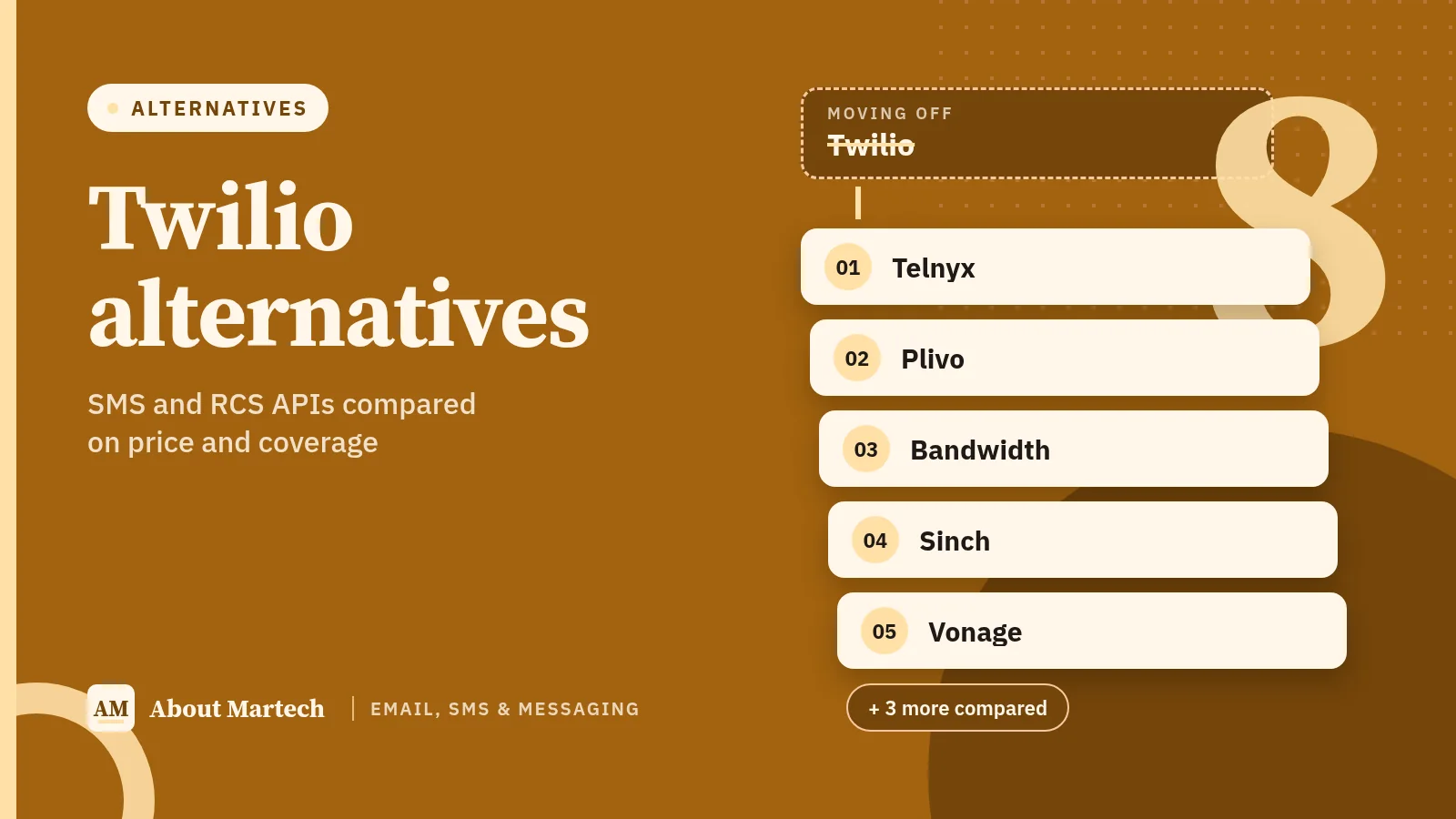
Twilio is the default way developers add texting to a product, and for good reason: the documentation is deep, the SDKs cover every major language and SMS, MMS and RCS all run through one Messaging API. It is rarely the cheapest option, though. At $0.0083 per US SMS segment before carrier fees, plus number rental, a failed-message fee and paid support plans, the bill grows quickly once you send six figures of messages a month. That is usually when teams start looking at Twilio alternatives.
We read Twilio’s US pricing page and the pricing page of every alternative below on November 1, 2026, priced the same 100,000-message month on each provider that publishes a US rate, and checked which ones can send RCS today. If you are choosing an RCS platform rather than replacing an SMS API, start with our guide to RCS business messaging platforms instead.
TLDR
- Twilio today: $0.0083 per US SMS or RCS Rich segment, $0.022 per MMS, $1.15 a month per long code, plus carrier fees of $0.0035 to $0.005 per message (Twilio pricing).
- Lowest published US rates: Bird at $0.0035 per segment, then Telnyx and Bandwidth at $0.004, all plus carrier fees.
- Closest like-for-like switch: Plivo, at $0.0077 per SMS and RCS Rich message, $0.50 long codes and the same carrier surcharge table as Twilio (Plivo pricing).
- Global and omnichannel: Sinch, Infobip and Vonage cover SMS, RCS, WhatsApp and more under one contract, but their US list rates are close to Twilio’s.
- Already on AWS: AWS End User Messaging publishes $0.00774 plus a $0.00421 carrier fee per US SMS, and bills RCS only on delivery.
- The catch: carrier fees rose in 2026 and apply to every provider, so a 50% cheaper base rate is closer to a 20% to 35% cheaper bill.
In this guide
Why teams look for Twilio alternatives
Most teams that leave Twilio are not unhappy with the API. They are unhappy with what the API costs at scale and with what it takes to get help. The reasons we hear most often line up with Twilio’s own price pages:
- A higher base rate. Twilio charges $0.0083 per US SMS segment on long codes, toll-free numbers and short codes alike, and the same $0.0083 per RCS Rich segment (Twilio pricing). Several carrier-grade alternatives publish rates at or below half that.
- Small fees that add up. A message that ends in a Failed status still costs $0.001. Link shortening and click tracking in the Engagement Suite cost $0.015 per message after the first 1,000 each month, and the Traffic Optimization Engine starts at $300 a month.
- Paid support. Developer support is included, but Production support costs the greater of $250 or 4% of monthly spend, Business the greater of $1,500 or 6%, and Personalized the greater of $5,000 or 8% (Twilio support plans). At $20,000 a month in usage, Production support alone is $800.
- Number rental. A Twilio long code is $1.15 a month and a toll-free number $2.15, against $0.50 to $1.00 at several alternatives. That matters when you run hundreds of local numbers.
- Carrier fees went up. T-Mobile raised its outbound 10DLC SMS fee from $0.003 to $0.0045 per message on January 19, 2026 (Twilio Help Center). Twilio passes these through, so total cost per text rose even though its own rate did not change.
Twilio is still a strong default for teams that want one vendor for messaging, voice, email and verification, and it is the platform most third-party tools integrate with first. If you are comparing it with a single rival for RCS, our Twilio vs Sinch and Twilio vs Infobip for RCS breakdowns go deeper than this list can.
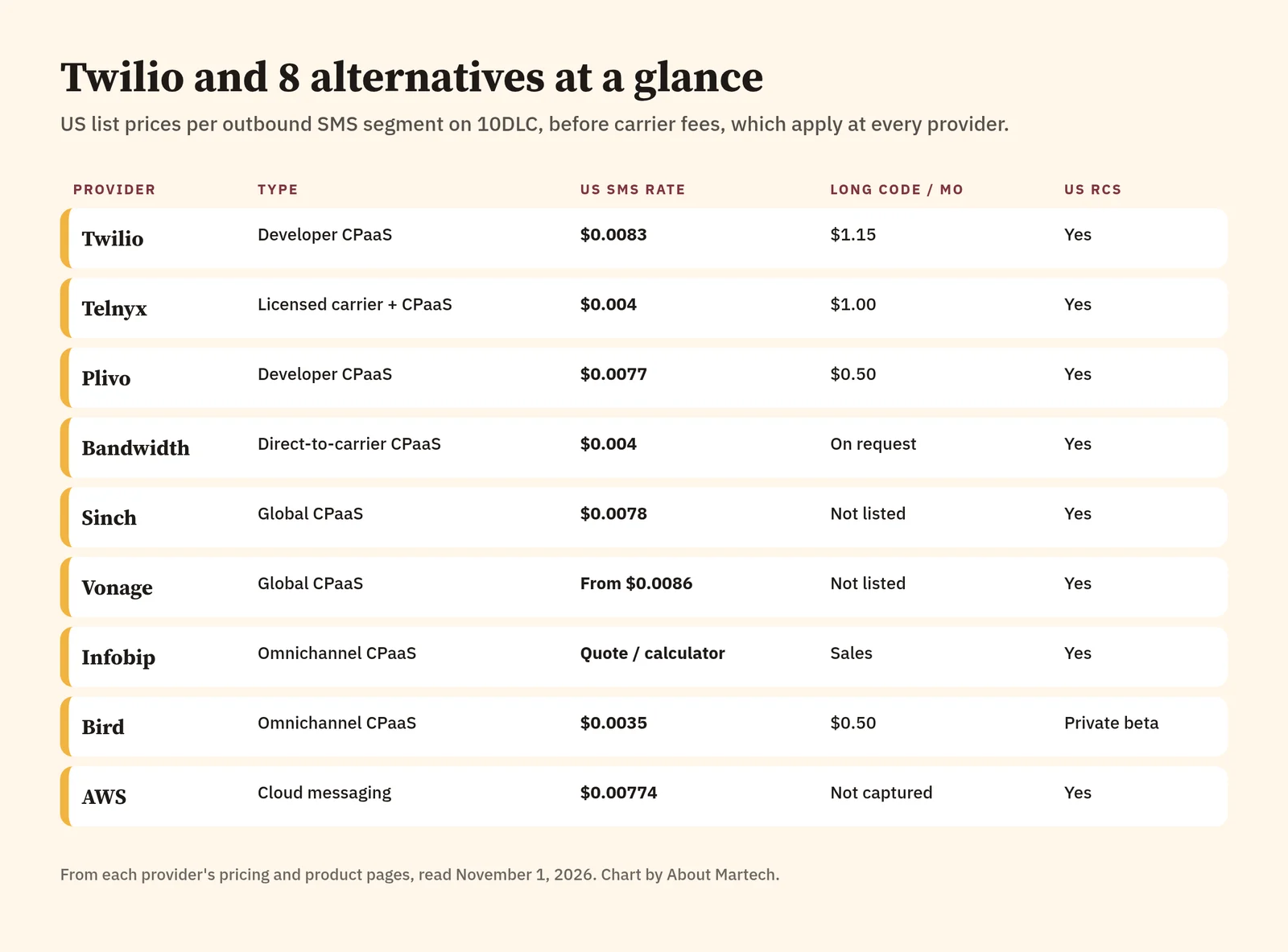
Twilio alternatives at a glance
US list prices from each provider’s own pricing page, read on November 1, 2026. Rates are per outbound SMS segment on a 10-digit long code (10DLC) and exclude carrier fees unless noted.
| Provider | Type | US SMS (10DLC) | US long code / month | RCS in the US | Best for |
|---|---|---|---|---|---|
| Twilio (baseline) | Developer CPaaS | $0.0083 | $1.15 | Yes, $0.0083 per Rich segment | Teams that want the broadest API ecosystem |
| Telnyx | Licensed carrier + CPaaS | $0.004 | $1.00 | Yes, same Messaging API | Developers who want the lowest carrier-grade rate |
| Plivo | Developer CPaaS | $0.0077 | $0.50 | Yes, $0.0077 per Rich message | The least disruptive switch from Twilio |
| Bandwidth | Direct-to-carrier CPaaS | $0.004 | Not published | Yes, launched 2025 | High-volume US messaging and voice |
| Sinch | Global CPaaS | $0.0078 | Not published | Yes, Conversation API | Enterprises messaging in many countries |
| Vonage | Global CPaaS (Ericsson) | From $0.0086 | Not published | Yes, Messages API | Teams that also need video and voice APIs |
| Infobip | Omnichannel CPaaS | Calculator / quote | Contact sales | Yes, with fallback | Enterprise omnichannel with no-code tools |
| Bird | Omnichannel CPaaS | $0.0035 | $0.50 | Private beta | Lowest published US SMS rate |
| AWS End User Messaging | Cloud messaging service | $0.00774 + $0.00421 carrier | Not captured | Yes, billed on delivery | Teams already building on AWS |
What 100,000 US texts a month actually costs
Headline rates are easy to compare and easy to misread, because carrier fees now make up a large share of every US text. So we priced the same month on every provider that publishes a US rate: 100,000 single-segment outbound SMS on one 10DLC number. Carrier fees are set by the carriers, not the provider, so we applied the same average to everyone: about $0.0043 per message, the simple average of the AT&T ($0.0035), T-Mobile ($0.0045) and Verizon ($0.005) outbound fees that Twilio and Plivo both publish. AWS publishes its own blended carrier fee, so we used that.
| Provider | Provider charge | Carrier fees | Number | Monthly total |
|---|---|---|---|---|
| Bird | $350 | $433 | $0.50 | About $784 |
| Bandwidth | $400 | $433 | Not published | About $833 + number |
| Telnyx | $400 | $433 | $1.00 | About $834 |
| AWS End User Messaging | $774 | $421 (AWS published) | Not captured | About $1,195 + number |
| Plivo | $770 | $433 | $0.50 | About $1,204 |
| Sinch | $780 | $433 | Not published | About $1,213 + number |
| Twilio | $830 | $433 | $1.15 | About $1,264 |
| Vonage | $860 (from rate) | $433 | Not published | About $1,293 + number |
| Infobip | Not published | $433 | Contact sales | Quote |
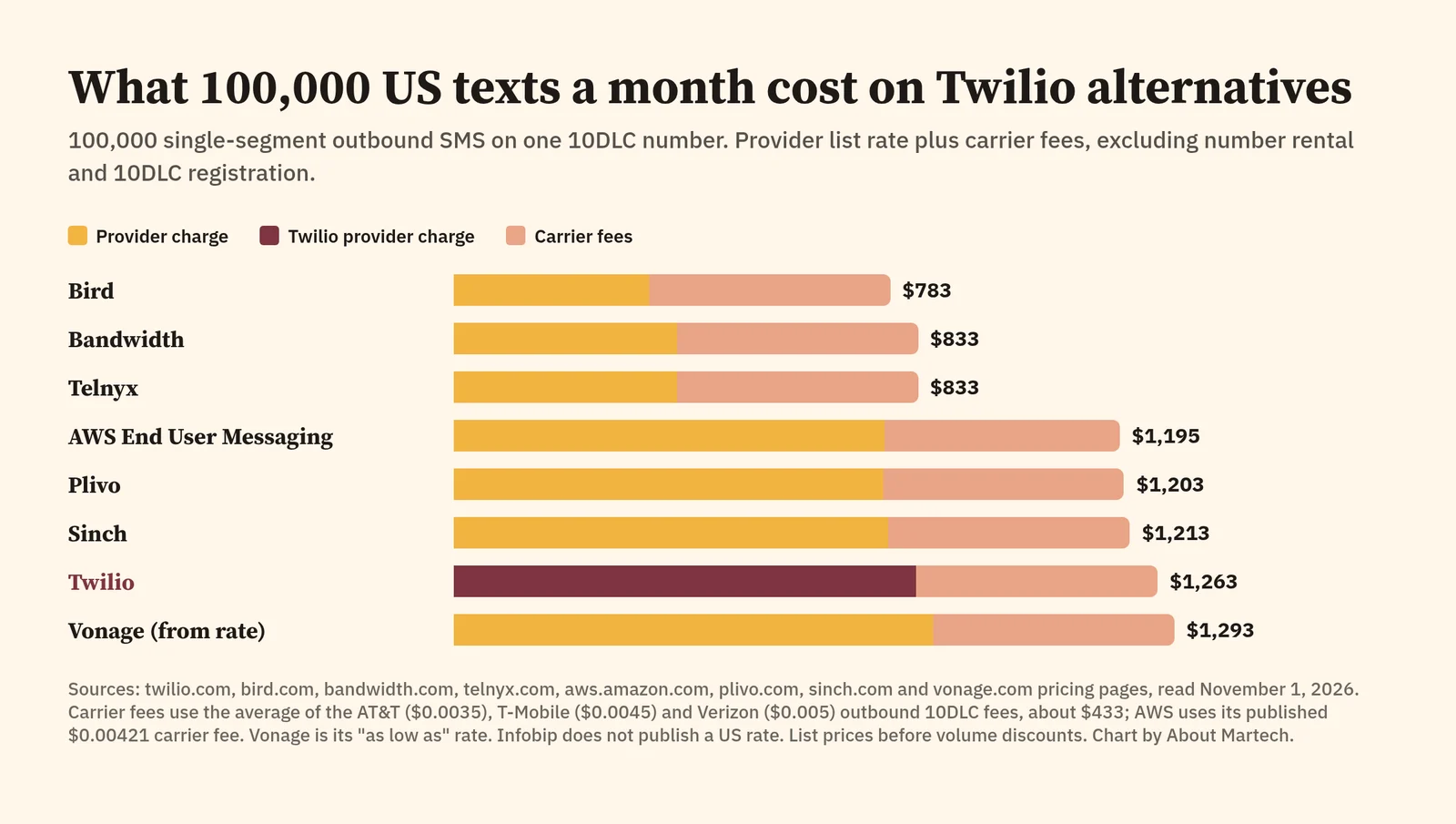
Three things stand out. First, the cheapest providers save real money: Telnyx and Bandwidth come in roughly a third below Twilio on this month, and Bird a little more. Second, the gap is smaller than the headline rates suggest. Telnyx’s rate is less than half of Twilio’s, but because both pay the same carrier fees, the total bill is about 34% lower, not 52%. Third, the big omnichannel platforms (Sinch, Vonage and AWS) are not meaningfully cheaper than Twilio on US list price. You move to them for reach, channels or an existing contract, not to cut the SMS line.
Two caveats. These are list prices: every provider here offers volume or committed-spend discounts, and Plivo’s own calculator shows lower “effective rates for typical sending volumes” than its rate card. And the table leaves out costs that are the same wherever you go, such as 10DLC brand and campaign registration, which we cover in the migration section below.
The 8 best Twilio alternatives in 2026
1. Telnyx: the lowest carrier-grade rate with published pricing
| Best for | The lowest carrier-grade rate with published pricing |
| US SMS list price | $0.004 per message part + carrier fee at cost |
| Pricing model | Pay as you go; optional $2,000 or $5,000 monthly commitments for discounts |
Telnyx describes itself as a licensed carrier that owns its network, which is how it explains a US SMS rate of $0.004 per message part, less than half of Twilio’s. Its pricing page shows two lines on every invoice: Telnyx’s rate and the carrier’s fee, passed through at cost and not marked up. Its own worked example of 1,000,000 parts a month comes to $7,800, of which $3,800 is carrier fees (Telnyx pricing).
There is no platform fee, support is free and so is HIPAA eligibility. MMS is $0.015 per part, US numbers are $1.00 a month, and volume tiers apply automatically above 100 million parts a month. Teams with steady volume can commit to a Growth plan ($2,000 monthly minimum spend for 15% off messaging, voice and numbers) or an Enterprise plan ($5,000 minimum with dedicated infrastructure). RCS runs through the same Messaging API you use for SMS, so enabling it is a messaging-profile setting rather than a new integration (Telnyx RCS), and Telnyx is also a WhatsApp Business Solution Provider.
Where it beats Twilio: price and transparency. You get carrier-grade routing at roughly half Twilio’s rate, with every fee published and free support.
Where it falls short: the ecosystem of third-party tools built for Twilio is larger, and the cheapest terms beyond pay as you go require a monthly spend commitment.
2. Plivo: the least disruptive switch from Twilio
| Best for | The least disruptive switch from Twilio |
| US SMS list price | $0.0077 per SMS (long code and short code); $0.0079 toll-free |
| Pricing model | Pay as you go; carrier surcharges billed separately |
Plivo positions itself squarely against Twilio. Its US pricing page includes a Plivo vs Twilio calculator, and its rates sit just under Twilio’s on every line: $0.0077 per SMS on long codes and short codes, $0.0079 on toll-free numbers, $0.018 per MMS on long codes, and $0.0077 per RCS Rich message (Plivo pricing). The carrier surcharge table on the same page matches Twilio’s for the big three carriers, so the saving is a real like-for-like difference.
Where Plivo saves the most is on numbers: long codes are $0.50 a month and toll-free numbers $1.00, against $1.15 and $2.15 at Twilio. Short codes are $500 a month billed quarterly, plus a $1,500 one-time fee. Message queueing is included. Plivo’s own calculator puts 100,000 messages a month at $528 on Plivo against $790 on Twilio, using what it calls effective rates for typical sending volumes rather than its list price, and a Twilio rate taken in May 2026, so treat that as the best case.
Where it beats Twilio: number rental and a familiar, Twilio-shaped product. Teams running many local numbers save the most.
Where it falls short: the per-message saving on list price is small (about 7%), and the company’s homepage now leads with voice AI agents, so check that SMS stays a priority on its roadmap.
3. Bandwidth: high-volume US messaging on a direct-to-carrier network
| Best for | High-volume US messaging on a direct-to-carrier network |
| US SMS list price | $0.004 per 10DLC message; $0.007 toll-free; $0.008 short code |
| Pricing model | Volume-based list rates; quotes for larger programs |
Bandwidth sells what it calls a direct-to-carrier pricing model pitches itself to everyone from first-time builders to large cloud communication platforms, and backs its voice API with a nationwide all-IP voice network. Its pricing page lists US SMS at $0.004 per message on 10DLC, $0.007 on toll-free and $0.008 on short codes, with MMS at $0.015 to $0.020 (Bandwidth pricing). Those rates exclude taxes and fees, and full pricing is available on request.
Bandwidth registered as a Google RCS Business Messaging partner in 2024 and launched its RCS for Business product in 2025. It is building RCS brand and agent registration into its existing messaging operations (Bandwidth RCS). Voice, two-factor authentication ($0.05 per authentication) and SIP trunking with emergency services sit on the same platform, and its pricing page says support is included. (Bandwidth’s site blocked our automated homepage capture, so there is no screenshot for this entry.)
Where it beats Twilio: the 10DLC rate. At $0.004 it is half of Twilio’s, from a provider built for US carrier-grade traffic and large platforms.
Where it falls short: it is US-centric, number rental and many fees are only available on request, and onboarding is more sales-led than Telnyx or Plivo.
4. Sinch: global SMS and RCS under one enterprise contract
| Best for | Global SMS and RCS under one enterprise contract |
| US SMS list price | $0.0078 per outbound 10DLC message + carrier fees |
| Pricing model | Pay as you go by country, with free trial; enterprise contracts through sales |
Sinch is one of the largest messaging providers in the world, and its catalog goes well beyond an SMS API: Mailgun and Mailjet for email, SimpleTexting and ClickSend for business texting, voice, verification and the Conversation API. Its US 10DLC rate is $0.0078 per outbound message plus carrier fees, and prices are set per country and updated at midnight UTC (Sinch pricing).
For RCS, the Conversation API sends branded, verified messages with automatic fallback to MMS or SMS when a device or country does not support RCS (Sinch RCS). That makes Sinch a natural fit for brands that message customers in many countries and want one routing layer. Our Sinch alternatives guide covers the reasons teams leave it, which are worth reading before you sign.
Where it beats Twilio: global reach and channel breadth. One contract can cover SMS, RCS, WhatsApp, email and voice across many countries.
Where it falls short: its US list rate is only slightly below Twilio’s, and the best terms come through enterprise sales rather than self-serve.
5. Vonage: teams that also need video, voice and network APIs
| Best for | Teams that also need video, voice and network APIs |
| US SMS list price | From $0.0086 per US message (local virtual number) |
| Pricing model | Pay as you go; feature add-ons priced monthly |
Vonage, owned by Ericsson since 2022, sells SMS alongside video, voice, verification and network APIs. Its API pricing page lists US SMS from $0.0086 per message on a local virtual number, which is slightly above Twilio’s base rate (Vonage API pricing). Its Messages API covers RCS, WhatsApp, Messenger, Viber, email, MMS and SMS through one integration (Vonage SMS pricing).
Vonage publishes its 10DLC fees in detail: $4.50 for brand registration, $41.50 for standard vetting, $15 per campaign vetting event and $10 a month for a standard campaign, or $1.50 for a low-volume mixed campaign (Vonage support). Compliance add-ons are priced separately, including an Audit API at $550 a month and automatic PII redaction at $1,100 a month.
Where it beats Twilio: breadth beyond messaging. If your product combines texting with in-app video or voice, one vendor can cover all of it.
Where it falls short: it is not cheaper than Twilio on US SMS list price, so it rarely wins a cost-driven switch on its own.
6. Infobip: enterprise omnichannel with no-code campaign tools
| Best for | Enterprise omnichannel with no-code campaign tools |
| US SMS list price | Calculator by country; US numbers through sales |
| Pricing model | Pay as you go per channel, or monthly subscriptions for the full platform |
Infobip is an omnichannel platform first and an SMS API second. Its pricing page covers SMS, email, Viber, WhatsApp, voice, RCS and video, which you can use through the API, through its no-code Broadcast tool or through AgentOS, its platform for AI-driven customer experiences (Infobip pricing). SMS is pay as you go with a per-country calculator, and US 10DLC, toll-free and short code numbers are arranged through sales.
Its RCS product offers verified sender IDs, rich cards and carousels, and smart fallback across RCS, SMS and chat apps (Infobip RCS). For a deeper look at how it compares on RCS specifically, see our Twilio vs Infobip comparison.
Where it beats Twilio: marketing and service teams who want campaigns, journeys and chatbots on top of the messaging layer, not just an API.
Where it falls short: there is no published US list rate to model, and the platform is more than a team replacing a simple SMS integration needs.
7. Bird: the lowest published US SMS rate
| Best for | The lowest published US SMS rate |
| US SMS list price | $0.0035 per US outbound long-code segment + carrier fees |
| Pricing model | Prepaid wallet: add funds and use them across products |
Bird, formerly MessageBird, publishes the lowest US SMS rate we found: $0.0035 per outbound long-code segment, plus carrier fees. US local numbers are $0.50 a month, WhatsApp marketing messages start at $0.005 plus Meta’s fees, and email starts with $15 a month of wallet funding (Bird pricing). Billing runs through a prepaid balance that you spend across SMS, WhatsApp, email, voice and its other products.
The trade-off is RCS. On Bird’s pricing page, RCS is listed as a private beta with custom quotes, so if branded rich messaging is part of your plan, confirm access before you migrate.
Where it beats Twilio: the per-message rate and cheap numbers. For pure US SMS volume it is the lowest list price on this page.
Where it falls short: RCS access is limited for now, and we would test delivery and support quality at your volume before moving a critical flow.
8. AWS End User Messaging: teams already building on AWS
| Best for | Teams already building on AWS |
| US SMS list price | $0.00774 per US SMS + $0.00421 carrier fee |
| Pricing model | Pay as you go on your AWS bill |
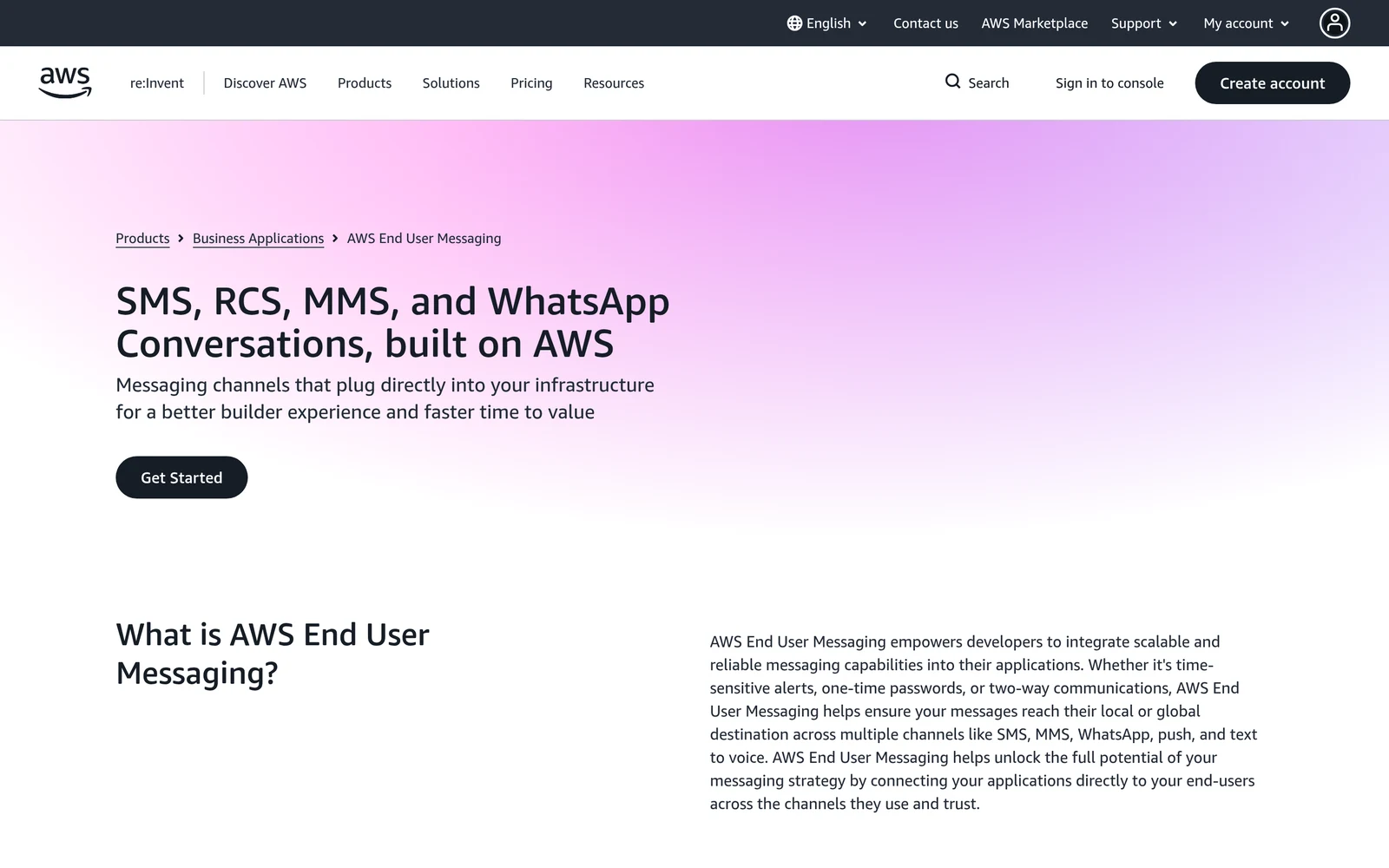
AWS End User Messaging (the service formerly sold as Amazon Pinpoint SMS) sends SMS, MMS, RCS, WhatsApp, push and voice from inside your AWS account. It publishes US SMS at $0.00774 per message on 10DLC, long codes, toll-free numbers and short codes, plus a carrier fee of $0.00421 ($0.00417 on short codes). An SMS Protect feature guards against artificially inflated traffic (AWS pricing).
Its RCS pricing is unusually clear. Rich RCS costs $0.007 per segment plus a $0.00494 carrier fee, Rich Media RCS costs $0.02 per message plus $0.00949, and you are charged only when a message is delivered. For teams whose infrastructure, logging and IAM already live in AWS, keeping messaging there removes a vendor and a bill.
Where it beats Twilio: consolidation. One cloud bill, AWS permissions and delivery-only RCS billing, with published US rates.
Where it falls short: the US SMS rate is close to Twilio’s once the carrier fee is added, and the console experience is built for engineers rather than marketers.
Twilio vs the alternatives: feature comparison
| Capability | Twilio | Telnyx | Plivo | Bandwidth | Sinch | Vonage | Infobip | Bird | AWS |
|---|---|---|---|---|---|---|---|---|---|
| Published US SMS rate | Yes | Yes | Yes | Yes | Yes | Yes (from) | Calculator | Yes | Yes |
| Carrier fees | Passed through | At cost, separate line | Passed through | Extra | Passed through | Passed through | Varies | Separate | Published flat fee |
| US RCS | Yes | Yes | Yes | Yes | Yes | Yes | Yes | Private beta | Yes |
| Yes | Yes (BSP) | Yes | Not listed | Yes | Yes | Yes | Yes | Yes | |
| Long code rental | $1.15 | $1.00 | $0.50 | On request | Not listed | Not listed | Sales | $0.50 | Not captured |
| Minimum commitment | None | None (optional plans) | None | Quote | None | None | None | Prepaid wallet | None |
| Support | Developer free; paid plans from $250 | Free | Not listed | Included | Enterprise via sales | Not listed | Not listed | Not listed | AWS support plans |
Read “Not listed” as “not on the pricing or product pages we checked on November 1, 2026”. CPaaS providers change rates often, so confirm anything critical in your own account before you migrate.
How to choose the right Twilio alternative
- Your bill is the problem and you have engineers: Telnyx or Bandwidth. Both cut the US provider rate roughly in half, and Telnyx publishes every fee.
- You want the smallest change: Plivo. Similar product shape, similar carrier fees, much cheaper numbers.
- You message customers in many countries: Sinch or Infobip, for one contract and one routing layer across markets.
- You need video or voice APIs as well: Vonage.
- You want the lowest US SMS line item: Bird, as long as you do not need RCS yet.
- Your stack already runs on AWS: AWS End User Messaging, for one bill and delivery-only RCS charges.
If RCS is the reason you are reviewing providers, compare per-message RCS costs separately in our guide to RCS business messaging pricing, and check how each provider handles RCS to SMS fallback before you commit.
Before you switch: a migration checklist
- Plan for 10DLC registration. Your brand and campaigns must be registered with The Campaign Registry through your new provider, and campaign vetting can take days or weeks. Budget for the fees (for example, Vonage lists $4.50 per brand, $15 per vetting event and $10 a month per standard campaign). Our guide to TCPA and 10DLC rules explains what carriers check.
- Port numbers, do not replace them. Long codes and toll-free numbers can be ported to a new provider, which keeps your sender identity and opt-in history. Short codes move through a separate carrier migration process and take longer.
- Re-register your RCS agent. RCS senders are verified per provider, so plan for a new brand verification. Our guide to getting a verified RCS sender walks through the steps.
- Map your webhooks and status callbacks. Delivery receipts, inbound message handling and error codes differ between providers. Write a thin messaging layer so you can switch or split traffic without touching product code.
- Run both in parallel. Move one low-risk flow first, such as notifications, compare delivery rates and latency for two weeks, then move marketing and authentication traffic.
Frequently asked questions about Twilio alternatives
What is the best alternative to Twilio?
For most US teams moving off Twilio to cut costs, Telnyx is the best alternative: it publishes a US SMS rate of $0.004 per message part plus carrier fees at cost, free support and RCS on the same API. Plivo is the easiest like-for-like switch, Bandwidth suits very high US volume, and Sinch or Infobip fit global omnichannel programs.
Which SMS API is cheaper than Twilio?
On published US list prices, Bird ($0.0035 per segment), Telnyx ($0.004), Bandwidth ($0.004 on 10DLC), AWS End User Messaging ($0.00774), Plivo ($0.0077) and Sinch ($0.0078) are all cheaper than Twilio’s $0.0083. Carrier fees of about $0.0035 to $0.005 per message apply on top at every provider, so total savings are smaller than the base rates suggest.
How much does Twilio charge per SMS in the US?
Twilio charges $0.0083 per outbound SMS segment on long codes, toll-free numbers and short codes, plus carrier fees of $0.0035 (AT&T), $0.0045 (T-Mobile) and $0.005 (Verizon) per message. MMS is $0.022, a long code costs $1.15 a month and failed messages cost $0.001 each.
Do Twilio alternatives support RCS?
Most do. Telnyx, Plivo, Bandwidth, Sinch, Vonage, Infobip and AWS End User Messaging all offer US RCS. Bird lists RCS as a private beta. Plivo publishes RCS Rich messages at $0.0077 and AWS at $0.007 per segment plus a carrier fee, against Twilio’s $0.0083.
Is Telnyx cheaper than Twilio?
Yes, on US SMS. Telnyx publishes $0.004 per message part against Twilio’s $0.0083 per segment, and numbers cost $1.00 a month against $1.15. Both pass carrier fees through, so for 100,000 texts a month the total bill is roughly a third lower on Telnyx.
Can I keep my phone numbers if I leave Twilio?
Yes. Long codes and toll-free numbers can usually be ported to a new provider, which keeps your sender identity. You will still need to register your 10DLC brand and campaigns with the new provider, and short codes move through a separate, slower carrier migration.
Why did my Twilio SMS costs go up in 2026?
Carrier fees rose, not Twilio’s own rate. T-Mobile increased its outbound 10DLC SMS fee from $0.003 to $0.0045 per message on January 19, 2026, and other carriers made smaller increases. These pass-through fees apply at every provider, so switching does not avoid them.
Is Plivo a good Twilio alternative?
Plivo is a good fit if you want a familiar product at a slightly lower price. Its US SMS rate is $0.0077 against Twilio’s $0.0083, its carrier surcharges match Twilio’s for the major carriers, and long codes cost $0.50 a month instead of $1.15, so teams with many numbers save the most.
The verdict
Twilio remains the safest default when you value ecosystem and documentation over unit cost. Once you send six figures of messages a month, though, the alternatives are worth a serious test. Telnyx and Bandwidth cut the US provider rate roughly in half, Plivo trims the bill with almost no change in how you work, and Sinch, Infobip and Vonage make sense when reach and channels matter more than the SMS line item.
Model your own month with carrier fees included, move one low-risk flow first, and compare delivery rates before you commit. For the wider view of rich messaging providers, see our guide to RCS business messaging platforms.