- Customer success software is not a fancier CRM. It surfaces behavioral signals, automates interventions, and routes risk to the right person before a customer decides to leave.
- Churn is almost always visible in product usage data weeks before a renewal conversation. CS platforms are built to read that signal; general CRMs are not.
- The platform you choose shapes what your CS team can actually do: teams on spreadsheets react to churn, teams on purpose-built platforms prevent it.
- Most B2B SaaS companies need CS software by the time they hit roughly 50 paying accounts or when one CS manager carries more than 30 accounts.
- Gainsight and Totango serve large, complex portfolios. ChurnZero, Vitally, and Planhat are faster to deploy for mid-market teams. Startups under 100 customers can often start with lighter tools.
Customer success software is a category of B2B tooling that monitors product usage, account health, and engagement signals to help CS teams identify at-risk customers and trigger retention workflows before those customers reach a cancellation decision. The core platforms in the category , including Gainsight, ChurnZero, Vitally, Planhat, and Totango , all share this foundation, though they differ significantly in complexity, pricing, and the team size they are designed for.
What Is Customer Success Software, and What Does It Actually Do?
Customer success software is not a CRM with a different label. A CRM like Salesforce records what happened in a customer relationship. A CS platform is designed to predict what will happen next and prompt the team to act before it does.
The difference shows up in the data model. CRMs organize around contacts, opportunities, and activities. CS platforms organize around accounts, health scores, lifecycle stages, and product usage metrics pulled directly from your application. That shift in data model changes everything downstream: what your team sees in the morning, which customers get a call this week, and which renewals are genuinely at risk versus which ones just look quiet.
At the infrastructure level, a CS platform typically connects to three data sources: your product (via API or event stream), your CRM (to pull contract and segment data), and your communication tools (email, Slack, in-app messaging). It synthesizes those inputs into a health score for each account, surfaces playbooks for CS managers to follow, and logs all touchpoints in one place. Some platforms also handle customer-facing portals, QBR decks, and NPS surveys, though those features vary by vendor.
Health Scores: The Core Mechanic
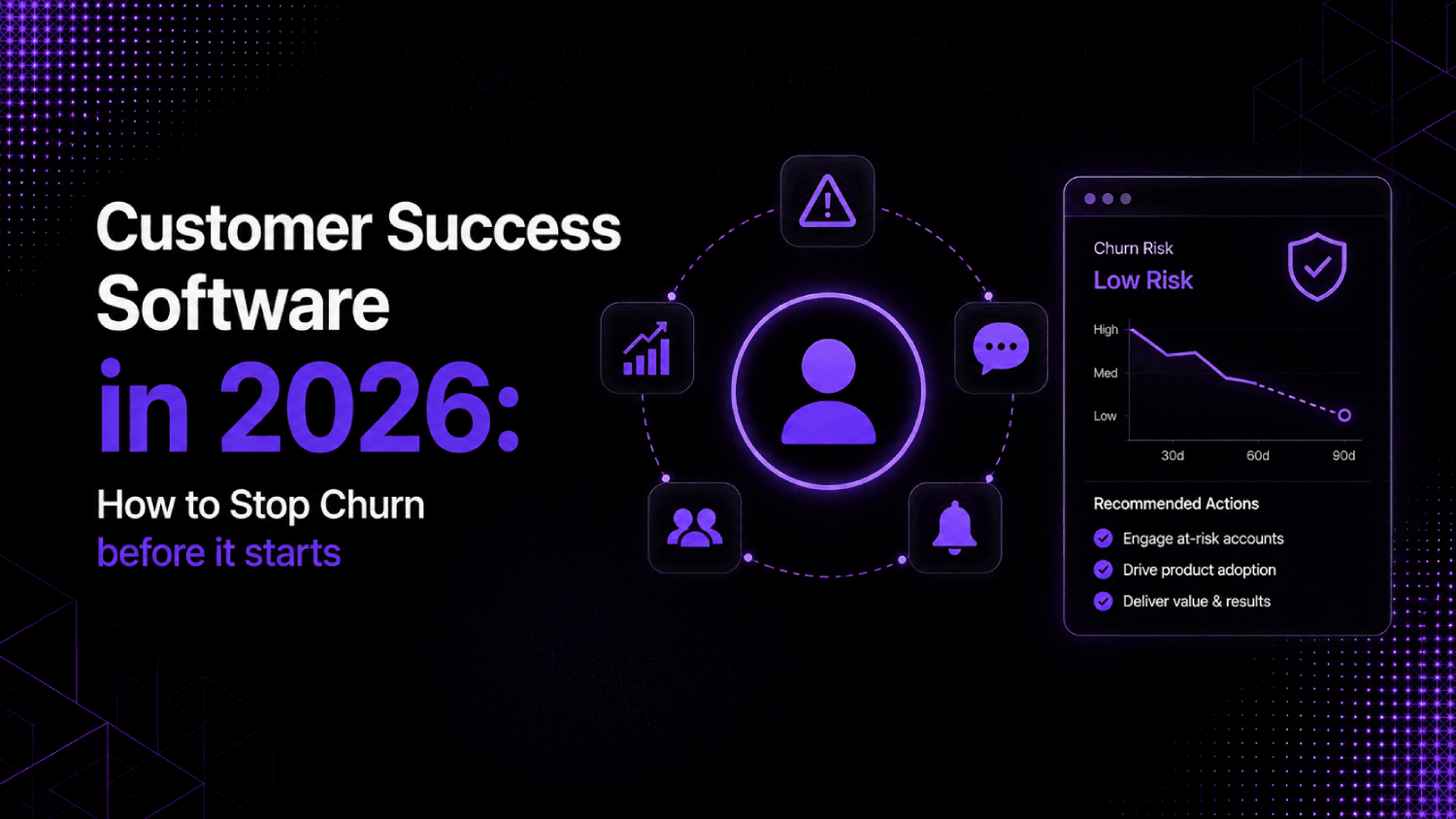
Every major CS platform builds its retention logic on a customer health score: a composite metric that weights product engagement, support ticket volume, NPS or CSAT responses, license utilization, and sometimes financial signals like invoice aging. The score turns a noisy data stream into a single number your CS team can triage each morning.
Health scores are only as good as the signals you feed them. A platform that ingests raw product events from your data warehouse will produce more accurate scores than one relying on a shallow API connection that only captures login frequency. This is why the data integration story matters as much as the feature set when you are evaluating CS software. For a deeper look at how to construct a defensible health score, the customer health score methodology guide on AboutMartech covers weighting, decay functions, and common signal gaps.
Playbooks and Automated Workflows
Health scores tell you who is at risk. Playbooks tell the CS manager what to do about it. A playbook is a triggered workflow: when an account’s health score drops below a threshold, the platform automatically creates a task, sends an internal Slack alert, or queues an outreach email for the CSM. The logic is simple, but the execution is where most teams without dedicated software fail. Without automation, risk identification depends entirely on a CSM remembering to check a dashboard, and CSMs who carry 50-plus accounts do not have that bandwidth.
Do I Need a Customer Success Platform, or Can I Build This in My CRM?
You can approximate health scoring in a CRM with enough custom fields, reports, and Zapier glue. Teams do it. It tends to break around the 40-account mark, when the CSM who built the system leaves, or when leadership asks for portfolio-level reporting that the CRM was never designed to produce.
The real cost of the CRM-based approach is not the setup time. It is the ongoing maintenance tax: every time your product changes, someone has to manually update the data model, the reports, and the health score formula. Purpose-built CS platforms handle that mapping as a core product function, not a configuration project.
There are three signals that indicate a team is ready for dedicated CS software:
- A CS manager is carrying more than 30 named accounts and cannot explain in one sentence why each account is healthy or at risk.
- Renewals are regularly surprising the team, meaning at-risk accounts are only identified after the customer raises a concern.
- Expansion revenue is untouched because the team has no systematic way to identify which accounts are ready for an upsell conversation.
If none of those apply, a structured spreadsheet process and a CRM with good reporting may genuinely be enough. Most companies outgrow that before they expect to.
How Does CS Software Reduce Churn, Specifically?
The mechanism is straightforward. Churn is rarely a surprise to the customer. They stop logging in, file more support tickets than usual, reduce their user count, or go silent on renewal calls. Each of those behaviors is detectable weeks in advance. CS software detects them and routes them to a human who can intervene.
Consider a specific scenario. A B2B SaaS company with 200 accounts and three CSMs processes renewals on a quarterly cycle. Without CS software, each CSM manually reviews their account list the month before renewal using CRM notes and gut feel. With a platform like ChurnZero or Vitally, the system flags any account whose product engagement has dropped more than 30% over the preceding 60 days, automatically enrolls that account in a “re-engagement” playbook, and creates a task for the CSM with a suggested outreach template. The CSM does not have to remember to check. The risk surfaces in their daily queue.
The second mechanism is expansion identification. CS platforms that track feature adoption can surface accounts actively using a feature that is only available on a higher tier, or accounts whose usage volume is consistently bumping against plan limits. That signal, routed to a CSM or an account executive, converts retention software into a revenue tool.
Where the Churn Reduction Claim Gets Complicated
CS software vendors make aggressive retention claims in their marketing. Take those numbers with skepticism. The platforms themselves do not control whether churn decreases; the team using them does. A CS platform installed without clear playbooks, clean product data, and CS managers with enough capacity to act on alerts will not move retention metrics. The software surfaces risk. Humans resolve it.
This is why implementation quality matters more than feature comparisons for teams buying their first CS platform. A well-implemented ChurnZero deployment will outperform a poorly configured Gainsight installation on every retention metric that matters.
The AboutMartech CS Platform Fit Test: Four Checks Before You Buy
Most CS software evaluations get derailed by feature lists. Vendors demo the most impressive capabilities, buyers get excited, and the team ends up with a platform built for a 10-person CS org when they have two people and 80 accounts. The AboutMartech CS Platform Fit Test is a four-point evaluation framework designed to cut through that noise.
Check 1: Data Connectivity
Ask each vendor how the platform ingests product usage data from your application. There are three common answers: native SDK instrumentation, direct database or warehouse connection, and event stream integration via tools like Segment or a reverse ETL layer. The warehouse-native approach is generally the most accurate and the most durable as your product evolves. If the vendor’s primary integration method is a shallow API that only captures login events, that is a ceiling on the health score quality you will ever achieve.
Common implementation mistake: Teams assume the CS platform will clean up messy product data during ingestion. It will not. Arrive with a defined event schema and tested data pipeline before the contract is signed, not after.
Check 2: Playbook Flexibility
Run a mock playbook during the demo. Describe your most common at-risk scenario and ask the vendor to build the workflow live. How many clicks does it take? Can you add conditional branching (if the account is on an enterprise contract, route to the enterprise CSM; otherwise, send an automated email)? Rigid playbook builders will constrain your CS process to fit the software, not the other way around.
Common implementation mistake: Buying for the most complex playbook scenario in the demo, then discovering the tool cannot handle the simpler, high-frequency playbooks your team runs every week without significant manual workarounds.
Check 3: Reporting Depth
Ask to see the portfolio health dashboard and the renewal forecast view. Then ask how you would export that data to your data warehouse or BI tool. CS platforms that keep data locked inside their own dashboards become a bottleneck the moment your VP of Revenue wants retention metrics in the company’s marketing and revenue dashboard. Platforms with strong export capabilities or native warehouse sync avoid that friction.
Common implementation mistake: Skipping the data export question entirely during evaluation, then discovering post-signature that getting cohort retention data into your BI tool requires a custom engineering project.
Check 4: Team-to-Platform Ratio
Every CS platform has an implicit complexity ceiling. Gainsight’s full platform is designed for CS organizations with dedicated operations staff to manage the configuration. Vitally and Planhat are designed for CS managers who also own their own tooling. ChurnZero sits in the middle. Match the platform’s operational complexity to the team that will actually use it. A two-person CS team buying Gainsight without an ops resource is buying a platform they will never fully deploy.
Common implementation mistake: Signing with an enterprise vendor based on a demo delivered by the vendor’s own solutions engineer, without accounting for the internal ops capacity needed to replicate that configuration independently post-onboarding.
What Are the Main Categories of Customer Success Tools?
The “customer success software” label covers several distinct tool types that sometimes overlap and sometimes operate as separate purchases. Understanding the category map prevents you from buying two tools that do the same thing or missing a critical gap in your stack.
| Tool Type | Primary Function | Representative Vendors | Best For | Typical Cost Range | Typical Time to Value |
|---|---|---|---|---|---|
| CS Platform (all-in-one) | Health scoring, playbooks, renewal tracking, CSM workflow | Gainsight, ChurnZero, Vitally, Planhat, Totango | Teams with 50+ accounts and at least one dedicated CSM | Quote-based; enterprise configurations commonly exceed five figures annually. Mid-market tiers vary by seat count. | 60 to 120 days to a functioning health score, depending on data pipeline readiness |
| Customer Onboarding Tools | Guided onboarding flows, checklist completion, time-to-value tracking | Arrows, Rocketlane, GuideCX | Teams with complex implementation processes or long onboarding cycles | Typically $400 to $1,500/month depending on seat count and features; most publish partial pricing | 2 to 4 weeks for initial template setup; live within a sprint cycle for most teams |
| Digital Adoption Platforms | In-app walkthroughs, feature adoption nudges, tooltip layers | Pendo, WalkMe, Appcues, UserGuiding | Products with high feature complexity or high self-serve volume | Wide range: UserGuiding publishes plans from roughly $89/month; Pendo and WalkMe are quote-based for full feature sets | First in-app guides live within 1 to 2 weeks; full adoption program takes 60+ days |
| Product Analytics | Feature usage tracking, funnel analysis, cohort retention | Mixpanel, Amplitude, Heap, PostHog | Product and CS teams that need granular behavioral data | Free tiers available at Mixpanel, Amplitude, and PostHog; paid plans scale with event volume. Enterprise tiers are quote-based. | Instrumentation and initial dashboards typically take 2 to 6 weeks depending on engineering bandwidth |
| NPS and CSAT Tools | Satisfaction surveys, sentiment tracking, feedback collection | Delighted, Medallia, AskNicely | Any CS team that lacks a survey mechanism in their existing platform | Delighted publishes plans starting around $17/month; Medallia and AskNicely are quote-based | First survey in market within days; meaningful response volume takes 4 to 8 weeks |
| Customer Data Platform | Unified customer profile across product, CRM, and marketing data | Segment, mParticle, Rudderstack | Teams that need a clean, centralized data layer feeding their CS platform | Segment publishes a free tier; Team plan starts at $120/month as of their public pricing page. Enterprise is quote-based. | Initial connections live in 2 to 4 weeks; full data model validation takes longer |
The most common stack architecture for a mid-market SaaS company runs a CDP or reverse ETL tool to unify customer data, feeds that into a CS platform for health scoring and playbooks, and uses a digital adoption platform on top of the product for feature adoption. Each layer does a specific job. Buying a CS platform and expecting it to replace product analytics is a common miscalibration.
For teams evaluating where their data infrastructure fits into this picture, the best customer data platforms for B2B teams comparison covers the vendors that most commonly feed CS platforms with clean account data.
How Do the Major CS Platforms Compare on Pricing and Fit?
Most enterprise CS platforms do not publish pricing publicly. Gainsight, Totango, and Medallia are all quote-based, and deal sizes for enterprise configurations run well into the five figures annually. Platforms targeting the mid-market are more transparent.
| Platform | Pricing Model | Public Pricing Available? | Best Fit |
|---|---|---|---|
| Gainsight | Quote-based, per-user and per-account tiers | No | Enterprise CS orgs with ops resources |
| ChurnZero | Quote-based, per-seat | No | Mid-market SaaS, 50-500 accounts |
| Vitally | Quote-based, per-seat | No | Lean CS teams that want a modern UX |
| Planhat | Flat fee plus usage tiers (per their public pricing page) | Partial | Revenue-focused CS teams tracking expansion |
| Totango | Free tier available; paid tiers are quote-based | Free tier only | Teams wanting to start free and scale |
| ClientSuccess | Quote-based, per-seat | No | Smaller CS teams wanting simplicity |
The detailed head-to-head between ChurnZero and Vitally, two of the most competitive options for lean teams, is covered in the ChurnZero vs. Vitally platform comparison. For teams considering alternatives to Gainsight specifically, the best Gainsight alternatives for teams without enterprise budgets covers seven options with a realistic take on where each fits.
What Should Early-Stage SaaS Companies Use for Customer Success?
Companies with fewer than 50 paying accounts should not buy a Gainsight-tier platform. The configuration overhead exceeds the value at that account volume, and the data required to produce meaningful health scores usually does not exist yet in a clean, accessible form.
The right starting point depends on what is already in the stack. If the team already uses HubSpot, extending it with HubSpot’s CS features or a lightweight add-on is often sufficient through the first 50 accounts. If the team already uses Salesforce, a similar logic applies. The goal at the early stage is to establish the habit of tracking account health, not to invest in enterprise automation infrastructure.
For product-led growth companies, where user behavior inside the product is the primary signal, a product analytics tool like Mixpanel or Amplitude often does more useful work than a CS platform at the early stage. The detailed breakdown of options for this segment lives in the best customer success tools for early-stage SaaS startups guide.
How Does Customer Onboarding Software Fit Into the CS Stack?
Onboarding is the highest-leverage moment in the customer lifecycle. An account that reaches its first meaningful outcome inside your product within the first 30 days churns at a materially lower rate than one that does not. CS platforms track onboarding completion as a health signal, but they rarely run the onboarding experience itself.
Dedicated customer onboarding tools like Arrows, Rocketlane, and GuideCX give CSMs and implementation teams a structured, client-facing project view of the onboarding process, with milestone tracking, shared task lists, and automated reminders. The data from these tools (completion rates, time-to-milestone) feeds back into the CS platform’s health score. The full comparison of onboarding tools and how they connect to the CS stack is in the best customer onboarding tools for reducing time-to-value guide.
The distinction matters because some CS platform vendors sell onboarding functionality as a feature, but the depth rarely matches a dedicated tool. If your average onboarding cycle is longer than two weeks or involves more than three stakeholders on the customer side, a standalone onboarding tool is worth evaluating separately.
How Does CS Software Connect to the Rest of the Revenue Stack?
Customer success software does not operate in isolation. Its value is proportional to the quality of data flowing into it and the quality of handoffs out of it to sales, marketing, and finance. A CS platform that sits disconnected from the CRM produces health scores no one trusts. One that feeds expansion signals back to the sales team creates a genuine revenue motion.
The typical integration architecture for a mature B2B SaaS team connects:
- Product event stream to the CS platform (via Segment, a reverse ETL tool, or direct API)
- CRM to the CS platform for contract data, account owner, and renewal dates
- CS platform back to CRM for health score, lifecycle stage, and CSM activity log
- CS platform to Slack or email for CSM alert notifications
- CS platform to a BI tool or data warehouse for portfolio-level reporting
The data warehouse connection is particularly important for teams that want to do cohort-level retention analysis rather than account-by-account triage. If your company runs a modern data stack with a warehouse at the center, the CS platform’s ability to sync data bidirectionally with that warehouse is a first-order evaluation criterion, not an afterthought.
What Features Should Every CS Platform Have?
Not all CS platforms are built equally, and some features that appear on every vendor’s marketing page are implemented so shallowly they add no practical value. Here is what to actually verify during evaluation:
- Configurable health scoring: You need to control the signals, their weights, and the decay logic. A platform that offers only a pre-built health score formula will not reflect your product’s actual usage patterns.
- Playbook automation with conditional logic: Basic playbooks that fire a single email are table stakes. The value is in branching: different actions for different account tiers, contract sizes, or lifecycle stages.
- Renewal and expansion tracking: The CS platform should own the renewal calendar and surface upcoming renewals by health score, not just by date. Expansion opportunity tracking should connect to actual usage data, not just CSM notes.
- Portfolio view for CS managers: A CSM carrying 60 accounts needs to triage risk in under five minutes each morning. The portfolio dashboard is where that happens. Test it with a realistic account load during the demo.
- Bi-directional CRM sync: Activity logged in the CS platform should appear in the CRM, and vice versa. If CSMs have to double-log, they will choose one system and the other will rot.
- Native or API-based survey tools: NPS and CSAT data are material health inputs. A CS platform that requires a third-party integration for basic surveying adds unnecessary complexity.
- Reporting and data export: Portfolio-level reporting should not require a BI analyst to build custom SQL every time leadership wants a retention update.
Is Revenue Operations Software Different From Customer Success Software?
RevOps tools and CS platforms share infrastructure but solve different problems. RevOps platforms like Clari, Gong, and Salesloft are built around forecasting, pipeline management, and sales rep productivity. CS platforms are built around account health, lifecycle management, and retention workflows. The overlap is in shared account data and renewal forecasting.
In mature revenue organizations, both exist. The CS platform owns the post-sale relationship and feeds renewal risk signals to the RevOps forecasting layer. The best RevOps tools for running revenue operations guide covers the sales-side of this architecture in more detail if your team is evaluating both categories simultaneously.
Frequently Asked Questions About Customer Success Software
What integration mistakes most commonly derail CS platform implementations?
The most common failure is signing a CS platform contract before validating that product event data is clean, consistently named, and exportable. Teams discover post-signature that their product fires inconsistent event names across environments, or that the engineering team needs months to instrument the event schema the CS platform requires. A second common mistake is mapping the CRM integration incorrectly at the account level, so the CS platform associates product usage with the wrong account records, producing health scores that are actively misleading. Both issues are diagnosable before you buy: ask the vendor for their standard integration checklist and work through it against your current data architecture during the evaluation period.
How does a CS platform connect to a data warehouse, and why does it matter?
CS platforms connect to data warehouses in two directions. Inbound: the warehouse pushes clean, transformed product event data into the CS platform via a reverse ETL tool or a native warehouse connector, which is how platforms like Vitally and Planhat ingest high-fidelity behavioral signals. Outbound: the CS platform syncs health scores, lifecycle stages, and CSM activity logs back to the warehouse, where BI tools can run cohort retention analysis or join CS data with financial records. The outbound direction is what most teams skip. If health scores only live inside the CS platform, your VP of Revenue cannot include retention data in board-level reporting without manual exports. Ask every vendor to demo both the inbound warehouse connection and the outbound sync before signing.
What is the realistic time to a functioning health score after signing with a CS platform?
For teams with a clean product data pipeline already in place, 60 days is achievable. For teams that need to instrument product events, clean up CRM account data, and validate the integration, 90 to 120 days is more realistic. The variables that most affect this timeline are: how many engineering hours the product team can allocate to instrumentation, how clean the CRM account hierarchy is, and whether the CS team has a defined list of health score signals before implementation begins. Vendors will quote shorter timelines in their sales process. Build your internal project plan around the longer estimate and treat the shorter one as the optimistic case.
Can CS platforms share data with marketing automation tools?
Yes, and the integration is underused. CS platform data , specifically health score, lifecycle stage, and feature adoption flags , can feed marketing automation tools to segment active customers for expansion campaigns, trigger re-engagement sequences for low-health accounts, or suppress at-risk accounts from upsell email flows. The integration typically runs through a CRM sync: the CS platform writes health score and lifecycle data to CRM fields, which the marketing automation tool reads for segmentation. Some CS platforms also offer direct webhook or API connections to tools like HubSpot or Marketo. If expansion revenue is a priority, this integration is worth building during initial implementation rather than treating as a phase-two project.
How do CS platforms handle account hierarchies for enterprise customers with multiple subsidiaries?
This is a significant differentiator between platforms and one that most evaluations overlook. Enterprise accounts often have a parent company with multiple subsidiary accounts, each with different contract terms, user counts, and health signals. Platforms like Gainsight handle parent-child account hierarchies natively, allowing CS teams to roll up subsidiary health scores into a parent account view and manage CSM assignments at the hierarchy level. Mid-market platforms like Vitally and ChurnZero handle basic hierarchies but may require workarounds for complex enterprise structures. If your portfolio includes enterprise accounts with four or more subsidiaries, test the account hierarchy model explicitly during the demo with a representative structure from your actual customer base.
What data does CS software need to work properly?
CS platforms need at least three data inputs to produce accurate health scores: product usage data (feature adoption, login frequency, session depth), CRM data (contract value, renewal date, account tier), and communication data (email open rates, support ticket volume, NPS scores). Product usage data is the most critical and the most commonly missing input. Teams that cannot cleanly export product events to their CS platform should address that data pipeline before evaluating platform features.